7. Communication and outreach
7.1 Aims and goals
Communication has been an important part of this project and has the long-term aim to strengthen CWR conservation and sustainable use. The approach has been to communicate not only the outputs of the project, but also basic knowledge about CWR and the importance of their conservation. This has been achieved by using a range of approaches targeting four main stakeholder groups: the nature conservation community, the scientific community, the interested general public, and policy makers.
7.2 Travelling exhibition
A travelling exhibition on CWR has been produced in five different versions, one for each of the five main Nordic languages. Each set includes ten outdoor posters in the local language(s) and in English, and an accompanying folder. The exhibitions have circulated in the Nordic countries from 2021 to 2024.
The exhibitions have been displayed in the following locations: Denmark: The Green Museum (Det Grønne Museum). Finland: Kumpula Botanic Gardens, Helsinki (2021, 2024); Elonkierto Agriculture Exhibition Park (now Countryside and Domestic Animal Park Elonkierto), Jokioinen (2021); University of Oulu Botanical Gardens (2022); The Rural Centre in Åland (Ålands Landsbygdscentrum) (2022) and Nuuksio National Park (2023). Iceland: Reykjavik Botanic Garden (2021, 2022, 2023); The Skagafjörður Heritage Museum (2022); Akureyri Botanic Garden (2022); Ásbyrgi, Vatnajökull National Park (2022); The Nordic House in Reykjavik (2022, 2023). Norway: Botanical Garden, Natural History Museum, University of Oslo (2021); Bergen Botanical Garden, Milde, University of Bergen (2021); The Museum Garden, University of Bergen (2022); Ringve Botanical Garden, NTNU University Museum, Trondheim (2023); Natural History Museum and Botanical Garden, Kristiansand, University of Agder (2024, Figure 16). In Kristiansand there was a quiz walk with CWR questions, both for children and adults: Natursti – Naturmuseum og botanisk hage. Sweden: Station Linné, Öland (2021); Fredriksdal’s open-air museum, Helsingborg (2021); Gothenburg botanical garden (2021); Tyresta National Park (2022); Jamtli open-air museum (2022); Naturum at High Coast World Heritage Site (2022); the Alnarp Park (2024).
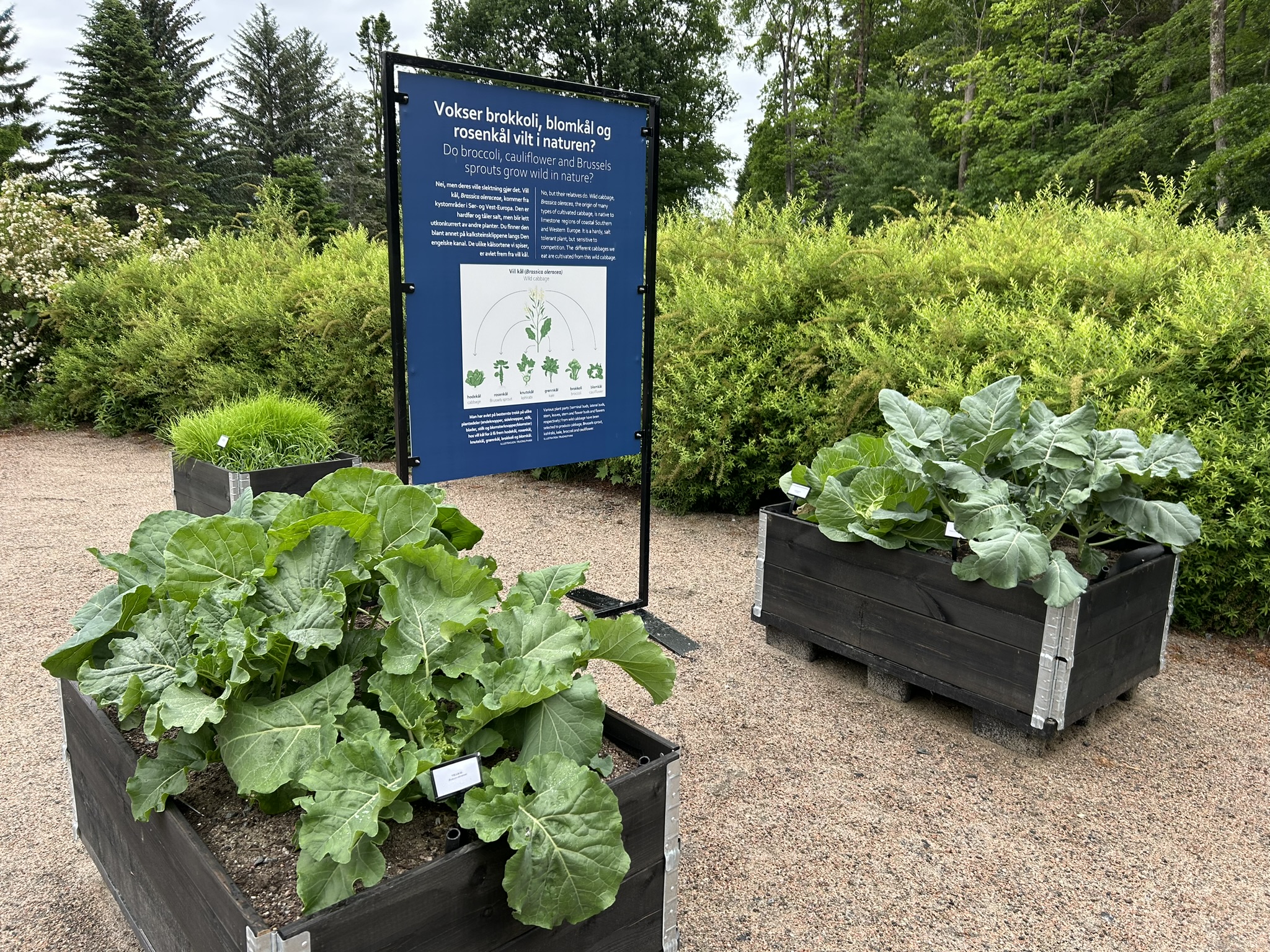
Figure 16. In Norway, the exhibition has been on display in five different botanical gardens between 2021 and 2024. The photo above is from the Natural History Museum and Botanical Garden, University of Agder, in Kristiansand, where the horticulturist has made displays of CWR plant species near each poster. The posters are still in good condition, and they will remain on display until next year. Photo: Malene Østreng Nygård.
7.3 Webpage and media
Plant portraits
The tradition of publishing plant portraits was initiated during previous Nordic CWR projects and since they were popular, it was decided to continue with this communication approach. Each year during the project time period, a few plant portraits have been published on the CWR project webpage. In total, there have been 14 plant portraits published on the following species: spring vetch, (Vicia lathyroides L.), alpine timothy (Phleum alpinum L.), cock’s-foot (Dactylis glomerata L.), wild radish (Raphanus raphanistrum L.), alpine meadow-grass (Poa alpina L.), European dewberry (Rubus caesius L.), bilberry/European blueberry (Vaccinium myrtillus L.), field mint/wild mint (Mentha arvensis L.), welsh onion (Allium fistulosum L.), white clover (Trifolium repens L.), blackthorn (Prunus spinosa L.), mountain clover (Trifolium montanum L.), bog bilberry (Vaccinium uliginosum L.) and supina bluegrass (Poa supina Schrad.). Among NordGen's project webpages, some of these portraits belong to the most visited pages.
Information films
As part of the project, four short information films have been produced and made available at the CWR project webpage and shared in NordGen’s social media channels. The overall purpose of the films is to inform a broad target group about CWR and briefly explain some of the project's tasks.
The first film, “The Nordic Project on Crop Wild Relatives 2021–2024”, serves as an introduction to the project focusing on why it is important to conserve CWR and use these valuable assets in research and plant breeding, and not least why Nordic cooperation is significant for success. As the title suggests, the second film, “CWR Inventories and Seed Collection”, revolves around inventories and seed collections with examples from Norway (Færder National Park), Finland (Hanko peninsula), Sweden (Abisko National Park and Kristianstads Vattenrike Biosphere Reserve) and Iceland (Vatnajökull National Park and Reykjavík/Geldinganes).
In the third film “Climate Change Affects CWR”, the work on climate change modelling is explained. The film describes the impact of climate change under the climate change scenarios SSP 245 and SSP 585, and how global warming will affect CWR populations in the Nordic countries. The fourth and last film “Genetic Diversity Analysis” focuses on the project’s use of DNA technology to conduct genetic diversity analyses using plant samples collected in all the Nordic countries. In the film, some preliminary results are presented as well as some visions for the future.
Webpage news items and media coverage
During the years, seven news articles about the project have been published on NordGen’s website. These news items cover activities such as project workshops, the updated CWR priority list, plant inventories and a seed deposit in the Svalbard Global Seed Vault. The CWR project has also been mentioned in press releases and debate articles written by NordGen. Below, you will find a selection of articles and features related to CWR and the project published by Nordic media during the project period.
7.4 Stakeholder workshops
Within the framework of the project, two stakeholder workshops have been arranged. The main goal of these were to strengthen and expand the Nordic CWR cooperation network, spread information about the activities within the ongoing CWR projects, knowledge exchange and discussions on national and regional conservation approaches, with the long-term aim to stimulate and improve Nordic conservation efforts on CWR. Stakeholders were invited from the in situ and ex situ conservation communities, the scientific community as well as policy makers.
The first workshop was held at the Natural History Museum in Oslo in November 2021. Forty participants, including people from all the Nordic countries, took part in the workshop, 25 of whom took part in person and the rest online. The workshop included information on activities in the projects, lectures given by international experts, group discussions and a mini future workshop (Figure 17). The outputs from the latter were summarised in an internal report, focusing on suggestions for future actions to strengthen Nordic CWR conservation (Appendix B).
The second workshop was held in the Meeting Centre of the Ministry of Agriculture and Forestry in Helsinki, in November 2023. Forty participants took part on site (the maximum possible with the funding acquired), including stakeholders from all the Nordic countries and international experts, as well as stakeholders from the Baltic countries in order to strengthen the Nordic-Baltic cooperation on this topic. The main sessions were on in situ conservation of CWR, use of CWR, outputs from the project, and European and international cooperation, followed by a discussion workshop on conservation of, and access to, CWR in the Nordic region and beyond. An internal report was written on the outcome of the latter and circulated to the workshop participants (Appendix C). The results from both the mini future workshop in Oslo and the group discussions in Helsinki fed into the recommendations presented in Chapter 9.
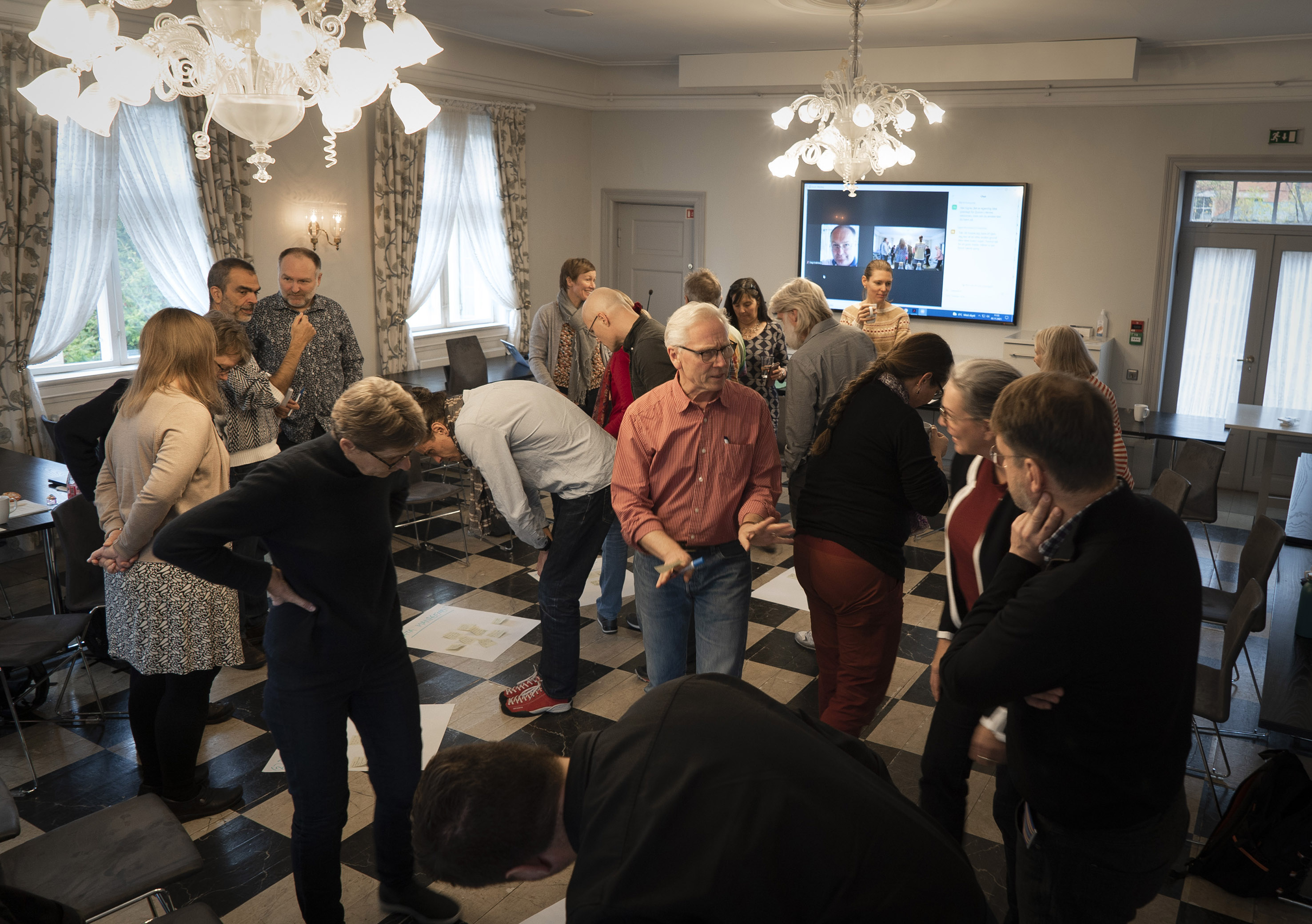
Figure 17. Active discussions at the Mini future workshop included in the Stakeholder workshop in Oslo 2021. All participants were invited to propose topics for discussion and six central themes were identified: processes at the policy level, developing protected area criteria, data management, network development, communication, and access, use and benefit-sharing. Photo: Jonatan Jacobson.
7.5 Webinars
During the autumn/winter of 2024, a series of lunch webinars was arranged. It included six separate seminars on topics central to the project. The goals were both to share the results from the project and to communicate other information of significance for CWR conservation and use. Speakers included people with a wide range of roles and expertise, such as protected area managers, plant breeders, researchers, representatives from national authorities, and ex situ conservation experts. They consisted of partners within the project network as well as other invited speakers.
In contrast to previous in-person workshops, the aim of the webinars was not only to reach Nordic stakeholders, but also a broader audience. Direct invitations were sent out to Nordic stakeholders according to a list developed within the project, as well as to Baltic stakeholders, European experts, and people in a number of groups relevant for this topic, e.g. the ECPGR CWR working group, The IUCN CWR specialist group, NetworkNature Nordic hub, and botanic gardens. In addition, the seminars were advertised on social media. Participation in the meetings varied from 72 to 92 (average 83) and in total 230 individual people from nearly 40 countries were reached with this communication effort.
An overview of the webinars and recordings of them can be found on the Nordic CWR webpage.
7.6 Publications and oral presentations
Publications
One of the approaches used to communicate the results from this project has been different kinds of open access publications. The exception has been a few student reports where open access publication was not possible. During the lifetime of the project (2021–2024), the publications include three datasets, seven inventory reports, one scientific newsletter, six student reports, and one popular science publication. In addition, there are two scientific manuscripts that have been submitted to peer reviewed journals, and additional data has been accumulated for further publications after the end of the project.
Below, we have collected the references of the different kinds of publications that are direct outputs from the project:
- Aronsson M (2022) Crop Wild Relatives – An Inventory in the Biosphere Reserve Kristianstad Vattenrike 2021. Figshare. Book. https://doi.org/10.6084/m9.figshare.21089752.v1 (Inventory report)
- Aronsson M (2023) Crop wild relatives – An Inventory in the Abisko-Torneträsk Area 2022. Figshare. Book. https://doi.org/10.6084/m9.figshare.24849915.v1 (Inventory report)
- Austad I, Hauge L, Svalheim E, Bjureke K, Rosef L & Aamlid T (2023) Norske blomsterenger – Forbilder, frøblandinger, etableringe og skjøtsel. Fagbokforlaget. Page 30-31 about this project. (Popular science)
- de Haro Reyes B, Palmé A, Fizgerald H, Göransson M, Pedersen O, Þorbjörnsson H, Madsen B, Treier UA, Normand S, Hagenblad J (submitted manuscript) An east - west distribution of genetic diversity in Nordic populations of caraway (Carum carvi L.) and its conservation priority consequences. (Scientific publication)
- Eriksson D (2023) Optimization of PCR protocol for microsatellite primers in Fragaria vesca. (Student project)
- Fahlgren S (2022) Optimisation of PCR Protocol for Microsatellites in Vaccinium myrtillus: A first step in evaluating genetic diversity for future conservation. Available from: https://urn.kb.se/resolve?urn=urn:nbn:se:liu:diva-185691 (Student project)
- Fitzgerald H and Kiviharju E (2023) Sukulaiset avuksi. Geenivarat p 15. Available from: https://www.luke.fi/fi/documents/geenivarat-2023-tiedelehti (Popular science)
- Fitzgerald H, Aronsson M, Borgen Nilsen L, Bjureke K, Byhring Jordal K, Dons Henriksen J, Göransson M, Henriksen J, Palmé A, Weibull J (2024b) Nordic Wild Food Plant Inventory. Figshare. Dataset. https://doi.org/10.6084/m9.figshare.27925893.v1 (Dataset)
- Fitzgerald H, Palmé A, Aronsson M, Asdal Å, Bjureke K, Endresen D, Hyvärinen M, Kiviharju E, Lund B, Nilsen L B, Göransson M, Thorbjornsson H, Weibull J, Wind P, Rasmussen M, Borgen Nilsen L, Helpdesk G, Palmé A, Bakken V (2023). Nordic crop wild relative priority list. Version 1.15. Nordic Genetic Resource Centre (NORDGEN). Checklist dataset https://doi.org/10.15468/4t4bm5. Accessed via GBIF.org 23/06/2024. (Dataset)
- Fitzgerald H, Palmé A, Aronsson M, Asdal Å, Bjureke K, Endresen D, Göransson M, Hyvärinen M, Kiviharju E, Lund B, Borgen Nilsen L, Rasmussen M, Thorbjornsson H, Weibull J, Wind P (updated 2021) The Nordic Priority Crop Wild Relative Dataset, version 3. Figshare. https://doi.org/10.6084/m9.figshare.5688130.v3 (Dataset)
- Fitzgerald H, Aronsson M, Göransson M and Palmé A (submitted manuscript) Climate change modelling predict dramatic changes in species distribution of Nordic crop wild relatives. (Scientific publication)
- Fitzgerald H, Levo M, Hyvärinen M, Häggblom M (2024) Crop Wild Relatives – Inventories in Nåtö Nature Reserve, Åland Islands, 2023. Figshare. Dataset. https://doi.org/10.6084/m9.figshare.25866787.v1 (Inventory report)
- Fitzgerald Heli, Lyytikäinen V, Hyvärinen M (2023) Crop Wild Relatives - Inventories in Oulanka and Nuuksio National Parks, Finland 2022. Figshare. Dataset. https://doi.org/10.6084/m9.figshare.23500413.v1 (Inventory report)
- Goodman C (2023) The genetic diversity of wild strawberry (Fragaria vesca) among and within Nordic populations. (Student project)
- Göransson M, Thorbjörnsson H (2022) Crop Wild Relatives – Inventories in Vatnajökull National Park 2021. Figshare. Book. https://doi.org/10.6084/m9.figshare.21090133.v1 (Inventory report)
- Haglund L (2022) Optimised PCR protocol for ten microsatellite primers (SSRs) in Fragaria vesca: Facilitating future work analysing genetic diversity and developing efficient conservation strategies. Available from: https://urn.kb.se/resolve?urn=urn:nbn:se:liu:diva-185689 (Student project)
- Moerenhoet R (2022) The genetic diversity of bilberry (Vaccinium myrtillus) in Nordic populations. (Student project)
- Palmé A, Lund B, Kiviharju E, Fitzgerald H, Thorbjörnsson H, Hagenblad J, Weibull J, Bakkebø Fjellstad K, Bjureke K, Borgen Nilsen L, Göransson M, Häggblom M, Hyvärinen M, Aronsson M, and Lyytikäinen V (2021) Recent progress on crop wild relative conservation in the Nordic region. Crop wild relative 13: 11 – 15. Available from: http://www.cropwildrelatives.org/resources/publications/newsletters/ (Scientific newsletter)
- Pedersen O (2024) Crop wild relatives in Færder National Park, Norway. Report from mapping on seven islands in 2021. Figshare. Book. https://doi.org/10.6084/m9.figshare.27179700.v1 (Inventory report)
- Thulesen Dahl J, Madsen B, Treier UA, Normand S (2024) Crop Wild Relatives - Population inventories in Denmark 2023. Figshare. Book. https://doi.org/10.6084/m9.figshare.25592187.v1 (Inventory report)
- Wreth C (2024) Developing an optimized PCR protocol for microsatellite analysis in Vaccinium myrtillus. Available from: https://liu.diva-portal.org/smash/get/diva2:1881235/FULLTEXT01.pdf (Student project)
Oral presentations
Results from the project and information about CWR have been presented in different conferences and meetings during the time frame of the project. For example, at international and Nordic conferences such as the 7th Global Botanic Gardens Congress in Melbourne 2022, the Nordic Conference on climate change adaptation in Reykjavik 2023, the Nordic nature-based solutions conference in Malmö 2024, as well as smaller/local meetings such as at the Swedish reference group for cultivated diversity, NordGen’s working groups, NordGen’s board, and Lund's botanical association.