6. CWR seed collection and ex situ conservation
6.1 Aims and goals
The goal of this part of the project was to enhance the ex situ conservation of CWR in the Nordic region. This initiative serves a dual purpose: firstly, to offer a safeguard for conservation should any adverse events impact the wild population, and secondly, to facilitate the utilisation of these genetic resources. In the former case, the seeds can be used to reintroduce the natural population, reinforce it, or they can be used for assisted migration if the original location is no longer suitable for the species. The conserved seeds will be available to various users such as researchers, plant breeders and educators. Consequently, the overarching goal is to reinforce the long-term conservation of CWR while simultaneously enhancing food security by providing genetic resources for developing cultivars that are adapted to future challenges, such as climate change.
6.2 Seed collection
Botanists from all the Nordic countries were involved in collecting seeds from CWR species during the first three years of the project period (2021–2023).
From the Nordic CWR priority list (see Chapter 2), a subset of taxa was selected for seed collection. The selection was based on criteria such as if the taxa were already conserved ex situ, possibility to sample adequate number of seeds and individuals, and whether the species is native, naturalised, or temporary (in which case it was not collected) in the area. This resulted in a list of 47 taxa selected for seed collection and of these, 16 were prioritised. In some cases, additional CWR taxa were collected, if they occurred at the same locations as the ones prioritised. In the first year of the project (2021) we focused on collecting seeds from plant species in the protected areas where CWR inventories had been done. Necessary permits were obtained, and the aim was to collect seeds in protected areas in a responsible way and to make them accessible to researchers and plant breeders. Another focus was to collect seeds from the same populations where leaves had earlier been sampled for genetic analyses (e.g. Carum carvi, Vaccinium vitis-idaea, and Schedonorus pratensis, see Chapter 4). In the second year (2022) we looked for gaps in the Nordic region where few or no seeds of CWR had been collected previously. There were fairly large areas where many of the prioritised taxa had not been collected. Examples include islands like Öland, Gotland and Åland in the Baltic Sea, the west coast of Norway, the very north of Scandinavia, and the east, north and west fjords of Iceland. We regularly discussed and decided which plant species and areas should be our current priority.
Before our collection trips, we consulted different national digital platforms for occurrences of the species. When collecting seeds, we noted details like scientific name of the plant species, locality, habitat, number of individuals, date, and geographic coordinates. We documented all plant species and their habitats with photos.
The seed sampling was conducted in such a way that the survival of the natural population was not endangered. It is also important to collect the seeds when mature, and to keep them in appropriate postharvest conditions. In addition, it is essential to check the population to avoid seeds that are escapees from cultivation, both from agriculture and from sown road verges.
In total 151 separate seed samples were collected and donated to NordGen (see Figure 14). Of these, some were re-samplings to increase seed amounts, some were samples that were later merged to create one gene bank accession, and some contained few or immature seeds. The final number of conserved accessions is therefore lower than this number (see Chapter 6.3).
In addition, seed samples from threatened species from Finland and Norway were collected within the framework of the project, but not sent to NordGen. In Norway, CWR species that are included in the Norwegian red list (Artsdatabanken 2021), are stored in the Norwegian National Seed Bank (Bjureke & Bruholt 2024). This affects the following species: Phleum phleoides (L.) H.Karst. (CR) (Færder NP), Malus sylvestris (L.) Mill. (VU) (Færder NP, Jomfruland and Hurum), Rubus caesius L. (NT) (Færder), P. phleoides (VU) (Oslo) and Lactuca sibirica (=Mulgedium sibiricum) (VU) (Troms). A total of seven accessions from Norwegian threatened species were collected. In Finland, the species included in the Finnish red list (Hyvärinen et al. 2019) are conserved at the Finnish Museum of Natural History seedbank. One accession of Trifolium montanum (VU) from Åland, Finland was collected.
Figure 14. Locations where seeds of crop wild relatives were collected for conservation at NordGen within the framework of the project.
6.3 Seed conservation and access
After a rough cleaning in the respective countries, all seeds were handed in to the seed gene bank at NordGen (Alnarp, Sweden) for further processing and storage, except the few accessions from threatened species from Norway and Finland. The threatened accession from the Åland islands was processed and stored long-term in the seed bank at the Finnish Museum of Natural History, and those from Norway in the Norwegian National Seed Bank in Oslo.
At NordGen, all seeds were threshed, cleaned and dried. Seed experts made visual evaluations regarding seed health and taxonomy, and a sample from each accession was used to make a germination test to determine seed viability. In addition, hundred grain weight was estimated, and seed number was determined based on this and the total seed weight.
The aim of the seed collection was to conserve as many of the collected samples as possible long-term and to make them accessible via the Nordic Baltic Genebanks Information System (GENBIS). Here, seed samples can be ordered for use in for example plant breeding, research and education. However, there is a set of minimum requirements for the inclusion of accessions for long-term conservation at NordGen (Appendix A). These requirements are set up to assure that the seed collection is done legally and in a manner that does not harm the natural population, that documentation is adequate for users, and that seed quality and amount is satisfactory and sampled diversity (number of individuals) is adequate for long-term conservation and seed distribution. For example, if the seeds are collected from few individuals, the diversity collected is most likely not representative of the whole population and regeneration can result in inbreeding depression. In addition, if very few seeds are collected, they cannot be made available to users before either regeneration or re-collection has been carried out.
After evaluation of the seeds and documentation, it is estimated that about 90 accessions will be conserved long-term at NordGen, and 8 accessions will be conserved short-term. For a few of these accessions, the evaluation was based only on documentation, and therefore the final number might change somewhat. All these accessions will be made available to users. They include accessions from all the Nordic countries (Demark, Iceland, Norway, Sweden, and Finland, including Åland) and consist of wild relatives to vegetables (e.g. Daucus carota subsp. carota, Lactuca serriola) forages (e.g. Festuca arundinacea, Phleum alpinum, Poa alpina, Trifolium arvense, Trifolium medium) berries (e.g. Vaccinium vitis-idaea), cereals (e.g. Leymus arenarius) and spices (e.g. Carum carvi).
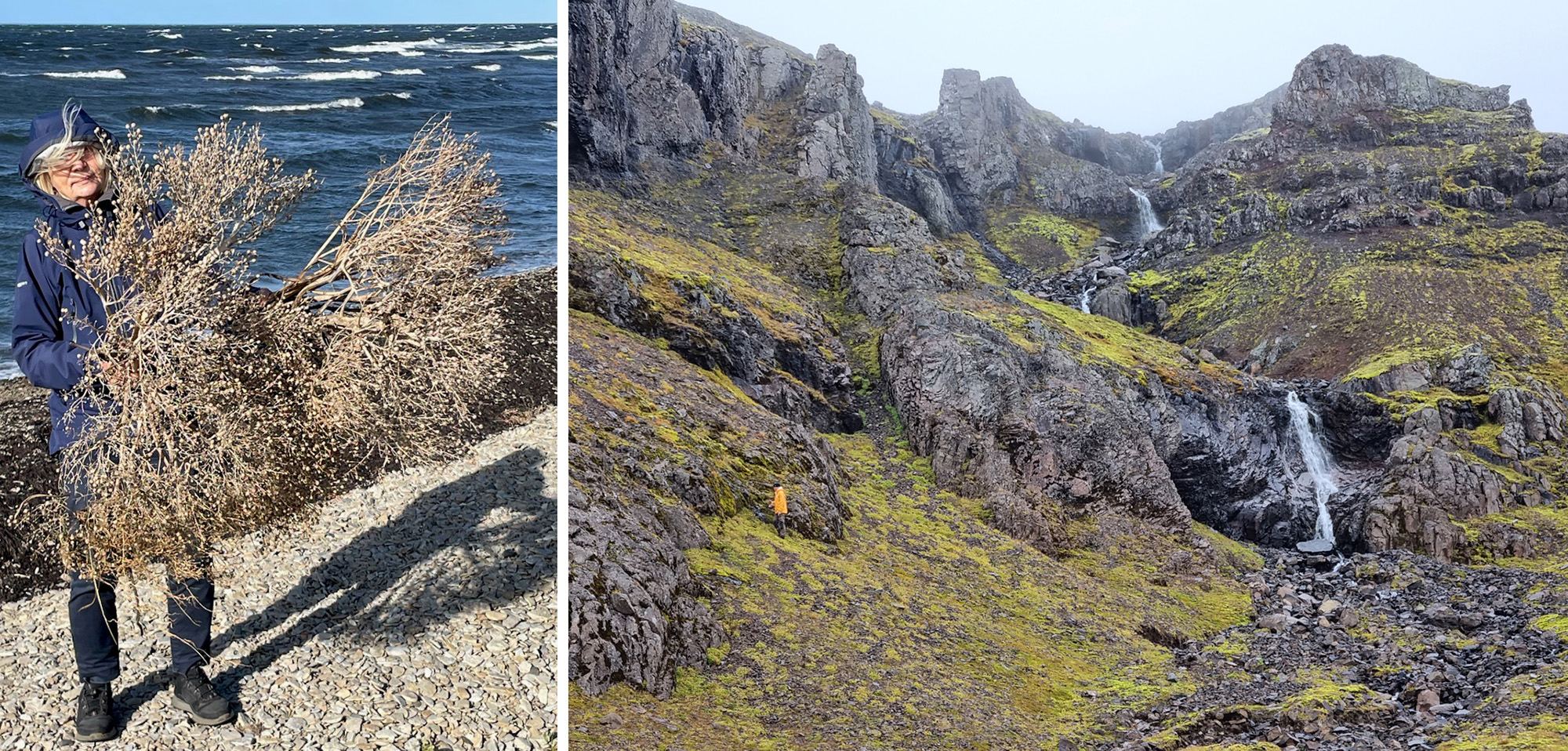
Figure 15. There are several challenges connected to seed collection, for example weather conditions and a demanding landscape. Collecting seeds of sea kale, Crambe maritima, on a windy day on Öland, Sweden, 2023 (left). Collecting seeds of Phleum alpinum and Poa alpina in Öxi, Iceland (right). Photos by Tor Mjaaland and Hjörtur Thorbjörnsson.
6.4 Budget
In the project budget, DKK 114,000 was assigned to seed collection in each country (including Åland), and it was mainly used for salary and travel costs. Different areas had different challenges (Figure 15), such as need for planning, demand and cost for travel, accessibility, access to experts and so on. This resulted in quite different outcomes in the different areas, and the division between salary and travel costs also varied. On average, the cost per collected seed sample was DKK 4,302. As described in the chapter above, not all seed samples lived up to the minimum requirements for long-term conservation and distribution. If the estimation of average cost only includes the accessions that live up to the criteria at NordGen for long-term or short-term conservation, and are therefore made available to users, the cost would be DKK 6,980 per accession.
The budget for seed processing and conservation included activities such as threshing/seed cleaning, taxonomic evaluation, germination testing, drying, and packing for long-term storage in three locations. The average cost per processed sample was DKK 4,619. This mainly includes salaries and to a small degree costs for materials.