1. Introduction
This report summarises the findings from the project “Conservation and sustainable use of genetic resources in the Nordic countries”, which forms part of the Nordic Council of Ministers’ Nature-based Solutions programme. The project is a collaboration among all Nordic countries and focuses on Crop Wild Relatives (CWR). Its long-term goal has been to contribute to a more sustainable and resilient Nordic agriculture by enhancing the conservation of Nordic CWR genetic resources and facilitating their use. In this way, the project improves long-term access to genetic resources that can be used to adapt agricultural plants to climate change and other future challenges. In addition, the project has aimed to achieve Nordic-wide synergy in this field and to enhance Nordic communication and cooperation.
What is a Crop Wild Relative?
A Crop Wild Relative (CWR) is a wild species / population that is closely related to a cultivated crop. It can be a wild species within the same genus as a crop (for example the wild species Phleum alpinum L., which is related to the cultivated forage grass timothy, Phleum pratense L.), a defined subspecies within the same species as the crop (for example wild Allium schoenoprasum subsp. sibiricum (L.) Hartm. and cultivated chives, Allium schoenoprasum L.), or wild populations of the same species as the crop (for example wild Allium fistulosum L. and cultivated welsh onion, also A. fistulosum). For more examples, see Figure 1. In rare cases, also closely related species within a different genus than the crop are regarded as CWR, if they have proven useful in pre-breeding or in the development of new crop cultivars.
CWR are not biologically different from other wild species but due to their close relationship, crop traits can be transferred from the CWR to the crop. Studies show that CWR contain traits such as drought tolerance and pest and disease resistance that are lacking from the related crop and can be used to adapt the crop to for example climate change and a more environmentally friendly agriculture.
1.1 Context of the study
The effects of climate change are becoming increasingly apparent around the world, and the impact is expected to be severe in the Nordic countries, particularly in Arctic areas (Rantanen et al. 2022; Aðalgeirsdóttir et al. 2024). This will affect ecosystems, challenge long-term conservation of biodiversity and have both direct and indirect effects on us as individuals and on human society. A major challenge will be food security, where the impact of climate change has already been observed in many areas, including the Arctic (IPCC 2023). It is now more urgent than ever to adapt agriculture to climate change, while at the same time minimising its impact on the environment and climate. One of the approaches available to achieve these goals is to develop new, climate-adapted plant cultivars and cultivation systems, and CWR can provide raw material (genetic variation) needed to develop these cultivars. CWR have been recognised for a long time as important sources of valuable traits for improving cultivated plants in general, as well as variation relevant for climate change adaptation in particular (Maxted et al. 2012; Dempewolf et al. 2014).
The value of CWR and their conservation has been recognised globally and is for example mentioned in the sustainable development goals (UN 2015, Target 2.5) and in plans and strategies connected with the Convention of Biological Diversity (e.g. UNEP 2022). Additionally, the importance of access to CWR has been emphasised (Maxted and Brehm 2023) and the recently updated Kalmar Declaration on access and rights to genetic resources supports facilitated access to CWR via NordGen (Nordic Council of Ministers 2024). However, it is clear that CWR are today neither adequately conserved nor sufficiently accessible (Engels and Thormann 2020; Maxted and Brehm 2023) and that actions are urgently needed. With that in mind, the goals of the current project were developed to target the conservation and access to Nordic CWR.
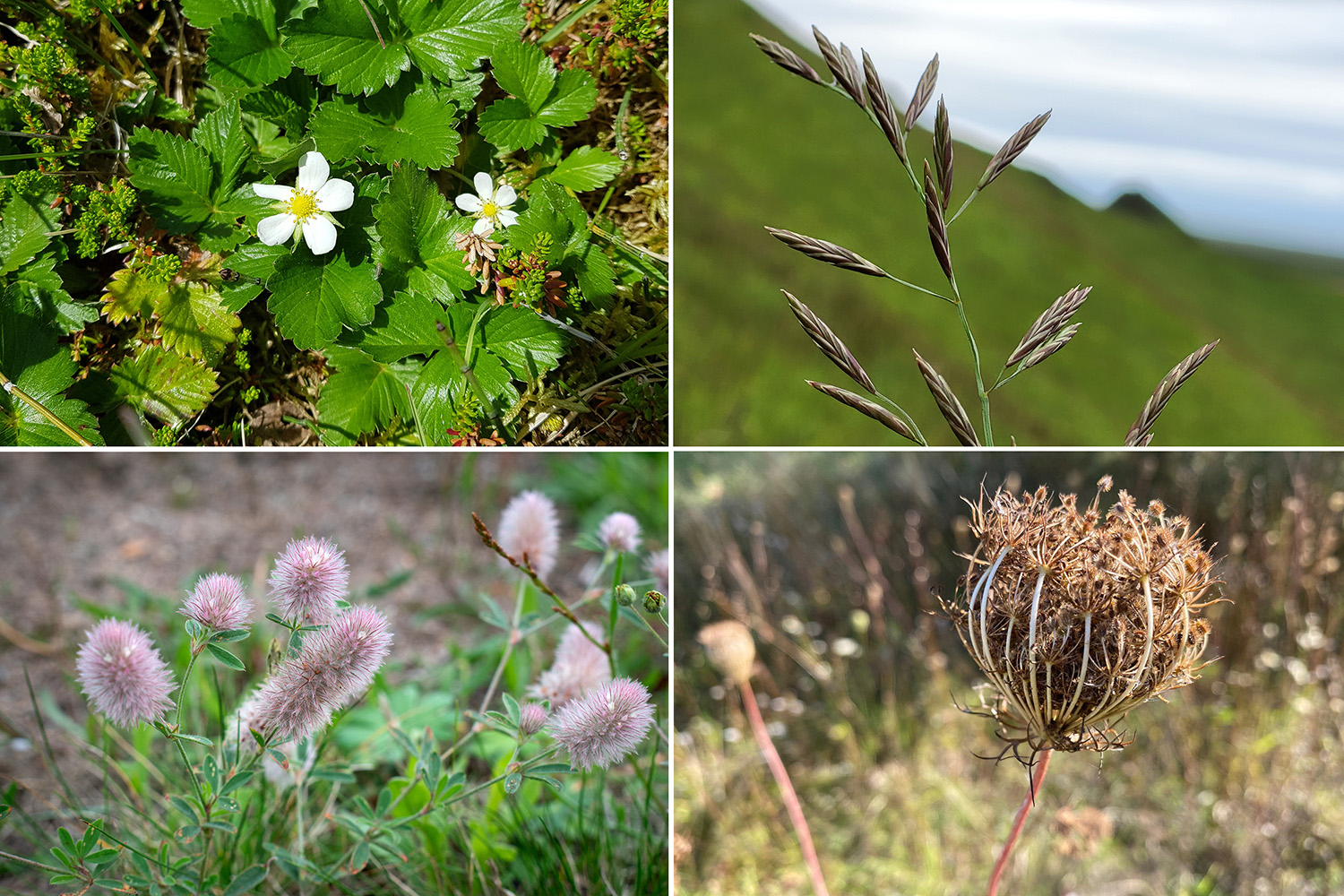
Figure 1. A few examples of Nordic Crop Wild Relatives (CWR): Fragaria vesca, a relative of wild strawberry (Fragaria × ananassa); wild Schedonorus pratensis, the same species as the cultivated forage grass Meadow fescue; Trifolium arvense, a CWR to red clover (Trifolium pratense) which is an important forage crop in the Nordic countries; Daucus carota ssp. carota, a CWR of the cultivated carrot (Daucus carota subsp. sativus). Photos by Magnus Göransson, Linn Borgen Nilsen and Kristina Bjureke.