2. Nordic CWR priority list and list of wild food plants
2.1 Updated CWR priority list
The Nordic countries have a large number of CWR in their flora. A previous study used a broad definition of CWR, resulting in a comprehensive checklist including over 2,700 Nordic CWR taxa (Fitzgerald et al. 2017; Palmé et al. 2019). These are related to food and forage crops as well as medicinal, ornamental, and forestry species. Based on this checklist, a priority list was developed (Fitzgerald et al. 2018) so that conservation efforts could be focused on the most relevant species. It was decided to include only CWR related to food and forage crops. Further prioritisation was based on the following two criteria: socioeconomic value of the crop that the CWR is related to and potential utilisation value of the CWR for breeding. The resulting list included mainly CWR related to crop categories of fruit and berries (36%), vegetables (29%) and forages (27%).
In 2021, an update of the list was made (Fitzgerald et al. 2023), and 19 new CWR species were added to the priority list, which now includes 103 species. This update was made by consulting Nordic scientists and plant breeders regarding what species that would be valuable to add. The additional species included taxa related to both food and fodder crops, such as Raphanus raphanistrum L. (CWR to radish), Leymus arenarius (L.) Hochst. (CWR to wheat), Apium graveolens L. (CWR to celery), and Phleum alpinum L. (CWR to timothy). In addition to the added taxa, data on occurrence, taxonomy and gene pool affinity was updated and, information on invasiveness and threat categories from Nordic countries was added. In total, 20 of the taxa are red-listed in at least one of the Nordic countries
The work described below (inventory, seed collection, selection of species for climate change modelling, and genetic analysis) was initially based on the first version of the priority list, but in some cases includes also species from the updated list.
2.2 Wild Food Plant list
Wild food plants (WFP) are edible wild species used for food (see examples in Figure 2). As CWR and WFP conservation often go hand in hand, the project initiated a Nordic-level co-operation on WFP. The first step was to create a Nordic list of wild food plants.
For doing so, we decided to define WFP as non-cultivated species of wild plants that grow spontaneously in their natural habitat and are used as human food. WFP can be found growing in very diverse habitats across the Nordic region. Some of them also grow on disturbed habitats or spontaneously on agricultural or urban land.
Historically WFP, such as wild berries, have been widely used in the region and the tradition of berry picking still continues today. Other WFP have been used as vegetables, or even as a bread substitute during years of famine and war. Even though many foraged wild species are similar throughout the Nordic region, there are also differences in the traditional use of WFP between the countries.
Data from Nordic sources (Bjarnadóttir and Hilmarsson 2018; Ellena 2012; Evira 2016; Lundström 1917; Plantelisten 2024; Rautavaara 1980a; Rautavaara 1980b; Stryamets et al. 2015; Svanberg 2012; Svanberg and Ægisson 2012; Teixidor-Toneu 2022) and European sources (EU 2023; EU 2024; EuroFIR-NETTOX 2007; Irving 2009; THIE 2023) were collected to find information on both historical and present human food use of Nordic plant species. The taxa with indigenous or naturalised status (SLU Artdatabanken 2024; Elven et al. 2022; Kurtto et al. 2019; Hartvig et al. 2015; Wasowicz 2020) in at least one Nordic country as well as having human food use were selected to form the Nordic wild food plant inventory. The inventory also contains additional data, such as national IUCN red list categories (Artsdatabanken 2021; Hyvärinen et al. 2019; Wasowicz and Heiðmarsson 2019; Moeslund et al. 2023; SLU Artdatabanken 2020) and invasive status in each country (Artsdatabanken 2023; EU 2022; Luke 2024; Náttúrufræðistofnun 2024; Strand et al. 2018; Skipper et al. 2020).
The number of species in the Nordic WFP inventory is 368 in total and with subspecies and varieties 624 taxa (Fitzgerald et al. 2024b). Altogether 90 taxa are listed as threatened in at least one Nordic country and 110 as invasive in at least one of the Nordic countries. Additional data on toxicity (HUS 2024; Swedish Poisons Information Centre 2024) includes information on whether the entire plant is toxic or only some parts of it are. In some cases, the plant is listed as toxic but is edible when used and prepared correctly, or it can be used as food to a reasonable extent.
The list includes edible plants of different uses. Medicinal plants were not included if their use was solely medicinal and not food. On the other hand, herbal teas, food decorations and spices were included along with plants used for example as vegetables, berries or bread flour substitutes. The taxa come from 75 different families and 237 genera showing the large variation of Nordic wild food plants. This WFP list should not be considered as static but rather aimed to be updated as more data becomes available, in a similar way to the CWR list.
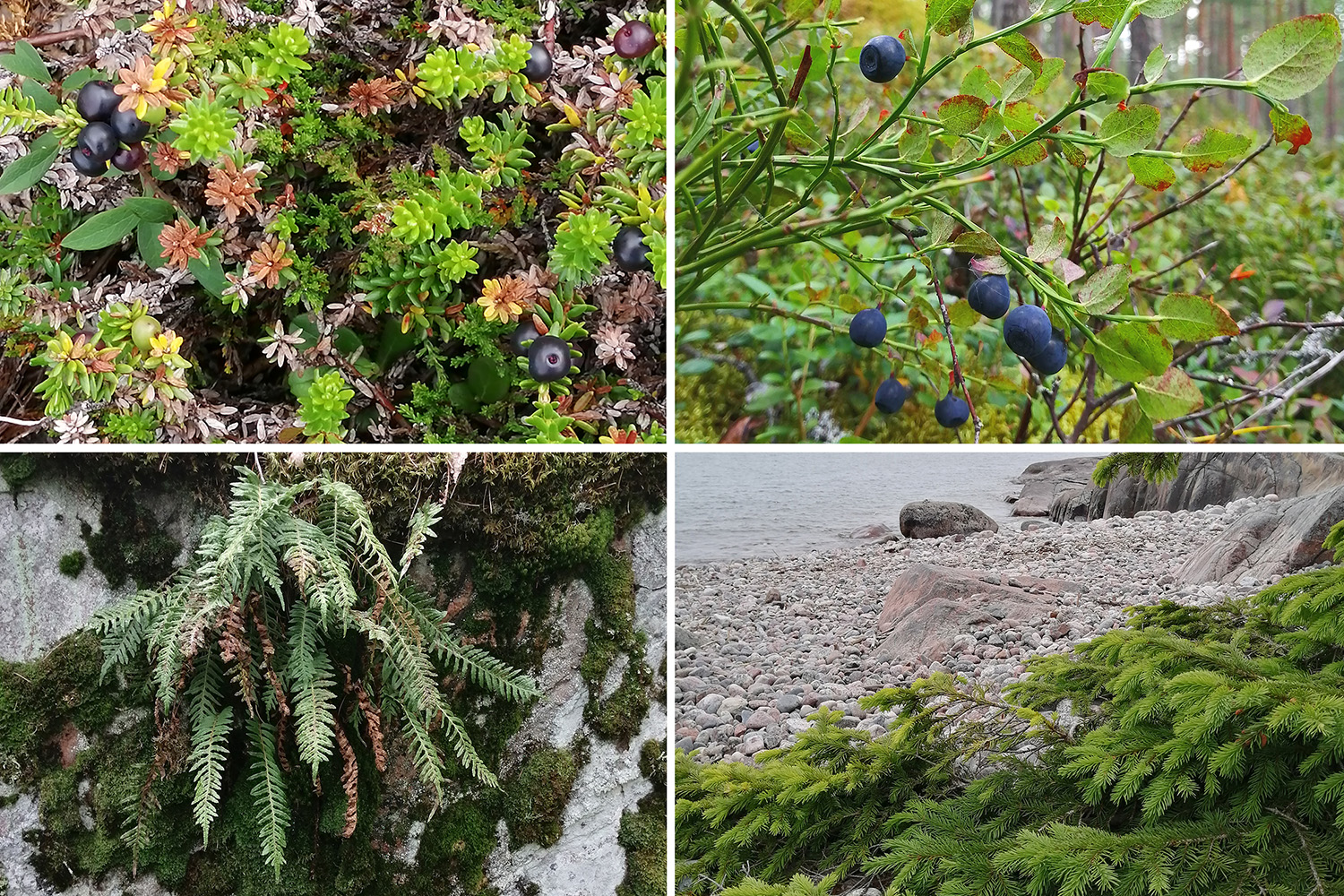
Figure 2. Examples of Nordic wild food plants: Empetrum nigrum can be used to make jams and juices; Vaccinium myrtillus is widely collected during late summer in the Nordic countries, it is both a CWR and WFP; Polypodium vulgare roots are often eaten by children as they have a liquorice-like taste; young shoots of Picea abies are used in making syrup in early spring. Photos. Heli Fitzgerald.