5. CWR inventories in protected areas
5.1 Aims and background
The aim of this part of the project was multifaceted. Firstly, it sought to evaluate various methods for inventory of Crop Wild Relatives (CWR) and to pinpoint sites with significant occurrences of CWR. Secondly, it served as a foundation for identifying the seed collection localities (see Chapter 6). Thirdly, it provided guidance on future site management and identified populations suitable for long-term in situ conservation.
The inventory was conducted across all Nordic countries: one area in Norway and Åland, two in Sweden, Iceland, and Finland and four in Denmark. The inventories took place between 2021 and 2023.
5.2 Norway
The inventory in Norway was carried out in Færder National Park (NP) in 2021 (Figure 13). The area was selected as previous studies showed that it contains a high CWR diversity, and it was recommended for the establishment of a genetic reserve. From earlier inventories, seven islands were selected (of 227 larger than 0.1 ha) as targets for the inventory. These seven islands include 30% of the land area in the NP and 90% of the vascular plants known from the NP (Pedersen 2024).
Fieldwork was carried out during 2021 during a total of 31 days (180 work hours). A 100x100 m grid (out of UTM zone 32) was used and 580 (out of 660) squares were visited. GPS position was recorded for all species on the CWR list, and the population size was estimated.
5.3 Iceland
In Iceland the inventory was done in Vatnajökull national park in 2021. The area was selected out of the highest ranking in CWR diversity in Iceland (Fitzgerald et al. 2019). Two smaller areas were chosen within the park, Skaftafjell in the south and Jökulsárgljúfur in the north. The sites were selected to cover as many of the vegetation types in the NP as possible (Göransson 2021).
The fieldwork was done during 15 man-days in 2021. Known sites (from GBIF and national databases) for taxa on the CWR priority list were targeted and other taxa from the list were recorded. Information on location, latitude, longitude, population size, viability and potential threats was collected.
5.4 Sweden
In Sweden, the inventory was carried out during two different years: in southern Sweden during 2021 and in the north during 2022. The southern area, Kristianstad Vattenrike, was chosen for several reasons. It includes the only Nature Reserve (NR) in the area with genetic preservation mentioned in its management plan (Lyngsjö NR), many NR in the area with diverse vegetation, and a large number of CWR priority species. Kristianstad Vattenrike is a Biosphere Reserve, and the management board is interested in developing the CWR engagement. Four NR were selected for inventory: Lyngsö (as mentioned above), Fjälkinge backe, Degerberga backar and Sånnarna. Together they contain most of the targeted species in the area (Aronsson 2022). In the north of Sweden, the Abisko-Torneträsk area was selected as it is far north, has well known biodiversity and allows for reasonable logistical costs. Five areas were selected based on the presence of species from the CWR priority list: South of Kopparåsen, Gearggevaggi, Gohpasjohhka, Abisko National Park and Boarrasacohkka. Abisko is a national park and the other four are inside Natura 2000 sites. Abisko NP and Gohpasjohhka were only visited for recording a single species (Elymus mutabilis) (Aronsson 2023).
The inventory in southern Sweden was carried out during three days in July and in northern Sweden during four days in July and one in August (together with leaf sampling for genetic analyses). The methods used differ between the north and the south. In the south, all parts of the NR were visited, except some parts that were too heavily grazed. In the north, the same method as in Iceland was used, with a focus on known sites for the rarer species and registration of all more common taxa on the walks between known positions. Information on location, population size, threats and viability were collected.
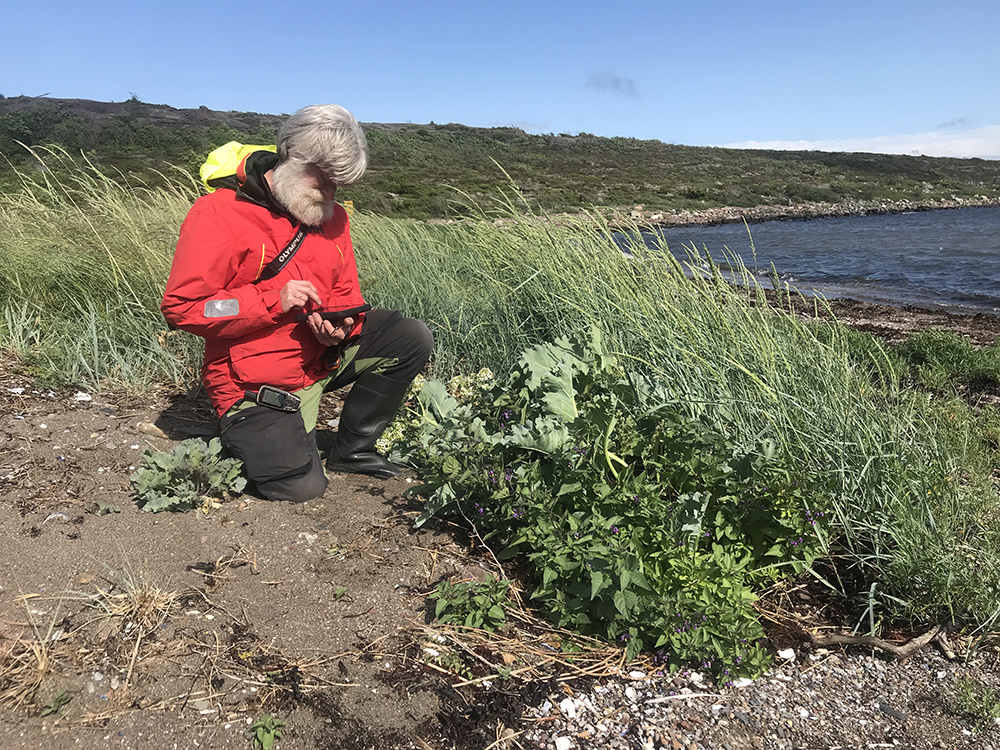
Figure 13. A scene from the inventory on an island in Færder National Park in Norway. Oddvar Pedersen is plotting the coordinates from various CWR plant species. Photo: Kristina Bjureke.
5.5 Finland
In Finland the inventory was conducted in 2022 in Oulanka and Nuuksio National Parks. These areas were chosen based on a national gap analysis and were identified as the most CWR species-rich complementary conservation areas. Additionally, they are excellent representatives for their ecogeographic zones (Fitzgerald et al. 2022).
The inventory took place in July in Oulanka and in August in Nuuksio. Given the extensive size of both national parks, smaller specific areas were selected for detailed study. In Oulanka, a 10x10 km square with the highest CWR diversity was chosen, while in Nuuksio the Myllypuro river valley was selected due to its known high CWR diversity. Within each selected area, 100x100 m squares were designated based on the known presence of CWR taxa – 14 in Oulanka and 5 in Nuuksio. All CWR taxa within these squares were catalogued, with details such as coordinates, number of individuals, population size, area covered, habitat, viability, and threats meticulously recorded.
5.6 Denmark
The inventory in Denmark was carried out in 2023 in four different sites: Husby, Stråsø, Mols, and Kattrup. The sites were selected to represent a west to east gradient across Denmark, but did also include diverse habitats and environmental conditions (Thulesen Dahl et al. 2023).
At each site, a number of points were randomly generated and selected for the survey. The CWR species were detected within circular plots with a 15 metre radius. In total, 212 plots were visited with a minimum and maximum of visited plots between 14 and 75 plots per site, depending on the total size of the site. For each species found in the plots, number of individuals, viability, threats, and status were registered. The work was done during 30 field days primarily between June and August, while a few sites were also visited in May (1 day) and October (2 days).
5.7 Åland
In Åland, the Nåtö-Jungfruskär Nature Reserve was chosen for the inventory, which was conducted during the summer 2023. Nåtö-Jungfruskär was selected as it is currently known to be the most CWR species rich area in Åland (Fitzgerald et al. 2023).
A specific area in the northwestern part of the nature reserve was targeted for the inventory, in anticipation of focusing future CWR in situ conservation efforts there. The area was divided in 100x100 m squares based on the Finnish Uniform Coordinate System grid. All squares in the reserve that included a terrestrial component (44 squares) were inventoried. All taxa from the CWR priority list were evaluated for the number of individuals, population size and its coordinates, status, viability, and threats. The fieldwork was conducted in July.
5.8 Result
The number of targeted taxa found in each country varied between 16 and 56 (see Table 1). In total, 89 of the taxa in the CWR priority list were identified during the inventory. A few species were found in all countries, such as Festuca rubra L., Poa pratensis L., Trifolium repens L. and Vaccinium myrtillus L. Some taxa were not covered, such as Lactuca sibirica (L.) Benth. ex Maxim. or Lactuca tatarica (L.) C. A. Mey., mostly because of local distribution outside any of the inventoried sites, or because the taxa were too rare to be captured, like Phleum phleoides (L.) H. Karst. or Trifolium montanum L.
5.9 Lessons learned
All tested methods, site selections and strategies seem to have given a relevant result. The sites varied widely in size from Sånnarna in Sweden (0.44 km2) to Vatnajökull in Iceland (14,967 km2).
Targeting areas with a known population and searching for other populations in the surroundings is suitable for large sites, and when one or a few species are prioritized for the work in an area. Randomised sampling strategy is suitable for small to medium sized areas with rather common CWR taxa that are evenly distributed. Total inventory is suitable for very small sites. When only a part of a large site is inventoried, it could bias the results.
The majority of the observed CWR taxa have viable populations. The inventory gives a good starting point for restauration and/or management planning and highlights relevant threats and pressures. The inventory also gives information on other important features such as red-listed and invasive alien plants.
The timing of inventory is important and varies between years because of weather, climate, and grazing regime, and can be costly for remote sites. In grazed areas some CWR species could be favoured by the grazing, and some not.
5.10 Recommendations
- Continue to identify areas of particular interest for in situ conservation.
- Obtain a better understanding of the threats to CWR.
- Build on the knowledge obtained from the inventory and conduct in depth studies on the management needs of CWR in targeted protected areas.
- Inclusion of CWR in management plans.
- Management plans should include actions both inside and in the surroundings of the protected areas, to address issues regarding genetic pollution and invasive alien species.
- Establish a long-term monitoring system on priority CWR, that also includes other relevant features such as red-listed and invasive alien plant species.
- Establish a link between in situ and ex situ conservation in seedbanks and botanical gardens.
- Avoid resowing grass fields with exotic seed, or using exotic seed in habitat restoration activities, to limit geneflow between exotic introductions and existing CWR populations.
- Communicate the results of the inventory and importance of CWR in situ work to make it more known.
5.11 Cost estimates
The actual costs for the inventories vary for many reasons, some areas are close to universities and towns, and travel costs are normally low, other areas are more remote and require days for simply travelling to and from the location. The size of the inventoried area varies among the locations and so does the effort needed to travel around the area (need for boats, availability of roads, etc.) as well as the number of species occurring in each site (see Table 1), which in turn affects the time spent in each location and therefore the costs. Who is doing the work is also an important factor. An expert is more expensive than a student per hour, but a student often has to spend more time on determination of species than a skilled expert, and also needs tutoring/guidance.
The following are therefore very rough estimates and includes not only the inventory work in the field but also planning, design and coordination of the inventory, as well as data management and writing of a report. With this in mind, we estimate the cost to be between DKK 0.03 and 1.79 per square meter that was inventoried. Different definitions of “population” were used in the inventories, but rather similar approaches were applied in Denmark, Finland, Åland and Norway, where the cost varied from DKK 83 to 856 per population inventoried (see Table 1). The high cost in Iceland (DKK 7,933 /population) is strongly affected by the high travel costs over a large area and the low number of CWR taxa but also by the way “population” is defined for the purpose of this calculation.
Table 1. An overview of the inventories conducted within the project as well as the costs. As different approaches were used for conducting inventories in each country, direct comparisons of costs are not straightforward. In addition, self-funding or other data sources were used in some cases, and the costs for these could not always be included for this calculation (see footnotes).
Country | Name of the protected area(s) (PA) | No sites | Area of the PA(s) (km2) | Area inventoried (m2) | No species | No populations/observations | Cost | Cost (DKK) per population | Cost per m2 (DKK/m2) |
Denmark | Husby, Stråsø, Mols, and Kattrup | 4 | 54.8 | 466,200 | 56 | 1,643 Denmark: Each taxon occurrence within an observation plot was counted as a “population”. | 835,000 DKK Denmark: The inventory data from 306 of the 518 observation plots was produced within another project, and therefore not included in this cost estimate. Only the analysis of this data is included. | 508 | 1.8 |
Iceland | Vatnajökull national park (Skaftafjell and Jökulsárgljúfur) | 2 | 14,967 | 1,750,000 | 16 | 30 Iceland: Populations in Vatnajökull National Park were registered as presence/absence of the taxa in each sub-location/landscape type visited. | 238,000 DKK | 7,933 | 0.14 |
Finland | Oulanka and Nuuksio National Parks | 2 | 323 | 190,000 | 33 | 216 Finland and Åland: Total number of CWR observations within plots. Each taxon occurrence within an observation plot was counted as a “population”. | 185,000 DKK | 856 | 0.97 |
Norway | Færder National Park | 1 | 340 (incl. sea) | 4,500,000 | 52 | 3,080 Norway: Taxon occurrences within an observation plot (Count of unique species x square in 100 x 100 meter grid = 3,080). 218 populations (7,914 observations). | 256,000 DKK Norway: This cost only includes the field work (travel cost and salary) in Norway. The writing of the report and other follow-up activities were self-funded. | 83 | 0.06 |
Sweden | Kristianstad Vattenrike and Abisko-Torneträsk | 2 | 615 | 7,032,000 | 40 | 322 Sweden: Swedish definition of population concerning vascular plants is a group of individuals separated from another group of individuals of the same species with more than 100 meters. | 185,000 DKK | 574 | 0.03 |
Åland | Nåtö-Jungfruskär Nature Reserve | 1 | 5.6 | 440,000 | 29 | 367 Finland and Åland: Total number of CWR observations within plots. Each taxon occurrence within an observation plot was counted as a “population”. | 185,000 DKK | 504 | 0.42 |