3. Climate change and species distribution modelling
3.1 Aims and background
The aim of this part of the project was to model the effect of climate change on crop wild relative species distributions for conservation planning purposes. Nordic CWR in situ conservation planning started during previous Nordic projects (Palmé et al. 2019; Fitzgerald et al. 2019). National CWR in situ conservation planning was also undertaken in several Nordic countries (Phillips et al. 2016; Weibull and Phillips 2020; Fitzgerald et al. 2023). Protected areas were identified which were complementary to each other and had a high number of CWR species and ecogeographic diversity.
However, as climate change is predicted to cause changes in habitats and species distributions, the selected in situ sites may not necessarily hold sufficient CWR diversity in the future. An example of an in situ site with high CWR diversity at present shown in Figure 3. Therefore, the modelling of climate change effects on CWR distribution presented here provides a first step in finding out which sites would be suited for long-term in situ conservation of CWR while climate change advances.

Figure 3. Reindeer grazing in Oulanka National Park, Finland. The CWR species composition is likely to change in the future, particularly in the northern parts of the Nordic countries. Photo: Virva Lyytikäinen.
3.2 Climate change in the Nordic region
The expected changes in the Nordic climate by 2100 include heavier rainfall, rising winter temperatures, a reduction of snow cover and soil frost, reduced winter sunlight, heat waves and periods of drought (Ruosteenoja and Jylhä 2021). Due to arctic amplification, changes occur faster in the Arctic than in the rest of the world (Serreze et al. 2009). In the Nordic region, the areas most affected are the ones north of the Arctic Circle. In recent decades, the warming of the Arctic has been four times faster than in other parts of the world (Rantanen et al. 2022). Therefore, the climate related risk for arctic ecosystems is significantly higher than in other regions (IPCC 2023).
Some examples of the effects of these changes to the Nordic environment include flooding and rising water levels resulting from heavier rainfalls, melting of glaciers (Figure 4) and areas with permafrost such as palsa mires (Verdonen et al. 2023), rising treelines resulting in the spread of forests upwards and northwards to tundra ecosystems (Kullman 2021), and spread of new species from outside of the region which may become invasive. Additionally, the fragmentation of habitats due to climate change and human activity will restrict the ability of indigenous and naturalised species to migrate to new areas and their ability to survive.
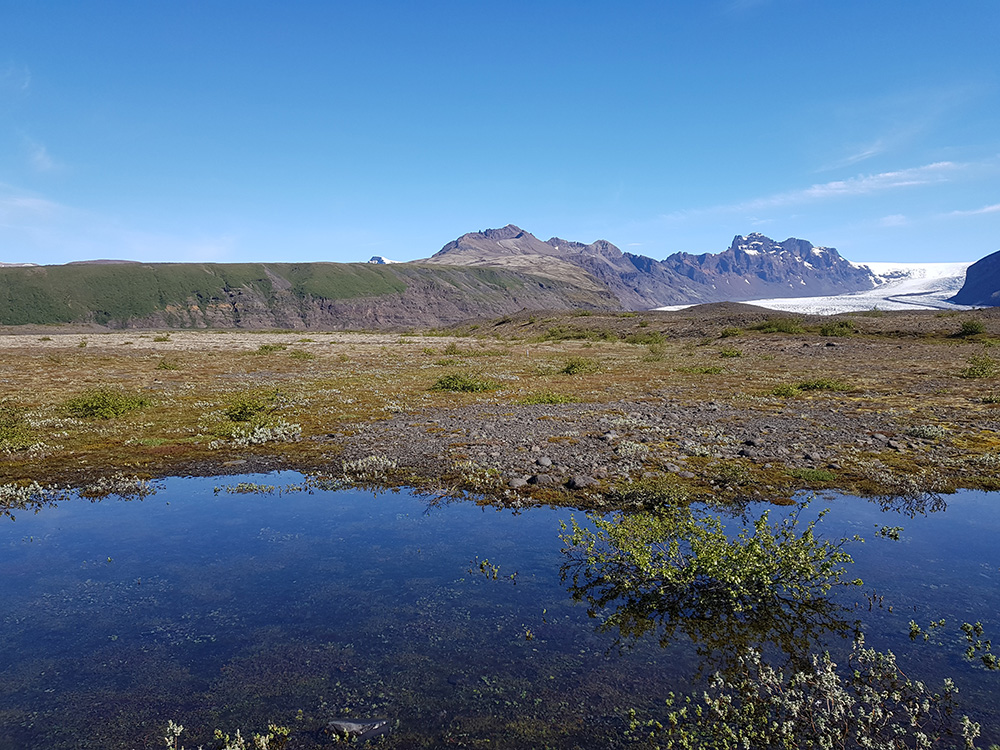
Figure 4. Glacier in Vatnajökull National Park, Iceland. Photo: Magnus Göransson.
3.3 Species distribution modelling
Species distribution modelling can be used in conservation planning for modelling both the current potential distribution of species and future distributions to find areas where the growing conditions will remain suitable for each species to thrive in the future.
The modelling was done for a majority of the species from the updated Nordic CWR priority list (Chapter 2). Two different climate scenarios (socio-economic pathway scenarios) out of five available ones were selected for the year 2100: the SSP2, and SSP5. SSP2 is a ‘middle of the road’ scenario with approximately 2.7 °C estimated warming by 2100 with low CO2 emissions cut to net zero around 2075. SSP5 is the worst-case scenario ‘Fossil-Fueled Development’ with estimated warming of 4.4 °C with very high CO2 emissions tripling by 2075. As the world is considered to have already gone past the possibility to stay within SSP1, the SSP2 was chosen as a mild scenario and SSP5 the worst case, to represent different future possibilities.
CMIP6 (IPCC 2021) downscaled future climate projections of species-specific climate variables along with edaphic and geophysical variables were used in the modelling. The current distribution was based on national observation data downloaded mainly from GBIF (GBIF 2024). For each species, a predicted present-day distribution map and two future suitable habitat maps were created based on the selected scenarios. These could then be compared to find the predicted change in distribution.
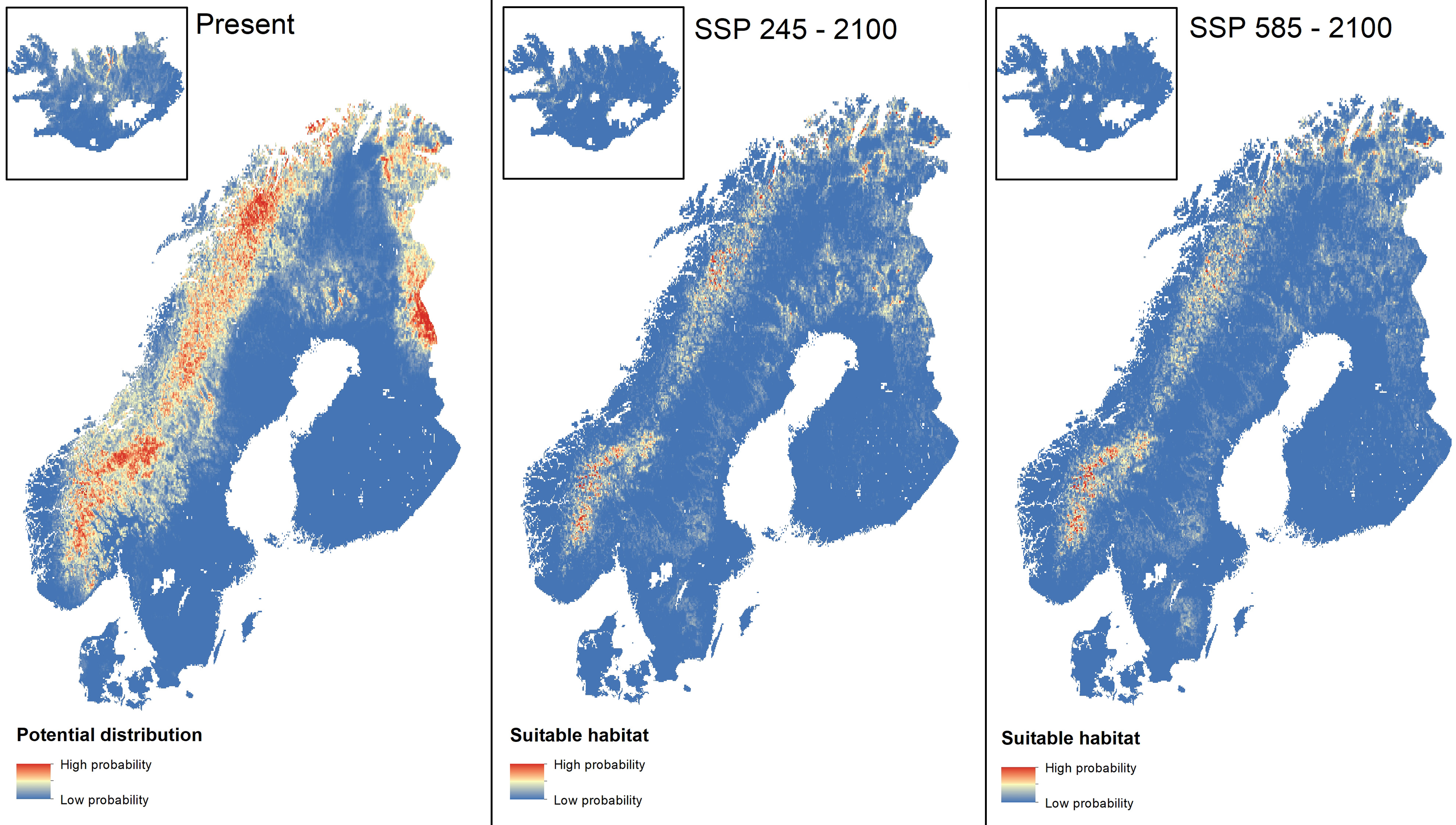
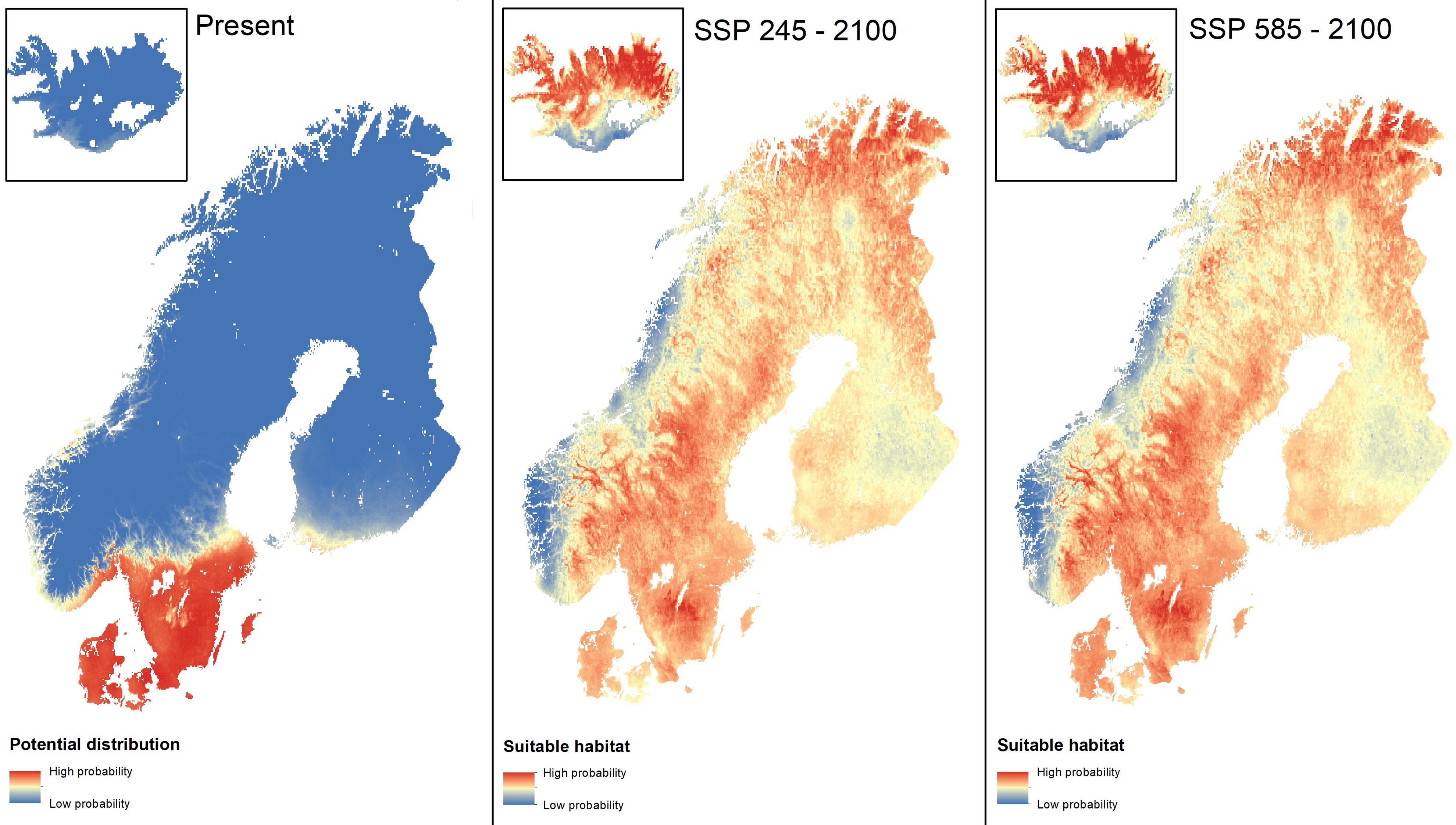
Figure 5. Examples of the present potential distribution and future predicted suitable habitat maps, showing both a mountainous species’ reduction in future habitat conditions (Elymus kronokensis – top) and a southern species’ increase in suitable future habitat conditions (Prunus avium – bottom) (Fitzgerald et al. 2024a).
3.4 Results and recommendations
The results of the analysis show that suitable habitats will in general shift northwards and to higher altitudes. This will lead to range reductions in both future models for approximately half of the target species. The other half of the target species shows an expansion of suitable habitats. It is, however, unlikely that all populations will be able to shift to new sites with better suited environmental and climatic conditions when their present habitats become unsuitable. Therefore, species that according to the models show a range expansion as well as a large shift in distribution area, might in fact experience a decrease their distribution area if their migration ability is not efficient enough. Taken together, large reductions in species ranges are expected, and some of the species may face higher threat levels or even extinction. Detailed results and maps of the analysis can be found in Fitzgerald et al. (2024a).
The species most vulnerable to the effects of climate change usually include those with poor resilience to changes, small populations, threatened species (van Treuren et al. 2020; Wrobleski et al. 2023) and species with restricted possibilities of movement such as mountainous species. The current analysis shows similar results, since the mountainous (Figure 5) and threatened CWR species appear to be at the highest risk of range reduction under investigated climate scenarios. On the other hand, suitable habitats for species growing on urban, disturbed or agricultural lands are, on average, expected to expand in the future.
Specific recommendations based on the climate change modelling results (for additional recommendations, see Chapter 9):
- Establishing and maintaining sufficient networks of interconnected protected areas that will support the survival of target species and provide migration options to new suitable habitats.
- Establishing active in situ monitoring of populations and undertaking seed collecting missions for ex situ conservation of those species predicted to face large range reductions in the future.
- Conducting further analysis to identify complementary protected areas for long-term survival in situ.