Appendix 1 Critical raw materials for EU
Aluminium/bauxite
Applications and market situation
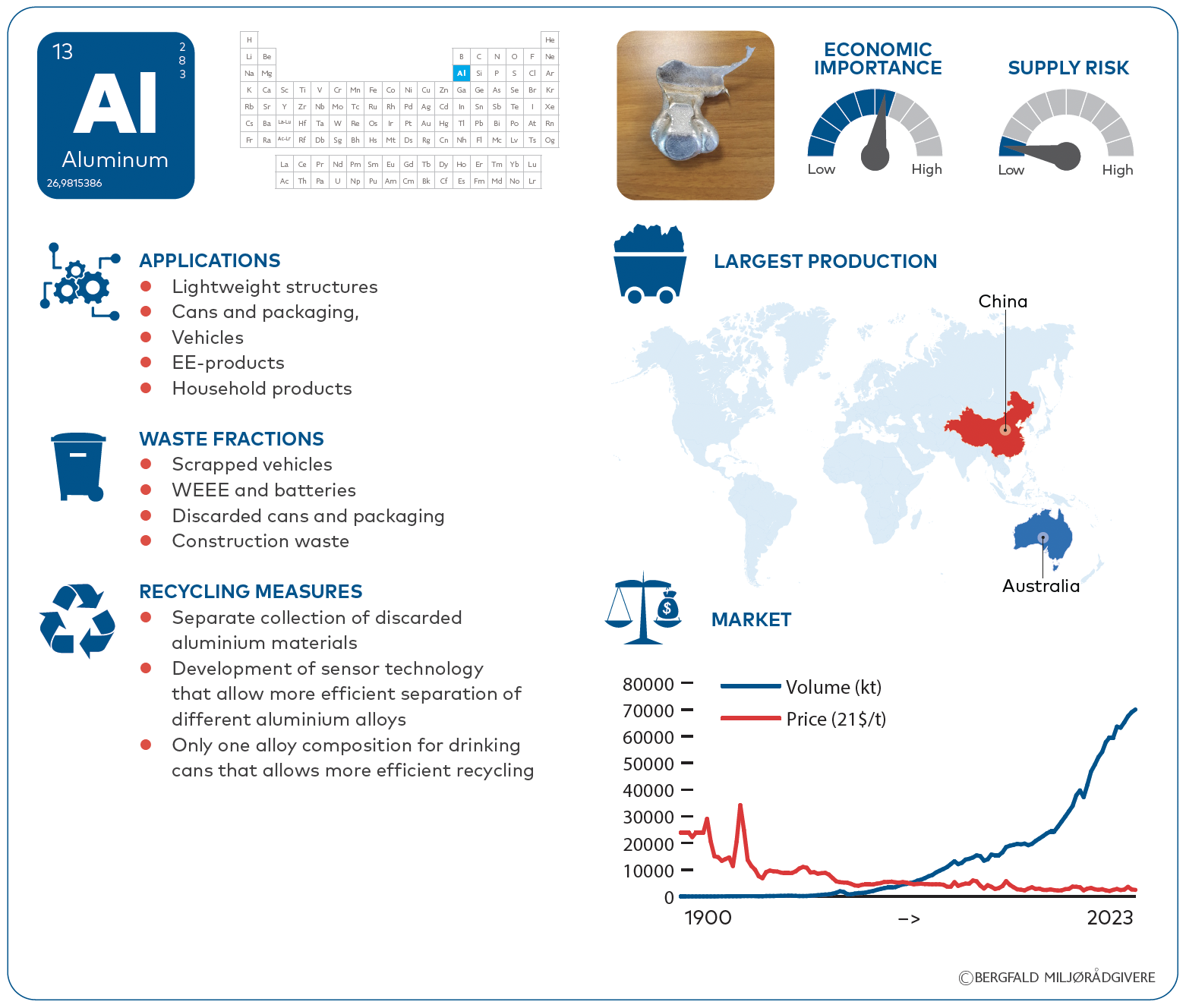
Bauxite is today the only raw material for production of aluminium and is listed as a critical raw material by all the major powers including USA, EU, China and Russia. This situation exists even though bauxite is found in huge quantities on all continents, is easily available and easy to process. Listing of bauxite as a critical raw material is also despite the fact that aluminium can also be produced from minerals other than bauxite.
The global production of primary aluminium is around 65 million tons. Only 21% of discarded aluminium materials is recovered. To produce one ton of aluminium, around 4 tons of bauxite is needed which creates approximately 3 tons of sludge. Production of primary aluminium also require large amounts of power, approx. 16 kWh/kg. In comparison recycling of aluminium require approximately 1 kWh/kg, which means that recycling of aluminium significantly minimize waste generation and energy consumption compared to primary production. The sludge from primary production of aluminium often contains recyclable amounts of other CRMs like gallium, indium, vanadium, selenium and rare earths. Recycling options for CRMs other than aluminium from waste from the aluminium industry is discussed in appendix 3.
Waste streams and systems for recycling
Despite strong environmental arguments and favorable economic conditions for aluminium recycling, little progress in recycling rates have been accomplished in later years. This should be seen in light of the strong growth in China, which has led to a sharp increase in primary production that has not yet been discarded as waste. Regardless, aluminium recycling rates both could and should easily have been higher, indicating that there may be a need for stronger political and economic incentives for recycling.
Many aluminium materials are alloys, and often contain other CRM-components such as manganese, zirconium or cerium. New technology in optical and laser reflection sorting is under development and implementation. This can make it possible to sort different aluminium components according to alloy, thereby achieving higher quality recycling.
Recycling of drinking cans is an important recycling option for aluminium. However, several aluminium alloys are used in cans and when these are melted together suboptimal mixing of metal components is created and collected as an output leading to loss of CRMs in secondary aluminium and a need for additional primary aluminium and CRM additives to achieve necessary alloy quality.
Antimony
Applications and market situation
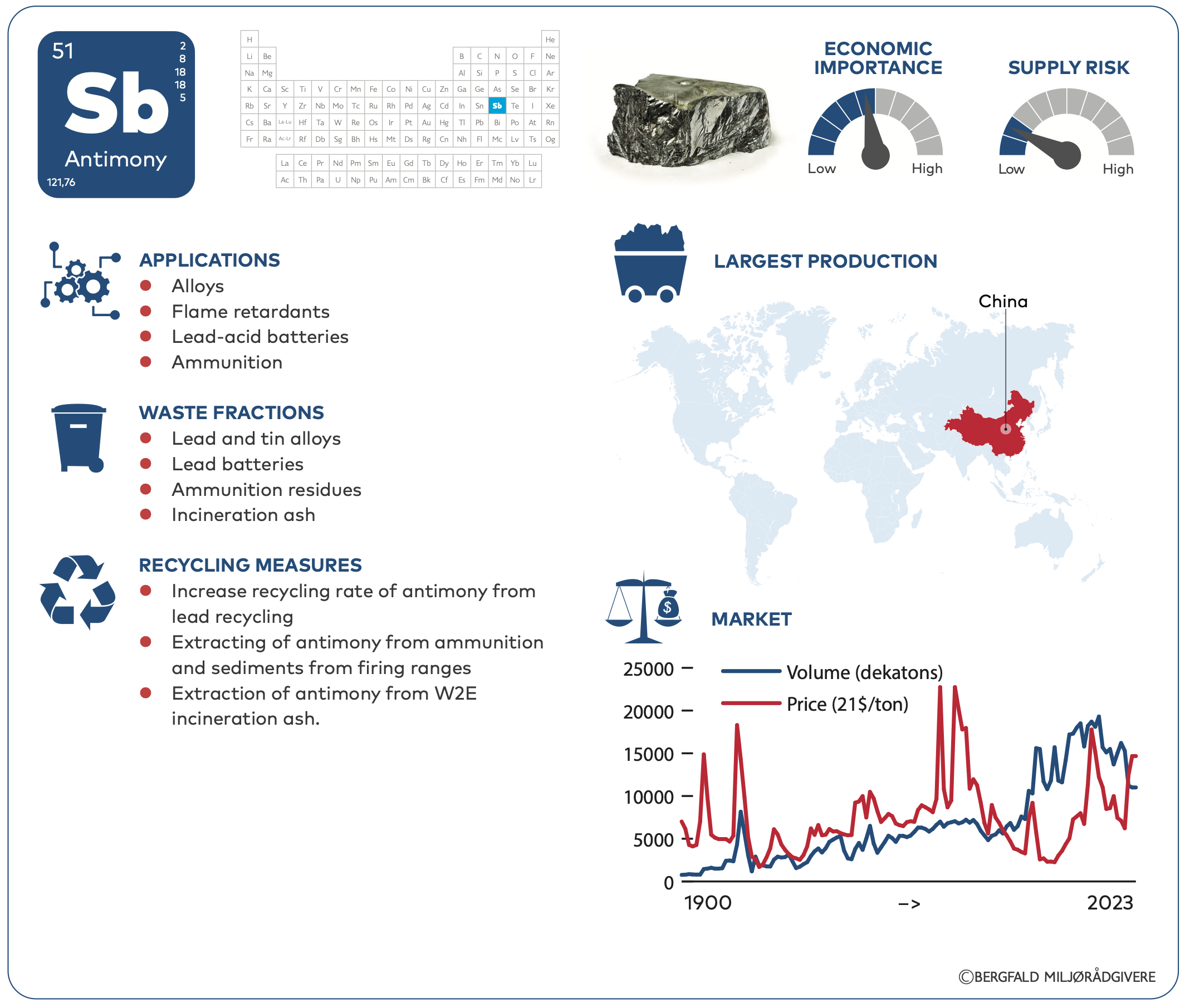
Antimony is a metallic element that has its main use as a flame retardant and additive in metal alloys, especially in lead and tin. Antimony-lead alloys are commonly used in lead batteries and lead-containing ammunition, and sometimes also in semiconductors, machine parts and tools. Antimony is also used as an additive in PVC plastic, paint and glass and ceramic materials, solder, and cable protection and as a catalyst to produce PET plastic. Antimony is harmful to health and both inhalation of dust and skin contact should be avoided. For many applications of antimony, substitution options do exist but sometimes with diminished function and at higher costs. Inorganic alternatives to antimony as flame retardants include hydroxides of aluminium and magnesium and various phosphate compounds. For ammunition there are lead-free alternatives that also eliminates the need for antimony. Antimony is a relatively rare element and occurs in the Earth's crust in low concentrations of around 1 ppm. The most common antimony-containing mineral is the sulfide mineral stibnite (Sb2S3). The total world production of antimony is around 100,000 tons. Production of antimony metal occurs by roasting ore and reduction with carbon or direct reduction using iron. China has for many years been the largest producer of antimony. However, this production is stagnating due to increasingly strict environmental requirements, and there is a growing concern that additional Chinese production will disappear in the coming years.
Waste streams and systems for recycling
The main proportion of secondary antimony is produced as a by-product of secondary lead production, and discarded lead batteries are an important feedstock for this recycling process. European recycling rate of antimony is estimated to be 28%. Other potential feedstocks for antimony recycling processes may be ammunition remnants, spent catalysts from production of PET-plastic and ash from waste incineration. Although there is to our knowledge no direct recycling of antimony in the Nordics, it may be recovered as a byproduct from the Boliden Bergsøe plant in Landskrona and Sala Bly.
Arsenic
Applications and market situation
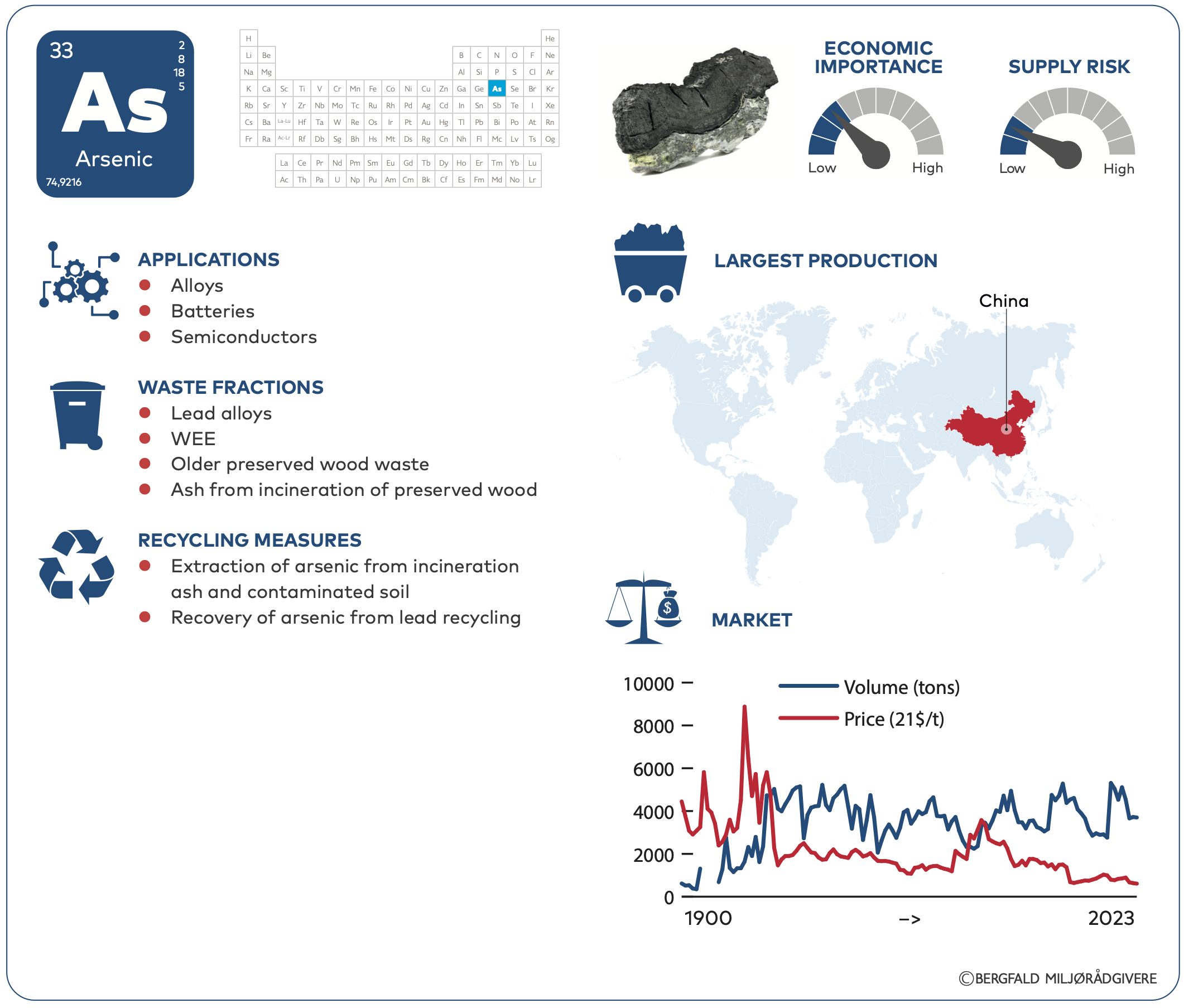
Arsenic is a toxic chemical element with atomic number 33. Arsenic is the 53rd most abundant chemical element in Earth’s crust and is typically found in minerals with the formula XAsS and XAs2 where X may be iron, cobalt or nickel. China is the main producer of arsenic with around 42% share of the global production.
Main applications of arsenic are as components in alloys, batteries and semiconductors. Most arsenic is used in alloys of lead, and as semiconductor arsenic is found in electronic products such as gallium arsenide. Historically arsenic was used as biocide including wood preservation, but most biocide use of arsenic has been banned. Being very toxic, soil and sediments contaminated with arsenic will sometimes be cleaned by remediation processes where arsenic is removed.
Waste streams and systems for recycling
No significant recycling of arsenic seems to occur neither in the Nordics nor the rest of the world. There are however dedicated incineration plants for CCA-waste, which brings forth a waste with high arsenic content that may serve as feedstock for arsenic recycling. Compared to many other CRMs, recycling of arsenic seems less urgent.
Baryte
Applications and market situation
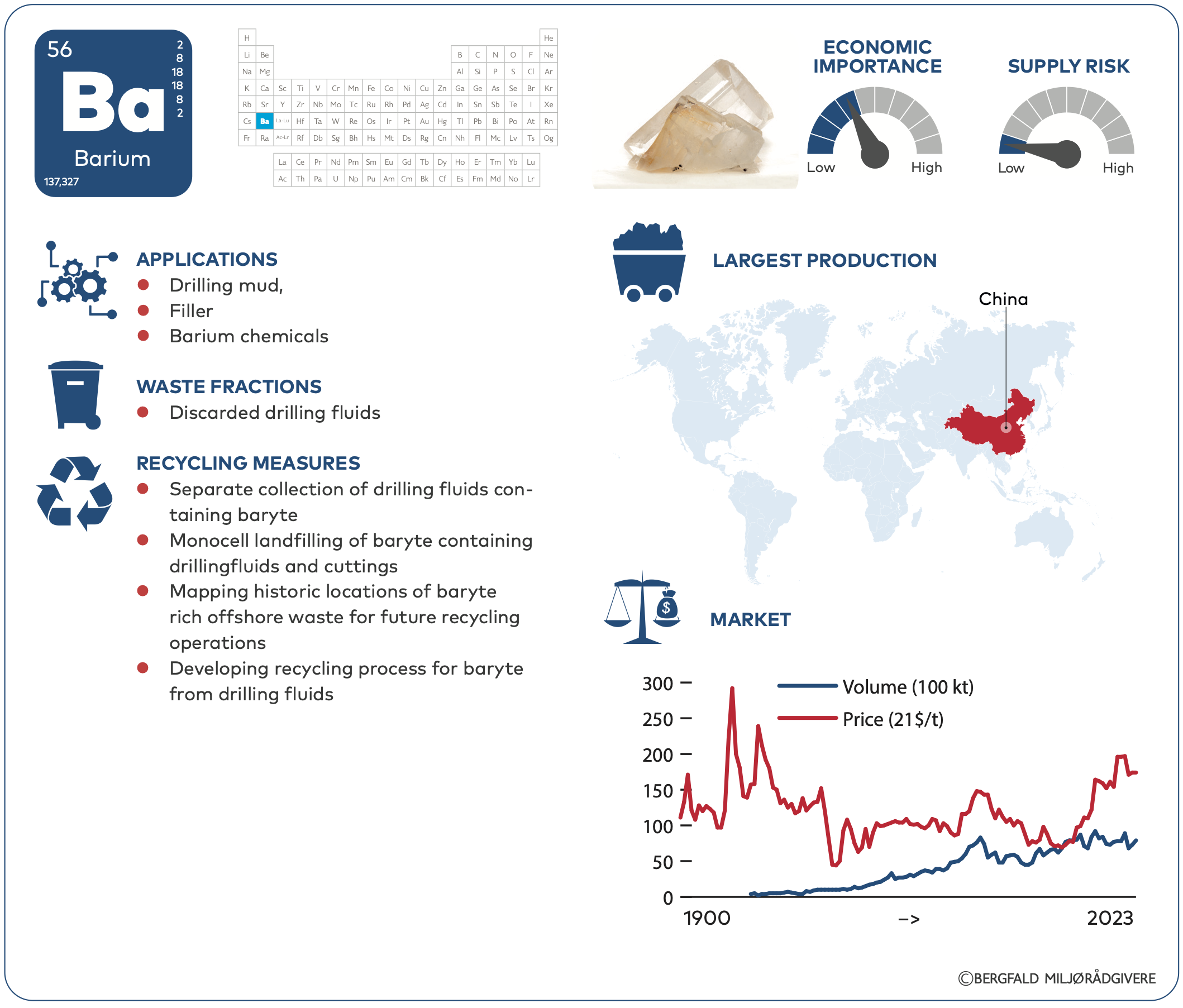
Baryte is a mineral with the chemical composition of BaSO4. The global production of baryte is estimated to be around 8,4 million metric tons (2019) with India and China as the biggest producer. The main application of baryte is as weight material in drilling mud, filler and raw material for production of barium chemicals.
Waste streams and systems for recycling
No significant recycling of baryte seems to occur neither in the Nordics nor the rest of the world. Baryte could however be extracted from spent drilling fluids if necessary. Compared to many other CRMs, recycling of baryte seems less urgent.
Beryllium
Application and market situation
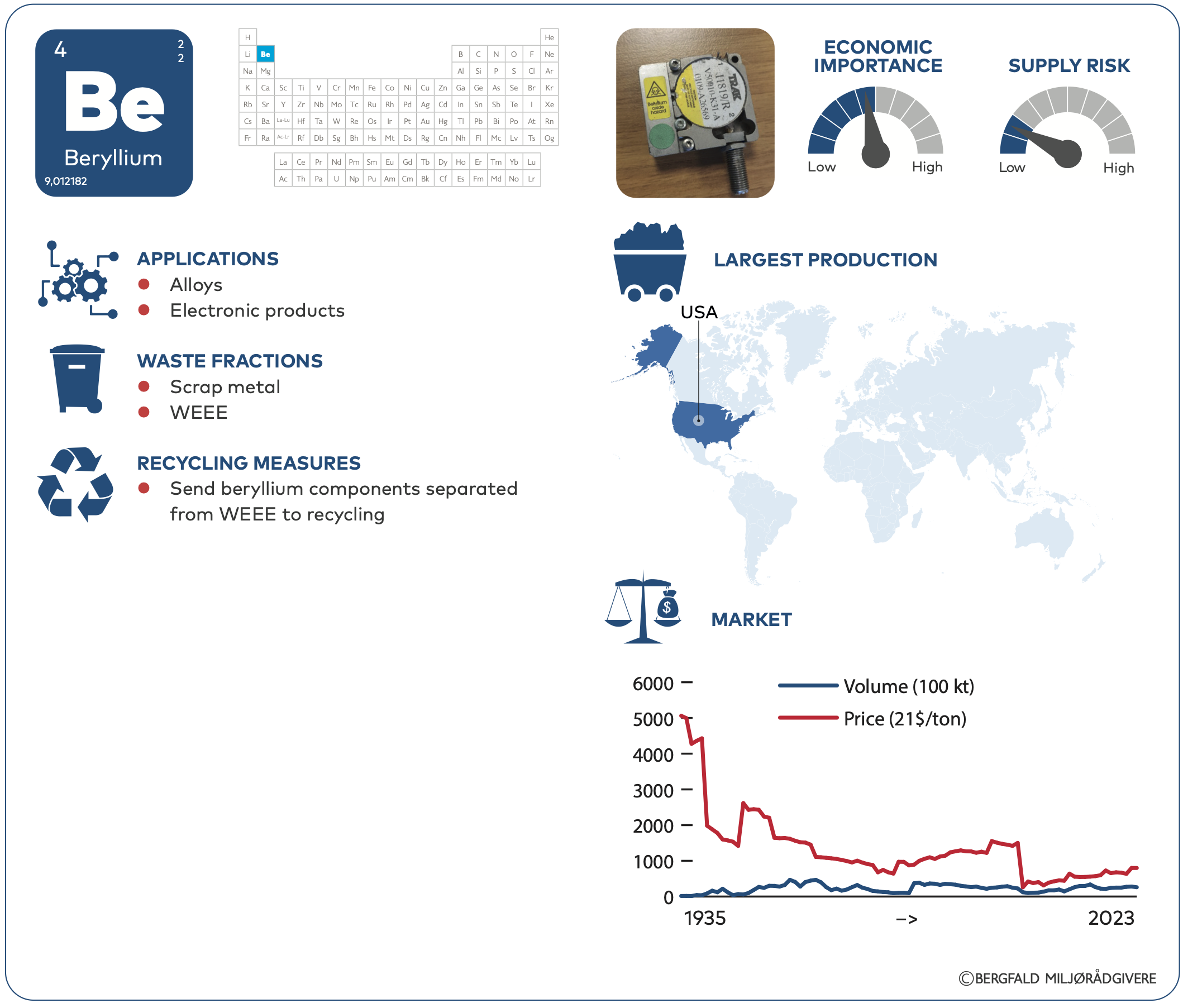
Although beryllium is extremely toxic, the chemical element also has important technical applications especially in advanced alloys. Historically, beryllium was primarily used in weapons systems and space travel, but in later years beryllium has also found increasing civil applications, most importantly in electronic products and alloys. Global annual production of primary beryllium is small and around 300 tons.
Waste streams and systems for recycling
Recycling of beryllium do exist, but there is no recycling capacity for beryllium or beryllium-containing alloys in the Nordic countries, neither in EU/EEA. Beryllium-containing components during WEEE dismantling are routinely separated due to health hazard, but handled as hazardous waste.
Bismuth
Applications and market situation
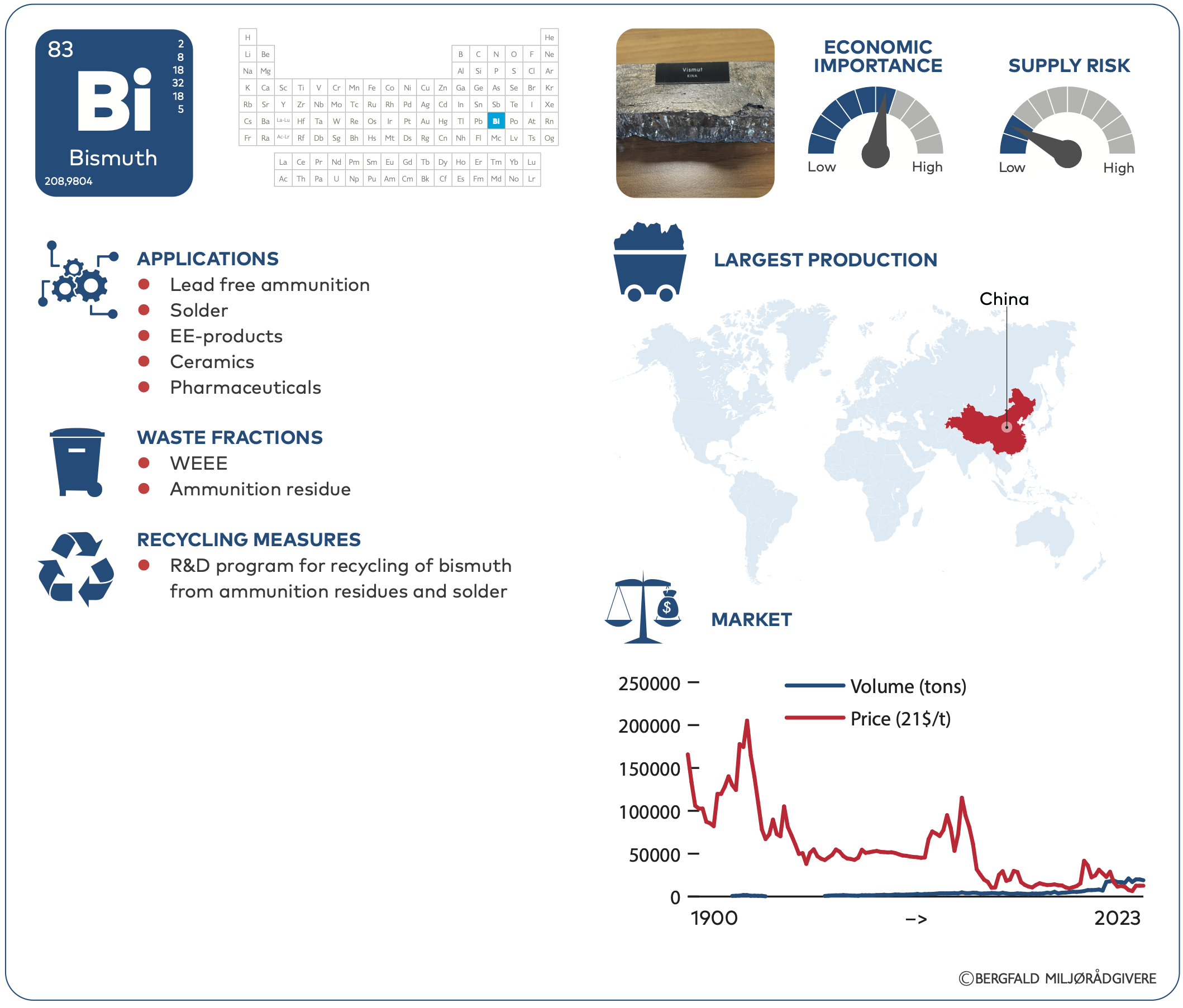
Bismuth is a brittle, high-density metal that has similar properties as lead, but is less toxic. For this reason, bismuth is sometimes used as a substitute for lead. Global production of bismuth is around 20,000 tons, and the main producer is China. Applications of bismuth include use as lead free ammunition, alloying addition in solder and EEE-products, ceramics and pharmaceuticals.
Bismuth is mainly extracted as a by-product of lead, and for this reason, reduction in the consumption of lead will also make bismuth less available although bismuth is also found in other industrial material streams, for example from copper and tin production.
Waste streams and systems for recycling
Most industrial users of lead solder have over time worked to minimize the consumption, and often switched to alloys with less lead. Use of solder also causes significant formation of scrap and dross in later recycling processes. During the work with this report no Nordic bismuth recycling capacity was identified, although components that contain bismuth are recycled for other CRMs. For example, recycling of circuit boards recover copper and silver, while tin and bismuth end up in the slag.
Low concentrations and interactions with other chemical elements make bismuth recycling from WEEE very challenging and may not be a realistic technical option for some time.
Boron
Applications and market situation
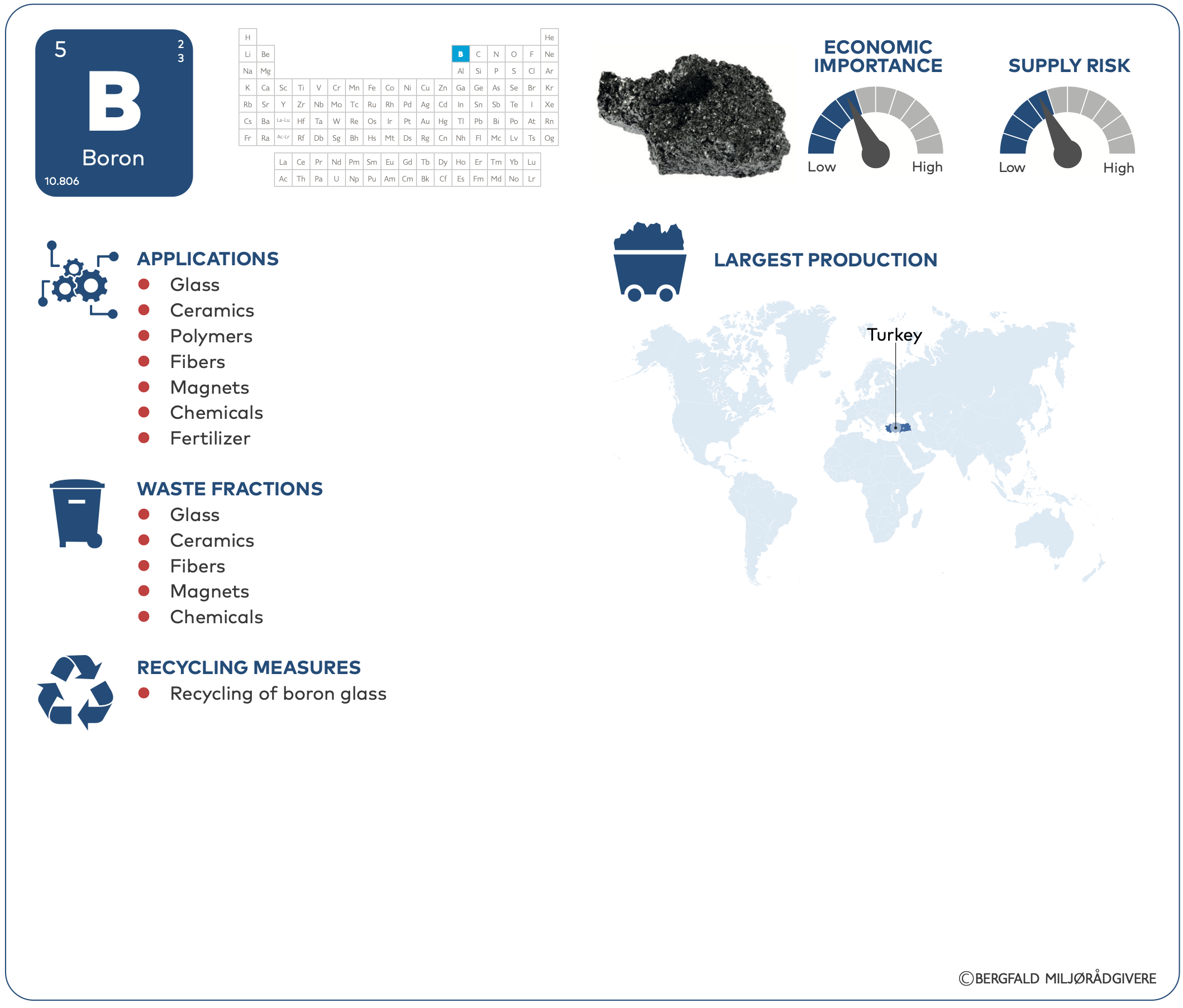
Boron is a chemical element with atomic number 5 and constitutes about 0.001% of Earth's crust by weight. Due to its water solubility many boron minerals are found as evaporites, including borax and kernite. The largest known deposits are in Turkey, and Turkey is also the global largest producer of boron minerals, making European industry heavily reliant on Turkish imports.
Important applications include additives in glass, ceramics and polymers. Boron compounds are also used as bleach and other chemical purposes, and small amounts are also used in electronic products. Although only very small amounts are needed, boron is also an essential plant nutrient.
Global consumption of boron compounds was about 5 million tons in 2021.
Waste streams and systems for recycling
Boron recycling is very low, estimated at around 1%, and no significant recycling capacity of boron has been identified in the Nordics or EU/EEA during the work with this report. For most applications of boron it is difficult to see easily available recycling opportunities.
Cobalt
Applications and market situation
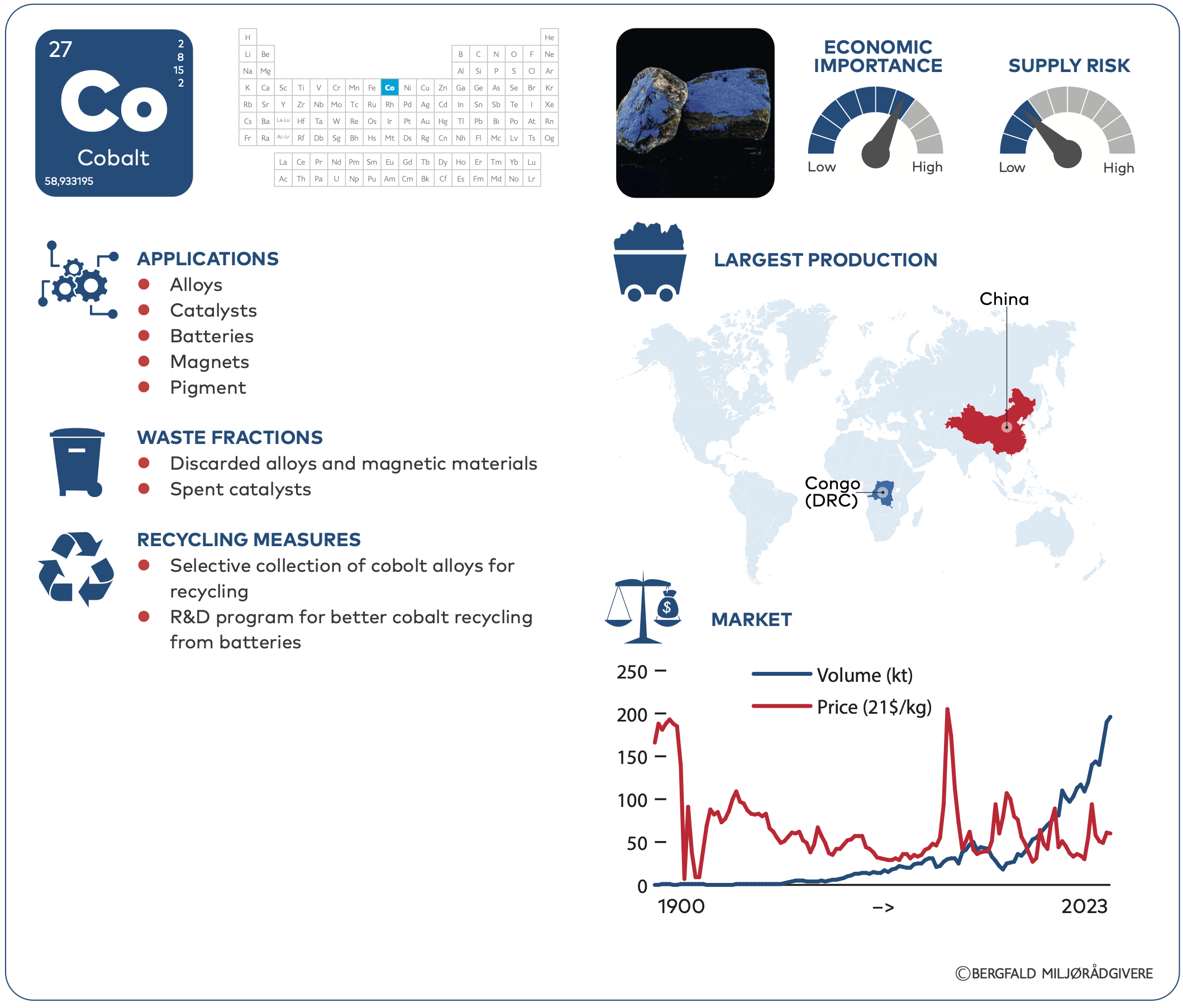
Cobalt is a silvery metal with atomic number 27 and comprises 0.0029% of the Earth's crust. Today, some cobalt is produced specifically from one of a number of metallic ores, such as cobaltite (CoAsS), but more often as a by-product of copper and nickel mining. The Copperbelt in the Democratic Republic of the Congo (DRC) and Zambia yields most of the global cobalt production. World production in 2021 was 166,000 tons. Cobalt is primarily used in lithium-ion batteries, and in the manufacture of magnetic, wear-resistant and high-strength alloys. Cobalt is also used in the petroleum industry as a catalyst for removing sulfur from crude oil and as a pigment. Cobalt is also the active centre of a group of coenzymes called cobalamins.
Waste streams and systems for recycling
Cobalt is recyclable, and the recycling rate is estimated to be 22%. The Nordic recycling capacity of cobalt is good as there are several processing plants available if cobalt in the future is recovered from wastes. These plants include the Nikkelverk plant in Norway and the Boliden plants in Sweden and Finland. From batteries, the LIB-recycling plants are taking out black mass containing cobalt that in the future will be recycled in these refineries.
Coking Coal
Applications and market situation
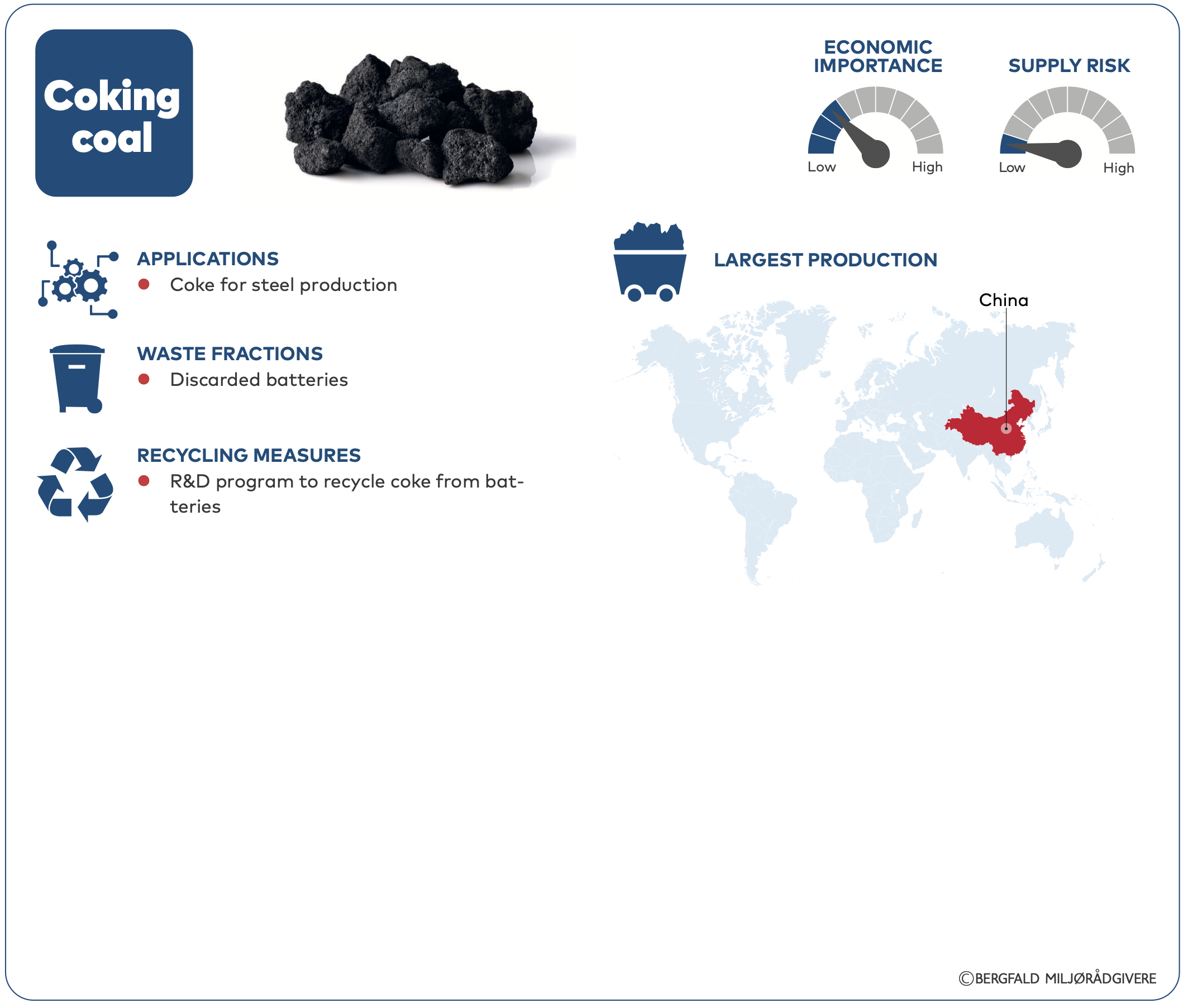
Coal is a carbon-based mineral that comes in many qualities. Coking coal also referred to as metallurgical coal and is grade of coal that can be used for production of high-quality coke. Coke is used in the blast furnace process for primary steelmaking and other industrial processes. Minor applications also include carbon fibres and battery electrodes. China, Australia and Russia are large producers of coking coal. The global production of coking coal in 2021 was about 1 billion tonns.
Waste streams and systems for recycling
Coke used for either metallurgical purposes or fuel is chemically converted and cannot be recycled. Today there are no significant recycling of coking coal neither in the Nordics nor the rest of the world. Although coke from batteries theoretically can be recycled it is hard to imagine a recycling process for metallurgical coke.
Copper
Applications and market situation
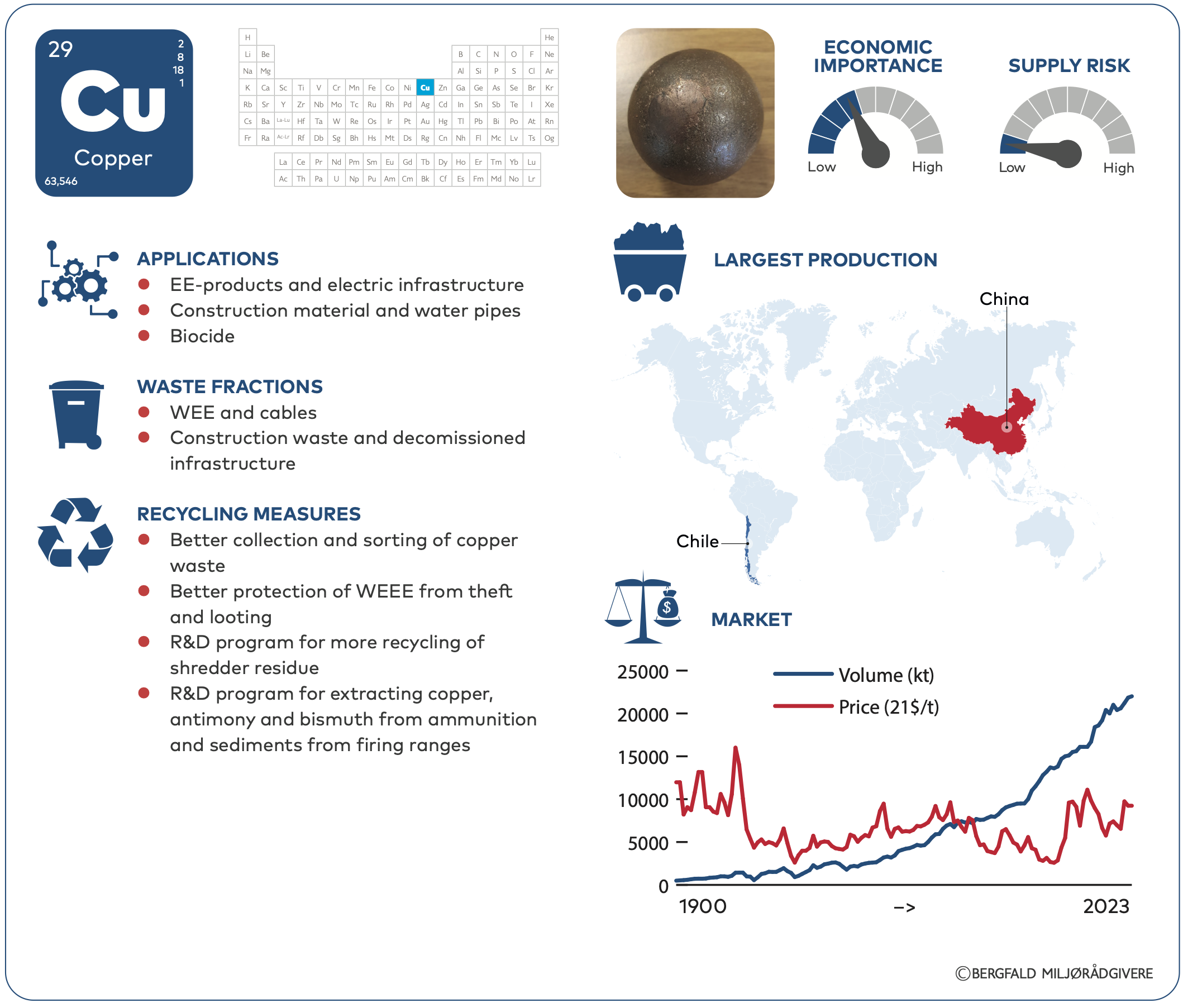
Copper is a malleable and ductile metal with very high thermal and electrical conductivity. It comprises 50 ppm of Earth’s crust making it the 26th most abundant element. Copper was the first metal used by mankind, more than 8000 years ago. It has always been valuable and corrodes little, with the result that about 80% of all copper ever mined is still in use. The main global producers of copper are Chile, Peru and China.
Due to its many favourable properties, it has many applications most importantly as an electric conductor in electrical wires and cables. Copper also has many other important electronic applications among other things in electric motors and dynamos. Copper and copper alloys are also in widespread use as construction material in consumer products and building structures, and as a biocide in various contexts. The global consumption of copper in 2021 was about 25 million tons.
Waste streams and systems for recycling
Recycling of copper has a long history and has resulted in an advanced and well-developed value chain for production of secondary copper. The European recycling rate for copper is about 30%, and there is a huge capacity in copper recycling in the Nordics. The Boliden plant in Skelleftå is by far the most important. Indeed, most of copper containing WEEE scrap is currently sent there for recycling. There are also other possibilities for recycling, both in the Nikkelverk plant in Norway and the Boliden plant in Harjavalta. A further increase in copper recycling therefore relies on better collection and sorting of copper containing waste more than further development of recycling processes. The existing value chains have through its long operating history had time to develop solid technical and industrial capacity for further tonnages and handling of off-spec material with increased recycling efficiency.
In addition to copper that can be recycled from discarded products, huge amounts of copper are available in the form of buried cables, installed and disconnected power grids in buildings etc. During remediation of copper-rich infrastructure, it is important to have good routines and systems for handling demolition waste that effectively picks out copper-containing components and materials.
Feldspar
Applications and market situation
Feldspar is not a chemical element, but a group of minerals that are quite abundant. As this mineral group make up about half of the Earth’s crust
Feldspar minerals have a similar chemical structure and composition that can be described by the formula X(AlSi)4O8 where X may be either K, Na, Ca, Ba, Rb, Sr or Fe. Common feldspars include orthoclase (KAlSi3O8), albite (NaAlSi3O8), and anorthite (CaAl2Si2O8).
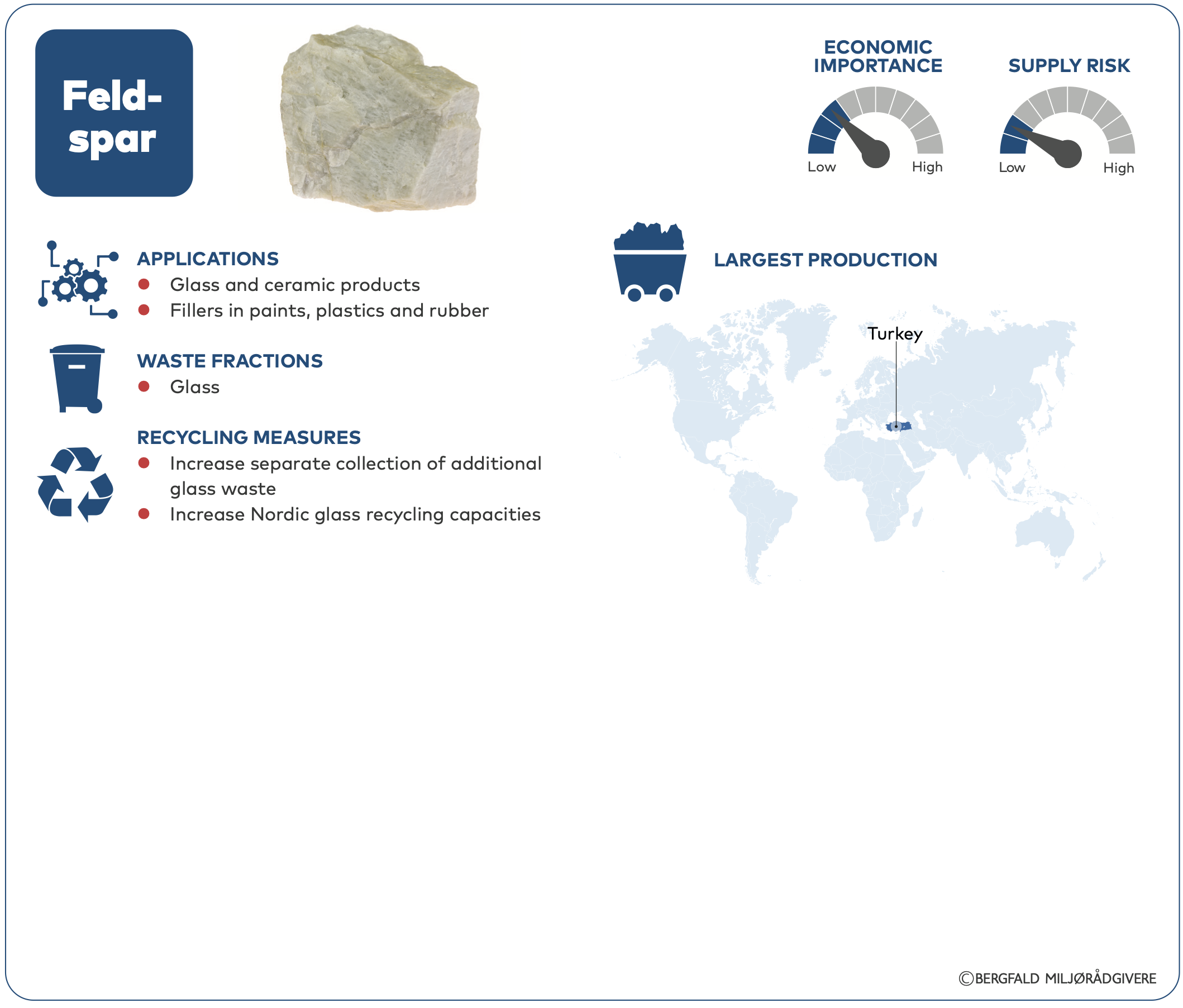
Feldspar minerals have many applications including being used as raw material for a wide variety of glass and ceramic products. Feldspar is also commonly used as fillers in paints, plastics and rubber. Several popular gemstones are feldspar minerals, including moonstone, sunstone, labradorite, amazonite and spectrolite.
Global production of feldspar has been estimated to be around 26 million tons (2020). Turkey (7,6 Mtons) and Italy (4 Mtons) are large European producers of feldspar.
Feldspar And Nepheline Syenite. U.S. Geological Survey, Mineral Commodity Summaries, January 2020
Waste streams and options for recycling
Recycling options for feldspar materials do exist, and European recycling rate for feldspar was estimated at 10%.
Report on Critical Raw Materials and the Circular Economy, European Commission, 2018
Scalable recycling of feldspar slime into high-quality concentrates by removal of coloured minerals using the combined beneficiation processes, Junxiong Zhan et al, Separation and Purification Technology, 2023
Fluorspar
Applications and market situation
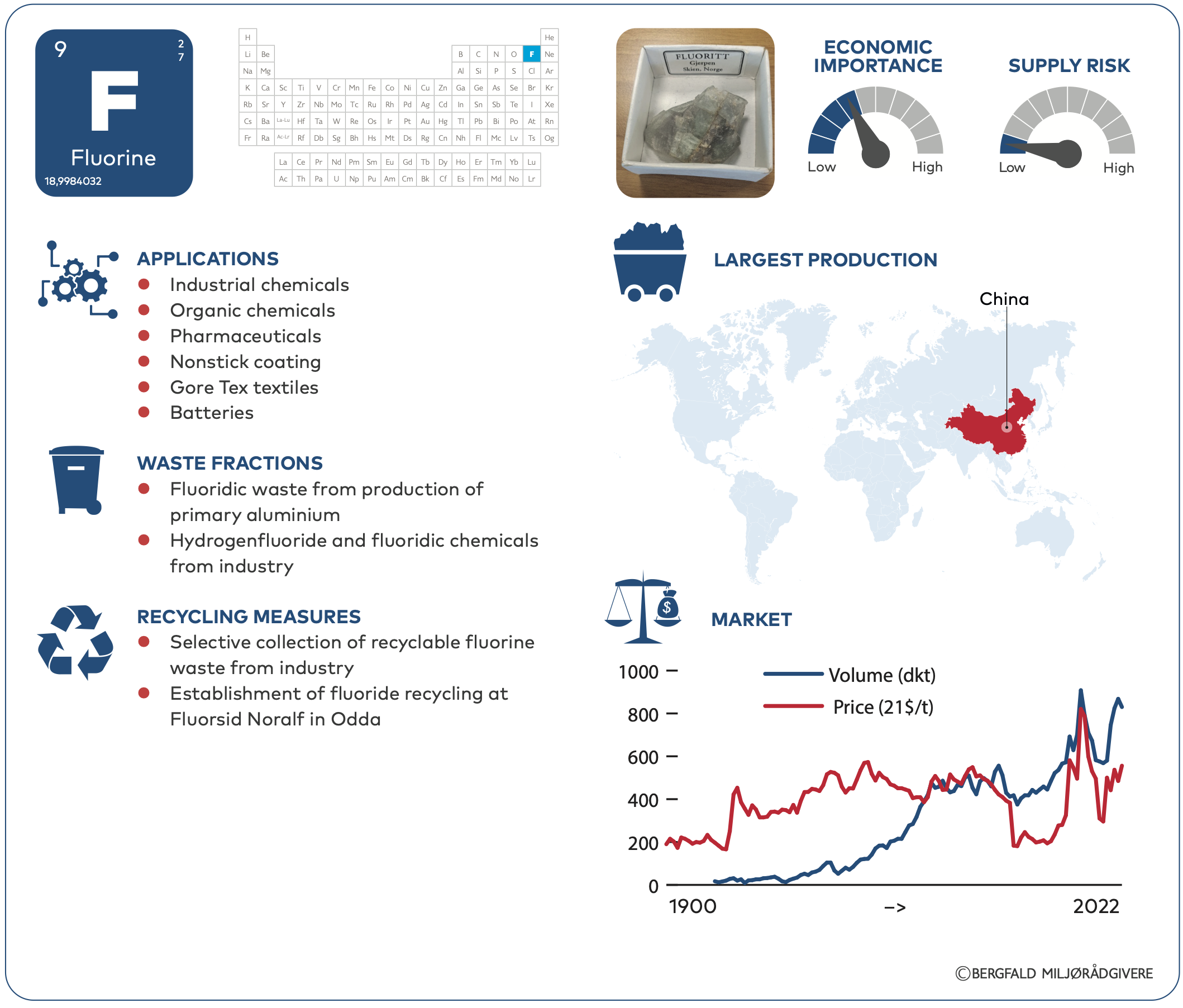
Fluorspar or fluorite is a fluorine mineral with the chemical formula CaF2. Fluorspar is both used directly and processed into other fluoride compounds and elemental fluorine. The strong electronegativity of fluorine gives both organic and inorganic fluorine compounds important properties. Fluorine has many applications that include metal production, industrial extraction processes, textiles and nonstick coating, batteries and pharmaceuticals. Fluorine is also used in small amounts in many high-tech electronic applications.
Fluorine is relatively available in the Earth's crust and ranks 13 as the most common element. Fluorine is supplied both from dedicated fluorspar mines and as a by-product from phosphoric acid production. The main global producers of fluorspar are China and Mexico. The global production of fluorspar in 2021 was about 8,4 million tons.
Waste streams and systems for recycling
Hydrogen fluoride (HF) and other fluorine chemicals are consumed in some production processes and end up as waste materials or sludge containing HF and CaF2 that can sometimes be recycled. Large amounts of recoverable fluorine are also used in the production of primary aluminium. Another recycling option is the hexafluorophosphate in the electrolyte in some lithium batteries. It is doubtful if this electrolyte can be reused directly due to chemical degradation. Chemical recycling could be possible, however. Actual recycling of fluorine is quite rare. The recycling rate of fluorine is about 1%, and no significant Nordic recycling operations for fluorine have been identified during the work with this report. There is however a Norwegian facility that could easily be adapted to recycling of fluorine waste. This facility is operated by Fluorsid Noralf and located in Odda where it currently produces aluminium fluoride based on Moroccan fluorspar.
As fluoridic waste is often both toxic and corrosive, comprehensive environmental and safety measures are necessary to ensure secure treatment. This combined with low prices makes profitable fluorine recycling challenging.
Gallium
Applications and market situation
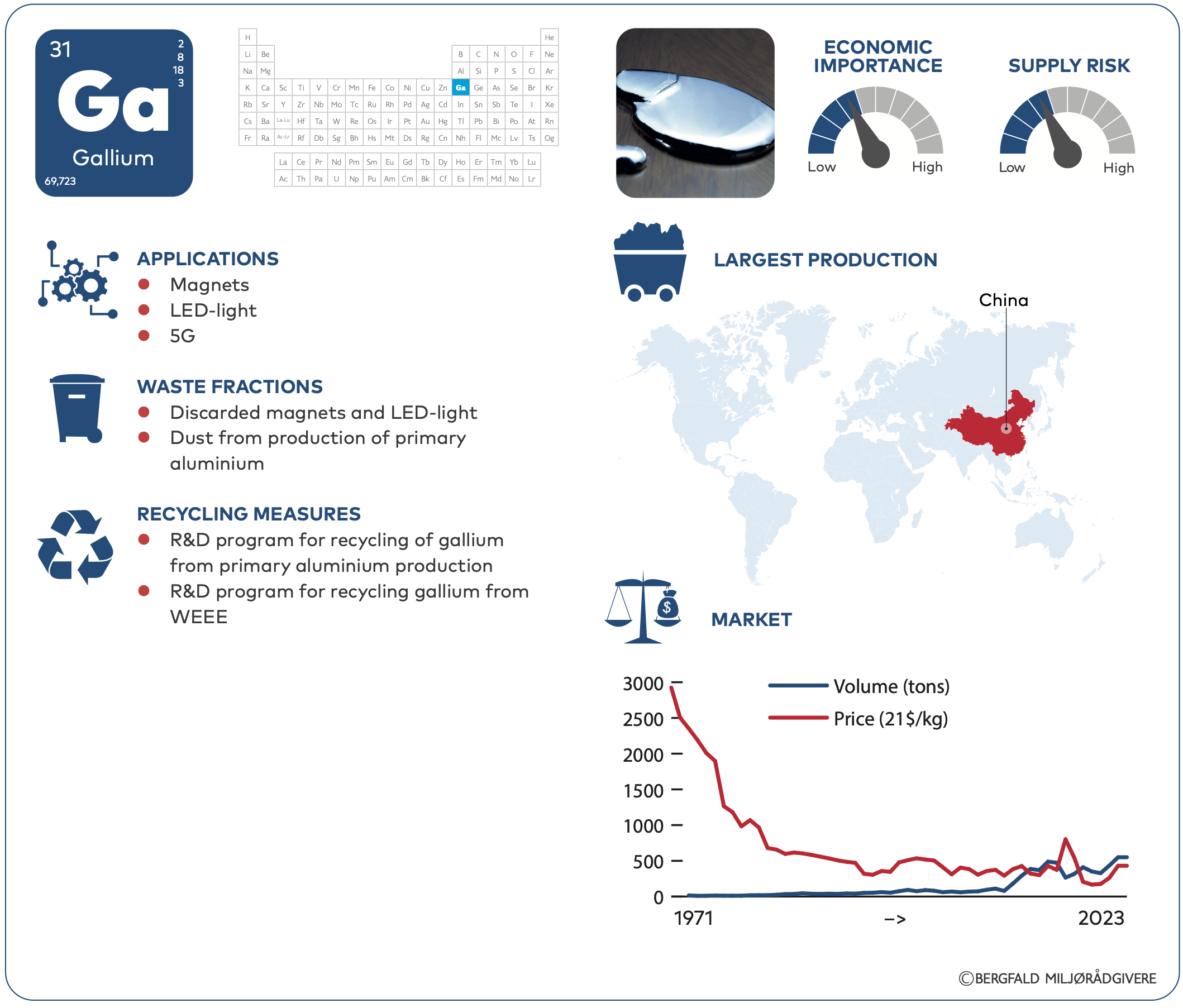
Gallium is a soft silvery semi-metal with atomic number 31 and special properties. It is ranked as the 35th most abundant element in the Earth’s crust and is mainly extracted as a byproduct from zinc- and aluminium ore. Due to its unique properties gallium has been an important component in the electronics industry since infancy, and today plays a key role in two critical sectors. Firstly, gallium is the basis for almost all lighting as it is the main chemical component of LEDs, either as gallium nitride, gallium arsenide or other compounds, and is often mixed with either rare earth metals or transition metals in addition to adjust the wavelength of the light. Of all the elements, gallium has the best ability to convert electricity to light photons, which explains its dominant role in lighting products. In the last couple of years, a new market has emerged for gallium in neodymium magnets. Neodymium provides very good magnets, but the metal is brittle and cracks easily especially with rapid temperature fluctuations. There are many metals that can be added to the magnetic alloy to make the magnets more physically stable, but most of these will weaken the magnetic field or have other negative side effects. A few parts per thousand of gallium in the neodymium however leads to significantly more stable magnets without significantly affecting the magnetic strength. Despite these important applications the market for gallium not large, only about 430 tons in 2021. China is by far the largest producer of gallium.
Waste streams and systems for recycling
The main waste stream for gallium is WEEE, and both discarded LEDs and magnets represent sub streams that could potentially be recycled. There is practically no recycling of gallium in the world today from consumer waste. Hydro's seven Norwegian primary aluminium plants and the two plants of Alcoa represents one of the world's largest aluminium fleets. These plants consume 5 million annually tons of bauxite as refined aluminium oxide, with a high content of gallium. In the production process much of the gallium evaporates, and then condenses as part of the electrostatic precipitator dust. Two of the Norwegian aluminium plants deliver dust with about 2000 ppm gallium, while the other five have a dust with about 300 ppm. It may also be possible recycle gallium through separation of a gallium concentrate from the LED through grinding down and selective electrostatic separation.
Germanium
Applications and market situation
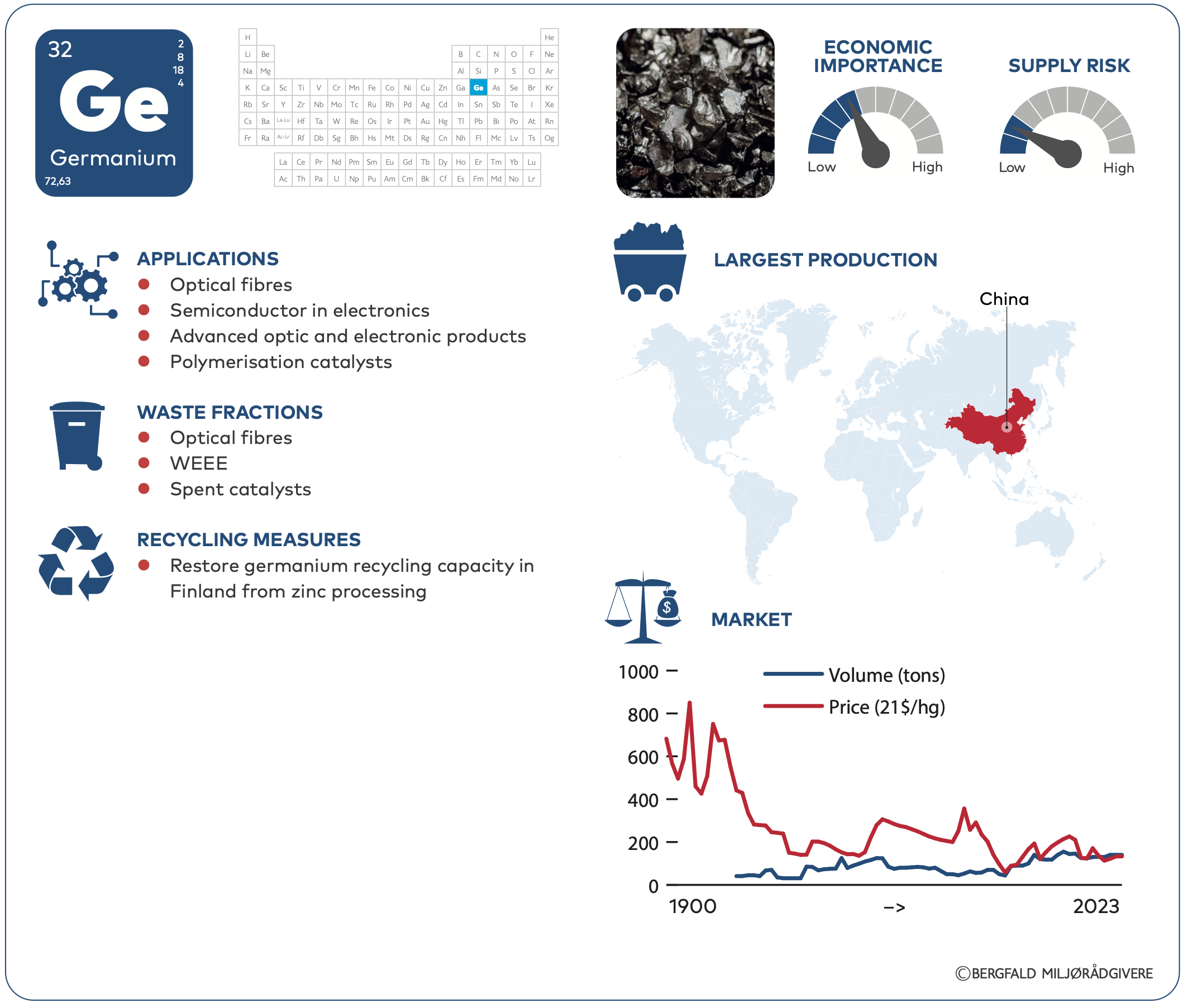
Germanium is a chemical element with atomic number 32 and has an appearance similar to silicon. The metalloid is a semiconductor with many electronic applications. Germanium is the 50th most common element in the Earth's crust and is mined primarily from the mineral sphalerite, which is also an ore for zinc, but can also be extracted from silver, lead, and copper ores. China is the world's largest producer of germanium. The global production in 2021 was about 180 tons.
The main applications of germanium are in fiber-optic systems to prevent loss of signal, infrared optics, solar cell applications, and light-emitting diodes (LEDs) and as catalysts for polymerization reactions.
Waste streams and systems for recycling
The European recycling rate of germanium is estimated to be about 2%. There are no significant germanium recycling operations in the Nordics.
Hafnium
Applications and market situation
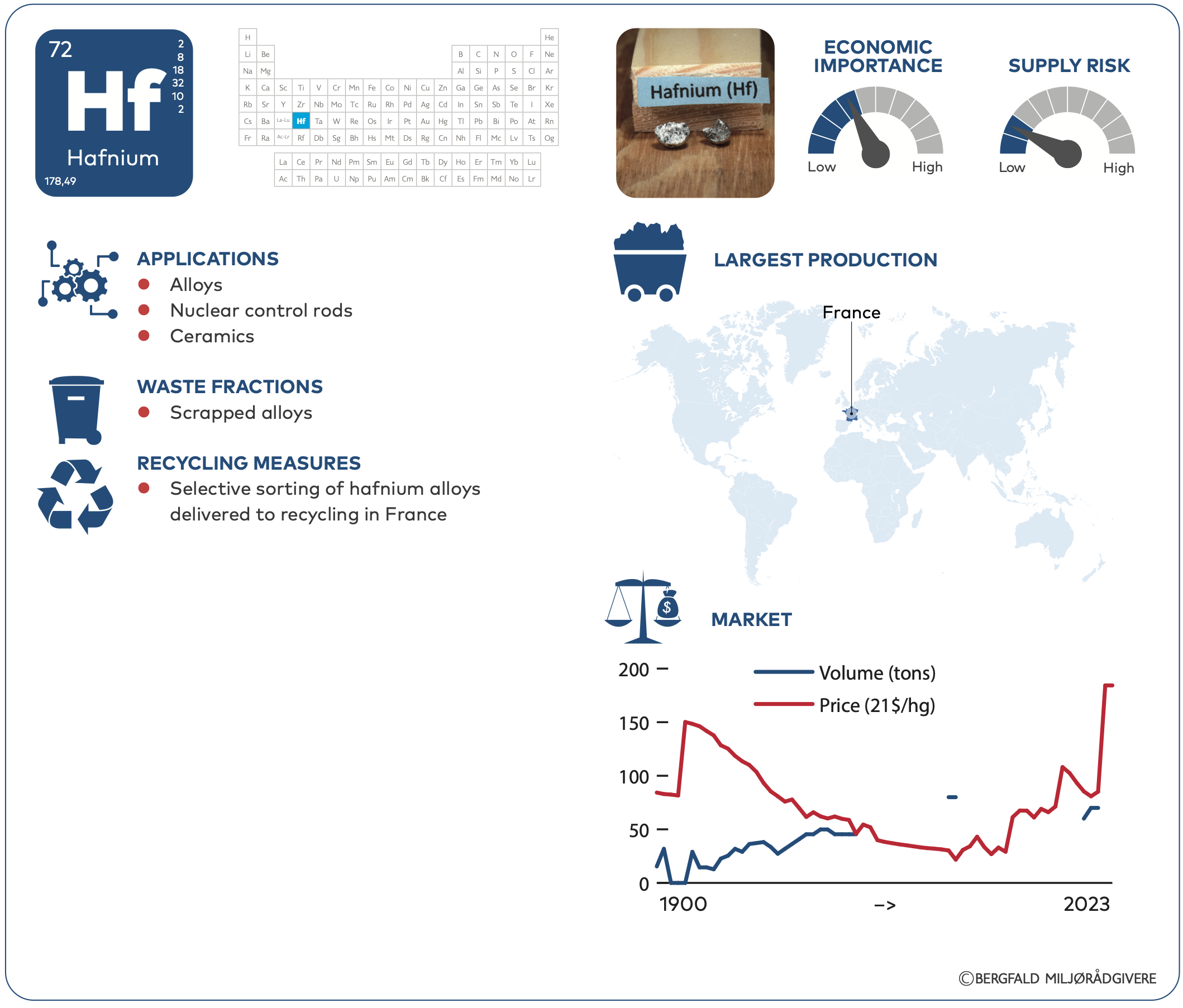
Hafnium is a chemical element with atomic number 72. The transition metal has similar chemical properties with zirconium, and the two elements are geologically found together. The most important minerals are zircon and baddeleyite where zirconium and hafnium are typically present in the ratio 50:1. The production of hafnium is for this reason strongly linked to the production of zirconium. Europe is the largest producer of hafnium, with France as the leading producer and exporter of hafnium. Hafnium is used in high temperature ceramics, and the metal is also used in nickel alloys, for plasma-based metal processing and in the nuclear power sector. In electronic products, hafnium is mainly used in semiconductors and optical parts, but this consumption is low compared to other areas of use. The global production of hafnium in 2017 was estimated to be around 70 tons.
Waste streams and systems for recycling
There is very limited if any recycling of hafnium, and no significant recycling operations for hafnium has been identified in the Nordics.
Helium
Applications and market situation
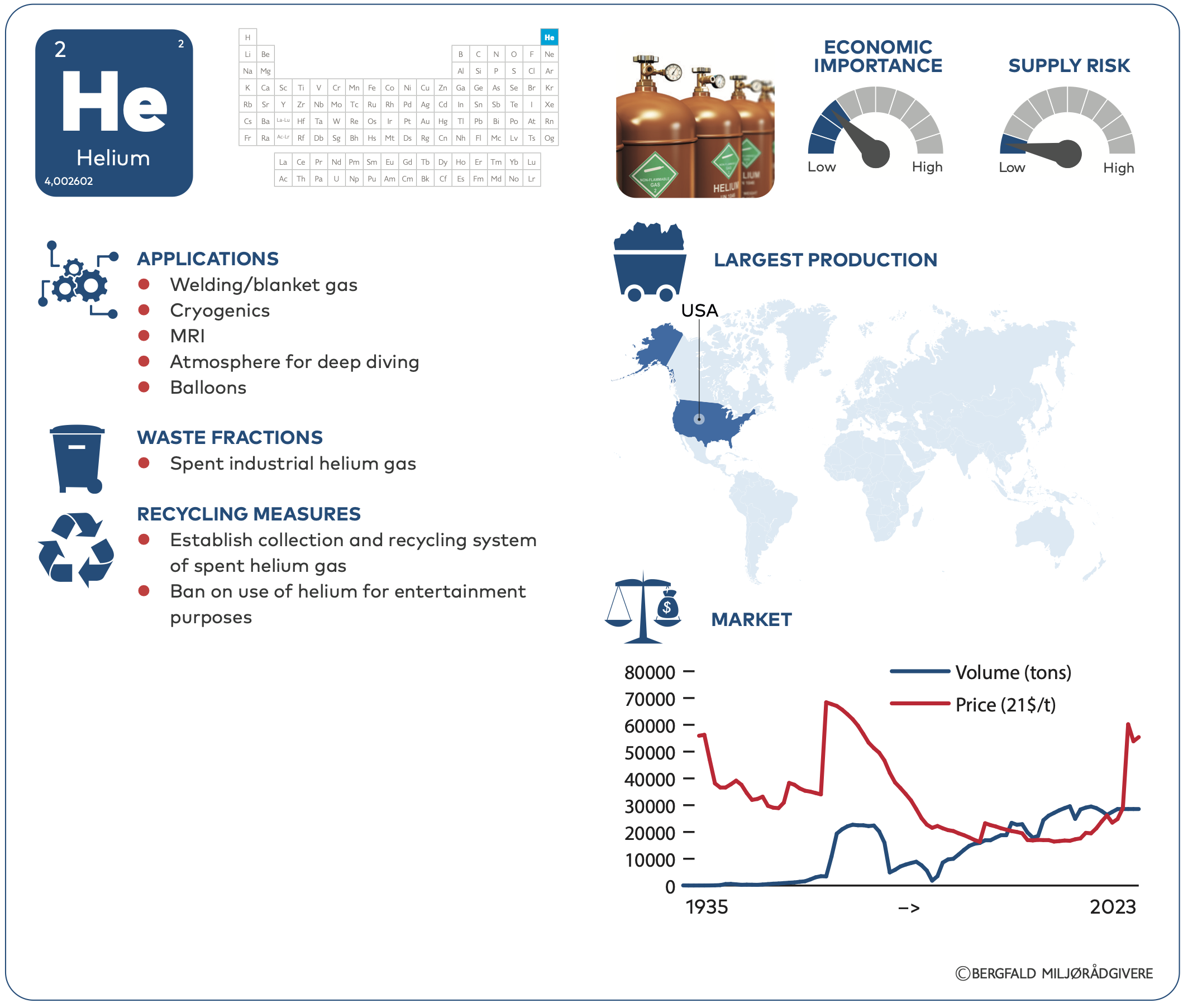
Helium is a chemical element with atom number 2. It is the lightest noble gas and has a lower density than air. Although helium is the second most common element in the universe after hydrogen, the element is far less common on the Earth’s surface. All available helium on earth is formed by radioactive alpha radiation from uranium and thorium in geological formations. Most of this helium leaks out through pores and cracks but some helium is trapped in reservoir rocks under mantle rocks, often together with natural gas, from where it can be extracted. All helium is for this reason produced as a byproduct from natural gas production. USA is the dominant global helium producer, followed by Qatar.
Important application of helium is as a cooling gas for extremely low temperatures, and as an inert atmospheric gas in many sensitive industrial processes that cannot tolerate other pollutants. Helium is also used in small volumes in some niche applications like MRI and other advanced medical equipment. Although the total consumption of helium is limited, it is virtually impossible to find substitutions for this noble gas. Therefore, it can be questioned if the large quantities of helium being used for entertainment purposes such as inflating balloons is sensible.
Waste streams and systems for recycling
Helium can be recycled, but this is difficult at low pressures or if helium is diluted through mixture with other gases. Discarded helium gas from, for example, cooling systems and inert atmospheres, however, can be easily reused. Around 1% of the European helium consumption is recycled. There is no significant helium recycling in the Nordics.
Heavy Rare Earth Elements
Applications and market situation
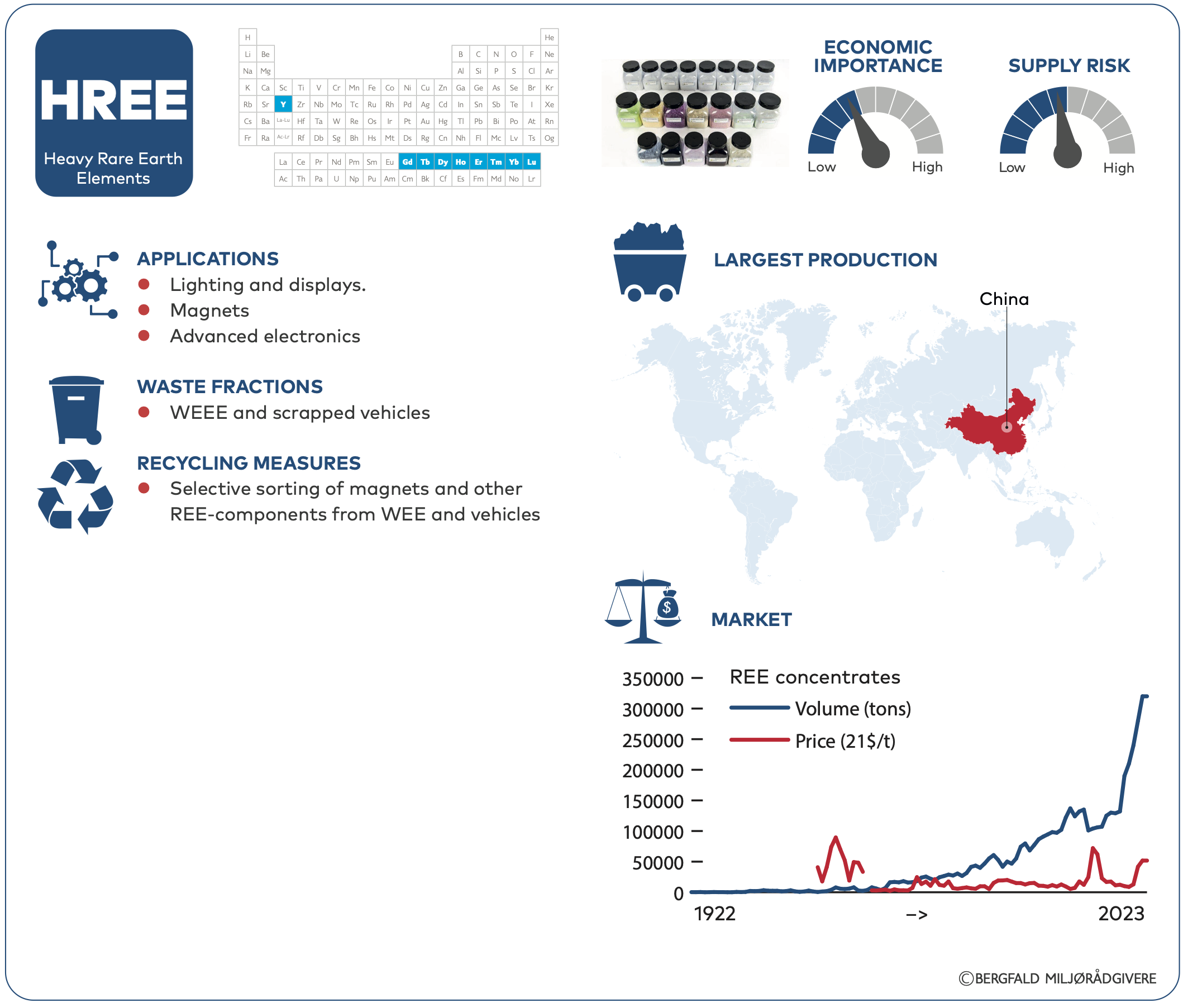
Rare Earth Elements (REE) consists of 15 chemical elements with atomic numbers from 57–71 and are also referred to as the lanthanoid group. The substance group show relatively similar chemical properties, and REE with atomic numbers 62–71 is referred to as heavy (HREE). All HREEs have important industrial applications.
Although most HREEs are not geological rare in a strict sense of the word, they are challenging to produce because they are not found concentrated in ores. Instead, they are more evenly distributed throughout the Earth’s crust. Due to HREEs having very similar chemical properties, chemical separation is difficult. REE ores will almost always contain all elements except promethium, but in varying ratios, and the market price for various REE metals also varies greatly from metal to metal.
Important applications of HREE include permanent magnets for electric motors and electricity generators, lighting phosphors, catalysts, lasers, glass and ceramics.
Magnetic metals make up around 90% of the value of the REE market, although other markets are equally large in tons. Permanent magnets made of neodymium (Nd) (often alloyed with praseodymium and/or holmium) form the strongest and most consistent magnetic fields, and therefore has a dominant position as a magnetic material, as this provides the greatest energy efficiency for both power generators in wind turbines and electric motors. The Green Shift where wind turbines and electric cars play a role key role, has provided a particularly strong development in the REE market, which is shown both in increasing production volumes and prices, and there is reason to expect that the total REE-market will continue to grow significantly in the coming years.
Today, China practically has complete control over the HREE-market making other countries concerned about this supply risk. All states that have published lists of critical raw materials have listed REE or LREE/HREE as critical materials. The global production of HREE (refined metal) in 2021 was around 12,800 tons.
Waste streams and systems for recycling
Despite many important applications and the status of China's as the single supplier of REE, there is so far very little recycling of these important metals, and the technology for recycling of HREE from many waste streams is still immature. Global recycling rate for HREE is estimated to be around 4%. There are however significant waste streams available from which HREE can be recovered when this becomes technologically possible and economically advantageous.
LREE and HREE will often exist in the same waste streams, with WEEE and scrapped vehicles being examples of waste streams that may form feedstock for future HREE/LREE recycling. HREE can be found in WEEE in fluorescent tubes, energy saving bulbs, screens, lasers, hard drives, electric motors, advanced batteries, fiber-optic equipment, and various types of electrical measuring equipment.
There is so far no recycling capacity for HREE-waste in the Nordic countries. There is however a LREE-processing plant under construction in Norway, which can be expanded to recycle HREE if provided incentives to do so.
Disclosure: One of the report authors is a minority shareholder in the REEtec plant.
Light Rare Earth Elements
Applications and market situation
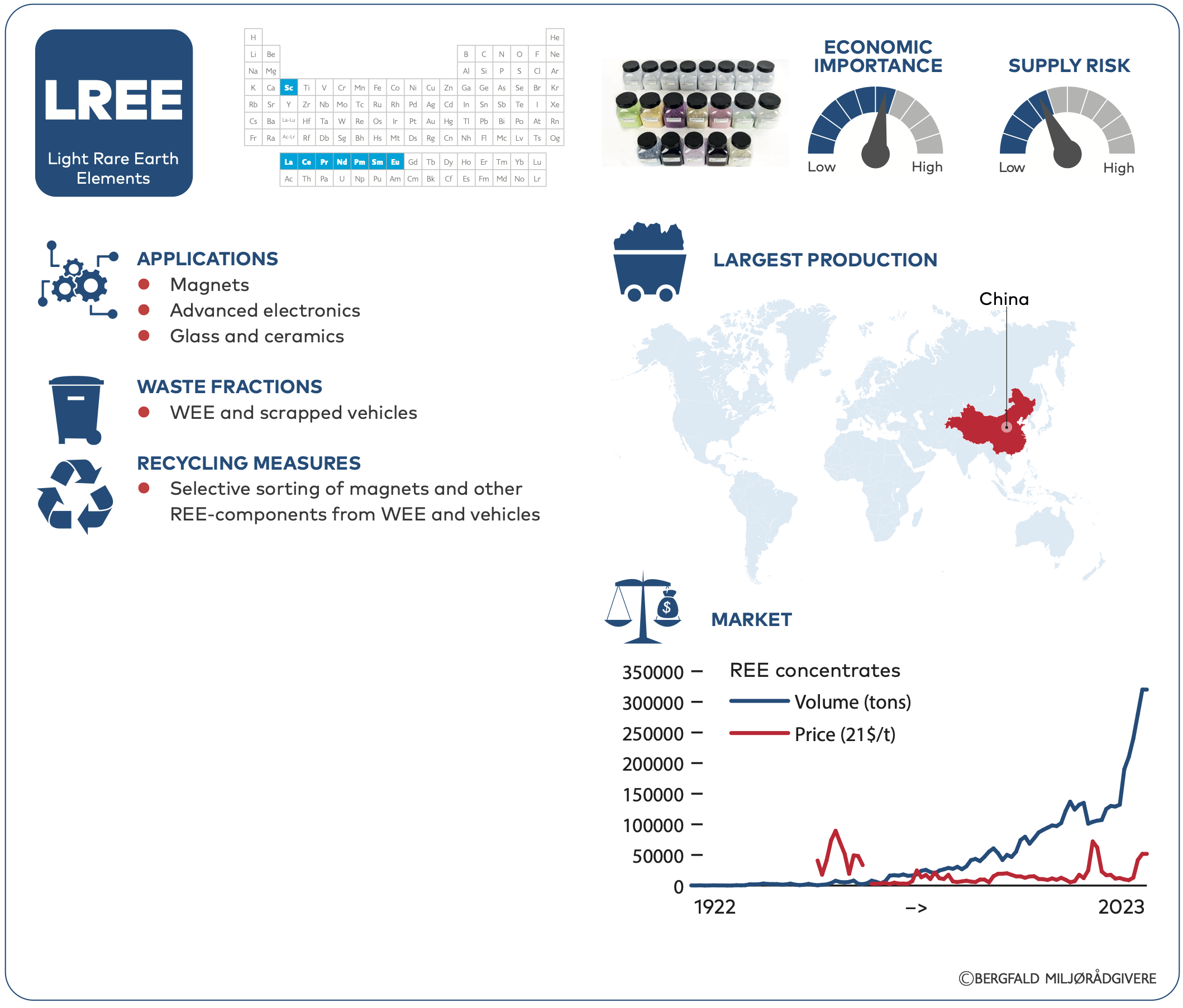
Rare Earth Elements (REE) consists of 15 chemical elements with atomic numbers from 57–71, also referred to as the lanthanoid group. The substance group has relatively similar chemical properties, and the elements with it atomic numbers 57–61 are referred to as light (LREE). All the LREE elements have important industrial applications except promethium, which is radioactive and so unstable that it is not available for industrial use.
Although most HREEs are not geological rare in a strict sense of the word, they are challenging to produce because they are not found concentrated in ores. Instead, they are more evenly distributed throughout the Earth’s crust. Due to LREEs having very similar chemical properties, chemical separation is difficult. REE ores will almost always contain all elements except promethium, but in varying ratios, and the market price for various REE metals also varies greatly from metal to metal.
Important applications of LREE include permanent magnets for electric motors and electricity, generators, lighting phosphors, pigments, catalysts, glass and ceramics.
Magnetic metals make up around 90% of the value of the REE market, although other markets are equally large in tonnes. Permanent magnets made of neodymium (Nd) (often alloyed with praseodymium and/or holmium) form the strongest and most consistent magnetic fields, and therefore has a dominant position as a magnetic material, as this provides the greatest energy efficiency for both power generators in wind turbines and electric motors. The Green Shift where wind turbines and electric cars play a role key role, has provided a particularly strong development in the REE market, which is shown both in increasing production volumes and prices, and there is reason to expect that the total REE-market will continue to grow significantly in the coming years.
Today, China practically has complete control over the LREE-market making other countries concerned about this supply risk. All states that have published lists of critical raw materials have listed REE or LREE/HREE as critical materials. The global production of LREE (refined metal) in 2021 was around 162,000 tons.
Waste streams and systems for recycling
Despite many important applications and the status of China's as the single supplier of REE, there is so far very little recycling of these important metals, and the technology for recycling of LREE from many waste streams is still immature. Global recycling rate for LREE is estimated to be around 3%. There are however significant waste streams available from which LREE can be recovered when this becomes technologically possible and economically advantageous.
LREE and HREE will often exist in the same waste streams, with WEEE and scrapped vehicles being examples of waste streams that may form feedstock for future LREE/HREE recycling. LREE can be found in WEEE in fluorescent tubes, energy saving bulbs, screens, lasers, hard drives, electric motors, advanced batteries, fiber optic equipment, and various types of electrical measuring equipment.
There is so far no recycling capacity for LREE-waste in the Nordic countries. There is however a LREE-processing plant under construction in Norway, which can be expanded to recycle LREE if provided incentives to do so.
Disclosure: One of the report authors is a minority shareholder in the REEtec plant.
Lithium
Applications and market situation
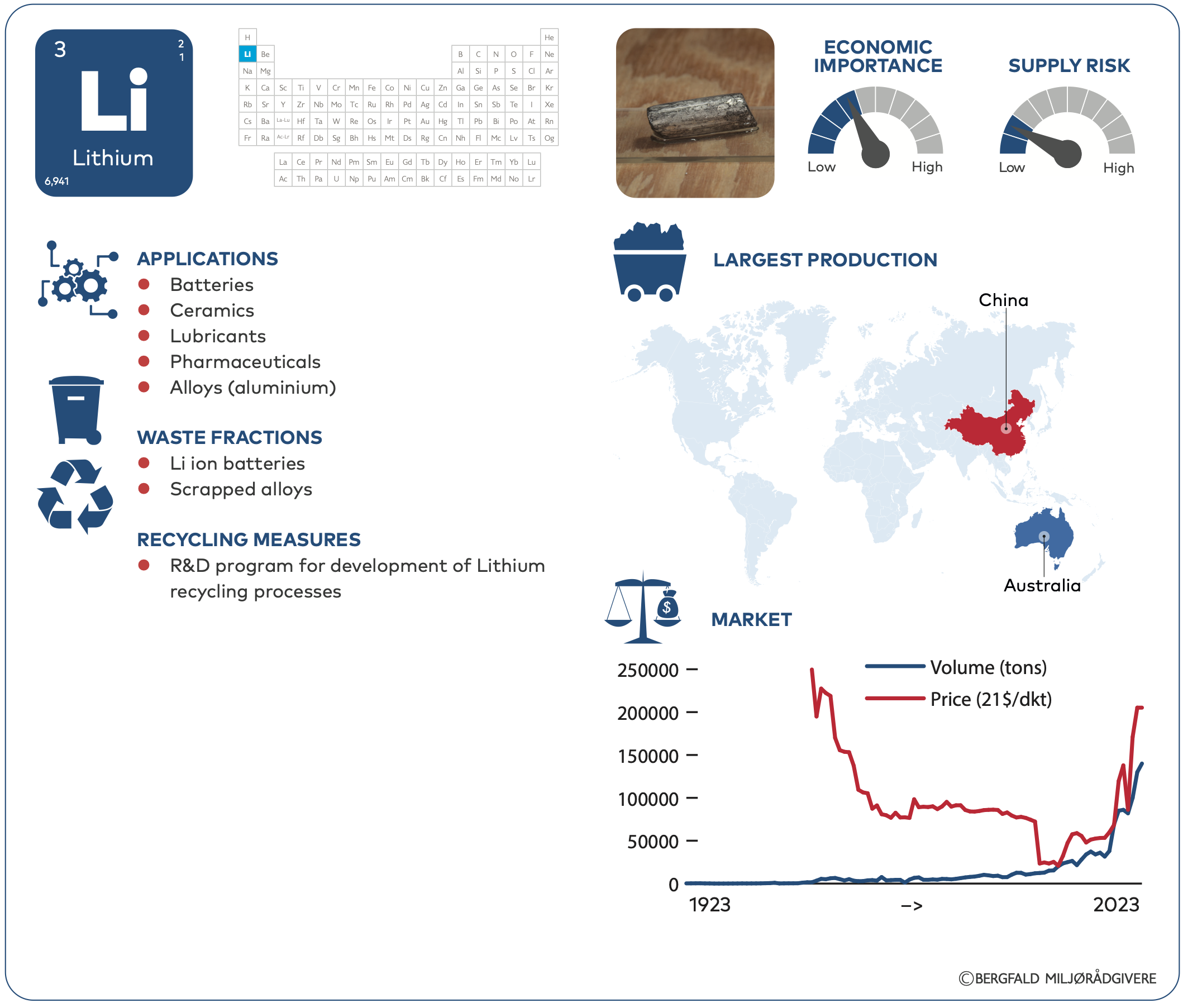
Lithium is a silver-white alkali metal with atomic number 3 that has low density and material strength, and the lowest electronegativity of all elements, which gives the element unique chemical properties. Lithium has many applications, including as an additive for glass and ceramic materials, in metallurgical processes, in lubricants and optical materials. However, the largest area of use in recent years are for batteries, and this consumption is expected to grow significantly in the coming years. While lithium was a niche metal only a few years ago with total global consumption of just under 10,000 tonnes per year, consumption has since increased dramatically and the global production of refined lithium in 2020 reached 339 000 tons. There are significant deposits of lithium in a number of places in the world, with large production in Atacama in South America (spread over three countries) and Greenbushes in Australia. China is also one of the largest producers of lithium.
Waste streams and systems for recycling
No significant recycling of lithium occurs in the world, although technologies for recovery of lithium from batteries are being developed. There is recycling capacity for post-consumer lithium batteries in the Nordics. Although these processes so far do not recover lithium but focus on extracting metals such as nickel and cobalt, the infrastructure for recycling of lithium is established. Recycling technology from batteries that include lithium is expected to be applied in the near future. The recycling process for recovery of lithium from batteries will most likely be energy intensive, and could therefore be suitable at Nordic locations with readily available surplus of electricity.
Magnesium
Applications and market situation
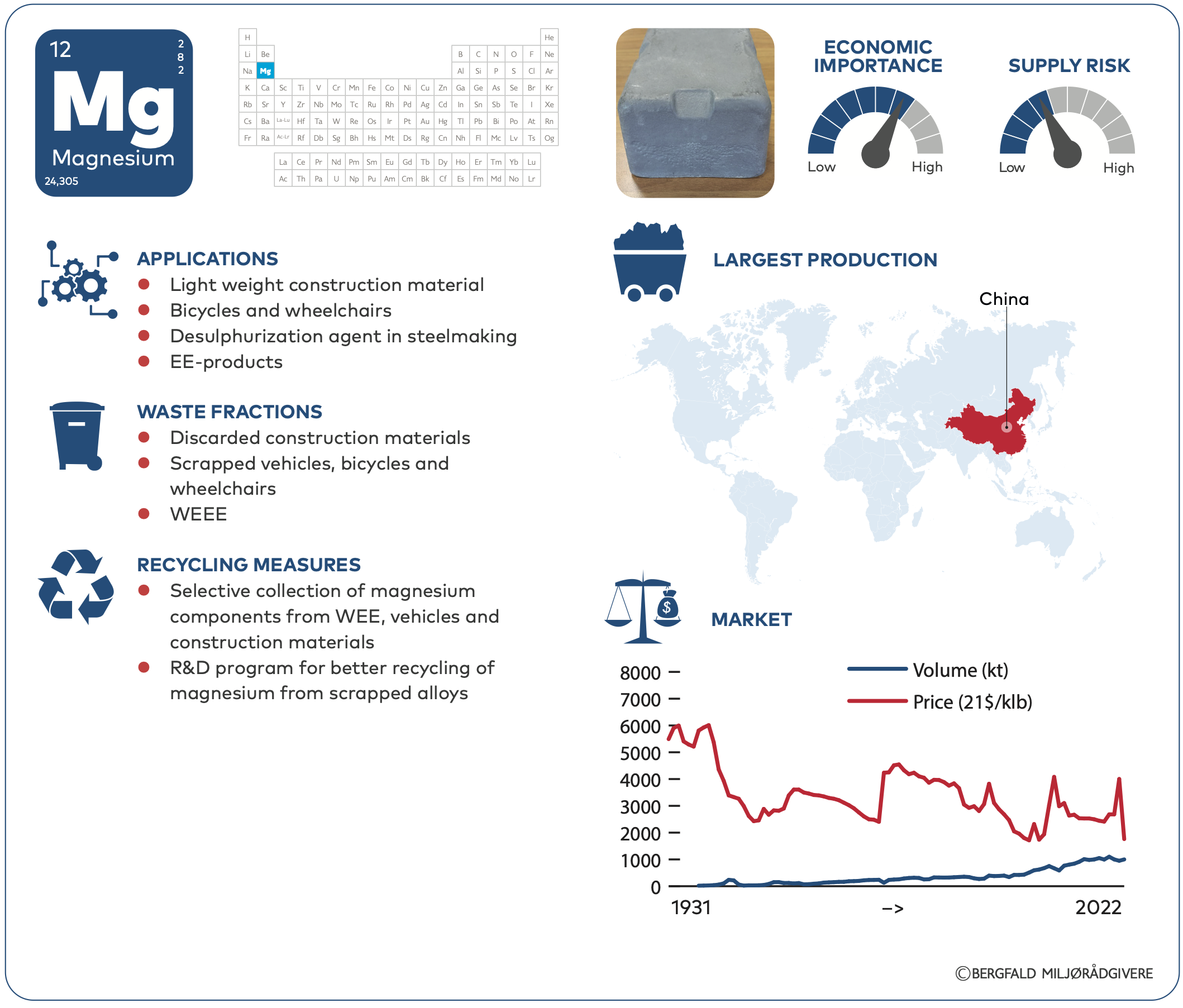
Magnesium is a silver white metal with atomic number 12. The light weight and high material strength of magnesium gives magnesium many applications as construction material in vehicles and in aviation. Magnesium alloys are also used in consumer electronics for example in chassis for laptops, mobile phones, camera housings or handhelds tools such as drills, screwdrivers or chainsaws. The global magnesium market is about 1 million tons with China being the largest producer.
United States Geological Survey
Waste streams and systems for recycling
European recycling rate of magnesium is estimated to be around 7 %. There is no recycling capacity however for post-consumer magnesium in the Nordic countries, although other European countries have a substantial capacity for recycling both sorted magnesium components and industrial scrap. Magnesium alloys are often tailor-made to their applications, which can make it challenging to achieve the desired chemical composition for secondary magnesium alloys, although magnesium and aluminum alloys do have considerable tolerance for each other. Magnesium recycling is further complicated by the fact that many magnesium components in discarded consumer products are varnished, and that magnesium dust is highly explosive.
Until 2005, there was a recycling operation in Norway for complex magnesium scrap, able to handle a wider range of waste than what is currently available in Europe. This plant is currently idle and possible to restart – given the right incentives. There is a substantial consumption of magnesium as an alloying element in the Nordic aluminium and steel industries of more than 20,000 tons that could have been converted from primary to secondary magnesium – if the necessary incentives were provided, which would reduce Nordic dependency on the current three primary magnesium suppliers to Europe; China, Israel and historically Russia.
Manganese
Applications and market situation
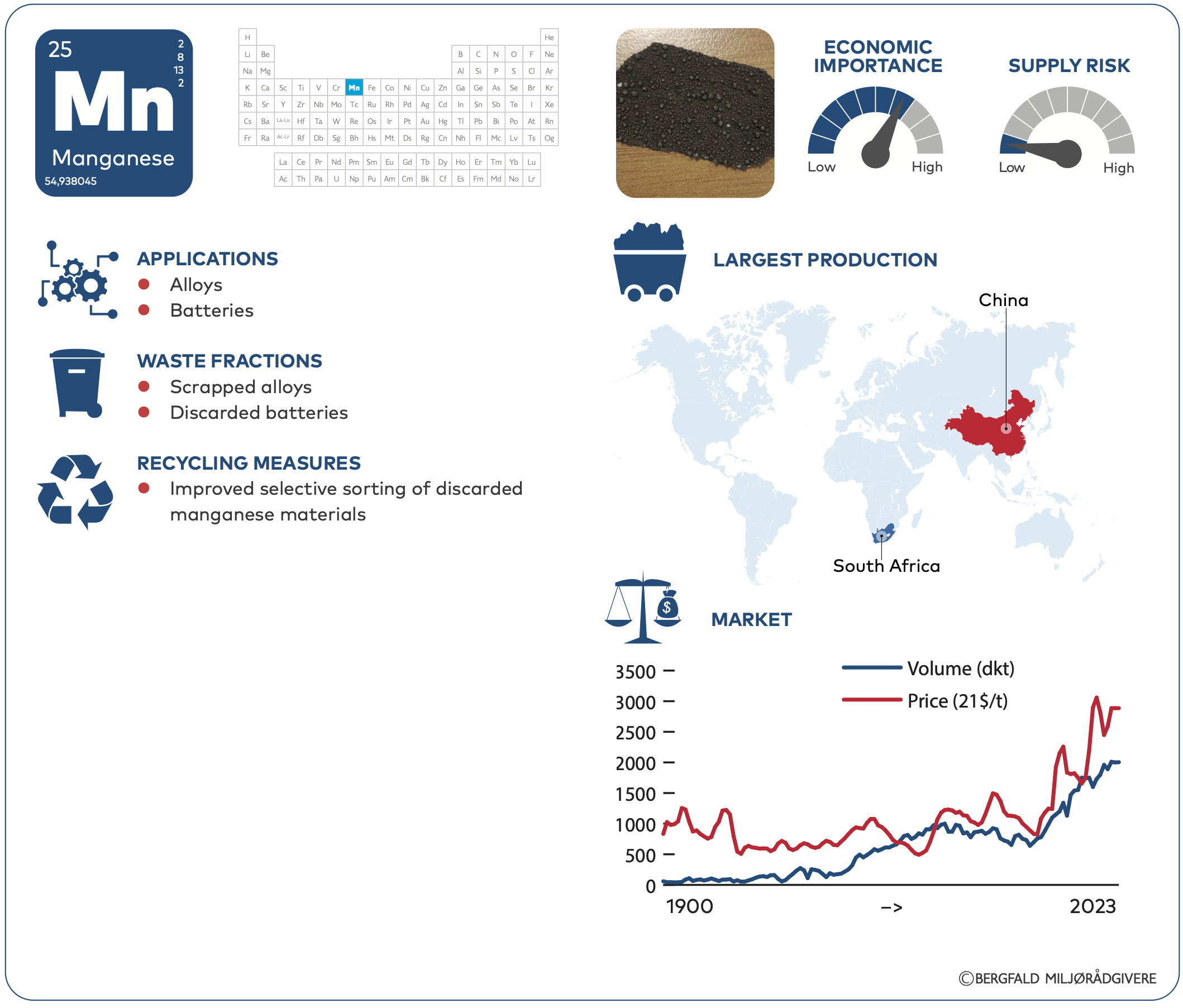
Manganese is a chemical element with atom number 25. The metal is silvery white, hard and brittle and has many industrial applications. The global manganese market is around 20 million tons, with China and South Africa as the largest producer. The main application of manganese is as an alloying agent in steel, but it is also an important raw material for batteries and as anode material in electric cars. Manganese is also a minor component in some fertilizers.
Waste streams and systems for recycling
Manganese has a recycling rate of around 9%. There is a Nordic recycling capacity for manganese through the Norwegian Eramet smelters located at Sauda, Kvinesdal and Porsgrunn, and at Ferroglobes smelter in Mo i Rana where manganese batteries and other waste materials with high levels of manganese could potentially be recycled.
Natural Graphite
Applications and market situation
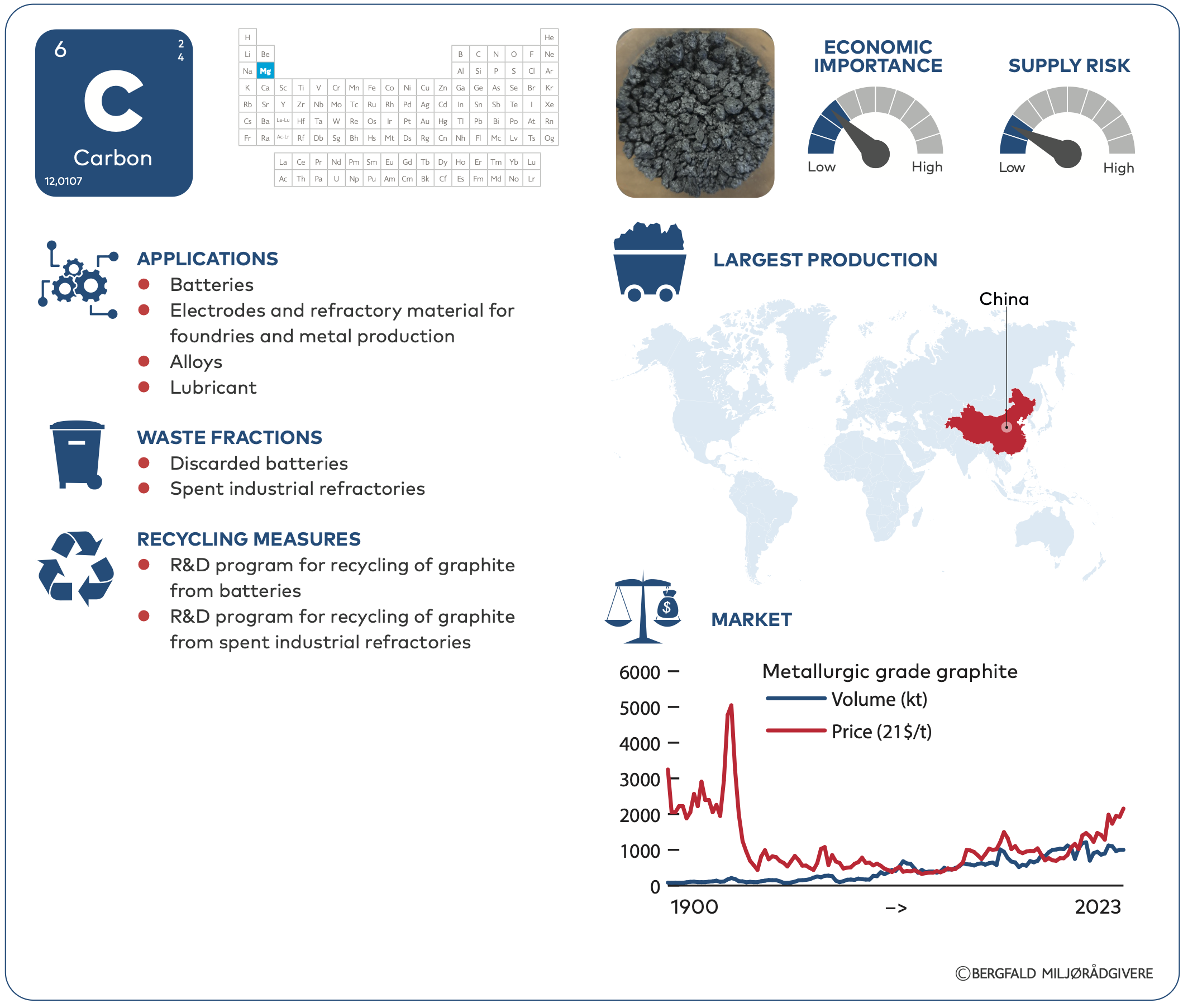
Graphite is one of two allotropic forms that the element carbon occurs in and is found as a mineral in the Earth's crust. Graphite is gray to black in color, soft, non-elastic and has often a metallic sheen. Natural graphite occurs in both crystalline, amorphous and flaky form. Graphite can also be produced industrially from other chemical compounds and is then referred to as synthetic. Graphite is chemical inert and has the greatest electrical and thermal conductivity among the non-metallic elements. The combination of graphite's ability to conduct electricity and thermal stability has given the material important applications in batteries, fuel cells and refractory products. Important areas of use for graphite are also found within the steel industry and other metallurgical industries. Amorphous and flaking graphite is included in the production of lubricants and for construction parts within the automotive industry, electronics and the construction sector. The global annual consumption of graphite is around 1,3 million tons, with China being the largest producer.
Waste streams and systems for recycling
Only around 3% of used graphite is recycled, and this is mostly refractory materials. Although lithium batteries contain around 16–22% graphite, this graphite is often oxidized to CO2 during the pyrometallurgical processes used for recycling of batteries, which means the graphite material is lost. Tests have shown that graphite can be separated from lithium and other metals in the electrode material from batteries, and several methods for recycling graphite from used lithium batteries have been patented. Graphite can also be synthesized from other carbon compounds, including CO2.
Nickel – battery grade
Applications and market situation
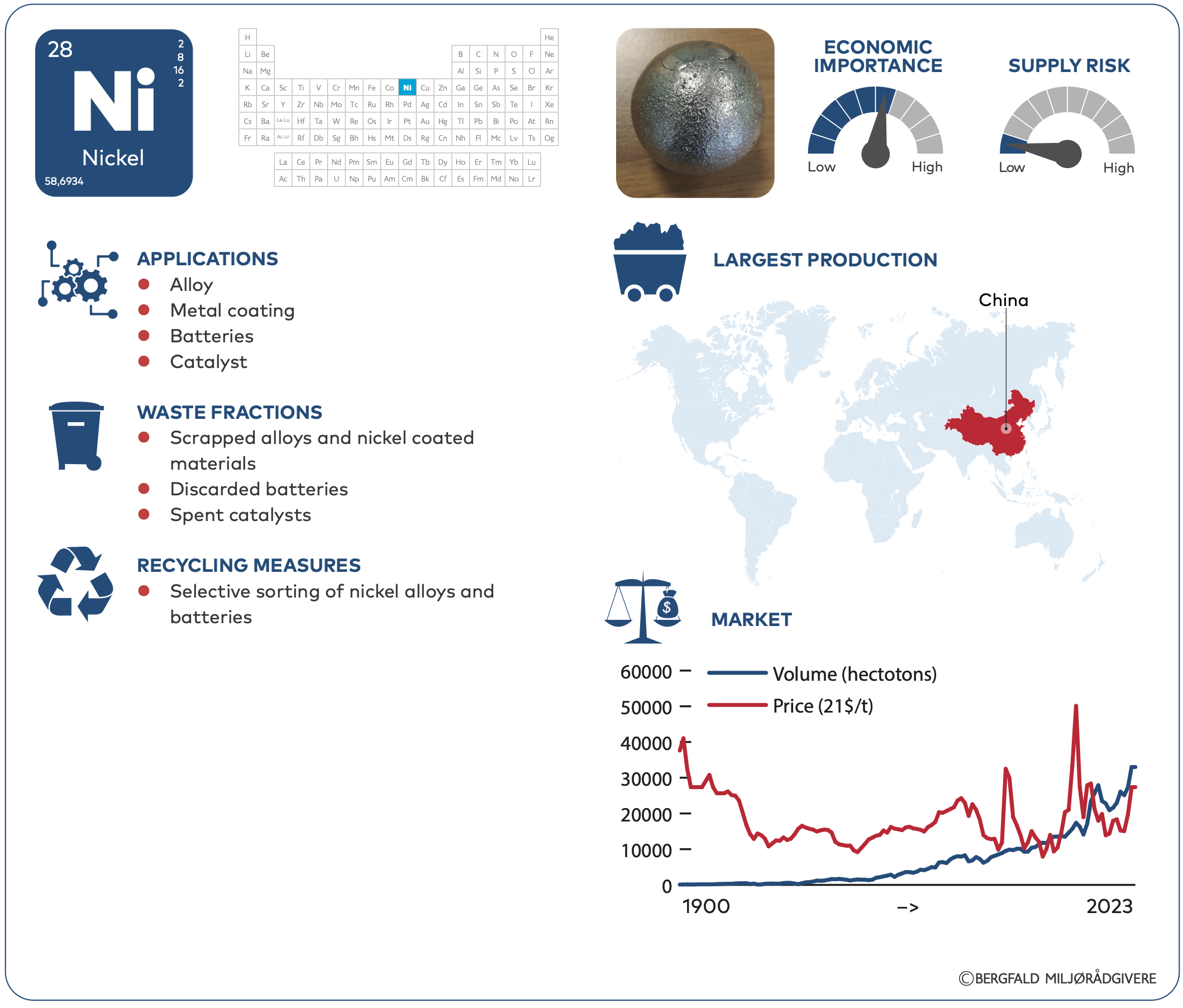
Nickel is a silver-white metal with atomic number 28 that is stable at high temperatures and resistant to oxidation in air. The largest application of nickel is as an alloying addition in stainless steel, in galvanic coatings, as catalysts for organic chemical reactions/processes and in batteries. Increased use of nickel in lithium batteries for vehicles means that the consumption of nickel is expected to rise. Nickel is produced from silicate- and sulphide-containing minerals, with Indonesia being the largest producer with approximately one third of the total nickel extraction in the world in the form of ferronickel. The Philippines accounts for around 20% of the global extraction but delivers all extracted ore directly to China which is the largest global processor of nickel.
Waste streams and systems for recycling
The European recycling rate of nickel is estimated to be around 16%, and recycling is performed through both pyrometallurgical and hydrometallurgical processes. There is a large and well developed Nordic capacity for nickel recycling. The Nikkelverk plant in Norway and Boliden plant in Harjavalta are both able to receive high-nickel feedstock for recycling. Indeed, both have declared their intention to increase the secondary feedstock supplies if such materials become available.
Niobium
Applications and market situation
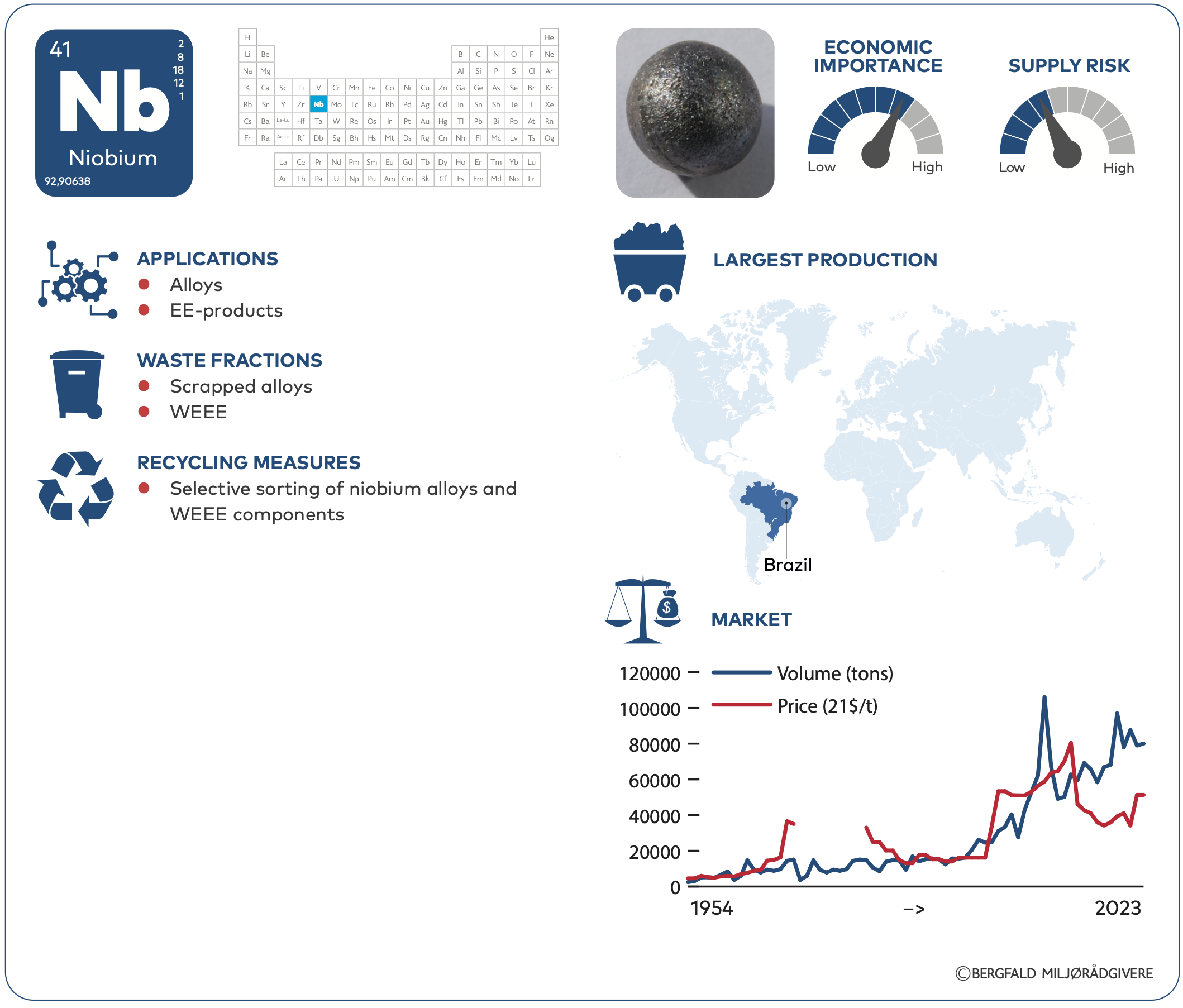
Niobium is a gray and ductile metal with atomic number 41 and its consumption is largely in the form of ferroniobium as an additive to steel to withstand high temperatures. Niobium also has important niche applications in EE products. The world market for niobium is around 120,000 tons, with Brasil being the largest producer.
Waste streams and systems for recycling
A limited recycling industry for industrial niobium scrap, superconducting materials and larger components and alloys does exist, although there is no recycling capacity for postconsumer niobium or niobium-containing materials in the Nordic countries.
Phosphate rock
Applications and market situation
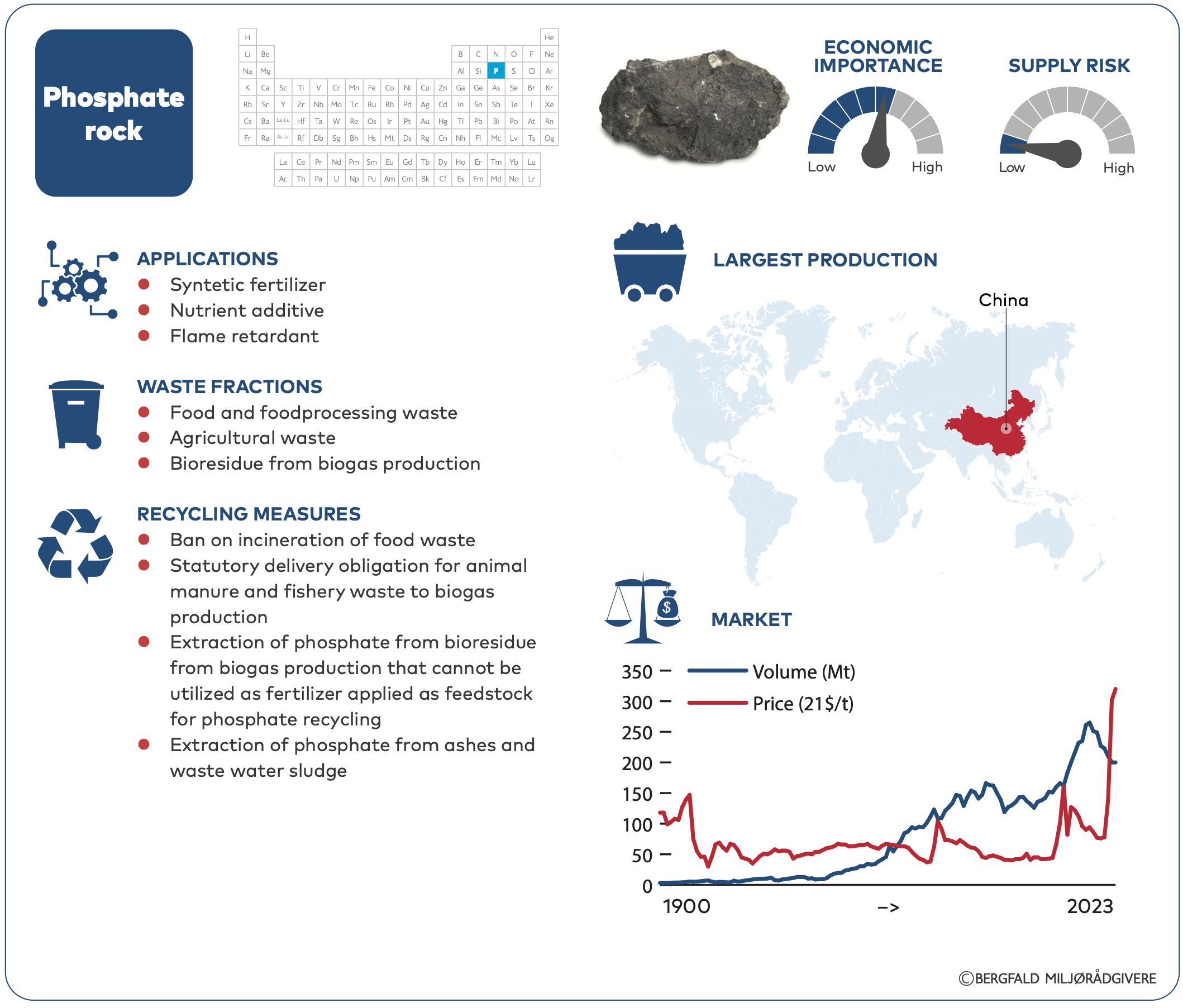
Phosphate (PO43-) is the anion of phosphoric acid and is an essential nutrient for all living organisms. Phosphate is also a chemical precursor for production of many phosphoric chemicals with applications that include food additives, detergents and flame retardant. The most important application is however as fertilizer. Phosphate is mined from various phosphate rocks, and the largest producer of phosphate is China. The global production of phosphate rock is around 75 million tons.
Waste streams and systems for recycling
Phosphate is found in organic waste and industrial waste containing phosphorous acid and chemical derivatives of this acid. The European recycling rate of phosphate is estimated to be around 17%. In agricultural waste phosphate is both found bound in organic matter and as residues of fertilizers. The dominant method for recycling of phosphate seems to be through biogas production where the nutrient-rich residue from the anaerobe digestion process can be used as phosphate rich fertilizer. All Nordic countries have extensive biogas production. There are also interesting projects extracting phosphate from incineration ashes and wastewater.
Phosphorus
Applications and market situation
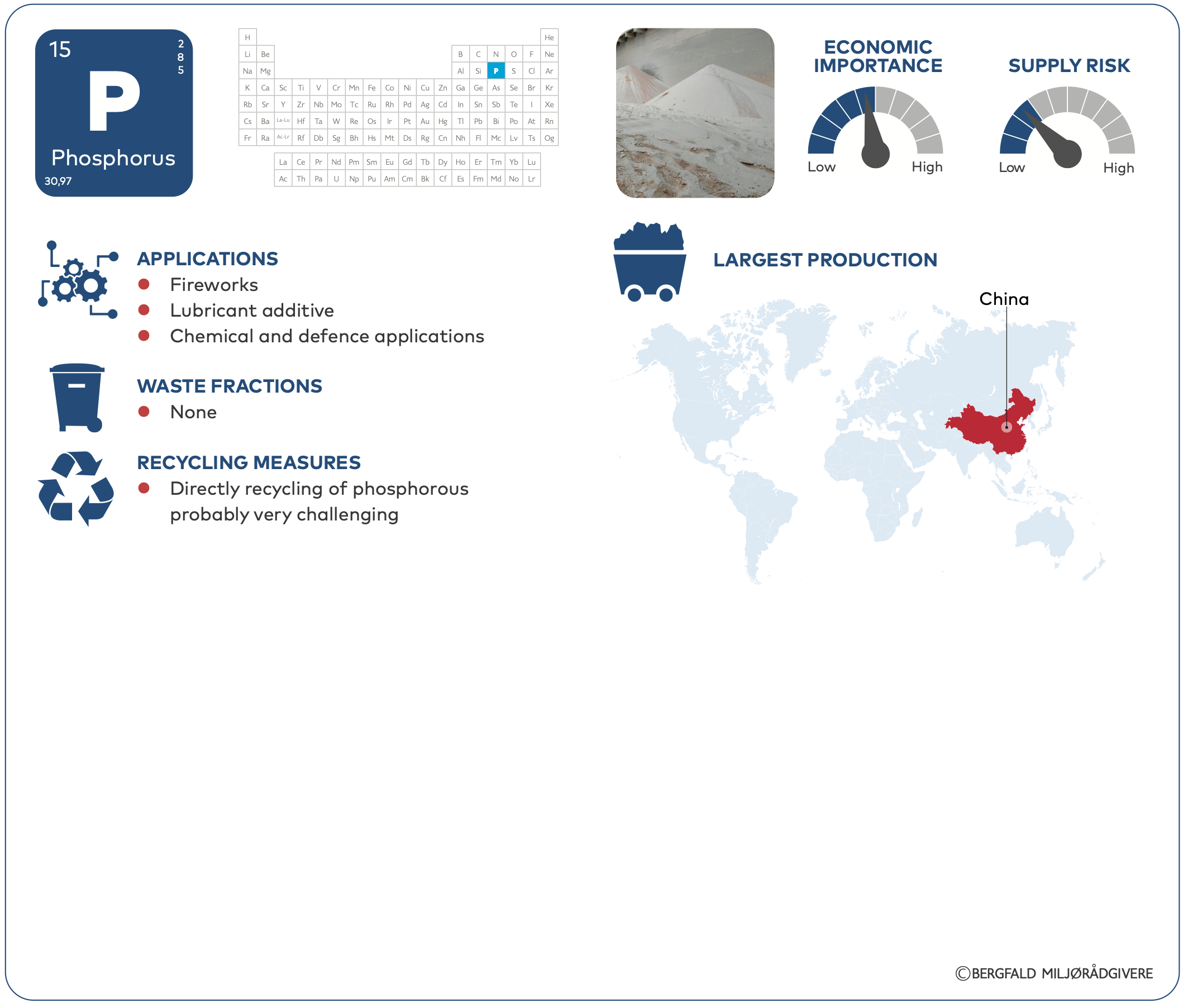
Phosphorus is a chemical element with atomic number 15 that exists as in several allotropic forms including white and red phosphorus. Due to its chemical reactivity elementary phosphorous is never found in nature but occurs mainly as phosphate minerals. Phosphorus has important industrial and defense applications. China is the dominant producer of phosphorous. The global production of phosphate rock is around 1,200 tons.
Waste streams and systems for recycling
Because phosphorous is very reactive, most spent elemental phosphorous will be converted to other chemical compounds. There is no significant direct recycling of spent phosphorus, and recycling from phosphate may be a more rational pathway.
Platinum Group Metals
Applications and market situation
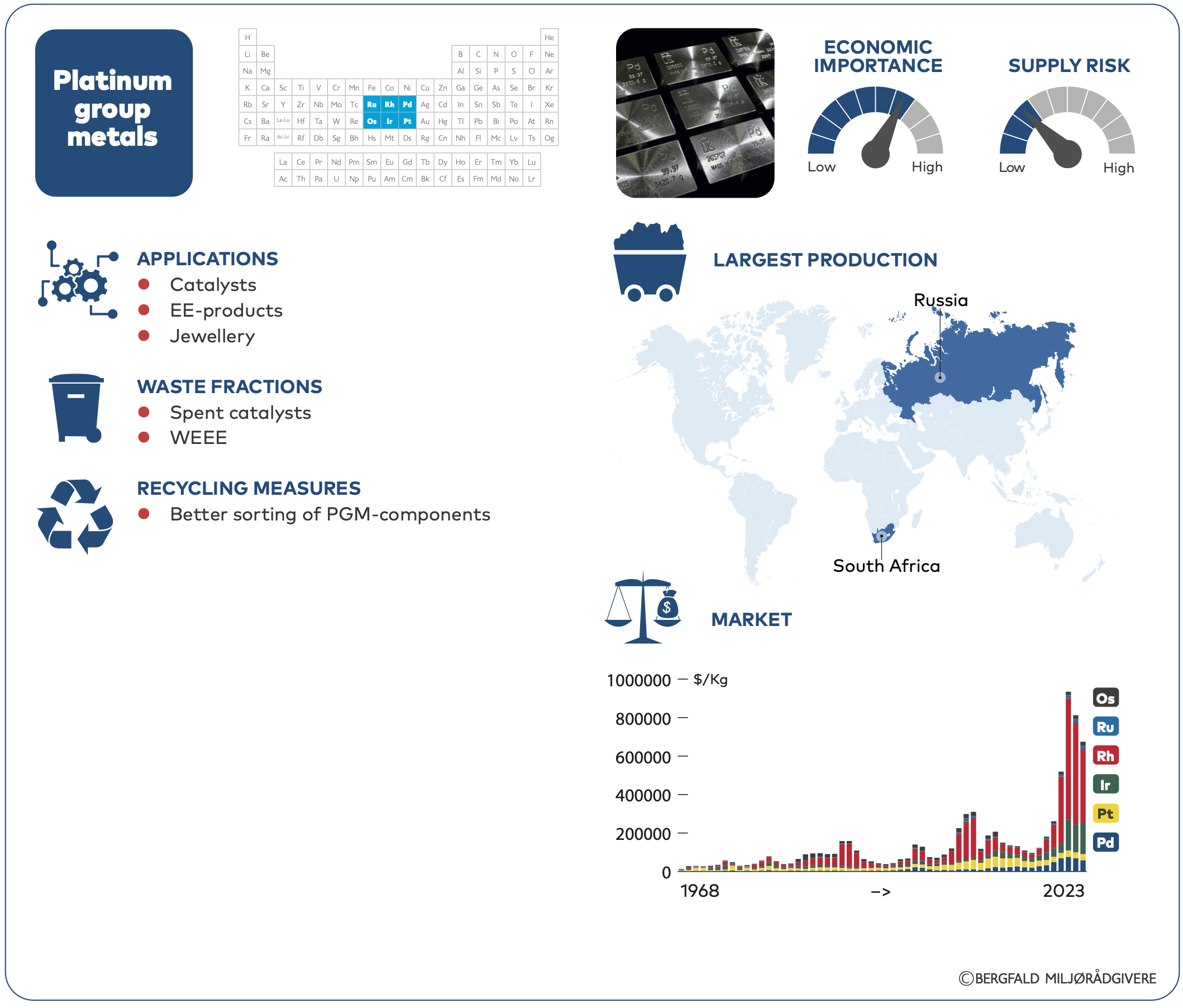
The platinum-group metals (PGMs) consist of six chemical elements where five is listed as critical by EU. These precious metals include ruthenium, rhodium, palladium, iridium, and platinum. PGMs are very rare in the Earth’s crust and are typically found together in the same ores. Important applications of PGMs include use as catalysts and electronic components. South Africa and Russia are the main producers of PGMs. Global production of PGMs was around 640 tons in 2021.
Waste streams and systems for recycling
Despite their high value, the European PGM recycling rate is estimated to be only around 30%. One reason for this is that many PGM applications involve use of small amounts that are hard to recover from other materials they are mixed with. There is substantial recycling capacity for PGM metals in the Nordics. The Nikkelverket plant in Norway, Boliden Rönnskär in Sweden and Boliden Harjavalta in Finland are all able to receive different PGM-containing secondary feedstocks for processing. The K.A. Rasmussen plant in Norway is able to process high grade metals such as industrial catalysts.
Scandium
Applications and market situation
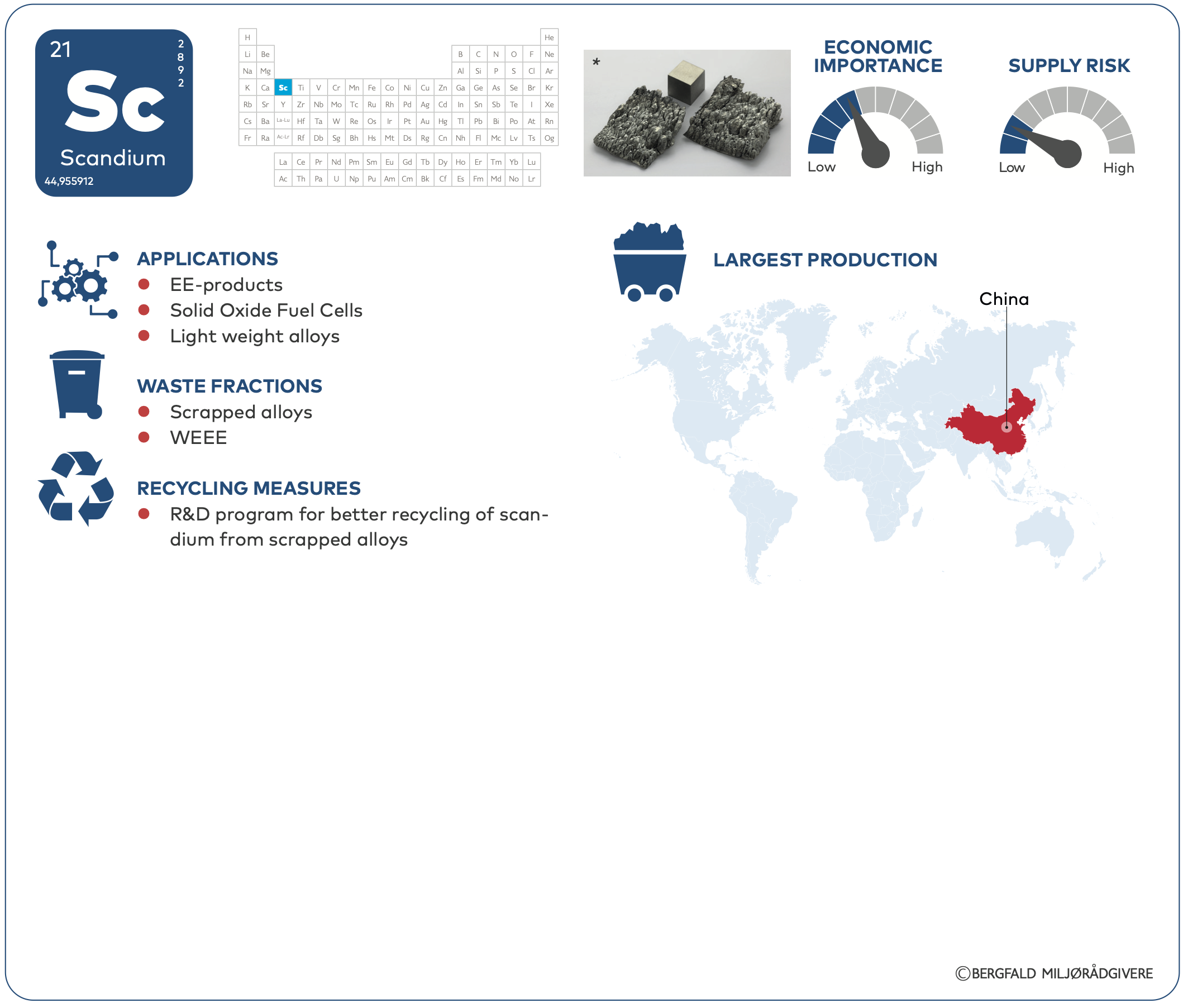
Scandium is a chemical element with atomic number 21. The metal has a silvery-white appearance. Scandium is present in most of the deposits of rare-earth and uranium compounds. The global trade of scandium is small, only about 20 tons per year, and its main application is as addition in aluminium alloys. Other minor applications include use in EE-products and fuel cells.
Waste streams and systems for recycling
There is no recycling capacity for postconsumer scandium or scandium-containing materials in the Nordic countries.
Silicon metal
Applications and market situation
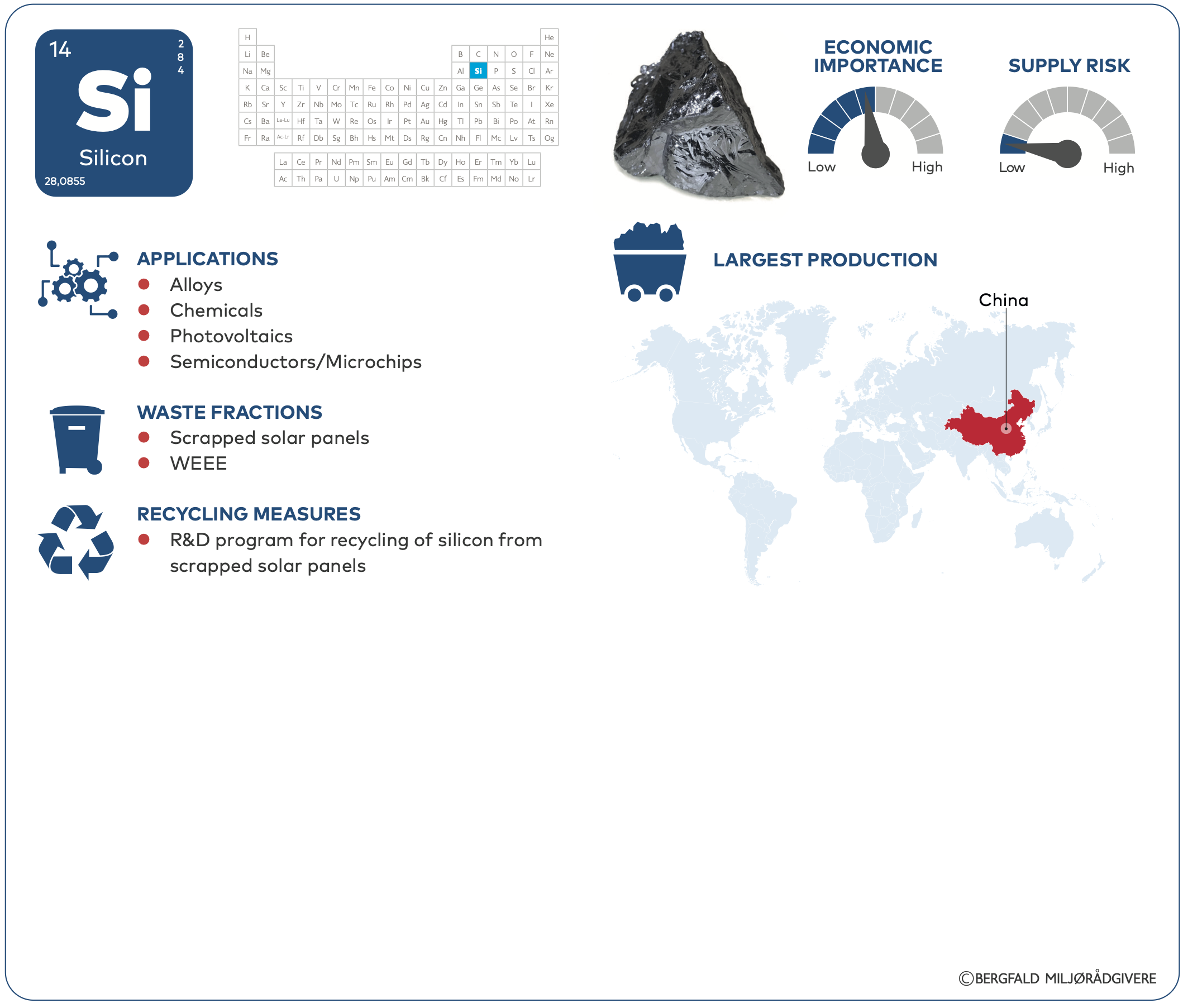
Silicon is a chemical element with atomic number 14. The metalloid has a blue-grey shine and good properties as a semiconductor with many important industrial applications that include photovoltaics and micro-chips. Silicon is the most common chemical element in Earth’s crust after oxygen. China is the largest producer of silicon. The global production of silicon metal in 2021 was around 3,3 million tons.
Waste streams and systems for recycling
There is no recycling capacity for postconsumer silicon or silicon-containing materials in the Nordic countries. There is however a substantial industry for production of primary silicon that may be fitted for recycling operations.
Strontium
Applications and market situation
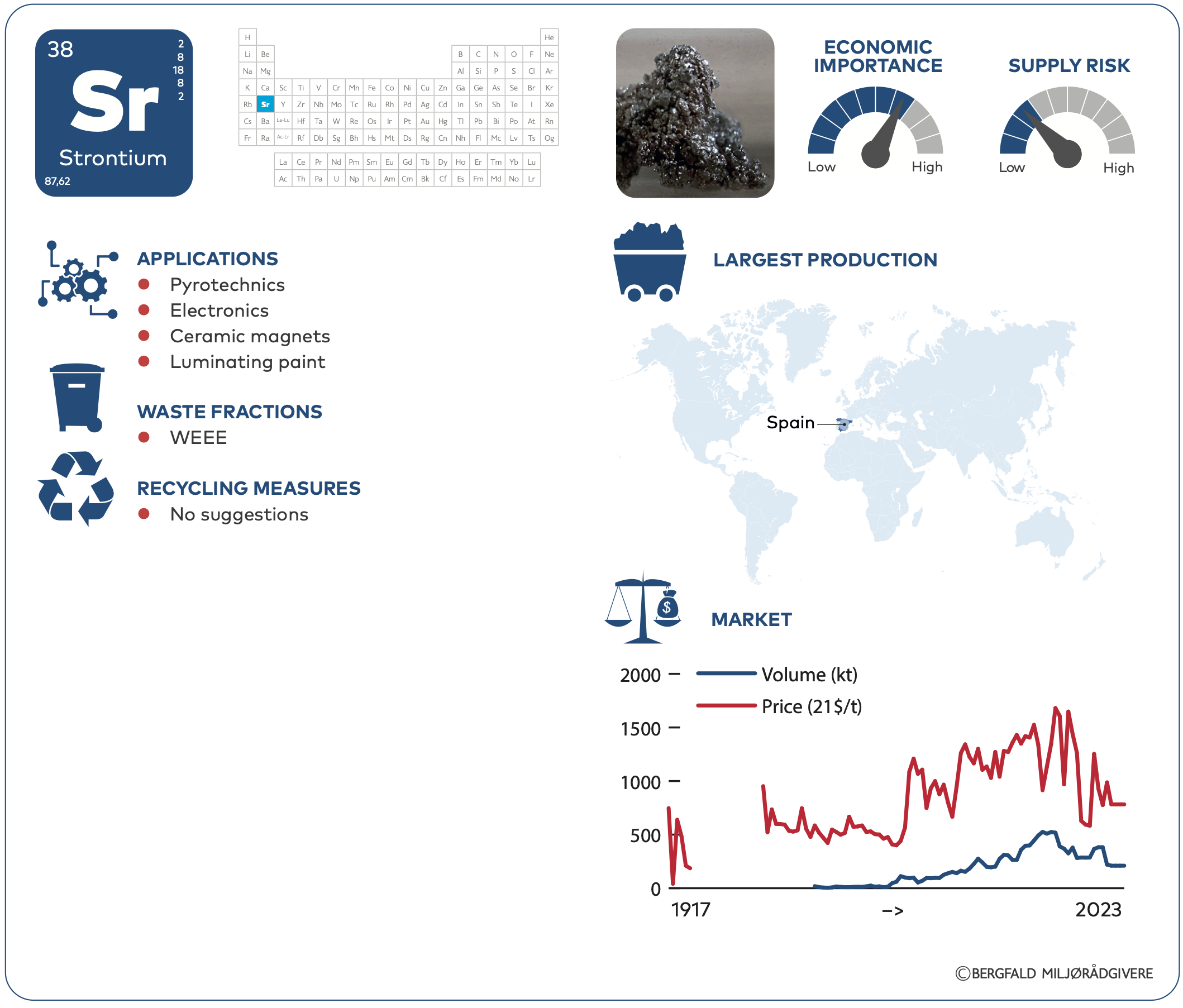
Strontium is a chemical element with atom number 38. The alkaline earth metal is soft and has a white or yellowish appearance and is highly chemically reactive. Applications of strontium include use in pyrotechnics, ceramic magnets, magnets and luminating paint. Strontium is mainly mined from the minerals celestine and strontianite with Spain and Iran as dominant producers. The global production of strontium in 2021 was around 580,000 tons.
Waste streams and systems for recycling
There is no recycling capacity for postconsumer strontium or strontium-containing materials in the Nordic countries. The European recycling rate of strontium is also zero.
Tantalum
Applications and market situation
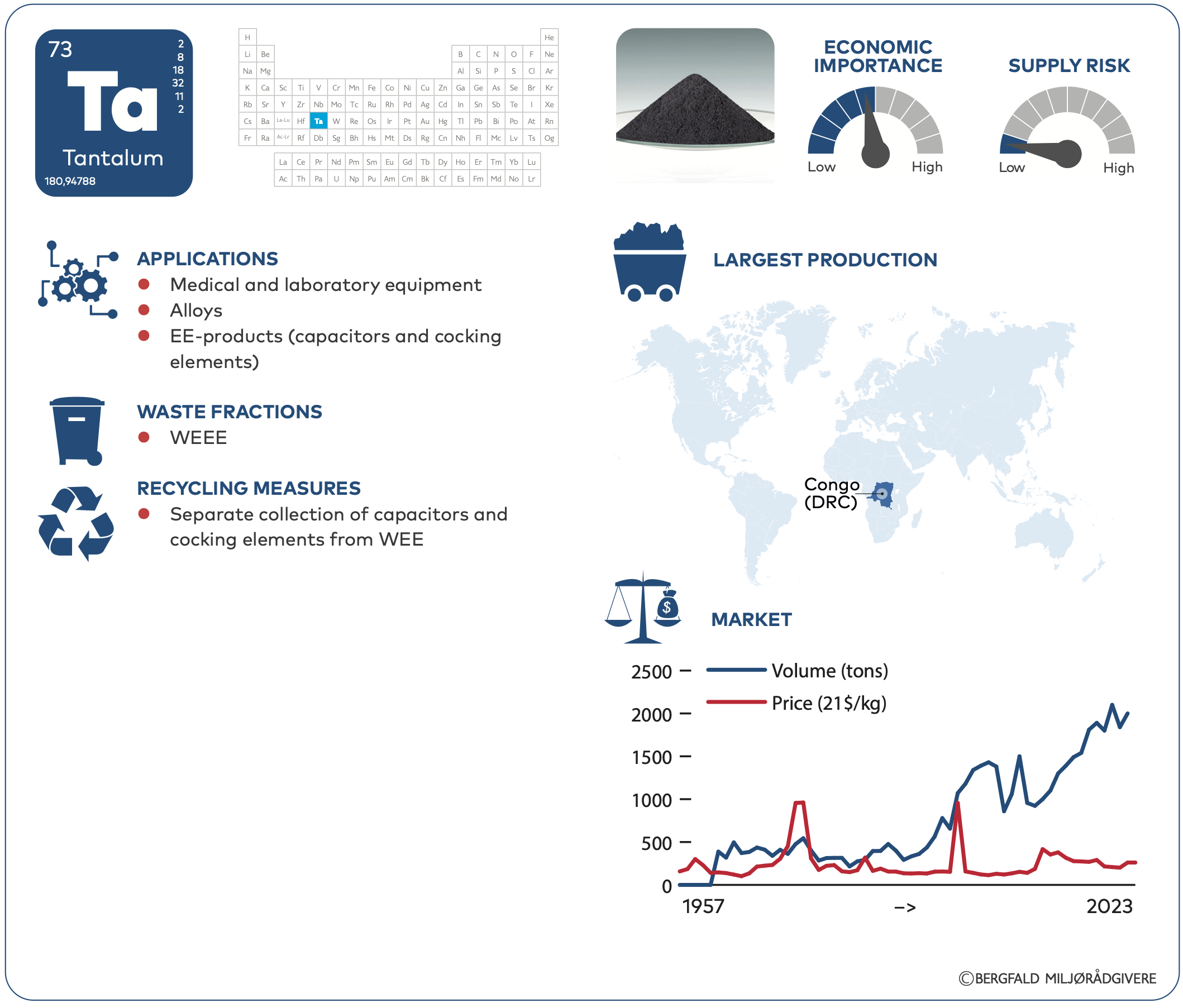
Tantalum is a chemical element with atomic number 73. The metal is hard ductile and chemically inert with a blue-gray appearance. Important applications include use in capacitors for electronic devices, cooking elements and super alloys. In nature tantalum is found in ores together with niobium in minerals like tantalite, columbite and coltan. The main producer of tantalum is Kongo DRC. The global production of strontium in 2018 was around 2,200 tons.
Waste streams and systems for recycling
The European recycling rate of tantalum is estimated to be 13%. There is no recycling capacity however for postconsumer tantalum or tantalum-containing materials in the Nordic countries.
Titanium metal
Applications and market situation
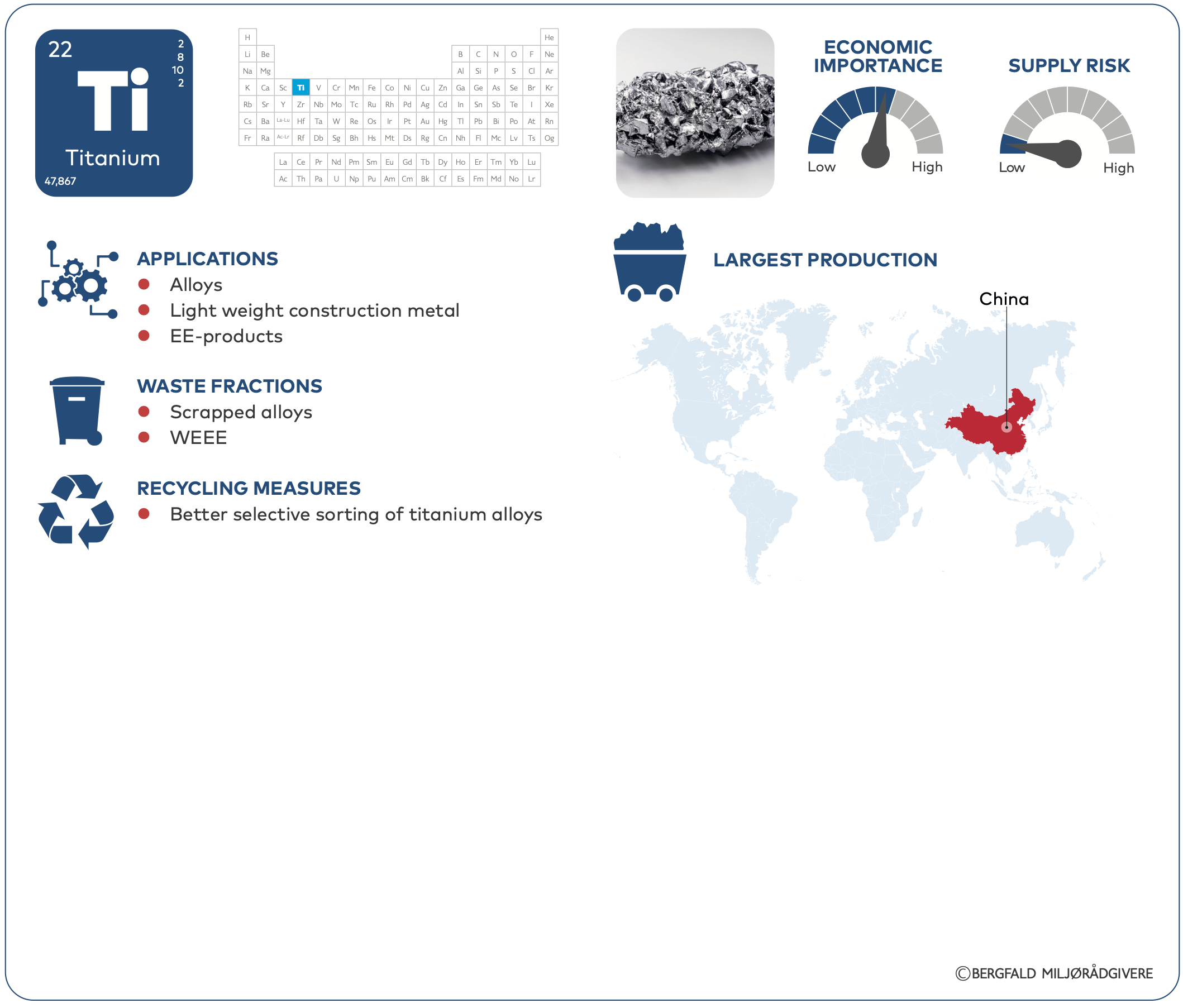
Titanium is a chemical element with atomic number 22. The metal has a silvery color, and has high material strength, low density and is resistant to corrosion. Important applications of titanium metal include medical implants, EE-products, light weight alloys and military, aeronautics and space applications. In nature titanium is found in minerals like ilmenite and rutile. China is the largest global producer of titanium metal. The global production of titanium metal in 2021 was around 244,000 tons.
Waste streams and systems for recycling
Around 6% of titanium metal is recycled, but there is so far no recycling capacity for post-consumer titanium or titanium-containing materials in the Nordic countries. There is from time to time the use of titanium metal turnings in the production of primary aluminium alloys. However, this is industrial scrap, a globally traded byproduct.
Tungsten
Applications and market situation
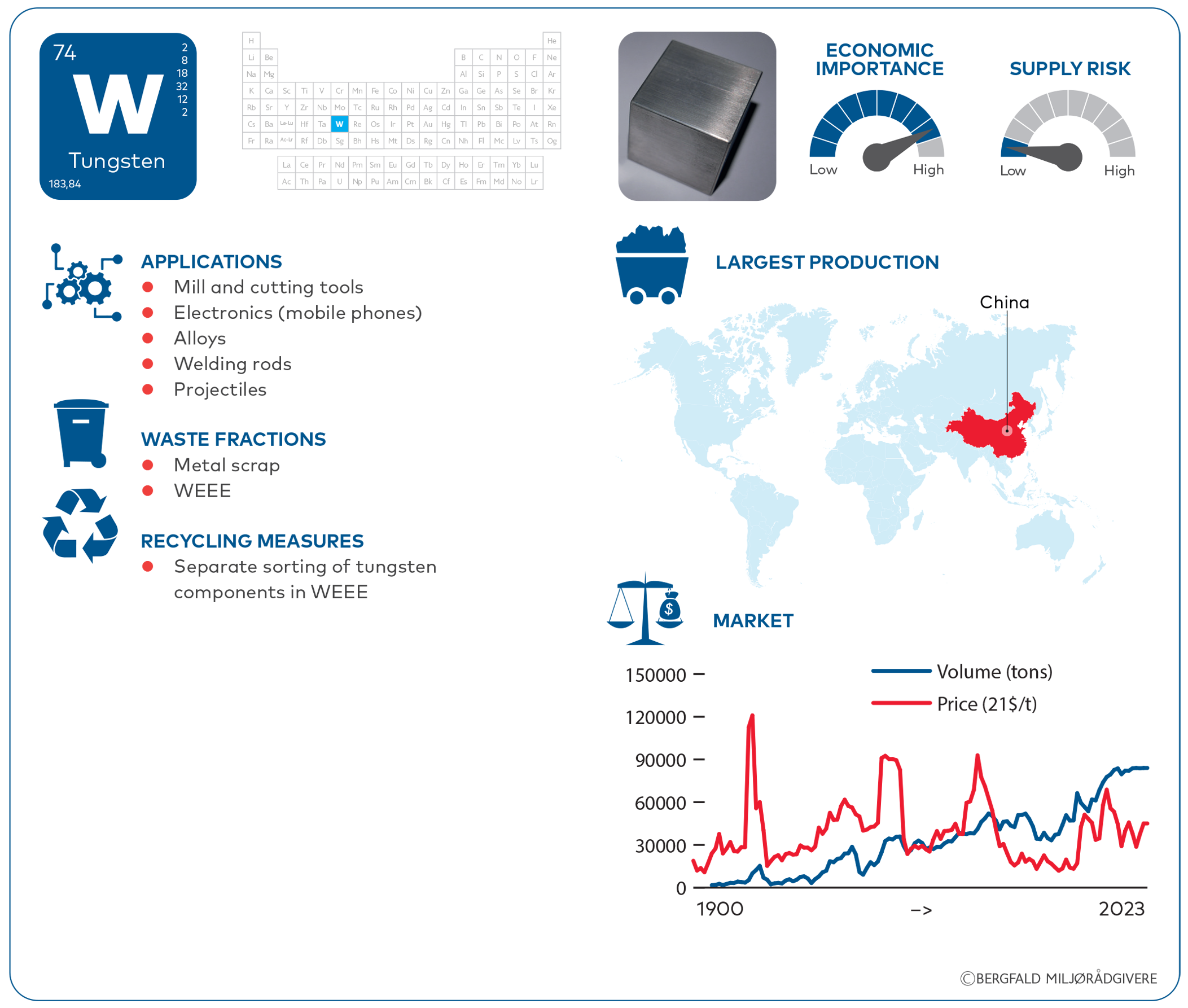
Tungsten is a chemical element with atomic number 74. The metal is hard and have a high density and the highest melting point of all known elements. Tungsten has important applications in super alloys, electronic equipment, coating of cutting and drilling bits, electrodes in gas tungsten arc welding, catalyst and projectiles. Its important ores include scheelite and wolframite, the latter lending the element its alternate name. China is the largest producer of tungsten. The global production of tungsten in 2021 was around 100,000 tons.
Waste streams and systems for recycling
There are well developed recycling systems for tungsten that have a reported recycling rate of 42%. Recycling in the Nordics is organized by the Swedish company Sandvik. The key recycling furnace is in Austria, and Sandvik operate a collection scheme. Increased tungsten recovery from WEEE is possible.
Vanadium
Applications and market situation
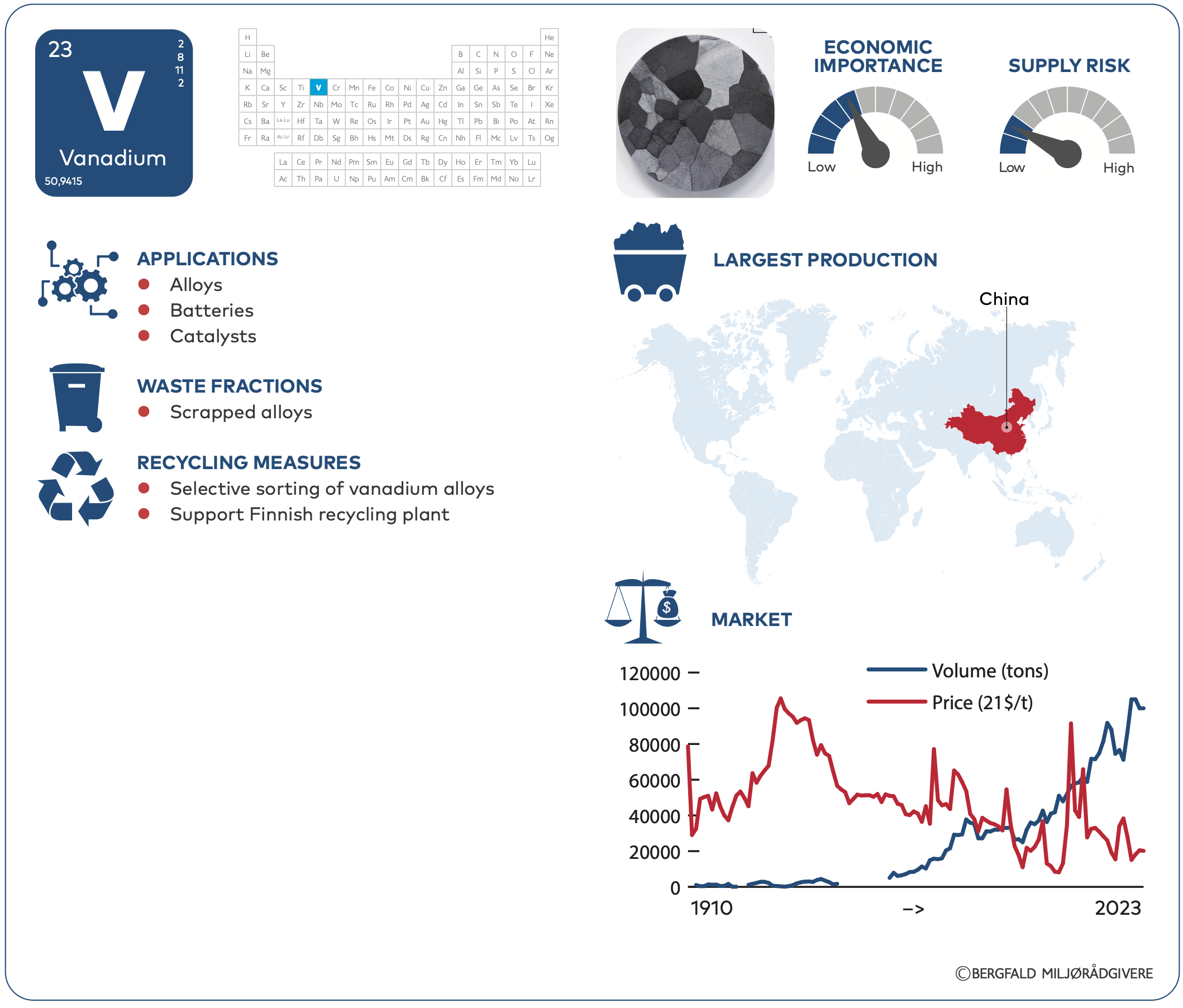
Vanadium is a chemical element with atomic number 23. The metal is hard, silvery-grey and malleable. Important applications include use in batteries, catalysts and alloys. Vanadium is mainly produced from steel smelter slag with China and Russia being the main global producers. The global production of vanadium in 2021 was around 116,000 tons.
Waste streams and systems for recycling
Very little vanadium is recycled globally, and European recycling rate is estimated to be 1%. There is no recycling capacity for postconsumer vanadium or vanadium-containing materials in the Nordic countries. Neometals in Finland have a project to upgrade vanadium-containing blast furnace slags currently produced and landfilled in Sweden and Finland to a commercial ferrovanadium alloy.