Section 7
fuel security
Oil is the second-largest energy carrier in the Nordics, and oil-based petroleum products remain the dominant fuel for transport, with a substantial role in industry, aviation and heating in the Island Energy Systems. Oil accounted for 29 per cent of total final energy consumption in 2024 in the Nordics, though the picture varies considerably across the region (see Figure 7.1). Iceland sits well below that average, with geothermal and hydro covering the bulk of its energy needs, while Greenland and the Faroe Islands are at the opposite extreme, depending on imported oil products for most of their primary energy. Among the mainland Nordic countries, Sweden has cut its oil intensity most sharply by half since 2004
, while Denmark and Norway retain higher shares, reflecting the continued dominance of oil in transport and, in Norway's case, a heating and industrial base that has electrified more gradually.
IEA (2024), Sweden 2024 – Energy Policy Review, International Energy Agency, https://www.iea.org/reports/sweden-2024
Sources: Eurostat, national statistical offices
Notes: To allow for comparison with the Island Energy Systems, the share also includes international aviation and marine bunkers
Three things matter for oil security: how oil is consumed, how the supply chain is structured (refining, stockholding and emergency response), and how exposed the region is to external supply shocks. As of May 2026, the Strait of Hormuz crisis has provided a live example of how the three factors interact with each other (see Box 7.1).
Box 7.1: The 2026 Strait of Hormuz crisis and Nordic fuel security
In March 2026, US and Israeli military operations against Iran prompted Iran to close the Strait of Hormuz. Around 20 per cent of global oil and LNG trade passes through this narrow waterway. The IEA described the resulting supply disruption as the largest in history. As of May 2026, the near-complete closure had lasted over two months. In that time the IEA coordinated its largest-ever emergency stock release (400 million barrels); crude oil prices (Brent) have risen by over 50% and fluctuated heavily in response to hopes and fears that the closure might either ease or extend; and jet fuel prices have roughly doubled compared with 2025 averages.
The direct exposure of the Nordics to Middle Eastern oil supply is modest. Excluding intra-Nordic trade, the Middle East supplied only around 1 per cent of refinery inputs and around 10 per cent of refined products. Yet Nordic consumers are paying sharply higher prices at petrol stations and, increasingly, in airline ticket prices. Crude oil and refined product prices are set by global supply and demand: a sudden removal of 20 per cent of global supply moves prices for every buyer regardless of where their barrels originate. The Nordic region produces significant volumes of oil but does not meet its own refined product demand. Approximately 45 per cent of refinery inputs are sourced from outside the Nordic region, which leaves Nordic consumers fully exposed to global price shifts.
The crisis has not yet produced physical fuel shortages in the Nordic region; the primary constraint remains price rather than availability. By May 2026, jet fuel stocks had nonetheless fallen to their lowest levels since 2015, and a prolonged closure would risk tighter physical supply constraints. Prices had already risen to levels where consumption was becoming uneconomical for many users, and several airlines including Nordic carriers had cancelled flights and raised fares. The Strait of Hormuz crisis underscores a key lesson: reducing oil dependence is the most durable way to insulate Nordic energy security from geopolitical supply shocks.
Sources:
www.iata.org/en/publications/economics/fuel-monitor/
www.bbc.com/news/articles/cqxlnrqjvzyo
IEA (2026), Oil Markets Rerport: May 2026, www.iea.org/reports/oil-market-report-may-2026
www.iata.org/en/publications/economics/fuel-monitor/
www.bbc.com/news/articles/cqxlnrqjvzyo
IEA (2026), Oil Markets Rerport: May 2026, www.iea.org/reports/oil-market-report-may-2026
7.1 Sectoral differences in oil use
Oil consumption is most often associated with road transport, but a significant share of demand sits outside transport in industry, the petrochemical sector and other applications, where electrification is progressing slowly (Figure 7.2). Transport accounts for over 60 per cent of Nordic oil demand, but industry, including petrochemical feedstocks, accounts for a further 21 per cent, driven mainly by petrochemical feedstocks and LPG use.
Source: Eurostat.
Notes: Percentages correspond to fuel share in total oil demand. Other sectors include agriculture, forestry, fishing, military and unspecified consumption. Buildings include residential, public and commercial buildings. Energy sector includes electricity and heat generation and energy industry own use.
The sectoral split shapes the security profile in two ways that matter for the cooperation discussion that follows. Transport remains the dominant exposure channel: a road-fuel disruption would feed straight into the working economy by disrupting business logistics, commuting and the agricultural and fisheries sectors that depend on diesel. Industry exposure is concentrated in petrochemicals and feedstock use, where substitution options are slow to deploy and supply continuity is therefore a security rather than an affordability concern. Aviation is an acute case: jet fuel is both critical for connectivity and the most import-dependent product in the Nordic oil basket, as Section 7.3 sets out. The implication is that “Nordic oil security” does not have a single answer; the cooperation needs are different at the road-transport, industrial-feedstock and aviation tiers, and the geopolitically induced supply and price shocks discussed in Section 1.5 land differently in each.
7.2 Nordic oil supply: production, imports and structural exposure
Within the Nordic region, only Norway and Denmark produce oil at any significant scale, and their positions are fundamentally different (see Box 7.2 for details on their production). Norway is by far Europe’s largest oil and natural gas producer. Norway (14 per cent of EU oil imports in 2025) is the second-largest supplier of oil products to the European Union, behind only the United States (15 per cent). Norway exports nearly 80 per cent of its crude production to the EU, the UK and Nordic neighbours. It is also the EU’s largest supplier of natural gas in gaseous form (52 per cent of EU imports in 2025).
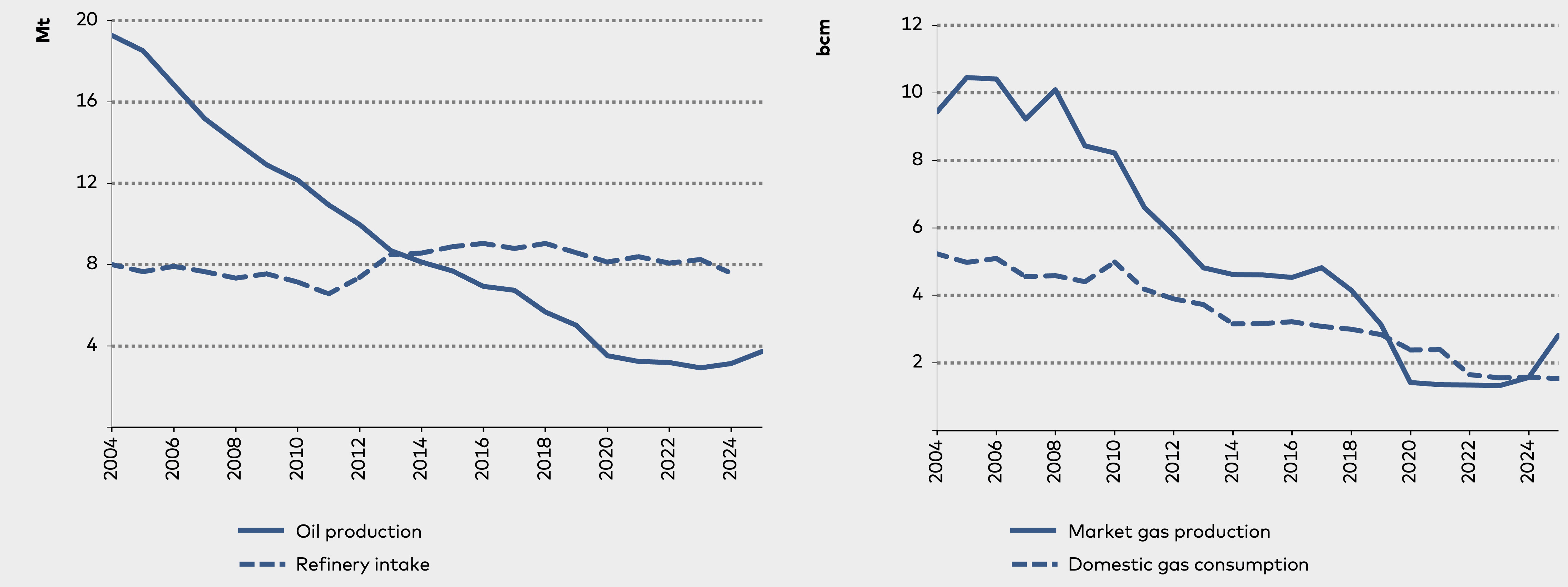
Denmark produces oil but is no longer self-sufficient: domestic crude production covers less than 40 per cent of consumption, and Denmark has been a net crude oil importer since 2017 as North Sea fields have depleted.
Eurostat, EU imports of energy products – latest developments, https://ec.europa.eu/eurostat/statistics-explained/index.php?title=EU_imports_of_energy_products_-_latest_developments
Box 7.2: Oil and natural gas production in Norway and Denmark
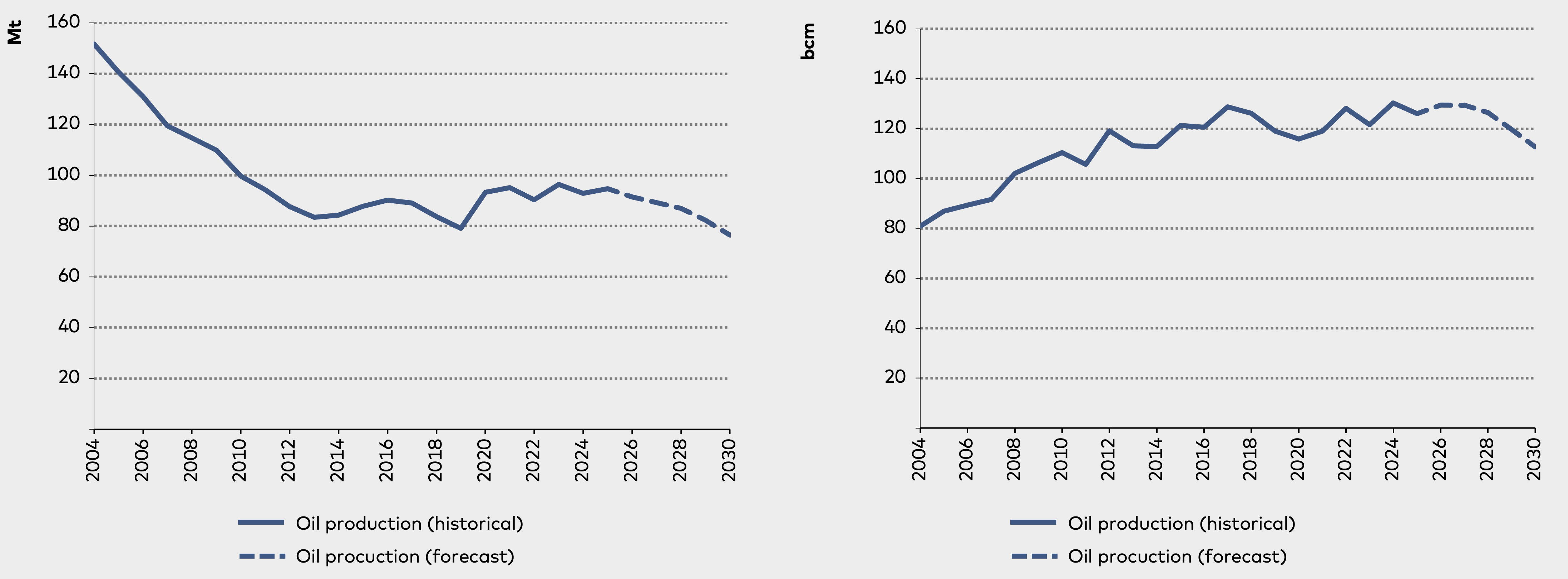
Norway is the only Nordic country that produces hydrocarbons at a scale that matters beyond its own borders. Oil production began in 1971, peaked in 2001 and has since stabilised at around 2 million barrels of oil equivalent per day (roughly 2% of global consumption). Natural gas production reached 126 billion cubic metres in 2025, just below the 2024 record (approximately 3% of global production). Output is forecast to decline by around 10 per cent by 2030. Production is concentrated in the North Sea, and the pipeline and terminal infrastructure connecting it to continental European and UK markets forms part of the wider European energy security system, not only the Nordic one.
Notes: Natural gas reported in standard conditions (15 °C). Reported volumes vary slightly between sources depending on the gas reporting condition.
Norway's oil and natural gas production, 2004–2025 with forecast to 2030
Sources: Eurostat, Energistyrelsen.
Notes: Gas figures exclude biomethane.
Denmark's oil and natural gas production and domestic demand, 2004–2025
All other Nordic countries depend fully on oil imports. Norwegian supply offers a significant buffer against geopolitical oil supply risks: Norwegian oil accounts for 55 per cent of Nordic oil imports, a far higher share than its position as a supplier to the rest of the EU (see Figure 7.3). Even so, proximity to Norway does not shield the Nordics from price shocks, because oil is a globally traded commodity.
This aggregate picture understates the Nordic region's real exposure. The relevant security question is not whether the Nordics import oil in aggregate, which they do substantially, but which specific products are most import-dependent and how exposed those supply chains are to disruption.
Sources: Eurostat; European Commission, EU imports of energy products – latest developments.
Notes: For the Nordics, natural gas includes both LNG and pipeline gas. Shares for the EU are calculated based on import values
7.3 Oil product import dependency and exposure
Headline import dependency understates the risk picture for refined products. A country can produce more energy than it consumes in aggregate and still depend heavily on imports for specific products with high domestic demand. The product-level analysis reveals four findings that matter for energy security.
First, Nordic refining capacity provides a meaningful but imperfect buffer against supply disruptions. Domestic refining reduces dependence on imported finished products from outside the region. In aggregate, the eight refineries operating across Denmark, Finland, Norway and Sweden have sufficient capacity to meet most Nordic refined product demand, but the security value of that capacity is limited in two ways (see Box 7.3 for details on Nordic refining capacity).
Second, the product mix of Nordic refineries does not match the region's import exposure. The Nordic refineries are collectively skewed towards gasoline and heavier products, and they do not have sufficient capacity to meet regional demand for diesel and jet fuel.
Third, regional refining capacity has been declining. Two refineries closed in 2021, removing roughly 15 per cent of Nordic refining capacity. The reduction in refining capacity increases the reliance on imports and further underlines the importance of emergency reserves.
Box 7.3: Nordic oil refining capacity
Eight refineries operate in Denmark, Finland, Norway, and Sweden. The Island Energy Systems have no refineries. The Nynäshamn refinery (Sweden) produces only specialised oil products. Relevant Nordic refining capacity stands at around 51 million tonnes per annum (Mtpa), equivalent to over a million barrels per day (Mbd). Of this capacity, liquid biofuel production accounts for 4 Mtpa (or 7%).
Two refineries closed in 2021, removing about 15% of the regional refining capacity: Naantali (Finland, 3 Mtpa) and Slagen (Norway, 5.8 Mtpa). Reliance on imported refined products has grown as a result. The Porvoo refinery in Finland is also expected to transition fully to renewable products, which would further reduce the region's capacity to refine crude oil.
Country | In operation since | Total capacity (Mtpa) | Of which: Biofuels (Mtpa) | Operator | |
Kalundborg | Denmark | 1961 | 5.5 | - | Klesch Group |
Fredericia | Denmark | 1966 | ~3.5 | - | Crossbridge Energy |
Porvoo | Finland | 1966 | 12.0 | 2.0 | Neste Oyj |
Mongstad | Norway | 1975 | 11.0* | - | Equinor / Shell |
St1 Gothenburg | Sweden | 1940s | 4.0 | 0.2 | St1 |
Preemraff Gothenburg | Sweden | 1967 | 6.4* | 0.3 | VAROPreem |
Preemraff Lysekil | Sweden | 1975 | 10.7* | 1.0 | VAROPreem |
Total | 51.0 | 4.0 | |||
Nynäshamn | Sweden | 1928 | 1.5 | - | Nynas AB |
Sources: Annual reports and websites of the operating companies
Notes: * capacity calculated from original reporting unit (1000 barrels / day = kbd) with average density of 7.5 barrels/tonne). For refinery capacity definition, see Annex 1.
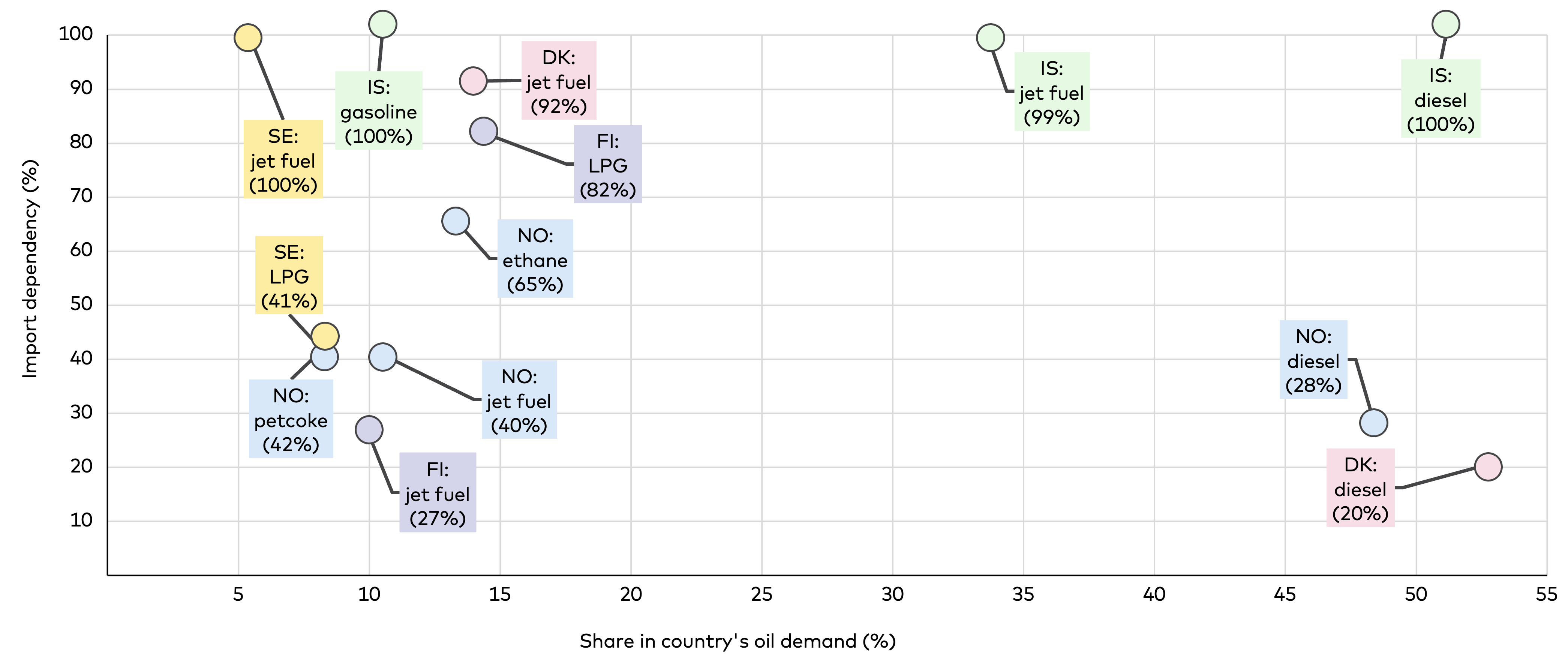
Fourth, and most strikingly, jet fuel stands out across the entire region as a critical import dependence vulnerability: combined Nordic jet fuel import dependency reaches 68 per cent (see Figure 7.4). In the period 2004–2024, jet fuel production in the Nordics fell by one-third (total refined product output fell only 12 per cent). Finland has the highest share of domestic jet fuel production, accounting for two-thirds of demand. Norway is also able to cover more than half of its jet fuel demand from domestic production. Denmark, Iceland and Sweden are effectively fully dependent on imports for their jet fuel supply.
Source: Eurostat.
Notes: Analysis excludes Greenland, the Faroe Islands and Åland. Only products above a 5 per cent share of national oil demand are shown. Oil product demand includes international marine and aviation bunkers. See details of methodology in Annex 1.
Internal Nordic trade in refined products is small, and only Iceland imports most of its most-exposed refined petroleum products from other Nordic countries (see Figure 7.5). The EU, the United Kingdom and the United States supply most of the import needs for diesel, LPG and other major products. Jet kerosene is again the clear outlier: most Nordic imports originate in the Middle East and Asia. The aggregate picture of Nordic oil import dependence is therefore more favourable than the position in critical products such as jet fuel.
Source: Eurostat.
Notes: Oil demand includes international marine and aviation bunkers.
Notes: Oil demand includes international marine and aviation bunkers.
7.4 Stockholding and emergency response mechanisms
Oil stocks are in place to give governments time to respond when supply is disrupted. Releasing reserves cushions the economic impact of price spikes and shortages and buys time for demand-restraint measures to take effect. They are not instruments for managing routine market-driven price movements that are better addressed through diversification and demand reduction.
The four mainland Nordic countries sit in three distinct governance frameworks, and the differences matter. Denmark, Finland and Sweden are members of both the EU and the International Energy Agency (IEA). They are bound by the more demanding of the two sets of obligations. Norway is an IEA member but not an EU member. Iceland belongs to neither, but emergency reserve regulations are under review by the Ministry for the Environment, Energy and Climate as of May 2026, but no requirements are yet in force. The obligations attached to the EU and IEA frameworks are set out in Table 7.1.
EU obligations | IEA obligations |
|---|---|
Stockholding: At least 90 days of net imports or 61 days of consumption, whichever is higher. Monthly statistical reporting to the European Commission. Only stocks owned by the member state or its central stockholding entity are counted towards the emergency reserves. Legal basis: Directive 2009/119/EC (Oil Stocks Directive). | Stockholding: At least 90 days of net imports, only obliges net importers of oil. Obligation can be met flexibly through emergency stocks, commercial stocks, or stocks held abroad under bilateral agreements. Stockholding structures peer-reviewed every five years. Legal basis: Agreement on an International Energy Programme. |
Emergency response: Each member state must analyse oil supply disruption risks and put crisis management procedures in place. The European Commission organises consultation between member states during a crisis. Stock withdrawals are not made before consultation except in urgent situations. The Oil Coordination Group provides standing advisory coordination with the IEA. | Emergency response: The IEA Secretariat assesses the market impact of disruptions and the case for coordinated response. If a disruption is judged sufficiently large, an IEA collective action may be recommended. Each member country contributes in proportion to its share of total IEA oil consumption. Members must maintain demand-restraint programmes capable of reducing oil consumption by up to 10 per cent. |
Denmark, Finland and Sweden have consistently fulfilled their EU stockholding obligations (Figure 7.6). Finland stands out as the strongest performer by a considerable margin, holding stocks well above the required minimum level, reflecting a long-standing national preparedness culture that treats energy reserves as part of broader supply security policy. Sweden tracks the 90-day import threshold more closely, and Denmark operates under the 61-day consumption criterion because part of its consumption is met by domestic production, which reduces its import dependency.
Source: Eurostat.
Notes: Finland and Sweden must meet the 90-day net imports criterion; Denmark the 61-day consumption criterion.
The EU and IEA mechanisms use different accounting rules, with the EU applying stricter eligibility criteria on industry-held stocks, which means the two headline numbers are not directly comparable for the same physical inventory. The EU rules are stricter on what counts, particularly on industry-held stocks. Figure 7.7 shows the comparison for January 2026 (For detailed calculation methodology, see Annex 1 section A1.2.5 and A1.2.6.
Source: IEA, Eurostat.
Notes: For Denmark, stocks towards the EU directive are measured as days of consumption.
Notes: For Denmark, stocks towards the EU directive are measured as days of consumption.
Norway's position is the most anomalous among the Nordic countries. The IEA stockholding mechanism binds only member countries that are net importers. As Europe's largest oil producer and exporter, Norway is ‘free’ of these rules. This allowed it to reduce the mandatory fuel readiness requirement from 90 to 20 days of consumption in 2007 against the recommendation of the IEA. This was done at a time when the country had two operational refineries and a policy assumption that production volumes made large domestic reserves unnecessary. One of those two refineries (the Slagen plant operated by ExxonMobil) closed in 2021, reducing Norway's domestic refining capacity by roughly a third.
Norway remains significantly dependent on imports for diesel and jet fuel specifically, and the 20-day stockholding obligation has never been revised to reflect either the changed refining footprint or the product-level vulnerabilities.
Argus Media (2021), 'ExxonMobil shut Norway Slagen refinery in June', https://www.argusmedia.com/ja/news-and-insights/latest-market-news/2237347-exxonmobil-shut-norway-slagen-refinery-in-june
Nordic Reporter (2026), 'Norway ill-prepared for energy crisis: only 20 days of reserves', April 2026, https://nordicreporter.com/2026/04/norway-ill-prepared-for-energy-crisis-only-20-days-of-reserves/
The North Atlantic Island Energy Systems (Iceland, Faroe Islands and Greenland) are the most exposed in terms of limited emergency reserves. All three are entirely dependent on imported oil products delivered through a small number of ports, with no pipeline connections to continental Europe. None of them are subject to mandatory stockholding frameworks of the EU or the IEA. In all three cases, the stocks that exist are operational reserves held by private fuel importers, with quantities not publicly disclosed. In Iceland, emergency reserve regulations are under review by the Ministry for the Environment, Energy and Climate as of May 2026, but no requirements are yet in force.
The result is a striking inversion: the countries most physically exposed to supply disruption, and facing the most severe weather constraints on delivery, are also the ones that sit entirely outside the formal reserve frameworks.
Iceland Monitor (2026), 'Government discusses emergency oil reserves', March 2026, https://icelandmonitor.mbl.is/news/politics_and_society/2026/03/14/government_discusses_emergency_oil_reserves/
7.5 Nordic fuel security cooperation
There is no dedicated Nordic fuel security cooperation framework comparable to NordBER for electricity. Cooperation runs along three tracks. The first is the IEA collective-action framework, which is the operational backbone for the four IEA-member Nordic countries (Denmark, Finland, Norway and Sweden) and was activated at the largest scale in the agency’s history during the 2026 Strait of Hormuz crisis with a coordinated 400 million barrel release.
The second track is the EU oil stocks regime, binding on Denmark, Finland and Sweden but not on Norway, Iceland or the Island Energy Systems. The third track, and the most relevant for Nordic-level cooperation specifically, is bilateral.
IEA (2026), Update on IEA Collective Action decision of 11 March 2026, International Energy Agency, https://www.iea.org/news/update-on-iea-collective-action-decision-of-11-march-2026
The most developed bilateral relationship is between Finland and Sweden, set out in Section 3.1.4. Conducted between Finland’s NESA and Sweden’s MSB under the framework of the 1992 Finland-Sweden security of supply agreement and the NESA-MSB joint strategic cooperation plan, the cooperation covers material preparedness across multiple sectors, including the piloting of joint emergency stockpiles relevant to fuel security. The fuel-specific application of this cooperation has not been fully elaborated in public communications and is therefore one of the areas where Nordic-level extension would benefit from targeted scoping. Beyond the Finland-Sweden track, formal Nordic-level cooperation on fuel security is thin. No multilateral Nordic forum coordinates national positions ahead of IEA collective-action discussions, and there is no regional mechanism to channel demand-restraint or affordability protection towards the autonomous and Island Energy Systems that sit outside the IEA framework.
Jet fuel, the most exposed Nordic oil product, is the clearest single carrier-level cooperation gap. The EU Commission’s May 2026 jet fuel coordination work, set up in response to the Strait of Hormuz Strait crisis to coordinate alternative jet fuel sourcing and propose distribution measures across Member States, is the binding framework for Denmark, Finland, and Sweden.
Norway engages with this work through its bilateral arrangements with the EU rather than as part of a Nordic position, and the Faroe Islands and Greenland sit outside the framework. The structural gap that emerges is therefore narrower than the gas case in 6.1 but real: a region with structurally elevated jet-fuel exposure, a refining base that does not match its product mix, and a stockholding regime that runs through three separate governance frameworks does not have a Nordic-level forum in which to coordinate. Section 8.4 returns to this with concrete recommendations.
European Commission (2026), 'EU prepares coordinated response to address jet fuel supply situation', press release, 7 May 2026, https://energy.ec.europa.eu/news/eu-prepares-coordinated-response-address-jet-fuel-supply-situation-conflict-middle-east-persists-2026-05-07_en
7.6 Fuel security: key findings for the Nordics
Overall oil dependence in the Nordics is trending downward, and Norway's production base provides a regional buffer that few other parts of Europe enjoy. The aggregate picture conceals where the real exposure sits. Refining capacity has fallen by around 16 per cent since 2021, and the regional product mix is skewed towards gasoline and heavier fractions. Diesel and jet fuel are the products where Nordic refining falls furthest short of demand, and jet fuel is a region-wide vulnerability. The 2026 Strait of Hormuz crisis is the live demonstration that price exposure to a global supply shock does not depend on direct import dependence.
The stockholding picture is uneven. Denmark, Finland and Sweden meet their EU and IEA obligations, with Finland holding stocks well above the required minimum. Norway sits outside the EU framework and reduced its mandatory readiness to 20 days of consumption in 2007, an obligation set when the country had two operational refineries. Iceland, the Faroe Islands and Greenland sit outside both the EU and the IEA frameworks and have no mandatory stockholding regime, despite being the most physically exposed parts of the region to supply shocks. Reducing oil dependence remains the most durable answer to global price shocks, but the more immediate cooperation question is whether the existing reserve and emergency-response architecture matches the actual exposure profile of the region.
Cooperation runs along three tracks: the IEA collective-action framework, the EU oil stocks regime, and bilateral arrangements, of which the Finland-Sweden NESA-MSB cooperation set out in Section 3.1.4 is the most developed. There is no dedicated Nordic fuel security cooperation framework. The trilemma trade-off in this carrier sits primarily on the affordability side: the Hormuz crisis demonstrated that price exposure to a global supply shock does not depend on direct import dependence, and the region’s most acute carrier-level vulnerability, jet fuel, has neither a dedicated Nordic forum nor a framework that brings Norway’s production base into shared regional crisis-response procedures. Section 8.4 takes that question forward.