Section 1
Understanding nordic energy security
This section sets out the conceptual frame for the rest of the report. It does so in four steps. Sub-sections 1.1 and 1.2 describe the two structural realities that any Nordic energy security framework needs to take seriously: the parallel tracks of electrification and continuing fuel dependence, and the geographic and institutional heterogeneity of the region. Sub-section 1.3 sets out the value-add test that determines where Nordic-level cooperation makes sense relative to bilateral, EU and NATO-level alternatives. Sub-sections 1.4 and 1.5 introduce the analytical tools used in the rest of the report: the energy trilemma as the lens for navigating the trade-offs between security, affordability and sustainability, and a typology of risks and resilience measures that informs the carrier-specific analysis. Sub-section 1.6 carries the framework forward into the cooperation discussion that follows.
In April 2026, an online headline announced that Norway was facing a fuel shortage within weeks. Months earlier, the claim would have looked like clickbait. By mid-April it reflected a real set of pressures. As of May 2026, the Strait of Hormuz crisis had removed around a fifth of global oil and gas flows from the market and sent commodity prices sharply higher, with spillover effects across the Nordic region despite the region's relatively low dependence on direct imports through the Strait.
The episode illustrates the starting point for this report. Energy security in the Nordic countries is not a solved problem, and the tools required to manage it are not only national ones.
The effects of the Hormuz Strait crisis are based on information available as of 18 May 2026. The most detailed account of the developments at the time is presented in the IEA’s monthly oil market report. See IEA (2026), Oil Market Report – May 2026, International Energy Agency, https://www.iea.org/reports/oil-market-report-may-2026
1.1 Two tracks of Nordic energy security: electricity and fuels
The Nordic energy system story of the past two decades has two parallel tracks, and a Nordic energy security framework needs to keep both in view. The first is the ongoing transformation of electricity generation towards low-carbon sources: roughly 90 per cent of Nordic electricity now comes from hydropower, wind, nuclear, and a growing share of solar. The second is the slow decline of combustion-based fuels in the energy mix outside of electricity. Oil alone still covers close to a quarter of total Nordic energy consumption, concentrated in road transport (roughly 60 per cent of oil use), industry, aviation, and as the dominant heating and back-up fuel in the Faroe Islands and Greenland.
Eurostat, energy statistics, https://ec.europa.eu/eurostat/web/energy/data
The distinction between electricity and energy matters for how this report frames Nordic energy security. In everyday discussions, the two terms are often used interchangeably, but electricity is only one of several energy carriers alongside oil products, natural gas, district heat, and biofuels that together make up the energy a society consumes. Despite the globally accelerating electrification trend, electricity has accounted for a remarkably stable share of total Nordic final consumption over the past two decades: roughly a quarter. Iceland is the clear outlier, because of its electrified industrial base.
The rising share of renewables in electricity generation, not overall electrification, has done most of the work in displacing fossil fuels in final consumption since the early 2000s. The outlook for the future is clear: electricity consumption is expected to rise substantially as transport and industry electrify. Rising electricity consumption combined with variable renewable generation will create new energy security demands, from managing system complexity to investing in flexible generation, demand-side flexibility, and grid-scale batteries and storage.
IEA, Iceland country profile, https://www.iea.org/countries/iceland/electricity
The dual reality has two implications for this report’s framing. The security of combustion-based fuels remains a first-order energy security concern. Oil products, residual natural gas, and the maritime and refinery logistics that bring them to consumers are not a legacy issue erased by the energy transition in the short term. At the same time, the centre of gravity of energy security is shifting towards electricity, and the institutional architecture for managing energy security needs to balance both the present reality and the direction of change.
1.2 Nordic energy security cooperation’s geographic and institutional realities
The second feature that a Nordic-specific framework must take seriously is the internal heterogeneity of the region. The four mainland Nordic countries are not a uniform energy bloc, and Island Energy Systems of Iceland, Greenland, the Faroe Islands and Åland have different energy system architectures and distinct challenges. Three structural distinctions matter for energy security analysis.
The first is geographic configuration. The four mainland Nordic countries' electricity systems are tightly interwoven with each other and with Central Europe and the Baltic States, operating as one integrated market through Nord Pool and ENTSO-E. Iceland is a single, fully isolated synchronous system with no connection to continental Europe. The Faroe Islands operate a small, oil-dominated isolated grid. Greenland is not a single grid at all but a set of standalone microgrids spread across coastal settlements. These configurations exhibit different vulnerabilities and call on different cooperation instruments.
The second distinction is resource endowment and overall energy mix. Norway is a major fossil fuel exporter and the cornerstone of Europe's natural gas supply. Sweden combines large hydro and nuclear electricity generation with a structurally constrained north-south transmission corridor. Denmark is at the leading edge of offshore wind development. Finland has added new domestic nuclear capacity, complemented by tenfold growth in wind generation over ten years. Iceland is the global leader in geothermal energy. Greenland and the Faroe Islands are oil-import-dependent for the bulk of their primary energy despite ramping up renewable generation. These differences mean that the same external shock from a low-wind cold winter, a geopolitical supply disruption to a subsea cable cut has very different local effects across the region.
The third distinction is institutional. Denmark, Finland, and Sweden are EU member states operating within the full Energy Union regulatory framework. Norway participates through European Economic Area (EEA) membership, with technical engagement but no vote in EU political decisions. Iceland is also in the EEA but, because of a lack of physical links, its energy market integration with the rest of Europe is more limited. The Faroe Islands and Greenland are self-governed regions of the Kingdom of Denmark and sit outside the EU framework altogether. Åland is an autonomous part of Finland with a distinctive demilitarised status.
Nordic energy security cooperation needs to take this institutional diversity into account by neither over-promising cohesion nor under-utilising the participation that is available. Heterogeneity is not only a complication; it is also the region’s most important asset. An interconnected system that brings together Norwegian hydro, Swedish nuclear and hydro, Finnish nuclear and wind, and Danish wind hedges against concentration risks at national level. For example, interconnections and diversified energy systems provide a buffer against shortfalls in wind output. At the same time, the distinct energy profiles especially of Island Energy Systems mean that Nordic energy security cooperation needs to be flexible: not every issue is relevant to every actor.
Energy security was, until recently, a politically sensitive area within Nordic cooperation. The word 'security' carried defence connotations that fell outside the mandate of the Nordic Council of Ministers: practitioners familiar with that history describe a culture in which discussions would 'shut down' at the first mention of national security framing.
Three developments have dissolved that hesitancy. Russia's full-scale invasion of Ukraine in February 2022 triggered a Europe-wide energy crisis whose price effects reached deep into the Nordic electricity market. A series of incidents of suspected sabotage on subsea energy infrastructure in the Baltic Sea between 2022 and 2024 (the Nord Stream pipeline explosions, the Balticconnector gas pipeline, and the Estlink 2 interconnector anchor-drag damage) demonstrated that infrastructure previously assumed safe from deliberate attack is now a target (See Table 1.1 for overview of the incidents).
Interview with senior Nordic energy official, conducted for this project, 2026 (not for attribution).
Incident | Description and energy security impact | Investigation status |
Nord Stream 1 and 2 | 26–29 September 2022. Four leaks on the Nord Stream 1 and 2 gas pipelines in the Swedish and Danish EEZs near Bornholm, caused by underwater explosions. Both pipelines rendered inoperable; several hundred million cubic metres of methane released. Direct supply impact limited as Nord Stream 1 flows had been halted and Nord Stream 2 was not operational. | Confirmed sabotage; perpetrator under investigation Reuters (2025), What is known about the Nord Stream gas pipeline explosions?, https://www.reuters.com/world/europe/what-is-known-about-nord-stream-gas-pipeline-explosions-2025-08-21/ |
Balticconnector | 8 October 2023. The 77 km Balticconnector gas pipeline between Finland and Estonia and two adjacent telecommunications cables damaged in the Finnish EEZ. Pipeline offline for around seven months; Finland's gas system relied on LNG imports via Inkoo. Direct gas dependency on the pipeline was around 5 per cent. | Vessel-caused damage confirmed; intent contested Ringbom, H., & Lott, A. (2024). Sabotage of Critical Offshore Infrastructure: a Case Study of the Balticconnector Incident. In A. Lott (Ed.), Maritime Security Law in Hybrid Warfare (pp. 155). Brill. https://urn.fi/URN:NBN:fi-fe2025022614432 |
Estlink 2 | 25 December 2024. The Estlink 2 submarine power cable between Finland and Estonia plus four telecommunications cables severed in the Gulf of Finland. Cross-border transfer capacity reduced from 1,016 MW to 358 MW for over seven months, with repair costs of approximately €60–70 million. Outage during peak winter demand. | Vessel-caused damage confirmed; intent disputed in court Reuters (2025) “Finnish Court Dismisses Case Againt Crew in Baltic Sea Cable Breah Trial”, https://www.reuters.com/business/media-telecom/finnish-court-deliver-verdict-baltic-sea-cable-breach-trial-against-tanker-crew-2025-10-03/ |
The 2026 Strait of Hormuz crisis has demonstrated that even in the absence of direct disruption of fuel supply, global price shocks have cascading effects that directly affect Nordic energy security. These developments represent a structural shift in the threat environment for which existing cooperation frameworks are not yet fully adapted.
European Commission and NATO (2023), EU-NATO Task Force on the Resilience of Critical Infrastructure: Final Assessment Report.
1.3 The value added of Nordic energy cooperation
Within these overlapping geographies, Nordic cooperation adds distinctive value where it is situated as a complementary addition to existing cooperation taking place under EU, NATO and other international frameworks, not as a duplicative process.
The continental Nordic countries are also embedded in a wider regional system that extends beyond the Nordic perimeter. The Baltic Sea region has seen rapid integration in recent years, both in infrastructure terms and in cooperation architecture. Denmark, Finland and Sweden maintain deep bilateral energy ties with their Baltic Sea neighbours, and the synchronisation of the Baltic States' electricity grids with continental Europe in February 2025 has materially altered the regional connectivity picture. Nordic and Baltic TSOs now operate in a shared synchronous area, and the security of cross-border infrastructure in the Baltic Sea, subsea cables, interconnectors, and gas pipelines is a matter of joint concern that cuts across the Nordic-Baltic region. This regional embeddedness shapes what Nordic energy cooperation can and should do: some challenges are best addressed at the Nordic level, others require a broader Nordic-Baltic or EU-level framing.
This study and roadmap for deepened Nordic-level energy security cooperation argues that Nordic cooperation adds value over national and/or existing international cooperation when:
- The risk is genuinely cross-border. No single country can address it alone, and national action creates externalities for neighbours.
- Collective action creates economies of scale. For example, joint stockpiling of large power transformers, shared cable repair vessel access, and joint cyber exercises are cheaper or more effective collectively than individually.
- Common standards reduce friction in emergency response. Interoperability built in peacetime is the precondition for cooperation in crisis. The speed of joint response during an emergency depends on the depth of the relationships established before it.
- Norway’s inclusion matters. Norway participates in the internal energy market through the EEA Agreement and is fully integrated into Nordic and European electricity market structures through ENTSO-E and Nord Pool. It is not, however, subject to EU energy security legislation in the same way as member states, and key EU emergency coordination mechanisms do not automatically extend to it. Nordic cooperation provides a framework for measures where the gap is consequential, particularly in gas supply coordination and cross-border emergency response, and this framework includes Norway in ways that EU-only mechanisms do not.
- Island Energy Systems are involved. Faroe Islands, and Greenland, which fall outside EU energy frameworks entirely, and for Åland, with its specific autonomous status, Nordic cooperation is the main forum for international cooperation. Iceland participates in the internal energy market through the EEA Agreement and participates in ENTSO-E and Nordic electricity market structures. It is not, however, subject to EU energy security legislation or part of EU emergency coordination mechanisms.
The Nordic region is not only part of European energy security frameworks but also a structural provider of energy security beyond the Nordic region. Norway supplied approximately 130 billion cubic metres of natural gas in 2024, with roughly 95 per cent exported to EU and UK markets by pipeline, making Norway the single largest gas supplier to European markets by volume.
Norwegian and Swedish hydro reservoirs, with combined storage capacity of around 140 TWh, function as a seasonal battery for the wider European electricity system. Denmark and Norway are in the early stages of becoming major offshore wind exporters, with projects such as the Bornholm Energy Island already under development.
Council of the European Union, 'Where does the EU's gas come from?', https://www.consilium.europa.eu/en/infographics/where-does-the-eu-s-gas-come-from/.
Nordic Energy Research (2024), Tracking Nordic Clean Energy Progress 2024 – More flexible storage needed, NER 2024-05, http://dx.doi.org/10.6027/NER2024-05
The Nordic region’s role as an energy security provider is a genuine strength but also a source of domestic political tension, visible most sharply in Norway and Sweden: the integration that delivers European energy security also transmits European price shocks into Nordic household bills. This has prompted calls to halt the construction of new interconnectors to the rest of Europe, and in some cases to sever existing links. In parallel, EU-NATO threat assessments document that Russian intelligence activity actively maps Nordic undersea infrastructure that is critical to the provider role.
European Commission and NATO (2023), EU-NATO Task Force on the Resilience of Critical Infrastructure: Final Assessment Report.
1.4 Theoretical framework: the energy trilemma
The Energy Trilemma, formalised by the World Energy Council, treats energy policy as the simultaneous management of three goals (security, affordability, and sustainability) that often pull in different directions.
The trilemma has become the dominant framing in European and Nordic policy discussion because it captures the political reality of trade-offs between keeping the system reliable, keeping it affordable, and keeping the energy transition on track. This report adopts the trilemma as its analytical lens, applying it to the directions in which the threat environment, the carrier scope, and the geographic coverage of Nordic energy security have moved since 2023.
Nordic Energy Research (2023), Nordic Energy Trilemma, http://dx.doi.org/10.6027/NER2023-04
Nordic Energy Research (2024), Energy Poverty in the Nordic Countries, https://pub.norden.org/nordicenergyresearch2024-02/
1.4.1 The three pillars of the energy trilemma
The trilemma captures three intertwined dynamics that sometimes present trade-offs between each other:
- Security: the ability to supply current and future energy demand reliably and to withstand and recover from system shocks through effective crisis management. In the Nordic context, this covers the physical adequacy of electricity supply across seasonal and geopolitical stress windows, the protection and repair of critical infrastructure (notably subsea electricity cables and gas pipelines), the security of fuel supply chains for transport and heating, and the resilience of the clean-technology supply chains underpinning the energy transition. This is the pillar this report develops in depth, in recognition that policy choices need to balance the full trilemma.
- Affordability: the ability to provide reliable energy for residential and industrial consumers at a price that does not undermine public welfare or political support for the energy transition. In the Nordic context, the 2022 price crisis showed how continental European gas-indexed electricity prices generate significant spillover effects across the Nordic countries
- Sustainability: the extent to which the green energy transition mitigates potential climate impacts by transitioning from fossil-based to low-carbon energy systems. In the Nordic context, the energy security relevance of sustainability lies in the way the transition itself reshapes the security agenda: with the increased role of electricity in the overall energy mix, new clean-technology supply-chain dependencies emerge, and new physical infrastructure risks arise, ranging from offshore wind farms to high-voltage interconnectors.
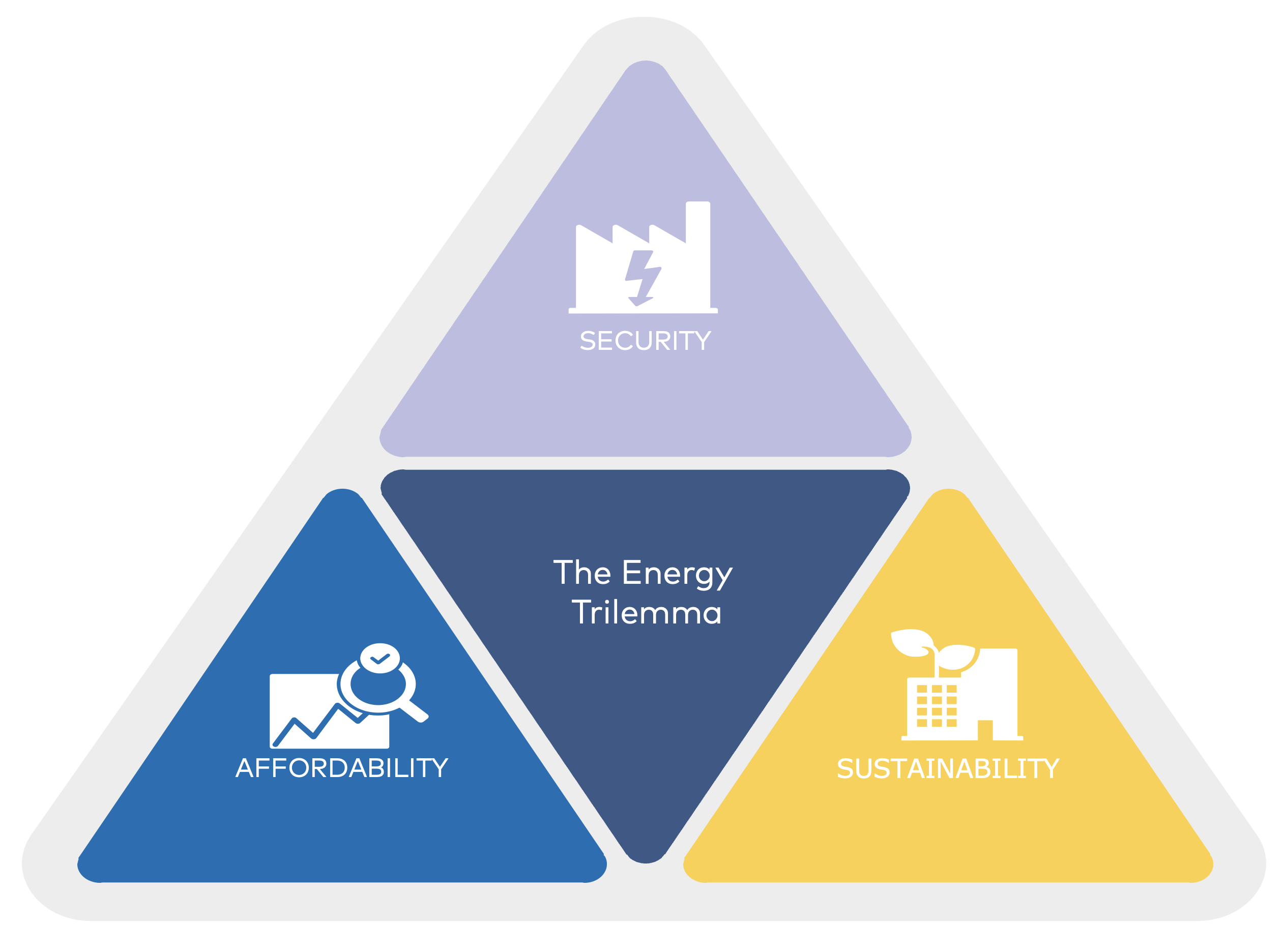
In the context of the trilemma, energy security is most usefully understood as making available a sufficient quantity of energy in a reliable and affordable way. It is not an end state that can be achieved and then maintained passively; it requires constant attention and management as the system, the actors, and the threats all evolve. Political decisions to strengthen energy security also need to be balanced against sustainability and affordability, and the policy response has to evolve with the underlying conditions.
Three trade-offs make the trilemma concrete in the Nordic context. Electricity interconnections deliver cross-border supply security and integrate Nordic renewables into European markets, but they also transmit European price volatility into Nordic household bills, generating political pressure that can constrain future integration. The offshore infrastructure that underpins Norway's role as Europe's largest pipeline gas supplier and the Nordic region's emerging position in offshore wind also concentrate security exposure in subsea assets that are difficult to monitor, protect, and repair.
Electrification illustrates the trilemma in both directions at once: it reduces the system's exposure to continuous fossil fuel import flows and advances the sustainability pillar, but shifts security weight onto physical electricity infrastructure where disruption of a single critical node can cascade across the system. The sustainability tension is sharpest on the fuel side: imported refined products remain critical for transport and aviation despite gradual demand decline, and addressing that exposure through expanded domestic refining capacity would run directly against the climate commitments of Nordic governments and energy companies.
1.5 Types of energy security risks and resilience measures
The concrete threats to energy security range from local to global, and the impact of a materialised risk can be short-lived (an extreme weather event) or persistent (a structural shift in geopolitical alignments or supply chains). Local risks originate within a country and have local impact. Regional risks may originate in one country but have an impact at the Nordic level. Global risks affect all countries regardless of their origin. The categories are not mutually exclusive; a single event such as the Estlink 2 incident or the 2026 Strait of Hormuz disruption can generate effects across all three levels simultaneously.
Risk level | Short-term impacts (days to weeks) | Long-term impacts (months to years) |
|---|---|---|
Local risk | Prolonged extreme weather patterns may lead to electricity rationing when large share of generation is based on wind, solar or hydro. | Concentrated supply chains for energy commodities elevate the impacts of supply disruptions. Unpredictable changes in national energy and climate policies may slow investments in energy infrastructure and unfairly punish the front-runners. Misinformed municipality-level policy decisions may block nationally important energy infrastructure projects. |
Regional risk | Military aggression by a neighbour country may target key energy infrastructure, including via sabotage. Sudden loss of a large electricity generation unit or an interconnector may elevate the prices in the Nordic electricity markets. | Lack of support for regional cooperation may lead to sub-optimal energy system design (e.g. by slowing interconnection development). |
Global risk | Energy resource supply shocks due to military conflict or other logistical chain disruptions quickly elevate end-use prices. Cyber attacks may incapacitate critical energy infrastructure (e.g. transmission systems, pipelines, power plants). | Prolonged global supply shocks may dry out fuel stocks, leading to sky-high prices and fuel rationing. Climate change gradually changes the weather patterns, impacting weather-dependent electricity generation but also the seasonal energy demand. |
Notes: Local risks originate from within the country and have local impact;
Regional risks may originate from one country but have an impact at the Nordic level;
Global risks may impact all countries regardless of the origin of the risk.
Regional risks may originate from one country but have an impact at the Nordic level;
Global risks may impact all countries regardless of the origin of the risk.
1.5.1 Energy security resilience measures
While the threats are multidimensional, the mitigation concepts are relatively simple and universally applicable: predictability of policies, diversification of the energy system, and cooperation at the regional and international level. Implementation is where the challenge lies, because some measures require notable time and financial investment.
Resilience can be understood as the capacity of an energy system to (i) prepare for disruptions, (ii) withstand shocks while maintaining operations, and (iii) rapidly restore service. That capacity needs to be adequate across the full range of relevant circumstances, from weather events to deliberate geopolitical action.
The IEA has distilled lessons from Ukraine's experience under sustained Russian attack on its energy system since 2022 into a ten-point resilience toolkit.
The list is not specific to wartime conditions: most of the items map directly onto vulnerabilities the Nordic region already faces, and the report returns to several of them in the carrier-specific sections that follow:
IEA (2026), Energy System Resilience: Lessons from Ukraine, International Energy Agency.
- Put resilience at the centre of energy system planning.
- Implement physical hardening and defence measures.
- Build comprehensive emergency response capabilities that cover multiple threat scenarios.
- Ensure effective emergency communication mechanisms to reach citizens.
- Leverage decentralisation and distributed resources as strategic security assets.
- Maintain emergency oil stocks as a buffer against supply shocks.
- Standardise and stockpile critical equipment.
- Treat data as a strategic asset and continue its collection during emergencies.
- Embed cyber resilience into all aspects of system planning and operations.
- Build mechanisms for cross-border cooperation.
The resilience principles set out the philosophy that should shape energy security policy. To translate those principles into action, governments need to be able to measure where their system stands, where it has improved, and where it remains exposed.
1.5.2 Measuring energy security
A small set of widely used quantitative indicators provides the basic toolkit for this purpose. The indicators in Table 1.2 are the ones most commonly used to assess national energy security performance, and the report draws on them throughout the energy profiles and the country-level analysis in later sections. No single indicator captures all aspects of energy security, but together they help governments to ask the right questions and to measure the impact of the actions taken.
Indicator | Question answered | Description and data source |
|---|---|---|
Import dependency | How much of our energy is imported? | Share of energy demand met through net imports, for the overall energy balance or by source. Emphasises external exposure. |
Self-sufficiency | How much of our energy demand can we produce domestically? | Share of energy demand met by domestic production, for the overall balance or by source. Emphasises domestic capacity. Technically the inverse of import dependency, but the framing matters in policy discussion. |
Fuel share in supply or consumption | Which energy sources are we most exposed to? | Relative share of an energy source in supply or consumption, total or by economic sector. Most useful when tracked over time. |
Sectoral share in total consumption | Which sectors will be most affected by supply disruptions? | Relative share of an economic sector in total energy consumption. Most useful when tracked over time. |
Supply diversity | Is our supply heavily dependent on a small number of suppliers? | Concentration of imports across supplier countries, measured via the Herfindahl-Hirschman Index. For the Nordic countries this indicator is mainly relevant for oil. |
Storage and stocks | How many days' worth of stocks do we hold? | Total storage and stocks in relation to average and peak demand (primarily oil). |
1.6 From energy security concept to energy security cooperation
Three points carry forward into the rest of the report. Combustion-based fuels still account for a substantial share of the Nordic energy mix outside the power sector, and the maritime, refinery, and aviation logistics that bring them to consumers remain first-order security concerns alongside the electricity system. The Nordic region is heterogeneous in geography, resource base and institutional setup, and that heterogeneity is both a challenge and the region's most important asset. Nordic cooperation operates as the inner ring of a wider Nordic–Baltic–European architecture, with distinctive value where speed, the inclusion of all Nordic countries, and operational depth matter and a complementary role where larger frameworks are better placed. The energy trilemma provides a lens that makes the trade-offs between security, affordability, and sustainability visible enough to manage them deliberately. Energy security is not an end state, and the success of the efforts to build it should not only be tested in shocks but also carefully measured and evaluated with data.