Section 4
Nordic energy security in two regional contexts: the Baltic and the Arctic
Sedction 3 mapped the institutional architecture for Nordic and Nordic-Baltic energy security cooperation. This section turns to the geography and the threat picture those frameworks are meant to address. The Nordic energy system sits at the intersection of two distinct strategic environments. The Baltic Sea is shallow, contained, multilateral, and holds one of the densest clusters of cross-border subsea energy infrastructure in Europe. The Arctic has seen mounting geopolitical tensions especially since 2022, in waters marked by vast, unguarded distances and the region's most exposed offshore energy infrastructure. Sub-section 4.1 sets out the Baltic vulnerability picture; sub-section 4.2 covers the Arctic; sub-section 4.3 synthesises the cross-theatre patterns and the institutional gap.
Both the Arctic and Baltic have been subject to rising geopolitical tensions since 2022, each with its own energy security vulnerabilities. The Baltic generates a clustering risk: many high-value cross-border assets concentrated in a small sea area, where a single anchor-dragging incident can disable a pipeline and a power cable within an hour and where busy maritime traffic makes attribution difficult. The Arctic generates a distance risk: high-value assets far apart, far from response and repair capability, and exposed to single points of failure where the next available alternative may sit a thousand kilometres away. The two pictures are different, but the underlying logic is the same: the post-2022 threat environment exposes the Nordic energy security system to two regionally distinct hazard profiles that cooperation must address in parallel.
4.1 The Baltic Sea: clustered exposure in a contained sea
4.1.1 The infrastructure cluster
The Baltic Sea concentrates more cross-border energy and digital infrastructure in a smaller and shallower water body than almost any other basin in the world. On the electricity side, the basin carries the NordBalt cable between Lithuania and Sweden, the Estlink 1 and Estlink 2 high-voltage direct current (HVDC) interconnectors between Finland and Estonia, the SwePol cable between Sweden and Poland, the Baltic Cable between Sweden and Germany, and several internal Nordic links, alongside the planned Estlink 3 and Harmony Link interconnectors. (See Figure 4.1).
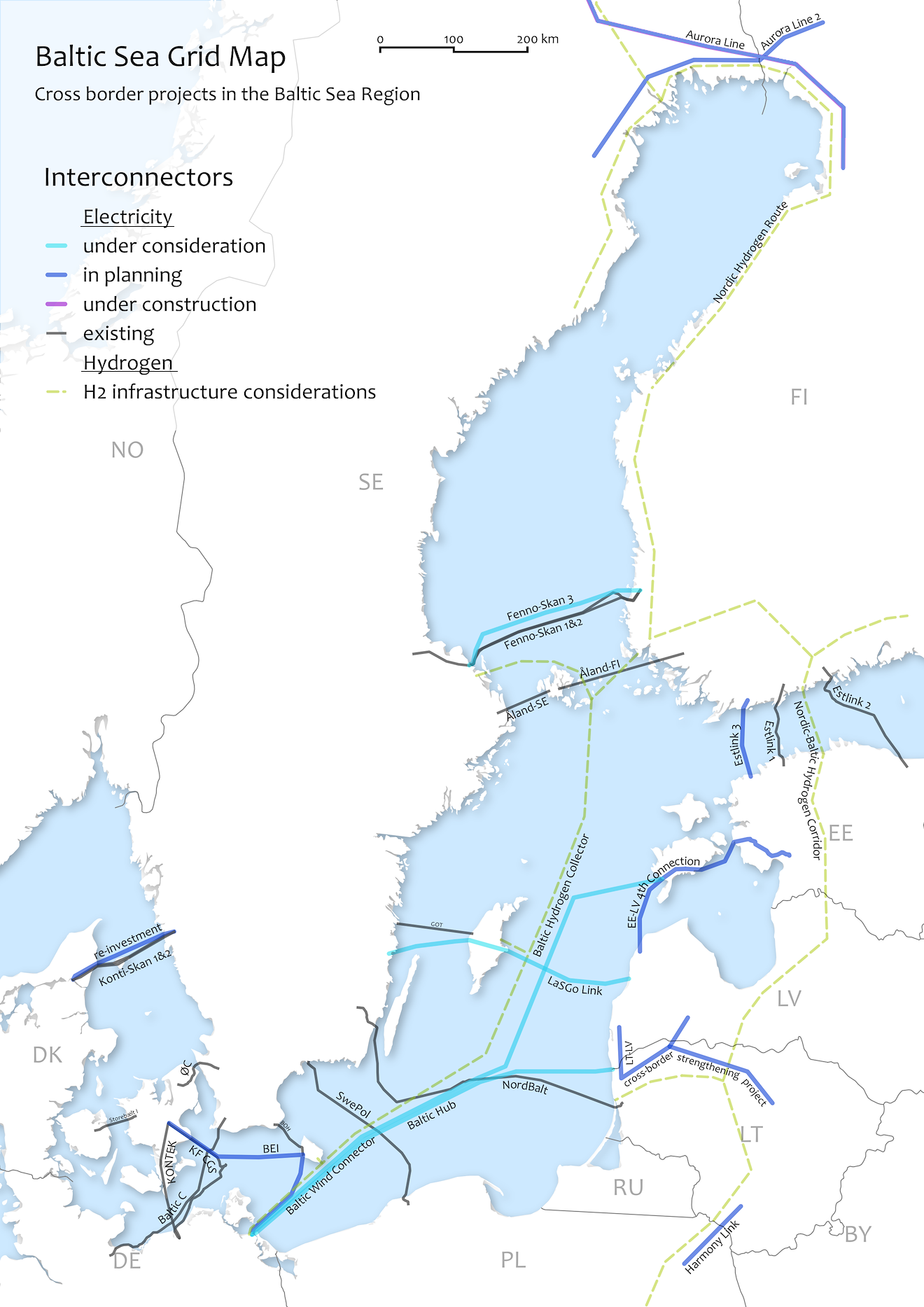
Source: Adapted from Baltic Offshore Grid Initiative, Expert paper 2025
Notes: Routes for future interconnectors and energy hubs are for illustration only and not to scale. Landfall points and grid connections are approximate and only for graphical demonstration.
On the gas side, it carries the Balticconnector pipeline between Finland and Estonia, and the Baltic Pipe from Norway through Denmark to Poland. The North Sea–Baltic data backbone runs through the C-Lion1 cable between Finland and Germany and the BCS East-West cable between Lithuania and Sweden, with multiple shorter telecommunications cables in between.
The offshore wind build-out adds a further layer: the Baltic Energy Market Interconnection Plan (BEMIP) target of 19.6 GW of installed offshore wind capacity in the Baltic Sea basin by 2030, rising to 93 GW by 2050. Interconnectors supporting the offshore wind build up from the Bornholm Energy Island, the Kriegers Flak interconnector hybrid project and the Estonia-Latvia ELWIND project add to the long list of critical energy infrastructure in the Baltic Sea.
ENTSO-E, Interconnected Network of Northern Europe Map, 2024; European Commission, BEMIP High-Level Group, Renewed Memorandum of Understanding, 12 May 2025; Gasgrid Finland, 'Balticconnector,' company technical description; Energinet, 'Baltic Pipe Project,' project documentation.
BEMIP High-Level Group, Joint Declaration of Energy and Climate Ministers of the Baltic Sea Region, Marienborg, 30 August 2022, and renewed MoU of 12 May 2025; WindEurope, 'Baltic Sea countries pledge closer collaboration to secure critical offshore energy infrastructure,' 2024; Eight Baltic Sea TSOs, 'Roadmap for an efficient and resilient offshore grid,' 2024.
The deepening cluster of energy infrastructure is the physical embodiment of Nordic-Baltic energy integration, which is only expected to deepen (see Box 4.1 for further details on specific vulnerabilities of Baltic island regions). The electricity grid desynchronisation of Estonia, Latvia and Lithuania from the Russian-controlled BRELL ring and their synchronisation with the Continental European Synchronous Area in February 2025 removed the last structural link between the Baltic states' electricity systems and the Russian grid, while simultaneously pulling the Baltic electricity market into full operational interdependence with the Nordic and Central European systems. The synchronisation was completed via the LitPol Link interconnector between Lithuania and Poland, making that corridor a load-bearing element of the new regional architecture rather than a supplementary tie.
Box 4.1: Baltic island energy systems and their distinct vulnerabilities
Four Baltic islands have specific vulnerabilities that the system-level picture above does not capture. Each is a small system that depends on one or two subsea power cables to a mainland for most of its electricity and has limited capacity to generate its own power locally.
Bornholm (Denmark) depends today on a single subsea power cable to southern Sweden, backed up by a local power station in Rønne. That cable has been damaged or failed repeatedly: in 2004, 2010, 2013 and again in January 2026, when the island had to switch to local backup generation. From the early 2030s, Bornholm will also host the converter platform for the Bornholm Energy Island: a 3 GW offshore wind hub (enough to power around three million homes) connecting Denmark and Germany through two new high-voltage cables of around 200 km each. The island therefore shifts from being a small dependent system to a critical link in the wider Danish-German power system integration architecture. The cables will carry both the wind output and cross-border electricity trade, and the converter platform becomes a single point of failure for a much larger flow.
Gotland (Sweden) combines a large military presence, civilian population and growing industrial energy demand on a single island. It is connected to the Swedish mainland by two existing high-voltage cables with a combined capacity of 260 megawatts, with a new and larger connection contracted in December 2024 and due in 2030. Because these are direct-current links, Gotland’s electricity system runs independently of the mainland grid frequency. Combined with a high local share of wind power, this places almost all the responsibility for system stability on the converter equipment at both ends.
Öland (Sweden), by contrast, is part of the mainland synchronous system and connected through the cable corridor that runs alongside the Öland Bridge from Kalmar. Its exposure is the more familiar one of a thin transmission spur into a tourist-and-agricultural area, sharpened by the fact that southern Sweden has the tightest electricity adequacy margins of any Swedish price zone.
Åland runs its own electricity grid through its own transmission company, Kraftnät Åland. The territory is supplied by an 80 megawatt alternating-current cable to Sweden, with a 100 megawatt direct-current cable to Finland (commissioned in 2015) as the reserve route, an older 10 megawatt cable to Finland, two gas turbines for standalone operation, and a small but growing battery base, including a 2 megawatt unit at the Söderby solar park commissioned in 2026 that can also restart the local grid after an outage. Either of the main cables on its own is enough to meet full island demand, and the Finnish cable has switched in automatically when the Swedish cable has failed. Åland’s vulnerability is therefore less about physical capacity and more institutional: as a demilitarised autonomous region of Finland with only observer status at the Nordic Regional Coordination Centre for transmission operators, Åland is less embedded in operational Nordic energy security cooperation than the mainland systems are.
4.1.2 Offshore wind buildout as expanding attack surface
The Baltic offshore wind build-out is in the early stages of a roughly fivefold expansion to 2030 and a thirty-fold expansion to 2050, against an installed base of 2.8 GW as of 2024. The principal projects span the basin: the Bornholm Energy Island (3 GW, Denmark-Germany), the Kriegers Flak combined grid solution between Denmark and Germany, the Estonia-Latvia ELWIND project of approximately 1 GW, and a substantial Polish pipeline in the southern Baltic that includes the 1.2 GW Baltic Power project developed by Orlen and Northland Power, with generation expected from 2026, and the Equinor-Polenergia Baltyk II and III farms of 720 MW each, expected to reach full operation by 2028.
BEMIP High-Level Group, 'Marienborg Declaration on offshore wind in the Baltic Sea,' 30 August 2022; Energy Islands of Denmark, Bornholm Energy Island project documentation; Estonia and Latvia, ELWIND joint project communications; Baltic Power, 'About the project,' https://balticpower.pl/about-the-project/; Reuters, 'Equinor, Polenergia agree on Polish offshore wind project,' 19 May 2025.
From an energy security perspective, the build-out has two contradictory implications. On the supply side, offshore wind in the Baltic operates with a capacity factor in the range of 45 to 55 per cent at the better sites, which gives it a firmer power-system role than onshore wind and closer to that of conventional baseload generation; the contribution of offshore wind to Nordic-Baltic adequacy through the 2030s is therefore substantial.
WindEurope, 'Offshore Wind in Europe: Key Trends and Statistics,' 2025 edition, with Baltic-specific capacity factor data; Energinet, 'Capacity factor assumptions for North Sea and Baltic Sea offshore wind,' internal note 2024.
On the security side, the build-out compounds the cluster exposure that 4.1.1 identified. Every new offshore wind farm adds a network of inter-array cables, an offshore substation, and an export cable to the basin's stock of high-value subsea assets. The Bornholm and Kriegers Flak hybrid projects are particularly exposed because their export cables function simultaneously as cross-border interconnectors.
The 2023 NATO ENSEC Centre of Excellence Coherent Resilience tabletop exercise on a drone swarm attack against an offshore substation revealed coordination gaps across critical infrastructure protection, crisis management, strategic communication, and maritime law that have not been comprehensively addressed.
The trade-off is not whether to proceed with the build-out, which is required for both the climate and security pillars of the Nordic energy trilemma, but how to protect what is being built. That challenge is treated in Section 8.
NATO Energy Security Centre of Excellence, 'Coherent Resilience 2023 Baltic table-top exercise: after-action observations,' 2023.
4.1.3 The Baltic offshore infrastructure disruption risk
Since September 2022, a series of incidents has damaged or severed subsea energy and telecommunications infrastructure in the Baltic, from pipelines and HVDC power cables to data cables, through methods including explosions, anchor drag by commercial vessels, and suspected deliberate interference. In many cases, investigation and criminal proceedings remain ongoing to determine the ultimate perpetrator (see Section 1 for details). The ambiguity over the nature of the acts is itself operationally significant: the Baltic's shallow waters, dense commercial traffic, and overlapping jurisdictions create a structural environment in which deliberate and accidental damage are difficult to distinguish in the short term, and in which plausible deniability creates opportunities for deliberate interference.
The pattern is more analytically important than any single incident. First, subsea energy infrastructure in European waters is now operationally vulnerable to physical disruption from sources ranging from state actors to commercial vessels operating with blurry ownership structures. Second, the Baltic is a low-attribution environment by design: shallow waters, dense traffic, and overlapping jurisdictional waters together make accidental anchor damage and deliberate sabotage operationally indistinguishable in the short term. Third, the repair gap that the Balticconnector rupture first exposed has been confirmed by every subsequent incident: HVDC cable repair takes between two and five months on a Baltic timeline, depending on the season and the availability of specialised cable-laying vessels, and gas pipeline repair takes longer still. Fourth, single events can disable energy and data assets simultaneously.
For the typology of confirmed, suspected, under investigation and dismissed attribution applied here, see NER feedback on the report draft, May 2026, and the methodological discussion in Section 1.
4.1.4 Repair capacity and the post-incident response
The post-incident picture in the Baltic is shaped by three constraints that together explain why repair times have stretched and why the gap between an incident and its resolution is now itself a material vulnerability. First, the global fleet of specialised cable-laying and cable-repair vessels is small, geographically dispersed, and overwhelmingly contracted to commercial telecommunications operators on long-term arrangements; access to repair vessels on short notice depends on contractual priority that Nordic and Baltic operators have not historically held.
Second, HVDC power cable repair requires heavier handling equipment and specialist jointing techniques distinct from the telecommunications cable repair toolkit, and a smaller subset of the global fleet is equipped accordingly.
Third, weather windows in the Baltic are narrow in winter, when shorter daylight, ice formation in the Bay of Bothnia and Gulf of Finland, and frequent storm activity all narrow windows of opportunity for repair works. The combined effect is that a single fault on a Baltic HVDC cable now plausibly takes between two and five months to resolve from incident to restoration, with the variance dominated by season and vessel availability rather than by the technical complexity of the repair itself.
The institutional response to this is treated in Section 4 and the recommendations in Section 8.2; the point in this section is that the repair gap is a vulnerability of its own, not merely a consequence of the underlying physical exposure.
European Commission, 'EU Action Plan on Cable Security,' February 2026, with the EUR 347 million Cable Security Toolbox allocation and the EUR 20 million Baltic Sea pilot for pre-positioned modular repair equipment; European Subsea Cables Association (ESCA), industry input on HVDC versus telecommunications cable repair lead times, 2024.
Box 4.2: The shadow fleet as a cross-theatre vulnerability
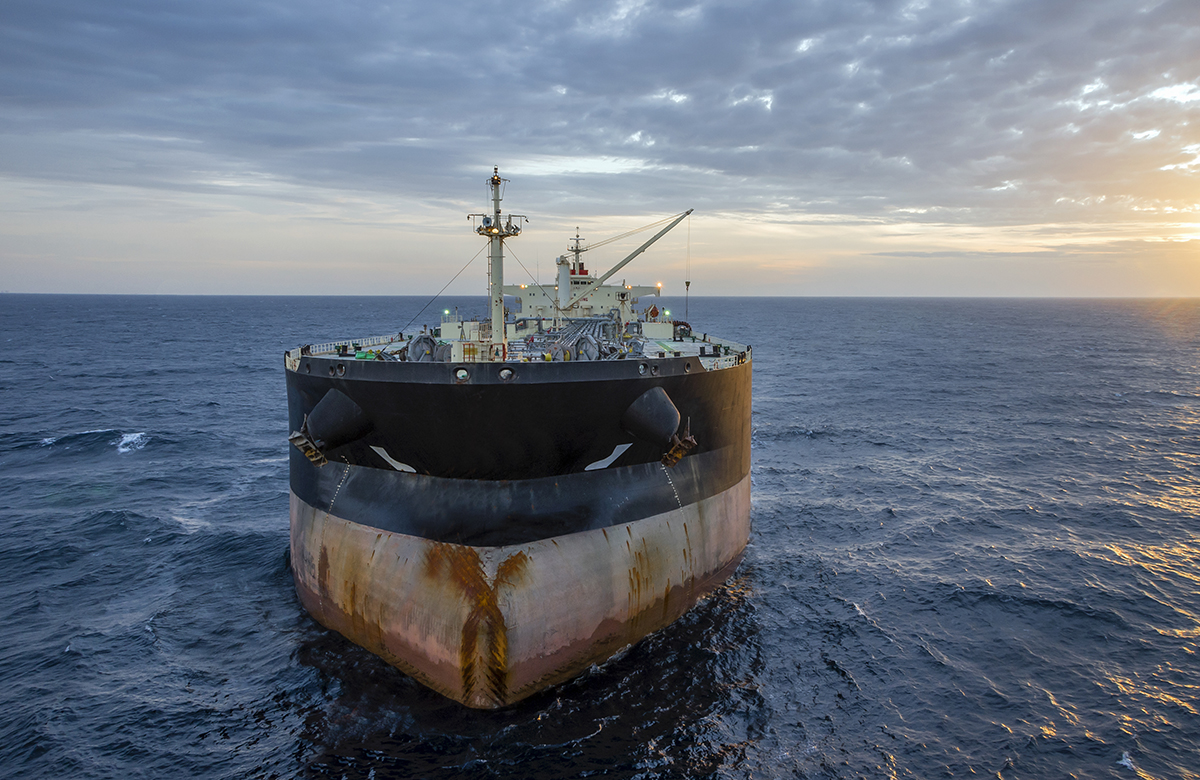
Russia's shadow fleet, the term applied to the loose constellation of 600 or more aging tankers operated under blurred ownership and frequent flag-state changes that has emerged to transport Russian crude and oil products under the Western price cap regime, has become a year-round presence in both Baltic and Arctic Nordic waters. The fleet creates three distinct Nordic energy security pressures that none of the standard maritime cooperation frameworks fully address.
The first pressure is physical risk to subsea infrastructure. The Eagle S incident of December 2024, in which a sanctioned shadow-fleet tanker is alleged to have severed the Estlink 2 cable and four telecommunications cables by dragging its anchor for tens of kilometres, is the clearest single illustration of the convergence between sanctions evasion and infrastructure damage. Whether the damage was deliberate or the result of the operational degradation typical of poorly maintained shadow-fleet vessels matters less for vulnerability assessment than the fact that the type of vessels with the means to cause such damage has grown substantially since 2022.
Finnish Border Guard and National Bureau of Investigation communications on the Eagle S case; Centre for Research on Energy and Clean Air (CREA), reporting on shadow-fleet operations in the Baltic, 2023–2025.
The second pressure is environmental risk to Nordic coastal energy infrastructure. Shadow-fleet tankers are typically older than the global commercial fleet average, frequently inadequately insured, and operate without the protection-and-indemnity coverage that would normally underwrite oil-spill response. A major spill in the Gulf of Finland, the Danish Straits, the Skagerrak or off the Norwegian Arctic coast would, beyond the ecological damage, directly threaten coastal energy assets including LNG terminals, oil terminals and offshore wind landing points, and would tie up Nordic emergency response capacity for weeks. The risk is structurally higher in Arctic waters, where response capacity is thinner and ecological recovery slower.
International Group of Protection and Indemnity Clubs, 'Reporting on shadow-fleet insurance gaps,' 2024 and 2025 updates; Norwegian Coastal Administration, communications on Arctic oil-spill response capacity assumptions, 2024.
The shadow fleet is therefore the single threat that most clearly bridges the two regional theatres covered in this section: the same vessels generate risks to the infrastructure and environment across the Baltic and Arctic regions.
4.2 The Arctic: distance, exposure and strategic contest
4.2.1 What the Arctic adds to the Nordic energy security picture
The Arctic theatre adds three structural features to the Nordic energy security picture that the Baltic does not contain in the same form. The first is distance. Response times to incidents in the Norwegian, Barents and Greenland seas are measured in days rather than hours; search-and-rescue coverage thins north of the Arctic Circle; and the global fleet of ice-class repair vessels capable of supporting Arctic infrastructure work is even smaller than the Baltic-capable fleet discussed in Section 4.1.4.
The second is geopolitical context. The Russian Northern Fleet headquartered in Severomorsk on the Kola Peninsula concentrates the bulk of Russia's strategic submarine force; and the so-called Bear Gap between Norway and Svalbard has, on the assessment of the Norwegian Chief of Defence in January 2026, replaced the Greenland-Iceland-United Kingdom (GIUK) gap as the principal point of military attention in the European Atlantic.
Norwegian Chief of Defence (Forsvarssjefen), Annual Address, Oslo Military Society, January 2026, as reported in Norwegian and international defence press; Russian Ministry of Defence, communications on the reorganisation of the Northern Military District, 2024.
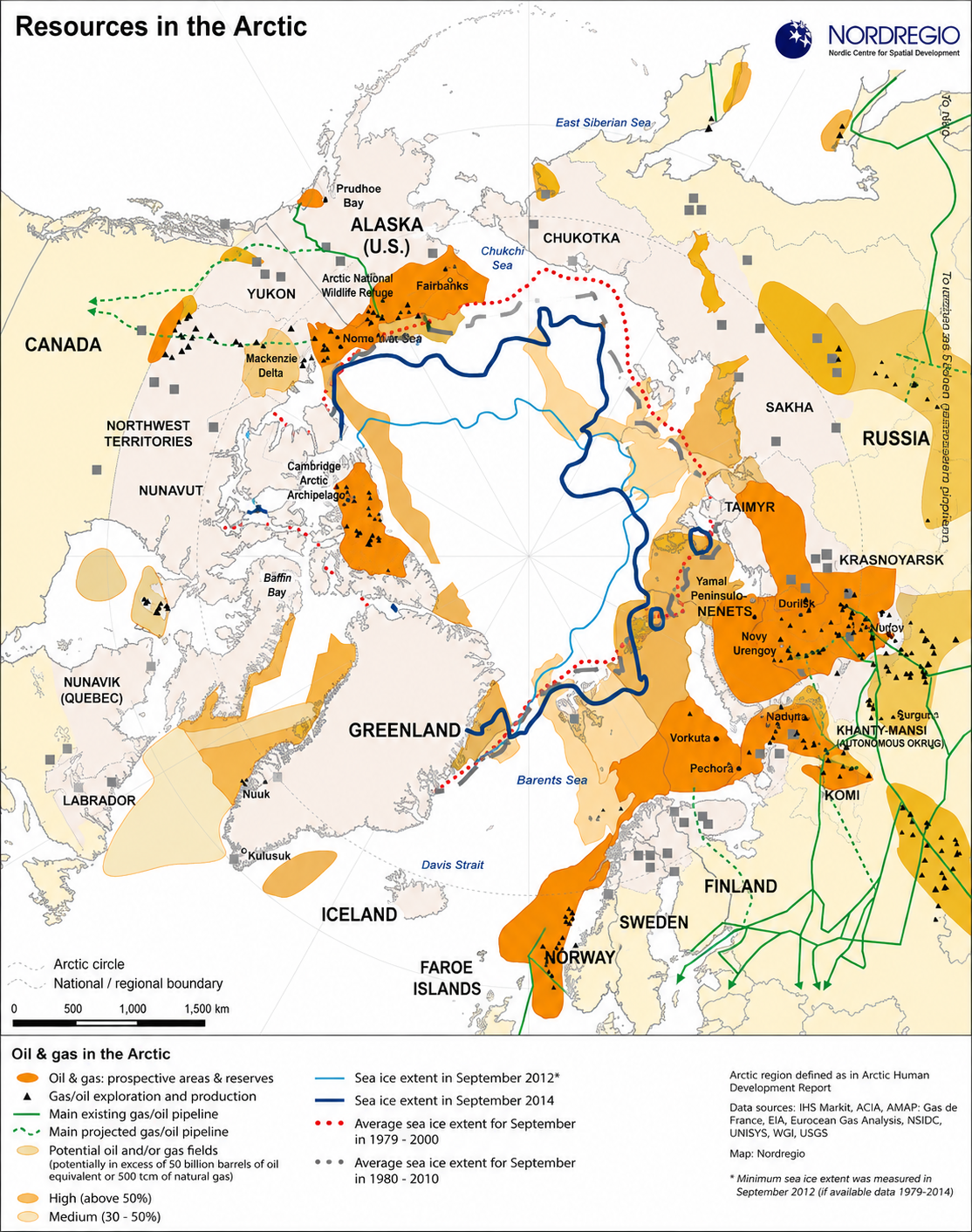
The third is resource centrality. The Norwegian Barents Sea contains the bulk of Norway's gas production reserve base; the Nordic critical minerals frontier sits inside the Arctic Circle in northern Sweden, northern Finland and Greenland; and Greenland itself has emerged since 2024 as a focus of transatlantic political contestation in ways that have direct consequences for Nordic energy security cooperation. The remainder of this sub-section addresses each in turn.
4.2.2 Northern infrastructure vulnerabilities
The energy infrastructure of Northern Norway and the wider High North shares a set of structural characteristics that distinguish it from the rest of the Nordic region. Distance from mainland supply chains, limited grid redundancy, and the concentration of critical functions in single assets all apply with particular force in Arctic conditions, where harsh weather, thin repair capacity, and long logistics chains compound the consequences of any disruption.
The most acute single-point-of-failure in the Northern Nordic energy system is the Hammerfest LNG plant on Melkøya island: it is the only export route for Snøhvit gas and the only exit point for any Norwegian Barents Sea production, with no Barents-to-continent pipeline as an alternative. A fire in the plant’s CO₂ removal unit in September 2020 illustrated what this concentration means in practice: an outage lasting 21 months, repairs costing over NOK 14 billion, and the need to import replacement equipment manufactured outside Norway before the plant could return to operation in May 2022.
A single disruption event at one facility removed an entire production basin from the export market for nearly two years.
Equinor, public statements on the Hammerfest LNG fire of 28 September 2020 and the subsequent restart in May 2022; Norwegian Petroleum Safety Authority, investigation report into the incident, 2021.
The Northern Finnmark electricity grid exhibits a similar pattern. Single 132 kV transmission rings with limited redundancy serve an area that includes industry, defence installations, the Banak air base, and the Melkøya gas processing infrastructure. The planned 420 kV Skaidi-Hyggevatn link, originally scheduled for 2026, has been delayed to 2027–2028 and remains the central bottleneck for Northern Norwegian energy adequacy for the rest of this decade.
The grid constraint and the single LNG export point are linked: any electrification of Melkøya’s own operations runs directly into the capacity ceiling of the transmission ring serving it.
Statnett, Network Development Plan 2023 and subsequent updates on the Skaidi-Hyggevatn 420 kV project; Norwegian Ministry of Energy, parliamentary briefings on Northern Norway grid capacity, 2024–2025.
Thin redundancy is a recurring theme across the wider High North. Svalbard’s connectivity to the mainland depends on two submarine cables between Longyearbyen and Andøya; when one was cut in January 2022, the second carried the load and no service interruption occurred, but the margin was a single cable.
Longyearbyen’s electricity supply, following the closure of its coal-fired plant in October 2023, now rests on diesel generation pending a low-carbon replacement that has not yet been commissioned, leaving the archipelago fuel-import-dependent for the foreseeable future.
The Faroe Islands and Greenland sit in a structurally similar position: isolated systems outside both the EU and IEA stockholding frameworks, where a single disruption to fuel imports has no network alternative to fall back on. That vulnerability is addressed in detail in Section 7.
Space Norway, public statements on the Svalbard Undersea Cable System incident, January 2022; Norwegian Police Security Service (PST), public communications, 2022 and 2023.
Store Norske Spitsbergen Kulkompani, communications on the closure of Mine 7 and the Longyearbyen coal-fired power plant, 2023; Government of Norway, parliamentary briefings on Svalbard energy transition, 2024.
4.2.3 Climate and weather risk specific to the High North
Arctic warming has been observed at approximately four times the global rate for the last 50 years, with the strongest warming in the Barents Sea region, where local warming over recent decades has reached peaks of 2.7 °C per decade.
Three consequences for energy infrastructure follow.
M. Rantanen et al., 'The Arctic has warmed nearly four times faster than the globe since 1979,' Communications Earth and Environment 3, 2022; K. Isaksen et al., 'Exceptional warming over the Barents area,' Scientific Reports 12, 2022.
First, permafrost degradation is reducing the bearing capacity of foundations, runways and onshore pipelines, especially in Svalbard and Greenland. Second, hydrological shifts are increasing total Norwegian and Swedish Arctic hydropower potential by an estimated 5 to 15 per cent by mid-century, but with substantially widened inflow variance; the operational planning window for hydropower in the Northern Nordic region is therefore both larger in expected value and harder to manage, which directly affects winter adequacy planning. Third, changing climate is affecting energy production: wind-turbine icing losses at northern sites have been documented at between 5 and 15 per cent of annual output at the most exposed locations, requiring expanded use of anti-icing systems that themselves consume power.
Intergovernmental Panel on Climate Change, Sixth Assessment Report, Working Group I, Chapter 9 (Polar Regions) and Working Group II, Chapter 13 (Europe), 2021–2022; International Energy Agency, 'Climate Resilience for Energy Security,' 2021, with subsequent regional updates; Energiforsk, 'Vindkraft i kallt klimat (Wind power in cold climate),' 2023.
Two recent verified events illustrate the operational consequences of climate risks. Storm Gyda in mid-January 2022 brought wind speeds in excess of 35 m/s to large parts of Western and Northern Norway, with widespread power outages and storm-surge flooding affecting coastal energy infrastructure. Storm Hans in August 2023 caused the partial collapse of the Braskereidfoss dam in eastern Norway and forced the controlled draw-down of multiple Norwegian and Swedish reservoirs as inflows exceeded design assumptions.
Norwegian Water Resources and Energy Directorate (NVE), incident reports on Storm Gyda (January 2022) and Storm Hans (August 2023), including the Braskereidfoss dam partial collapse; Norwegian Meteorological Institute, climate event briefings, 2022 and 2023.
4.2.4 Hybrid threats and the geographic dimension
The Baltic is a shallow, densely monitored sea with average depth around 54 metres, where surface surveillance, NATO maritime patrols, and the high density of commercial shipping all create a relatively rich observational environment even if attribution remains difficult. The Arctic operates on an entirely different geometry. The Norwegian Sea reaches depths of 2,500 metres and the Barents Sea averages 230 metres across a vast, sparsely monitored area. At those depths, interference with subsea infrastructure requires capabilities beyond opportunistic anchor drag: it demands purpose-built equipment, remote vehicle operations, or submarine assets, a technological threshold that points towards state-level actors and that simultaneously makes detection from the surface far harder. The low event frequency and thin monitoring coverage mean that incidents may not be identified quickly, and when they are, attribution is structurally more difficult than in the Baltic.
4.2.5 Greenland’s strategic centrality
Greenland's position in Nordic energy security is materially different from that of any other Nordic jurisdiction and warrants separate treatment for two key reasons (See Box 4.3 for discussion of the vulnerabilities across Arctic island regions). First, the material energy picture: approximately 80 per cent of Greenland's final energy consumption is met by imported petroleum products. Greenland sits outside both the EU and IEA stockholding frameworks; and it operates a series of isolated microgrids rather than a synchronously connected national grid. Buksefjord, currently the largest hydropower plant in Greenland, is undergoing capacity expansion to meet rising Nuuk electricity demand, and the Tasersiaq prefeasibility study points to a potential 700–1,000 MW export-scale hydropower resource over a longer horizon; these would, if developed, materially change Greenland's energy security profile, but neither is currently part of the operational Nordic energy system.
Government of Greenland, Energy Strategy 2030; Nukissiorfiit, public communications on the Buksefjord hydropower expansion, 2024; Government of Greenland, Tasersiaq hydropower prefeasibility study summary.
Second, the security dimension. Since late 2024, the second Trump administration has made explicit claims to Greenland, including statements declining to rule out economic or military coercion to bring Greenland under US sovereignty. What matters for the Nordic energy security frame is that the foreign and security policy axis of one of the eight Nordic jurisdictions is now exposed to direct external pressure from a treaty ally in a way that no other Nordic jurisdiction faces.
Box 4.3: Arctic and North Atlantic island energy systems and their distinct vulnerabilities
Iceland, Greenland, the Faroe Islands and Svalbard share one feature that sets them apart from every mainland Nordic country: none of them is connected to another country’s electricity grid, and all four rely on imported oil products for the bulk of either their primary energy or their non-electricity demand. Resupply and emergency repairs are measured in days rather than hours, the ice-class shipping fleet available to serve them is small, and the Faroe Islands and Greenland sit outside both the EU and the International Energy Agency stockholding frameworks entirely. The Faroe Islands are not formally part of the Arctic, but their energy security logic is the same one that applies to Greenland and Svalbard rather than the one that applies to mainland Denmark.
Iceland runs a fully isolated electricity system supplied almost entirely by hydropower and geothermal energy, with no cable to continental Europe or the British Isles. Its electricity supply is therefore well shielded from external shocks. Iceland’s exposure sits instead on the fuel side. Transport, the fishing fleet and aviation depend almost entirely on imported oil products that arrive by tanker into a small number of ports, with Keflavík airport serving as a major North Atlantic hub. Iceland is among the highest per-capita oil importers in Europe, and a sustained disruption to maritime fuel deliveries (whether from a price shock, North Atlantic shipping disruption or insurance withdrawal) would feed straight through into transport and fisheries, without an electricity-side buffer to soften the impact.
Greenland is not a single grid but around 70 standalone local power systems serving towns and coastal settlements separately. Hydropower at five plants (Buksefjord, Tasiilaq, Qorlortorsuaq, Sisimiut and Ilulissat) supplies roughly 70 per cent of electricity for the larger towns, with diesel generators serving the rest; recently approved expansion projects could raise the renewable share to around 90 per cent. Greenland’s energy security exposure runs in two directions. Inwards, around 80 per cent of total energy consumption is met by imported petroleum products that arrive by sea. Outwards, the Tanbreez rare earth project in southern Greenland, consolidated under US-listed Critical Metals Corp at 92.5 per cent ownership in 2025 with around USD 120 million in US Export-Import Bank financing interest, places Greenland inside the supply chain for some of the most strategically contested critical raw materials, with direct implications for the geopolitical context set out in Section 4.2.5.
The Faroe Islands run an isolated electricity grid operated by the municipally owned utility SEV. The mix is around 100 MW of diesel capacity, 40 MW of hydropower, around 60 MW of wind and a small but growing battery base. SEV reports one to three total blackouts a year, well above continental European frequencies. The Faroese 2030 target of fully renewable electricity reduces but does not eliminate the wider exposure, since heating, transport and the fishing fleet will remain dependent on imported oil products for some time to come.
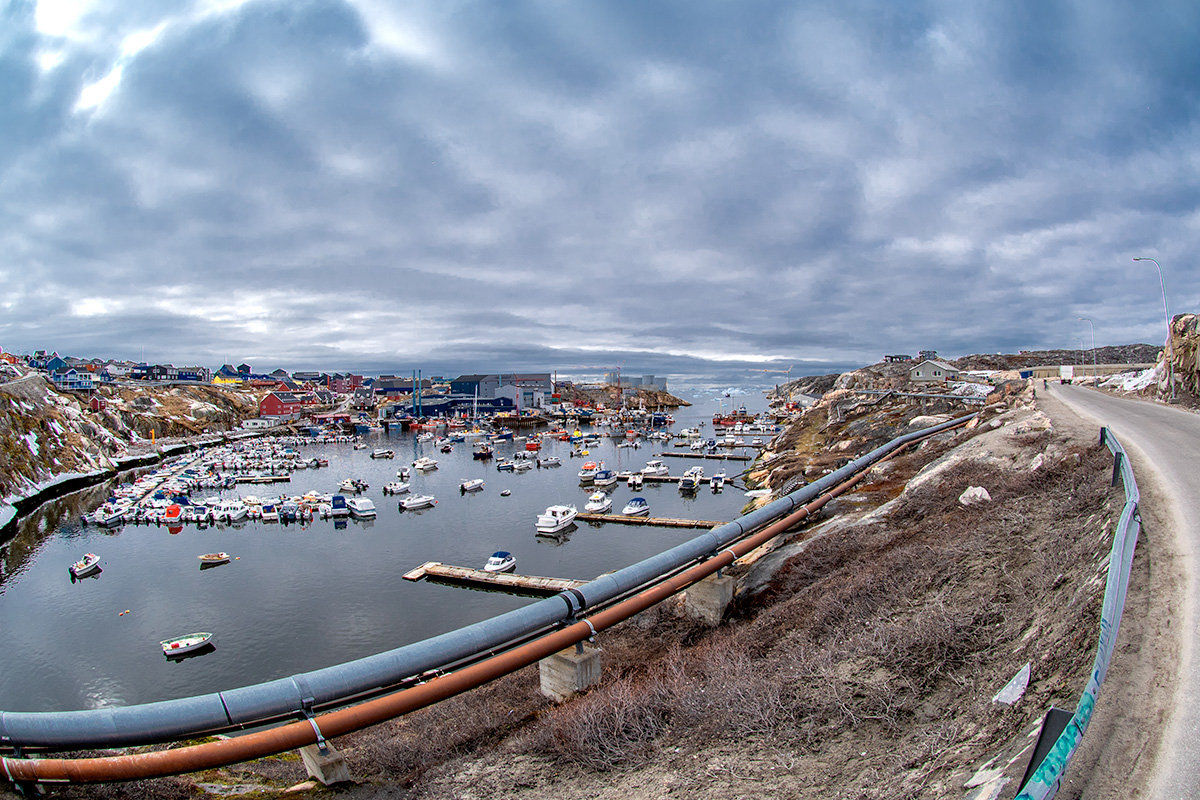
Svalbard sits at the far end of the same logic. Since the closure of Longyearbyen’s coal-fired power station in October 2023, the archipelago has run on diesel generators with a small battery providing short-duration backup; a long-term renewable replacement has not yet been built. Geographically, Svalbard sits inside what the Norwegian Chief of Defence in January 2026 identified as the principal point of military attention in the European Atlantic.
4.3 Cross-theatre patterns and the institutional gap
Three patterns connect the Baltic and Arctic vulnerability pictures. The first is shared threats with different geographic expression. The same shadow tanker fleet generates risks across both spaces. The same Russian intelligence vessel, the Yantar, has been documented in both the Baltic approaches and the Norwegian Sea. The same global constraint on cable repair vessel availability applies in both, with an additional ice-class capacity gap in the Arctic.
The second pattern is asymmetric institutional coverage. The Baltic theatre is densely institutionalised, with BEMIP at the energy-policy level, the Council of the Baltic Sea States Vihula Memorandum of Understanding at the foreign-minister level, NATO's Maritime Centre for the Security of Critical Undersea Infrastructure and the Baltic Sentry deployment at the military level, and the Nordic-Baltic Eight at the broader political level.
The Arctic theatre is institutionally thinner: the Arctic Council has been operating in reduced functionality since the 2022 pause in cooperation with Russia and the 2025 effective freeze of the working groups. There is no Arctic equivalent of the CBSS Vihula framework on subsea infrastructure; the West Nordic Council is focused on parliamentary cooperation between Iceland, Greenland and Faroe Islands but lacks technical depth; and the institutional response to Northern Nordic infrastructure exposure has therefore had to be improvised through national, Joint Expeditionary Force (JEF) and NATO channels rather than through a dedicated regional framework.
The third pattern is the implementation gap. In both theatres the political signal is sharper than at any point in the post-Cold War period, and in both the operational follow-through lags. The Baltic has the political vehicles but needs the technical and operational depth on which their declarations rely. The Arctic lacks both the political vehicles of equivalent density and the implementation depth, and is therefore at an earlier stage of the same trajectory. The roadmap in Section 8 addresses both, recognising that the Nordic value-add in the Baltic is principally to provide the technical substance beneath existing Baltic-level frameworks, and that the Nordic value-add in the Arctic is partly to compensate for the absence of equivalent frameworks until such time as the Arctic Council or successor arrangements can resume that role.
The vulnerabilities mapped in this section recur in different forms in the carrier-specific analysis that follows. Electricity exposure in the Baltic is treated in Section 5, where the cooperation architecture around Nord Pool, the Nordic Regional Coordination Centre and NordBER is the principal subject. Natural gas security, including the Hammerfest chokepoint and the Balticconnector exposure, is treated in Section 6. Fuel security exposure, including the shadow-fleet and Northern Sea Route dimensions, is taken up in Section 7. The recommendations that follow these analyses are gathered in the roadmap.