Expected main climate change impacts on marine ecosystems in the Nordic sea regions
The Baltic Sea
Thorsten Blenckner and Susa Niiranen, Stockholm Resilience Centre, Sweden and
Johanna Yletyinen, University of Jyväskylä, Finland
Johanna Yletyinen, University of Jyväskylä, Finland
Unlike the other Nordic seas, the Baltic Sea is semi-enclosed and has only a narrow connection to the North Atlantic via the Danish Belts and Kattegat. This unique feature, and the large catchment area with many rivers entering the Baltic Sea, makes the water masses there less saline (i.e., brackish) than common for seawater, and results in strong environmental gradients both in temperature and salinity. Moreover, climate change effects on the Baltic Sea will vary between different parts of the sea. Sea level rise, for instance, has less effect on the northern parts of the Baltic Sea than the southern regions due to differential post-glacial uplift. The Baltic Sea ecosystem is impacted by multiple drivers, eutrophication and lack of oxygen being key environmental stressors (Fig. 2). In this chapter, when discussing the ecosystem effects of climate change, we adopt the common view (supported by ecosystem modelling), that climate change partially will counteract and undermine the positive effects of nutrient reduction measures. For more comprehensive information on climate change impacts on the Baltic Sea ecosystem we recommend in particular the in-depth reviews conducted within the Second Assessment of Climate Change for the Baltic Sea Basin (BACC; BACC II Author team 2015) and Baltic Earth Assessment Reports (BEAR; especially Viitasalu and Bonsdorff 2022).

Figure 2. An artist’s view of important parts of the Baltic Sea ecosystem(s). Although relatively species-poor compared to many other seas, the Baltic Sea is home to many species including a variety of algae, seagrass, crustaceans, molluscs, fish, seabirds, and mammals. Due to its brackish water environment and decreasing salinity levels towards the north both freshwater and marine species inhabit the Baltic Sea. Graphic from Voice of the Ocean foundation (https://voiceoftheocean.org/baltic-sea-biodiversity/)
Primary Production
For phytoplankton, clear symptoms of climate change, such as early spring blooms (Hjerne et al 2019, Jan et al 2024) and prolongation of the growing season, are evident over recent decades and can be explained by rising temperatures (Viitasalu and Bonsdorff 2022). However, climate effects vary from species to species and across the spatial gradient in the Baltic Sea. Future projections indicate a decrease of phytoplankton bloom in spring and an increase in cyanobacteria blooms in summer (Viitasalu and Bonsdorff 2022). These projections also depend largely on the interplay of climate change and the level of nutrient load from land. These climate and nutrient load scenarios also determine if the primary production stays high or decreases compared to today´s conditions. In the case of cyanobacteria, uncertainties remain because some field studies claim that cyanobacteria have not increased, and some experimental studies show that cyanobacteria's responses to temperature, salinity, and pH vary from species to species. An increase in riverine organic matter (browner water) may also decrease primary production in the Northern Baltic Sea, but the relative importance of this process in different areas is not well known. Bacteria growth is favoured by increasing temperature and organic matter, but complex effects in the microbial food web are probable.
Secondary Production
For zooplankton, the direct effects of changing climate include temperature and salinity impacts on metabolism and growth, as well as dietary effects of changes in primary production. The response of zooplankton is often species, and species group, specific. In the past, for example, larger zooplankton species (such as Calanus), that form an important food source for planktivorous fish and larvae of piscivorous fish, have been negatively impacted by decreases in salinity and increases in water temperature. Meanwhile, some smaller zooplankton species, present also in fresh waters, have benefitted from such environmental change. Hence, it is likely that the changing climate will result in changes in the zooplankton composition in the Baltic Sea. Serandour et al (2024) project that most of the species are likely to experience an increase in the area with suitable conditions in the northern part of the Baltic Sea under future scenarios, driven by increasing water temperature. Yet, this improvement may be countered by the projected decrease in salinity levels which would prevent the northern expansion of marine-originated zooplankton species. It has also for long been suggested that changes in the timing of phytoplankton blooms, due to earlier ice break-up, may result in changes in the temporal overlap between zooplankton and its food resources, and potentially even mismatches may occur. However, only little evidence is currently available on these dynamics.
Frequent jellyfish blooms with substantial biomass have been observed in the Baltic Sea, but no overall increase in jellyfish density across the region has yet been established. In the recent decade the species Blackfordia virginica has been established in the south-west area of the Baltic Sea (Jaspers et al., 2018). This species is regarded as an invasive species due to its successful establishment in various brackish regions of the Atlantic, Pacific, and Indian oceans and has therefore likely a high potential for a strong colonization in the Baltic Sea in the future.
Benthic plants and animals
The deep bottoms of the Southern and Central Baltic Sea, as well as the Gulf of Finland, suffer from a chronic lack of oxygen, which is a key driver in defining the presence and composition of benthic fauna (Fig. 3). When water temperatures increase, also the water-column's capacity to withhold oxygen decreases. Further, future climate projections for the Baltic Sea indicate increased water stratification, and hence potentially decreased ventilation of deeper waters, which can result in increased benthic and deep-water hypoxia (low oxygen concentration). This is particularly a risk in case no significant reductions in nutrient inflow to the sea are accomplished. As a result, even larger areas of the Baltic Sea may become void of benthic macrofauna in the future and species particularly sensitive to low oxygen concentrations (e.g. amphipods) may decrease in abundance, while more tolerant species take up more space.
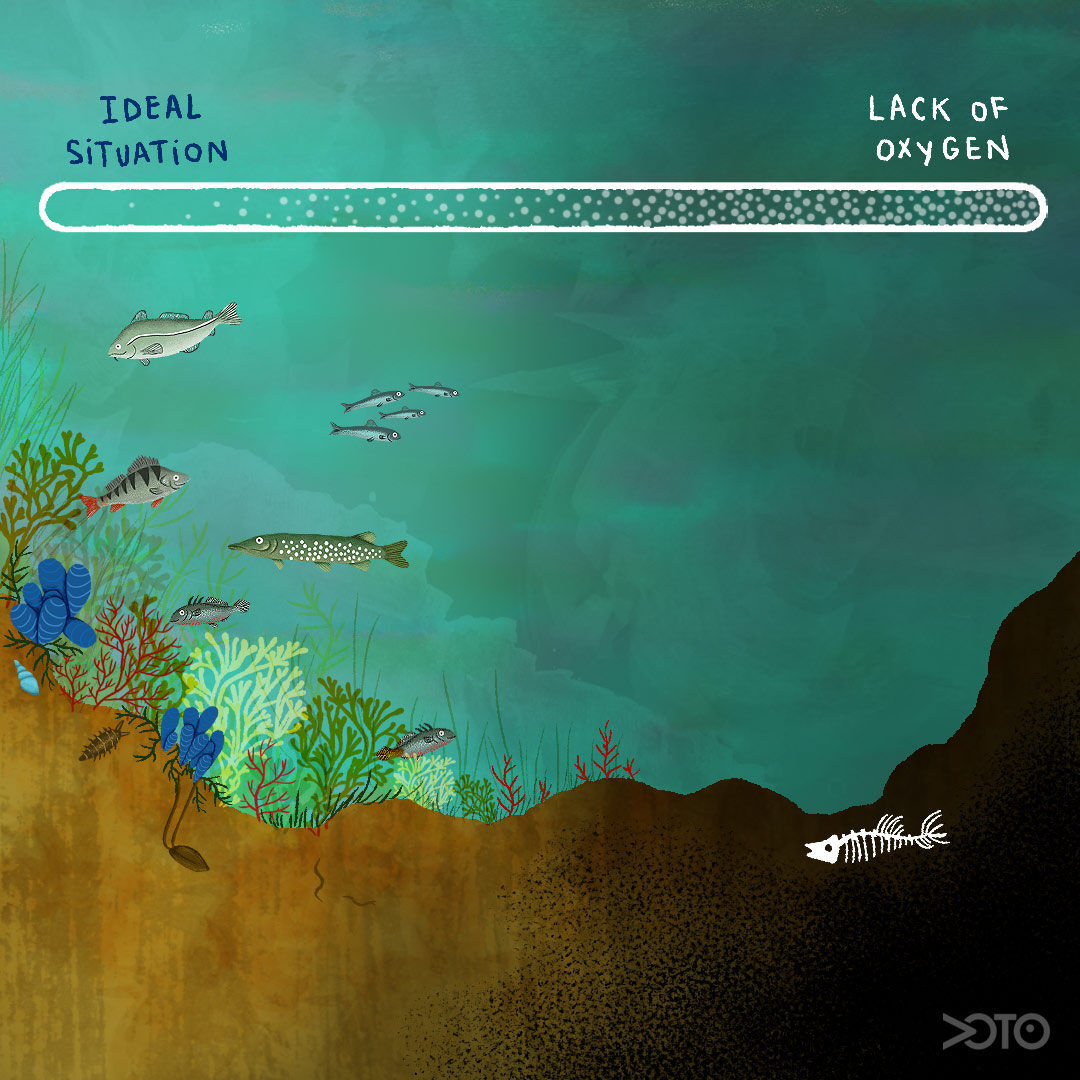
Figure 3. Eutrophication may lead to a lack of oxygen, hypoxia, especially at or near the seabed. The Baltic Sea is unfortunately naturally disposed to hypoxia mainly due to being an enclosed, shallow sea with only limited and sporadic water exchange with the North Sea. Hypoxic areas lose their function as a habitat, damaging the food web and ultimately Baltic Sea biodiversity. Illustration from Voice of the Ocean foundation (https://voiceoftheocean.org/baltic-sea-biodiversity/)
In a simulation study, Ehrnsten et al. (2020) extended an existing model of benthic macrofauna coupled with a physical–biogeochemical model of the Baltic Sea. This expanded model allowed them to examine how changes in nutrient levels and climate in combination affects the biomass and metabolism of seafloor animals, looking at both past patterns and future scenarios. In scenarios with decreasing nutrient loads according to the Baltic Sea Action Plan overall macrofaunal biomass was projected to decrease significantly by the end of the century despite improved oxygen conditions at the seafloor. In a very different scenario with nutrient loads similar to the highest historically recorded, climate change counteracted the effects of increased productivity. Biomass increased up to mid-21st century but then decreased, giving very little net change by the end of the 21st century compared to present. These results indicate that benthic responses to environmental change are nonlinear and partly decoupled from pelagic responses (Ehrnsten et al. 2020).
In more coastal and shallow parts of the Baltic Sea, the future trajectory of benthic fauna may differ from that of the deep-sea basins. Also here, hypoxia is a defining factor if present but also changes in primary production (food source), predation, ice-conditions and introduction of non-indigenous species affect benthic fauna. Hence, the response of shallow water benthos to changes in climate is likely very heterogeneous depending on local environmental conditions, as well as species composition. In the northern Baltic Sea, for example, salinity seems to be one of the key drivers defining benthic fauna composition, including the likelihood of non-native species invasions (Holopainen et al. 2016).
The same is largely true for the benthic plants, of which for example bladderwrack and eelgrass have key functional roles in the ecosystem providing both habitats for coastal organisms, as well as climate regulation via carbon capture. However, as the photic zone is shallow in most parts of the Baltic Sea, benthic plants are likely affected by changes in ice-conditions, temperature increase, as well as run-off from land affecting water transparency and thus light capture of these photosynthetic plants.
Still, in the Baltic Sea benthic plants and animals are generally expected to be more affected by eutrophication due to nutrient overload than direct effects of a warming climate.
Fish
Scientific evidence suggests that climate change (in combination with other anthropogenic drivers) will change the fish species composition in the Baltic Sea by the end of the century. The direct impacts of climate change on the Baltic Sea fish occur mostly through changes in water temperature, salinity, oxygen and pH levels. Fish species will respond to climate change impacts in diverse ways, based on a complex interplay between their physiology and habitat preferences. In general, climate change-driven changes in temperature, ice-cover, salinity, and river-discharge will affect especially coastal and migratory fish (fish from freshwater origin), whereas the pelagic and demersal fish (fish of marine origin) mainly respond to changes in water temperature, salinity, and oxygen conditions (HELCOM/Baltic Earth, 2021). Moreover, species with complex life cycles, particularly those that move/migrate between freshwater and seawater, may be very sensitive to climate change effects (Moll et al. 2024).
The effects of climate change on the marine fish species of high commercial value (cod, sprat, herring) remain uncertain (Viitasalo and Bonsdorff, 2022, Andersson et al. 2023). Higher spring and summer temperatures could increase the success of sprat reproduction (Viitasalo and Bonsdorff 2022), but there is limited knowledge on the (combined) effects of increasing temperature and lower salinity on sprat (Andersson et al. 2023). Climate change will add pressure on herring and cod, in the Baltic already living on the borderline of their preferred conditions. Especially cod are heavily exploited, and research indicates that climate change can contribute to retaining the low cod abundance (Viitasalo and Bonsdorff, 2022, Andersson et al. 2023). If climate change leads to lower salinity and decrease in oxygen in the Baltic Sea, cod may suffer from lower reproductive success and decrease in food availability. Herring may be physiologically able to adapt to the new conditions, but the fishing pressure and ecosystem change could hinder the adaptation, especially if there are changes to the zooplankton that herring preys on (Andersson et al. 2023). Higher temperatures appear to provide a longer reproductive season for stickleback, yet the increase in temperature may reduce their reproductive success (Olin et al. 2022). Thus, the net direct effect of climate change is unclear also for stickleback.
Baltic Sea’s invasive fish species (e.g. goby) have proven capable of adapting to different environmental conditions and are thus projected to benefit from the climate change (Moll et al. 2024). Rising seawater temperature may increase the abundance of some Atlantic fish species in the Baltic Sea, such as anchovy and tuna. However, this is highly uncertain as the Baltic Sea environmental conditions, especially salinity and oxygen levels, differ pronouncedly from what these fish are used to.
Seabirds
Climate change is altering the wintering patterns of sea birds in the Baltic Sea, with bottom feeders benefiting from reduced ice cover, while fish-feeders are less favoured (Marchowski et al 2017). Species-specific responses vary, with some species thriving and others declining. Breeding failures of common guillemots and their nest attendance can be partly linked to heat stress in the current extremely warm summers (Olin et al 2024). The observed northward distributional shifts might continue in the future (Pavon-Jordan et al 2019). Overall, future projections of how seabirds are affected by climate change are complex and can include reduction of habitats due to sea level rise, timing of migration, changes in prey availability and heat stress.
Additionally, the ongoing issue of contaminant exposure continues to impact the health and population abundance of Baltic sea birds, potentially interacting with climate change effects (Sonne et al 2020). Climate change is also causing earlier spring arrivals and breeding times for many bird species in the Baltic region. This earlier timing enhances breeding performance, leading to population growth for some species.
Marine mammals
There are four marine mammal species resident in the Baltic Sea: Baltic grey seal, ringed seal, harbour seal and harbour porpoise. Climate change is expected to affect these animals, both via direct physical changes that affect their habitats (e.g., changes in ice-cover and decrease in low lying haul-out areas due to increase in sea levels), and via ecosystem effects (i.e., changes in prey). Recent studies show that increasing sea-levels and decreasing salinities can result in loss of habitat for the grey seal and harbour seal, particularly in the Southern Baltic Sea (van Beest et al. 2022). The habitat suitability of the currently rarely observed harbour porpoise, on the other hand, is expected to increase. There is also some indication that increased sea water temperatures may increase the amount of parasites amongst marine mammals.
Holistic ecosystem considerations and summary of main effects of climate change
Overall, future climate projections indicate significant changes in the Baltic Sea’s biogeochemical conditions, which will likely affect species distribution, growth, behaviour, and interactions. It is important to note the real risk of major changes, including both novel (never yet observed) and currently existing, but disappearing, conditions across different climate and nutrient management scenarios. Such environments will impact many plants and animals, including iconic species like cod, eelgrass, and starfish (Table 2). This underscores the importance of pre-emptive adaptive management to account for these emerging conditions resulting as compound effects of climate change and other human pressures (Blenckner et al 2021).
Phytoplankton | Earlier spring phytoplankton bloom |
Longer summer phytoplankton growing season and longer summer blooms | |
Potential increase in cyanobacteria blooms | |
Zooplankton | Change in species composition due to climate-induced temperature and salinity changes |
With further northern Baltic salinity decrease a change towards even more freshwater related species such as Cladocerans and Bosmina | |
Various species-specific responses | |
Benthic plants and animals | Negative impact on benthos of increasing area with oxygen deficiency, oxygen-sensitive species most affected |
Besides climate multiple drivers affect especially coastal benthos | |
Salinity-sensitive species especially affected in the northern Baltic due to changes in salinity (freshening related to ice-melt expected) | |
Invasive species may put local species at risk | |
Fish | Species compositional change. Especially related to increasing temperatures and decreasing salinity and oxygen levels |
Some species likely favoured by temperature increase (e.g., stickleback, sprat and (the to the Baltic invasive) round gobi | |
Cod likely negatively affected, less clear climate-induced effects on herring | |
Marine mammals | Ringed seal reduction due to decrease of sea ice cover |
Habour and grey seal populations may decline if salinity decreases strongly | |
Harbour porpoise may be positively affected by increasing temperature | |
Seabirds | Species-specific changes in composition and migration patterns |
Some species may breed earlier, but depends on available resources during | |
Socioeconomic consequences | If extreme storm events increase, this will complicate maritime traffic, aquaculture, fisheries, and coastal protection against erosion. |
Fisheries will be affected by changes in fish abundance and distribution | |
In aquaculture, increase in water temperature and potential decrease in salinity may decrease fish wellbeing and yield, and limit species selection for fish farming. | |
Industries and coastal communities may have to prepare for greater variability in environmental conditions (MHWs, sea ice) |
Table 2. Some anticipated major consequences of climate change on the Baltic Sea ecosystem(s).
It is important to note the uncertainties in future projections of climate change impacts on the physical and biogeochemical environment of the Baltic Sea, particularly regarding salinity, storminess, and sea level rise (Meier et al 2022). These uncertainties arise from various factors. First, salinity changes are uncertain due to the complex interplay between wind patterns, freshwater inflows from rivers, and sea level rise across the entire Baltic Sea gradient. Although some models predict a slight decrease in salinity, the results are not statistically robust across different scenarios. Similarly, projections for sea level rise vary, especially because they depend on global climate models and assumptions about ice melt rates, with considerable variation in potential outcomes. These combined uncertainties create challenges in projecting future environmental conditions for the Baltic Sea’s ecosystem.
Climate change is expected to have significant socioeconomic impacts on the Baltic Sea region, affecting both industries and communities that rely on its resources. Fisheries, a key economic sector, will face challenges due to changes in fish species composition and the continued low abundance of cod if the salinity decreases and temperature increases (Viitasalo and Bonsdorff 2022). Culturally important winter fishing activities in the northern Baltic Sea will likely suffer from sea ice loss. In aquaculture, changes in water temperature and salinity could necessitate a shift toward more heat-tolerant species. Warmer waters can lead to more frequent algal blooms, reducing water quality and harming fish health. Such conditions could increase the risk of disease outbreaks and lower aquaculture yields (Krämer et al. 2013).
Since high concentrations of human settlements and transport infrastructure are located along the Baltic Sea’s coast, climate change may raise the direct costs of coastal protection and have indirect effects on sectors like tourism. Sea level rise and its consequences (for example, flooding, erosion, ecosystem changes, and the intrusion of saline water into coastal groundwater aquifers) will vary across the region and will be most noticeable in the southern and southeastern parts of the Baltic Sea. Already now, many eroding coastlines in the region are artificially stabilized. If storms become more frequent and/or intense, coastal protection efforts must account for accelerated coastal erosion (Krämer et al. 2013). Strong impacts on offshore wind farms are not expected (HELCOM/Baltic Earth 2021).