Introduction
In its Sixth Assessment Report (AR6), the United Nations’ Intergovernmental Panel on Climate Change (IPCC) leave no doubt that marine ecosystems will be strongly affected by climate change. IPCC AR6 stresses that climate change is even greater and clearer than previously demonstrated, “recent changes in the climate are widespread, rapid, and intensifying, and unprecedented in thousands of years” (IPCC 2021), and that the effects on humans and nature will be very extensive (IPCC 2022). Further, IPCC (2019) states that the ocean so far has acted as a buffer against climate change, but climate change now alters the ocean in many ways and consequences for nature and humanity are sweeping and severe.
Globally, average sea temperature is 0.88 °C higher in 2011–2020 compared to 1850–1900 (IPCC 2021). In the North Atlantic the increase has been about the same. In addition to a relatively slow gradual trend, there are natural fluctuations on different time scales. Due to the uptake of excess heat caused by warming of the atmosphere, the world’s oceans have steadily warmed since the 1970s. For 2023, the average sea surface temperature for the European oceans was the warmest on record and associated with extreme heatwaves in the northeastern Atlantic Ocean (ESOTC 2023). Besides warming, the increase in carbon dioxide emissions has led to ocean acidification. Increasing the concentration of CO₂ in the atmosphere affects the acidity of seawater, which generally reduces the pH and saturation state of carbonate minerals (aragonite and calcite). This development is clear and will continue over the 21st century (IPCC 2019). Also reduced oxygen levels are anticipated in many regions. In addition, climate-change induced alterations in weather patterns, including more intense rainfall, may enhance runoff increasing coastal eutrophication and browning.
So far, the world’s oceans have absorbed about a third of the human CO₂ emissions to the atmosphere. From now on they will be increasingly affected by both heat and CO₂ uptake. Climate scenarios are a tool used by IPCC to study and quantify how future developments are highly dependent on the extent to which we in the coming decades are able to reduce greenhouse gas emissions. These scenarios are a foundation for the future climate simulations run by global climate models (in IPCC context especially the Coupled Model Intercomparison Project, present generation is Phase 6, CMIP6). The degree of projected warming depends on future emission scenarios (Representative Concentration Pathways) and their narratives that describe different pathways of societal development, including factors like economic growth, population change, education, technology, and governance (Shared Socioeconomic Pathways). This integration considers both socioeconomic pathways and their associated emissions trajectories. For example, a sustainable socioeconomic pathway (SSP1) with a low-emission scenario (RCP2.6) reflects a world making strong efforts to reduce emissions. In contrast, a worst-case scenario (SSP5-8.5) merges a fossil-fuelled development pathway (SSP5) with a high-emission scenario (RCP8.5).
Warmer water alters organisms’ metabolisms by increasing oxygen demand and causing mobile species to shift their distribution ranges. This leads to changes in food webs and ecosystem dynamics, as already observed in the Nordic Seas. Extreme temperature events, named marine heatwaves (MHWs), can severely affect species, especially during summer. Higher temperatures will in many regions cause environmental conditions that are new to species living in that specific area (Blenckner et al. 2021), pushing many marine species and ecosystems beyond their adaptive capacities, with potentially widespread consequences. Increasing sea temperature leads to ecological changes, through affecting, e.g., physiology, competition between species, access to food for early life stages and distribution and migration patterns.
Ocean acidification causes conditions that may be corrosive for calcium carbonate shell-producing organisms. Such changes in ocean chemistry are potentially a major challenge for several forms of marine life, making it hard to build and maintain their shells and skeletons. This especially affects corals, molluscs and calcifying algae, but also sea snails with "hard parts". In the North Atlantic Ocean, the potential impacts on cold-water corals are expected to be severe (Fransner et al., 2022). Generally, other parts of the ecosystems will likely be affected, although the degree is uncertain as scientists disagree about the sensitivity of species to acidification and their scope of adaptation to the new conditions (Meredith et al. 2019, Ottersen et al. 2023).
In this report, we present an up-to-date overview of knowledge on the expected future of a wide range of species and ecosystems in the seas around the Nordic countries under climate change. The weight is on impacts of warming and, mainly in the Baltic, also lack of oxygen. Acidification is introduced, but not covered thoroughly as the degree of biological effects generally still is unclear and disputed. Phytoplankton may, e.g., have the capacity to compensate for ocean acidification under a range of temperatures and pH values (Hoppe et al., 2018, Meredith et al. 2019).
The report is based upon examination and assessment of research studies from reputable journals and organizations, which provide scientific backing for our evaluation of observed and projected climate change effects on marine ecosystems in the Nordic marine regions. The time horizon is to a large degree the same as for the IPCC scenarios, i.e., towards the end of this century. However, climate change is already at present an important driver, and some aspects were focused on the development over the coming two-three decades.
The seas of the Nordic region (map in Fig. 1) are characterized by expected rapid climate development and unique marine environments and ecosystems, which may be especially vulnerable to climate change. While the impacts of climate change on marine life most likely will be severe for all the Nordic sea areas, they are not at all expected to be the same. Consequently, we at the highest level structure the report by geographical area: the Baltic Sea, North Sea, Norwegian and Iceland seas, Seas around Greenland, and Barents Sea. Biodiversity and productivity in the Baltic Sea already face challenges from problematically high nutrient levels (eutrophication), occasional oxygen deprivation and salinity levels that are very low for marine species (such as cod and herring). The North Sea also has an extensive total burden from many other human impacts in addition to climate change. In the north, the Barents Sea and northern parts of the Greenland-Iceland-Norwegian Sea (also named the Nordic Seas), some of the largest changes on the planet are expected, associated with increased sea temperatures and reduced ice cover.
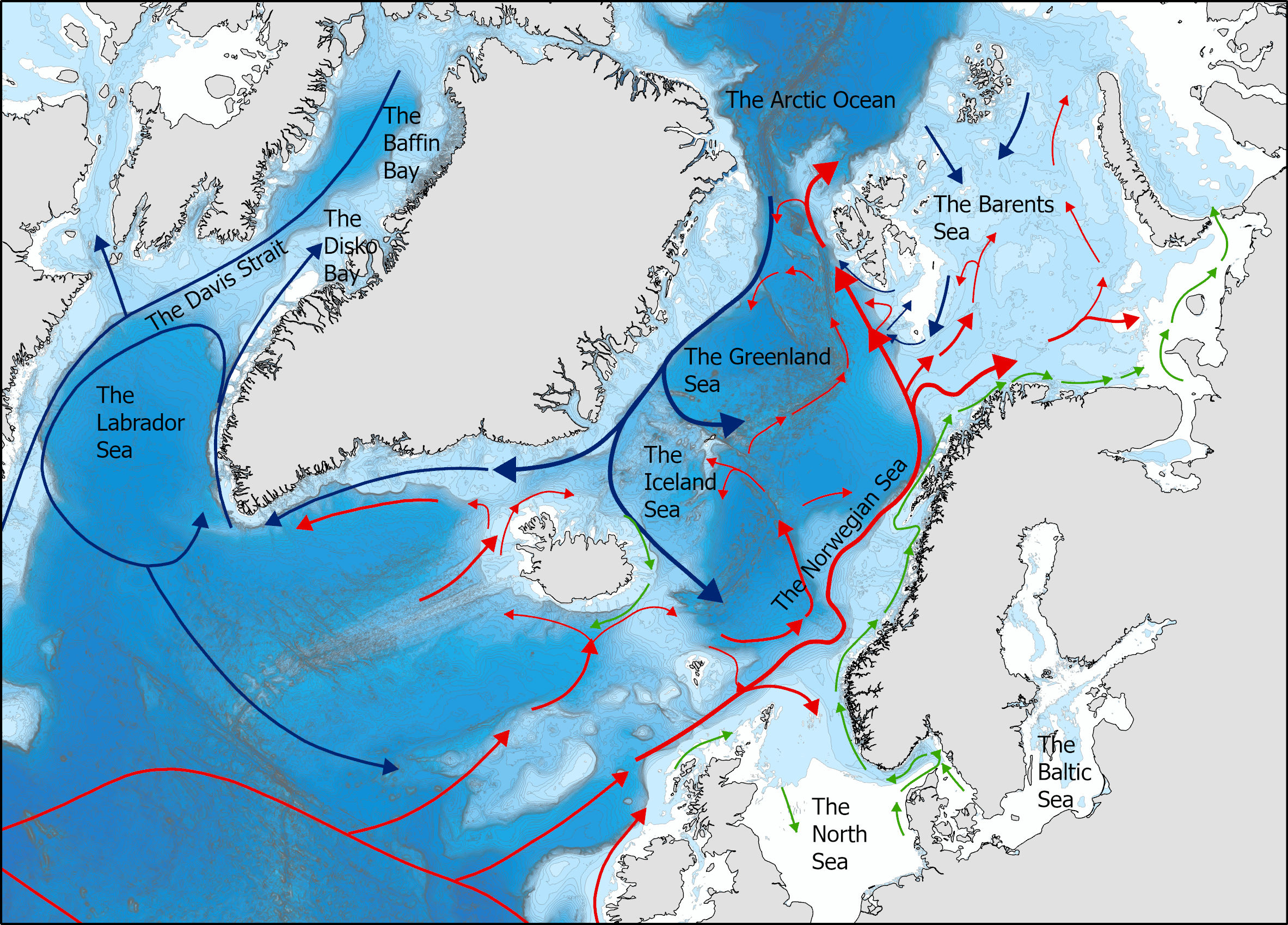
Figure 1. The main seas treated in this report with currents imposed: Atlantic currents with relatively warm and saline water (red arrows), Arctic currents with colder and less saline water (blue arrows), and fresher coastal currents (green arrows). Nuances of blue denotes bottom depth, the darker the deeper. Map by Per Arne Horneland, IMR.
Measurement series since the 1990s show an increasing degree of acidification, significant decrease in pH, almost everywhere in the North Sea and Norwegian Sea where we have sufficient data to investigate trends (Ottersen et al. 2023). It should be noted that since the solubility of CO2 is higher in colder water, polar regions are more vulnerable to OA. The addition of fresh water from sea-ice melt and river runoff reduces the ocean’s buffering capacity further accelerating OA in northern areas including parts of the Barents and Nordic Seas, especially on the freshwater-influenced shelf areas (e.g. Drinkwater et al. 2021). In the worst-case scenarios, the pH in the Nordic Seas will be markedly lower in the year 2100 than today.
Other climate-related effects that are important for organisms and marine ecosystems in (parts of) the Nordic region are sea level rises (coastal erosion and habitat loss), reductions in sea ice cover (affect ice-dependent species, such as polar bears and seals), changes in ocean circulation (changes in the distribution of small non-active swimming organisms and nutrients), and decreases in oxygen (affects species life and reproduction). Key characteristics and expected consequences of climate change of the different seas covered in our assessment are summarised in Table 1.
Region | Key characteristics |
Baltic Sea | The Baltic Sea is a shallow, near-enclosed sea with low salinity and limited water exchange, making it prone to eutrophication. The health of key fisheries (cod, herring, sprat) is tied to the sea’s unique environmental conditions and face challenges from overfishing, pollution, and habitat degradation. Climate change is expected to further increase surface temperatures, shorten ice cover period, intensify eutrophication, and lower the salinity and oxygen levels. Human use includes fishing, maritime transportation, tourism, and offshore wind farms. |
North Sea | The North Sea is a shallow semi-enclosed northeastern arm of the Atlantic Ocean, with significant oil and natural gas reserves, as well as its busy shipping lanes and historically rich fishing grounds. Consequently, marine life in the North Sea faces an extensive total burden from many other human impacts, including eutrophication, habitat damage and overfishing, in addition to climate change. |
Norwegian and Iceland seas | The Nordic Seas are deep and open ocean. Despite of the northerly location, most of the area are ice-free year-round due to the warm Atlantic current. Large quantities of phyto- and zooplankton are produced here. This allows the free water masses of the Norwegian and Iceland seas to be the habitat of large fish stocks, in particular herring, mackerel and blue whiting. Their distribution is highly temperature dependent. Ocean acidification has advanced faster here than the global average. |
Seas around Greenland | The seas around Greenland, including coastal waters, support diverse marine life, including seals, whales, and (primarily arctic) fish. During the past decades, the region has experienced rapid warming, with consequences for e.g. the ice cap melt rate, ocean temperature and ecosystem structure. Fish stocks are already affected by changes in the physics, primary and secondary production, affecting habitats, food availability, and predation pressure, and species are migrating north. Such changes are projected to continue over the coming century. |
Barents Sea | The Barents Sea is a comparatively shallow shelf sea. While the southwestern part is heavily influenced by relatively warm Atlantic water masses, the northern and eastern parts are essentially of Arctic nature. The Barents Sea is home to several abundant and commercially harvested fish stocks, notably the “skrei” cod. With climate change some of the largest changes on the planet are expected here, temperature increase resulting in a fundamental change from a seasonally ice-covered to a permanently open ocean system. Maritime transport and tourism is increasing, potentially causing further pressure on the ecosystem. |
Table 1. Key characteristics and expected consequences of climate change of the different seas examined.
In addition to this review, we also provide a short overview based on input from a small, targeted group of Nordic managers and decision makers. They were asked to describe which climate change related pressures they consider to be the largest treats to our marine ecosystems, and also to suggest means to further develop Nordic cross-border cooperation to sustainably solve common environmental challenges. Marine Protected Areas (MPAs) independent of national boundaries were particularly highlighted by respondents. This latter section is a follow-up to questions to a panel debate at the final conference of the Nordic Council of Ministers Vision Project Marine Management and Climate in Gothenburg, November 2024.