Seas around Greenland
Vibe Schourup-Kristensen and Marie Maar, Aarhus University, Denmark
The seas around Greenland consist of both regions with cold polar and warmer Atlantic waters, providing very different conditions for marine life and potential for harvesting. Cold polar water that flows south on both sides of the country meets with warm Atlantic water and creates particularly favourable production conditions in areas on the continental shelf (Fig. 10). Due to Greenland's northern location, most waters experience seasonal ice coverage in winter, the main exception being Southwest Greenland.
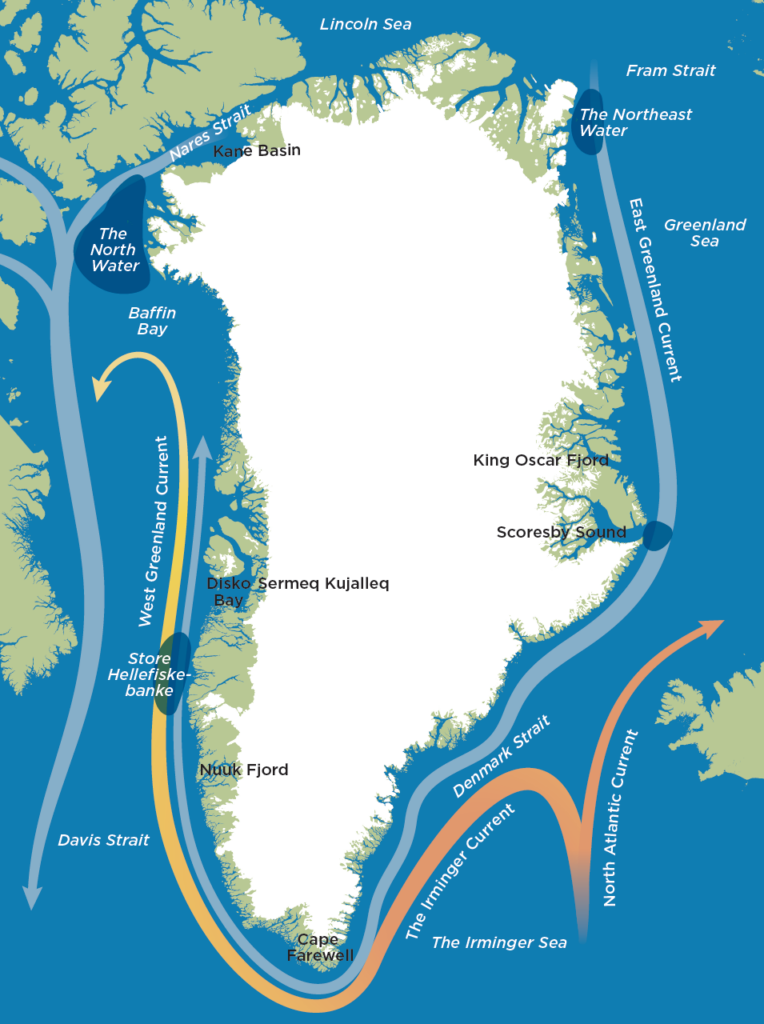
Figure 10. The main currents around Greenland. Cold ocean currents from the Arctic Ocean are shown in light blue and the relatively warm North Atlantic Current in orange fading to yellow. From Professor Mads Peter Heide-Jørgensen, Greenland Institute for Natural Resources and Trap Greenland (https://trap.gl/en/natur-og-landskab/havet-og-fjordene/)
Physical and biogeochemical changes
During the past decades, Greenland has experienced rapid warming, with consequences for e.g. the ice cap melt rate, ocean temperature and ecosystem structure. Changes that are projected to continue over the coming century.
The CMIP6 earth system models project that air temperature over Greenland will increase by more than 5 °C at the end of the century in the (extreme) SSP5-8.5 scenario, and precipitation will likewise increase significantly (Zhang et al. 2024). The globally increasing atmospheric temperature has implications for the water temperature, for which the CMIP6 multi-model mean shows an increase that exceeds 2 °C at the end of the century in the low SSP1-2.6 scenario, and 5 °C in the SSP5-8.5 scenario (Kwiatkowski et al. 2020). The glacier volume loss is projected to reach 67% in the SSP5-8.5 scenario (Kang et al. 2024).
The combination of increased precipitation and glacier melt leads to increasing freshwater runoff from land to the seas around Greenland. For the SSP1-2.6 scenario, the runoff volume is projected to peak in 2037, while more severe scenarios lead to progressively later peaks in runoff (e.g. year 2083 for SSP5-8.5). The change in runoff has a strong seasonal signal, and is projected to increase the most during summer, in July and August (Kang et al. 2024). With regards to nutrient supply, marine terminating glaciers currently induce upwelling of nutrient-rich water from below, thus playing an important role in sustaining the marine coastal ecosystem (Hopwood et al. 2020). However, as glaciers retreat inland, this mechanism will no longer occur, likely with large ecosystem implications locally. Meltwater from the Greenland Ice Sheet further provides smaller concentrations of bioavailable iron, phosphorus and silica (Hawkings et al. 2014, 2016 and 2017), while also nitrate appears to be supplied by meltwater (Wadham et al. 2016). Ocean simulations show that runoff from east Greenland will be transported to the Labrador Sea, while runoff from West Greenland will be moved toward Baffin Bay, thus bringing nutrients and increasing stratification in these areas (Luo et al. 2016). Meltwater has already been shown to reduce light limitation for phytoplankton in open waters, through shallowing of the pycnocline, and thus reduced light limitation in the Labrador Sea (Oliver et al. 2018). Future changes in the mixed layer depth (MLD) depend on the balance between increased wind mixing and stronger stratification due to increased freshwater runoff, leading to large variability between models in both CMIP5 (Steiner et al. 2014) and CMIP 6 (Kwiatkowski et al. 2020), but overall the model means show a small tendency toward shallower MLD around Greenland.
Primary production
Currently, marine primary productivity around Greenland follows a pattern of higher productivity south, southwest and southeast of Greenland, areas which are warmer and predominantly ice-free year-round at present time. CMIP6 projections show that these southern areas will experience a decrease in productivity, associated with stronger stratification and nutrient limitation. In the northern areas, Baffin Bay and the eastern parts of the Greenland Sea, productivity is projected to increase to a decrease in ice cover, and thus less light limitation (Kwiatkowski et al. 2020, Tittensor et al. 2021). Compared to the earlier CMIP5 projections, the changes in CMIP6 are similar in direction, but with a stronger trend. In the Greenland Sea, northeast of Greenland, projections show a significant increase in productivity (Popova et al. 2014, Tittensor et al. 2021). This increase can be attributed to a combination of increased light availability due to a smaller sea-ice extent, and increased vertical mixing of nutrients (Popova et al. 2014). While the overall trend in primary productivity is similar between the earth system models, the strength and timing of change differs. However, productivity is changing in relation to both duration, strength and timing of blooms, as well as species composition.
CMIP5 and CMIP6 projections show that over the coming decade CO2 uptake will act to decrease pH in the waters around Greenland, with potential implications for organisms with calcium carbonate shells (Popova et al. 2014, Steiner et al. 2014, AMAP 2018). CMIP6 projections show that the waters around southern Greenland will experience significant reductions in the aragonite saturation state, which will be corrosive (<1) year-round by 2100 in SSP2-4.5, and more severe in SSP5-8.5. The drop in pH and saturation state is smaller towards the north in Baffin Bay and at the east coast north of Greenland. Here, productivity is projected to increase, thus counteracting acidification (Popova et al. 2014, Steiner et al. 2024).
Secondary production
The CMIP6 multi-model mean shows a decrease in zooplankton biomass in the waters southwest, south and southeast of Greenland, areas that currently are ice free and have higher phytoplankton and zooplankton biomass than waters toward the north (Tittensor et al. 2021). However, the calculation of zooplankton grazing on phytoplankton is a large source of uncertainty in CMIP6 models (Rohr et al. 2023).
The copepod Calanus glacialis is a nutritious food source and thus a key species for the marine food web in Greenlandic waters. However, changes in sea ice cover and temperature has caused the smaller and less fatty C. finmarchicus to move northward from the Atlantic Ocean with warming water, currently dominating the Calanus biomass in Disko Bay (Møller et al. 2020). This change in species composition has implications for the food web as the mean lipid content of the Calanus females has decreased by 34% due to the change in species composition (Møller et al. 2020). A model study shows that C. glacialis has moved northward in Baffin Bay over the past 30 years (Feng et al. 2018), brought on by changing conditions in the northern parts. Changes in ice cover and temperature have led to a prolonged growth and feeding season, as well as increased food availability. This study thus suggests that the poleward movement of C. glacialis will continue, as current changes with regards to ice cover, temperature and primary productivity are projected to continue (Tittensor et al. 2021). Similarly, Freer et al. (2022) showed that habitats for C. finmarchicus are moving northward in the Greenland Sea.
Benthic plants and animals
In the Arctic, the pelagic and benthic productivity is closely coupled (Grebmeier et al. 2015). Consequently, benthic biomass and the variety of species living on the surface of the seabed decreases with latitude, ice cover and depth along the west Greenland shelf (Maier et al., 2024). Given the projected decrease in ice-cover and increase in primary productivity in poleward areas around Greenland, an increased flux of organic matter to the seafloor is likewise expected. In the northern areas of both the west coast and east coast of Greenland, increased food availability for epifauna (Rysgaard et al., 2007), including bivalves (Sejr et al. 2009), is therefore expected, indicating increased benthic biomass in the future.
Further, bottom temperature has increased by more than one degree from 1990 in the water off west Greenland, leading to poleward expansion of communities especially west of Greenland, a tendency which is likely to continue with continuing ocean warming over the coming decades (Renaud et al. 2015). Species of macroalgae from the intertidal zone have likewise expanded poleward along the west coast of Greenland, e.g. F. vesiculosus, which moved from 73 to 76N over a period of 40 years from 1970. However, no similar trends have been observed on the east coast, possibly due to the southward current here (Krause-Jensen et al. 2020). In Jungsund, the growth rate of kelp (Saccharina latissima) correlates with the increasing ice-free period (Krause-Jensen et al. 2020).
Factors that may affect communities in a negative direction are, e.g., acidification, which is especially projected to affect the shelves, bottom trawling, and Walrus feeding on benthic communities. The latter may increase as the ice coverage decreases in northern areas, making feeding more accessible (Węsławski et al. 2011).
In western Greenland, shrimp (Pandalus borealis, also known as northern prawn or deepwater prawn) play an important role for the economy and local employment, and are a key food source for fish and birds (AMAP 2018). Shrimp habitats currently include the continental shelves of southern Greenland, south of Iceland in the east, and south of 75 °N on the west coast, but with changing temperature shrimp are increasingly observed also north of 69.3 °N (AMAP 2018). The shrimp fishery takes place both in coastal and offshore waters. The shrimp life cycle is closely coupled to the physical and biological environment, with e.g. larvae hatching time co-occurring with the phytoplankton spring bloom. As climate change is projected to change the timing and strength of the phytoplankton bloom, the feeding of shrimp may also be affected in the future. Additionally, warming is likely to impact stress sensitivity. Higher temperatures are known to reduce recruitment, but they may also benefit shrimp (Richards et al. 2015). Shrimp seem to be able to internally counteract the effects of acidification (AMAP 2018), though their taste may be affected negatively (Dupont et al. 2014). In summary, the combined effect of increasing stress on shrimp due to climate change is not well understood, and more studies are needed to understand how the Greenlandic shrimp stock will change in the future.
Fish
The fish around Greenland are currently already affected by increasing temperature and decreasing ice cover, leading to changes in optimal habitats, food availability, and predation pressure, as primary and secondary production is changing, and new species are migrating north.
The fish model intercomparison in CMIP5 and CMIP6 project a global decline in animal biomass by the end of the century (Lotze et al. 2019). However, in the areas around Greenland that are currently ice-covered during winter, e.g. Baffin Bay and the east Greenland Sea, the multi-model mean projects an increase in animal biomass by up to 50% in 2100 under SSP5-8.5. This is mainly brought on by decreased ice cover, increased temperature, and shallowing mixed layer depth, combined with increased primary production. In the sea south of Greenland, animal biomass projections show minor to no decline (Lotze et al., 2019). In CMIP6, the area of positive change in biomass is further north, while the southern area shows a larger decline than what was projected in CMIP5 (Tittensor et al. 2021). The future fish stocks are affected also by changes in other human pressures, something that is not addressed in the simulations, neither are changes in species composition.
Given the large importance of fisheries for Greenlandic society, changes in fish stocks are currently monitored by researchers and fishermen alike (Jacobsen et al. 2023). In waters off south and east Greenland, changes in sea ice distribution, duration and thickness affect the availability of habitats. Here, poleward expansion of distributions of boreal generalists is currently happening with increasing temperature, opening new habitats for mobile pelagic species such as saithe (Post et al. 2020). Further mackerel and tuna appear to be moving poleward, but with fluctuations over the years (Heide-Jørgensen et al. 2022). At the same time, a decrease in Arctic bottom dwelling benthivores and demersal fish has occurred. However, the loss of species with Arctic traits was not compensated by the number of new species, leading to a functional diversity decline in waters southeast of Greenland (Emblemsvåg et al. 2022a). An example is the subarctic capelin, which has moved closer to the east Greenland shelf due to changed temperatures (Heide-Jørgensen et al. 2022).
The deep-water flatfish Greenland halibut is an important species for fisheries in west Greenland. Given the deep habitat of the species, only little is known about the distribution. However, studies have shown that the seasonal and interannual distribution is affected by variations in temperature (Boje et al. 2014, Wheeland and Morgan 2019). Additionally, the distribution of fisheries along the west coast shows how the halibut has moved northward, with halibut fisheries having been common in Ilullissat (69 °N) for 100 years, in Uummaanaq (71 °N) for 70 years and in Upernavik (73 °N) for 30 years (Jacobsen et al. 2023). In general, the fishermen in northwest Greenland experienced increasing fishing opportunities with decreasing sea ice (Jacobsen et al., 2023).
All in all, current experiences with increasing fisheries west of Greenland, combined with projected continued warming of the water, reduction in summer sea ice and increased primary productivity suggests that a borealisation in southern parts of west Greenland, while a poleward expansion of Arctic species, is likely to continue.
Seabirds
Greenlandic seabirds are expected to be affected by factors such as changes in temperature and sea ice extent and thickness, which will lead to shifts in spatial distribution of prey species, affecting timing of prey availability. Physical and ecosystem changes brought on by climate change are expected to impact specialized Arctic species, while generalists will be more likely to adapt to, or even take advantage of, new conditions.
An example of an Arctic specialist is the ivory gull in east Greenland, which forages at the ice edge throughout the year. The ivory gull breeds in northeast Greenland, while the ability to obtain sufficient food to raise young depends on the distance to the ice edge. The population trend in Greenland is unknown due to the remote habitat but is thought to decline south of 70 °N e.g. due to loss of sea ice habitat (Gilg et al. 2009). Similarly, the Canadian population has declined by 80% from 1980 to 2002 (Gilchrist et al. 2005), and the Svalbard population by 40% from 2006 to 2019 (Strøm et al. 2020). In northeast Greenland, the projected change in ice extent over the coming century is small compared to the rest of the Arctic, and it is thus possible that the population here will remain stable in the future (Gilg et al. 2009). However, winter-habitats for the ivory gull are found around the ice-edge south of the Polar Circle (66 °N), mainly in the Labrador Sea, due to the need for light to forage. Consequently, if the ice edge moves too far north, the winter habitats will be lost, likely causing a decline in the populations and ultimately extinction (Kuletz et al. 2024).
Little auk is the most abundant seabird in the Atlantic Arctic, playing an important role in the ecosystem by transporting organic matter from the sea to land, where it breeds exclusively on rocky coasts of the high Arctic, especially in northwest and east Greenland (Wojczulanis-Jakubas et al.,2022). Little auk is dependent on Arctic copepods with high fat content, and it is thought that the increased temperature over the past century, combined with poleward movement of e.g. C. glacialis, has contributed to a decline in the population in southeast Greenland, though other factors may also contribute (Jakubas et al. 2024). The habitats of the Arctic copepods are expected to continue the poleward displacement, likewise, pushing the habitat for little auk northward.
However, some Greenlandic seabirds, such as the common eider and great black-backed Gull, benefit from warmer conditions and have expanded their habitats northward (Boertmann et al. 2016; Boertmann and Frederiksen, 2020). Additionally, opportunistic species, such as the lesser black-backed gull, which were previously limited in northward movement by e.g. temperature, ice or prey availability, are likely to increasingly move north to southern Greenland (Boertmann and Frederiksen 2016). Further, some birds which currently do not have a strong presence in southern Greenland, such as the herring gull, may move north to Greenland in the future (Boertmann and Frederiksen 2016).
Marine mammals
In addition to the importance of marine mammal hunting for Inuit communities, marine mammals are apex predators in Greenlandic waters, and their distribution thus provides information on the state of the ecosystem. Species such as narwhal, walrus and hooded and ringed seals rely on ice and cold temperatures for their habitats and are thus likely to be affected by the changes in the environment. A study combining CMIP6 earth system models with long-term time-series of the distribution of three Arctic ice-dependent whale species (bowhead whale, beluga, and narwhal) around Greenland, has assessed the projected habitat changes for these cetaceans (Chambault et al. 2022). The study showed a major loss of summer habitats for all three species both west and east of Greenland, especially in the SSP5-8.5 scenario, except for narwhal habitat east of Greenland, which was increased in Scoresbysund in the projections. In winter, an overall gain of habitat was projected for Bowhead whales, especially in the Canadian Archipelago, though a loss habitat was projected east of Greenland. Narwhals likewise lost habitat during winter both in Baffin Bay and east of Greenland (Chambault et al. 2022).
Narwhals have a preferred feeding temperature of <2C, and it has been shown that southward migration takes place later in the season during warmer years with increased meltwater runoff and delayed ice formation, suggesting that narwhal habitats are currently being pushed north- and westward as their habitats are reduced due to less sea ice (Laidre et al. 2024). However, currently no trend in the number of narwhals is observed at Melville Bay in west Greenland. In east Greenland, a decline has been observed due to e.g. changed temperature and ice conditions (Heide-Jørgensen et al. 2023).
Walrus habitats include the coasts of northwest and northeast Greenland where they rely on ice for resting and nursing their young. In recent years, the number of walruses caught in northwest and west Greenland has declined, partly due to sea ice decline, which has moved walrus habitats westward with the Baffin Bay pack ice (Born et al. 2017). However, walruses have a good heat tolerance, and longer ice-free periods may also be positive for Atlantic walrus, giving prolonged access to foraging and access to terrestrial haul-outs. In addition, primary production and thus benthic growth is thought to increase in the north toward 2100. Hence walrus may thrive in a future climate, provided other human pressures are kept down (Born et al. 2021).
In southeast Greenland, the number of boreal cetaceans, such as pilot whale, dolphin and killer whale, has increased since 1980 with decreasing summer ice cover. At the same time, the number of walrus and narwhals has declined in the area (Heide-Jørgensen et al. 2023). The loss of summer ice can be considered a tipping point that has led to major habitat changes, and which is not likely to be reversed under current climate scenarios.
Holistic ecosystem considerations
The Arctic has been identified as an area experiencing climate change at a rate faster than the global average, and climate change impacts are already altering the ecosystem around Greenland. In the northern regions both east and west of Greenland, the trend of an increase in temperature and a decrease in sea ice extent, duration and thickness over the past decades is projected to continue until the year 2100. For Arctic species adapted to low temperature and sea ice, such as the copepod G. glacialis and the narwhal, habitats are moving northward thus also causing a poleward movement of these species which is likely to continue with future changes. However, the CMIP6 multi-model mean also projects increases in primary and secondary production due to, e.g., increased light, higher temperatures and nutrients from runoff, leading to increased primary and secondary production, and thus an increased flux of organic matter to the sea floor, and increased benthic biomass. Likewise, the projections show that fish biomass will increase in the northern areas around Greenland. These projections do, however, not have information about changes in species composition. Current observations show that economically important species, such as shrimp and halibut, can be fished progressively further north as temperature increases. Especially on the west coast of Greenland, fisheries are important for the economy, and the northward movement of fish opens up new opportunities in the northern locations, such as Upernavik and Qaannaaq.
Further towards the south, in the areas that do not currently have summer sea ice, CMIP6 projections show an increase in temperature, stronger stratification and a small decrease in primary and secondary production, as well as animal biomass by the year 2100. However, south, southwest and southeast of Greenland, the warmer water has seen an increase in boreal species over the later years. For fish, the boreal species are generally characterized by being pelagic generalists that are able to move to new locations, such as mackerel and tuna, while Arctic demersal fish are increasingly moving northward. Also, cetaceans, such as pilot whales and dolphins, have been observed in the area. Especially the region southeast of Greenland is relatively well connected to Iceland, making it possible for species to move northward to Greenland, suggesting that the fisheries there might become increasingly successful in the future.
Changed trophic interactions may have both negative and positive impacts that are difficult to predict on, e.g., fisheries. IPCC (2019, 2022) generally predict mainly negative impacts for Greenlandic society. Given the large importance of fisheries and hunting for the local economy and culture, communities are generally adaptable to new possibilities, making it important to identify, e.g., new harvestable fish species. However, the ability to adapt to changes depends on several factors, including the existence of infrastructure, such as local piers and fish factories, and political decisions, such as fish quotas and export prohibitions (e.g., narwhal tusk and walrus ivory). Thus, local communities, government and private companies all play a role in the resilience and adaptability in Greenland.
Another change brought on by decreasing ice extent and improved infrastructure is an increasing number of tourists, filmmakers and researchers visiting even remote areas of Greenland. This provides new possibilities in terms of earning money servicing the visitors, something that may widen the gap between those who can take advantage of new options and those who cannot, e.g., English language is becoming more important in communicating with tourists (Hayashi and Delaney 2024).