Norwegian and Iceland seas
Hjálmar Hátún, Faroe Marine Research Institute, Faroe Islands
These seas, together with the Greenland Sea covered below, comprise the Nordic Seas. These seas have cold, nutrient-rich waters, which support a diversity of marine life, including enormous amounts of zooplankton, large fish stocks, whales, and seabirds (Fig. 9). The region – remote to major cities – is to less degree than most under direct pressure from land-based human activities. Despite their high latitude, most of the Norwegian and Iceland seas remain ice-free year-round thanks to as a continuation of the Gulf Stream. The region plays an important role in global ocean circulation as the Atlantic Meridional Overturning Circulation (AMOC) here constitutes a conveyor belt where relatively warm and saline Atlantic water masses flow into the Norwegian Sea from the south, are transported north and westwards to the Greenland Sea where a fraction of the then cold, dense waters sinks and flows southwards, driving the thermohaline (water density determined) circulation (Fig. 9).
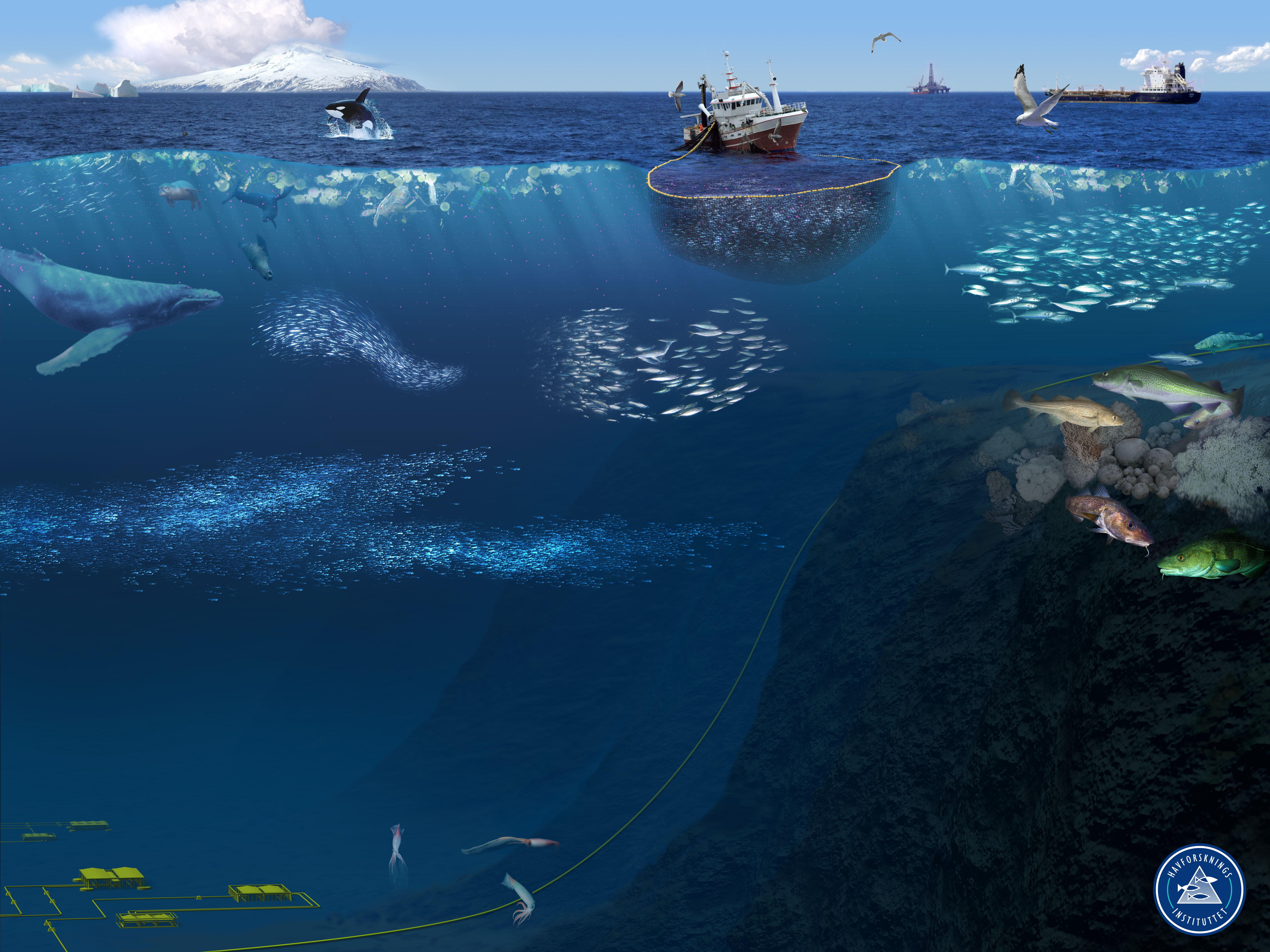
Figure 9. An artist’s view of the Norwegian-Iceland Sea region. Credit: Institute of Marine Research, Norway.
For this area we have chosen a different approach to our presentation. Instead of by species group we here give a more integrated ecosystem description, focusing on bottom-up, food driven mechanisms and energy flowing throughout the environment and ecosystem. Climate is a main driver, influencing physical, biogeochemical and biological processes. To better understand the effects of climate change, we need to understand as much as possible about the mechanisms through which climate impacts the Nordic Seas ecosystem today.
Introduction to the bottom-up drivers of the region
The population sizes of several demersal fish stocks (e.g. Atlantic cod) and seabird species (e.g. kittiwakes) in the subpolar North Atlantic (SPNA) have been declining during the last 2–3 decades. A critical question is whether this is due to anthropogenic influence, natural environmental cycles or maybe (and more likely) a combination of these. The fisheries do, naturally, directly impact commercial fish stocks, but direct exploitation cannot explain, e.g., the decline of kittiwakes, which are not being harvested by humans. A decline in common food resources for both fish and birds is a plausible candidate, where the ecologically important copepod C. finmarchicus and forage fish like sandeel and Norway pout are primary candidates. While acknowledging the importance of top-down impacts, the following summary is limiting to bottom-up (food driven) processes. This bottom-up perspective focuses on the most plausible physical drivers underlying ecosystem changes on the south Iceland, Faroe and Norwegian shelves – especially through the trophic pathway from large zooplankton (copepods) via forage fish (e.g., sandeel and Norway pout) to commercial fish stocks and seabirds. Historical temporal changes in the SPNA are here categorized into i) recurrent pulses every 5–8 years, ii) major longer-lasting shifts and iii) long-term trends.
The strong and highly variable atmospheric jet stream impacts all three shelf environments both through direct air-sea interaction, and indirectly through changes in large-scale ocean circulation, which subsequently impacts the shelves laterally by ocean-shelf interaction. In our simplified perspective, we discuss how the size and circulation strength of the subpolar gyre (SPG) regulates the temperature and salinity (Hátún et al., 2005) and the biogeochemical and biological content (Hátún et al., 2016; Hátún et al., 2017a) in the relatively warm and saline Atlantic Water (AW). This Atlantic inflow flows westwards south of Iceland, crosses the Iceland-Faroe ridge and flows poleward through the Faroe-Shetland Channel. The AW properties thus impact the south Iceland (Hátún et al. 2016) and Faroes (Hátún et al. 2021a, Jacobsen et al. 2019) shelves directly and are likely to influence the Norwegian shelf as well. Immediately north of the Iceland-Faroe ridge, the AW meets south-eastward flow of cold and low-saline waters from the East Icelandic Current (EIC), which carries large amounts of nutrients and zooplankton into the southern Norwegian Sea (Kristiansen et al. 2019). Interplay between the AW and the (modified) East Icelandic Water from the EIC determines the physical oceanography and planktonic food abundance in the southern Norwegian Sea, which has potential to influence the Faroe (Kristiansen et al., 2021) and Norwegian shelves (Skagseth et al. 2021). Like the SPG regulates the distribution of, and mixing between, source water masses west of the British Isles, the Norwegian Sea gyre regulates water mass distribution and mixing in the southern Norwegian Sea (Hátún et al., 2021).
Pulses
Periods with an intensified atmospheric jet stream, often proxied by a high North Atlantic Oscillation (NAO) index (Hurrell, 1995), increases heat losses from the SPNA oceans and this induces deep winter convection, which is especially strong in the Labrador and Irminger Seas (Yashayaev 2007). Strong convection increases the volume/size of the SPG and invigorates nutrient upwelling and thus primary production. Increased SPG volume, as well as the action of winds (through the so-called wind stress curl) brings the nutrient and zooplankton rich SPG water closer to the south Iceland and Faroes shelves, and can in this way “blow life” to these shelf ecosystems (Hátún et al. 2016). Such pulses have been documented to a) increase the nutrient contents all the way from the Labrador Sea, across the Irminger Sea and the Iceland Basin and into the southern Norwegian Sea (Hátún, et al. 2017a), b) increase the abundance of the subarctic zooplankton species C. finmarchicus in the central Irminger Sea, the south Iceland shelf (Hátún et al., 2016) and in the subarctic water masses in the Norwegian Sea (Kristiansen et al. 2021), c) increase the breeding success of the seabird black-legged kittiwake (Hátún, et al. 2017b) and the total abundance of juvenile fish on the Faroe shelf (Jacobsen et al. 2019). During the last half century, such pulses occurred in the years: 1976, 1984–1985, 1987, 1993–1995, 2000–2001, 2009, and 2017.
Major shifts
Associated with the same atmospheric drivers, but with additional profound shifts in gyre circulation and major ocean currents, we have also witnessed longer lasting shifts in the northeastern Atlantic. After a period with generally high NAO index values during the late 1980s and early 1990s, an abrupt weakening in the atmospheric forcing during winter 1995–1996 led to much weakened winter convection, which again initialized a major decline of the SPG size and circulation (Häkkinen and Rhines 2004, Hátún et al. 2005). Less subarctic water reached the mixing region west of the British Isles, and the AW therefore became both warmer and more saline, but poorer in nutrients and C. finmarchicus (Hátún, et al. 2009a). This, and the simultaneous strong decline in sandeel abundance, likely caused seabird populations like the world’s largest puffin colony, located in the Icelandic Westman Islands (Vestmannaeyjar), to decline, although the puffin abundance has since ca 2015 strongly increased again (Mehto 2021). The strong subarctic pulse in 2000–2001 gave Calanus-dependent species on the south Iceland and the Faroe shelf a much-needed injection, but after this pulse had passed these shelf ecosystems went into a serious recession. This event also had detrimental impacts along the European margin, were e.g. the sandeel abundance and the prosperity of several seabird species strongly declined (Coulson 2011). The mid-1990s change had, however, positive impact on the large pelagic blue whiting stock (Hátún et al. 2009b), which is less sensitive to food availability early in the season (before May), and which benefits from a warmer and more stratified ocean. Many new marine species with warmer water affinity entered Faroese and Icelandic waters during this event (Valdimarsson et al. 2012), and it is therefore justifiable to refer to this as the mid-1990s regime shift (Hátún et al. 2009a).
Since the above discussed pulses and longer-lasting shifts are related to similar physical processes, it is not trivial to determine whether a present or recently observed change represents a pulse, or if it marks a shift to a new state. Although the pulses around 2000–2001 and 2008–2009 were evident in hydrographic records around the northeastern Atlantic (clearest in salinity) and in biological production on the Faroe shelf (Jacobsen et al. 2019), they were not strong enough to flip the SPNA back into a subarctic state – like in the early 1990s. A major pulse initiated by increased convection during the winters 2014–2016 (Yashayaev and Loder 2016) managed, however, to re-invigorate the SPG, evidenced by a drop in sea surface heights south of Iceland (Hátún and Chafik 2018) and in the most rapid salinity drop in historical records in the same region (Holliday et al. 2020). Observations during the following years have demonstrated that the system shifted back to a state resembling the early 1990s. It is therefore timely to review possible ecological changes in the northeastern Atlantic for the years after 2015. And for those species exhibiting a change, to distinguish if this was a post-2015 pulse or maybe a more lasting shift back to a subarctic/more productive state.
Discussions on the Norwegian Sea must include the additional influence by the EIC. The properties and transport in the EIC are, as mentioned, related to the SPG story due to similar atmospheric forcing, and since the AW properties in the clockwise circulation constitutes one of the sources for the EIC (Valdimarsson et al. 2012). The SPG and EIC signals are, however, not the same. The EIC influx was strong during the 1990s, and this brought large amounts of large and lipid rich copepods (C. hyperboreus and large stages of C. finmarchicus) into the Norwegian Sea. This influx declined sharply in 2003–2005, and with it decline the abundance of the nutritious zooplankton (Kristiansen et al. 2019). This relatively warm and saline Atlantic period prevailed until around 2016, when the EIC influx increased yet again, which immediately brought more of the subarctic copepods to the waters north of the Faroes, and even east to the Norwegian slope (Kristiansen et al. 2021, Skagseth et al. 2021). These shifts in the Norwegian Sea likely have implications for zooplankton and the fish species herring, mackerel, and salmon. Updates on the further development of these processes and their potential impacts on adjacent shelves and seabirds is warranted.
Long-term trends
Evidence for longer-term physical and ecological trends must also be discussed, especially now anthropogenic climate change is projected to fundamentally alter the functioning of marine ecosystems during the next 50–100 years (IPCC 2019, 2022). Only few hydrographical and biological records are longer than 50 years, and since the North Atlantic Ocean is characterized by a natural cycle of 50–60 years (the Atlantic Multidecadal Oscillation, AMO, Goldenberg et al. 2001), it is not trivial to distinguish between uni-directional trends and natural variability. Although we regularly read about warming trends and biota migrating polewards, fact is that increasing temperature trends are difficult to establish from hydrographic records in the northeastern Atlantic. The first order signal in these hydrographic records is a mid-1990s warming, followed by about twenty years with anomalously high temperatures and a subsequent temperature decrease down to the early 1990s level, i.e. the above-mentioned shift. The pre-bloom (winter) silicate levels throughout the entire SPNA have, on the other hand, been declining since the 1980s in a more linear fashion than what can be ascribed to SPG-related natural variability alone (Hátún et al. 2017a). Silicate is the limited nutrient in the SPNA, so if this trend persists through the coming decades, the working of North Atlantic subarctic marine ecosystems is bound to change - fundamentally. It is conceivable that the mentioned bio-physical linkages, established during a period with higher nutrient concentrations already are altered. Based on a review of recent ecosystem changes on the Iceland, Faroe and Norwegian shelves, we should be able to test and maybe adjust/improve previously proposed hypotheses on bio-physical linkages.