2. PSS in the Nordics
This report marks the culmination of three years of dedicated research into the potential of Product-Service Systems (PSS) in the Nordic region. The aim is to explore when, how, and under what conditions PSS models can deliver resource efficiency and economic value.
The concept of PSS, which combines products and services with a degree of provider ownership, has been recognised as a powerful strategy for advancing the circular economy (CE) and improving resource efficiency (Reigado, 2017). Industries can implement circular principles and unlock new value-creation opportunities by emphasising the continued use of products through maintenance, leasing, or repair services. However, while PSS offers a promising pathway toward a more circular and sustainable economy, the success of these models is not guaranteed. Their ability to reduce material consumption and generate economic gains depends heavily on careful business model design, practical measures to curb resource use, and widespread consumer acceptance.
In the Nordic context, the adoption of PSS remains understudied (Hernandez, 2019). Although the region is often seen as a global leader in sustainability, limited penetration of PSS models across industries and countries reflects an untapped potential. Barriers such as a lack of cross-border knowledge sharing, inconsistent industry collaboration, and underutilisation of synergies persist. This report aims to bridge these gaps by examining the conditions necessary for PSS to thrive in the Nordics, providing a detailed analysis of the opportunities, challenges, and policy frameworks that can support PSS development and adoption.
Our aim is to contribute to a deeper understanding of how PSS can be harnessed to deliver both environmental benefits and economic growth. By fostering collaboration between Nordic industries and sharing best practices, this project seeks to chart a roadmap for scaling PSS models aligned with the region’s strong commitment to sustainability and circularity. The insights in this report are intended to guide policymakers, businesses, and stakeholders in unlocking the full potential of PSS in the Nordic region.
2.1 About the project
In August 2019, the Nordic prime ministers and the Nordic Council of Ministers set forth a vision for the Nordic region to become the most sustainable and integrated region in the world by 2030. This vision centres on three key pillars: a green Nordic Region, a competitive Nordic Region, and a socially sustainable Nordic Region (Nordic Council of Ministers, 2019). Circular business models and innovation pathways are critical components in realising this vision, as they foster resource efficiency, economic growth, and societal sustainability while reducing environmental impacts and promoting a more resilient economy.

Figure 1: Project overview.
In support of this vision, the Nordic Council of Ministers launched the project "Product-Service Systems in the Nordics – Paving the Way for Circular Business and Sustainable Consumption" in November 2021. The project’s purpose is to explore how, when, and under what circumstances PSS models can succeed in the Nordic context, delivering both resource efficiency and economic gains.
The project is structured into two phases with five key steps (illustrated in Figure 1).
- Phase One involved creating an overview of existing PSS models and identifying key product groups suited to PSS in the Nordic region. This phase also identified barriers to PSS adoption, including cultural, technical, economic, and regulatory challenges, and provided tools and recommendations for PSS providers. Twelve significant barriers and suggestions for improving regulatory frameworks to support PSS growth were highlighted.
- Phase Two focused on the selection, execution, and evaluation of 16 pilot projects, each representing different stages of PSS implementation across the Nordic countries.
Phase Two also linked the empirical findings from the pilots to broader EU and Nordic strategies, offering a comprehensive analysis of how PSS models can be aligned with existing policy frameworks to drive sustainable business practices in the region.
This report integrates insights from both phases to provide a detailed understanding of the opportunities and challenges associated with PSS adoption in the Nordics, offering a roadmap for scaling these models to achieve both environmental and economic benefits.
2.1.1 Report structure
The report is structured in the following chapters:
Table 1: Structure of the report.
Table 1: Structure of the report.
2 | Regulatory framework for Nordic PSS models | This chapter provides an overview of current EU and Nordic action plans, strategies, and economic incentives supporting PSS development. It evaluates technical criteria, cultural barriers, and assesses if the current regulatory framework effectively addresses these challenges. |
3 | Introduction to PSS models and product groups | This chapter introduces established PSS business models, market trends, and perspectives. It also offers insights into tendencies across Nordic PSS models by product group, providing a broad overview before delving into detailed analyses. |
4-13 | PSS product groups and pilot findings | Each of these chapters focuses on one of the ten most relevant product groups in the Nordics, with insights into their subcategories. The chapters include theoretical and analytical introductions, followed by in-depth, empirically informed analyses of pilot-tested product categories, examining key drivers, barriers, and environmental potential. |
14 | Sustainability potential of Nordic PSS models | This chapter discusses the sustainability potential of PSS models, drawing on both theoretical insights and empirical data from the 16 pilot studies. It explores potential benefits, as well as risks, disadvantages, and unintended consequences associated with PSS implementation in the Nordic region. |
15 | Drivers and barriers to achieve the sustainable PSS model | This chapter explores challenges such as cultural attitudes toward ownership, financing, procurement, technology development, and documentation requirements. |
16 | Conclusions and recommendation | The final chapter summarizes findings and presents recommendations for three stakeholder groups: 1) Businesses exploring PSS development, 2) Policymakers promoting PSS adoption, 3) Public institutions seeking PSS solutions, 4) Financial actors improving financing access for PSS. The focus is on key enablers to support PSS development and the transition to a circular economy in the Nordics. |
2.2 Defining product-service systems
Product-Service Systems (PSS) represent a shift from traditional product ownership towards more integrated, service-based business models. Several related concepts are used interchangeably, including Product-as-a-Service (PaaS) and Product-Ownership Model (POM), each reflecting different approaches to servitisation (Kim, 2019). These models share the goal of providing value through services rather than product ownership, with PSS encompassing the most comprehensive transformation towards sustainability.
- Product-as-a-Service (PaaS): PaaS focuses on providing products as services, like Software-as-a-Service (SaaS), where customers pay for usage rather than ownership. It’s commonly used in cloud computing but lacks the deeper systemic changes needed for sustainability, as seen in PSS.
- Product-Ownership Model (POM): In POM, the provider retains ownership of the product and offers services such as maintenance and repairs. While it extends product life, it maintains the traditional ownership structure and does not fully integrate service solutions like PSS.
- Product-Service System (PSS) integrates PaaS and POM into a holistic approach, rethinking the entire product lifecycle, from design to disposal. It entails a systemic transformation of business operations, from cash flow and product design to supply chains and customer relationships, marking a full transition from linear business models to circular ones.
This report adopts PSS as the primary framework for examining sustainable business models, offering a broader perspective on how servitisation can contribute to a more circular economy.
2.2.1 The product-service systems archetypes
Despite multiple definitions in circulation, no universally accepted characterisation of PSS exists. One of the most frequently cited definitions comes from , who defines PSS as combinations of tangible products and intangible services designed for their joint capability of fulfilling specific needs while generating value. Tukker’s framework breaks PSS into three primary orientations:
- Product-Oriented Models: These focus on selling tangible products with added services like maintenance and warranties. The core business remains product-based, but services enhance the customer experience and extend product life.
- Use-Oriented Models: Here, the product remains owned by the provider, and customers access it through leasing, renting, or sharing. This model promotes resource efficiency and longer product lifecycles by ensuring that the provider maintains responsibility for the product’s condition and performance.
- Result-Oriented Models: Here, the focus shifts to delivering a specific outcome or performance rather than a physical product. Customers pay for the result, while the provider determines how best to achieve it, often without a predefined product being involved. This approach shifts the emphasis from owning or using a product to simply receiving the desired service or function.
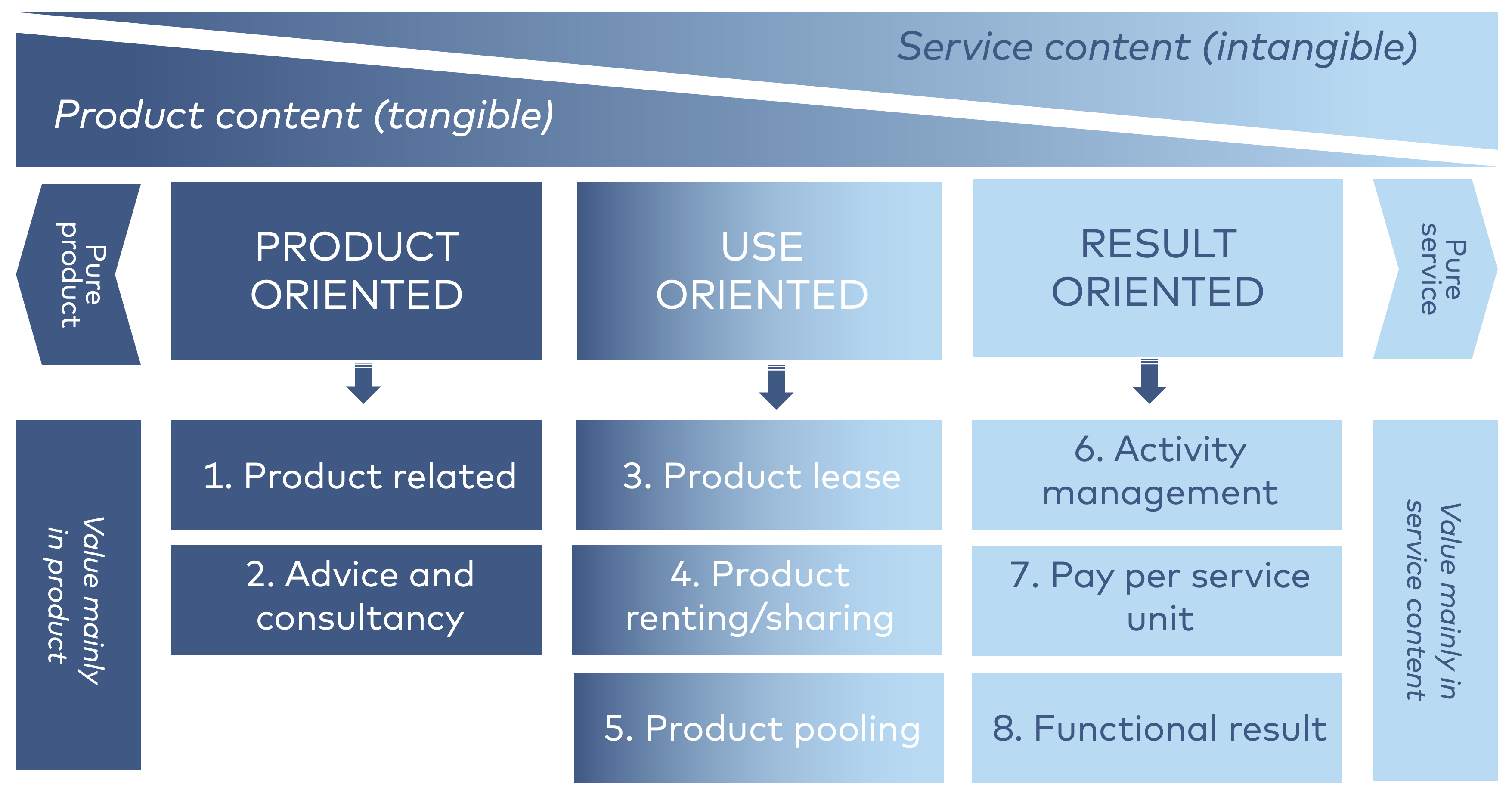
Figure 2: Eight archetypical models of product-service systems based on Tukker 2004.
Adapted from Tukker (2004): Eight Types of Product – Service System: Eight ways to sustainability?
Adapted from Tukker (2004): Eight Types of Product – Service System: Eight ways to sustainability?
Tukker further expanded these orientations into eight archetypical models to capture the diverse ways PSS can be structured. Each archetype offers a different combination of economic, environmental, and service-related impacts, allowing for a more nuanced understanding of how PSS can be applied across various industries. These archetypes will be used throughout the report to explore how PSS can be applied in various industries and how each model influences environmental impact and value creation.