Socio-technical approach
For practical changes to be implemented appropriately, a theoretical lens is often a pertinent instrument to start with. This can offer holistic insights to the matter and tie it in with the surrounding context. The socio-technical approach is socio-evolutionary. This means that deep change at the social level is necessary. This includes changes in motivations and behaviour of social actors including businesses and individuals such as consumers and buyers of e-commerce products and services. The I-Smile project therefore took its point of departure in investigating such motivations and behaviours of actors in last mile ecosystems in four Nordic countries, Norway, Finland, Sweden, and Denmark. In addition, the project examined the development of technical solutions and business models as potential driving forces of change. The premise of the applied socio-technical theory is that change of systems must be analysed in three levels to understand the transformation process towards sustainability. Notably, this theory is seen as a new approach to innovation that relates to the UN Sustainability Development Goals that are inclusive and also address social aspects of wellbeing. Socio-technical systems change is particularly well suited for developments of so-called backbone systems of societies such as transport (Schot and Steinmüller, 2018).
The three levels of socio-technical systems are so-called ’landscape’, ‘regime’, and ‘niche”. ‘Landscape’ depicts an exogenous context to a ‘regime’ that is a functioning and well-knit system of actors, technologies etc. The ‘regime’ is hard to change due to systems bonds, but impact can come from the ‘landscape’ such as climate change and energy crises. The ‘landscape’ has only indirect impact on ‘regimes’ and ‘niches’, and only when actors of these two system levels act upon changes in ‘landscape’. The ‘niche’ level is constituted by entrepreneurs, inventions and innovations of new technology and business models. In the beginning, such newcomers of the last mile transport and logistics system struggle with their innovations’ technology and economy and therefore it takes time to challenge the existing ‘regime’. However, that is the task of this system level as fundamental change, and thereby transition, requires socio-technical innovations.
Figure 12 illustrates the three-layered model of urban last mile logistics adopted by i-Smile. Inspiration is gathered from Aurinen and Tuominen (2014) and Ballantyne et al. (2013) in selecting relevant analytical dimensions and actors in the last mile logistics systems.
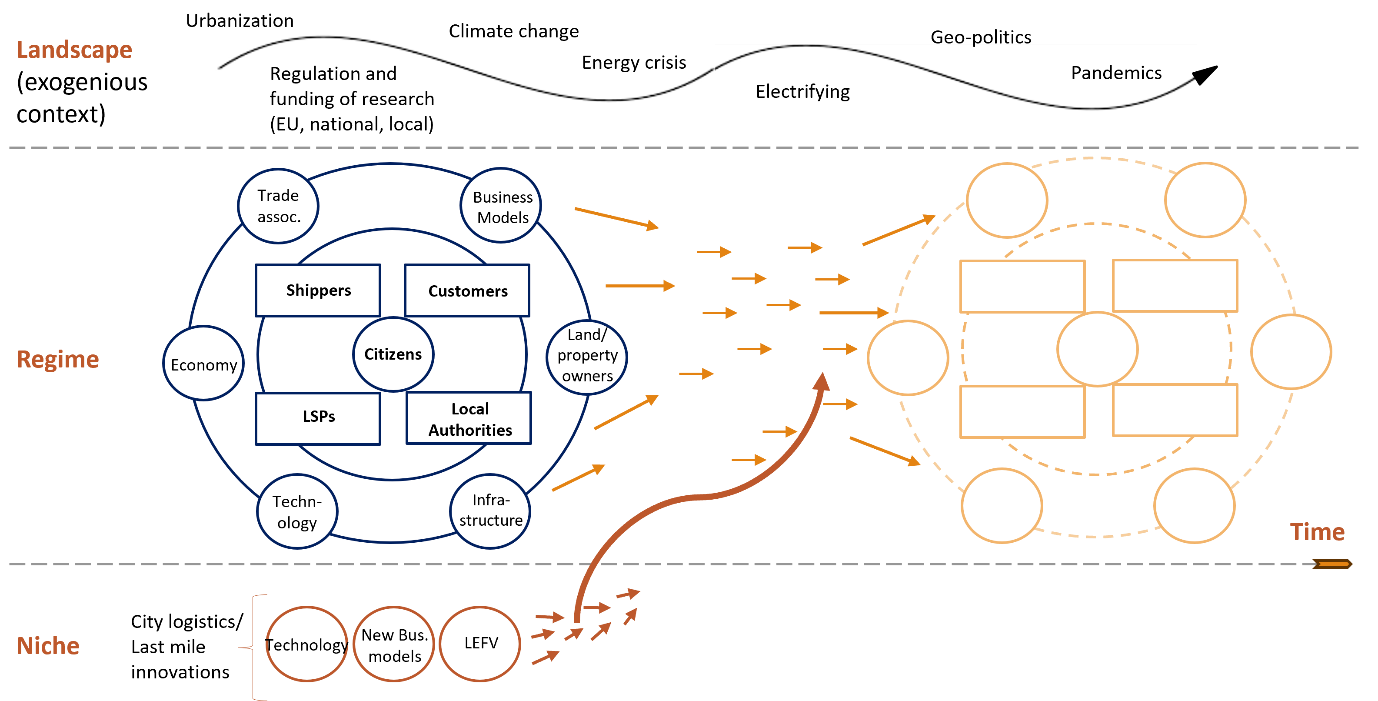
Figure 12 The socio-technical model
On the ‘landscape’ level, we see urbanization, regulation, and funding of research (particularly promoted by the EU and followed by national and local levels), and the energy crisis that has led to increased focus on electric vehicles. Further, this crisis has supported electrification of societies that is also a reaction to geo-political tensions. This development has been enforced by the climate crisis. Finally, the global disruptions caused by pandemics are also a part of the ‘landscape’. Changes on this level may be slow, long-term, or rapid external shocks. As the focus of this project is sustainability, and changes seem to be considered long-term, we analyse the change as a transition rather than f. ex. a breakdown of the socio-technical systems caused by rapid shocks.
On the relative stable level of ‘regime’, the outer circle illustrates analytical dimensions that may have an impact on changes of the system, but which are not studied empirically in this project. Rather, actors in the next circle, Shippers including retailers, Customers including consumers, Local Authorities and Logistics Service Providers (LSP’s) are studied empirically as they have direct impact on the ‘regime’ and potential changes herein. In the middle of the ‘regime’ are the Citizens. Citizens are stakeholders of the ‘regime’ and beneficiaries of changes towards sustainability.
In the model, the ‘niche’ consists of new technologies, new business models, and the use of light electric vehicles as potential game changers. Although changes within the regime take place to some extent, the thesis of this project is that change of the existing ‘regime’ to a new ‘regime’ with environmental and social sustainability as primary goals (”shaded” version of the ‘regime’), must come as inspiration and indirect pressure from the ‘landscape’ but importantly also from direct pressures from the ‘niche’. The project found positive developments in that direction (small arrows in the model), but there still seems to be a way to go if recent climate change does not trigger a rapid shock in the existing socio-technical system of last mile logistics.
Case of DHL Express
The aim of the project’s embedded case study of two divisions of DHL Express was to dig deeper into successful implementation of e-cargo bikes in cities despite the challenges to see what could potentially be learned from this case. An embedded case study is a case of one single entity such as implementation of e-cargo-bikes in DHL Express. However, in this case two subcases were studied to investigate potential differences within the case. These cases were DHL Express’s implementation of e-cargo bikes in Copenhagen and Oslo.
DHL Express is a company that has worked with e-cargo bikes in cities such as Copenhagen (DHL Express DK) and Oslo (DHL Express NO) for some time. The i-Smile project has investigated the organization of e-cargo bike operations in these two cities to detect the success factors of implementation, the so-called micro foundations of operations originating from the theory of Dynamic Capabilities. This theory takes a strategic view on organizations and operations.
DHL Express is one of the Deutsche Post DHL Group’s divisions. It is the global market leader in delivering urgent goods and documents reliably and on time from door to door. According to the DHL Group’s GoGreen program, their goal is to achieve zero emissions logistics. One of the milestones pertains to the group's endeavours to enhance the quality of life in local communities by implementing environmentally friendly transportation alternatives. Specifically, the Group plans to “operate 70% of its own first and last mile services with clean pick-up and delivery solutions”, such as bicycles and electric vehicles.
Aiming to go green to comply with the DHL strategy as well as new regulations and at the same time solve issues such as traffic, congestion, and pollution within inner cities like Copenhagen, DHL Express DK started to invest in, set up and operate a city hub, six electric cargo bike routes, as well as three electric vans in inner Copenhagen end of 2019. The project and its realization were internally driven within DHL Express DK. To bring the new solution to life, a space within the inner city was rented, serving as front as well as back office. The cargo bikes utilized are front loaders called Bullitt, which are small and easy to manoeuvre. Within Denmark and the industry, DHL Express was the first company to implement cargo bikes.
In Norway, the Oslo municipality started an initiative in 2017 in which it engaged with DHL Express NO in conversations about the livability of the city and sustainable distribution. Entering a strategic partnership, their collaboration led the company to implement a micro terminal in form of a 25-foot container close to Oslo harbour. Three electric cargo bikes were utilized which were loaded and departed from the container. The cargo bikes were equipped with a loading system consisting of two containers, one located in the front of the bike and a trailer in the back. The trailer located at the back of the bike was easily attachable and detachable, enabling efficient and flexible transportation of shipments. Rental costs for the container location were funded throughout the first two years of operation by the municipality. Afterwards, rent should be paid for the square meters used.