Introduction
The world faces many challenges today. Climate change causes natural disasters and geo-political unrest. The COVID19 pandemic locked down many economies for months. These events affect the economy and wellbeing of many people. They also change the way people shop and consume goods. The lockdowns boosted e-commerce and online shopping, which require more last mile deliveries, especially in cities. This leads to more noise, emissions, and congestion from urban freight transport. How can we reduce these negative effects and keep the economy, environment, and social conditions balanced? The Nordic Innovation i-Smile project explored this question. It focused on Light electric freight vehicles (LEFVs), such as electric cargo bikes, as a possible solution for more sustainable urban last mile transport.
A recent report from Swedish Trafa (2023) (fig. 1) states that there are around 600 000 light trucks (vans or LGVs) in service in Sweden, double that of 20 years ago. Despite their growing numbers, these vehicles constitute just 2 percent of the total ton-kms being transported. However, they also constitute about two thirds of the total vehicle kilometres, around half the NOx and particulate matter emissions, and a third of all CO2 in Sweden. A vast majority of these light vehicles are driving in our cities, where the NOx and particles are directly harmful to the inhabitants living there. A swift electrification of last mile distribution would thus have a great impact on emission reduction targets.
However, electrification alone does not solve issues related to particulate matter from tires and brake dust, nor does it reduce the amount of space used. E-commerce is expected to grow and with that the need for more freight vehicles in our cities. It is therefore of interest for cities and companies to find ways of reducing the impact of freight activities related to e-commerce. A mixed fleet that includes a significant number of LEFVs could address many of these challenges. LEFVs could alleviate many of the negative impacts that would result from more freight vehicles, and this project has studied these types of vehicles and the possibility of making them a less intruding and more frequent addition to the cityscape by replacing either electric or conventionally fuelled larger vehicles.
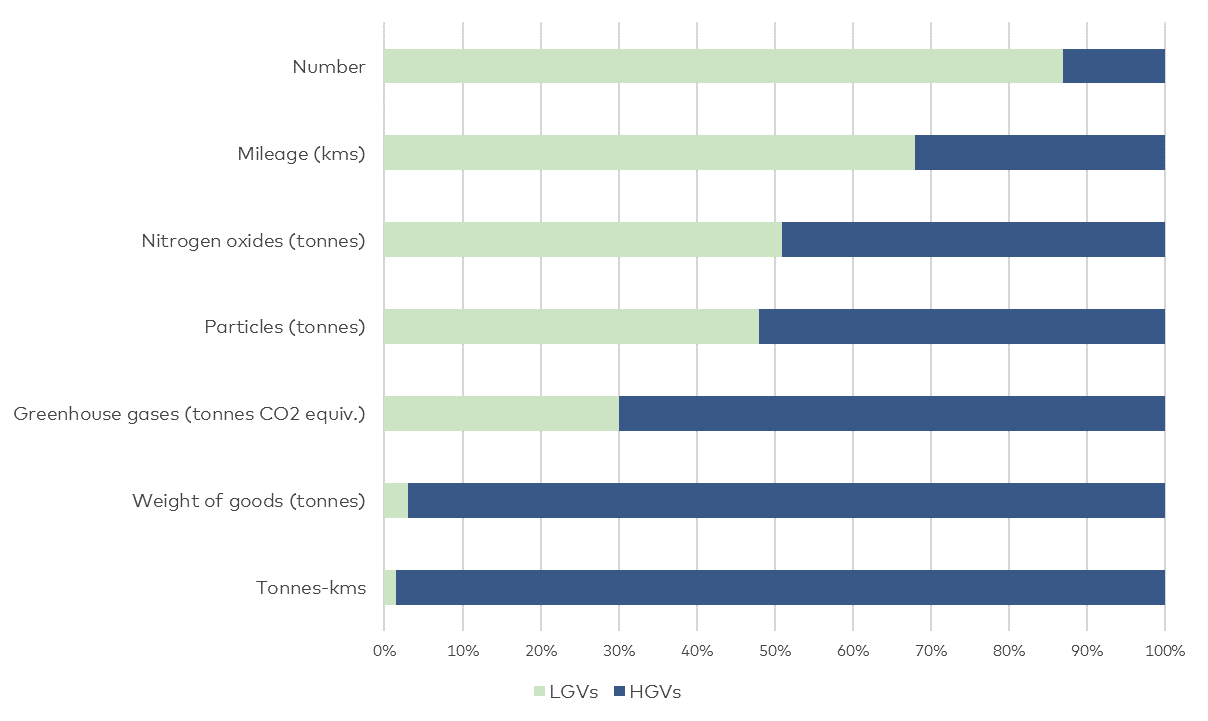
Figure 1 Shares of light and heavy goods vehicles with respect to a range of variables 2023 (trafa.se)
The project adapted a socio-technical approach to the transition towards sustainability of urban last mile deliveries and logistics. This means that in addition to researching technical solutions, a social aspect in the form of business models was integrated. Technical solutions and business models are therefore seen as interdependent entities of the system and if change should happen, this must be done in a socially shared way. Therefore, change takes time and although technical change is not enough, change in the longer run may very well be initiated by technical innovations as well as overall pressures from the macro-environment. In addition to this approach, the dynamic capabilities approach was adapted with the purpose of explaining how LEFVs may lead to competitive advantage for involved LSPs.
This publication is the final report of the i-Smile project, encompassing the main results and recommendations for companies operating in the context of last-mile deliveries. The report includes practical research with case companies as well as a theoretical approach. The socio-technical model is explained thoroughly in the report and juxtaposed with the development in the last-mile landscape.