Business Models in the Last Mile
Business models in LMD play a crucial role in addressing environmental and social concerns, and optimizing the delivery process for a more sustainable and efficient last mile delivery network. This section presents business models that have a crucial role in the LMD landscape and were explored in more detail within the i-Smile project.
The platform economy has in recent years had a big effect on the last mile, both in terms of increased delivery speed, technology development, as well as new types of freelance or the platform economy. A news media analysis shows trends in different types of last-mile-related platforms that include both corporate use software platforms and digital multi-sided marketplaces (e.g. apps). The emergence of "super apps" has blurred the boundaries between commercial delivery, micro-mobility, and transit, making the last mile even more complex and integrated with other traffic and urban spaces. Some examples of super apps include Venezuelan Yummy, Nigerian Gokada, and Estonian Bolt. Platform business models are part of the sharing economy and affect especially the social sustainability of the last mile, as they are part of the platform economy. However, hyper-local and community-based services like Super and ShopUp play a role in last mile innovation and can have positive effects on social sustainability. In this context it also needs to be noted that FinTech enables new business models for last mile delivery, including secure and quick payments for gig workers. Last mile innovations also appear in agriculture technology (AgriTech) with positive social sustainability impacts.
As last mile is the most resource intensive part of the supply chain, numerous innovations have come forward as solutions to make the last mile more economically, socially and environmentally sustainable. In this report we want to highlight three different business models and innovative technologies in the realm of last mile deliveries that are disrupting traditional delivery methods and business models.
Some strategies that LSPs and other last-mile stakeholders have implemented are:
- omnichannel solutions for fulfilment and pick-up
- flexibility for delivery and pick-up for both LSPs and consumers
- transparency and communication in real time
There are several different business models and solutions that aid in implementing these strategies. Parcel lockers have emerged as a viable solution to involve consumers in the supply chain and remove some of the strain on urban environments and delivery services by consolidating pick-up to a central location. Parcel lockers are an integral part of the omnichannel model for last mile and provide flexibility as well as transparency within the supply chain. They have been a subject of much research interest recently due to their increased prevalence as part of the last-mile delivery process. The flexibility is rooted in the consumer participating in the service in two roles: as the service receiver and the service creator. For consumers, the location of the parcel locker is the most relevant factor for user acceptance, i.e. if the lockers are not placed strategically in places people would visit otherwise, they will rather opt for another delivery solution.
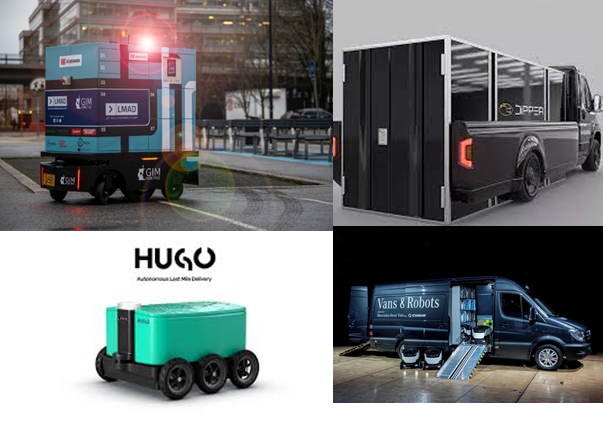
To increase flexibility, autonomous delivery vehicles is a solution explored by many companies. They are defined as ‘electric and self-driving ground vehicles driving on sidewalks and streets and can manage all driving tasks themselves without human intervention in an urban environment with deliveries/stops and interactions with pedestrians and cyclists’. Previous research has shown some benefits in using the ADVs. It is suggested to reduce greenhouse gas emissions and energy consumption, cost savings, faster service to customers, energy conservation and sustainability, safety for delivery personnel, and accuracy delivering the right package to the right customer. There are several ways in which ADVs are used in the logistics services, some examples of these are presented in Table 2
Type | Description | References |
Autonomous support vehicle for letter and parcel deliveries | Use of (multiple) self-driving vehicles that follow the delivery person during the delivery of several packages in an area might decrease the walking distance of couriers. One such example is the German start up Ducktrain. This type of assisted delivery vehicle could be equipped with a number of auxiliary systems to make the delivery job easier. This type of delivery aid could be appropriate to support urban delivery processes. The biggest advantage is its potential to increase the productivity of each delivery person, which makes their job easier and at the same time more attractive. | DHL (2015) Self-driving vehicles in logistics: a DHL perspective on implications and use cases for the logistics industry, DHL Trend Research, p. 35. |
Autonomous and integrated mobile parcel lockers | Autonomous and integrated mobile parcel boxes are parcel lockers on wheels that customers open using a personal code. These are also called autonomous ground vehicles (AGVs). These mobile lockers can make door-to-door deliveries or park in a location advertised to customers so they can collect their parcels. These ADVs can make door-to-door deliveries or park in a location advertised to customers so they can collect their parcels and they can come closer to the customer than ‘traditional locker boxes. The IT system of logistics company can relay information to customers when the vehicle is nearby. These ADVs have a potential to reduce labour costs, but they require high population density to be economically viable. One example of this is the pilot reported in this paper. Other examples include Dipper and Hugo. | (Bouton et al., 2017) |
Mothership with small autonomous robots/droids | Droids are designed to handle the last logistic step of the delivery process; that is, to navigate the last few kilometres to the end customer. They can be distributed from a static hub, such as a local store, or from a mobile hub, such as a van carrying the robot units and dropping them off outside the intended residential area. They can operate both day and night. |
Table 2 Autonomous sketch board and pilot examples from Europe
A Snapshot of Last Mile Market Development
The total size of the global last mile market is expected to reach 200 billion euros in 2027. Since 2010, nearly 330 million dollars have been invested in in mobility technologies and roughly two thirds of this money have been funnelled towards autonomous technology and smart mobility. According to market research reports, the last mile delivery robot market is expected to grow from being valued at 18.1 million dollars in 2021 to reach 36.2 million dollars by 2032. Even if the general investment trend in mobility and vehicle technology has flattened, technology enabling electrification has gained most acceleration in investment. In total, investors have spent over 100 billion dollars on technology in four main sectors of technology:
- Autonomous (radar, camera, maps, object recognitions, driving strategy, steer/break, and lidar),
- Connectivity (Vehicle to infrastructure, cybersecurity, voice recognition, augmented reality, gesture control, blockchain)
- Electrification (Lithium-ion batteries, other battery technology, battery analytics, digital twins)
- Smart mobility (including mobility demand management)
Smaller and more targeted technology investments are expected in the future. Funding rounds are very prevalent in technology news and have a great impact on last mile delivery development. Same day deliveries are on the rise and the importance of delivery speed is growing in all sectors. New technology and innovations such as drones, delivery robots, crowdsourcing, dynamic pricing, and different forms of app-based on-demand delivery are part of the rapidly changing last mile landscape.