Light Electric Freight Vehicles
This section delves into the dynamic landscape of last-mile deliveries, focusing particularly on the role of Light Electric Freight Vehicles (LEFVs).
Defining light electric freight vehicles
These vehicles, encompassing cargo cycles, electric mopeds, and other L-category options, are gaining attention for their potential to address environmental concerns associated with traditional logistics in urban areas. Despite their energy efficiency and environmental benefits, integrating LEFVs into established logistic systems poses challenges. Their small size, advantageous for navigating congested city centres, comes with limitations in terms of volume and weight capacity. This section explores the regulatory advantages, operational strategies, and challenges associated with LEFVs through real-world case studies and operational experiences, shedding light on the drivers and barriers for their successful adoption in last-mile delivery systems.
In the ever-changing landscape of last mile deliveries, LEFVs have drawn attention as a potential solution to many of the negative externalities associated with logistic activities in cities. They are more energy efficient, emit less pollution, and take up less space than traditional vehicles. However, it can be a challenge to integrate these newcomers into established and sometimes rigid logistic systems that have developed alongside traditional vehicle types (such as vans). Despite their advantages, LEFVs have different requirements and capabilities that must be addressed for them to be considered a suitable alternative.
LEFVs can be roughly defined as freight vehicles smaller than a van with a maximum capacity of 750kg, and can be again divided into cargo cycles, electric mopeds, and other L-category vehicles such as microvans and quadricycles (van Amstel et al. 2018). These categories are somewhat flexible and constantly being challenged by new innovations in vehicle technology and design. Cargo cycles have proven especially resistant to hard categorization, with the recent acceptance of a series of hybrid drive trains by the EU allowing new chain-less designs of three- and four-wheel heavy cargo cycles to flourish (Roetynck, 2022).
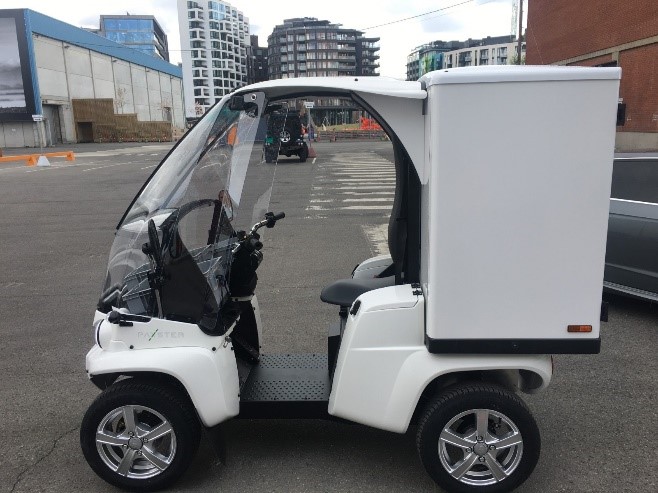
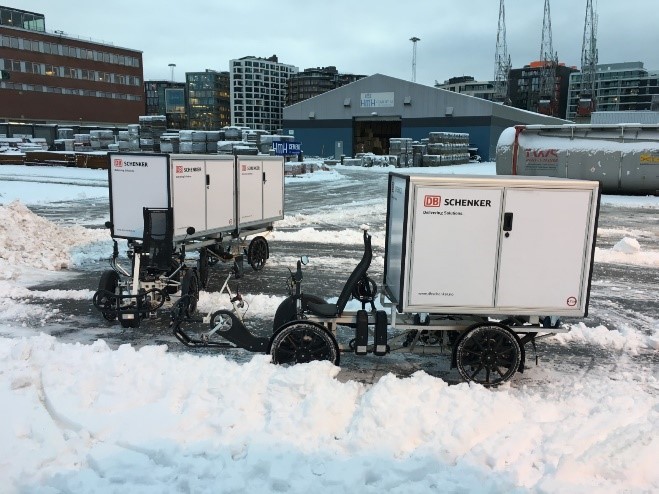
Figure 4 Paxster electric quadricycle (left) and Velove cargo cycles (right) are two examples of LEFVs. Photo credit: Howard Weir
One of the major advantages LEFVs offer is their small size, allowing them to operate with ease in areas that are challenging for larger vehicles to navigate. This applies not only to driving in dense city centres, but can also have implications for how terminals are organized; the small size of LEFVs allows vehicle loading zones to be more compact and flexible, saving space. Their small size can also make it possible to park closer to customers as they can bypass barriers such as bollards that prevent access for larger vehicles.
Depending on the type of LEFV and the city and country in which it is implemented, there may also be a number of regulatory advantages to be gained over traditional vehicles. They are, by definition, zero emission vehicles and face no restrictions in cities that have implemented low or zero emission zones. Drivers may require a more simplified moped license or, in the case of cargo cycles no license at all to operate the vehicle, which increases the pool of potential employees. Cargo cycles have the added benefit of not being restricted to where they can travel and park, using both road and cycle infrastructure. In some countries, such as Norway, these vehicles are also allowed to use the sidewalk.
Automatic delivery vehicles (ADVs) have been suggested as one solution to sustainability challenges in LMD. To advance and scale up the use of ADVs, it is important to understand the perspectives of different stakeholders LMD; the consumer and/or citizen, the sender, and the city authorities in charge of urban infrastructure. From a sustainability perspective these developments are important to track as the use of ADVs in urban areas can significantly reduce CO2 emissions and reduce energy consumption. There is a large variety of so called “micro-vehicles” intended for delivery, and they differ in terms of size, sensor technology, driving behaviour, and infrastructural needs and in how they affect different aspects of sustainability.
However, their small size naturally limits their capacity for both volume and weight. According to the type of LEFV used and the type of goods to be delivered, different strategies must be implemented to address their limitations and make them competitive with other vehicles. The two primary strategies seen are to either 1) limit the type and size of goods delivered such that an entire workday’s worth of goods can be carried without needing to reload or 2) to arrange transloading points in the delivery area so the LEFVs can take multiple rounds to refill.
Transloading points can be as simple as an exchange of goods between a large vehicle and a smaller one at a designated location or they can be facilitated using more permanent infrastructure such as a micro terminal or city hub. Some of the LEFVs used by companies involved with the i-Smile project could reload as many as five times in the course of a day at a city hub, which greatly expanded the size, weight and type of goods that could be delivered by these smaller vehicles.
However, transloading can introduce significant costs to the supply chain, both through the increased complexity that results from adding an extra stop, as well as the costs related to the space and infrastructure needed in desirable locations near the delivery area. The cost of the additional goods handling needs to be offset by increased efficiency and benefits as a result of using smaller vehicles to make the final delivery. While the extra costs are often borne by the LSPs, the benefits (such as reduced traffic or pollution) are more difficult to capture from an economic perspective, which can make finding a viable business model challenging.
Case studies on operational experiences of LEFVs in the field
To better understand the use of LEFVs, researchers from i-Smile collaborated closely with the partner companies to collect data. Through interviews, site visits, route data and surveys, the i-Smile project was able to gain insight into the real-world operations of LEFVs and better understand some of the drivers and barriers for their success. An overview of the data collection activities is available in Table 1. Three case studies were conducted. Two companies’ (A and B) use of cargo cycles in coordination with a city hub were examined to better understand how different delivery profiles (weight, volume, goods type) could impact the use of cargo cycles. Company C’s rapid adoption of the Paxster electric moped for their delivery operations also offered the possibility to better understand how drivers experienced the transition from using a private vehicle to using a LEFV.
Type of data | Quantity |
Interviews | 20 |
Email exchanges | Approx. 500 |
Company websites | Approx. 50 |
Company documents | 20–25 |
Route data | 2 companies |
Site visits | 2 |
Survey | 1 |
Table 3 Overview of interaction/data collection from companies
Company A used electric vans, trucks and cargo cycles based on a city hub to distribute packages in the city centre. The overlapping routes meant that these vehicles interacted closely with one another and operated in slightly different ways. Drivers working in the same area of the city had the possibility to exchange packages with one another based on their experience as to which vehicle type would be best suited for a specific delivery. Drivers reported that the cargo cycles were better suited to delivering smaller packages in areas that were harder to reach for vans, whereas the vans were more likely to have a larger number of packages to areas such as shopping centres. The different delivery profiles for Company A show up in Table 2 as a large relative difference between the number of deliveries versus the number packages. We also see that the cargo cycles refilled three times and carried less weight on average.
Company B used cargo bikes to replace vans and the delivery loads were characterized by smaller, lighter packages (often envelopes). This proved to be the ideal use case for a cargo cycle as they were not limited by needing to return frequently to the hub to refill, and instead could maximize their advantages of using multiple types of infrastructure and traveling closer to the customer without being hindered by traffic. It is also important to point out that the actual weight per parcel on the cargo cycles for Company B was even lower than 2,5 kg, since Company B used a sweeper van for the heavier parcels. A sweeper van is a term for a van that delivers (heavier) parcels within the same delivery zone as, in this case, smaller vehicles. In both cases we see that cargo cycles travelled significantly fewer kilometres than vans, suggesting they were better able to utilize short cuts and take more direct routes to customers.
Averages | Rounds | Number of deliveries | Volume (m3) | Number of packages | Kilometres /day | Total weight (kg) | Package weight (kg) | Delivery weight |
Cycles (company A) | 3 | 37.9 | 2.2 | 64.7 | 23.4 | 320.8 | 5.0 | 8.4 |
Vans (company A) | 1.5 | 43.2 | 3.7 | 102.6 | 52.8 | 492.6 | 4.8 | 11.0 |
Cycles (company B) | 1 | 76,9 | n/a | n/a | 23.0 | Max 125kg | <2.5 | n/a |
Vans (company B) | 1 | 67,8 | n/a | n/a | 73.0 | n/a | 2,5 | n/a |
Table 4 Overview of route data from two companies using cargo cycles and vans
Company C’s switch from having drivers use their own vehicles to make deliveries to providing each employee with a Paxster was of particular interest. The company experienced benefits in terms of the speed at which routes were completed using the new vehicles and were better able to standardize some of their loading and sorting processes, but wanted more information about the reception of Paxster by their drivers.
To this end, a survey was designed and sent out to 1179 drivers at a national level. 321 answered, among them 94 users of the new LEFV and 227 who used their own private vehicle for work. The survey included questions about vehicle use, workload, and challenges in the workday. Perhaps unsurprisingly, the results showed quite strongly that weather protection is a major concern for drivers, suggesting a need for adaptations that better protect from the rain and cold.
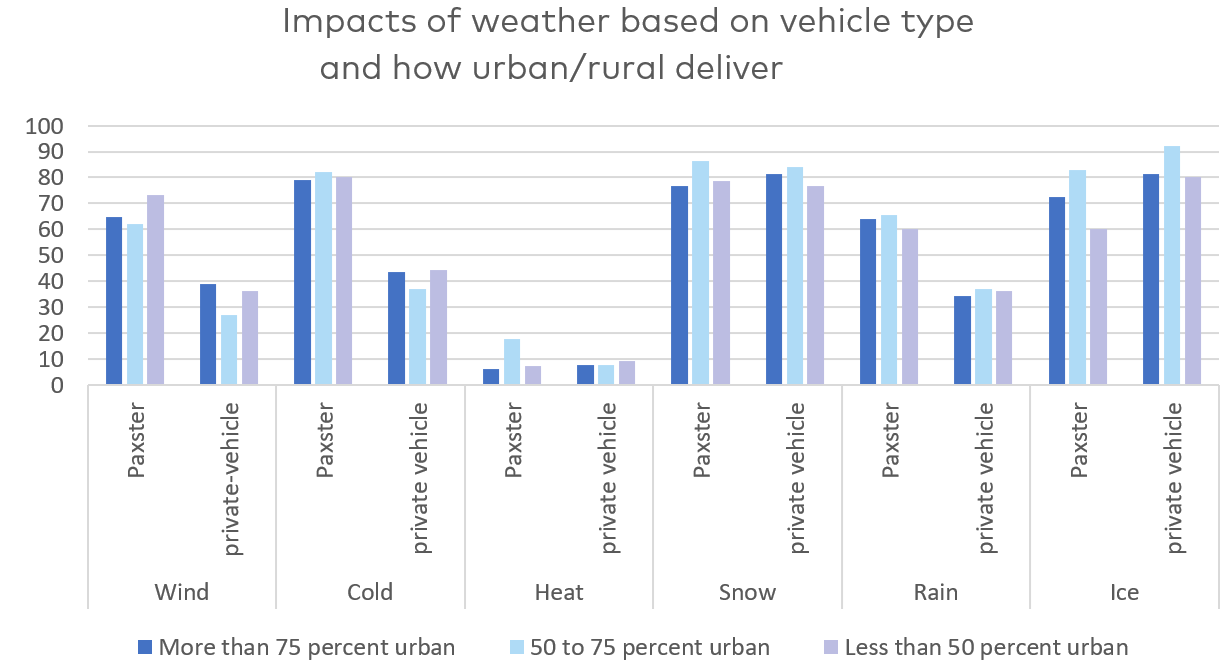
Figure 5 Percent answering often or sometimes challenging according to vehicle type, how urban/rural delivery route is, and weather type
Better weather protection could be accomplished both through changes in hardware, such as heated seats and floors, or through adaptations using clothing and equipment and teaching drivers how to dress to remain warm. Interestingly, while snow and ice created challenging conditions for LEFV drivers, the drivers using normal cars responded that they were just as, if not more, negatively impacted by poor road conditions. Whether a route was mostly urban or rural had little impact on how challenging weather and road conditions were perceived by the drivers. Drivers of both cargo cycles and Paxsters reported in interviews that they felt it was often easier to navigate snowy and icy conditions with a smaller vehicle.
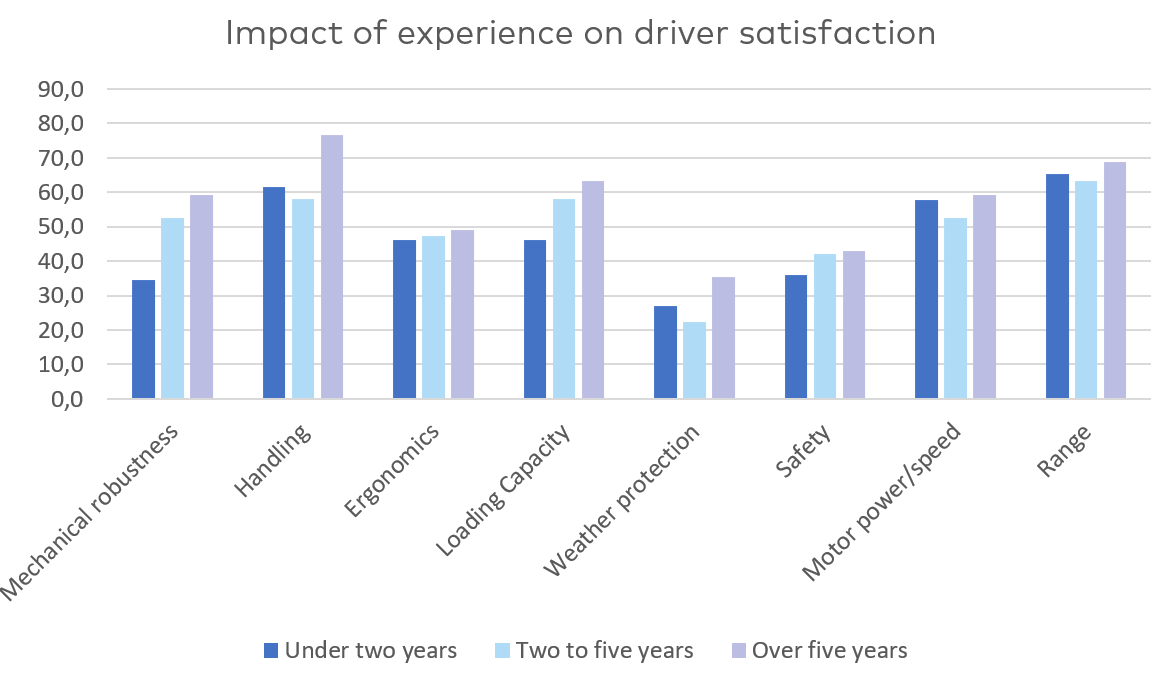
Figure 6 Percent of drivers either very or somewhat satisfied with different aspects of the LEFV used at work.
Results from the survey also showed that driver satisfaction for eight different aspects of LEFV use increases over time (Figure 5). However, there is clearly room for improvement in areas such as weather (discussed above) and safety. The drivers in this survey were using either their own private vehicle or a Paxster, and we saw generally that they were more willing to be critical towards the Paxster. However, when asked what type of vehicle they would choose to do the job, 70% of Paxster drivers reported that they would choose Paxster again. On the other hand, those who use their own car were interested in continuing to use either their own vehicle or a van. These results show a certain scepticism towards using LEFVs, but also that it can become the preferred vehicle choice if it is well suited to its task.
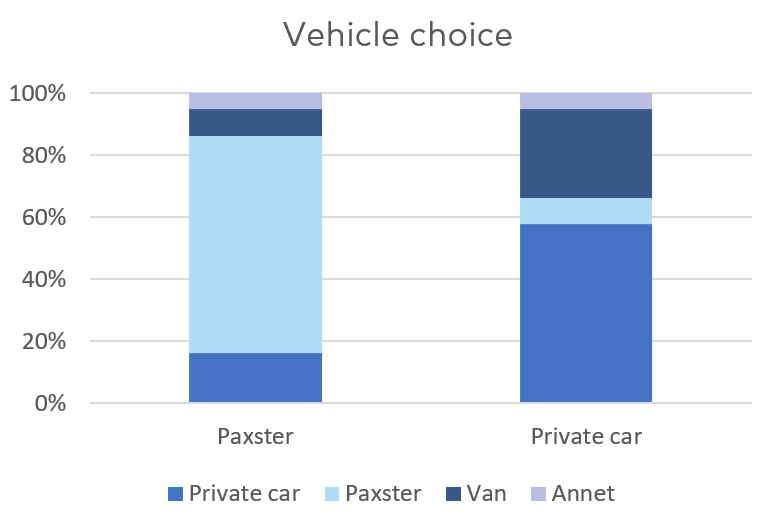
Figure 7 Given a choice, which vehicle would you choose? According to which vehicle drivers currently use.
LEFVs for sustainability and innovation
From a sustainability perspective, these developments are important to track as the use of autonomous delivery robots (ADR) in urban areas can significantly reduce CO2 emissions and energy consumption. There is a big variety of so called “micro-vehicles” intended for delivery and they differ in terms of size, sensor technology, driving behaviour, and infrastructural needs, and in how they affect different aspects of sustainability. In the news analysis it was evident that sustainability is not a key topic when discussing last mile development, aside from electric vehicles being zero-emission vehicles. Social sustainability considerations included the safety of customers and pedestrians when encountering autonomous vehicles. In most cases sustainability is implicit, meaning it is not the focus in articles, but the technology contains measures that could be considered to impact sustainability. The main issues that are reported are related to social sustainability and the working conditions of couriers who work as entrepreneurs or freelancers for platform providers in sharing-economy schemes. Here strikes and concerns have gained media attention, but also the lack of available workfares and delivery drivers are emerging topics globally. These themes are also supported by interviews conducted within this research project.
The transformation of the last mile landscape, visible in the news media, includes rapid innovation in both vehicles, software, and business models. These changes all impact sustainability and even though the focus within the news is on vehicle development, previous research as well as interviews conducted within the scope of the i-Smile project, suggest sustainability impact could be considered in a more nuanced manner, including trade-offs between environmental and social values.
A more comprehensive understanding of sustainability implications requires considering business models and stakeholders' roles. Future research could focus on mapping stakeholders and their contributions to new last mile business models. Additionally, studying the dynamics of the retailer-LSP-consumer triad and the impact of platform or marketplace solutions on sustainability needs further attention. The emergence of vehicle subscription services for couriers in sharing-economy delivery schemes also presents sustainability paradoxes that warrant further investigation, along with how real estate affects warehousing developments and the city landscape. Also, reverse logistics would need to be included in last mile research and development of new reverse last mile services provide an innovation opportunity for both LSP and retail companies.
Gaps and barriers to scaling up on LEFVs
Several companies, especially the larger ones, identified recruitment as an issue. Nordic weather conditions, relatively low unemployment, and competition for staff from companies like Foodora and Wolt have likely made recruiting and retaining couriers more challenging. Companies that have historically focused on van and truck drivers have also experienced problems in transitioning these drivers to LEFVs. On the other hand, the smaller companies saw recruitment as a unique selling point and often supplied the bigger companies with staff. Cargo cycle drivers tend to be younger, enjoy working outside, see the physical exertion as an attractive aspect of the job, and to some degree are bike enthusiasts.
The same partner companies that find recruitment to be an issue, mention difficulties in finding staff to ride cargo bikes due to the challenging Nordic weather conditions, and this is a hindrance to upscaling. Finding cargo bike riders requires a different recruitment process and it can be challenging to transition a van driver to be a cargo bike rider. LEFVs that offer weather protection are seen by some companies as better candidates to replace vans as they share more similarities, making it easier to ask employees to use a new vehicle. However, these types of vehicles lose the flexibility of cargo bikes regarding for example use of city infrastructure. It is important to delve deeper into the different forms of employment used by delivery companies to see which system works the best.
Suggested solutions: One thing in common for these partners that view this as an issue is size. The larger LSP companies see recruitment as an issue. The smaller ones see it as a unique selling point (USP) to recruit cargo cycle drivers
Lack of sector maturity manifests itself in the form of maintenance issues and parts availability that reduce the uptime of cargo cycles to the extent that some companies use uptime as a KPI. It can also make developing routes specifically tailored for cargo cycle more challenging if there is uncertainty on whether or not a cycle will be available due to maintenance issues. The number and type of cargo cycles available for purchase is rapidly expanding, but few are from large manufacturers. This can make the selection process difficult as companies are buying vehicles they have little experience with and may not choose the best solution. Larger manufacturers entering the cargo cycle sector would help increase standardisation and drive down costs, while also building trust in using cargo cycles as a dedicated logistics tool.
Suggested solutions: This is such an important part of the cargo cycle industry that they even use “uptime” as a key performance indicator in operations. A potential solution to this issue is for larger, more experienced manufacturers to enter the market, and this seems to be the case. Renault, for instance, recently announced that they will start to manufacture cargo cycles drivers. More larger players with experience are needed. Greater standardization across the sector would also help alleviate issues related to maintenance, parts availability, and the general knowledge base, etc. It is surprising, as researchers, that billions of dollars are put into electric scooters in all our major cities by venture capital, but almost none of this is directed towards cargo cycle operations.
The city design and transport policy issues play an important role as cities and citizens are vital stakeholders and beneficiaries from the introduction of LEFVs, but cities often lack the knowledge of how to involve themselves in what is often seen as a private sector domain. Regulation for a more people centric and multimodal city is important and can be achieved through regulations such as environmental zones, parking regulations and lower speed limits for cars. This would have benefits for safety, use of space, transport related emissions. Additionally, such changes can give a competitive advantage to LEFVs over more traditional vehicles and push companies to find innovative solutions in how they organize and carry out urban logistics.
Suggested solutions: Cities (and their citizens) play an important role here, since they are the ones that benefit the most from smaller, safer, zero emission solutions. Applying regulations to foster a more people centric city, such as environmental zones and lower speed limits for cars will not only have positive health effects but also increase the use of alternative modes in passenger and logistics operations. Factors such as public procurement and environmental zones that are specific for freight (not personnel transport) can be used to nudge in the direction of more LEFVs. Such policies can also help encourage the use of micro terminals and city hubs that can allow more widespread and efficient use of LEFVs. It is important to check the possibility of disconnecting passenger transport and logistics for the environmental zone laws. If it would be possible to create a zone where passenger transport has one set of rules and logistics another, this would be ideal. For instance, higher maximum speeds for bus lanes than car/truck lanes.
Apart from the extra handling, hubs located centrally in cities are expensive and make the creation of a profitable business model for cargo cycles challenging.
Suggested solutions: In the i-Smile project some of the benefits of cargo cycles has been put forward. But what about innovation to address the drawbacks? Innovation can be “new combinations of existing elements” and it is important to study how various elements connect and coordinate with each other, through hybridization and add-ons. However, transportation history is full of examples where this is a stepwise process. The steel ship came about with the help of hybridization, composite ships with steel elements reinforcing weaker parts on wooden ships existed before the first steel ship, the first steam ship was a sail ship with a steam engine that was used when there was no wind, the first car was a horse carriage with an engine. All innovations addressing limitations/weaknesses with the current technology. It can thus be argued that to improve the concept of cargo cycles with the help of hybridizations and add-ons could enable large-scale implementation of zero emission solutions the last mile. Operational models are quite similar for cargo cycles and other LEFVs including small autonomous vehicles. They also share many of the same disadvantages, 1) capacity (weight and volume), 2) range, and 3) costly intermediate reloading/storage. So, solving these issues is not only beneficial for cargo cycles, but for light electric freight vehicles in general. Perhaps looking into a simpler form of a “terminal” or micro hub for transloading between vehicles is a way forward, to use infrastructure that is available at least some of the time in a day. Like parking lots in centrally located malls or gas stations that most likely are looking into new business models for the use of their space, especially in a future where the need for gas will dwindle. The Department of Transportation in New York City are currently testing a version of this, dedicating curb side for delivery operations, see NYC DOT (2023).
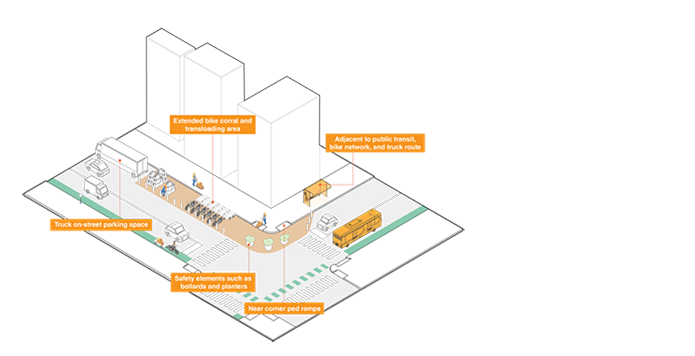
Figure 8 Delivery hubs on NYC’s roadside parking for transloading from bigger to smaller vehicles.
NYC DOT to Launch Local Delivery Hub Pilot to Reduce Negative Environmental and Safety Effects of Truck Deliveries
NYC DOT to Launch Local Delivery Hub Pilot to Reduce Negative Environmental and Safety Effects of Truck Deliveries
Development and innovation in the last mile landscape – media analysis
The current state of development and innovation of last mile and sustainable last mile solutions was explored by analysing news media. This study covered 611 news pieces from six different international news sites that specialize in logistics and supply chain related news (four sites) and technology and innovation news (two sites). The results from the media analysis revealed that there is plenty of activity in the vehicle sector. Most news articles published on the six analysed sites between January 2020 and July 2022 (44%) relate to the physical transport and vehicle part of the last mile. Within the 44%, 28% describe different vehicle types under development or in trial use. Autonomous vehicle development is visible. The vehicle types that have gained most attention are curb-side autonomous delivery robots (ADRs), drones, and van-sized electric and or autonomous delivery vehicles. Most of the vehicle development seems to happen in the US, with also Chinese and German projects mentioned.
There has been a tremendous growth in last mile related news since 2020, as seen in Figure 8, depicting last mile news from 7 different news sites from January 2020 until July 2022.
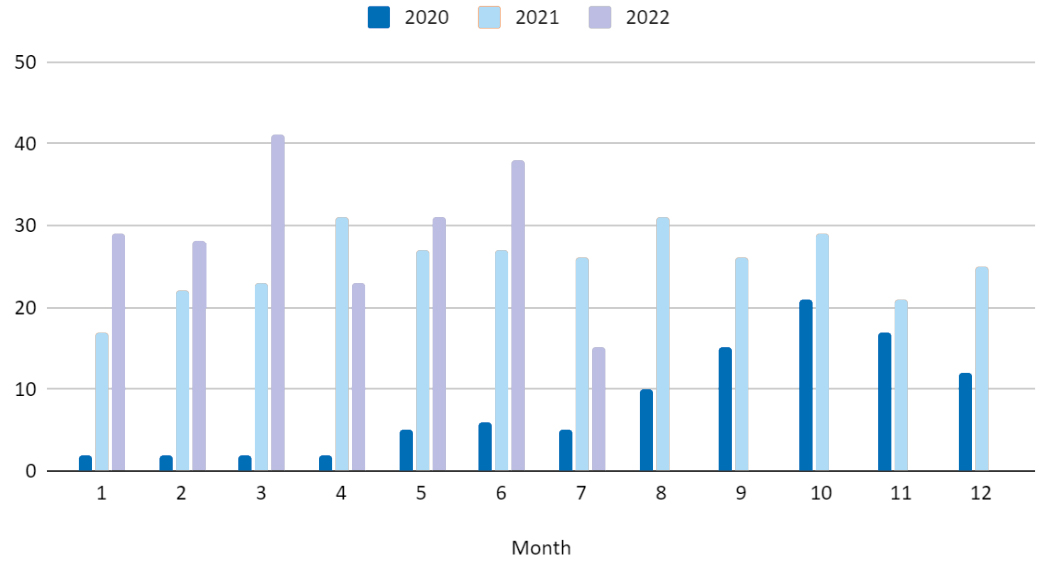
Figure 9 Last mile news
From a delivery perspective it is interesting that urban mobility solutions are merging with delivery services as many micro-mobility providers also offer subscription-models targeted at couriers who work within the platform economy. Another area that seems to drive market development is the growth in e-grocery deliveries that is connected to the development of many innovative new vehicle types.
Regarding delivery as a service, news that specifically focus on the added value or the consumer experience of last mile delivery are widely discussed. Here collaborative business models and community or crowd-based services seem to be on the rise. Especially interesting are group-buying and community-based delivery models that are appearing in emerging economies.