5. Sensory quality
5.1. Sensory profiles
Seaweed flavours and odours
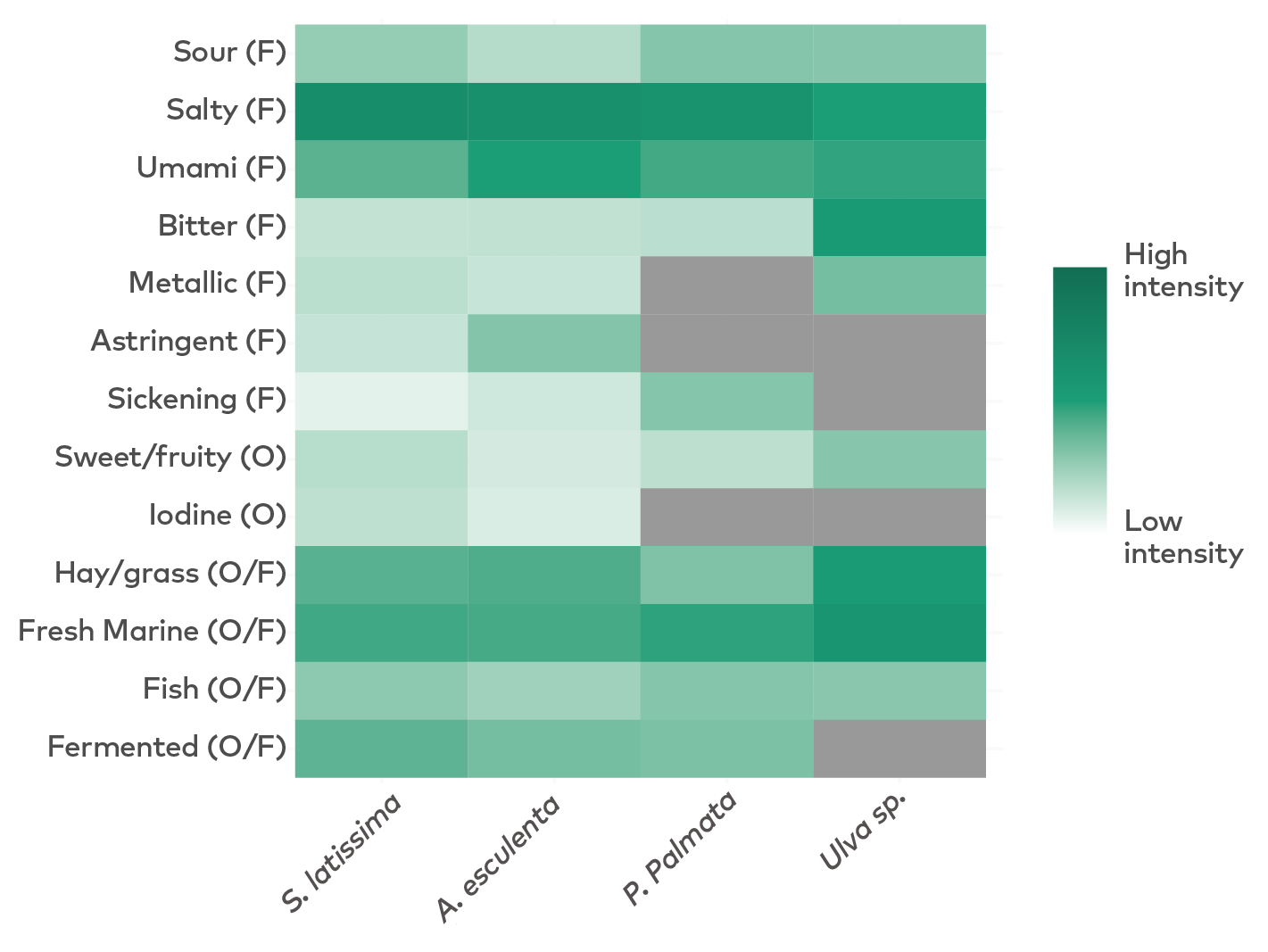
The growing appreciation of seaweed as a natural source of flavour has contributed to the recent rise in interest across Europe. Yet, most consumers remain unfamiliar with seaweeds, and their flavour profiles have been only partially defined and characterised for food product development. Early descriptions of individual species were provided by gastronomists and high-end chefs, often with scientific insight (Mortensen et al. 2004; Rhatigan 2009; Mouritsen 2013). Subsequent academic studies have aimed to systematically document the sensory characteristics of major edible species through objective assessments (Chapman et al. 2015; Dahlstedt et al. 2025 and references therein). Species-level differences can be substantial, comparable to those observed between distinct terrestrial vegetables or fruits. Indeed, seaweed species can differ as markedly as broccoli and bananas, making generalisations difficult. In addition, flavour and odour profiles vary with harvest season, geographic origin, physiological state, and post-harvest processing. The main cultivated edible seaweeds in Europe i.e., S. latissima, A. esculenta, P. palmata and Ulva spp. (Araújo et al. 2021) are generally characterised by salty and umami tastes combined with grassy and fresh marine notes of variable intensity (Figure 11 ).
Umami
In addition to salt, umami is the most prominent characteristic flavour of seaweeds and has received the greatest attention from both culinary and academic studies. Umami is a basic taste described as brothy, meaty and savoury, known for enhancing the intensity and complexity of other flavours (Mouritsen and Styrbæk 2014). First identified in Japanese kelp (S. japonica), umami taste is associated with the presence of the free amino acid glutamate. The umami response can also be enhanced by the presence of synergetic compounds to glutamate in food, particularly the free nucleotides inosine-5’-monophosphate (IMP) and guanosine-5’-monophosphate (GMP). However, recent studies have shown a weak correlation between umami intensity and glutamate levels in A. esculenta and S. latissima and identified specific volatile compounds and other free amino acids contributing umami in these species (Mouritsen et al. 2019a; Frøst et al. 2021; Stévant et al. in prep.). Umami is strongly linked to food preference and the use of monosodium glutamate (MSG, E-number E621; commonly produced by chemical synthesis or bacterial fermentation) is well established to enhance palatability of processed foods (Figueroa et al. 2021). The natural umami quality of edible seaweeds therefore offers considerable potential for their use as natural flavour-enhancing condiments across a wide range of food products and preparations, including meat, vegetables, bread, and even desserts (Mouritsen et al. 2012; Chapman et al. 2015).
Off-flavours and -odours.
Marine and fishy odours and flavours are present in the four species mentioned above (Figure 11 ) and are generally regarded as off-flavours associated with lower consumer acceptance as they can relate to odours from decomposing beach-cast on the shore (Mouritsen 2013; del Olmo et al. 2018). Bitterness, another common off-flavour, can be characteristic of Ulva spp. and may also originate from volatile compounds (Figueroa et al. 2022; Wirenfeldt et al. 2024). Various nitrogenous and volatile compounds with unpleasant odours are produced during seaweed spoilage and can serve as sensory indicators of shelf-life. Reported off-odours include “vinegar”, “acetic acid”, “rotten”, “old hay”, “chlorine”, or “sulphur-like” notes in S. latissima (Wirenfeldt et al. 2022) and “fishy” notes in P. palmata (Nayyar and Skonberg 2019). These off-notes corresponded with observable early signs of spoilage and biomass degradation.
Seaweed-based foods and consumer preference
Numerous studies from Europe showed that increasing seaweed content in food product above 5% often leads to reduced consumer liking (Dahlstedt et al. 2025 and references therein). This underscores the importance of careful species selection and post-harvest processing to achieve favourable sensory profiles. Product success further depends on appropriate pairing with other ingredients, where the flavour and odour interactions can create synergy and/or enhance umami. These considerations are closely linked to whether seaweed is intended to act as a dominant sensory component or as a subtle background ingredient in the final product.
5.2. Textural properties
Phycocolloids
Purified seaweed polysaccharides extracted through chemical processes, such as alginates from brown seaweeds or agar and carrageenan from red seaweeds, are widely used in foodstuffs as gelling, clarifying, emulsifying and stabilising agents. However, these compounds must be declared as food additives (E-numbers E401 to E407), a category that has drawn negative public attention due to the refining approach of the additive and health concerns linked to ultra-processed foods (Monteiro et al. 2025).
Seaweeds as texture ingredients
Using whole seaweeds in suitable forms (e.g., powders or flakes) can provide similar physicochemical and textural benefits than phycocolloids extracts, and retain a more natural image (Roohinejad et al. 2017). For example, the addition of powdered brown seaweeds at levels between 1% and 10% has been shown to enhance water- and oil-binding capacities in meat products such as pork and beef patties and frankfurters (Cofrades et al. 2008; López-López et al. 2009; Choi et al. 2012; Cox and Abu-Ghannam 2013). Whole seaweeds also allow exploitation of both their gelling and flavour properties. When off-flavours and/or potentially toxic elements (e.g., iodine) pose a challenge, processing methods that remove water-soluble flavour compounds (e.g., blanching, PEF; see Table 7 and Table 8 ) may be preferred, allowing more seaweed ingredient to be added to the food. Processed seaweed ingredients designed for use in hybrid meat products (e.g., burgers) are beginning to enter the market. Blends combining flavour-retained seaweed ingredients (e.g., umami-rich) with components rich in structural polysaccharides (texture ingredients), derived from different species and/or processing routes, could also be developed for tailored applications within the food industry.
5.3. Effects of post-harvest processes and storage on the sensory quality
Pre-processes
Processes involving osmotic pressure (e.g., freshwater blanching, PEF) or those that induce the formation of a liquid phase (e.g., freezing/thawing, fermentation, acid preservation) generally reduce the content of small water-soluble components such as minerals and free amino acids. Short freshwater blanching has been shown to drastically decrease sodium, potassium and free glutamate and aspartate levels (Wirenfeldt et al. 2022; Stévant et al. 2024), which likely explains the markedly reduced perception of saltiness and umami following this treatment (Krook et al. 2023). Heat treatments such as blanching are also known to induce colour changes in kelps, typically from olive-brown to bright green (Blikra et al. 2018; Stévant et al. 2024). This bright green, vegetable-like appearance has been positively correlated with hedonic scores (Akomea-Frempong et al. 2021), suggesting that such colour changes may increase the visual appeal of seaweeds and lower the acceptance barrier among Western consumers.
Blanching (95 °C, 15 min) followed by LAB-induced fermentation | S. latissima | Heat treatment significantly reduced saltiness and umami and gave the kelp a less “slimy” appearance. Fermentation further resulted in decreased intensity of marine aromas (“smell of sea”). No effect of heat-treatment and fermentation on firmness. | (Bruhn et al. 2019) |
Freshwater-/seawater-blanching (45 °C, 2 min), Steaming (15 min) | S. latissima | Seawater-treated kelp was highest in saltiness, umami and “fresh sea aroma”. Steaming retained umami flavour while freshwater-treated kelp was mild and dominated by “hay” and green notes. | Krook et al. (2023) |
Blanching/heat treatments (boiling, vacuum and steam cooking) | U. rigida | Fresh marine aromas (“seaside” and “seaweed”) decreased in heat-treated samples while “cooked fish”, “salty dry fish” and “crustacean” aromas increased. | Sánchez-García et al. (2021) |
LAB-induced fermentation, pulsed electric field (PEF), seawater-blanching (50 °C, 2 min) | S. latissima, A. esculenta | PEF treatment decreased umami flavour intensity and saltiness. Fermentation appeared to reduce the perceived umami intensity. | Stévant et al. in prep. |
Convective air-drying (52 °C), microwave vacuum drying (-40 to 40 °C), freeze drying (-20 to 20 °C) | Ulva sp. | More intense marine aromas (“seaweed”, “sea”, “fresh fish”) in freeze-dried samples. Air drying produced firmer, crispier and darker samples. | Wirenfeldt et al. (2024) |
Convective air-drying (25, 40 and 70 °C), freeze drying | S. latissima | No major effect of drying temperature (25 vs. 70 °C) on aromas and flavour. Reduced swelling capacity in air-dried samples at high temperature | Stévant et al. (2018b) |
Storage at 4 and 16 °C for 12 days | U. rigida | Aromas of “seaside” and “seaweed” decrease over time, and “boiled vegetable” odours became more pronounced. | Sánchez-García et al. (2019) |
Storage in seawater (4 °C) for 15 days vs. frozen | P. palmata | Dulse stored in seawater retained fresh and marine aromas (“seaside”, “iodised”, “seaweed”) while frozen dulse developed “green” aromas. | Le Pape et al. (2002) |
Refrigerated storage (2 °C, 7 °C) for up to 2 weeks | P. palmata | “Fresh” aromas decreased during storage for unpleasant “fishy” aromas | Nayyar and Skonberg (2019) |
Storage dry (6% moisture) and semi-dry (20% moisture) for 126 days | P. palmata | Marine and fishy flavours faded upon semi-dry storage, while sweet, rich and complex notes (incl. umami) arose. Semi-dried dulse was also more tender. | Stévant et al. (2020) |
Storage dry (6% moisture) and semi-dry (15–18% moisture) for 97 days | S. latissima | Dry-stored kelp maintained fresh marine aromas while green notes (“hay”, “green tea”) developed upon semi-dry storage instead of marine aromas. No effect of storage condition on saltiness and umami. | Stévant (2019) |
Storage in acid (lactic vs. citric acid) for 56 days | S. latissima | Citric acid storage resulted in a higher perceived sourness than lactic acid at comparable concentrations. No significant effects detected over storage time. | Krook et al. (2024) |
Storage dry and fermented for 2 years | A. esculenta | No significant changes in sensory profile upon dry storage. Sourness tends to increase during storage of fermented kelp. | Larssen et al. in prep. |
Brining (6% NaCl), pickling (sugar, salt and acetic acid or apple cider vinegar) | U. fenestrata | Bitterness and fishy flavours are reduced in all treatments. Brining enhanced seaweed odours, umami, and saltiness, while vinegar pickling introduced sweetness and distinctive vinegar-related flavours. | Björkman et al. (2026) |
Drying and dry storage
Drying, by reducing water content to a minimum, can greatly affect the perceived flavour and texture of food materials. Michel et al. (1997) observed lower levels of volatile compounds in air-dried samples of P. Palmaria and Ulva sp. at 60 °C compared to fresh material, although the relative proportions between compounds remained similar, in line with relatively similar sensory profiles between fresh and dry material. In contrast, drying at 150 °C caused drastic changes in colour and volatile composition, with the formation of low-molecular-weight compounds at the expense of long-chain fatty acids and aldehydes, attributed to Maillard and oxidative reactions at high temperatures. Drying below 60 °C is generally recommended to preserve nutritional and bioactive compounds (Badmus et al. 2019), and no major sensory differences were detected between S. latissima dried at 25 °C and 70 °C (Stévant et al. 2018b). Several studies indicate that low-temperature drying, including freeze-drying, better preserves the integrity of odour- and flavour-active volatiles responsible for fresh marine and fishy aromas and flavours (Wirenfeldt et al. 2024; Dahlstedt et al. 2025). High drying temperatures negatively affect the physicochemical properties of kelp such as water- and oil-binding and swelling capacities due to product shrinkage and reduced porosity (Sappati et al. 2017; Stévant et al. 2018b). Similar temperature-related losses in hydration properties upon drying have been reported for P. palmata (Stévant 2019) and other edible seaweeds (Tello-Ireland et al. 2011; Chenlo et al. 2017), which may lower the quality of dried seaweed as a textural ingredient.
Fermentation
LAB-induced fermentation involves the conversion of fermentable sugars in seaweeds into lactic acid, resulting in a sourness in the final product. However, sourness may not appear as a dominant flavour when the fermented seaweed is subsequently dried (Stévant et al., in prep.). A recent shelf-life study of fermented A. esculenta stored in the fermenting fluid for up to two years showed an increase in sourness intensity with storage time (Larssen et al., in prep.). Fermentation of S. latissima was also reported to reduce marine-like aromas (Bruhn et al. 2019), likely due to the degradation of odour-active compounds responsible for these aromas and/or the emergence of other flavour-active compounds masking them. Similarly, fermentation of S. japonica with the yeast Aspergillus oryzae resulted in the removal of marine-type odours often perceived as off-flavours (Seo et al. 2012). Flavour profiles developed during seaweed fermentation depend strongly on the seaweed species, starter culture, and processing conditions, which influence the formation of flavour-active substances. This was illustrated by Uchida et al. (2017) when developing a sauce made of Pyropia sp. fermented following different protocols and incubated for two years, which yielded variable umami intensities. Although fermented seaweeds are not yet mainstream food ingredients, even in Asia, some commercial innovations are emerging. In France, for example, fermented brown seaweeds are promoted as locally sourced, low-footprint sea vegetables suitable as functional ingredients in the food industry or for direct consumption in salads and cooked dishes (www.algood.fr/). Ensuring product consistency in both safety and flavour will be key to establishing fermented seaweed ingredients in commercial food products.
Freezing
There is limited research systematically describing the effects of freezing on seaweed sensory properties. As outlined in the Chapter 4 , freezing typically leads to substantial drip loss upon thawing, which is associated with texture softening and structural changes in kelps (Sund et al. 2024; Stévant et al. 2024). This liquid fraction from drip loss has been shown to contain flavour-active compounds such as free amino acids (Sund et al. 2024; Stévant et al. 2024). In a sensory study on P. palmata, panellists described frozen samples with odours such as “cut grass”, “tea” or “hay”, whereas fresh samples were characterised by marine notes (e.g. “seaside”, “seaweed”, “iodized”). These changes may result from cell lysis during freezing and thawing, leading to the release of enzymes such as lipoxygenases that generate green, grassy volatile compounds from fatty acids (Le Pape et al. 2002).
Flavour development
While numerous studies have focused on optimizing the extraction of high-value compounds from seaweeds, much less attention has been given to processes that modulate flavour to appeal to Western consumers. In Asia, established methods exist for flavour development in commonly used seaweeds. For instance, nori (Pyropia spp.) is washed, chopped, and mixed with water to form a slurry, which is then dried into sheets and roasted to develop its characteristic aroma, colour, and crisp texture. Likewise, Japanese konbu (S. japonica) undergoes sun-drying followed by storage in ageing cellars under controlled humidity and temperature for up to ten years, during which strong marine odours diminish, and rich, savoury umami flavours develop. In Western contexts, traditional practices focusing on flavour enhancement are scarce. One example comes from coastal Canada, where open-air drying of giant kelp (Macrocystis pyrifera) and bull kelp (Nereocystis leutkeana) allows ultraviolet radiation to break down bitter polyphenols (Mouritsen et al. 2019b). According to historical records of P. palmata harvests in Iceland, the flavour value of the seaweed increased after sun-drying and subsequent storage in closed barrels for weeks or months (Kristjánsson 1980). Sun-drying typically results in products with higher levels of moisture than when using forced air drying systems (Chan et al. 1997), promoting the activity of endogenous enzymes and other reactions (hydrolysis of proteins, carbohydrates, oxidation of lipids), leading to the formation of flavour compounds such as free amino acids, mono- and oligosaccharides and the formation of volatile compounds. This was confirmed experimentally by Stévant et al. (2020), who observed that lightly rehydrated P. palmata fronds (containing approx. 20% moisture) stored for weeks or months developed sweet, rich, and complex flavours with umami, honey, and liquorice notes, along with a tenderised texture. These changes were paired with increased levels and diversity of volatile compounds. Together, these examples illustrate that targeted processing and storage conditions can produce a diverse range of desirable sensory profiles in seaweeds.
5.4. Quality control methods for the industry
Quality standards
To improve the sensory quality of seaweed ingredients used in commercial foods and enhance their market success, harmonised and consistent production and quality assessment methods are essential. Such methods should be applicable across the seaweed industry and aligned with consumer acceptance. In other food sectors, industry-adjusted control systems for sensory quality are well established, e.g., quality standards for fish products and fish oils, or standards set by the International Olive Oil Council (IOOC). These frameworks help define product categories (as in the Codex Alimentarius) and support better product positioning on the market.
Sensory vocabulary
Developing a suitable sensory vocabulary that captures both positive and negative sensory properties, including flavour, texture, and colour, is a key step toward evaluating overall seaweed quality, whether the product is used for flavouring or as a texturizing ingredient. A sensory wheel for edible seaweeds and microalgae, comprising descriptive terms for relevant sensory attributes, was proposed by Francezon et al. (2021), inspired by similar work on marine oils (Larssen et al. 2018). Creating species- or group-specific (e.g., kelps) sensory frameworks can provide accurate, representative descriptions of seaweed product quality. Such tools can support sensory quality control, ensure product consistency, and guide process optimization in seaweed production for food use.
5.5. Conclusions
Sensory quality including appearance, odour, flavour and texture is central to consumer acceptance and the commercial success of seaweed-based foods . While edible seaweeds offer substantial potential as natural flavour enhancer, texturising ingredients, and visually distinctive food components, their sensory properties are highly dependent on species, processing, and storage conditions. Nutritional and sustainability benefits alone are insufficient to compensate for unfavourable sensory attributes. A clear understanding of how sensory quality is shaped along the value chain is therefore essential to enable wider integration into Western food products.
Seaweeds are naturally rich in umami-active compounds and minerals , making them attractive as flavour ingredients capable of enhancing savoury intensity and reducing reliance on synthetic flavour additives. At the same time, strong marine, fishy or bitter notes may limit acceptance if not appropriately managed. Post-harvest processing plays a decisive role in shaping these sensory attributes. Heat treatments, drying, fermentation, freezing and storage each influence flavour intensity, aroma composition, colour and texture in distinct ways, offering opportunities to either retain fresh marine characteristics or develop more complex, mild or mature flavour profiles.
Beyond flavour, seaweeds can function as minimally processed textural ingredients , providing gelling, thickening and water-binding properties without the need for extracted hydrocolloids. This aligns well with clean-label and sustainability-driven formulation strategies. However, achieving consistent quality requires careful selection of species, processing routes and storage conditions, supported by appropriate quality control tools.
Overall, targeted processing and informed sensory management enable seaweeds to move from niche ingredients to versatile components in mainstream food products. Developing shared sensory vocabularies, quality frameworks and application-oriented processing strategies will be key to unlocking the full sensory and commercial potential of seaweeds in European food systems.
- Sensory quality drives acceptance: Appearance, flavour, odour and texture are decisive for consumer acceptance of seaweed-based foods; health and sustainability benefits alone are not sufficient.
- Seaweeds as flavour ingredients: Edible seaweeds are rich sources of natural umami and minerals, offering opportunities to enhance savoury flavour and reduce reliance on synthetic flavour additives.
- Managing off-flavours: Marine, fishy or bitter notes can limit consumer acceptance. Species selection and tailored processing are essential to achieve balanced and application-specific flavour profiles.
- Seaweeds as textural ingredients: Whole or minimally processed seaweeds can provide gelling, thickening and water binding functionality, supporting “clean-label” formulations without extracted hydrocolloids.
- Processing shapes sensory outcomes: Blanching reduces saltiness and umami; low temperature drying preserves fresh marine aromas and texture; fermentation reduces marine notes and introduces sourness and complexity; freezing tends to shift aromas towards green and grassy notes.
- Opportunities for flavour development: Traditional Asian practices such as roasting and ageing demonstrate how targeted processing can purposefully develop desirable flavour profiles, offering inspiration for innovation in Western seaweed-based foods.
- Quality control is essential: Harmonised sensory vocabulary and quality framework are needed to ensure product consistency, guide processing decisions and support market positioning of seaweed ingredients.