3. Food safety
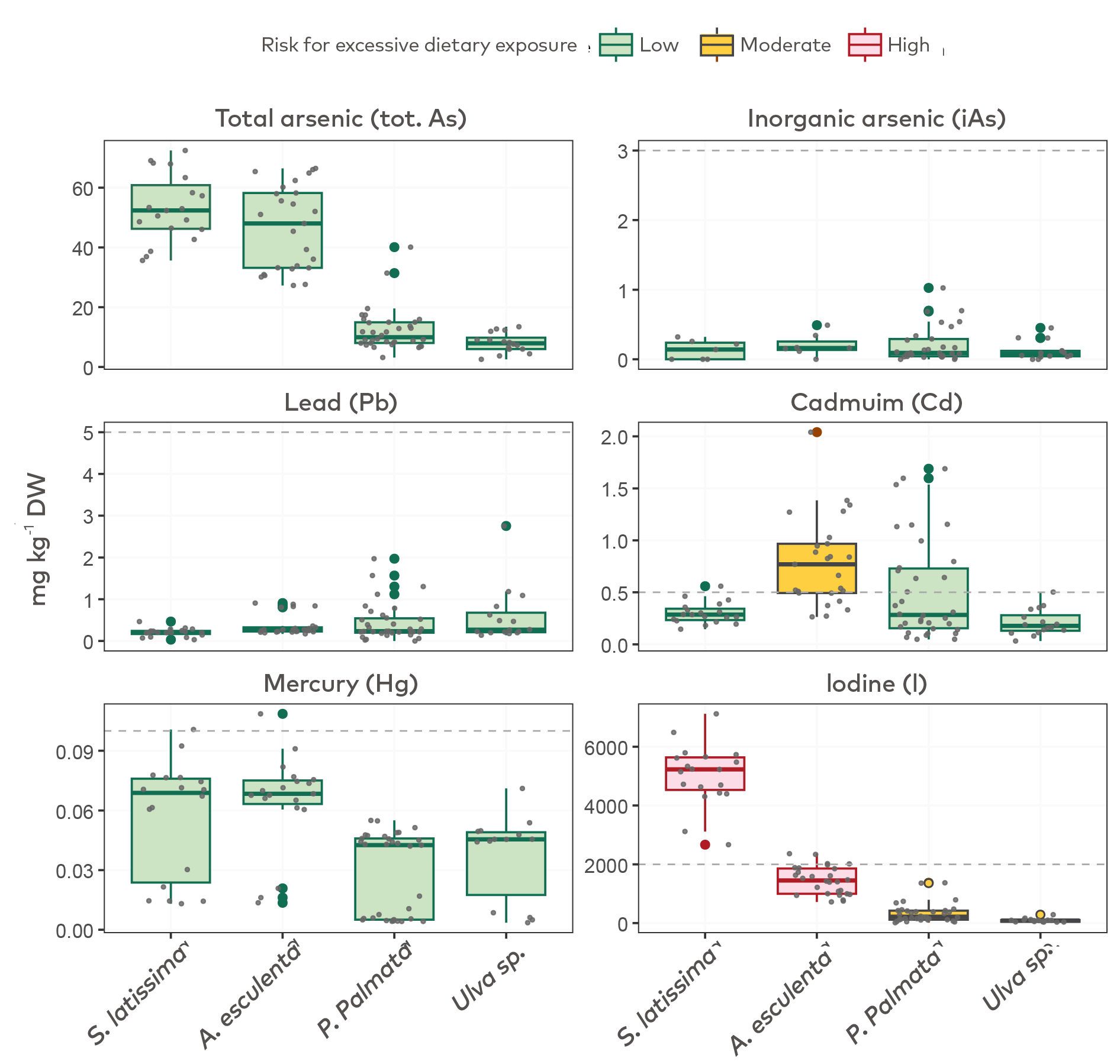
Besides being a source of nutrients and bioactive substances, seaweeds may also accumulate potentially toxic elements (PTEs) which may have negative effects on human health. Both non-essential metals as well as essential elements, especially iodine, in excessive amounts may limit the use of seaweeds in large-scale food applications (Sá Monteiro et al. 2019; Banach et al. 2020; Blikra et al. 2022a). An overview of the range of concentrations of the most relevant PTEs in S. latissima, A. esculenta, P. palmata and Ulva spp. is shown in Figure 3.
3.1. Ongoing regulatory process by EFSA
Current status (as per January 2026)
Seaweed is the world's largest aquaculture product in volume, and its production is expected to grow in the coming years. However, while EU legislation establishes maximum levels (MLs) for several contaminants in foods, seaweed-specific thresholds remain limited and are currently most developed for food supplements and selected national guidelines (FAO and WHO 2022; AFSSA 2009). In Europe, MLs for various PTEs in foods, including heavy metals but excluding iodine, are established under EC food legislation (EU No 2023/915). However, seaweed-specific MLs for use as food are currently restricted to a French national recommendation (CSHPF 1990; AFSSA 2009) and a section of the EC food legislation applying only to seaweed used as food supplements (EU No 2023/915) (Table 4 ). In recent years, the European Food Safety Authority (EFSA) identified seaweed consumption as an emerging risk for public health and the EC recommended monitoring of PTEs and iodine for future risk management of seaweed as food and feed (EU No 2018/464). A recent initiative by the national food authorities of the Nordic countries (Norway, Iceland, Denmark, Sweden, and the Faroe Islands) recommends developing harmonised legislation on seaweed food safety, with seaweed classified as a distinct group of foodstuffs (Hogstad et al. 2023).
Inorganic arsenic (iAs) | 3.0 | No regulation |
Lead (Pb) | 5.0 | 3.0 |
Cadmium (Cd) | 0.5 | 3.0 |
Mercury (Hg) | 0.1 | 0.1 |
Iodine (I) | 2,000 | No regulation |
1 National recommendation applied to seaweeds as vegetables or condiments (CSHPF 01/1990; AFSSA 04/2009); 2 MLs for food supplements (Commission Regulation (EU) 2023/915) | ||
Ongoing process
Based on monitoring PTE concentrations in edible seaweeds commercialized in Europe (EFSA et al. 2023), threshold values for cadmium, lead and inorganic arsenic were drafted by EFSA following a hearing process, specifically to seaweed groups (brown, red, green) or in some cases species, but not yet adopted (SANTE PLAN 2025). The proposed ML values are based on occurrence data and aim to exclude samples with concentrations well above typical levels, such as those affected by environmental pollution. In addition, a ML for iodine was suggested. In this draft, the suggested ML for cadmium is 3.0 mg kg-1 in brown and 4.0 mg kg-1 in red and green seaweeds. In contrast, the iodine threshold was set as low as 1,000 mg kg-1 DW (as sold seaweed product e.g., fresh, dried flakes, dried powder, fermented), a change that is expected to have significant consequences for companies producing seaweed (particularly kelp species) for food applications. As of January 2026, input from research and industry stakeholders has highlighted the need for proportionate risk management, including (i) clear consumer labelling and dietary guidance, and (ii) a stronger focus on iodine levels in final foods and portion-based exposure rather than restrictive limits on raw seaweed ingredients alone. This approach would avoid unnecessarily constraining innovation, particularly for kelp-based seasonings and other low-inclusion food applications.
3.2. Iodine
Dietary exposure and risk
The EFSA recommends a daily adequate intake (AI) of iodine of 150 µg day1 for adults (EFSA 2014) and a tolerable upper intake level (UL) of 600 µg day-1 (EFSA 2006). Common dietary sources of iodine are white fish, eggs and milk. From a toxicological perspective, iodine is a challenging element, since there is a small window of suitable iodine intake levels. Several physicochemical properties and physiological mechanisms (e.g., Wolff-Chaikoff effect) indicate that occasional high intakes (acute exposure) are generally not problematic, whereas substantially lower sustained daily intakes (chronic daily exposure) can pose a risk (FAO and WHO 2022). Occasional high iodine intake from seaweed has not yet been formally risk-assessed; however, emerging evidence suggests that such exposures may also present risks in individuals without identified sensitivity (Blikra et al. 2024c). Consequently, establishing a single fixed ML for iodine in seaweed foods is challenging, underscoring the critical importance of clear dietary guidelines and consumer advice. Extra care should be taken when incorporating iodine-rich kelp ingredients into foods intended for daily consumption, ensuring low inclusion levels so that iodine intake per portion remains well below the UL (Max Hansen, Toxicologist and Food Authority advisor, DTU Food, pers. comm. 2025).
Iodine and food safety in seaweeds
Brown seaweeds generally contain higher levels of iodine compared to other foods, with kelp species (Laminariales) being the highest iodine accumulators among all living systems (Ar Gall et al. 2004). Among edible kelps, species of the Laminaria and Saccharina genera (Laminariaceae family), contain higher levels of iodine than species of the Alaria and Undaria genera (Alariaceae family) (Blikra et al. 2022a) (Figure 3 ). Iodine in kelps has a physiological role as inorganic antioxidant, and a role in defence against bacterial grazing has also been suggested (Küpper et al. 2008). Iodine accumulates in the form of iodide (I-) (Küpper et al. 2008). Jerše et al. (2023) showed that in all seaweeds studied within the brown, red and green species, iodide was the predominant species, constituting between 65% and 100% to the sum of the iodine species. Iodide is highly water-soluble and bioavailable to the human body compared to other forms. In vivo studies estimate the bioavailability of iodine from S. latissima and A. esculenta to range between 57% and 78% (Blikra et al. 2022a; Fjære et al. 2022). Hence, the iodine concentration in kelps is one of the main food safety concerns regarding the increasing interest in seaweeds as food. Considering the AI and UL, only small amounts of unprocessed dried kelp (approx. 1 g and below depending on the species) should be consumed to prevent exceeding these limits (Aakre et al. 2021; Jacobsen et al. 2023; Blikra et al. 2024c; Stévant et al. 2025a). Red and green seaweeds (e.g., P. palmata and Ulva sp.) typically have lower iodine levels (Figure 3 ) (Biancarosa et al. 2018; Duinker et al. 2020) and therefore, do not represent a high risk of excessive dietary iodine exposure. However, these iodine concentrations are still much higher than other high iodine foods such as white fish (typically between 3 and 10 mg kg-1). Moreover, food processing methods (e.g., blanching at 40–100 °C) can significantly reduce the iodine concentration in kelps and, therefore, the risk of excessive iodine exposure upon consumption.
Processing and iodine reduction
Blanching is an effective strategy to reduce the iodine content of kelps, while pulsed electric field (PEF) treatment can also achieve iodine reduction, although typically to a lesser extent. Optimisation and practical implementation of post-harvest processing are addressed in the Chapter 4 . Iodine reduction may also occur during conservation processes, such as fermentation (Bruhn et al. 2019; Krook et al. 2024), acid preservation (Krook et al. 2024), salt-pickling (Klein et al. under review) and freezing/thawing (Stévant et al. 2024; Sund et al. 2024), during which iodine leaks into the liquid fraction. However, the extent of reduction achieved through these methods is generally lower than that obtained with blanching or PEF treatment.
Future perspectives
Edible seaweeds contain iodine at varying levels, which can be adjusted to predictable ranges through processing. Importantly, iodine-related risk is a function of intake and consumption frequency rather than iodine concentration in the raw material alone. Commercially available seaweeds therefore represent a valuable plant-based source of dietary iodine, particularly for populations at risk of deficiency. Minimally processed kelp included at low levels in foods can provide natural iodine without extensive reduction steps, while also contributing desirable flavour characteristics in products such as dehydrated soups and seasonings, with iodine levels per portion remaining well below the tolerable upper intake level (UL) (Krook et al. 2023). Establishing strict MLs for iodine concentration in raw seaweed would likely exclude some of the most economically important species produced in Europe (e.g., Saccharina latissima), as well as entire product categories such as dehydrated condiments and seasonings, without necessarily improving consumer protection. Raw materials marginally below a proposed ML could still lead to excessive iodine intake when used at high inclusion levels. The development of seaweed-based food products would benefit from focusing on the iodine content in the final product rather than on restrictive limits for raw seaweed ingredients alone. Clear product labelling and tailored dietary guidance will allow kelps and other edible seaweeds to be incorporated sustainably into a variety of food formulations while providing a predictable and nutritionally valuable source of plant-based iodine. This intake-based approach is consistent with existing EU food-safety practice for nutrients such as sodium, for which no MLs are established in foods despite well-documented associated chronic diseases, relying instead on labelling, intake recommendations and national reformulation strategies.
3.3. Arsenic
Arsenic in edible seaweeds
Arsenic is a metalloid occurring in the environment both naturally and through anthropogenic activities, such as the use of fertilizers and pesticides. It exists in both organic and inorganic forms, of which the inorganic forms are considered the most toxic and can be associated with adverse health effects, including lung, skin, and bladder cancers (EFSA 2014). In the kelps A. esculenta and S. latissima, arsenic is predominantly found in organic forms such as arsenosugars (50%–80% total arsenic) and lower levels of arsenolipids (mostly below 10%) (Pétursdóttir et al. 2019; Sim and Petursdottir 2024), which are regarded as non-toxic or whose toxicity is not yet fully characterized (Taylor et al. 2017; Cubadda et al. 2017). The main contributors of dietary exposure to inorganic arsenic are cereals, rice and drinking water. Inorganic arsenic is usually present at low levels in seafood, with the notable exception of the brown seaweed hijiki (Sargassum fusiforme), widely consumed in Asian food traditions, and has been reported to contain 42–117 mg kg-1 DW (Almela et al. 2006). Comparable levels have been observed in other species of the Sargassum genus e.g., the non-native Sargassum muticum found in the Nordic waters. Elevated levels of inorganic arsenic have also been reported in oarweed (Laminaria digitata) collected along the Norwegian coast, with concentrations ranging from 0.06 to 79 mg kg-1 DW, and 50% of the samples containing more than 24 mg kg-1 DW (Duinker et al. 2020). Hence, a warning has been issued by the Norwegian Food Safety Authority regarding L. digitata. In general, arsenic concentrations are higher in brown compared to red seaweeds. However, inorganic arsenic levels are low in A. esculenta and S. latissima, i.e., respectively 0.5% and 0.4% of the total based on the data presented in Figure 3 (median concentrations below 0.2 mg kg-1 DW for both species). Short blanching treatments can reduce the total arsenic concentration by half (Krook et al. 2023; Stévant et al. 2024; Stévant et al. 2025a; Sund et al. 2025a).
Dietary exposure and risk
No MLs for total or inorganic arsenic have been established for seaweeds as food, except the French recommendation of 3 mg kg-1 DW for inorganic arsenic (Table 4 ). Most edible seaweed species commercialised in Europe contain inorganic arsenic below this limit, except hijiki (S. fusiforme) and L. digitata. New MLs have recently been proposed for inorganic arsenic, namely 1 mg kg-1 DW for brown and green seaweeds and 0.5 mg kg-1 DW for red seaweeds. Based on the occurrence data shown in Figure 3 and in Duinker et al. (2020), cultivated Norwegian kelps (S. latissima and A. esculenta) would comply with the proposed limit. However, broader datasets from European seaweed-producing countries, covering both cultivated and wild-harvested kelps as well as other edible brown, red and green seaweeds, show that the proposed MLs overlap with observed concentration ranges. While most values remain below the French recommendation, the proposed limits would exclude a substantial share of the produced biomass from the market. Based on current consumption patterns, seaweeds do not pose a significant risk to dietary exposure to inorganic arsenic (Ficheux et al. 2023). Monitoring arsenic levels in end products (e.g., seaweed condiments or seaweed-containing food products) will provide better exposure estimates for risk assessment, as processing steps can influence concentrations. Future risk assessments considering both inorganic arsenic and potentially toxic organic species, are also warranted (Taylor et al. 2017; EFSA et al. 2023).
3.4. Cadmium
Cadmium levels in seaweeds
Human exposure to cadmium is of concern as it can cause kidney failure and is associated with increased risks of cancers (lung, endometrium, bladder and breast) as well as bone demineralisation (EFSA 2012). Seaweeds generally contain low levels of cadmium and under current consumption patterns, they do not significantly increase dietary exposure. They are therefore considered minor contributors to overall cadmium intake (Ficheux et al. 2023; EFSA et al. 2023). Nevertheless, EFSA has highlighted seaweed as a food category with relatively high cadmium concentrations (EFSA 2012). In general, higher levels are reported in brown and red seaweeds compared to green species, although large variations occur both between and within species. Among the most consumed seaweeds, the highest levels have been reported in Undaria pinnatifida (wakame, 0.72–4.0 mg kg-1 DW), and Porphyra/Pyropia spp. (nori, 0.17–3.4 mg kg-1 DW) (Duinker et al. 2020). Relatively high levels are also found in A. esculenta (0.26–1.4 mg kg-1 DW, Figure 3 ), often exceeding the recommended ML recommended by the French food safety authority (0.5 mg kg-1 DW, Table 6 ). However, these concentrations will generally be below the new proposed MLs of 3 mg kg-1 DW for brown and green seaweeds and 4 mg kg-1 DW for red seaweeds.
Effect of processing on cadmium levels
Cadmium in seaweeds is largely bound to structural cell wall compounds, such as alginates in kelps, meaning levels are not significantly reduced by most processing steps, including blanching (Stévant et al. 2017a; Stévant et al. 2024; Blikra et al. 2024b; Sund et al. 2025b). Processing methods involving low pH, such as fermentation, may partly dissociate cadmium from alginates and thereby lower concentrations, as reported by Bruhn et al. (2019) following the fermentation of S. latissima with Lactobacillus plantarum. However, this effect was not confirmed in a study investigating acid preservation and spontaneous fermentation of the same species (Krook et al. 2024). In a small trial from the SusKelpFood project, cadmium levels were reduced when using seawater at 45 °C adjusted to pH 2.5 with acid, whereas no reduction was observed at pH 3.7 (Duinker, unpubl. results). Salting treatments, whether brining (Stévant et al. 2017a) or dry salting (Stévant et al. 2024) also appear to reduce cadmium concentrations to some extent.
Dietary exposure and risk
The cadmium contribution from servings of dried warm seawater-treated A. esculenta (1.9–4.6 g) with cadmium concentrations of 1.4–1.6 mg kg-1 DW has been estimated to provide 12–25% of the tolerable daily intake (TDI), whereas a similar contribution from S. latissima was less than 2% (Stévant et al. 2025a), derived from the tolerable weekly intake (TWI) of 2.5 µg (kg body weight (bw))-1 week-1 (EFSA 2012). In the context of developing seaweed-based foods for larger consumer markets, such contributions highlight the need to monitor cadmium levels in raw materials and finished products, to avoid substantially increasing overall dietary exposure. Cadmium concentrations from A. esculenta show substantial site-to-site variability (Roleda et al. 2019). Monitoring within the SusKelpFood project showed higher concentrations in wild-harvested A. esculenta compared to cultivated samples (Stévant et al. 2025a, Appendix table 3 ). Current average dietary exposure of the European population to cadmium already ranges from 1.5 to 2.2 µg kg⁻¹ bw week⁻¹, close to the TWI (EFSA 2012), suggesting that additional dietary sources of cadmium should be limited. In this regard, targeted monitoring of cadmium levels in seaweeds, combined with better understanding of accumulation patterns in A. esculenta and other edible seaweeds, will help prevent unintended increases in dietary cadmium exposure.
Bioavailability
The chelation of cadmium by alginates in kelp suggests that its bioavailability in the human body may be low. This is supported by Fjære et al. (2022), who reported that 93% of ingested cadmium was excreted by rats fed with S. latissima. However, they also found elevated cadmium levels in the liver and kidney tissues of rats receiving a high-kelp diet (5%). Further research is needed to clarify cadmium bioavailability and metabolism in humans following seaweed consumption.
3.5. Lead
Lead levels in seaweeds
MLs for lead in foodstuffs range from 0.01 mg kg-1 wet weight (WW) for infant liquid formulae to 1.5 mg kg-1 WW for bivalve molluscs (EU No 2023/915). MLs for seaweed are defined on a DW basis, likely reflecting the predominance of dried products on the marked. So far, only the French limit of 5.0 mg kg-1 DW for dried seaweeds and the EU ML of 3.0 mg kg-1 DW for food supplements consisting of seaweeds have been established (Table 4 ). Reported concentrations in most edible species are below 1.0 mg kg-1 DW and often below the limit of quantification (LOQ) of the analytical methods (Figure 3 ). However, occasional higher levels have been observed in A. esculenta and S. latissima (Duinker et al. 2020), as well as Ulva spp. (Desideri et al. 2016; Jacobsen et al. 2023). Newly proposed MLs, based on occurrence data, are 1.5 mg kg-1 DW for brown, and 2.0 mg kg-1 DW for green and red seaweeds except for Pyropia/Porphyra spp., for which a lower ML of 0.5 mg kg-1 is suggested. Based on the concentration data presented here for the four main edible seaweed species commercialized in Europe, compliance with the proposed MLs can generally be expected. However, monitoring data from a wider geographic range across Europe and including several edible species (data not shown) suggest that these limits may exclude a substantial share of seaweed samples from the market.
Risk assessment
Since no evidence supports a threshold exposure level for several critical health endpoints of lead (e.g., nephrotoxicity, developmental neurotoxicity), previous toxicological guidelines are no longer considered appropriate. Instead, risk assessment is now based on the margin of exposure (MoE) approach (EFSA 2010). Stévant et al. (2025a) calculated MoE for lead intake from iodine-reduced kelp with kelp portions limited by the UL for iodine (600 µg day-1), and found MoEs corresponding to exposure levels that can be regarded as low and of no appreciable risk. Similar calculations can be done with other species and intake scenarios. A risk assessment based on current consumption patterns in Western Brittany, France, concluded that seaweed are relatively low contributors to dietary lead exposure (Ficheux et al. 2023). EFSA similarly notes that increased seaweed consumption may contribute to lead exposure, but generally within the range of existing dietary exposure, depending on species and consumption levels (EFSA et al. 2023). In this context, the proposed MLs for lead in seaweed appear more stringent than those applied to other seafood. For example, the ML for lead in shellfish is 1.5 mg kg-1 WW, corresponding to approximately 10 mg kg-1 DW (assuming a dry matter content of 15%). Harmonization with comparable food categories will help maintain a high level of consumer protection while avoiding disproportionate regulation. In addition, establishing relevant MLs using a percentile-based methodology requires robust and representative data covering European population and measured across various production systems and seaweed species.
3.6. Mercury
Regulatory status
Under Regulation (EC) No 2018/73 a maximum residue level (MRL) for mercury in algae and prokaryotic organisms is established at the default level of 0.01 mg kg-1. This limit is considerably lower than the MLs applied to other seafood commodities such as fish and bivalves, and it remains uncertain whether this MRL will be implemented in practice. Mercury is also not included among the MLs proposed by EFSA for seaweeds in 2025.
Mercury in seaweeds
In seaweeds, most measured mercury concentrations fall below the LOQ (Figure 3 ). The LOQs themselves vary due to differences in sample dilution, which is often necessary because of the high salt content in seaweed and can lead to elevated LOQs. In the SusKelpFood dataset, the highest upper-bound mercury values corresponded to LOQ values. Therefore, differences between species cannot be meaningfully interpreted based on these results. Overall, mercury concentrations in seaweed are generally low (Duinker et al. 2020), and consequently, the dietary exposure risk is considered low.
3.7. Microbiological safety
General facts on microbiological safety of seaweeds
Compared with iodine and PTEs, the evidence base for seaweed-specific microbiological risk patterns is more heterogeneous and strongly dependent on processing and handling practices. Bacterial pathogens on seaweeds for human consumption may originate from two main sources: the environment in which they are grown and contamination from equipment and humans during post-harvest handling and processing. While bacterial density and composition often reflect the surrounding water, the seaweed-associated microbiota is typically distinct from seawater communities (Chan and McManus 1969; Hollants et al. 2013). High initial bacterial loads can reduce shelf-life and sensory quality of seaweeds, but do not necessarily make the product unsafe. Conversely, low bacterial counts do not guarantee safety, as toxin-producing pathogens may cause illness even at low levels. Human pathogens are generally assumed to occur on seaweeds in similar densities as in surrounding waters; hence, cultivation or wild-harvesting sites near polluted coastal areas pose a higher risk. Seaweed harvested from clean waters, i.e., away from harbours and agricultural and industrial run-off areas, are considered safe in Denmark (Hendriksen and Lundsteen 2014). A Norwegian risk assessment concluded that the likelihood of foodborne disease from consuming seaweed is no greater than that of other non-filter-feeding marine organisms, including fish (Duinker et al. 2020). However, contamination or recontamination may occur during handling and processing (Sakon et al. 2018; Banach et al. 2020).
Main risks
According to Løvdal et al. (2021), the main bacterial groups of concern in seaweeds are Bacillus spp., Vibrio spp., and Aeromonas spp. Bacillus forms heat-resistant spores and produces heat-stable toxins, while Vibrio and Aeromonas can grow under chilled conditions. Other pathogens, such as E. coli, Salmonella spp., Staphylococcus aureus, Listeria monocytogenes, Norovirus, and Hepatitis A virus, can mainly be introduced by accidental contamination. Occasionally, Campylobacter, Shigella, yeasts and moulds may be reported, typically following serious hygiene failures. The occurrence and concentrations of pathogenic microorganisms found in edible seaweeds harvested in Europe are summarised in Table 5 . Seaweed products are considered safe when pH remains below 4.3 at 4 °C (or below 3.8 at higher temperatures), provided water activity limits pathogen growth (Løvdal et al. 2021)
Bacillus licheniformis | A. esculenta | Raw | West Norway, April 2015 | < 200 | Blikra et al. (2018) |
Bacillus pumilus | A. esculenta | Raw | < 200 | ||
Bacillus subtilis/amyloliquefaciens | S. latissima | Raw | < 200 | ||
Bacillus licheniformis | S. latissima | Raw | < 200 | ||
Bacillus pumilus | S. latissima | Raw | < 200 | ||
Bacillus spp. | L. digitata | Raw | West Norway, March 2015 | 257 | Løvdal et al. (unpubl. results) |
Bacillus spp. | S. latissima | Raw | 240 | ||
Bacillus spp. | A. esculenta | Raw | 226 | ||
Bacillus spp. | A. esculenta | Raw | 1,109 | ||
Bacillus spp. | A. esculenta | Blanched (85 °C, 15 min) | < 100 | ||
Bacillus spp. | S. latissima | Raw | 245 | ||
Bacillus spp. | S. latissima | Blanched (100 °C, 15 min) | < 100 | ||
Bacillus spp. | S. latissima | Fresh | Sweden, April 2021 | n.d. | Jönsson et al. (2023a) |
Clostridium spp. | S. latissima | Fresh | n.d. | ||
Bacillus spp. | S. latissima | Frozen | n.d. | ||
Bacillus subtilis | H. elongata | Blanched (85 °C, 15 min) | Ireland, September 2008 | n.d. | Gupta et al. (2010) |
Bacillus subtilis | L. digitata | Blanched (85 °C, 15 min) | Ireland, September 2008 | n.d. | |
Bacillus subtilis | S. latissima | Blanched (85 °C, 15 min) | Ireland, September 2008 | n.d. | |
Bacillus licheniformis | S. latissima | Blanched (85 °C, 15 min) | Ireland, September 2008 | n.d. | |
Bacillus spp. | A. esculenta | Dried | Scotland, 2019 | ~ 10,000 | Lytou et al. (2021) |
Bacillus spp. | A. esculenta | Dried | Scotland, 2020 | ~ 1,000 | |
Bacillus spp. | S. latissima | Dried | Scotland, 2019 | ~ 1,000 | |
Bacillus spp. | S. latissima | Dried | Scotland, 2020 | ~ 1,000 | |
Yeasts/Molds | A. esculenta | Dried | Scotland, 2019 | ~ 1,000 | |
Yeasts/Molds | A. esculenta | Dried | Scotland, 2020 | ~ 100 | |
Yeasts/Molds | S. latissima | Dried | Scotland, 2019 | ~ 1,000 | |
Yeasts/Molds | S. latissima | Dried | Scotland, 2020 | ~ 100 | |
Vibrio alginolyticus | A. esculenta | Dried | Scotland, 2020 | n.d. | |
Listeria monocytogenes | A. esculenta | Dried | Scotland, 2020 | n.d. | |
Moulds | P. palmata | Dried | France/November 2017 | 350–830 | Stévant et al. (2020) |
Reported concentrations are given as colony-forming units (CFU) per gram, except for Jönsson et al. (2023a) and Gupta et al. (2010), where microbial characterisation was performed using high-throughput sequencing (16S rRNA amplicon). | |||||
Bacillus spp
Occurrence of Bacillus species has been reported on edible seaweeds and products, including cultivated kelp (Blikra et al. 2018; Lytou et al. 2021) and wild-harvested seaweed (Gupta et al. 2010) in Europe, and ready-to-eat (RTE) seaweed-based foods (Martelli et al. 2021). Although Bacillus levels on fresh seaweed are generally low, further growth may occur during improper handling and storage. Modelling studies of RTE kimbap (popular Korean dish made of cooked rice and various fillings in a sheet of nori) show that manual preparation and room-temperature storage strongly promote B. cereus proliferation (Park et al. 2005). Illness is linked to their toxin production, typically occurring above ~10⁵ colony forming units (CFU) per gram (Salkinoja-Salonen et al. 1999; Granum and Braid-Parker 2000). Bacillus spores are highly resistant, tolerating over 100 °C and pH below 3.0 for several minutes (Setlow 2006), though they cannot reproduce under such conditions. Once favourable conditions return, spores may germinate, grow, and produce toxins. After heat treatment, non-spore-forming bacteria are generally eliminated, and spore-forming bacteria can proliferate faster than in untreated products. For seaweed, similar precautions as for rice are recommended, i.e., cooked product should be cooled quickly to prevent outgrowth of B. cereus or Clostridium perfringens.
Vibrio spp
Pathogenic Vibrio species, i.e., V. parahaemolyticus and V. vulnificus, have been detected on both wild and cultivated seaweeds across different species and growing conditions (Mahmud et al. 2007; Mahmud et al. 2008; Musa and Wei 2008; Kudaka et al. 2008; Barberi et al. 2020). Their occurrence indicates a potential food safety risk when seaweeds are consumed raw and underscores the need for strict hygiene during post-harvest handling, particularly during summer when Vibrio levels peak. Vibrio alginolyticus, a potential but uncommon foodborne pathogen, was isolated from fresh A. esculenta cultivated in Scotland, but not from dried samples (Lytou et al. 2021), while no Vibrio spp. were found in wild P. palmata from Ireland (Moore et al. 2002). Vibrio parahaemolyticus and V. vulnificus are well-known causes of illness from other seafoods such as prawns and oysters (Honda and Iida 1993; Sumner and Ross 2002), but cases of food poisoning linked to Vibrio spp. in seaweed are extremely rare. Vibrio spp. are sensitive to thermal processing but may survive mild drying. For instance, low levels (below 10 CFU g-1) were found in low-temperature dried Ulva lactuca from Turkey, suggesting incomplete inactivation (Karacalar and Gamze 2008). Therefore, suitable handling procedures are crucial, particularly for seaweeds consumed raw or lightly processed.
Aeromonas spp
Aeromonas spp. are potential foodborne pathogens which may occur on seaweeds and survive or grow at chilled temperatures. Most studies have dealt with A. hydrofila, which have been implicated in many seafood-borne outbreaks, but evidence of seaweed-specific outbreaks is scarce. However, based on their indigenous aquatic prevalence, Aeromonas spp. could be expected to colonize seaweeds and possibly follow the raw material to processing. Occasional detections of Aeromonas spp. in e.g., air-dried Ulva reticulata from Malaysia (Vairappan and Suzuki 2000), and fresh Chondrus crispus and Chondracanthus teedii from Italy (Ziino et al. 2010) suggest the need for attention to hygiene and cold-chain handling.
Escherichia coli, Salmonella spp., Listeria monocytogenes, Staphylococcus aureus and other pathogens
Studies show variable contamination levels, with generally low counts in most regions but occasional detections near pollution sources. In Maine, USA, E. coli and Vibrio spp. were found on farmed S. latissima from multiple sites although at low levels (Barberi et al. 2020). The same study also reported the detection of Salmonella and enterohemorrhagic E. coli in several kelp samples subjected to a microbiological enrichment step (i.e., to detect microbes present in small numbers) prior to characterisation using molecular methods. Several European studies did not detect gastrointestinal pathogens on wild or farmed seaweeds (Liot et al. 1993; Moore et al. 2002; Gupta et al. 2010; Duinker et al. 2020). In Norway and Scotland, L. monocytogenes, Salmonella, E. coli, and S. aureus were largely absent (Blikra et al. 2018; Lytou et al. 2021), with one A. esculenta sample positive for L. monocytogenes likely contaminated during handling (Lytou et al. 2021). RTE products containing seaweed tend to show higher contamination rates, likely due to handling failures rather than the seaweed itself. Hygiene surveys of Korean kimbap frequently reported S. aureus, B. cereus, and occasionally Salmonella (Park et al. 2005; Cho et al. 2008; Kim et al. 2008).
Other potential hazardous microorganisms include:
- Campylobacter jejuni and Yersinia enterocolitica: rarely detected but may grow under refrigeration upon contamination.
- Clostridium spp.: occasionally detected in nori, but not the pathogenic species C. botulinum nor C. perfringens (Choi et al. 2014).
- Shigella spp.: detected in a minority of kimbap samples using enrichment methods (Cho et al. 2008).
- Yeasts and moulds: generally absent from fresh seaweed; may appear during prolonged storage of dried products (Stévant et al. 2020).
Viruses
Norovirus and Hepatitis A virus are the main foodborne viruses relevant to seaweed. Several outbreaks, in Asia (Kusumi et al. 2017; Sakon et al. 2018) linked to dried, shredded, or uncooked nori contaminated during processing or handling, and in Norway from a contaminated wakame salad (Folkehelseinstituttet 2019). Norovirus is environmentally robust and can remain infectious for months under dry conditions. Heat treatments ≥ 90 °C for longer than 90 seconds effectively inactivate enteric viruses, but post-processing contamination remains a key risk (Bosch et al. 2018). Refrigeration and freezing do not eliminate viral infectivity.
3.8. Allergens
Allergens in seaweeds
To date, seaweed protein is not among the established food allergens, and there is limited data on the allergenicity of seaweed proteins by themselves (Garciarena et al. 2022). Proteins extracted from Ulva sp. were annotated to known allergens using sequence similarity (Polikovsky et al. 2019), however, assessing the allergenic potential of novel proteins is a complex process, as complete allergens need to bind IgE‐antibodies, elicit an allergic reaction, and have de novo sensitisation capacity (Verhoeckx et al. 2019). On the other hand, seaweed farming infrastructure in the marine environment creates habitats for a variety of fish and shellfish species. The marine food allergens crustacean and mollusc tropomyosin and fish parvalbumin have previously been detected in edible seaweeds (Motoyama et al. 2007; Mildenberger et al. 2022). The European food regulation imposes the labelling of specified allergenic foods when used or added to food products and encourages the precautionary labelling of unintentionally occurring allergens (EU No 1169/2011). Therefore, to enable the broad inclusion of seaweeds in food products, the allergenic potential of seaweed-based ingredients must be better characterized in relation to different seasons and locations.
Regulation and product labelling
The European food regulation (EU No 1169/2011; article 36) also states that voluntary information should not be misleading or ambiguous, and should be based on scientific data to not unnecessarily restrict the available food products for allergenic customers. The Voluntary Incidental Trace Allergen Labelling (VITAL®) approach was developed over time to establish a program of risk-based precautionary allergen labelling (PAL) (Allergen Bureau 2024a). The key parameter in the current risk assessment framework (VITAL 4.0) is the eliciting dose (ED), specifically ED05, which is used as the reference dose. ED05 represents the amount of protein from a given allergenic food below which only 5% of the allergic population is expected to experience objective symptoms (Allergen Bureau 2024b). ED05 has been adopted in place of the more conservative ED01 used in the previous VITAL 3.0 framework with the aim to increase food choice for allergic consumers while maintaining a minimal risk to public health. With ED05, it is still extremely unlikely that life-threatening reactions occur, and allergic symptoms will be mild or moderate for most (>95%) of the 5 % of reacting allergic consumers (Allergen Bureau 2024b). VITAL 4.0 additionally includes a reference dose for molluscs, which was missing in the previous framework. Consumer exposure to allergenic proteins further depends on the quantity of the food typically consumed in a single eating occasion (referred to as the reference amount). Action levels (ALs) are defined to guide when precautionary allergen labelling (PAL) should be used. AL1 indicates that PAL is not recommended, while AL2 means that PAL is warranted. The cut-off between AL1 and AL2 corresponds to the amount of allergenic protein in a typical serving (reference amount) that would expose consumers to the reference dose (ED05), i.e., the level at which allergic reactions could occur (FAO and WHO 2023; Allergen Bureau 2024a). The recommended reference doses for seafood allergens from current and previous VITAL risk assessment frameworks, as well as AL transition points and the highest measured levels of this study are summarised in Table 6 .
Fish (parvalbumin) | 1.3 | 5.0 | 1,667 | 21.3 |
Crustacea (tropomyosin) | 25 | 200 | 66,667 | 560 |
Mollusc (tropomyosin) | - | 20 | 6,667 | 4,047 |
Reference doses based on a ED01 and b ED05. c based on VITAL 4.0 values and a reference amount of 3 g. d in raw/unprocessed seaweed samples. | ||||
Risk assessment
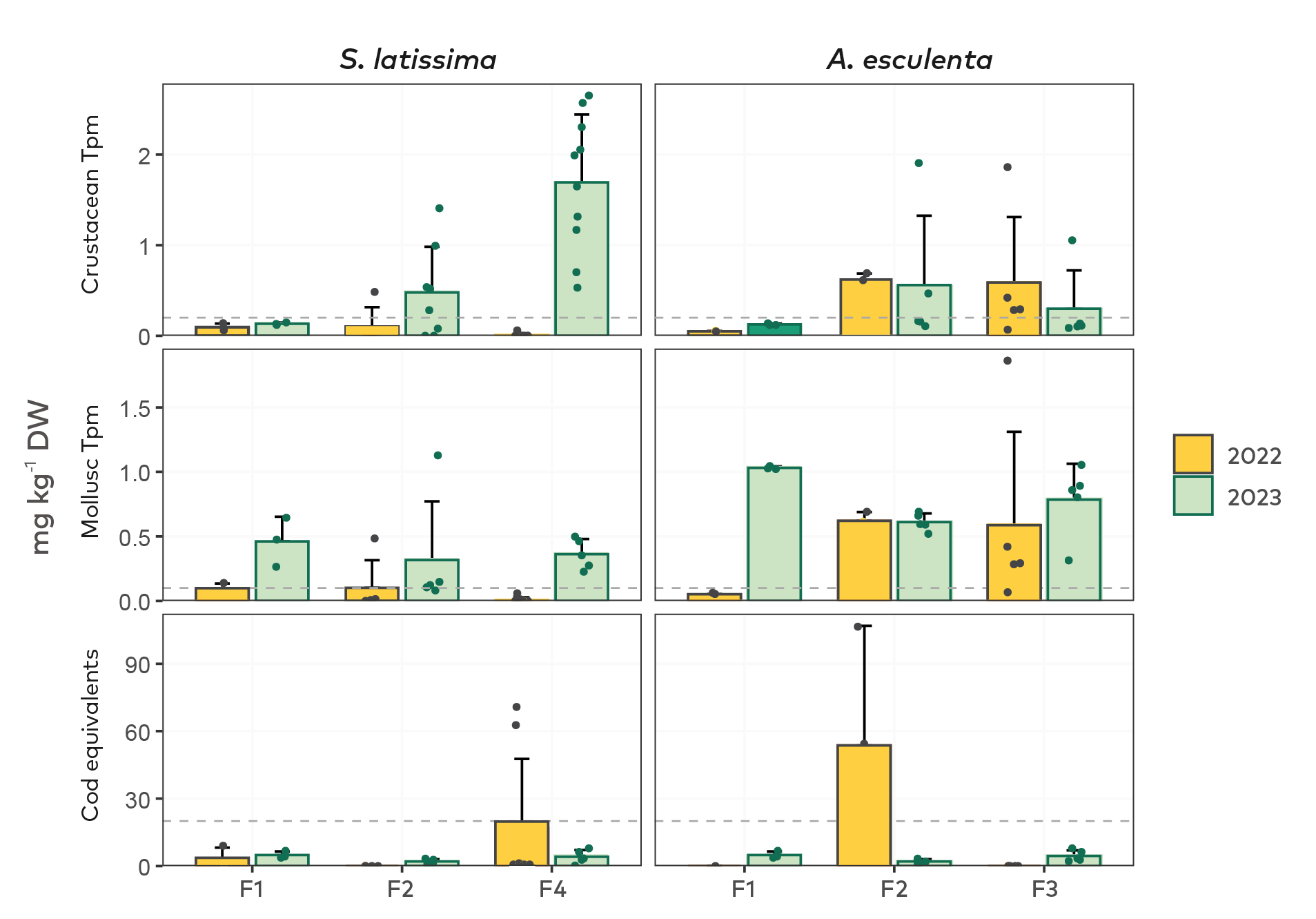
In the SusKelpFood project, the occurrence of marine allergens was investigated in samples of cultivated kelp (A. esculenta and S. latissima) collected over two consecutive years from four Norwegian farms and covering several cultivation and post-harvest methods (Mildenberger and Rebours 2025). Crustacean, mollusc, and fish allergens were detected in many of the samples, regardless of the kelp species, at varying levels and with no consistent distribution pattern (Figure 4 ). All detected concentrations remained below levels of food safety concern (Table 6 ), even with the more conservative ED01 values, and would not require PAL. While the detected levels of crustacean and fish were clearly lower than the AL transition points, calculation with the newly adopted reference dose for mollusc shows that mollusc is closest to its AL transition point and thus closest to requiring PAL. Crustacean tropomyosin exhibited the highest variability among the samples (Figure 4 ). It has previously been suggested that a minimum of eight subsamples might be needed to improve the confidence of the estimate for this analysis (Faassen et al. 2024). The results of the study further suggested that position within a single farm (upstream vs. downstream), cultivation method (direct seeding vs. twine seeding) and timing of harvest (early vs. late) may affect the occurrence of crustacean and mollusc tropomyosin. Extensive complementary data would be needed to identify the factors influencing the presence of marine allergens in seaweeds cultivated in open-water environments. Food processing steps including blanching and fermentation as performed and assessed in the study did not affect the concentrations of marine allergens (Mildenberger and Rebours 2025), but reports of reduced allergenicity after processing exist (Fu et al. 2019; Dong and Raghavan 2022; Healy et al. 2024; Dong et al. 2025). Thus, if needed, it might be possible to optimize the processing to further limit the allergenicity of kelp products. Considering the VITAL 4.0 reference doses, it seems that efforts to reduce allergens in kelp products might be most relevant to be targeted to reduce mollusc allergens. Homogenisation of several batches reduced the variation, making this a preferred stage for allergen analysis. Nevertheless, care must be taken to avoid cross-contamination e.g., from other production lines. The study of Mildenberger and Rebours (2025) used ELISA as detection method, which is a recognized method for the evaluation of allergens as it is based on the direct recognition of proteins (Allergen Bureau 2023). A verification by other methods could be needed in future studies if a reduction in allergen levels is suspected to be due to protein denaturation.
Recommendations
According to the VITAL guidelines, all farmed seaweed that were analysed for allergens in the SusKelpFood project, fall into the category AL1 which does not require PAL, except for one batch contaminated during processing. The food producer is ultimately responsible for appropriate allergen labelling. The variability in the occurrence and diversity of marine organisms associated with seaweed farms as potential sources of food allergens, particularly in the context of a changing climate, warrants routine, batch-wise analysis prior to the inclusion of seaweeds in food products.
3.9. Conclusions
While seaweeds are a valuable source of nutrients, their frequent consumption by large population groups is not without risks. The main food safety concern in Europe relates to their high iodine content, particularly in kelp species, and the potential for excessive dietary exposure if seaweed-based foods are consumed in large quantities. At the same time, iodine deficiency remains an established public-health issue in Europe. When incorporated in appropriate forms and at suitable levels, seaweeds can provide a useful source of dietary iodine without exceeding safe intake levels. Other potentially harmful elements such as inorganic arsenic, cadmium and lead, as well as marine allergens, are also present in seaweeds. Although current data indicate that these are not major contributors to dietary exposure, their concentrations vary widely between species and can be influenced by environmental conditions and processing methods. Ensuring the safe use of seaweed ingredients therefore requires a robust food-safety management system, including good production and processing practices and careful monitoring of contaminants.
- Iodine: Seaweeds, particularly kelp species, contain naturally high levels of iodine, posing a risk for frequent consumption, particularly in sensitive groups (e.g., pregnant women, children, thyroid disorders). Safe use requires low inclusion levels and portion-based control of iodine in final products; processing (e.g., blanching) can substantially reduce iodine. Red and green species typically present lower iodine risk under realistic intake patterns.
- Non-essential metals (i.e., inorganic arsenic, cadmium, lead, mercury): Seaweeds can accumulate PTE’s, with levels varying by species and site. Under current consumption patterns, they are generally minor contributors to dietary exposure, but routine monitoring remains important. More research is needed on bioavailability and absorption in humans.
- Microbiological safety: Microbial hazards primarily relate to growing-site water quality and post-harvest handling. The main bacterial groups of concern include Bacillus, Vibrio and Aeromonas species. HACCP-based controls, effective cooling/storage, and prevention of cross-contamination are essential.
- Marine allergens: Seaweeds may contain trace seafood allergens from co-occurring marine organisms (i.e., fish, crustaceans, molluscs). Available data indicate levels below thresholds requiring precautionary allergen labelling (PAL), but variability and occasional contamination justify batch-wise checks and good hygiene. Homogenising small batches prior to testing can help reduce analytical variability.
- Regulatory framework: Harmonised EU legislation for seaweed as a distinct food category is still evolving (as of January 2026), including maximum levels (MLs) for iodine and selected contaminants. For iodine, portion-based limits, labelling and dietary advice may be more effective than strict MLs for raw ingredients, which could disproportionately restrict the use of kelp in food at low inclusion levels. Representative occurrence data are needed to set proportional MLs for non-essential metals across species and groups.