2. Nutrients and bioactive compounds in edible seaweeds
Seaweeds are a diverse group (red, green and brown) of photosynthetic marine organisms whose chemical composition varies considerably with species, season, and habitat. The fresh biomass of seaweed typically contains 80–90% water. In the dry matter, most seaweed species are characterized by high levels of carbohydrates and minerals, moderate to low protein, and low lipid levels.
This section provides an overview of the nutritional characteristics, bioactive compounds and associated health benefits of seaweeds, particularly in the context of their use in large-scale food applications. It summarizes key findings from the literature and presents new data on the levels of specific compounds (e.g., vitamins) and their potential dietary contributions based on realistic consumption scenario.
2.1. Carbohydrates
Dietary fibres
Carbohydrates in seaweeds, comprising both structural and storage polysaccharides, typically account for 40–60% of the dry weight (DW) (Stiger-Pouvreau et al. 2016). A large proportion of these polysaccharides, such as alginates, fucoidans, and cellulose in brown seaweeds; sulphated galactans (agar and carrageenans), xylans, and mannans in red seaweeds; and cellulose, xylans, and mannans in green seaweeds (Lahaye and Kaeffer 1997), are not digestible by humans and are therefore classified as dietary fibres. Consequently, seaweeds are low in calories. From a nutritional perspective, dietary fibres have several benefits as they can increase faecal bulk, retain water, reduce intestinal transit, and modulate gastrointestinal microbiota (Brownlee et al. 2005). Based on fibre content data reported in the scientific literature, Jacobsen et al. (2023) estimated that a 5 g portion of S. latissima and Ulva spp. provides approximately 3–6% of the daily reference intake (DRI) in fibres. Since the fibre content of P. palmata and A. esculenta is similar, their dietary contributions are likely at comparable levels.
Seaweeds as texture ingredients
Alginates extracted from kelps (e.g., L. hyperborea), as well as agar and carrageenans derived from red seaweeds, are widely used as gel-forming additives in the food and pharmaceutical industries. These phycocolloids are industrially manufactured and typically classified as ultra-processed food ingredients. They belong to a broader category of additives for which growing evidence links high intake of ultra-processed foods to adverse health outcomes, including cardiovascular disease, type-2 diabetes and inflammatory bowel disease (Monteiro et al. 2025). Using edible seaweeds in minimally processed forms (e.g., blanched, dried; see Chapter 4) offers an alternative approach for providing natural texture and mouthfeel (Mouritsen 2013; Chapman et al. 2015; Mouritsen et al. 2019b) as well as fibre and micronutrients. This aligns with recent recommendations from public health and nutrition experts encouraging a shift from ultra-processed to whole or minimally processed food ingredients (Baker et al. 2025).
Bioactive polysaccharides
In kelps such as A. esculenta and S. latissima, soluble glucose occurs in the form of laminaran, a storage glucan accumulating in the biomass during summer and autumn. Another carbohydrate, fucose, is mainly found in sulphated form as the main constituent of fucoidans. Evidence from both in vitro and in vivo studies suggests that these compounds exhibit various bioactivities, including roles in immunoregulation (Neyrinck et al. 2007), prebiotic effects (O’Sullivan et al. 2010), anti-inflammatory activity (Ale and Meyer 2013) and anti-obesity effects (Sharma and Baskaran 2021; Zheng et al. 2024).
2.2. Protein
Amino acid profile
Although seaweeds are often considered a potential alternative source of protein for human and animal nutrition, only a few species reach protein levels comparable to conventional protein-rich foods such as pulses, beans, and soy (approximately 20–35 g per 100 g DW) (Fleurence 1999). In general, the protein-bound amino acid profile of seaweeds is dominated by glutamic and aspartic acids, and essential amino acids are well represented (Bak et al. 2019; Stévant et al. 2023), although substantial interspecific variations in protein composition have been reported.
1–16 2 | 9–20 1 | 8–20 3 | 4–27 4 |
References: [1] Sæther et al. (2024); [2] Kraan (2020); [3] Stévant et al. (2023); [4] Hofmann et al. (2025). | |||
Dietary contribution
As already mentioned, the protein in seaweed does not contribute a lot to the diet (Jacobsen et al. 2023), but protein content can be up-concentrated in the solid fraction of processed seaweed using various technologies (see Chapter 4 ) such as pulsed electric field or enzymatic extraction (Naseri et al. 2020; Steinbruch et al. 2024). These approaches have been proposed to produce protein-rich ingredients from seaweeds (e.g., Ulva spp., P. palmata), although the economic viability of their production has yet to be demonstrated.
2.3. Minerals
Sodium salt reduction
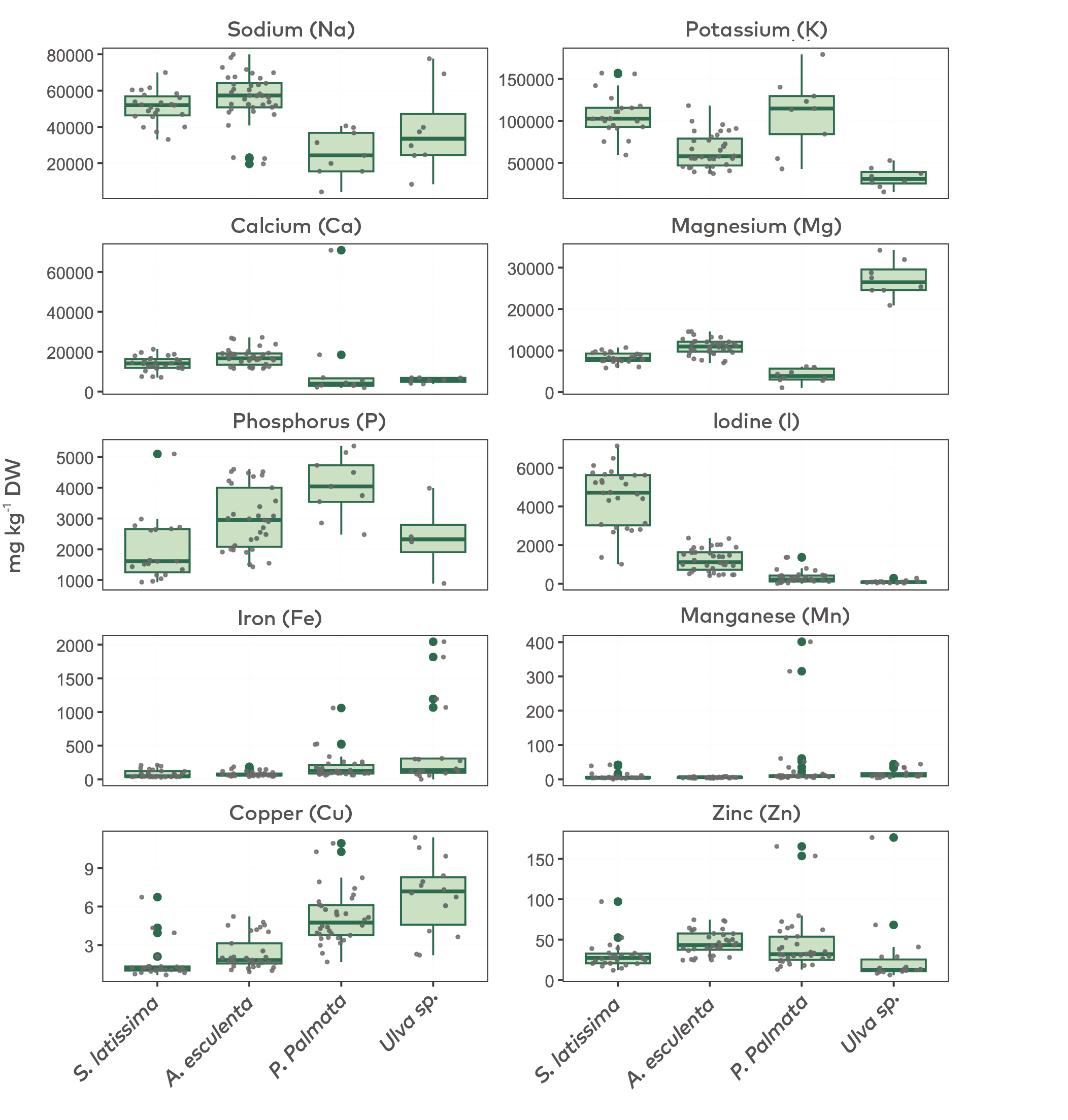
Seaweeds typically contain potassium (K) levels equal to or higher than sodium (Na), which is nutritionally beneficial, as high dietary Na/K ratios are linked to hypertension and cardiovascular diseases (Perez and Chang 2014). Reducing sodium intake is therefore a public health priority in many Western countries, as processed foods such as meat, bread, sauces, and condiments often exhibit Na/K ratios above 5.0 (Circuncisão et al. 2018). The World Health Organization (WHO) recommends a Na/K ratio close to 1.0, indicating that foods with lower ratios support cardiovascular health. In this context, edible seaweeds are promising functional ingredients for salt reduction. Even at low inclusion levels (≤ 5%) in processed foods, edible seaweeds have been shown to improve mineral balance by lowering Na/K ratios (López-López et al. 2009; Sund et al. 2025a). Processing methods such as blanching tend to increase the ratio, because of greater potassium reduction compared to sodium (see Chapter 4 ).
Iodine
Seaweeds are also an excellent plant-based source of iodine, a micronutrient required in small amounts for the synthesis of thyroid hormones involved in the regulation of metabolism, growth, and numerous body functions. While iodine deficiency disorders (IDDs) are associated with multiple adverse health effects on growth and development, including impaired cognitive development in children (de Benoist et al. 2008), excessive iodine intake can also have negative consequences. This is particularly relevant when considering iodine-rich seaweed species (i.e., kelps) as discussed in Section 3.2 . Adequate iodine nutrition remains a global challenge, particularly in Europe and Nordic countries, despite national salt iodisation programmes. This is partly due to changing dietary patterns, including reduced intake of seafood and dairy products and increased consumption of plant-based alternatives, as well as food-industry practices such as salt reduction initiatives aimed at lowering the risk of hypertension and other non-communicable diseases (Zimmermann and Andersson 2021). Incorporating seaweeds at low inclusion rates into formulated foods can help supply iodine to foods that typically contain very little (e.g., plant-based products) (Ballance et al. 2024). However, the iodine content of the final product must be carefully monitored and controlled, for example, through processing (see Chapter 4 ), or merely by low inclusion, to avoid excessive intakes (Blikra et al. 2024c; Stévant et al. 2025a). For most edible seaweeds, iodine content is the primary factor determining maximum inclusion levels in foods and therefore governs the achievable dietary contribution of other minerals.
Dietary contributions
Based on mean %DRI per portion (5 g DW), S. latissima and Ulva sp. are considered as good sources (%DRI >15) of calcium, magnesium, iron, selenium (Jacobsen et al. 2023). These conclusions can reasonably be extended to A. esculenta and P. palmata, given their relatively similar mineral profiles (Figure 2 ). However, the mineral composition of edible seaweeds can be altered by post-harvest and processing steps, which will in turn influence their dietary contribution (Stévant et al. 2025a). Under an iodine-limiting scenario, only potassium in P. palmata and magnesium in Ulva spp. exceed 15% of the DRI when inclusion levels are constrained by the tolerable upper intake level (UL) of 600 µg iodine per day for adults established by the EC (Appendix Table 4 ). If higher intakes were considered acceptable, such as in Japan (UL = 3 000 µg iodine per day for adults) (Katagiri et al. 2015), P. palmata and Ulva spp., as well as iodine-reduced kelp by warm seawater treatment, would contribute a broader range of minerals above 15% DRI while kelps would still mainly contribute iodine and sodium (data not shown).
2.4. Lipids
Lipid profile
Foseid et al. (2020) highlighted the particularly favourable lipid profiles of S. latissima, A. esculenta, and P. palmata. While these species cannot serve as major dietary sources of n-3 PUFAs, they can nonetheless contribute meaningfully to n-3 intake, particularly high-quality EPA and DHA from marine sources, and help improve the omega-6/omega-3 ratio. This is relevant given that Western diets are typically skewed toward omega-6, a pattern associated with chronic inflammation.
Lipid analysis
It should be noted that lipid content is often underestimated in seaweed. Different extraction methods can yield substantially different lipid or total fatty acid contents from seaweed, mainly because they vary in solvent polarity, extraction time, and ability to disrupt cell walls. Direct transesterification is the most accurate method and gives 1.5 to 2 times higher yields of total fatty acids compared to even the most effective conventional solvent methods (Kumari et al. 2011; Saini et al. 2021).
2.5. Vitamins
Dietary contributions
Recent data for B-group and C-vitamin concentrations in S. latissima, A. esculenta and Ulva spp. are presented in Table 3 . A review by Nielsen et al. (2021) indicated that while seaweeds can contribute to daily vitamin C intake, they are not particularly rich sources compared to common vegetables, such as lettuce or broccoli. Ulva spp. and P. palmata generally contain higher vitamin C levels than the kelps A. esculenta and S. latissima (Jacobsen et al. 2023; Stévant et al. 2023). Saccharina latissima and to an even greater extent Ulva spp., have been highlighted as notable sources of vitamin B12, although substantial variations among individual samples have been reported (Jacobsen et al. 2023). Iodine-reduced A. esculenta (processed by mild seawater blanching) was also identified as a potential dietary contributor of vitamin B9 (Stévant et al. 2025a).
Overall, vitamin data for edible seaweeds remain limited. More comprehensive and systematic assessments are needed to substantiate nutritional claims regarding vitamin content in edible seaweeds.
B1 (thiamine) | mg kg-1 | 2.6 ± 0.35 (n = 9) | 2.4 ± 0.90 (n = 16) | n.a. |
B2 (riboflavin) | mg kg-1 | 5.1 ± 0.23 (n = 3) | 12 ± 0.49 (n = 3) | n.a. |
B3 (niacin) | mg kg-1 | 10 ± 2.5 (n = 3) | 41 ± 1.2 (n = 3) | n.a. |
B5 (pantothenic acid) | mg kg-1 | 6.7 ± 0.12 (n = 3) | 4.9 ± 0.34 (n = 3) | n.a. |
B6 (pyridoxine) | mg kg-1 | 0.64 ± 0.02 (n = 3) | 0.9 ± 0.07 (n = 3) | n.a. |
B9 (folic acid) | mg kg-1 | 1.7 ± 1.2 (n = 9) | 19 ± 20 (n = 16) | n.a. |
C (ascorbic acid) | mg kg-1 | 100 ± 74 (n = 9) | 47 ± 130 (n = 16) | 650 ± 770 (n = 3) |
n.a.: not analysed. | ||||
2.6. Bioactivity
The bioactivity of whole seaweed ingredients or seaweed-derived extracts is influenced by post-harvest and processing methods. While numerous in vitro and in vivo studies indicate potential bioactivities, human intervention and clinical data remain limited. Population-based observations, mainly from East Asia, suggest associations between seaweed consumption and health outcomes, but causality remains difficult to establish.
2.7. Nutritional claims
Nutrition claims
Assessing the nutritional profile of food ingredients from edible seaweeds and comparing their nutrient levels with DRIs and conventional reference foods provides important insights into their potential contribution to future sustainable diets. The nutritional benefits derived from seaweed-based foods will ultimately depend on the extent to which key nutrients remain available after processing and the amount of seaweed incorporated into the final product. Within the EU, the use of nutrition and health claims is regulated by Regulation (EC) No 1924/2006, which aims to protect consumers and ensure transparent product labelling. The regulation specifies that a claim may only be made when “the substance that is the subject of the claim is present in the final product in quantities that are sufficient (…) to produce the nutritional or physiological effect claimed”. In the context of seaweed-based products, this means that nutrient levels in the finished food (not the raw seaweed) must comply with the required threshold. Conditions relevant to seaweed ingredients, including criteria for “source of” and “high in” claims for vitamins and minerals, are summarised in Appendix Table 1 and Appendix Table 2 . For example, modest inclusion levels of minimally processed kelp may allow a product to qualify as a “source of iodine” while higher inclusion levels of iodine-reduced kelp could support claims such as “source of fibre” or “source of calcium”, provided the regulatory thresholds are met.
2.8. Conclusions
- Source of nutrients: Seaweeds are low in calories yet naturally rich in essential micronutrients. Depending on species and processing, they can provide meaningful amounts of macrominerals (e.g., calcium, magnesium, potassium), trace minerals (e.g., iron, selenium, iodine), and selected vitamins (e.g., B9, B12). Iodine levels in final products should be monitored and controlled to avoid excessive dietary exposure.
- Sources of dietary fibre: Minimally processed edible seaweeds offer a valuable alternative to ultra-processed food ingredients, supplying both functional fibres and micronutrients. When incorporated into formulated foods, they can contribute texture, water/oil-binding properties and support more balanced dietary patterns.
- Salt reduction: Even at low inclusion rates, seaweeds can act as functional ingredients for sodium reduction, helping food manufacturers lower the sodium-to-potassium ratio and improve overall nutritional quality.
- Functional ingredients and nutraceutical potential: Numerous in vitro and in vivo studies indicate diverse bioactivities across seaweed-derived compounds. However, more studies with human subjects including clinical studies are needed to document health effects and substantiate functional claims for whole seaweeds, extracts, and purified compounds. Such evidence will support high-value applications based on small quantities of raw material.