1. Introduction
Food production systems and global diets
The rising global population demands an increasing production of food. It is projected that the global demand for food will increase by 50–60% in 2050, compared to the baseline of 2019 (Falcon et al. 2022). However, global food production is one of the primary drivers of climate change and ecosystem degradation. Hence, producing quality food in sufficient quantity without any or minimal environmental degradation is one of the major future global targets. Furthermore, unhealthy diets, whether due to undernutrition, overconsumption or poor-quality food, are among the major causes of several global health burdens. Achieving healthy diets from sustainable food systems requires major shifts in dietary composition, including increasing the share of plant-based food, paired with the reduction of red meat consumption (Poore and Nemecek 2018; Willett et al. 2019).
Seaweed as industrial feedstock
Alternative food resources from the marine environment may contribute to more sustainable sourcing of food in the future. In this context, seaweeds (i.e., marine macroalgae) are considered a promising resource for food and supporting human and animal nutrition and health (Araújo et al. 2021; Mapelli-Brahm et al. 2023; Hofmann et al. 2025). Seaweeds also hold potential as feedstocks for several other industrial applications, including biofuels, -plastics and -chemicals, plant biostimulants, cosmetic and pharmaceutical products (Rotter et al. 2020). Seaweed biomass can be cultivated at sea on a large scale without using chemicals and fertilizers and does not require fresh water or soil resources. If properly regulated, seaweed cultivation can also provide ecosystem services, such as supporting biodiversity and mitigating CO2 emissions (Cotas et al. 2023). Alternatively, seaweeds can be cultivated under controlled conditions in land-based facilities, allowing for further optimization of growth and biomass quality, and allowing wastewater integration from e.g., finfish aquaculture for nutrient recycling (Neori et al. 2004; Troell et al. 2009).
Seaweed aquaculture in Europe
In Europe, seaweed cultivation is considered as an alternative food supply chain contributing to diversifying aquaculture production while minimizing the environmental footprint (European Commission 2021d). Although most of the European seaweed supply still relies on wild-harvested biomass, industrial cultivation is developing rapidly, particularly in Nordic countries such as Norway, Sweden, Denmark, the Faroe Islands, Greenland, and Iceland (Stévant et al. 2017c; Vazquez Calderon and Sanchez Lopez 2022). Large scale cultivation protocols are well established for kelp species, mainly sugar kelp (Saccharina latissima) and winged kelp (Alaria esculenta), and are also being developed for other high-value species like dulse (Palmaria palmata) and sea lettuce (Ulva spp.). These countries benefit from extensive coastal and offshore areas, established aquaculture sectors (and industrial seaweed harvesting in the case of Norway and Iceland), as well as strong research infrastructures. Together, these factors provide favourable conditions for fostering a thriving seaweed industry.
Blue bioeconomy & future perspectives
According to recent forecasts, global seaweed demand for direct food consumption and food additives, primarily in East Asia, remains the main driver of industry growth (Aarnes et al. 2024). Most of the existing seaweed-producing companies (both from aquaculture and wild-harvest) direct their biomass to food and food-related uses (Araújo et al. 2021). However, demand is also rising for seaweed biomass in the broader bio-based economy, including applications such as feed and food supplements, pharmaceuticals, bio-packaging materials, and plant biostimulants. This trend aligns with EU policies promoting the Blue Bioeconomy, Blue Growth and sustainable development. The European seaweed aquaculture sector is expected to expand in response to the growing global demand for high-quality, sustainably produced seaweed biomass. By 2030, the European Commission aims to increase production to 8 million tonnes, valued at 9 billion €, and potentially creating 85,000 jobs (Vincent et al. 2020). Nonetheless, risks related to the establishment of a large-scale cultivation of seaweed in Europe are still poorly reported and knowledge gaps persist in areas such as biology, production technology, environmental impacts and market access (Loureiro et al. 2015; Campbell et al. 2019).
Seaweed as food and food ingredient
Seaweeds are widely regarded as a rich source of flavours and nutrients, including minerals, fibres, vitamins, trace elements and other health-promoting compounds, that may offer benefits beyond basic nutrition (Holdt and Kraan 2011; Wells et al. 2017). In Europe, predominantly wild-harvested seaweeds have traditionally been used for industrial extraction of phycocolloids (alginates, carrageenan and agar), which are primarily utilised as food additives owing to their thickening and gelling properties. Interest in seaweeds as food items or ingredients (i.e., sea vegetables, condiments) has grown in recent decades, driven by global trends favouring natural food products, plant-based diets and the popularity of Asian dishes (Aarnes et al. 2024). In response, the European Commission (EC) has compiled a list of seaweed species recognized as non-novel (i.e., consumed in any European Union (EU) member state before 15 May 1997) and authorized as food after approval procedures. Most of these species are valued for their distinctive nutritional and flavour profiles and hold promise for everyday culinary uses. The four species mentioned above (highlighted in green in Table 1 ) are native, non-novel, cultivated, already present on the market, and well-studied. They are therefore the focus of this report. Despite the culinary potential, seaweed remains underutilized in European and Nordic food industries. This is partly due to relatively high production costs and limited supply of biomass at this early stage of industry development, variabilities in the quality of seaweed ingredients caused by the lack of quality consistent production methods, concerns about food safety (e.g., high iodine content), as well as low consumer awareness of the benefits of seaweed as food.
Addressing challenges
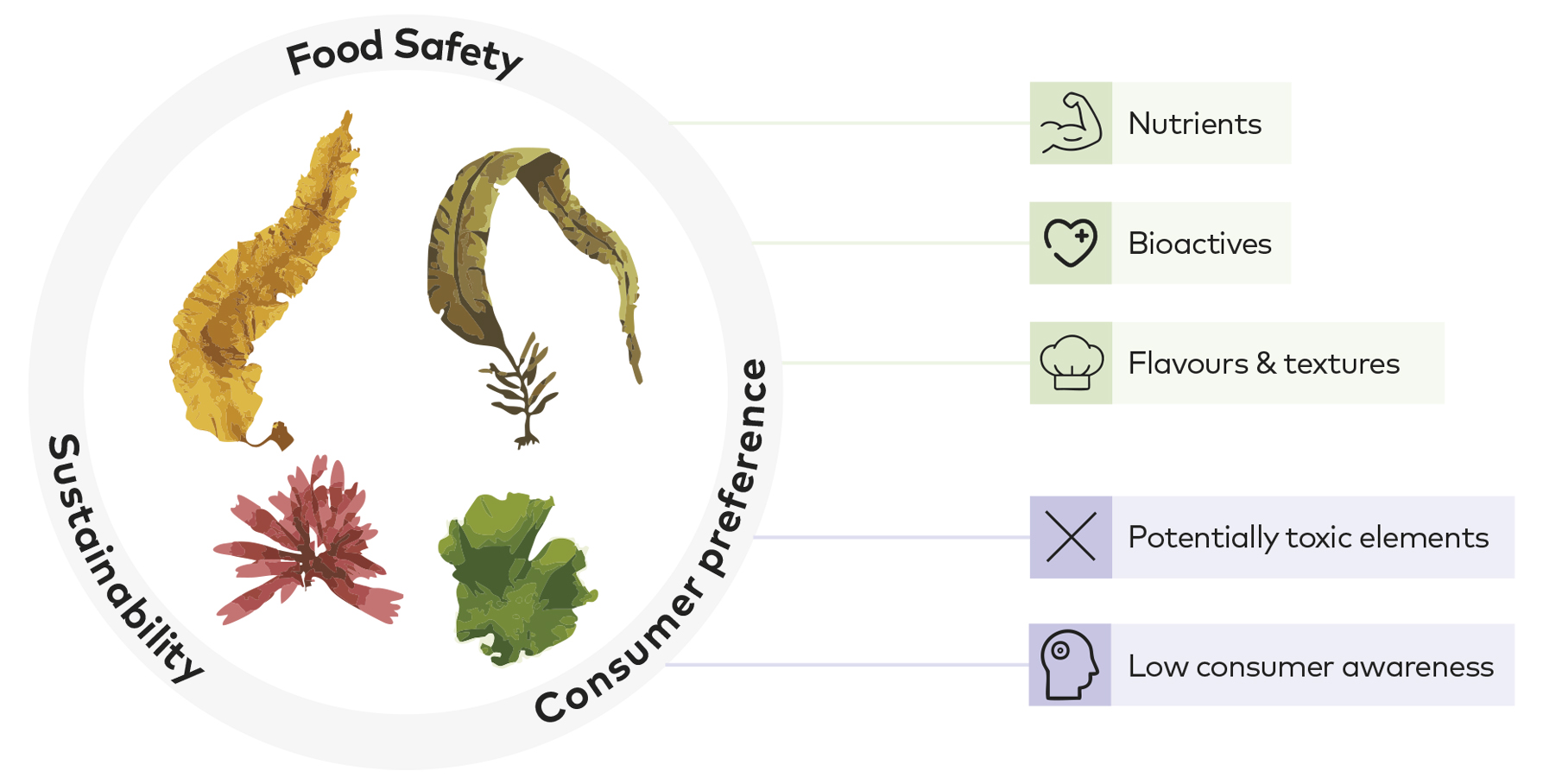
For seaweeds to be more widely incorporated into food products, their production must comply with food safety regulations, align with environmental, economic and social sustainability principles, and deliver clear value in terms of functionality, quality and consumer acceptance (Figure 1 ). In recent years, collaborative efforts between research institutions and industry have focused on improving seaweed quality and post-harvest processing for food applications. Among these, the SusKelpFood project (2021–2024, financed by the Research Council of Norway) addressed cultivated kelps as renewable, climate-resilient food crops by developing efficient post-harvest processing strategies, managing iodine and allergen levels while retaining nutrients, and characterising sensory properties and consumer preferences. Together, these efforts have contributed to a strong scientific and technological foundation for the use of kelp in the food value chain.
Brown seaweeds | Red seaweeds | ||||
Alaria esculenta | Winged kelp | NN in food | Chondrus crispus | Irish moss | NN in food |
Alsidium helminthochorton | NN in food supplement | Corallina officinalis | Coral weed | NN in food supplement | |
Ascophyllum nodosum | Egg wrack | NN in food | Corallina officinalis | Coral weed | NN in food supplement |
Durvillaea antarctica | Bull kelp | NN in food supplement | Erythroglossum laciniatum | Laver | NN in food |
Eisenia bicyclis | Arame | NN in food | Eucheuma denticulatum | Sea moss | NN in food supplement |
Ecklonia cava | Paddle weed | NN in food supplement | Eucheuma horridum | Sea moss | NN in food supplement |
Fucus serratus | Toothed wrack | NN in food | Gelidium amansii | Agar | NN in food |
Fucus spiralis | Spiral wrack | NN in food | Gelidium corneum | Atlantic agar | NN in food |
Fucus vesiculosus | Bladder wrack | NN in food | Gracilaria gracilis | Slender wart weed | NN in food supplement |
Himanthalia elongata | Sea spaghetti | NN in food | Gracilariopsis longissima | Long wart weed | NN in food |
Laminaria digitata | Oarweed | NN in food | Mastocarpus stellatus | False Irish moss | NN in food supplement |
Laminaria hyperborea | Tangle | NN in food | Pyropia tenera | Laver, nori | NN in food |
Macrocystis pyrifera | Giant kelp | NN in food supplement | Palmaria palmata | Dulse | NN in food |
Saccharina japonica | Kombu | NN in food | Phymatolithon calcareum | Maërl | NN in food |
Saccharina latissima | Sugar kelp | NN in food | Porphyra dioica | Laver, nori | NN in food |
Undaria pinnatifida | Wakame | NN in food | Porphyra purpurea | Laver, nori | NN in food |
Sargassum fusiforme | Hijiki | NN in food | Porphyra umbilicalis | Laver, nori | NN in food |
Green seaweeds | Pyropia leucosticta | Laver, nori | NN in food | ||
Ulva lactuca 1 | Sea lettuce | NN in food | |||
Ulva intestinalis | Sea lettuce | NN in food | |||
1 Morphology-based identification of the common foliose Ulva species has proven difficult as many Ulva species display subtle morphological differences. As a result, specie names attributed in the database and literature must be considered with precaution (Fort et al. 2022). Correct species identification considering morphological characteristics, DNA sequencing and species biogeography is critical to commercial applications and should be updated in the database of the European Commission. | |||||