Cost-effectiveness in marine ecosystem restoration
Dr Wenting Chen
Dr Wenting Chen, Senior Researcher from the Norwegian Institute for Water Research (NIVA), began by addressing the immense challenges marine ecosystems have faced in recent years, with many habitats now in degraded states. Citing a recent European Environment Agency (EEA) report and the European Climate Risk Assessment, she highlighted the critical and catastrophic impacts of climate change on both coastal and marine ecosystems.
This year’s Ocean Health Index, Dr Chen noted, showed a score of only 73 out of 100, signaling that the ocean is not healthy enough to deliver its crucial ecosystem services. This, she emphasized, is a clear indication of the urgent need for ecosystem restoration across the marine environment. The Nature Restoration Law, which mandates restoring degraded habitats, underscores the scale of the task ahead.
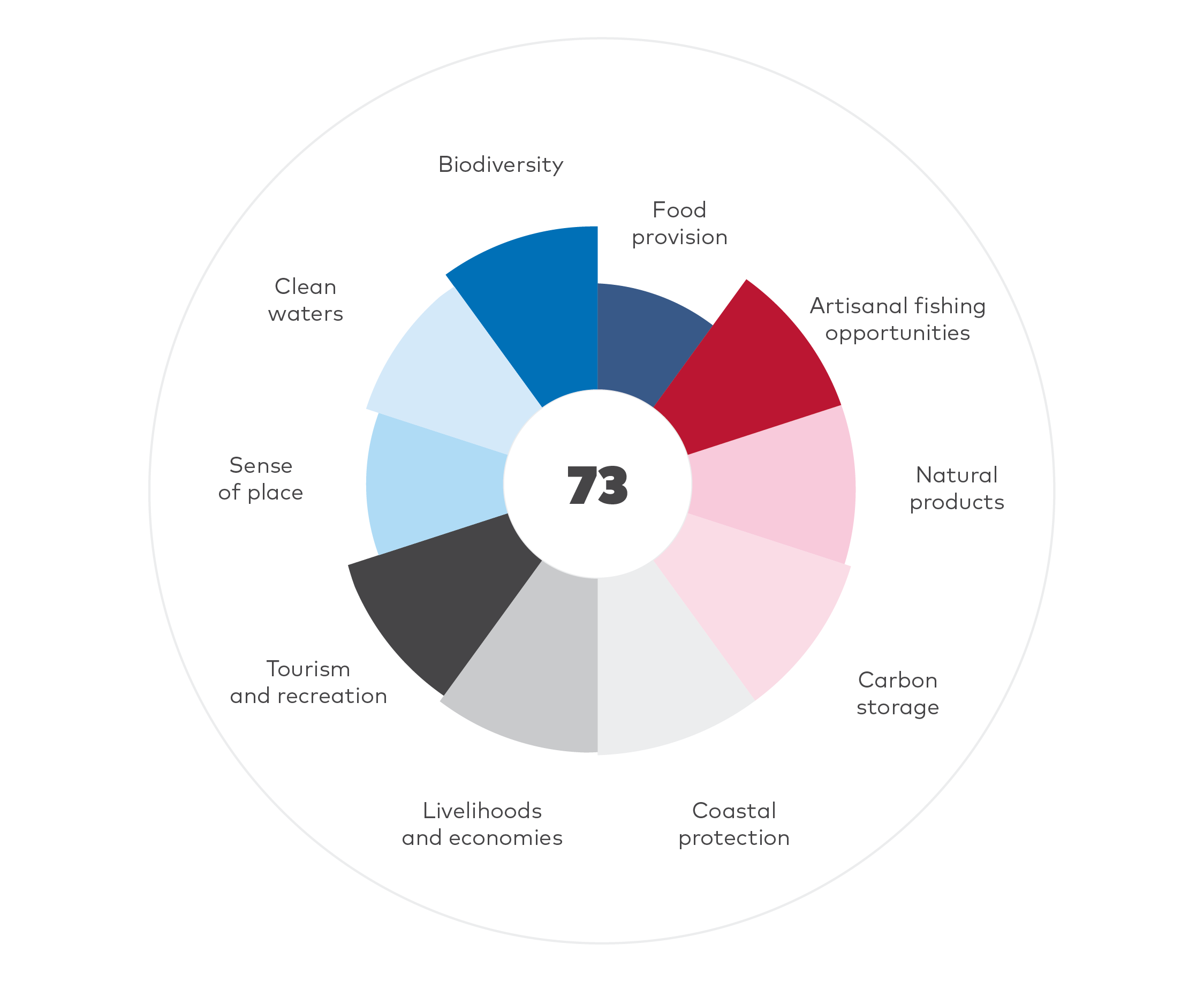
Figure 3: Global ocean health index score 2023. A score of only 73 out of 100 signals that the ocean is not healthy enough to deliver its crucial ecosystem services.
Source: Ocean Health Index. 2023. ohi-global version: Global scenarios data for Ocean Health Index, [date downloaded]. National Center for Ecological Analysis and Synthesis, University of California, Santa Barbara. Available at: https://github.com/OHI-Science/ohi-global/releases
Navigating high costs
Dr Chen elaborated on the high costs of marine ecosystem restoration, explaining that restoration efforts can be very expensive due to a variety of factors. Different restoration methods, such as those for salt marshes, seagrass, or coral reefs, come with different cost ranges. On this note, she provided a comparison of costs across various marine restoration projects, illustrating that restoration for different habitats can vary significantly.
For example, salt marsh restoration is comparatively cheaper than coral reef restoration, and methods for restoring seagrass fall in between. The varying costs of these approaches depend on many factors including the type of habitat, the method used, and the level of restoration required.
Identifying the most efficient measures
A key challenge discussed was determining which restoration measures to invest in, especially given their varied costs and potential outcomes. Here, she introduced the concept of cost-effectiveness analysis, which is a common tool used in project appraisals, particularly when benefits are not easily quantified in monetary terms.
She clarified that, in marine ecosystem restoration, the goal is to identify the most cost-effective measures that will still meet restoration targets. The success of restoration measures can vary, and some approaches require multiple attempts before achieving the desired result. Dr Chen then emphasized that cost-effectiveness analysis allows for comparing different restoration methods to identify the one that achieves the target at the lowest cost, while considering the likelihood of success and the time required for restoration.
Illustrating cost-effectiveness: a practical example
To demonstrate the application of cost-effectiveness analysis, Dr Chen presented a comparison of three different restoration measures, each with a different level of success and associated cost. In her example, the measures all aimed to achieve a 95% success rate for restoration, but each required a different number of attempts to reach this target.
She showed that while some measures (e.g. Measure 1) had high costs and low success rates, others (e.g. Measure 2) were more successful despite a higher per-square-meter cost. In this case, Measure 2 turned out to be the most cost-effective despite its higher initial cost because it required fewer attempts overall to reach the success target (see Table 3).
| Restoration measures | ||
| Measure 1 | Measure 2 | Measure 3 |
Target success rate | 0.95 | 0.95 | 0.95 |
Expected success rate at each restoration cycle | 0.45 | 0.90 | 0.35 |
Number of attempts | 6 | 2 | 7 |
Cost (NOK/m2) | 76.0 | 47.8 | 27.3 |
PV (mill NOK) | 1.6 | 0.5 | 1.1 |
Table 3: Cost effectiveness of marine restoration measures can be connected to a minimum success rate.
Controlling stressors for successful restoration
Dr Chen also underscored the importance of controlling stressors when restoring marine ecosystems. She explained that many marine habitats are affected by factors such as fishing, agricultural runoff, invasive species, and marine litter, which can significantly impact the success of restoration efforts. She stressed that controlling these stressors should be an integral part of any restoration project, and the costs of stressor control should be included in the overall restoration budget.
Addressing uncertainties in cost-effectiveness
Finally, Dr Chen addressed the issue of uncertainty in cost-effectiveness analysis. Restoration outcomes are inherently uncertain due to various factors, including incomplete knowledge about the ecosystem, data limitations, and unpredictable environmental conditions. She identified three main types of uncertainty: incomplete knowledge, unpredictability, and ambiguity.
She emphasized that cost-effectiveness analysis should not just provide a single figure but rather a range of outcomes that consider all the uncertainties involved in the restoration process. This would give a more comprehensive understanding of the costs and potential benefits, helping policymakers make more informed decisions about which restoration measures to pursue.
A tailored approach to restoration
In conclusion, Dr Chen emphasized the need for context-specific solutions that consider local conditions, species, and habitat types. She reiterated that, while the methods for marine ecosystem restoration may vary, the goal remains the same: to restore marine habitats in a cost-effective manner that will ultimately support the broader environmental and societal goals of sustainability.
