5. Discussion and conclusion
Critical raw materials are necessary for the development of a modern society, sustainable technologies and the defence of our democracy. Much of the needed critical raw material can be found in specific waste fractions from some Nordic industries and some used items and products. In the first report of this series, it was shown that almost one million tonnes of CRMs are lost in different Nordic waste streams every year.
Recycling operations and a circular economy can only be sustained over time by being part of an intact value chain that includes collection, sorting and pre-treatment of waste used as feedstock for the recycling operation. Therefore, a national strategy for increased and improved CRM-recycling should consist of steps to ensure healthy and well-functioning operations at all central steps in this value chain.
The same recycling operation also depends on market demands for the secondary CRMs that are being recovered at prices that make the recycling operation profitable. If such a market doesn’t already exist a CRM-recycling strategy should also include steps to develop such market conditions.
Figure 5.1 presents an overview showing which part of the value chain the sixteen measures discussed in Chapter 4 of this report address. Although not shown in the illustration, these measures also impact at least one of the five milestones presented in the first report of this report series.
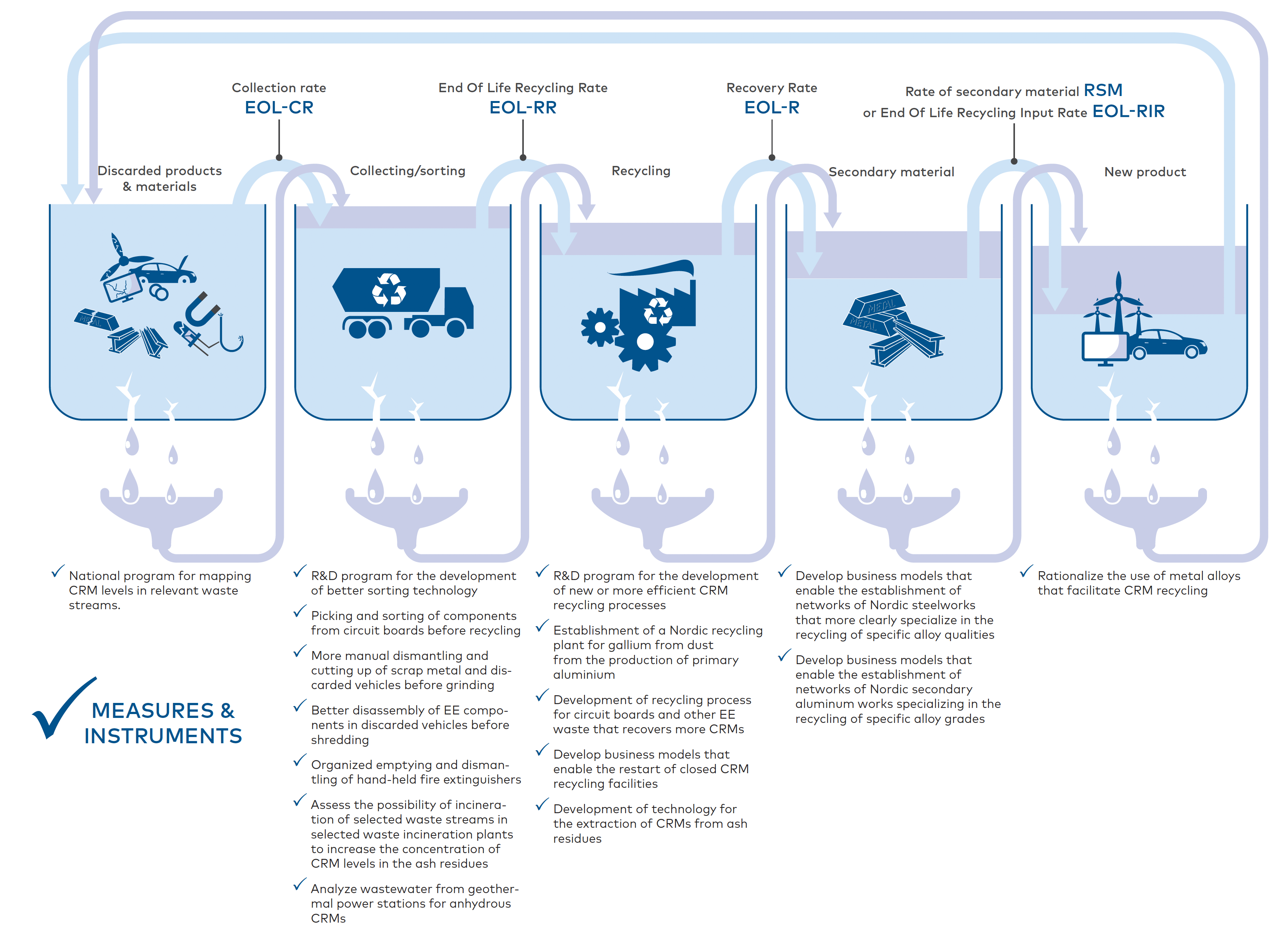
Figure 5.1 Possible measures and instruments for increased Nordic CRM-recycling. Illustration: Bergfald Miljørådgivere.
The measures include activities that collect necessary data, such as information about waste streams that may serve as new feedstock for CRM-recycling. It discusses establishing a national program for mapping CRM-levels in relevant waste streams or wastewater or assesses the CRM-recycling potential of different ash types from incineration processes. It contains measures for better sorting and pretreatment of waste before CRM-recycling like stripping waste electronics of components that should be recycled in separate recycling processes, better disassembly of EEE-components from scrapped cars before shredding and more thorough separation of specific alloys when collecting metal scrap that will ensure higher quality secondary CRM-materials. It also describes measures for updating existing business models for the aluminium and steel sector that will allow better recycling of CRM-components in alloys. There are also measures for establishing new CRM-recycling operations, such as building new plants or restarting Nordic CRM-recycling plants currently closed.
While the Nordic countries prefer that private companies operate industries, it is also important to acknowledge that such industries need proper operating conditions and protection against undue competition from countries with authoritarian agendas.
Finally, there are measures for accelerating the development of better technological solutions for tasks and processes that today represent technical barriers against more efficient CRM-recycling, including economic support schemes that are considered crucial for Nordic success in this area.
Not all measures described will be relevant for all Nordic countries, but all Nordic countries will eventually need access to all the CRMs coming from future recycling operations. Upgrading business models for the aluminium and steel industry will obviously only apply to countries with such industries. The steel industry in Sweden and Finland and the aluminium industry in Norway and Iceland are considered the most significant. Examining the CRM-recovery potential of wastewater from geothermal power stations is probably only relevant for Iceland. Coordination of efforts between the Nordic countries may also be beneficial as this will allow for common resources to be pooled when setting up support schemes and can help avoid unnecessary overlapping tasks.
All measures described in this report should be considered when setting up a national program for increased and better CRM-recycling. In addition to the 16 measures evaluated in Chapter 4, 69 additional measures are summarised in Appendix Table 2.
All national programs should include measures for mapping waste streams with CRM-recovery potential, as this is also a requirement of CRMA. All programs should include systems for cost-effective collection of waste streams that can be CRM-recycled, as well as improved recycling processes. However, the design of these measures may vary due to different national conditions.
Each country can only establish specific recycling operations for some CRMs. All Nordic countries should, however, seek to have a coordinated role in building a regional network of recycling operations that expands and supplements existing European secondary CRM-production. This should be done by focusing on specific CRM-recycling where national competitive advantages can be identified.
Technical barriers limit the potential for reducing the CRM-material loss throughout the value chain at several stages. Today’s sorting and pretreatment of many waste streams that contain recoverable CRMs are a particular concern as large amounts of CRMs are lost due to imperfect sorting and separation of material fractions that need to be recycled separately for optimal CRM-recovery to take place. There is an urgent need for massive R&D efforts towards more intelligent and robust automated sorting solutions that allow for resource- and cost-efficient separation of individual alloys and component stripping of WEEE. Another crucial R&D area that needs increased public support is for improving available recycling processes. Many of today’s dominating recycling processes recover only a few, if any, of the CRMs found in the waste used as feedstock. There are also many CRMs for which recycling processes for post-consumer waste have yet to be developed. This means that until such technology is made available, no CRM-recycling from these waste streams can take place, even if there is an economic incentive to do so. It seems unlikely that the necessary improvements needed for these technologies will occur in the near future unless significant public R&D funding is made available for this purpose. The Nordic countries already possess a leading role in automated waste treatment and CRM-recycling. Through coordinated efforts, this position can be strengthened further by making improved CRM recycling technologies available that can increase CRM-recovery not only in the Nordic countries but also in other countries that want to purchase the same technology.
One example of a strategic instrument that may play a role in strengthening R&D efforts towards these goals is the Partnership on Raw Materials for Green and Digital Transitions which is a new European co-funded funding scheme that aims at supporting lower to medium Technology Readiness Levels.
This report aims to be used as a toolbox of possible measures that can be applied to improve CRM recycling. As such, it represents an early attempt at presenting an overview of potential initiatives. The 85 measures listed in this report should not be considered as a final list as future examinations may lead to the formulation of additional concepts and improved understanding.