4. Maria Ahlholm:
Multilingual classrooms
From policy to practice in Finland
This chapter summarises insights from the webinar presentation by Adjunct Professor Maria Ahlholm, Senior University Lecturer, University of Helsinki
Focusing on Finland, Senior University Lecturer Maria Ahlholm from the University of Helsinki shared examples of how policies are implemented in practice across the country when teaching Finnish as a second language.
Ahlholm started by giving a hypothetical example, highlighting how every classroom is unique.
If a statistically average classroom existed, we would expect to find 16 Finnish speakers in a class of 20 students, one Swedish speaker, and three speakers of other languages: most probably one Russian speaker, one Arabic speaker, and one Ukrainian speaker. But in reality, urban classrooms often consist of 16 multilingual students, many of whom are bilingual with one Finnish-speaking parent. Then we also have inland classrooms that consist of 20 Finnish speakers, but even in these circumstances, during the school breaks, we would hear a lot of English.
The distribution of newly arrived students across schools in Finland is highly uneven. Given the complexity of school reality, Maria Ahlholm argues that models that rely solely on statistics might result in a one-size-fits-no-one approach that fails to address the needs of diverse classrooms.
Ahlholm argues that ongoing discussions with teachers in different contexts are necessary. A survey conducted by the University of Helsinki shows that teachers’ attitudes towards multilingualism are more positive in schools and regions with higher migration rates than in those with fewer than 5% of students from migrant backgrounds (Suuriniemi et al., 2021).
The survey also found that teachers in Swedish-speaking schools in Finland hold a more permissive attitude towards multilingualism than their counterparts in language-majority schools, and they have considerably more experience of navigating multilingual environments daily.
This indicates that teachers who have little experience with multilingualism recognise their lack of tools for effectively addressing this issue. Additionally, the survey also shows that working in a multilingual context enhances teachers’ awareness and develops their pedagogical skills.
Thirdly, the survey found that lower secondary teachers are generally more reserved in their views on multilingualism compared to primary school teachers. I think this finding is a bit different, since it reveals that subject education teachers working with older students in grades 7 to 9 are concerned about their students’ ability to progress after compulsory school. There is a pressing need for more subject-specific tools for language-aware pedagogy. This also includes supportive structures, such as language-specific tutoring and collaboration with resource teachers.
Inclusion does not depend on joint or separate classrooms
Maria Ahlholm notes that a common question is whether to have joint or separate classrooms for various learners. She explains that this dilemma has historically taken different forms, including divisions based on gender, religion, social class, or ability levels. And today we are encountering this issue as a language-based question: should the language of instruction be taught in integrated groups or separately?
Maria Ahlholm argues that there is no simple answer to this question, as both models can be effective depending on the context and the individual groups. The important thing is to work towards inclusion, regardless of which model the school chooses.
Separate groups for newly arrived students and others learning a second language can be advantageous, but they must be integrated effectively. Shared groups can also be beneficial, under certain conditions, as long as the differentiation is well managed. (See Ahlholm et al., 2023)
As both models can be beneficial, they can also have negative effects on inclusion if not managed properly, Ahlholm argues.
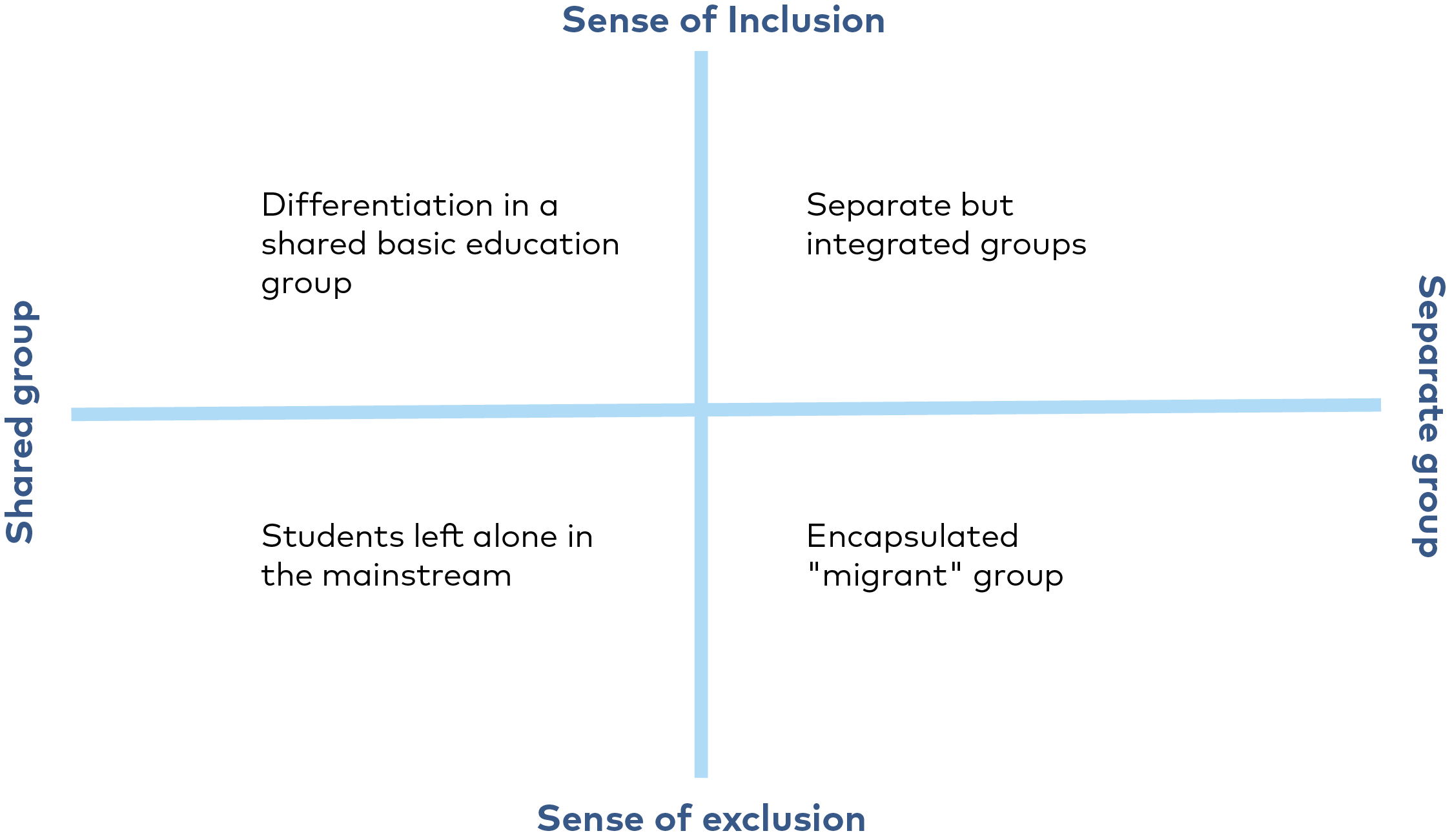
A separate group can become an encapsulated “migrant” group, which may heighten feelings of exclusion. The same could also occur in shared groups if students learning a second language are left unsupported in the mainstream class.
Following this, Maria Ahlholm presented more detailed research results on how separate versus shared groups can work well (see Ahlholm & Latomaa, 2023; Ahlholm et al., 2023; Shestunova, 2022; Venäläinen et al., 2022).
A separate group can promote inclusion if it works with basic education and customises lessons for each member. The group should be a safe space for practising speaking, and the teacher must be specialised in early-stage language learning. Additionally, support in the students’ native language must be accessible. Here, the integration process occurs as a group.
A shared group, Maria Ahlholm argues, works best for the youngest learners. It is also crucial that teachers, resource teachers, and the teaching assistant form a team, with pre-planned support for second-language learners. Peer communication must be encouraged daily; teachers should use language-aware working methods, and support must be accessible in students’ native languages. In this scenario, the integration process is more focused on the individual level.
Balance and skilled teachers are key
Our research, along with that of many of our colleagues, indicates that second-language learners benefit from a balanced combination of togetherness and differentiation.
Maria Ahlholm believes that togetherness is nurtured through shared group activities. However, having separate time with other language learners also offers advantages: it creates a safe space for practice, promotes initiative, and unlocks students’ potential.
In conclusion, the dilemma of togetherness versus separation must be continually addressed in each context. It is an enduring and complex challenge in education, and there is no one-size-fits-all solution. These approaches must be tailored to individual contexts.
Maria Ahlholm states that this optimal outcome can only be achieved by highly skilled teachers who adapt their teaching to different learners (see Shestunova, 2022). She mentions that sometimes the newly arrived are not assigned to the most well-educated teachers, which can pose a problem.
I think my key message to policymakers is that we really need to maintain a high standard of teachers. At least in Finland, many young people are still eager to become teachers, and we must recognise how valuable this resource is.
Key sources and recommended reading
Ahlholm, M., & Latomaa, S. (2023). Vastasaapuneiden opetus Suomessa: Käytänteet ja ideaalit [Teaching the newly arrived in Finland: practices and ideals]. In M. Ahlholm, I. Piippo, & P. Portaankorva-Koivisto (Eds.), Vastasaapuneet luokkahuoneissa: Ikkunoita valmistavaan opetukseen ja monikieliseen kouluun [The newly arrived pupils in classrooms: perspectives on preparatory education and multilingual school] (pp. 35–56). Vastapaino. https://vastapaino.fi/media/f/7849
Ahlholm, M., Väätäinen, E., & Latomaa. S. (2023). Vastasaapuneet ja osallisuuden rakentuminen yhteisissä ja erillisissä luokkahuoneissa [Newly arrived pupils and the construction of participation in joint and separate classrooms]. In N. Hynninen, I. Herneaho, E. Sippola, J. Isosävi, & M. Yang (Eds.), Kieli ja osallisuus. Language and participation (pp. 17–47). AFinLA 80. Suomen soveltavan kielitieteen yhdistys. https://journal.fi/afinlavk/article/view/127123
Emilsson Peskova, R., Lindholm, A., Ahlholm, M., Vold, E. T., Gunnþórsdóttir, H., Slotte, A., & Busch, S. E. (2023). Second language and mother tongue education for immigrant children in Nordic educational policies: Search for a common Nordic dimension. Nordic Studies in Education, 43(2), 128–144. https://doi.org/10.23865/nse.v43.3982
Shestunova, T. (2022). Teachers challenges in preparatory classes: A socio-ecological perspective. Teachers and Teaching: Theory and Practice, 28(4), 496–515. https://doi.org/10.1080/13540602.2022.2062750
Suuriniemi, S., Ahlholm, M., & Salonen, V. (2021). Opettajien käsitykset monikielisyydestä: heijastumia koulun kielipolitiikasta [Teachers’ views on multilingualism: reflections of school language policies]. In M. Ahlholm, I. Piippo, & P. Portaankorva-Koivisto (Eds.), Koulun monet kielet [Plurilingualism in the school] (pp. 44–69). e-AFinLA 13. Suomen soveltavan kielitieteen yhdistys AFinLA. https://doi.org/10.30660/afinla.100518
Venäläinen, S., Laimi, T., Seppälä, S., Vuojus, T., Viitala, M., Ahlholm, M., Latomaa, S., Mård-Miettinen, K., Nirkkonen, M., Huhtanen, M., & Metsämuuronen, J. (2022). Kielellisiä taitoja ja koulunkäyntivalmiuksia. Valmistavan opetuksen ja oman äidinkielen opetuksen tila ja vaikuttavuus -arviointi [Linguistic skills and capacities to attend school – evaluation of preparatory education and instruction in the student’s own mother tongue]. Julkaisu 19:2022. FINEEC. https://www.karvi.fi/fi/julkaisut/kielellisia-taitoja-ja-koulunkayntivalmiuksia-0