4. Knowledge gaps and needs for further research
In the following we identify the most pressing knowledge gaps and research needs that are needed for a well-informed AMOC risk management. In section 5, we make concrete suggestions on how the Nordic countries could take action to close these gaps.
4.1 Observations
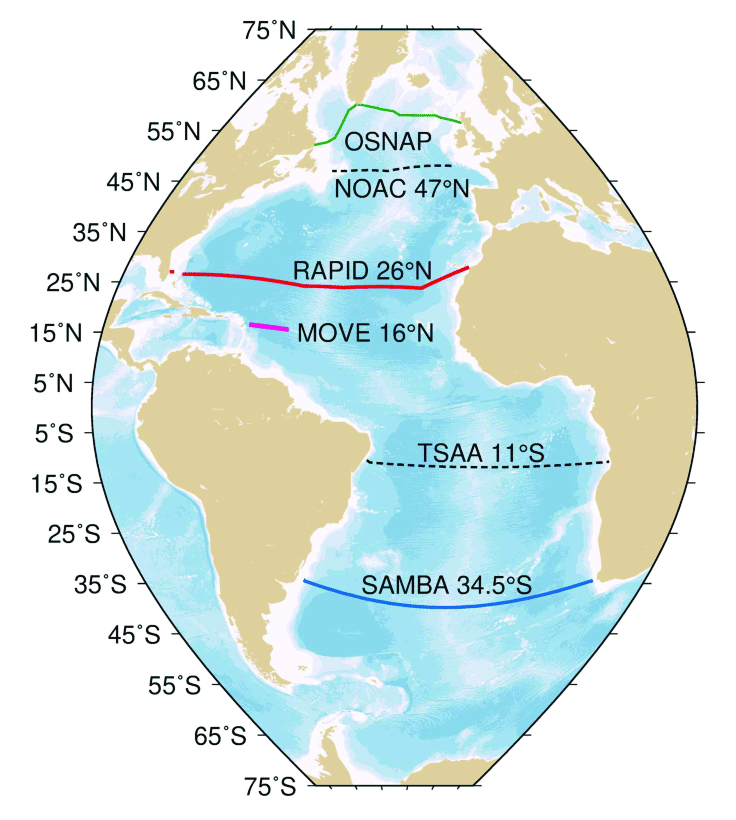
Currently only three programs monitor AMOC strength using direct observations across the full basin width (McCarthy et al. 2017; Frajka-Williams et al. 2019; Figure 4.). RAPID/MOCHA in the subtropical North Atlantic (26.5 °N), °OSNAP in the subpolar North Atlantic (53–59 °N) and SAMBA in the South Atlantic (34.5 °S). Three other programs measure partial transport TRACOS 11 °S, MOVE 16 °N, GSR 60–66 °N. These measurements have given great insight into the complex system of the AMOC and have taught us that on interannual timescales the AMOC responds to different processes on different latitudes (Johns et al. 2023, Fu et al. 2024). However, monitoring efforts have started relatively recently (RAPID 2004, OSNAP 2014, SAMBA 2009) and thus observations are not long enough to attribute the observed AMOC trends to the climate change signal (Volkov et al, 2024; Fu et al, 2024, McCarthy et al 2025). Monitoring efforts in the Atlantic are bottom up initiatives, largely coordinated by individual scientists, with no guaranteed funding in the long term. Some components, such as the Florida Current cable measurements and part of SAMBA are maintained by NOAA (USA). As a result, monitoring efforts are vulnerable to socio-economic and political factors in individual countries. To secure the long-term operation of AMOC monitoring, an international coalition with a dedicated fund and automated data stream (preferably near real-time, e.g., OSNAP currently has a ~2.5 year lag) is needed. Such an initiative not only would secure the long-term monitoring of the AMOC, but it would also contribute to data availability to policymakers. The Nordic countries can and should play a leading role in such an international cooperation that will ensure an early warning system for future AMOC changes.
An AMOC early warning system (see section 4.3) should also include observations of essential ocean variables (EOVs) such as temperature, salinity, and mixed layer depth – as well as forcing terms, such as runoff from Greenland and freshwater export from the Arctic. The Arctic outflow is presently monitored by small-scale observational systems in the Arctic gateways, i.e., the Fram and Davis straits (Curry et al, 2014; Karpouzoglou et al, 2022), however, funding limitations and extensive sea-ice conditions hinder large scale monitoring, resulting to great uncertainties in the magnitude of the Arctic freshwater outflow (Karpouzoglou et al, 2023). Temperature, salinity, and mixed layer depth observations require both sustaining and expanding the automated buoy (Argo) network and ensuring continued satellite missions for both temperature, salinity and sea surface height. Here, the Nordic countries can play a key role by ensuring continued funding through the Euro-Argo network and ESA – as well as explore possibilities to complement the Norwegian glider surveys. There may also be potential in innovative monitoring (e.g., sensors on submarine cables). Also, indirect estimates (statistical ‘fingerprints’ , paleo-proxies) of AMOC strength and Northward Heat transport should be further developed and validated against multiple lines of evidence as they appear sensitive to forcing (McMonigal et al., 2025).
All of these monitoring methods have some dual use potential and as such synergies with the increased defense spending should be explored, and especially the scientific access to non-sensitive data should be ensured.
4.2 Modeling & Simulation
As a result of short observational time series, our understanding of AMOC weakening or collapse relies foremostly on modelling studies and proxy evidence. Although climate models compose a great tool in projecting future climate change, they are subject to certain limitations. More specifically, many present-day models poorly represent convection in the north Atlantic Ocean localising it in the Labrador Sea and underestimating the contribution from the Irminger and Iceland Basins (Lozier et al, 2019). Furthermore, most climate models do not resolve the overflow waters from the Greenland Scotland Ridge ( ~5 Sv; Østerhus et al, 2019), which link deep convection in the Nordic Seas with the AMOC. As a result, these models may not correctly account for the resilient dense water formation in the Nordic Seas and the Arctic (Årthun et al, 2025; Moore et al, 2022), that can supply a stable overflow branch to the lower limb of the AMOC (Larsen et al, 2024). Determining the probability (and timing) of crossing an AMOC tipping point is further complicated due to effects of ocean circulation changes beyond the North Atlantic, such as within the Southern Ocean and Indo-Pacific Ocean (Baker et al., 2025; which the models may not adequately simulate due to insufficient resolution), as well as due to the lack of inclusion of coupling to ice sheets (Ackermann et al., 2020; Sinet et al., 2023; Pöppelmeier and Stocker, 2025).
On top of uncertainties surrounding AMOC stability and projections, the climatic impacts of AMOC weakening also play out in different magnitudes across models. While the direction of the impacts of AMOC weakening is consistent across models, the magnitude of these impacts can vary widely across models (Jackson et al., 2023).
To reduce the uncertainty in the likelihood of AMOC collapse, we need better projections of the freshwater and heat budgets in the subpolar North Atlantic. Essential components of such a model system would be a coupled Greenland Ice Sheet (Goelzer et al., 2025; Haubner et al., 2025), eddy resolving ocean resolution (1/12° horizontal resolution) to capture the eddy driven heat and freshwater exchanges between the subpolar gyre and its boundaries (e.g., Schiller-Weiss et al., 2024), and ideally high enough atmospheric resolution to allow for capturing the regional circulation and Greenland Ice Sheet mass balance. A promising approach are global models with regional grid refinement, combining global coherency with regional detail (Herrington et al., 2022). Since the response in Northern Europe is so heavily influenced by sea ice expansion, these model systems should minimize their sea ice biases and be able to capture the observed sea ice trends. Understanding the broader impacts on climate evolution and the global carbon budget such simulations should be emission driven and include the land vegetation and ocean biogeochemistry.
To reduce the uncertainty in the impact of AMOC collapse, we need sectoral information at regional scales. To do so, we need regionally downscaled AMOC collapse scenarios or global model simulations at high enough horizontal resolution. One such global system could be the EU Destination Earth Climate Digital Twin – albeit it lacks coupling to the Greenland Ice Sheet. At regional scales, the EURO-CORDEX activity could consider protocols for downscaling some of the existing global simulations in which AMOC collapses – ideally such simulations would be done with a regional coupled climate model.
4.3 Early Warning & Indicators
An early warning system for monitoring AMOC tipping point needs to be built using a combination of different approaches. We can aim to monitor the state of the system itself either directly, via proxies, together with timeseries analysis as an indicator of approaching tipping point (Smolders et al., 2025). It remains unclear what kind of lead time direct monitoring of AMOC strength (i.e., timeseries based indicators) could provide, but since AMOC is sensitive to the deep water formation, built up in stratification leading up to cessation in convection can give a decadal lead time. Decadal predictions, initialized on the current ocean state and forecasting near-term forcing, also need to be advanced. Another approach is to monitor the forcing and rely on our theoretical understanding of certain forcing levels being an indicator of forthcoming collapse. For example, freshwater from the Arctic Ocean and Greenland Ice Sheet reaches the subpolar gyre convective regions on 5–10 year timescale (Dukhovskoy et al., 2019).
Currently, we are monitoring the AMOC strength via mooring arrays (and ship based observations), strength of convection in key locations via Argo floats and moorings, and strength of forcing via monitoring Greenland Ice Sheet mass balance and freshwater outflow via Fram and Davis Straits. In addition, satellite observations provide us estimates of sea surface salinity, temperature, and surface current strengths and positions. It would be imperative that these observations continue and that we improve them by:
- Sustain current monitoring efforts and making the direct mooring array estimates near real time (NRT) – this could potentially be done by renewing equipment and adding a surface unit to allow for NRT data transfer and by automating the data processing into the final AMOC estimate.
- Ensuring dense enough Argo/ship/other observations and satellite coverage of temperature and salinity for monitoring freshwater, stratification, mixed layer depth, sea surface height and ocean currents, within the key convective regions within the Subpolar Gyre and the Nordic Seas – including observations below 2000 meters (deep Argo) especially south of the Greenland Scotland Ridge.
- Link observations between different monitoring systems and study the forcing mechanisms imposing the observed variability by combining models and observations (state estimation).
- Link AMOC observations with other monitoring efforts such as the regularly maintained hydrographic sections along the coasts of Iceland and Norway in order to better understand impacts on local climate and ecosystems.
In an operational early warning system, observations would be complemented by model simulations. Within the EU, the Copernicus Marine Service, Digital Twin of the Ocean, and Destination Earth Digital Twin of Climate all provide platforms that can be useful. The direct AMOC observations could be operationalized by funding through the Copernicus program. The mass balance of Greenland Ice Sheet is monitored from different satellite products, including the GRACE-FO that is joint US-German effort (and the planned continuation of gravity measurements to make up a full MAGIC constellation), and ground based observations by Greenlandic/Danish actors. The DTO and DestinE Climate DT could both serve as a basis for the European early warning model system. For example, the Climate DT system would have the necessary resolution, but lacks coupling to the Greenland ice sheet.
4.4 Socio-Economic & Sectoral Research (impacts and adaptation)
There is an urgent need for interdisciplinary work combining climate physics, ecology, and social sciences along with transdisciplinary work which goes beyond academic disciplines and includes non-academic actors such as local communities, private sector and policy makers.
Most coverage has emphasized physical change – colder winters, altered precipitation, ecosystem disruption (Lenton et al., 2023). The IPCC AR6 defined Climate Impact Drivers (CID) that are relevant for different socio-economic drivers. To help link the physical impacts to societal impacts, a first step could be to map those CIDs that are most impacted by AMOC. Potential areas that have a link to AMOC are agriculture, forestry, fisheries, industrial production, transportation, job markets, energy production, security and supply chains. Agriculture in particular needs priority given its potential impact on social stability and human survival. The change in temperature and precipitation patterns would have direct impacts, such as decreasing agricultural yield or even recurring crop failure particularly in European countries in the Northwest, such as UK, Norway or Finland (OECD 2022, Merikanto et al. 2024).
Social science offers means of interpreting and translating climate science into impacts on societies how change would affect vulnerability. It is also necessary to examine the impacts of AMOC collapse alongside ongoing megatrends in the Nordic countries, including population aging, the dependence ratio, resource scarcity, and mistrust in science. Better science education and communication skills might help to prevent the spread of dis- and misinformation. The impacts of AMOC collapse, as well as the effects of communicating about AMOC collapse on the psychological state of populations and on social acceptance of climate policies, merits research.
The AMOC impact and adaptation research could draw from existing climate change adaptation. For example, Central India has seen an increase in extreme weather events and an increase in temperature, and as an adaptation measure, India has adopted the Dry Farming program to make agriculture climate-resilient. Other efforts to build resilience include laying significant emphasis on organic farming, farming of indigenous crops and cropping style such as paddy cum pisciculture (fish farming in the rice fields; e.g., Apatani community in Arunachal Pradesh). For example, ensuring that cold resilient indigenous crops have large enough seed reserves for further development and eventual use in large scale agriculture would be a plausible adaptation measure for the risk of AMOC collapse. Use of measures such as Geographical Indicator (GI) tags may ensure the continued use of indigenous species that may have relatively low yields. These emphases have empowered people with better alternatives providing them socio-economic resilience which indirectly contributes to climate resilience as well (Rai, 2005; Houmai et al. 2021).
4.5 Indigenous & Local Knowledge
Indigenous Peoples, particularly the Sámi, and local communities in the Arctic practice traditional nature-based livelihoods like reindeer herding and fishing. They possess extensive, experience-based knowledge of environmental change accumulated over centuries. For example, the Northern Sámi language contains over 100 words for snow, highlighting detailed knowledge rooted in its importance for everyday practices. Practitioners of nature-based livelihoods develop expertise through daily interaction with their environment and are often the first to experience climate change impacts, including potential effects of AMOC changes. Hence, scientific monitoring of climatic and environmental change can be significantly enriched by integrating it with indigenous and local knowledge. Relying only on scientific data risks neglecting place-specific, practical manifestations of environmental change in the North, including winter melt-refreezing cycles and summer heat waves affecting reindeer herding communities. Conversely, relying only on indigenous and local knowledge may miss the wider picture on AMOC, including its drivers, mitigation strategies and manifestations across geographical areas. Adaptation strategies for nature-based livelihoods should thus be co-created with local practitioners and policymakers to ensure fit-for-purpose and maximized impact. Overall, integrating scientific, indigenous, and local knowledge systems provides a fuller picture on environmental and climatic changes related to AMOC. There is a need to map existing knowledge gaps and include a mixed-method approach that integrates both qualitative and quantitative methodological approaches – as well as to develop structures to maintain experience-based knowledge through decades.