2. Impacts of an AMOC collapse
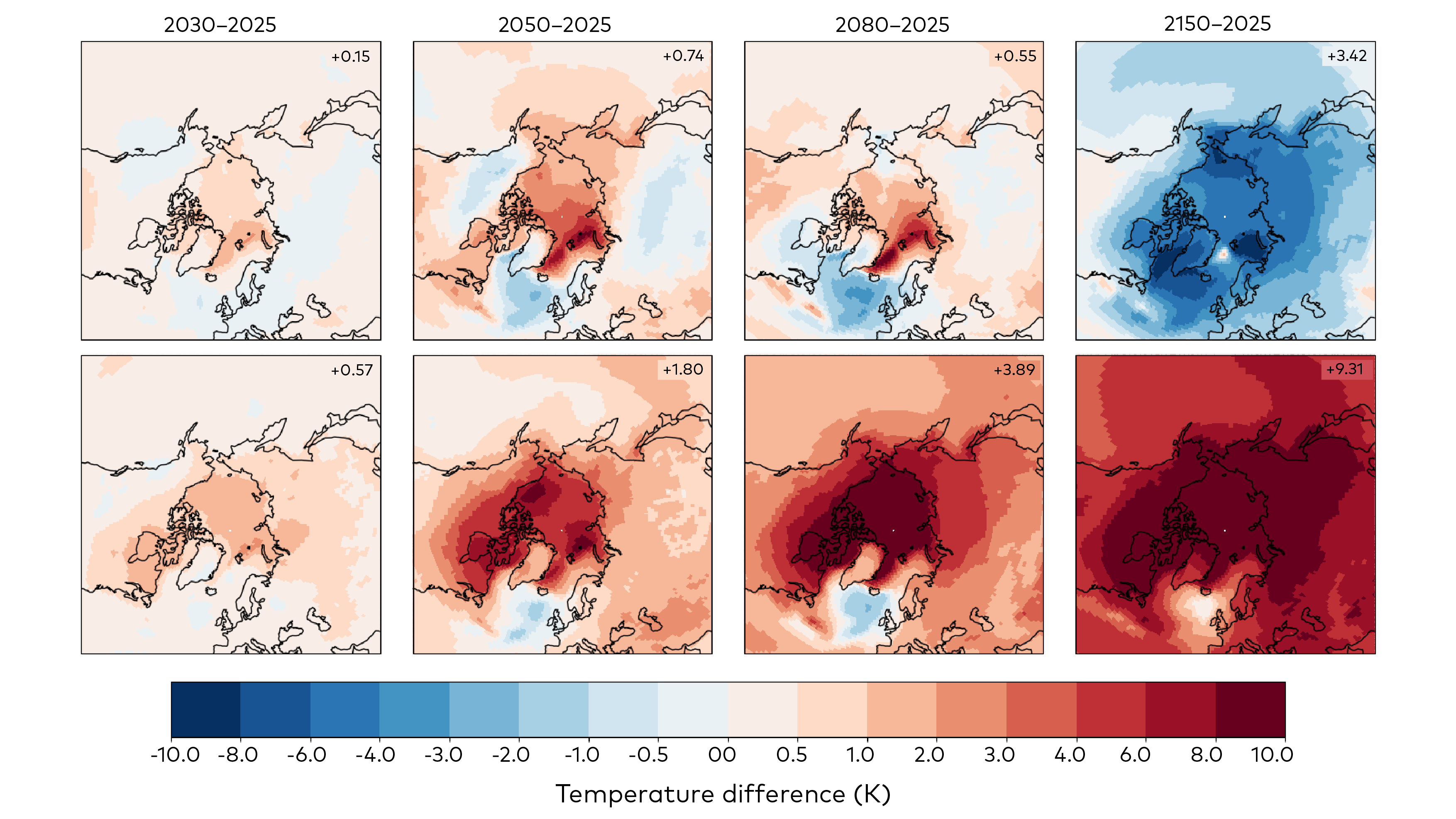
The impacts of an AMOC collapse divide into direct impacts on the earth system and the consequent second order impacts on society and livelihoods. These impacts, and their uncertainties, vary regionally. For the Nordic Countries, and Northern Europe in general, many of the impacts strongly depend on the background global warming level at which AMOC changes occur (see an example in Figs. 2–3), with the exception of the AMOC contribution to sea level rise, which directly follows AMOC slowdown. In the following we summarize the state of the art knowledge on the direct and indirect impacts.
2.1 Impacts on the physical climate
The present-day AMOC redistributes heat from the Southern Hemisphere to the Northern Hemisphere (Buckley and Marshall, 2016). When the AMOC weakens, this heat transport is reduced, causing the Northern Hemisphere to cool (Menary & Wood, 2018; Gervais et al., 2018; Liu et al., 2020; Li & Liu, 2025) and the Southern Hemisphere to warm (Orihuela-Pinto et al., 2022). As a consequence, not only the natural and human systems of the Northern Hemisphere will be affected but also AMOC’s global teleconnection will have implications in different parts of the world. The southward shifting of intertropical convergence zone (ITCZ) – the tropical rain belt - from its present-day mean position in the Northern Hemisphere is one such example (Ben-Yami et al., 2024) with possibilities of disastrous consequences for monsoon dependant regions such as Sahel and India (IPCC AR6).
It has been shown that under increased warming due to rising GHG emissions, the AMOC will weaken substantially, but with low likelihood for cooling outside the subpolar gyre region by 2100 (IPCC AR6). However, this assessment focused on changes until 2100 and did not include the possibility of increased freshwater forcing at the surface of the subpolar gyre where overturning takes place, due to freshwater input from the melting of Greenland ice sheet (e.g., Jackson et al 2022), and extreme internal variability (Romanou et al, 2023), both of which would increase the likelihood of AMOC collapse. Over longer timescales, however, the models project an AMOC shutdown over the 21st and first half of the 22nd centuries, even without additional freshwater input (Drijfhout et al. 2025). While AMOC weakening in models takes several decades, deep mixing in the subpolar gyre could shut down more abruptly, with an associated local 1–2 °C cooling over 10–15 years (Gu et al., 2024; Falkena et al., 2025; Drijfhout et al., 2025), a northward shift in the jetstream, and increasing risk of summer heatwaves in Europe (Swingedouw et al., 2021). A subpolar gyre convection collapse precedes AMOC shutdown in simulations (Drijfhout et al., 2025). However, as deep convection may shift poleward under warming, the role of subpolar convection as a necessary precursor for AMOC shutdown remains uncertain (Årthun et al., 2025; Moore et al., 2022; Brodeau & Koenigk, 2016).
The shift in global distribution of heat, and the associated impacts, directly follow from an AMOC slowdown, independent of the timing and the speed of the slowdown itself (Bellomo and Mehling, 2024). However, the regional impacts in the Nordic countries and Europe in general depend on three key factors. First, the amount of global warming; second, the timing for the onset of AMOC collapse; and third, is the strength and pattern of the regional cooling signal.
If AMOC sensitivity to global warming is at the high end of the most recent estimates (Drijfhout et al., 2025) and AMOC would slowdown at ~2 °C global warming level, then a strong cooling, especially during winter, is likely in the North Atlantic and Nordic Countries (Figure 3). The extent of the area that experiences net cooling is uncertain and depends on how sea ice will respond (van Westen & Baatsen, 2025; Romanou et al., 2023). Possible changes include a strong reversal in sea-ice cover trends, with winter sea-ice reaching the entire coastline of Iceland, the Scandinavian coast in the north, and with increasing ice extent also in the Baltic Sea (Drijfhout et al., 2025). This regional cooling would increase the north-south temperature gradient across the North Atlantic storm track and lead to more intense mid-latitude storms, but with less precipitation (van Westen & Baatsen, 2025). In such a scenario moderate summertime cooling and shorter growing seasons in Scandinavia are also likely (Ritchie et al., 2021; van Westen et al., 2025d).
However, if the AMOC is more stable and a rapid slowdown takes place in a 3–4 °C warmer world, then net cooling in winter with increasing storminess is unlikely in the North Atlantic and Northern Europe and summers are very likely to be warmer than today, dominated by the greenhouse gas-driven warming. However, even without net cooling, many serious climatic impacts such as warming of the Southern Hemisphere, associated ITCZ shift and increasing sea level rise would still play out following an AMOC collapse.
Independent of the timing of an AMOC collapse, such a collapse implies fresher and lighter water in the North Atlantic. Lighter water masses occupy larger volumes leading to dynamic sea-level rise, with recent estimates suggesting up to about 50 cm sea-level rise along European coastlines (van Westen et al., 2025c). Combined with the warmer Southern Hemisphere and possibly faster warming of the Western Antarctic Ice Sheet, as well as the melting of the Greenland Ice Sheet, the global warming driven sea-level rise accelerates following an AMOC collapse (Wunderling et al., 2024).
2.2 Impacts on the socio-ecological system
Due to lack of research, our understanding of the AMOC collapse impacts on the socio-ecological systems is incomplete. Here we review some of the main physical changes and their anticipated impacts on key systems, notwithstanding the lack of research, especially on the impacts on social systems.
Impacts on marine ecosystems: Collapse in marine primary productivity; species redistribution; biodiversity loss.
A collapse of deep convection in the sub-polar gyre can influence marine ecosystems in several ways. The collapse can lead to a shift in the timing of the spring bloom (Kelly et al., 2025), which, if higher trophic levels cannot respond to this shift, might lead to strong changes in ecosystem functioning (Asch et al., 2019; Cyr et al., 2024). Besides a shift in the timing of the bloom, the magnitude of the bloom is projected to decrease lowering overall productivity (Henson et al., 2022; Boot et al., 2023; Oliver et al., 2025). Depending on the amount of warming, the recovery of the magnitude of the bloom could take centuries (Oliver et al., 2025). Furthermore, as mixing reduces, small phytoplankton will outcompete large phytoplankton leading to a potential regime shift (Boot et al., 2023, 2025; Lee et al., 2025) that also influences higher trophic levels (Boot et al., 2025). When a collapse of deep convection is accompanied by a strong AMOC weakening, total marine ecosystem biomass will decline strongly over the North Atlantic, and specifically the subpolar gyre, with strong implications for fisheries (Boot et al., 2025)
Sea temperature drops would affect not only the size of fish stocks, but also their location, which may move to new regions or to deeper waters. The Northern European Shelf seas, particularly the North Sea and the Baltic Sea are under stress due to strong anthropogenic influence and warming. It is not clear how the impact of AMOC collapse would influence these habitats, but changes in temperature, sea level, and sea ice cover would likely be important for the local ecosystem health. As mentioned above under “food security”, cooling and decreased vertical mixing could affect fisheries around Iceland.
Impacts on food, energy, and social security, and their geopolitical implications: Vulnerability due to cooling, drying, and unpredictable seasonality; Increased heating demand; Risk of negative impacts on renewable energy production; migration from ITCZ shift affected regions; geopolitical instability.
An AMOC collapse at relatively low global warming levels could cause significant regional cooling and prolonged winters across Northern Europe, severely disrupting agriculture (Merikanto et al., 2024; Ritchie et al., 2020). Shortened growing seasons and delayed sowing due to heavy snowfall, late frosts, and spring flooding could reduce crop productivity, while drier summers and altered precipitation patterns could further undermine yields and soil quality. Livestock systems could also suffer from reduced pasture growth and increased energy demands for housing and feed. Terrestrial ecosystems would experience major shifts, with boreal forest productivity declining under strong cooling, although permafrost melt might be prevented (Boot et al., 2024). It is unclear how these changes impact Indigenous and local, such as reindeer herding – the local communities participating in the Rovaniemi workshop delivered a coherent message of their adaptive capacity being dependent on the amount of land area, and different ecosystems, in their disposal. Nevertheless, it is likely that all land-based livelihoods in the Nordic countries and thereby personal and cultural identities and values, would be affected.
Oceanic changes linked to AMOC tipping – such as overall cooling, shifts in ocean fronts, and collapse of deep convection – could reduce phytoplankton and fish stocks around Iceland and Greenland, though uncertainties remain in marine ecosystem models (Post et al., 2020; Hatun et al., 2016; Boot et al., 2025). Combined with agricultural decline, these disruptions could trigger widespread domestic food insecurity in Northern Europe, increasing reliance on imports and vulnerability to global trade shocks. A southward shift of the ITCZ could exacerbate drought in regions like the Sahel, northern Amazon, and India, further straining global food systems and social safety nets, potentially leading to institutional failures.
Hydropower and municipal water systems would be highly sensitive to precipitation shifts, rain-on-snow events, and frost, while severe winter storms could cause energy grid breakdowns. Offshore energy infrastructure could face risks from changing sea ice and storm conditions, and heating demand could surge under cooling scenarios, possibly increasing carbon emissions if fossil fuels are used (J. Lee et al., 2025). Broader consequences include migration from ITCZ shift affected regions, heightened geopolitical instability, and security challenges for Nordic countries and NATO. AMOC-driven climate shifts could also reshape Arctic resource competition and Northern Sea Route accessibility, influencing trade, energy extraction, and regional geopolitics. The AMOC collapse driven local sea level rise, could harm infrastructure, ecosystems, agriculture, and potentially even displace people in low-lying areas like the Netherlands (J. Lee et al. 2025).
Impacts on economies and trade: Unequal global effects; disrupted trade and supply chains; maritime transport challenges.
AMOC weakening would have highly unequal economic effects across the globe. Low amounts of cooling might reduce some of the adverse effects of global warming in the Northern Hemisphere, but strong cooling and drying as a consequence of complete AMOC collapse might lead to strong negative economic impacts in Northern countries (Kotz et al., 2022). At the same time, additional warming in the Southern Hemisphere would exacerbate the economic impacts of climate change in the hardest-hit regions of the globe (Waidelich et al., 2024), and the AMOC-related monsoon shift would further adversely affect economies in the subtropics and tropics (Ben-Yami et al., 2024). The increased sea level rise due to an AMOC collapse would further lead to globally and regionally differentiated economic impacts (Diaz, 2016).
These unequal economic impacts across space and income levels raise important questions about justice and sustainable development. They could also disrupt global trade patterns in multiple ways.
Although uncertain, the authors of this report foresee the potential for AMOC collapse driven large scale disruptions to the global supply of goods and services with adverse impacts in the Nordic region. The Nordics depend on imports of food, goods and agricultural and industrial inputs from other countries, many of which are produced in the Global South. Disruptions to monsoon patterns and agricultural productivity could significantly constrain supply chains beyond what is expected under gradual warming. Consequently, international trade could be heavily affected, increasing prices and reducing availability of critical imports. Additionally, increased atmospheric carbon dioxide concentrations due to reduced ocean carbon uptake in response to an AMOC collapse could, until the end of the century, cost several trillion US dollars in additional economic damages due to stronger global warming (i.e., without accounting for possible regional effects; Schaumann & Alastrué de Asenjo, 2025).
With a potential net cooling, winter navigation would become more difficult and expensive due to extensive sea-ice cover in the North Atlantic and the Baltic Sea. Sea-level rise (on top of other sources of sea level rise) and increased winter storminess would damage coastal and offshore structures and increase flood risk. For example, Finland's security of supply is highly dependent on maritime shipping, as most goods are transported via the Baltic Sea (Fjäder, 2018). Handling, transporting, and storing temperature-sensitive products such as food and medicines could also become more difficult, adding further economic and logistical pressures.