4 Guiding the way: certifications and trademarks
In his presentation, Sébastien Desnoyers-Picard said that there was much less interest in Indigenous tourism 15–20 years ago than now. Demand for Indigenous tourism is growing. Nevertheless, according to him, even today DMOs do not promote Indigenous tourism, and some tourists assume that Indigenous tourism is fake. For these reasons, Indigenous tourism certifications are needed and were one of the main topics of the conference. In this context, certification means that ‘an independent third-party has verified the conformity of an activity or product to a written standard’ (Spenceley, 2019, p. 180). Currently, only one “purely” Indigenous tourism certification is operational in the world, that is, a certification that is Indigenously designed, implemented and controlled and for Indigenous-owned tourism companies only. This certification is the Original Original run by the Indigenous Tourism Association of Canada (ITAC). Two other such certifications are in the making, Sello de Turismo Indigena in Chile and the certification of responsible, ethically sustainable Sámi tourism companies in Finland. A fourth one, Sápmi Experience in Sweden, is not operational any more due to insufficient funding.
In contrast, there are over 200 sustainable tourism certifications (ECOTRANS, n.d.) worldwide that aim to minimise the negative impacts of tourism and maximise its positive impacts. Some of these certifications include Indigenous sub-certifications to certify Indigenous-owned tourism companies (Nature’s Best Sápmi in Sweden) or Indigenous- and non-Indigenous-owned tourism companies (Respecting Our Culture in Australia). Those and other certifications have criteria concerning how to recognise Indigenous communities, lands, waters and cultures in tourism business operations. These include Certificacion para la Sostenibildad Turistica in Costa Rica and the criteria that the Global Sustainable Tourism Council uses to accredit sustainable tourism certifications.
Tourism certifications can be used to assure tourists, tour operators and other interested parties of the Indigeneity, authenticity or sustainability of tourism companies. An Indigenously designed, implemented and controlled certification can also strengthen Indigenous self-determination. Other potential benefits include identifying and spreading good practices and guiding business development in Indigenous-owned tourism companies (Akama et al., 2011; Spenceley, 2019). The last mentioned point was emphasised by several speakers at the conference. According to Heikki Paltto, young Indigenous entrepreneurs in particular need certifications to guide them in their tourism business. Furthermore, Aviaja Jensen saw Indigenous certifications as a tool to attract responsible tourists and give them a better understanding of Indigenous cultures. Nevertheless, John Barrett reminded the conference participants that certifications are just one tool. They can help to eliminate the unethical use of culture (i.e., cultural appropriation), but many tourists are not familiar with certifications.
Many sustainable tourism certifications have no Indigenous involvement in their design or decision-making bodies although the certified companies operate on Indigenous lands and waters. The standards of these certifications may differ from what Indigenous peoples see as important to include in a tourism certification, and thus may marginalise Indigenous peoples and concerns. These external standards may also displace Indigenous worldviews, norms and practices (Buultjens et al., 2010; Vivanco, 2007, 2012). Indigenous understandings of sustainability may also differ from the Western definitions of sustainability. For example, the Sámi principle of sustainability is “do not use more than you need.” Ellinor Guttorm Utsi presented the 7 generations principle: Based on the wisdom of the last seven generations, make decisions that will sustain the next 7 generations, while Lennart Pittja had as his principle that if the reindeer thrive, humans thrive. That is why reindeer should be taken care of.
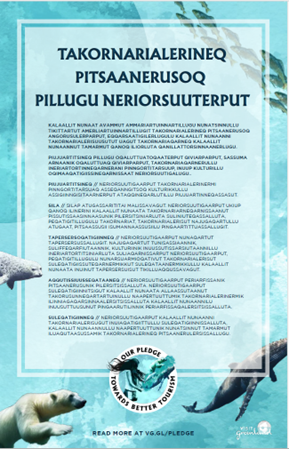
In Kalaallit Nunaat, most organised efforts to certify the tourism sector have centred on standardised international certifications. For instance, Nuuk became the first capital to be certified as an EarthCheck destination and many hotels have worked to receive the Green Key certification. One notable exception is a 2023-initiative Visit Greenland termed “Our Pledge Towards Better Tourism” (Figure 14). The pledge is organised around five pillars of sustainability, weather (Sila), support, creating better opportunities and collaboration.
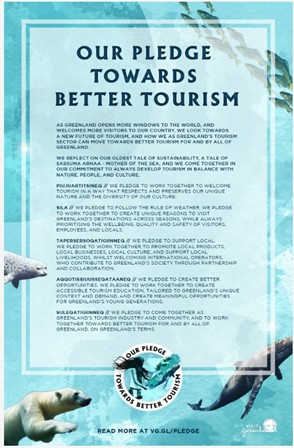
We commit to working together to welcome tourism in a way that respects and preserves our unique nature and the diversity of our culture.
We commit to following the rules of the weather.
We commit to supporting the local.
We commit to creating better opportunities.
We commit to working together.
The Pledge has so far been signed by 70 Greenlandic tourism companies and organisations and is seen as a first step towards an actual national certificate.
In Sápmi, there are currently two pan-Sámi certification trademarks, the Sámi Duodji (Figure 15) for traditional Sámi handicrafts and Sámi Made (Figure 16) for any Sámi-made goods and services. Similarly, to the above tourism certifications, they guarantee that the certified goods and services fulfil standards set by the certifying body.
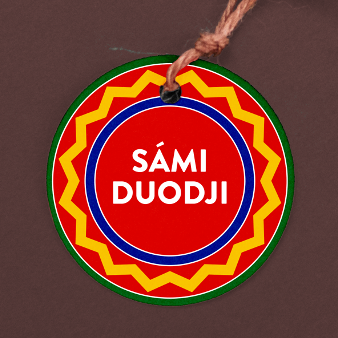
The Sámi Duodji and Sámi Made trademarks are owned by the Sámi people and managed by the Sámi Council. They serve as a guarantee that the product is authentically Sámi-made. The trademark system helps implement the Sámi people’s right to self-determination over their culture and traditional crafts, while also addressing the challenges of cultural appropriation. The Sámi trademarks are important because they protect and promote the cultural identity and self-determination of the Sámi people. They help to preserve traditional Sámi crafts. By using or purchasing products with these trademarks, people directly support the Sámi community and uphold their right to control and represent their own culture and heritage.Christina Hætta, Head of Cultural Unit, Sámi Council, Norway
Christina Hætta argued in the conference that in the future, there could be a pan-Sámi trademark for Sámi Food and perhaps another one, Sámi Experience, for Sámi tourism experiences, following the model of the former Sápmi Experience certification in Sweden. According to Håkan Jonsson, the Sámi Parliament in Sweden also aims to bring in a quality label for Sámi tourism products, goods and services in Sweden. ITAC is interested in spreading the Original Original certification to other countries with Indigenous tourism businesses, also to Sápmi. Sébastien Desnoyers-Picard suggested in the conference that Sámi certificates could be parallel to the Original Original certification. The American Indigenous Tourism Association has decided to take into use the Original Original certification programme in the USA (American Indigenous …, 2025), and New Zealand Māori Tourism is testing it (Miettunen, 2025). Among the Sámi, wishes have been expressed for a pan-Sámi tourism certification. Desnoyers-Picard noted that when tourists have a good experience of a certified Indigenous tourism company in one country, they want to have the same also elsewhere, which benefits all.
A major challenge with certifications is funding: the Sápmi Experience certification faded away due to lack of funding (and political support). The Sámi Parliament in Finland has applied for funding for several projects to create a certification system for responsible, ethically sustainable Sámi tourism companies in Finland, and the Sámi Council needs to apply for project funding to finance the trademarks it is running. The truth and reconciliation processes might help here, but at least in Finland, Norway or Kalaallit Nunaat, up to now this has not happened. In Canada, ITAC has created a fund to which tourists and non-Indigenous tourism companies can donate money to advance reconciliation by supporting Indigenous tourism development (ITAC, 2023). At the conference, Sébastien Desnoyeres-Picard suggested that all tourists should pay a land stewardship fee that would be used to support local Indigenous tourism development (e.g., certifications).
The Original Original: https://indigenoustourism.ca/programs-services/the-original-original-accreditation-program/
Nature’s Best Sápmi (in Swedish): https://www.naturturismforetagen.se/natures-best-sapmi/
Respecting Our Culture: https://ecotourism.org.au/sustainability/businesses/respecting-our-culture-certification/
Certificacion para la Sostenibildad Turistica (in Spanish): https://cst.turismo-sostenible.co.cr/
Global Sustainable Tourism Council: https://www.gstc.org/
Sámi Duodji and Sámi Made: https://samitrademarks.com/
Visit Greenland “Our Pledge towards better tourism”: https://traveltrade.visitgreenland.com/da/pledge/
There were also several other entrepreneurs at the conference, and some of them presented their company activities on the stage. It was great to hear that also many others than us want to develop their products towards a more informative and ethically sustainable direction. The general opinion at the conference was that the best tourism products are produced by the persons who have a personal experience and knowledge of the Indigenous culture. If the products are produced by outsiders, they should be familiarised well with the culture to avoid misunderstandings.The tourism certificate of the Indigenous peoples in Canada was presented at the conference. The focus of the presentation was on the value of the certificate in marketing and how the certificate helps the customer to find the right product. This is important, but I see a greater value in the certificate as a tool for the companies to develop their activities towards authenticity and cultural responsibility.All we Sámi represent Sámi culture in our own ways. Family specific differences are part of the richness of the culture, and it is precisely the showcasing of this diversity that makes tourism products meaningful and authentic. Although the Sámi are a small group of people, trying to present their culture in a museum is not possible without leaving something out which is important to somebody in the group.Per-Henrik Tornensis, Reindeer Herder, Owner, Yläperän Safarit Oy/Kilpisjärvi Reindeer, Finland)
I have been running reindeer related activities like sleigh rides and different kinds of programmes for 4 years now. And the reason is because it is my passion. And I want to educate our guests on our beautiful culture, nature and about the shared issues Indigenous peoples have like climate change. Certification makes it easier for conscious guests to find authentic Indigenous made services. It builds more trust between the company, tourists and local Indigenous communities. The relationship with tourism and Indigenous peoples needs healing and maybe even its own truth and reconciliation process. When there is competition, certification gives us an advantage from non-Indigenous tourism operators. Also, the certification process educates companies on cultural sensitivity and how to do Indigenous tourism in a better or more ethical way. It is important that companies take the responsibility to spread truthful information about our cultures.In both Indigenous tourism and mainstream tourism there is the need to focus on environmental sustainability. Environmentally we should be able to make NO-GO-ZONES to holy places and reindeer herding areas as well areas with fragile nature and also implement visitor caps in areas where there are too many tourists. Tourism itself is not very sustainable because of travelling and flying. But offering guests reasons like promoting activities to stay longer decreases the fly-in-fly-out tourism and also by spending more time here the guests learn more about our land and people.But in Indigenous tourism you also have to think about how to protect our cultures from exploitation and misuse. We need to think about the context where we represent our culture and what to share and what not to, some things are just for us. Because people outside of our culture don’t know much about it, you are their first-hand knowledge. You have the responsibility to share truthful information and break stereotypes. The culture is for us, so we don’t need to change it to fit the needs of tourism.Emma Krupula, Owner, Emma’s Reindeer, Finland
- There is a growing interest among Indigenous peoples to create certifications for Indigenous-produced goods and services.
- Indigenous-created certifications, such as Sámi Duodji, Sámi-Made and The Original Original, maintain Indigenous peoples’ right to control and represent their own culture and heritage.
- Selecting certified Indigenous goods and services is a direct support to Indigenous companies and communities.
- Sustainable tourism certifications should have Indigenous involvement in their design and decision-making bodies if the certified companies operate on Indigenous lands and waters – currently this Indigenous involvement is often lacking.