Life Events – Journey Maps
Life Event 1 – Moving to work in another country
Life Event 1 involves relocating to another country for work. The process of moving abroad for work involves steps to ensure proper registration and compliance with immigration and employment regulations. Citizens in the Nordic and Baltic countries benefit from the EU's right to free movement, allowing them to live and work freely within EU member states. As per Directive 2004/38/EC,
The European Commission and the Council (2004). Directive 2004/38/EC. https://eur-lex.europa.eu/eli/dir/2004/38/oj/eng (Accessed on May 1st, 2025)
A journey map illustrates the key steps to register and establish oneself in a new country. Challenges often arise in navigating administrative processes and understanding new legislative requirements, so best practices include providing clear, multilingual information on registration and residency processes, simplifying administrative procedures with digital tools, and offering support services for newcomers to ease the transition. The following section analyses existing frameworks and challenges associated with each step, focusing on improving the overall experience of moving abroad for work and streamlining digital registration and administrative processes.
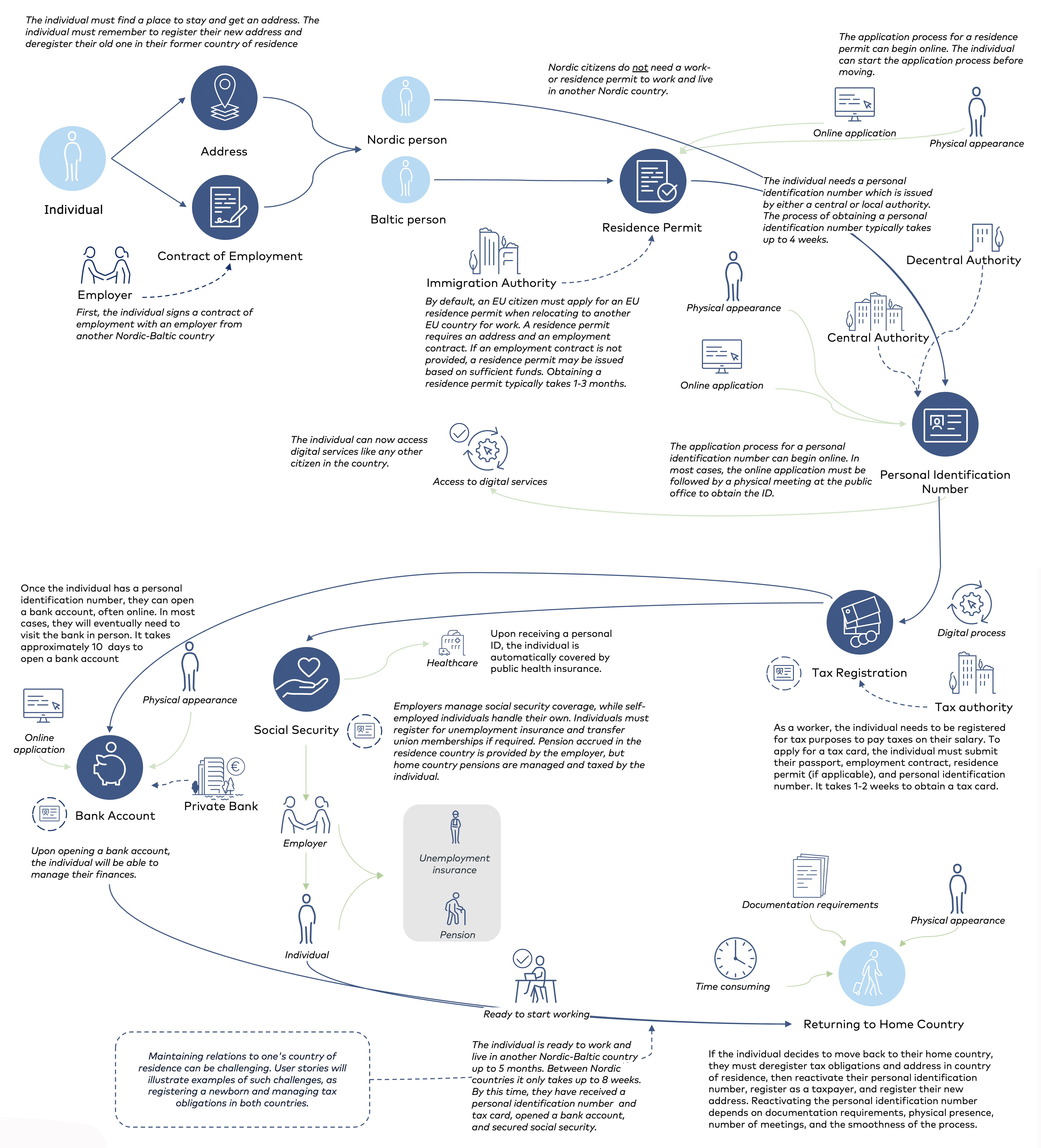
Figure 1 Journey Map for Life Event 1
Note: The figure and related text boxes are based on information from interviews with users and stakeholders (authorities and companies appointed by the users), as well as publicly available information from the authorities' websites.
Accommodation When a citizen decides to move to another country for work, they must secure an address upon arrival. The address is necessary to obtain the required documents that ensure legal residence, formal rights and access to services. The sequence of events can be challenging, as it can be difficult to secure suitable accommodation from a distance, partly because it is hard to enter the accommodation market and partly because it can be difficult to assess the suitability of a property and whether the contractual terms are in order while still residing in another country. Therefore, it is a common strategy to secure a temporary address for the necessary registrations before searching for a more permanent solution.
EU Residency permit It is required for EU citizens to apply for an EU residence permit no later than three months after arrival, to ensure legal residence based on a valid reason. For Nordic citizens moving to another Nordic country, the EU residence permit is not required. The residence permit confirms the individual's legal status and provides access to certain rights, such as healthcare, social services, and, in some cases, employment. Applications should be submitted to the immigration authorities of the country where one intends to reside. The reasons for the application can include work, studies or family reunification. Depending on the purpose there may be a requirement to demonstrate the ability to support oneself financially. The estimated processing time is 1–3 months,
Estimate based on the immigration authorities' processing times provided on their websites.
Arvo' user story:
Upon arrival in Estonia, Arvo needed to establish his residency and obtain an Estonian ID card. He regis-tered with the Estonian Police and Border Guard, where all supporting data was obtained automatically. Once his residency was established, Arvo applied for an Estonian ID card, which required undergoing a verification process.
Personal identification number As an essential part of relocating to another country for work, it is necessary to obtain a national ID. The national IDs are essential for accessing public services, working, and in some countries, opening bank accounts. Another important aspect is, that it is often a prerequisite for gaining digital access to public services as well as managing bank information digitally. In the Nordic countries (Denmark, Finland, Iceland, Norway, and Sweden), the registration and ID issuance process is generally handled by tax or civil registration authorities e.g. municipalities. For instance, in Denmark, Sweden, and Norway, the tax authorities issue the personal identification numbers (CPR number, personnummer, and fødselsnummer, respectively). In the Nordic countries, a personal identification number allows access to publicly administered digital IDs
Information from Info Norden about electronic identification in the Nordic countries. https://www.norden.org/en/info-norden (Accessed on 1 May 2025)
Finnish BankID: https://www.nets.eu/developer/e-ident/eids/Pages/BankIDFI.aspx (Accessed on 1 May 2025)
Norwegian BankID: https://bankid.no/en/about-us (Accessed on 1 May 2025)
Swedish BankID: https://www.bankid.com/en/privat/skaffa-bankid (Accessed on 1 May 2025)
Information obtained from the websites of the relevant national authorities and the European Commission.
Estimate based on the processing times provided on the websites of the relevant national authorities (immigration, tax, and civil registration).
Alisa' user story:
Upon arrival in Denmark, Alisa visited the citizen service in her municipality to register her family in the Citizens Registry. She provided valid identification and proof of their new address. This registration granted her access to various services, underscoring the importance of a personal ID number as a gateway to healthcare, banking and other public services.
Tax payment When a person relocates all their activities, including their employment, from one country to another, their obligation to pay taxes generally shifts to the new country of residence.
Your Europe (2025). Income taxes abroad, Europa.eu, April 10th, Belgium. https://europa.eu/youreurope/citizens/work/taxes/income-taxes-abroad/index_en.htm (Accessed on May 7th, 2025).
In some cases, this necessity to avoid double taxation can restrict the individual's movement between countries. Some may find themselves limiting travel to prevent complications with tax residency and overlapping tax liabilities.
Arvo’s user story:
Arvo manually corrected his tax situation with Finnish authorities each year by providing detailed documentation to avoid double taxation. He sought help from tax consultants and advisors to ensure compliance with regulations in both countries, carefully managing his cross-border tax obligations.
Furthermore, some experiences that the approach taken by tax authorities is inherently suspicious of their intentions, presuming an intent to evade taxes rather than facilitating smooth and proactive processes. This perception can make interactions with tax authorities feel adversarial rather than supportive, increasing stress and complicating the already complex task of managing international tax responsibilities.
Overall, these challenges require individuals to remain vigilant, stay informed about their tax obligations, and often seek professional advice to navigate the complexities effectively. Improvements in the automation and digitalization of tax systems across countries, as well as a more supportive and facilitative approach from tax authorities, would significantly ease the burden on cross-border workers.
Bank account Once a personal identification number is obtained, the process becomes more straightforward, allowing for efficient management of banking tasks online. Ensuring proper registration with financial authorities is critical to avoid issues related to tax residency and account restrictions. This often involves updating residency records and providing necessary information to banks. Overall, while managing banking tasks online can simplify the process, initial setup and ensuring compliance with both countries' regulations require careful attention and coordination.
Social security, insurance and pension In both Nordic and Baltic countries, individuals are enrolled in the social security system upon obtaining a personal identification number, indicating residency in the respective country. This personal identification number is central to accessing various social security benefits, and the enrollment process shares similarities and differences among these nations.
One common feature across Nordic and Baltic countries is the central role of the personal identification number. Obtaining this identifier ties individuals to various national systems, including healthcare, social security, and tax authorities. The registration process generally involves submitting identification documents, proof of residency, and employment contracts, ensuring that individuals are officially recognized as residents and granting them access to social security benefits.
Estimate based on the processing times provided on the websites of the relevant national authorities in the Nordic and Baltic countries (e.g. immigration offices, tax authorities, and civil registration bodies such as Skatteverket in Sweden, the National Population Register in Norway, Þjóðskrá in Iceland, and the Population Registers in Estonia, Latvia, and Lithuania).
Countries such as Sweden, Denmark, Finland, Norway, Iceland and Estonia typically have more streamlined and digitalized systems, making it easier for individuals to manage their social security, insurance, and pension obligations.
Agnes' user story:
Registration tasks included notifying various authorities about her move and securing an Icelandic identification number, which facilitated access to the necessary insurance and social security systems. Cultural similarities between Iceland and Norway made integration easier, and English-speaking authorities helped streamline interactions with social security and pension services.
Latvia and Lithuania are increasingly adopting digital processes, although some aspects may still rely on traditional paperwork.
While having systems that allow easy registration is advantageous, maintaining social security and pension contributions in more than one country can pose difficulties. Individuals may need to register and regularly update their information in both countries’ systems, ensuring compliance with each country's regulations and often requiring substantial documentation.
For maintaining pension rights, individuals must understand how contributions will be recognized and transferred. This process typically involves notifying the pension authority in the home country about the move and registering with the pension system in the new country. These steps ensure pension rights are maintained across borders, but individuals may encounter complexities due to differing national policies and requirements.
Efficient management of social security, insurance, and pensions when moving abroad relies on understanding these processes, timely registration, and coordination between the home and host countries’ systems. Preparing documentation in advance and leveraging bilateral agreements facilitate smooth transitions and continuity in benefits. Nevertheless, seeking professional advice is advisable to navigate the nuances of international social security and pension management.
Moving back When a citizen decides to move back to their home country after residing in another Nordic or Baltic country, there are several essential steps to ensure all registrations, obligations, and rights are properly managed. The process involves interactions with tax authorities, civil registration, and financial institutions.
Firstly, taxation is a significant consideration. Moving between Nordic or Baltic countries typically requires contacting the relevant tax agency to update one's address and regain a social security number. In Finland, individuals must contact the Finnish Tax Agency to update their address and regain social security numbers. This is particularly important if there were employment or income sources from another country, which may complicate taxation procedures. Clarifying tax residency and applying for social security are integral steps. In Sweden, upon moving back, individuals need to contact the Swedish Tax Agency to regain their social security number and register their new address. This process ensures that all tax obligations and rights are correctly managed.
Arvo’s user story:
Re-registering involved contacting the Social Insurance Institution of Finland to regain social security numbers and register their new address. Taxation and social security posed major complications as Arvo's employment remained tied to Estonia, requiring clarification of tax residency and separate applications for Finnish social security.
Secondly, employment status can further complicate the taxation process if one continues working in the country they are moving from. It is essential to update tax records to reflect the new residency status and ensure compliance with both countries' tax regulations.
Moreover, re-establishing financial ties in the home country often involves maintaining or updating bank accounts. For example, having an active bank account in the previous country can simplify the financial transition and management of funds between countries.
Finally, other administrative considerations include re-registering one’s civil status and ensuring all necessary documents for family members, such as children's school enrollment and spousal education pursuits.
Overall, moving back to one's home country within the Nordic/Baltic region involves coordination with multiple agencies and institutions to ensure a smooth transition. Key steps include updating civil registration, addressing tax obligations, managing financial accounts, and considering educational and employment impacts to achieve seamless integration into the home country's systems.
Key take aways
The relocation process for work in the Nordic and Baltic countries involves various critical steps and considerations that ensure proper integration into the new environment. The following key takeaways highlight important aspects that individuals need to be mindful of to navigate this transition effectively:
- Necessity of EU residence permit despite freedom of movement
While the EU’s freedom of movement allows citizens to live and work across member states, an EU residence permit is often necessary for formal processes such as accessing public services, healthcare, and social benefits. In the Nordic region, no residence permit is needed between countries due to their special agreements, but this requirement apply when moving to or from the Baltic countries. - National ID as gateway to services
A personal identification number is vital for a range of administrative processes, including registering for healthcare, opening bank accounts, and securing other public services. Depending on the country, obtaining this ID may require a visit to the local authorities or may be automatically issued once the address registration is completed. - Awareness of home country assets and tax obligations
Individuals relocating across borders must be aware of their ongoing tax obligations in both their home country and the new country. Many countries require residents to report global income and assets, which could lead to double taxation if not properly managed. Ensuring that tax and legal residency status align with the requirements of the new country is crucial to avoid complications. - Need for address registration to prove residency
To establish legal residency, individuals must register their address in the new country. This registration is crucial for accessing services such as healthcare, social security benefits, and education. Without it, individuals may face barriers in securing these services or legal issues in residency verification. The same procedure applies if moving back to one’s former country of residence.
Key take aways
The relocation process for work in the Nordic and Baltic countries involves various critical steps and considerations that ensure proper integration into the new environment. The following key takeaways highlight important aspects that individuals need to be mindful of to navigate this transition effectively:
- Necessity of EU residence permit despite freedom of movement
While the EU’s freedom of movement allows citizens to live and work across member states, an EU residence permit is often necessary for formal processes such as accessing public services, healthcare, and social benefits. In the Nordic region, no residence permit is needed between countries due to their special agreements, but this requirement apply when moving to or from the Baltic countries. - National ID as gateway to services
A personal identification number is vital for a range of administrative processes, including registering for healthcare, opening bank accounts, and securing other public services. Depending on the country, obtaining this ID may require a visit to the local authorities or may be automatically issued once the address registration is completed. - Awareness of home country assets and tax obligations
Individuals relocating across borders must be aware of their ongoing tax obligations in both their home country and the new country. Many countries require residents to report global income and assets, which could lead to double taxation if not properly managed. Ensuring that tax and legal residency status align with the requirements of the new country is crucial to avoid complications. - Need for address registration to prove residency
To establish legal residency, individuals must register their address in the new country. This registration is crucial for accessing services such as healthcare, social security benefits, and education. Without it, individuals may face barriers in securing these services or legal issues in residency verification. The same procedure applies if moving back to one’s former country of residence.
Life Event 2 – Working abroad while residing in the home country
Life Event 2 is about cross-border employment, where the individual works either fully in a country other than their country of residence or partially in both their country of employment and their country of residence.
To illustrate Life Event 2, a journey map is provided. In the following section, we will describe and analyze existing regulation, frameworks, and challenges associated with each step to explore how the systemic facilitation of cross-border work in the Nordic and Baltic countries may be improved.
As such, Life Event 2 is primarily focused on the essential registration processes required for the employee to work across borders.
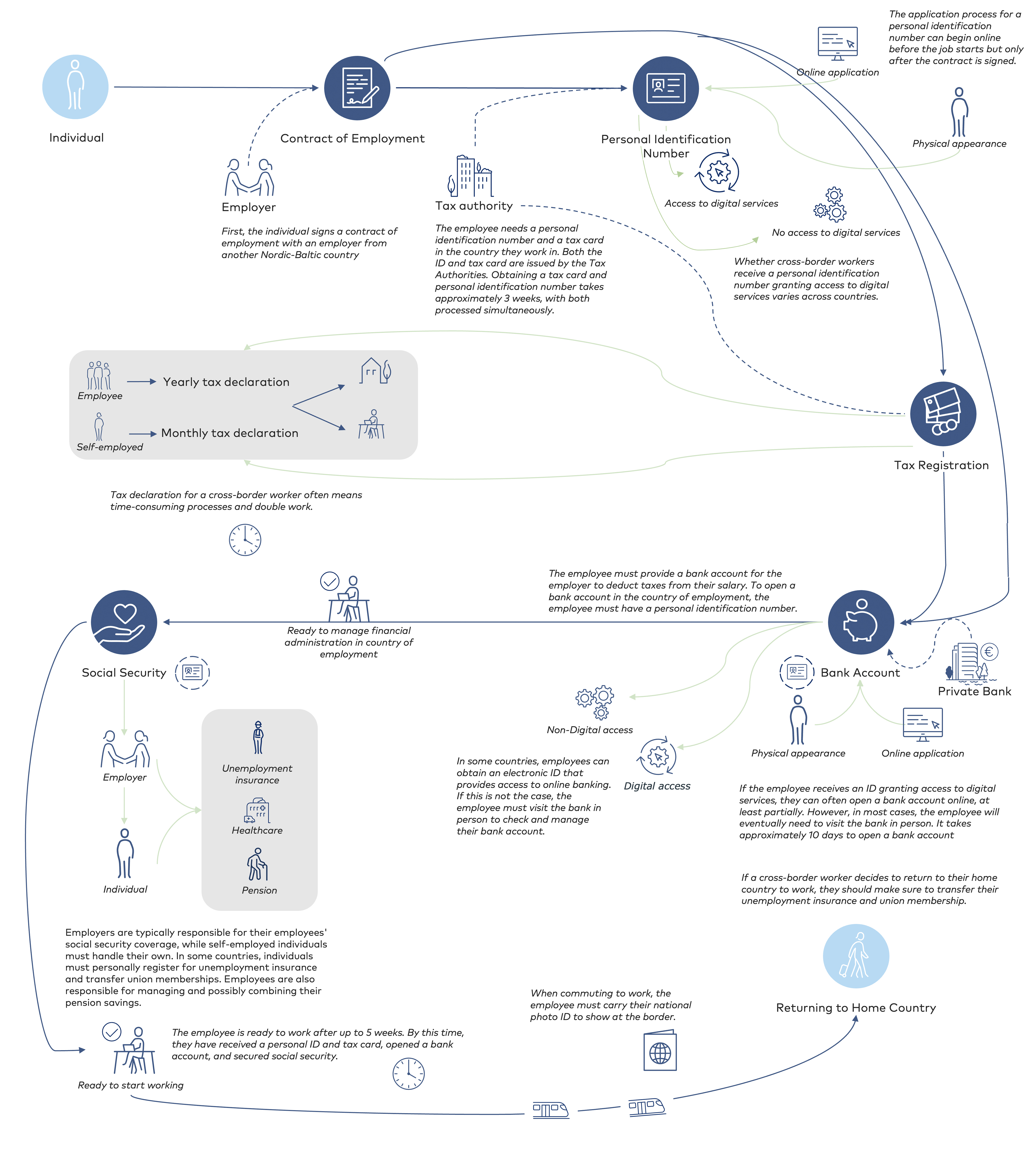
Figure 2 Journey Map for Life Event 2
Note: The figure and related text boxes are based on information from interviews with users and stakeholders (authorities and companies appointed by the users), as well as publicly available information from the authorities' websites.
Personal Identification Number In the Nordic and Baltic countries, it is generally necessary to obtain a national identification number in order to receive a tax card and avoid a high withholding tax rate. While it may be possible to start working before obtaining the ID number in some countries, having one is typically required early in the employment process. The purpose of the identification number is to ensure that one is registered as being obligated to pay taxes in the respective country, and it is therefore issued by the national tax authority. The process and compatibility of national identification numbers for foreigners vary across countries:
In some countries, such as Sweden and Norway, foreigners are issued a temporary identification number such as Samordningsnummer
Swedish personal identity: https://www.norden.org/en/info-norden/swedish-personal-identity-number (Accessed on May 1st, 2025)
Norwegian personal identity: https://www.norden.org/da/info-norden/norske-identitetsnumre (Accessed on May 1st, 2025)
Denmark requires individuals to obtain a CPR-number from Skattestyrelsen to be registered in the Danish tax system. The CPR number enables access to Denmark’s digital systems, significantly simplifying the management of ongoing administrative processes. In Estonia, the employer is responsible for registering employees in the Employment Registry. When registered, the employee will receive an ID-code, which allows access to health care and other services in Estonia.
There are also differences in the procedures for obtaining an identification number, particularly in terms of whether physical attendance is required. For example, in Sweden and Latvia, individuals must be physically present to receive a national personal identification number. In Denmark, the process is fully digital, allowing applicants to submit their forms online. In Norway, while the application form for a tax card is available digitally, individuals are generally required to attend an in-person ID check to complete the process. In Estonia the process is prepared by fulfilling a digital form and requires physical presence at a local government office or The International House to finalize the process.
Information regarding the physical/digital process is based on interviews with users and stakeholders as well as on information published on the websites of the relevant authorities.
Furthermore, the processing time for obtaining these identification number varies. For example, in Sweden, it typically takes up to three weeks to receive a Samordningsnummer,
According to Skatteverket, the process for obtaining a Samordningsnummer in Sweden takes up to three weeks: https://www.skatteverket.se/privat/folkbokforing/samordningsnummer.4.5c281c7015abecc2e201130b.html#Hurlangtidtarhandlaggningen (Accessed on May 5th 2025)
According to International House Copenhagen, the application process for a CPR-number takes approximately 15 working days. https://ihcph.kk.dk/registration-guidance/cpr-registration (Accessed on May 5th, 2025)
Anna’s user story:
Anna faced challenges with registration upon arriving to Finland. The process of validating her residency required multiple in-person visits and Anna experienced the process as confusing and bureaucratic partly due to the need for in-person meetings.
These differences might be perceived differently depending on the level of digitalization one is accustomed to, as well as the degree of trust one has in the systems. For citizens in countries with a high level of digitalization, it may feel inefficient and unnecessary to have to attend in person.
Tax-registration Next, the employee needs tax-registration, an essential element in becoming eligible for cross-border work. The purpose of tax registration is to ensure that the correct taxes are paid in the country of employment. In all countries, this requires contact with the tax authorities.
The process of paying taxes is very similar across countries but is at the same time the source of most challenges as tax systems do not communicate across countries. This results in employees having to register their tax information in both their country of residence and the country where they work. This is an ongoing individual responsibility, as the employee must keep track of their tax matters and submit at least two tax returns annually. This is the case for Sweden, Denmark, Latvia and Norway. Since the systems do not interact, it is up to the individual to manage the rules regarding deductions in both countries. For self-employed cross-border workers this also involves a monthly income registration.
Eino’s user story:
Eino was initially taxed under the Swedish system, but as Eino began commuting, the taxation process became more complex. In Finland, Eino was required to report and pay taxes on travel activities, while in Sweden, the SINK tax scheme required Eino to track the days worked in each country.
Taxation is generally a source of frustration for cross-border workers across all countries, as it requires continuous effort and is never fully automated. Tax systems are often highly complex, and some countries have less digitalized processes making it challenging to feel confident in complying with all relevant regulations.
However, there are differences between countries in how digitalized tax registration is. In Latvia, for example, handling taxes requires a significant amount of physical paperwork, whereas in the Nordic countries, the process is digitalized, making it easier to manage.
Bank account To receive a salary, one must open or link to an existing bank account in the country where they work. Across different countries, a national identification number is required to open a bank account.
The process of opening a bank account varies between countries, depending on how personal identification numbers are used. In Sweden and Norway, for example, opening a bank account requires an in-person visit, as their personal identification numbers are not digitally compatible. This also means that if you commute to Sweden for work, you cannot access your bank account digitally; instead, you must visit the bank in person or contact them via email. In Norway, it is up to individual banks to assess whether a commuter is eligible for BankID to access their bank account digitally. Banks may have different criteria for issuing BankID to individuals with a D-number.
Jære, Lisbet (2024). BankID er diskriminerende, Finansfokus.no, September 25th, Norway. https://www.finansfokus.no/2022/12/05/bankid-er-diskriminerende/ (Accessed on May 1st, 2025)
Jesper’s user story:
Jesper does not have a Swedish bank ID, and as a result, all correspondence with bank authorities must be conducted by letter. He finds it frustrating not to have access to digital services because of this lack of a bank ID, which is an issue confirmed by Øresundsdirekt.
In contrast, in Denmark, it is possible to obtain a digital ID (MitID), which allows you to open a bank account online. MitID also enables access to digital banking services.
In the Nordic countries, some banks have branches across multiple countries e.g. Nordea, Danske Bank, Handelsbanken. According to the users, his allows for the creation of so-called commuter accounts, which can be linked to an account in one's home country. While commuters must still open a bank account in the country where they work, transferring money to their home country's account is made easier.
In the Baltic countries, there are also banks with branches across the countries. However, despite having a presence in multiple countries, the banks operate as separate legal entities, meaning customer data is not automatically shared. This can create additional bureaucratic hurdles when applying for financial services across borders.
Unemployment insurance fund, social security and pension In both the Nordic and Baltic countries, it is a personal responsibility to transfer an unemployment insurance membership to the country in which one works. This ensures coverage in the event of unemployment. When, or if, employment ends and the individual stops working across borders, the membership of the unemployment insurance fund must be manually transferred back to the home country. Across the countries, this is generally perceived as a simple process, as it has been digitalized in the different nations. A personal identification number is required to apply for unemployment insurance.
Additionally, it is important to determine where one is socially insured. As per Regulation 2004/883/EC,
The European Commission and the Council (2004). Regulation 2004/883/EC. https://eur-lex.europa.eu/legal-content/EN/TXT/?uri=CELEX%3A32004R0883 (Accessed on May 1st, 2025)
Anitas user story:
Anita had to join social security systems in both Lithuania and Latvia, which posed significant challenges due to temporary residence permits. She had to repeatedly provide proof of residency and the system’s lack of adaptation for cross-border workers led to unexpected gaps in essential services.
It is also an individual responsibility to ensure the correct arrangements for pension contributions. It is important to avoid double taxation on pensions if a person has pension schemes in both their home country and their country of employment. The Nordic and Baltic countries have double taxation agreements.
In some countries, such as Sweden and Norway, the lack of a high-security ID with fully digital access also affects how easily individuals can access their pension data. Without a digital ID, they must communicate with their pension provider via email, phone or paper, which can create administrative challenges.
Transportation When an employee commutes cross-border between residence and the workplace, it is mandatory to have photo identification at hand to document the reason for entering and exiting the country.
In several of the user stories the cross-border workers expresses that there are many factors to keep track of regarding the national rules of two countries, and that it is associated with a certain level of uncertainty, as the responsibility falls so heavily on the individual. In many cases the employer assists the employee in the initial registrations, but the continuous management of administrative tasks related to cross-border work is an individual responsibility. This is further complicated by the lack of digital access in the cases where this applies.
Moving back If a cross-border worker decides to return to their home country to work, they must make sure to transfer their unemployment insurance and union membership.
The process of transferring one’s unemployment insurance fund and social security when starting work in another country is very similar. In the user stories from this project, no significant challenges have been reported when moving back and working in one’s home country. However, in the specific user stories, all returns have been voluntary and not the result of a dismissal.
Key Takeaways
Living in one's home country while working in another Nordic or Baltic country entails navigating a complex landscape of administrative, identification, and tax-related processes. This analysis highlights several key takeaways that can significantly impact cross-border commuters, emphasizing the importance of streamlined systems and efficient procedures. Understanding these aspects can help improve the experience of individuals managing dual-country responsibilities.
The key takeaways from the analysis of living in one's home country while working in another country in the Nordic and Baltic Countries are as follows:
- Differences in the process of obtaining a national personal identification number
There are variations in how personal identification is obtained, which is necessary for working in another country. In some cases, physical presence is required to receive an identification number, while others offer a fully digital process. The need for physical presence may be perceived as inefficient in countries with high levels of digitalization. - Different levels of access to systems with the personal identification number
In some countries, the assigned identification number provides access only to basic services, while in others, it enables access to a wider range of digital systems, including banking and social services. - Frequent in-person interactions with systems
Cross-border commuters often need to engage in physical meetings or visits to complete administrative processes. This can be seen as an inconvenience, as the responsibility for managing these processes often lies with the individual. - Awareness of tax obligations in two countries
Individuals working across borders need to be aware of their tax responsibilities in both their country of residence and their country of employment. This includes managing assets in their home country, which can create a complex situation when it comes to tax filings and ensuring compliance with both national tax systems.
Life Event 3 – Starting a business abroad while residing in the home country
Life Event 3 is about starting a business abroad while remaining in one’s home country, encompassing entrepreneurship and the establishment of a business in a foreign nation without physically relocating. This life event has gained considerable traction due to advancements in digital technology and global connectivity, allowing entrepreneurs access to international markets while managing operations remotely.
Although precise statistics on the number of businesses started in another Nordic or Baltic country without relocation are not readily available, the concept is becoming increasingly relevant. Interviews with country representatives and findings from various reports indicate that more aspiring entrepreneurs are exploring this opportunity. This trend highlights the importance of robust digital solutions and comprehensive support infrastructure to facilitate such business endeavors.
In the following section, we will describe and analyze existing regulations, frameworks, and challenges associated with each step to explore how systemic facilitation of cross-border entrepreneurship in the Nordic and Baltic countries may be improved.
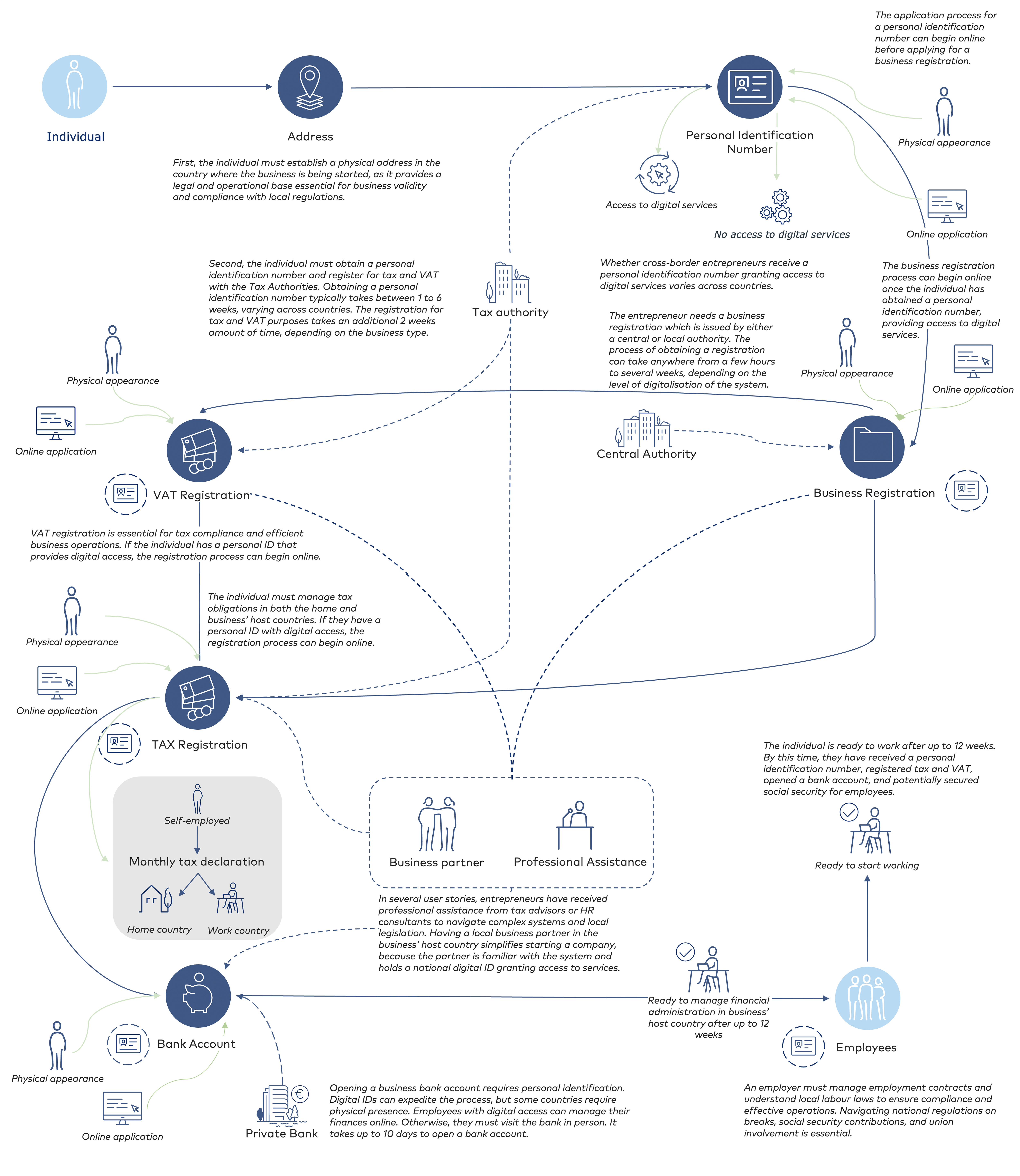
Figure 3 Journey Map for Life Event 3
Note: The figure and related text boxes are based on information from interviews with users and stakeholders (authorities and companies appointed by the users), as well as publicly available information from the authorities' websites.
Address Establishing a physical address is a fundamental requirement when starting a business in any foreign country, as it provides a legal and operational base essential for business validity and compliance with local regulations. Securing an address involves understanding local real estate markets, lease agreements, and zoning laws, which can vary significantly between countries. Additionally, having a physical address enhances credibility with clients and facilitates access to essential services such as banking.
Personal Identification Number Obtaining a personal identification number is crucial for administrative tasks and accessing services required for business operations. This involves proving residency or employment status, which varies by country.
Information on application criteria is based on data from the websites of national authorities (e.g., tax authorities in Sweden and Norway, Digital and Population Data Agency in Finland, and Police and Border Guard Board in Estonia).
Estonia’s e-Residency and Iceland’s eID systems offer streamlined digital processes without physical presence. Denmark's CPR number requires proof of residency but is straightforward. Sweden's Samordningsnummer requires physical attendance, complicating remote operations.
Kristjan’s user story:
Obtaining personal identification was challenging for Kristjan in Finland. Without Finnish identification, he struggled with various administrative tasks, requiring his partner to secure bank credentials and manage other requirements. This emphasizes the need for physical presence and comprehensive documentation for non-resident entrepreneurs.
The timeframe for obtaining personal identification numbers varies across countries. In Iceland, the process takes about six working days plus sending time.
Procedural time to obtain a personal identification number in Iceland: https://island.is/en/o/digital-iceland/news/application-for-a-identity-card-on-island-is (Accessed on May 5th, 2025).
Procedural time to obtain a personal identification number in Lithuania: https://www.migracija.lt/en/noriu-gauti-atk-ir/ar-lr-pas%C4%85-copy- (Accessed on May 5th, 2025)
Procedural time to obtain a personal identification number in Norway: https://www.udi.no/en/word-definitions/d-number/#undefined (Accessed on May 5th, 2025)
Procedural time to obtain a personal identification number in Denmark: https://ihcph.kk.dk/registration-guidance/cpr-registration (Accessed on May 5th, 2025)
Procedural time to obtain a personal identification number in Denmark: https://www.politsei.ee/en/instructions/e-resident-s-digital-id/procedural-time-limit (Accessed on May 5th, 2025).
Estonia and Iceland's systems are highly compatible with digital platforms. Denmark's CPR integrates well with digital services. Sweden’s Samordningsnummer and Norway’s D-nummer lack fully digital support due to their lower-security level accessibility, complicating online tasks. Finland’s less digitized system hinders remote management.
Understanding these factors ensures efficient access to administrative systems, enabling effective business management, tax compliance, and essential services whether managing locally or remotely.
Julia’s user story:
Obtaining personal identification was a significant challenge for Julia. Despite securing a Y-tunnus (business ID), several banks refused to open an account, viewing the new business and substantial fund transfers from Sweden as a risk. Finally, the fourth bank agreed to open an account requiring the directors (two Swedes and one German) to fly in and sign documents in person.
Business Registration Registering a business involves various administrative tasks and understanding local legal requirements. This process typically includes filling out forms, providing documentation, consulting with local authorities, and sometimes attending orientations. Digital platforms can significantly ease this process, though professional guidance is often necessary to ensure compliance with all regulations.
Denmark offers a streamlined online registration through its digital platforms, typically completed within minutes.
Procedural time to obtain a business registration in Denmark: https://investindk.com/our-services/how-to-set-up-a-business-in-denmark (Accessed on May 5th, 2025).
Procedural time to obtain a business registration in Norway: https://www.brreg.no/en/business-2/coordinated-register-notification/ (Accessed on May 5th, 2025).
Procedural time to obtain a business registration in Latvia: https://www.ur.gov.lv/en/register/company-or-merchant/limited-liability-company-sia/founding/registration-with-the-enterprise-register/ (Accessed on May 5th 2025).
Procedural time to obtain a business registration in Lithuania: https://immigration.lt/lithuania/company-registration/ (Accessed on May 5th, 2025).
Procedural time to obtain a business registration in Sweden: https://www.skatteverket.se/servicelankar/otherlanguages/inenglishengelska/businessesandemployers/startingandrunningaswedishbusiness/declaringtaxesbusinesses/vat.4.12815e4f14a62bc048f52be.html (Accessed on May 5th 2025).
Procedural time to obtain a business registration in Finland: https://www.vero.fi/en/businesses-and-corporations/business-operations/setting-up-a-business/ (Accessed on May 5th, 2025).
Procedural time to obtain a business registration in Estonia: https://www.politsei.ee/en/instructions/e-resident-s-digital-id/procedural-time-limit (Accessed on May 5th, 2025).
Erik’s user story:
Registrering the business in Sweden was smooth and easy. Erik utilized resources from Bolagsverket and Skatteverket. The registration process was completed online, and no significant challenges were encountered.
Timeframes vary from a few hours in countries with advanced digital systems to several weeks in countries requiring more direct interactions. Leveraging digital tools where available can streamline the registration process, while professional guidance ensures compliance with local regulations. Understanding these processes helps entrepreneurs efficiently manage business setup across different countries.
VAT Registration Registering for VAT is crucial for compliance with tax obligations and smooth business transactions. Digital systems significantly ease the administrative burden by facilitating detailed interactions with tax authorities to ensure all transactions are accounted for and legal requirements are met.
In Denmark, VAT registration through SKAT.dk can be completed within a few days if all necessary information is correctly submitted.
Procedural time for VAT registration in Denmark: https://virk.dk/myndigheder/stat/SKST/selvbetjening/Declare_VAT/ (Accessed on May 5th, 2025)
Procedural time for VAT registration in Sweden: https://www.skatteverket.se/servicelankar/otherlanguages/inenglishengelska/businessesandemployers/startingandrunningaswedishbusiness/declaringtaxesbusinesses/vat.4.12815e4f14a62bc048f52be.html (Accessed on May 5th 2025).
Procedural time for VAT registration in Norway: https://www.skatteetaten.no/en/business-and-organisation/vat-and-duties/vat/register-change-delete/ (Accessed on May 5th, 2025)
Finland’s Vero provides comprehensive guidelines and digital tools, typically allowing VAT registration within days.
Procedural time for VAT registration in Finland: https://www.vero.fi/en/businesses-and-corporations/taxes-and-charges/vat/how-to-register-for-vat/ (Accessed on May 5th, 2025)
Procedural time for VAT registration in Estonia: www.emta.ee/en/business-client/taxes-and-payment/value-added-tax/registration-vat-payer (Accessed on May 5th, 2025)
Procedural time for VAT registration in Latvia: https://www.vid.gov.lv/en/value-added-tax?utm_source=https%3A%2F%2Fwww.google.com%2F (Accessed on May 5th, 2025)
Procedural time for VAT registration in Lithuania: https://finmin.lrv.lt/en/competence-areas/taxation/main-taxes/value-added-tax/(Accessed on May 5th, 2025)
Leveraging advanced digital platforms and understanding the detailed procedures required can help entrepreneurs navigate VAT registration more efficiently. This ensures compliance with tax laws and facilitates smoother business transactions across different jurisdictions, allowing effective integration into the respective administrative systems.
Tax Registration Tax registration involves understanding and managing tax obligations in both the home country and the business's host country. This process can be complex, especially with dual taxation issues. Consulting professional tax advisors is essential for navigating these complexities and ensuring compliance.
Estonia’s e-Tax/e-Customs system simplifies tax registration, generally completed within a few days if documentation is thorough.
Procedural time for tax registration in Estonia: https://www.emta.ee/en/business-client/registration-business/non-residents-e-residents/registration-non-resident (Accessed on May 5th, 2025)
Procedural time for tax registration in Latvia: https://www.vid.gov.lv/en/services/registered-tax-payers (Accessed on May 5th, 2025)
Procedural time for tax registration in Lithuania: https://finmin.lrv.lt/en/competence-areas/taxation/main-taxes/corporate-income-tax-1/ (Accessed on May 5th, 2025)
Sweden and Finland offer digitized processes for tax registration, typically taking several weeks.
Procedural time for tax registration in Sweden: https://www.skatteverket.se/servicelankar/otherlanguages/inenglishengelska/individualsandemployees/declaringtaxesforindividuals.4.7be5268414bea064694c5df.html (Accessed on May 5th 2025)
Procedural time for tax registration in Finland: https://www.vero.fi/en/individuals/tax-cards-and-tax-returns/tax_card/ (Accessed on May 5th, 2025)
Procedural time for tax registration in Denmark: https://skat.dk/en-us/businesses/employees-and-pay/non-danish-labour/get-a-tax-card-as-a-non-danish-employee (Accessed on May 5th, 2025)
Erik’s user story:
Erik’s cross-border business operations led to the complexity of navigating double taxation agreements. The differences in tax systems between Denmark and Sweden required detailed knowledge and professional advice to ensure compliance.
Navigating tax registration in complex systems like Denmark and Norway demands a deep understanding of international taxation. Consulting tax advisors ensures accurate compliance, while digitized systems in Estonia, Latvia, Lithuania, Sweden, and Finland streamline the process.
Open a Bank Account Opening a business bank account is essential for financial operations, requiring personal identification and varying bank-specific requirements. Digital identification systems can expedite this process, but some countries still mandate physical presence in banks.
Countries with streamlined digital processes include Denmark and Estonia, where businesses can use digital ID (MitID) or e-Residency to open bank accounts online, typically within days. Iceland's efficient eID system also facilitates remote account opening, though logistical hurdles may extend the timeframe. Lithuania allows account opening with a confirmed electronic signature and residency documentation, usually completed within a few days.
Baldur’s user story:
Opening a business bank account in the Faroe Islands was challenging for Baldur due to the initial requirement for a Faroese ID. After multiple redirects and trying different banks, he managed to open an account using his passport.
In countries requiring physical presence and more complex procedures, such as Sweden and Finland, in-person visits are necessary, extending the process to several weeks. Latvia's process demands comprehensive documentation, often taking several days to weeks. Norway requires presenting a D-nummer in person, extending the timeframe to several weeks due to verification processes. However, once a bank account is established, account holders in Norway can obtain a digital BankID, greatly easing subsequent online management. The Faroe Islands involve navigating specific local banking requirements, necessitating multiple interactions over several weeks.
Understanding these varied processes helps entrepreneurs navigate the requirements for opening a business bank account across different countries. Countries like Denmark and Estonia offer streamlined digital processes, reducing time and complexity. Conversely, countries requiring physical presence, such as Sweden, Finland, Latvia, Norway, and the Faroe Islands, need more extensive preparations and interactions, extending the timeframe. Identifying specific requirements and leveraging digital tools will streamline financial operations and ensure effective integration into banking systems across various jurisdictions.
Employees Managing employment contracts and understanding local labor laws is crucial for compliance and effective business operations. Differences in national regulations regarding breaks, social security contributions, and union involvement require detailed navigation.
In Sweden, strong labor unions and specific practices significantly impact employer obligations, requiring extensive consultations. Denmark and Finland have unique social security contributions and employment regulations that, according to the interviewed users, take long to understand. Norway’s labor laws and employee rights involve prolonged consultations over several weeks.
The Faroe Islands and Iceland have unique cultural values and labor standards requiring careful consideration and extended engagements with local HR experts to develop effective management strategies.
Emma’s user story:
Emma needed to understand local labor regulations, especially due to Iceland’s strong labor unions. These unions and the cultural values associated with them required careful consideration in developing business model and managing payroll and employee relocations.
The Baltic countries have distinct labor regulations demanding careful compliance. Estonia’s employment contracts must include mandatory health insurance and social security contributions.
Rigsportal (2025). Health insurance and taxes, Eesti.ee, April 4th, Estonia. https://www.eesti.ee/eraisik/en/artikkel/doing-business/occupational-environment-and-personnel/health-insurance-and-taxes (Accessed on May 5th, 2025).
Navigating labor regulations across various countries requires understanding local laws and practices. Countries like Sweden, Denmark, Finland, and Norway need extensive consultations for compliance. The Faroe Islands and Iceland require special consideration of cultural and labor standards, while the Baltic countries demand precise management of health insurance, social security, and union requirements. By leveraging local expertise and comprehensive guidance, entrepreneurs can effectively manage employment contracts and ensure compliance, promoting smoother business operations across jurisdictions.
Key takeaways
Entrepreneurs embarking on the journey of starting a business in a foreign country while residing in their home country face various administrative and logistic challenges. This analysis sheds light on crucial aspects that can significantly impact the entrepreneurial experience. Understanding these insights can help streamline the process and enhance international business operations.
The key takeaways for entrepreneurs living in their home country and starting a business in another country are as follows:
- Personal ID for business registration
To register a business in a foreign country, a personal identification number is essential. This identification is necessary for accessing various administrative services and fulfilling legal requirements. Some countries offer digital solutions for obtaining an ID, while others may require in-person attendance. - Leverage digital platforms for quick business registration
Registering a business is made easy through digital platforms in most countries. The registration process is typically streamlined, allowing businesses to complete registration within a few days to a few weeks, depending on the country. Understanding each country’s digital systems can save time and reduce the administrative workload. - Navigate complex cross-border taxation
Managing taxes across multiple countries can be complicated. Different tax systems and dual taxation issues may arise. Professional guidance is often necessary to ensure compliance with local and international tax regulations, making tax management one of the most intricate aspects of starting a business abroad. - Prepare for physical presence when opening a bank account
While some countries offer digital options for opening a business bank account, many still require physical presence. Countries such as Denmark and Estonia offer online processes, but in others, entrepreneurs must visit the bank in person, which can extend the setup time. Planning ahead for this requirement ensures smoother financial operations.
Possible improvements of efficiency
The following section explores how upcoming EU regulations, including the Single Digital Gateway Regulation (SDGR), the Once Only Technical System (OOTS), and eIDAS 2.0, can help minimize inefficiencies and administrative burdens in Life Event 2.
Single Digital Gateway Regulation (SDGR) and Once Only Technical System (OOTS)
In general, the SDGR should reduce administrative burdens for both citizens and public authorities by, among other things, ensuring that citizens will not have to provide information to one public authority if another authority already holds that information.
In Life Event 1, the administrative burden for citizens will be simplified by the SDGR by introducing a single gateway system. By having this, citizens will only need to interact with one portal or platform to accomplish multiple tasks, rather than navigating through several different agencies or systems. Specifically, the process involves the citizen starting by applying for residence permission through the single gateway. Once the application is reviewed and approved, the system automatically takes care of further administrative processes. Upon approval, the citizen will therefore not need to apply separately for a personal identification number, as the system will automatically assign this number to them. Similarly, the system will automatically register the citizen for tax purposes, eliminating the need to visit the tax office or fill out additional forms which reduces the time, complexity, and administrative burden.
Furthermore, SDGR may be relevant to the tax area. As described in detail, citizens in life events 2 are currently required to track and register their tax information in both their home country and the country where they work. However, the OOTS facilitates seamless cross-border document transfers between authorities in different member states. In cases where employees work in a different country than where they live, OOTS can save time by allowing them to submit tax matters and annual tax returns in one place, from which authorities can transfer the documents as needed.
Thus, in relation to life event 2 – when the OOTS is fully implemented – information provided by the citizen in connection with assignment of personal identification number shall not afterwards be required by other public authorities, e.g. when setting up pension, social security or unemployment insurance.
Lastly, it would be beneficial to have a single gateway in Life Event 3, which involves living in a citizen’s home country and starting a business in another country. By using a single gateway, the citizen would only need to apply for a personal identification number and permission to register a business in the desired country. Once these applications are submitted, the tax authority will automatically be notified about the new business and proceed to register it. By this, the single gateway simplifies the steps involved and ensures efficient communication between relevant authorities.
eIDAS 2.0 and EU Digital Wallet
eIDAS 2.0 including EUDIW, the central component of the regulation, will provide a secure, convenient and efficient digital identity wallet, for EU citizens and businesses to validate their identity when interacting within both the public and private sectors. The wallet has numerous use cases, however the most essential will likely be; for identification purposes and accessing services in the public and private sectors.
Once fully implemented the EUDIW is going to simplify and streamline digital access for EU citizens and businesses. Having a digital wallet where personal information can be securely stored and shared across EU member states is not only convenient but also allows for simpler and more uniform interactions cross-border. The wallet will likely reduce the reliance on physical documents such as driver’s licenses, national IDs or academic diplomas.
With regards to the three Life Events, the digital identity wallet has a variety of use purposes.
In Life Event 1 “Moving to work in another country”, the digital identity wallet would be especially useful for identification purposes since the wallet stores official documents. For healthcare the wallet can be used for sharing medical prescriptions or for storing medical certificates. When opening a bank account in another country, it is a requirement for banks to verify the person’s identity. The wallet can be used for identification purposes, as the wallet will contain the necessary official documents. This will lessen manual submissions and allow for a faster and thereby more simple process of e.g. opening a bank account.
For Life Event 2 “Living in one’s home country while working in another country”, the wallet would be very helpful with regards to opening a bank account (step 2) or showing a national photo ID (step 5). In most cases an employee will have to open a bank account in the country in which they work. The wallet can in this instance be used for identification purposes, hence opening a bank account in Life Event 1. Additionally, when commuting to work and crossing a border, the employee must carry a national photo ID to show. With the digital identity wallet, the employee would have this data digitally in an app version, and therefore not having to carry a physical form of identification.
Lastly in Life Event 3 “Living in one’s home country and starting a business in another country”, the digital wallet will be relevant when registering the business at the relevant national authority (step 3). When opening a new business or expanding a business in another EU country, the owner will be able to share the necessary documentation or the registration details of the parent company, directly via the wallet. This will bypass manual submissions and other administrative hurdles, thereby improving efficiency. Like Life Event 1 and 2 the wallet will be useful when opening a bank account.
Overall, the eIDAS 2.0 including EUDIW streamlines digital identification, verification and authentication across the EU, allowing for more simplified cross-border interactions for citizens, businesses and government.