Appendix 6: Life Event 3
User Story 13 – Starting a business in the Faroe Islands while living in Iceland
Baldur lives in Iceland and founded a company in the 00’s. The company’s services were successful, and a few yoears ago he decided to expand to the Faroe Islands to tap into new markets and protect the company against the large exchange rate fluctuations of the Icelandic currency. Establishing a separate company in the Faroe Islands simplified administrative work related to the expansion.
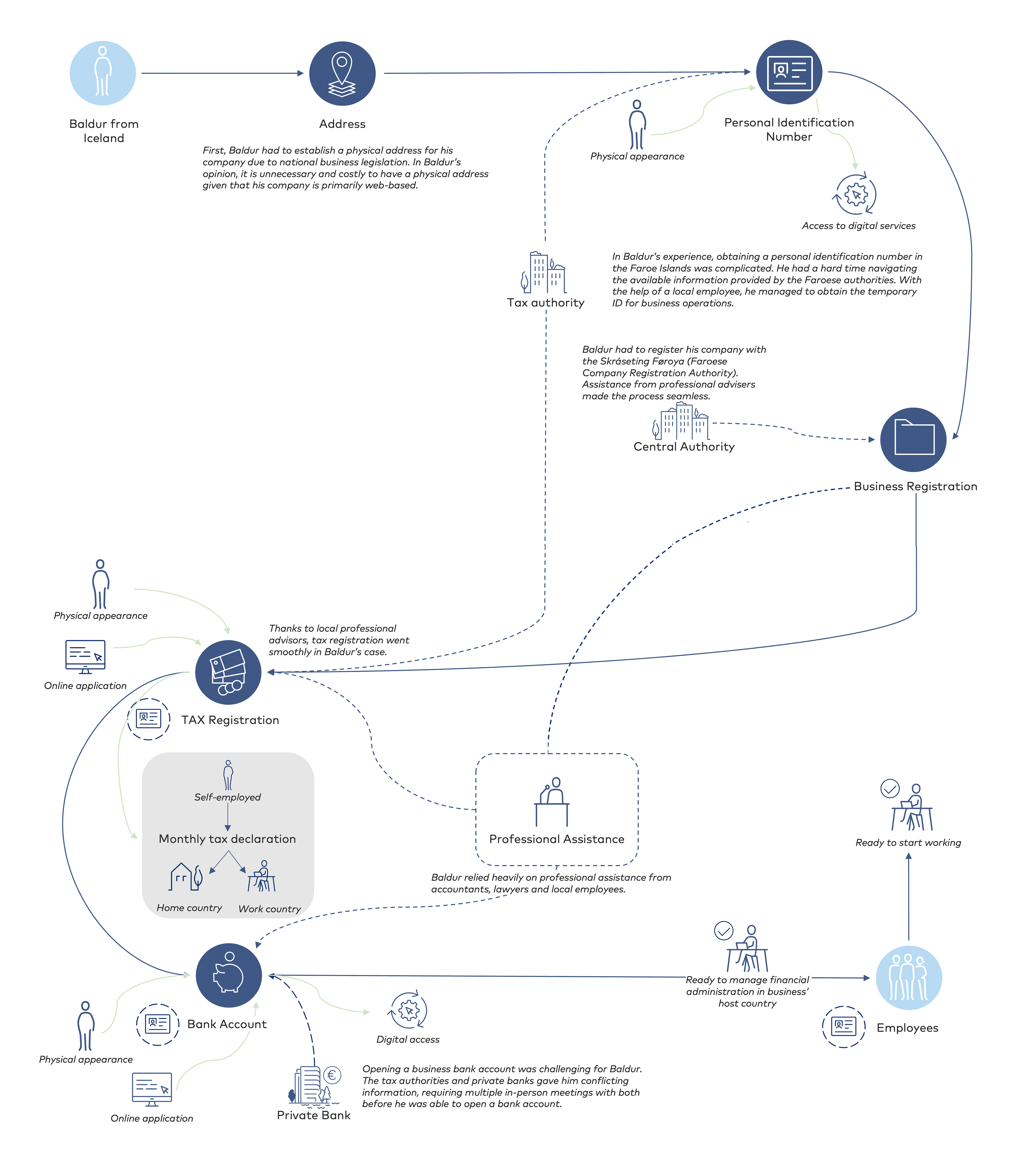
Figure 16 Journey Map for User Story 13
Note: The figure and related text boxes are based on information from interviews with users and stakeholders (authorities and companies appointed by the users).
Accommodation Due to national legislation, Baldur's company must have a physical address to run a business in the Faroe Islands. This requirement, while not necessary for the web-based aspects of his business, adds extra costs but is predictable and manageable. Baldur travels to the Faroe Islands a couple of times a year to support good relations and keep in touch with business partners. Administrative status meetings with the accountant are always part of these trips.
Personal Identification (ID) Obtaining personal identification in the Faroe Islands proved to be a significant challenge for Baldur. Initially, the first bank required a Faroese ID to open a business bank account, even though the company already had a business ID. As a non-resident, Baldur faced complications because the tax agency initially told him he could not have a personal identification number. This was different from his experience in Iceland, where obtaining personal identification was straightforward.
After being redirected multiple times between the bank and the tax agency, Baldur tried another bank based on a friend’s suggestion. This bank only required his passport to open an account, allowing him to receive payments from customers and make payments to providers. Despite paying taxes and creating jobs, accessing the bank account remained challenging due to the need for a personal ID.
In 2022, the application system transitioned to Samleikin, adding further complexity. After several trips to the Faroe Islands and receiving conflicting information, Baldur learned that a temporary ID was available for non-residents. With the help of a local employee, he managed to obtain the temporary ID for business operations.
Register business With prior experience in opening a company in Iceland, Baldur found starting a company in the Faroe Islands to be relatively straightforward. He received assistance from professional advisors, including a lawyer, to ensure that all administrative work and formalities were correctly handled. Baldur enlisted an accounting firm in the Faroe Islands to manage the administrative tasks.
Tax registration Handling tax registration in the Faroe Islands was smoother thanks to Baldur's previous experience and assistance from professional advisors. However, the need for a personal ID complicated the administrative process. Despite the challenges, Baldur's proactive approach and support from local professionals enabled successful tax registration.
Bank account Opening a business bank account in the Faroe Islands was challenging for Baldur due to the initial requirement for a Faroese ID. After multiple redirects and trying different banks, he managed to open an account using his passport. This bank account facilitated his business transactions, although the process revealed inconsistencies in handling cross-border business operations.
Employees Baldur did not mention anything on employees. But Baldur’s company relies heavily on the accessibility of suitable vehicles for guided trips. Initially, the company rented vans, but later began using two to three cars weekly. Due to limited availability in the Faroe Islands, a car was brought from Iceland in 2019. However, local police fined the guide for driving an Icelandic car as Faroese residents are not permitted to do so without registration. Subsequently, the car was registered in the Faroe Islands at a cost of 35,000 DKK, which was more economical than renting. The un-registration process in Iceland remains problematic since the car cannot hold registration in both countries simultaneously, revealing regulatory inefficiencies.
User Story 14 – Starting a business in Finland while living in Estonia
Kristjan runs a company. He decided to expand his business to Finland, recognizing Finland as a key market. The expansion was motivated by the proximity to Estonia and the higher demand for his products in Finland compared to other markets. Due to transportation challenges associated with his products, it was more practical to operate a sales company within Finland.
Kristjan’s journey in expanding his business to Finland highlights the importance of understanding local regulations, securing proper identification, and leveraging professional support to overcome adminis-trative hurdles. He emphasizes that having a local partner and utilizing the services of accounting and legal professionals were key to managing these challenges. Stakeholders like Vero, PRH, and Business Finland reiterate the need for improved digital services, more accessible information, and streamlined processes to support foreign businesses in Finland. The use of an ID card or passport as a basis for person-al identification could significantly ease the business setup process, as demonstrated by Kristjan's experi-ence.
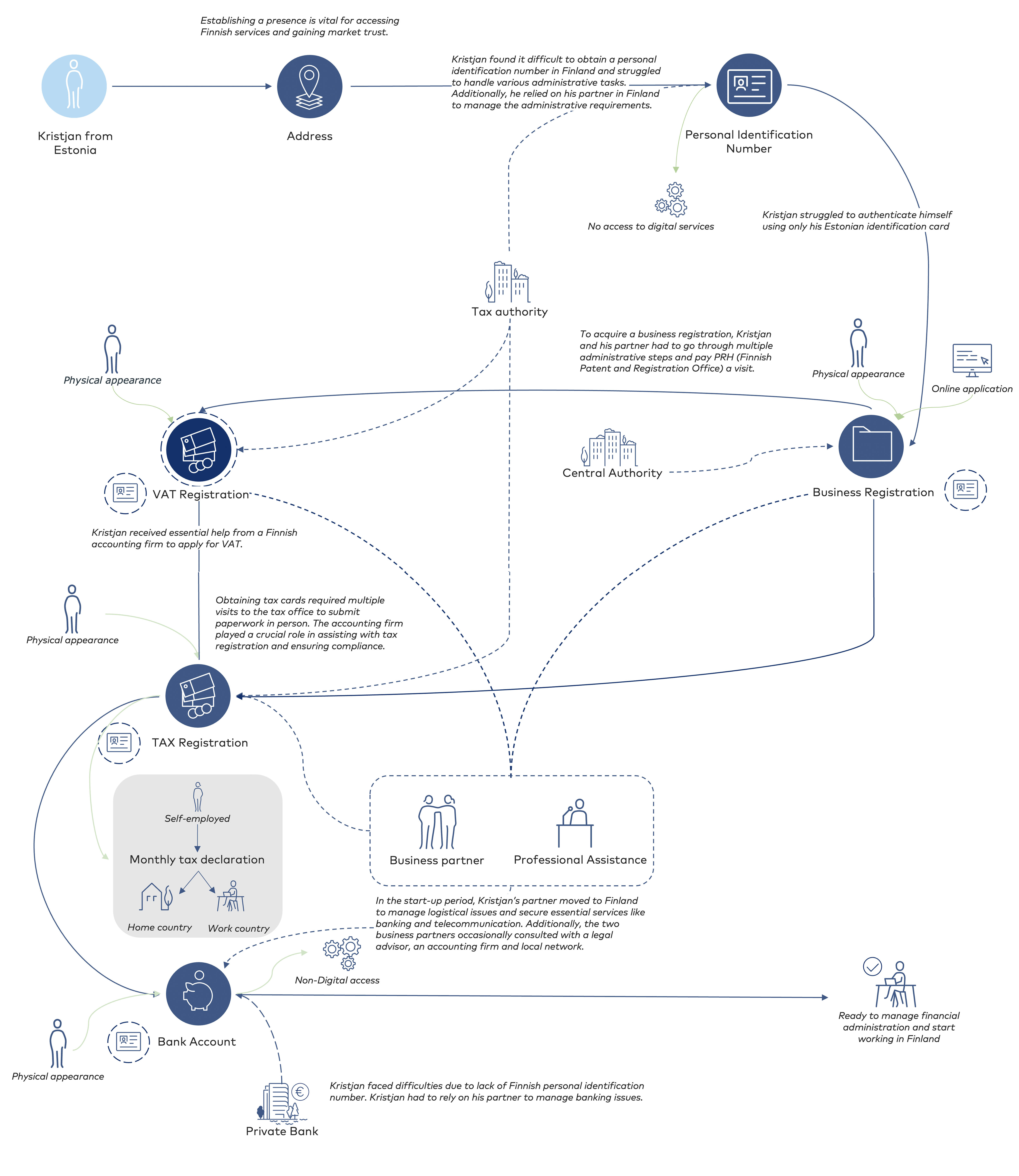
Figure 17 Journey Map for User Story 14
Note: The figure and related text boxes are based on information from interviews with users and stakeholders (authorities and companies appointed by the users).
Accommodation In establishing his business in Finland, Kristjan faced several challenges. Initially, the company operated as a branch, but they soon realized it would be better to have a separate entity. A business location was essential to facilitate operations efficiently. Kristjan’s partner moved to Finland to manage logistical issues and secure essential services like banking and telecommunication. Having a physical presence and address in Finland was crucial to successfully running the business. From the perspective of Business Finland, creating a presence in Finland is vital for accessing local services and gaining market trust.
Personal Identification (ID) Obtaining personal identification in Finland proved difficult for Kristjan. The key challenge was how to authenticate himself using only his Estonian ID card. Without Finnish identification, Kristjan struggled to handle various administrative tasks. His partner moving to Finland made it possible to acquire the necessary bank credentials and manage other administrative requirements. Unlike Estonia, where using a passport to obtain business credentials is straightforward, the process in Finland was much more complicated and time-consuming.
Vero emphasizes the necessity of understanding tax obligations and registration processes, highlighting the importance of timely submission of forms such as the Y form.
Register Business The process of registering the business in Finland involved multiple steps, including direct interaction with the PRH (Finnish Patent and Registration Office). Although Kristjan did not encounter significant difficulties in this phase, there were challenges related to understanding mandatory and recommended insurance types, as well as navigating unfamiliar regulations. Consulting with a legal advisor and utilizing the services of Business Finland and local networks proved beneficial in making this process smoother. PRH points out the need for better digital tools and English-language resources to streamline registration for foreign businesses.
Submit Application for VAT Kristjan registered his company for VAT in Finland, a necessary step to comply with tax obligations and facilitate transactions. He received substantial help from an accounting firm, which played a crucial role in navigating VAT registration and other tax-related processes. Vero emphasizes the necessity of timely and accurate VAT registration as part of setting up a new business, ensuring compliance from the outset.
Tax registration Kristjan constantly had to deal with various tax-related challenges. Obtaining tax cards required frequent visits to the tax office to submit paperwork in person. This repeated interaction with the Finnish Tax Authority highlighted the complexities of tax registration for non-residents. The accounting firm proved indispensable in assisting with tax registration and ensuring compliance. Vero points out that foreign businesses often need more guidance and support to navigate the Finnish tax system effectively, including understanding tax residency and obligations based on business presence.
Open a Bank Account Opening a bank account in Finland was particularly challenging for Kristjan. Despite being a 50% owner of the company, he faced difficulties due to the lack of personal identification recognized by Finnish banks. Unlike Estonia, where personal identification through a passport is straightforward, Kristjan had to rely on his partner, who relocated to Finland, to manage banking issues. This experience underscores the necessity of having a local presence and proper identification to navigate banking and financial operations efficiently. Business Finland emphasizes the importance of ensuring foreign businesses have the right to open a bank account, suggesting that policy changes might be necessary to facilitate this process.
User Story 15 – Starting a business in both Sweden and Denmark
Erik runs a business that he decided to expand into Sweden. He aimed to create a more sustainable and circular organization. The complexities of tax regulations led him to split the business operations between Denmark and Sweden. Opening a department in Denmark proved difficult, especially regarding money laundering regulations by Danish municipalities. The decision to expand was facilitated by his experience working in Sweden and having Swedish colleagues.
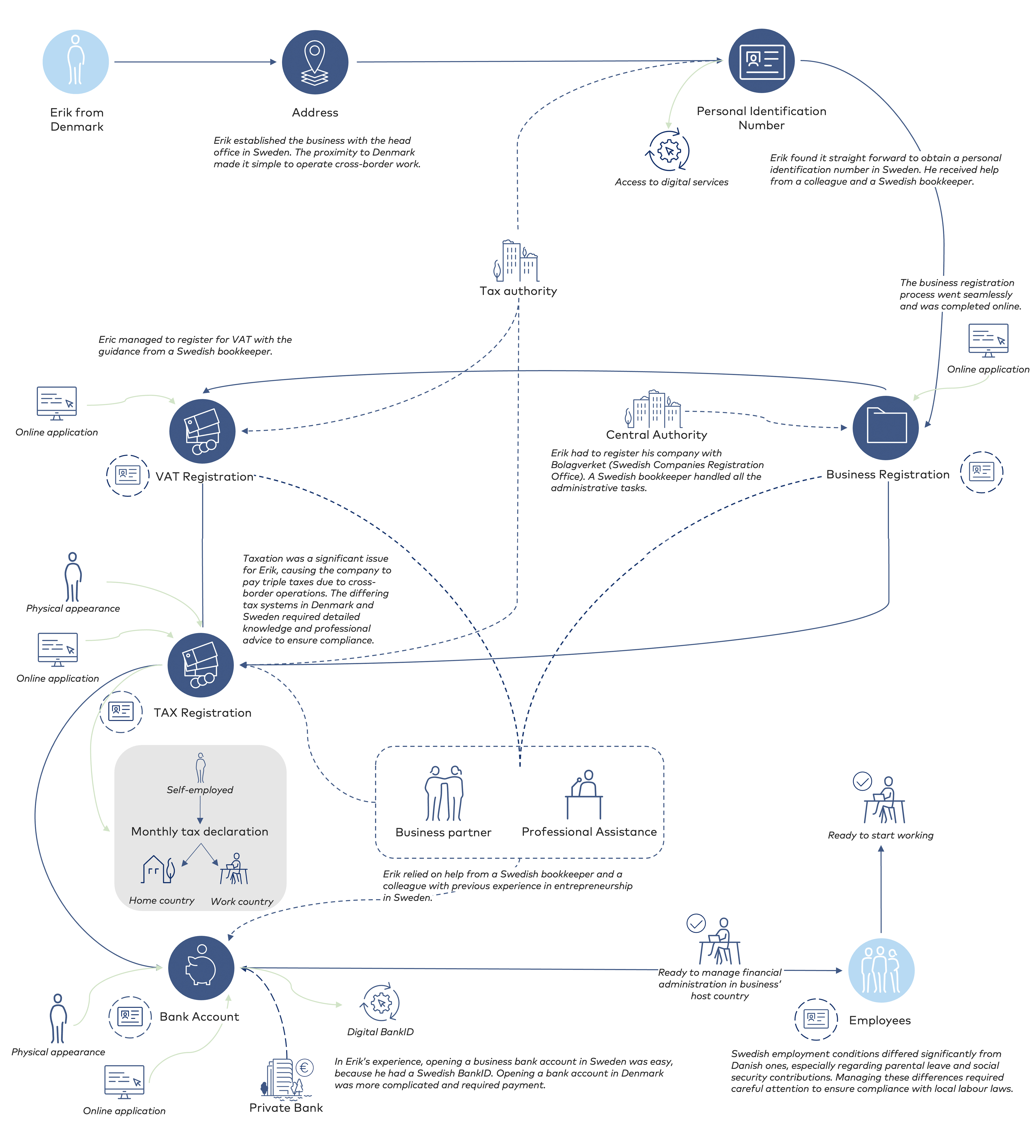
Figure 18 Journey Map for User Story 15
Note: The figure and related text boxes are based on information from interviews with users and stakeholders (authorities and companies appointed by the users).
Address Erik established the business with the head office in Sweden. The proximity to Denmark made it convenient for operations. Despite the ease of logistics, the administrative and legal processes of operating a cross-border business were challenging, especially regarding workspace regulations and establishing a local presence.
Personal Identification (ID) Obtaining personal identification and a bank account in Sweden was relatively straightforward for Erik. He registered the company through Bolagsverket and Skatteverket with the help of a colleague who was a serial entrepreneur in Sweden. The process took approximately a week and was managed by a Swedish bookkeeper who handled all administrative tasks. Encouraged by his colleague, Erik found it more straightforward to start the business in Sweden compared to Denmark.
According to stakeholders, if someone wants to start a company in Sweden but doesn’t have a BankID, it is often easier to buy a shelf company and complete the registration through Verksamt.se. BankID is essential in Sweden for many administrative tasks, and advising entrepreneurs to seek help from a bookkeeping firm or lawyer is common. Business Sweden and Øresunddirekt offer comprehensive information online which could further simplify the process.
Register business Registering the business in Sweden was smooth and easy. Erik utilized resources from Bolagsverket and Skatteverket. The registration process was completed online, and no significant challenges were encountered. The key was using a knowledgeable Swedish bookkeeper who managed the administrative details.
Submit application for VAT Erik managed to register for VAT smoothly with the guidance of the Swedish bookkeeper. This registration was necessary for tax compliance and business transactions. The consultant advises that understanding VAT registration thoroughly and leveraging help from local experts can prevent complications.
Tax registration Taxation became a significant issue for Erik, resulting in the company having to pay triple taxes due to its cross-border nature. Here are more insights into the complexities Erik faced with tax registration:
Erik's experience with tax registration highlighted the importance of thoroughly understanding the tax obligations in both Denmark and Sweden. Due to the nature of his business model, which was circular and distributed profit based on sustainability principles, Erik faced unexpected challenges. The Swedish Tax Agency did not fully understand this business model, leading to many critical questions. The Danish tax authorities meticulously scrutinized every bill, often associated with sketchy businesses, despite Erik's straightforward business operations.
Erik's cross-border business operations led to the complexity of navigating double taxation agreements. The differences in tax systems between Denmark and Sweden required detailed knowledge and professional advice to ensure compliance. Collaboration with experts and continuous advisory support were crucial to managing these tax implications effectively.
To comply with both Danish and Swedish tax requirements, Erik had to ensure that all documentation was accurate and thorough. Misunderstandings or lack of completeness in tax filings could lead to severe penalties. Erik's engagement with a Swedish bookkeeper and seeking advice from Danish Skat and the Swedish Tax Agency were essential in managing these requirements.
The complicated tax situation significantly impacted Erik's business operations, ultimately leading to the separation of the business entities. The need to pay triple taxes and the bureaucratic hurdles compromised the integrity of his sustainable business model. Erik's experience underscores the importance of understanding tax obligations in cross-border operations and the necessity for clearer and more supportive tax policies for businesses.
Stakeholders such as the Danish Tax Authority highlight that it is crucial for businesses to seek advisory services before starting cross-border operations to understand tax implications fully. The complexities Erik faced are common among businesses operating in multiple jurisdictions, emphasizing the need for comprehensive support from tax authorities to ensure smooth and compliant operations.
Opening a bank account Getting a bank account in Sweden was straightforward due to having a Swedish BankID. However, Erik notes that opening a bank account in Denmark was more complicated and required payment. Swedish society seems more geared for entrepreneurship, offering flexibility and trust, whereas Denmark had stricter regulations.
From stakeholders' perspectives, obtaining a company bank account can be challenging and time-consuming, especially in Denmark. When advising businesses, stakeholders recommend thorough preparation and possibly seeking professional advisory services to manage these administrative hurdles efficiently.
Employees Erik’s company initially had eight employees, making it a small enterprise. Swedish employment conditions differed significantly from Danish ones, especially regarding parental leave and social security contributions. Handling these differences required close attention to ensure compliance with local labor laws.
Stakeholders point out that companies often face surprises regarding employment conditions when expanding to Sweden. Issues such as parental leave and social security contributions can significantly impact an employer's costs. Consulting with local experts to understand these conditions before hiring is recommended.
User Story 16 – Starting a business in both Finland while living in Sweden
Julia runs a company, headquartered in Sweden. A few years ago, she decided to expand her business to Finland by establishing a subsidiary. Inspired by discussions with industry leaders who emphasized the significance her company, Julia and her collaborators, which included several Finnish firms, recognized the need for a presence in Finland to capitalize on the market opportunities and address cultural differences between Sweden and Finland.
Julia's experience highlighted the complexities and challenges of expanding a business across borders, emphasizing the importance of utilizing local expertise and professional support to navigate administra-tive and regulatory hurdles. The insights from Vero, PRH, and Business Finland indicate a need for better digital services, more accessible information, and streamlined processes to support foreign businesses in Finland.
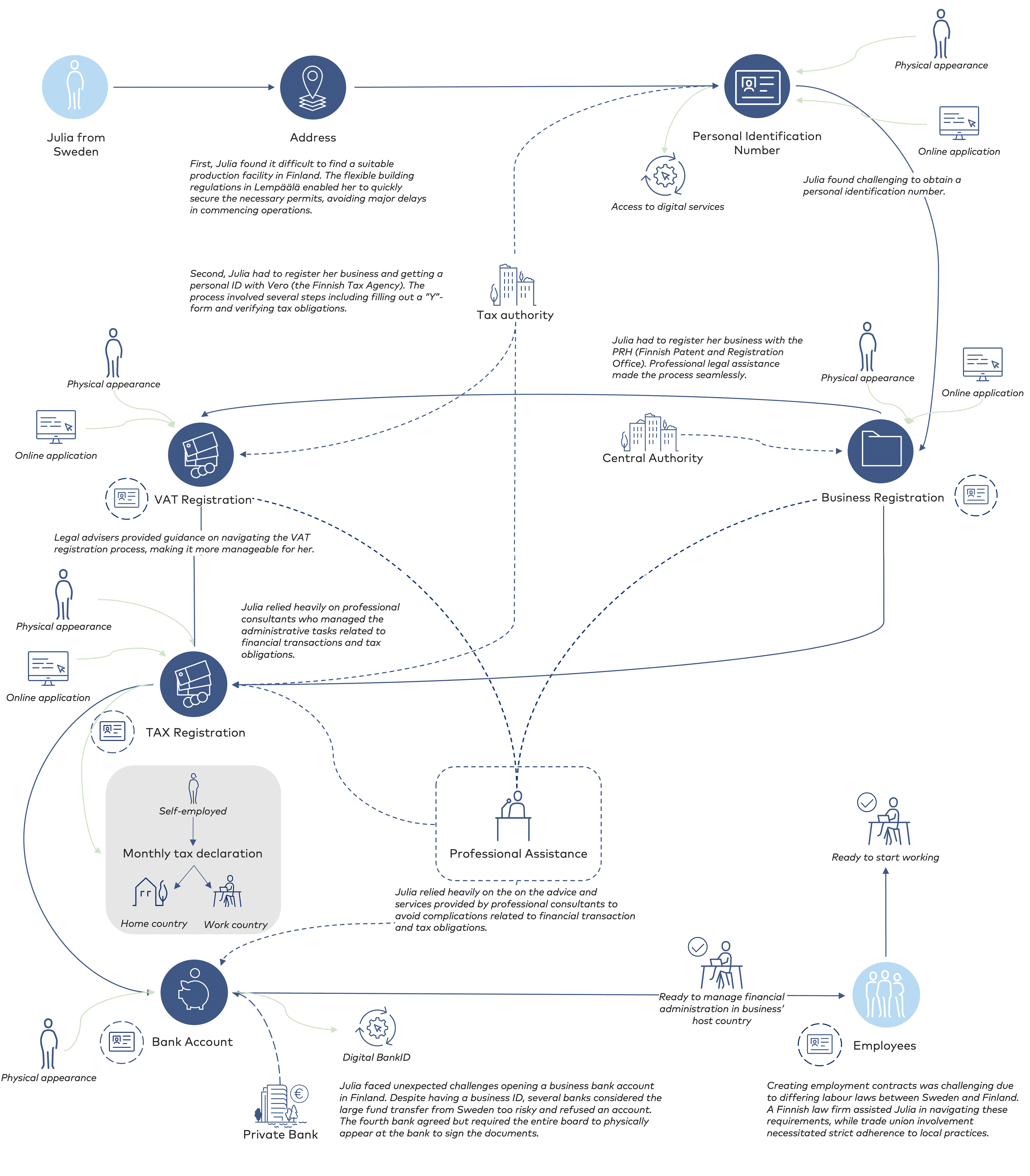
Figure 19 Journey Map for User Story 16
Note: The figure and related text boxes are based on information from interviews with users and stakeholders (authorities and companies appointed by the users).
Address Finding a production facility in Finland proved challenging for Julia. Initially, she secured office space in a business hotel, but locating a suitable production facility was more difficult. Flexibility in building regulations in Lempäälä allowed her to quickly obtain the necessary permits, avoiding significant delays in starting operations. Utilizing a leading Finnish law firm and Business Sweden's initial support, Julia navigated the bureaucracy effectively, although the support was somewhat limited. The Production Facility setup initially faced delays due to stringent building regulations which were resolved only with persistence.
Personal Identification (ID) Obtaining personal identification was a significant challenge for Julia. Despite securing a Y-tunnus (business ID), several banks refused to open an account, viewing the new business and substantial fund transfers from Sweden as a risk. Finally, the fourth bank agreed to open an account, requiring the directors (two Swedes and one German) to fly in and sign documents in person. This experience highlighted the difficulties faced by foreign business owners in obtaining banking services without a personal ID in Finland.
From the perspective of the tax agency (Vero), registering a new business or getting a personal ID involves several steps, including filling out the Y form and verifying tax obligations. This process is necessary to ensure the correct tax handling from the outset. Challenges arise particularly for non-residents, who may struggle with obtaining personal IDs or understanding their tax responsibilities. Vero highlights the importance of more streamlined digital communication and better guidance for foreign businesses.
Register business Julia was able to register her business in Finland without major issues, thanks to the legal help she received. Using the expertise of a top Finnish law firm and actively participating in preliminary discussions, the registration process was handled smoothly. The support from Business Sweden during the early stages was helpful, albeit somewhat limited.
However, both Vero and the Finnish Patent and Registration Office (PRH) emphasize the necessity of providing more comprehensive digital tools and English-language resources to make the registration process even more efficient for foreign businesses.
Submit application for VAT Julia ensured her company was registered for VAT in Finland as part of the business setup process. This registration was essential for ensuring compliance with tax obligations and facilitating smooth transactions. Legal advisors provided guidance on navigating the VAT registration process, making it more manageable for her. According to Vero, having clear instructions and digital systems in place for VAT registration can significantly ease the administrative burden for foreign businesses.
Tax Registration Direct interactions with the Finnish Tax Authority were minimal for Julia. She relied heavily on the advice and services of professional consultants to avoid complications related to financial transactions and tax obligations. The international movement of funds raised concerns, which were handled by these consultants to ensure compliance and prevent issues. Vero notes that for larger projects, seeking guidance on VAT and tax obligations is crucial and having collaborative efforts with agencies like PWC and EY can help mitigate any potential issues.
Opening a bank account Opening a business bank account in Finland was unexpectedly challenging for Julia. Despite having the business ID, several banks considered the transfer of substantial funds from Sweden too risky and refused to open an account. The fourth bank agreed, but only after requiring the entire board to be physically present to sign the documents. This requirement posed logistical challenges but was eventually met, allowing her to proceed with financial operations. Business Finland emphasizes that addressing the issues related to bank accounts and ensuring foreign businesses have the right to open one is critical for improving the ease of doing business in Finland.
Employees Creating employment contracts posed a challenge due to differences in labor laws between Sweden and Finland. Julia aimed to implement consistent HR policies across both countries, including offering employees greater flexibility in working hours and mealtimes. However, Finnish labor regulations—especially the strong role and influence of trade unions—made it difficult to introduce such benefits without going through extensive formal processes. In practice, even when the employer wanted to provide more freedom or benefits to employees, doing so often required official approval from the unions, adding layers of bureaucracy, according to Julia. A Finnish law firm assisted in navigating these constraints to ensure compliance with local requirements.
User Story 17 – Starting a business in Iceland while living in Norway
Emma has relocated from Finland to Norway and is considering moving her business to Iceland. Her journey began with extensive experience in the Nordic countries, having previously been involved in entrepreneurship while residing in Finland. Motivated by the business potential in Iceland, Emma conducted a financial analysis indicating a favorable opportunity for success, particularly due to Iceland's relatively small market which allows for testing and refining the business model before potential expansion. The company was co-founded by an Icelandic colleague who handled the practical aspects of setting up the business.
Emma's experience highlighted the importance of local partnerships and thorough preparation in navi-gating the challenges of starting a business abroad. Leveraging local expertise and government resources enabled her to establish her business effectively, despite encountering several barriers.
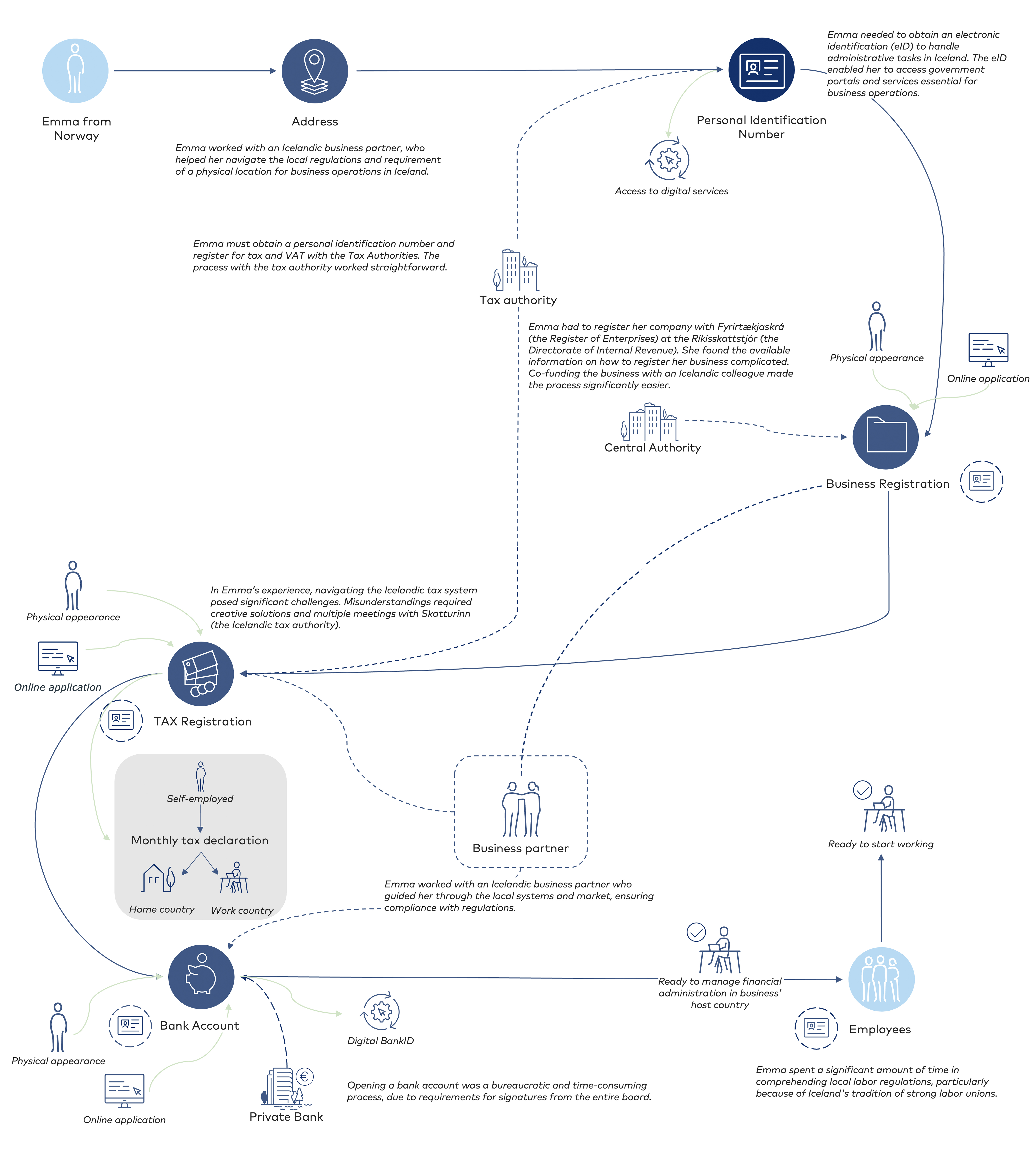
Figure 20 Journey Map for User Story 17
Note: The figure and related text boxes are based on information from interviews with users and stakeholders (authorities and companies appointed by the users).
Address Emma must establish an address for her business in Iceland. This entails having a registered office, providing a physical location for business operations as well as correspondence. Working with an Icelandic business partner helped navigate this requirement, ensuring proper adherence to local regulations and establishing credibility within the Icelandic market. Emma lived in Iceland for four months to prepare and set up the business. Afterwards, she moved back to Finland and continued handling administrative tasks remotely.
Personal Identification (ID) Emma needed to obtain an electronic identification (eID) to handle administrative tasks in Iceland. This process was straightforward, enabling her to access government portals and services essential for business operations. The eID serves as Emma's primary identification for interacting with Icelandic authorities and managing digital invoicing and other business activities.
Register business Co-founding the business with an Icelandic colleague significantly eased the process of setting up the company. Utilizing the government portal, Island.is, provided official guidance on company registration, tax regulations, and other administrative processes. Instead of starting a new company, Emma purchased an existing "sleeping" company, which was already registered for tax purposes. While this decision proved to be more costly in hindsight, it facilitated faster setup.
Tax registration Navigating the Icelandic tax system posed significant challenges for Emma, particularly due to unique regulations and the business model's novelty. Misunderstandings from tax consultants and challenges with inter-system payment integrations required creative solutions and significant interaction with Skatturinn (the Icelandic tax authority). According to Emma, in Finland, businesses can grant power of attorney to another company for tax-related matters, a provision that was not available in Iceland, adding to the complexity. Despite the challenges, having an Icelandic business partner proved invaluable in understanding and complying with local tax laws.
Bank account Emma faced bureaucratic hurdles when opening a business bank account in Iceland due to requirements for signatures from the entire board. This process was time-consuming but ultimately successful. Having an established Icelandic partner aided in fulfilling these requirements and streamlining the banking setup.
Employees Emma needed to understand local labor regulations, especially due to Iceland's strong labor unions. These unions and the cultural values associated with them required careful consideration in developing the business model and managing payroll and employee relations.
User Story 18 – Starting a business in Denmark while living in Estonia
Martin has relocated from Estonia to Denmark and is considering moving his business as well. His journey began when he moved to Denmark to pursue his Ph.D., which provided substantial income. Recognizing the potential for his consultancy business to expand in Denmark, Martin started exploring how to transition his one-person limited liability company from Estonia.
Martin initially found the business registration process in Denmark to be efficient. However, understanding the legal and procedural requirements posed some challenges. He sought advice from specialized consultants to navigate these complexities.
Currently, Martin operates his business from Estonia but pays personal taxes in Denmark. This approach allows him to manage his obligations while he continues to explore the best way to fully integrate his business into the Danish system.
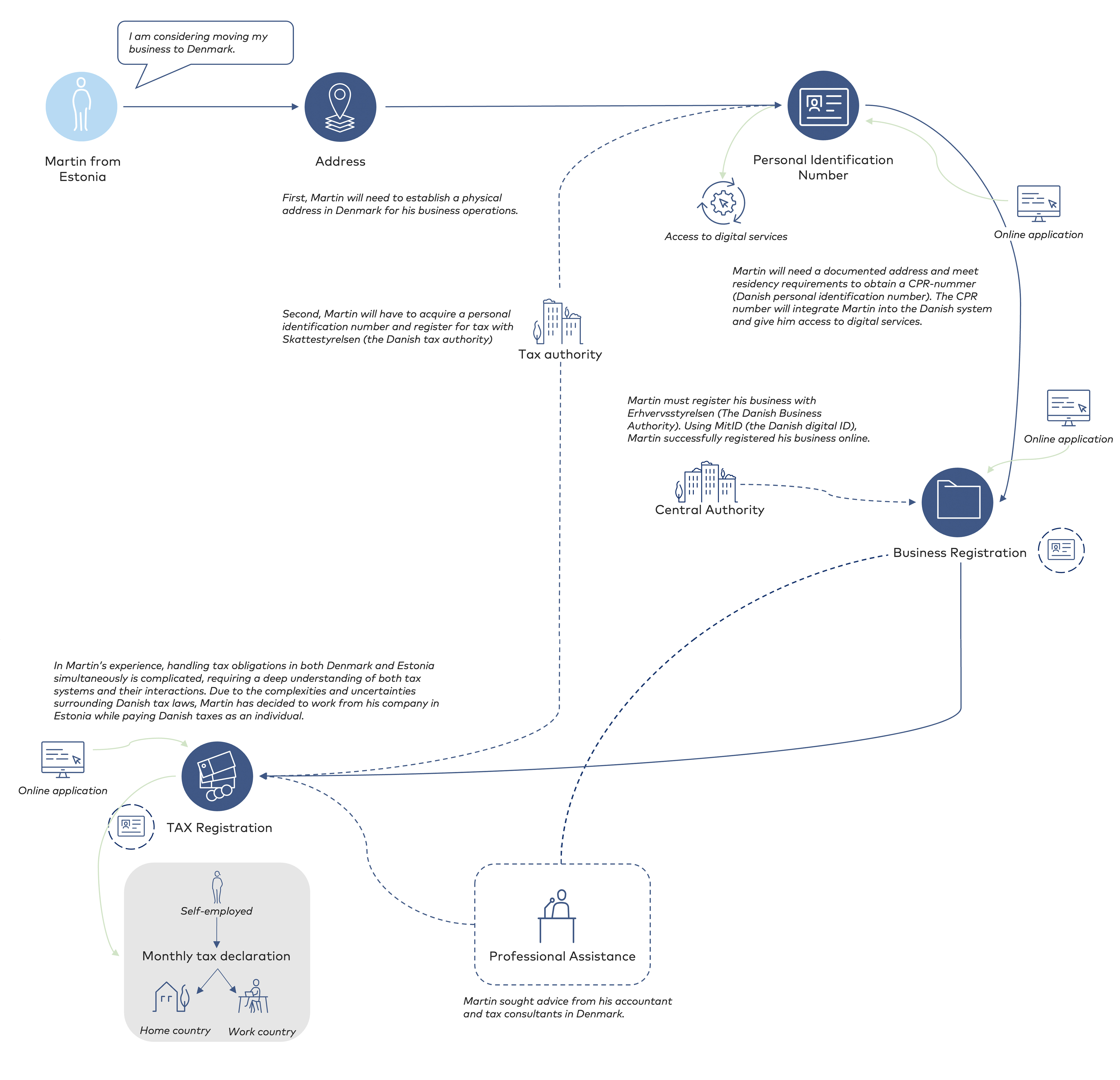
Figure 21 Journey Map for User Story 18
Note: The figure and related text boxes are based on information from interviews with users and stakeholders (authorities and companies appointed by the users).
Address Martin must establish an address in Denmark to register his business. This requires obtaining a CPR number, which is essential for proving residency.
Personal Identification (ID) To get a CPR number, Martin needs to have a documented address and meet residency requirements, which include having employment, sufficient funds, or being a dependent of someone legally residing in Denmark. Having a CPR number is crucial as it allows Martin to access various services and offers legitimacy for his business operations in Denmark.
Obtaining a CPR number was a crucial step for Martin as it is necessary for various administrative tasks and services. Without this number, many essential activities such as opening a bank account, securing health services, and interacting with public authorities could not be efficiently managed. This number integrates him into the Danish system and ensures smoother transitions in his personal and professional life.
Register business Martin needs to register his business in Denmark, and he found the process to be surprisingly swift. Denmark’s business registration system is known for its efficiency, allowing businesses to be registered online quickly. However, Martin realized that registering the business is just one part of the process. Understanding the various legal and procedural requirements that follow, including tax obligations and compliance with local laws, introduced an additional layer of complexity. To navigate these intricacies, Martin sought advice from specialized consultants who could provide clear guidance on how to meet all regulatory requirements effectively.
Tax registration Tax registration in Denmark presents significant challenges and complexities for Martin, who is transitioning from owning a business in Estonia. Handling tax obligations in both Denmark and Estonia simultaneously is intricate, requiring a deep understanding of both tax systems and their interactions.
When considering moving his business to Denmark, Martin faced numerous questions about whether to close his Estonian company, establish a second location in Denmark, or have affiliations in both countries. Seeking advice from his accountant and tax consultants, he realized that Danish tax laws involve many intricate details and scenarios, making it challenging to get a definitive answer.
According to the tax agency in Denmark Martin must be aware of dual taxation issues due to operating in both Estonia and Denmark. In Denmark, he would be taxed on global income, meaning he must declare his foreign income and any taxes paid abroad. For instance, if Martin expects a profit of 200,000 DKK from his Danish operations and foresees paying 50,000 DKK in taxes in Estonia, he will need to report this on his Danish tax declaration. The Danish system will calculate any additional taxes owed after considering the foreign taxes paid.
Engaging specialized tax advisors who understand cross-border tax laws can be crucial for Martin. These advisors can offer tailored guidance, helping Martin navigate the complexities of dual tax responsibilities while ensuring compliance with regulations in both Denmark and Estonia. Consulting with Danish tax authorities (SKAT.dk) provided him with valuable insights, but definitive answers were difficult to obtain due to the multitude of variables involved, like the number of days spent in each country and specific business activities.
Due to the complexities and uncertainties surrounding Danish tax laws, Martin found it initially more beneficial to keep his company in Estonia. He decided to work from his Estonian company while paying Danish taxes as an individual. This approach meant his company in Estonia was responsible for taxes according to Estonian laws, while he handled personal taxes in Denmark.