Appendix 4: Life Event 1
User Story 1 - Moving to Denmark for work as a Latvian citizen
Alisa, an experienced diplomat from Latvia, is accustomed to living in various countries due to her and her husband's careers. When her husband was offered a permanent position in Denmark, they jointly decided to embrace the opportunity with the intention of exploring life in Denmark for a period of time before making a decision about permanent settlement. With extensive experience in settling down in different countries, Alisa felt well-prepared for this move.
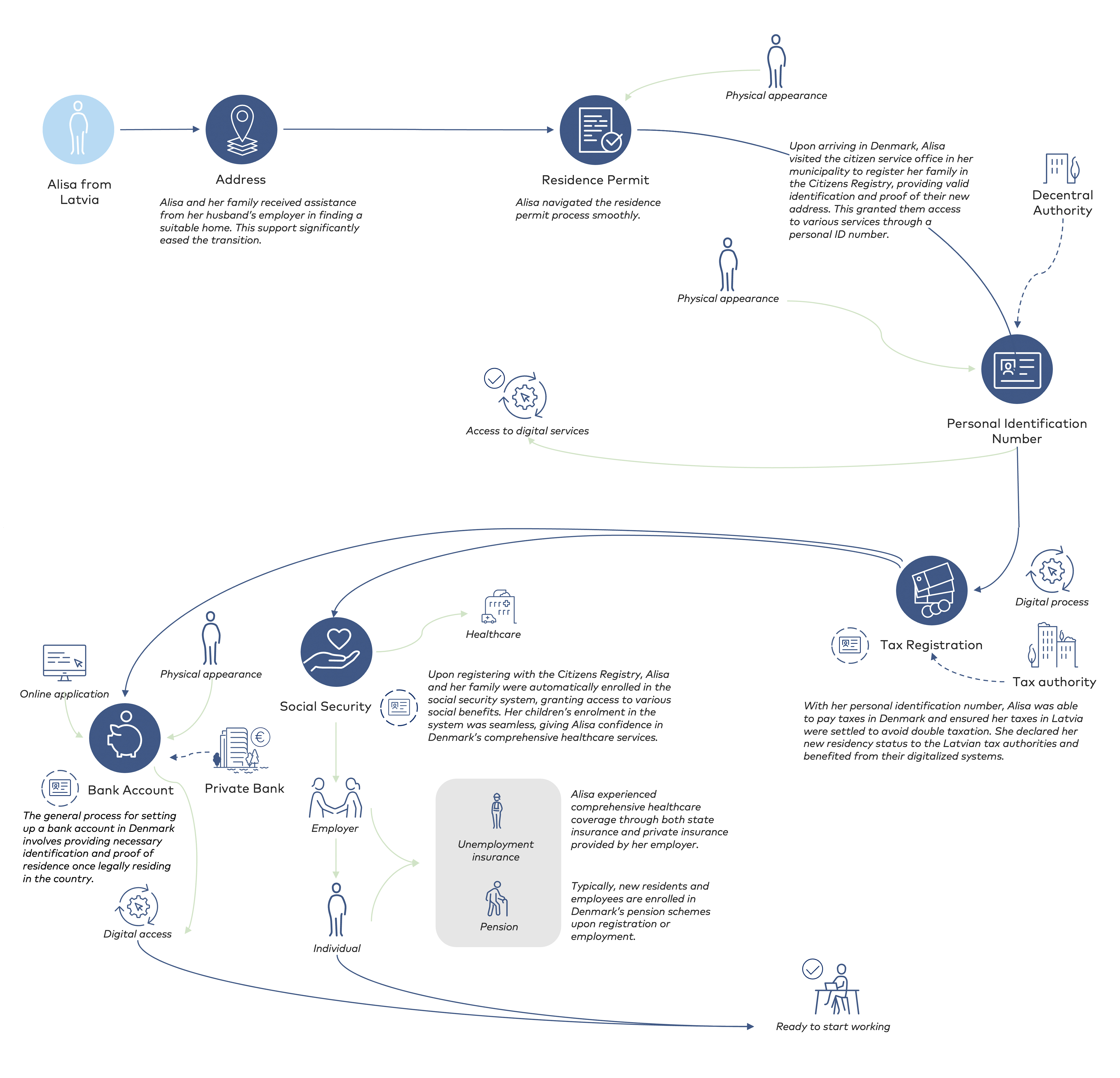
Figure 4 Journey Map for User Story 1
Note: The figure and related text boxes are based on information from interviews with users and stakeholders (authorities and companies appointed by the users).
Accommodation Upon arrival, Alisa and her family received assistance from her husband's employer in finding a suitable home. This support significantly eased the transition and allowed them to focus on other crucial aspects of their settlement.
Residence permit Navigating the residence permit process was smooth for Alisa, who applied for it simultaneously with her move. Her organized approach, including preparation of necessary documents and having all tax affairs in order, helped streamline the process. Alisa appreciated Denmark’s efficient and consolidated systems.
Personal Identification Upon arriving in Denmark, Alisa visited the citizen service office in her municipality to register her family in the Citizens Registry. She provided valid identification and proof of their new address. This registration granted her access to various services, underscoring the importance of a personal identification number as a gateway to healthcare, banking, and other public services. According to Alisa, the municipality was supportive and provided clear explanations, accommodating her English language needs whenever necessary.
Tax payment With her personal identification number (CPR) obtained, Alisa was registered in Denmark and able to open a bank account. However, she did not begin working—and thus did not start paying taxes in Denmark—until about a year after her arrival. In the meantime, she declared her new residence in Denmark to the Latvian authorities and registered as a non-tax resident in Latvia. She declared her new residency status to the Latvian tax authorities and benefited from their digitalized systems for managing procedural steps. When selling her property in Latvia, both Alisa and her husband managed notarization processes by traveling back and forth within the same day, as they had to be both physically present.
Bank account While not detailed in the interview, the general process for setting up a bank account in Denmark involves providing necessary identification and proof of residence once legally residing in the country. This step is crucial for managing day-to-day finances.
Social security Upon registering with the Citizens Registry, Alisa and her family were automatically enrolled in the social security system, granting access to various social benefits. Her children’s enrollment in the system was seamless, giving Alisa confidence in Denmark’s comprehensive healthcare services.
Insurance Alisa experienced comprehensive healthcare coverage through both state insurance and private insurance provided by her employer. She received prompt responses for urgent medical needs and efficient communication with healthcare providers, making the system reliable and supportive for her family’s needs.
Pension Although Alisa did not specify pension-related steps, typically, new residents and employees are enrolled in Denmark’s pension schemes upon registration or employment. Deductions are automatically withdrawn from the monthly salary, ensuring future financial security.
Throughout her relocation journey, Alisa encountered both challenges and supportive systems. Denmark’s community engagement and efficient administrative processes played critical roles in her successful integration and long-term settlement.
User Story 2 - Moving to Finland for work as an Estonian citizen
Aleksandr, originally from Estonia, often visited Finland during his high school years and eventually decided to move there to pursue higher education at a Finnish university. With a close relative in Finland, Aleksandr initially had a place to stay, which made the initial move easy. Since he was moving for studies and not for employment, he did not receive assistance from an employer regarding the moving process or obtaining necessary documentation. Instead, he relied mainly on guidance from the International House in the city where he settled.
According to data from 2022, there are a little over 50,000 people from Estonia living in Finland.
Finland and Estonia sign agreement on the electronic exchange of population data – the reform will particularly facilitate the updating of data for persons moving from one country to the other: https://dvv.fi/en/-/finland-and-estonia-sign-agreement-on-the-electronic-exchange-of-demographic-data-the-reform-will-particularly-facilitate-the-updating-of-data-for-persons-moving-from-one-country-to-the-other (22. Sep, 2022)
The visual representation below outlines Aleksandr’s journey through the system, segmented into seven key steps.
International House
In several larger cities in the Nordic and Baltic countries, there are International House’s which are service hubs for international citizens, offering support with relocation, work, and integration into the respective society. It is part of a broader network of organizations that assist expatriates and migrants, collaborating with municipalities, businesses, and government institutions to help newcomers settle more easily. It is not a single global organization but rather a local initiative within a wider network of similar services.
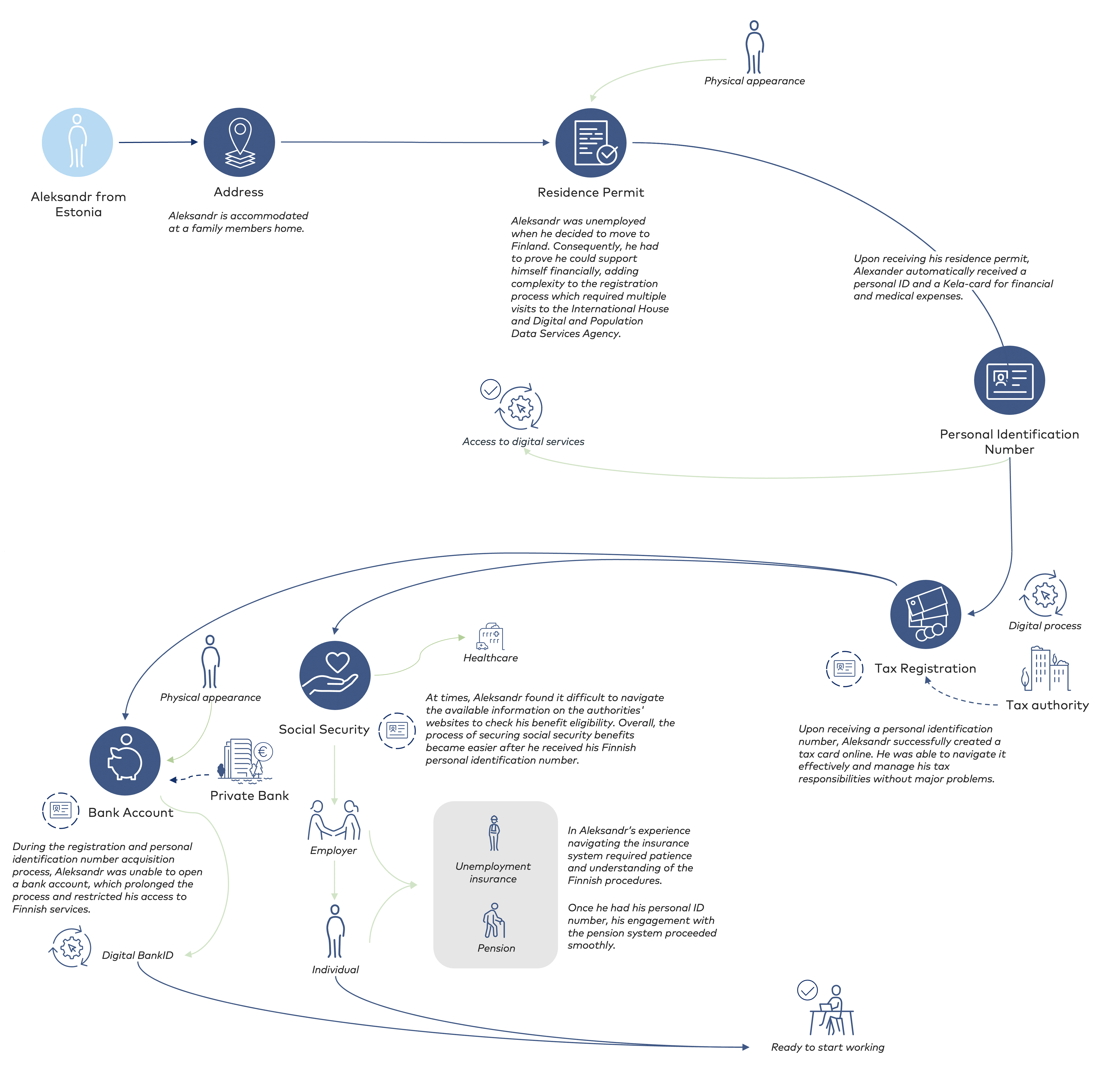
Figure 5 Journey Map for User Story 2
Note: The figure and related text boxes are based on information from interviews with users and stakeholders (authorities and companies appointed by the users).
Accommodation Aleksandr could stay with a close relative in the beginning, which made the initial move easy.
Residence Permit Upon arrival in Finland, Aleksandr sought assistance from the International House to navigate the EU residence permit registration process. The submission required multiple visits due to frequent requests for additional information, and Aleksandr also contacted the Digital and Population Data Services Agency (DVV) for guidance, visiting their office multiple times. An Estonian-speaking employee provided helpful instructions. Family ties had no bearing on registration, so Aleksandr had to explain his income and expenses, making multiple visits to prove he had sufficient funds to support himself. After significant effort, he managed to register, receiving an EU citizen registration based on sufficient funds. However, this registration posed challenges later when applying for student financial aid due to the inability to select the exception under which he registered.
Personal Identification (ID) Once Aleksandr succeeded in obtaining the correct documentation for the right to live in Finland, he was granted a Finnish ID. With this personal identification number, he automatically received a Kela card for medical expenses.
Bank account Opening a bank account presented difficulties for Aleksandr, as he needed a Finnish personal identification number. Without it, he couldn't open a bank account, prolonging the process and limiting his access to financial services. After receiving his personal identification number, Aleksandr was able to open a bank account and gain access to these services.
Tax payment Aleksandr encountered no significant issues with tax payments. Upon receiving his personal identification number, he successfully created a tax card online and managed his tax responsibilities without major problems.
Insurance, Social Security, and pension Aleksandr had mixed experiences with social security. After obtaining his personal identification number, he automatically received a Kela card for medical expenses. Challenges arose later when applying for student financial aid due to the registration exception. He used the Omakela (the online service portal of Kela, the Finnish Social Insurance Institution) website to check his benefit eligibility, and overall, the process of securing social security benefits became easier with his Finnish personal identification number.
Regarding insurance, once Aleksandr obtained his personal identification number, he managed his insurance needs more effectively. The Kela card served as proof of entitlement to healthcare benefits. Navigating the insurance system required patience and understanding of Finnish procedures.
Aleksandr's engagement with the pension system improved after obtaining his personal identification number, which integrated him into the broader social security framework, including pension contributions. He accessed pension information through Finnish websites and services like Omakela.
Overall, Aleksandr's journey through social security, insurance, and pension systems improved significantly after obtaining his personal identification number. This milestone simplified access to healthcare benefits, insurance services, and pension information, though initial bureaucratic hurdles required persistence and proactive engagement.
User Story 3 – Moving to Iceland for work as a Norwegian citizen
Agnes, originally from Norway, studied in Slovakia for a few years before moving to Reykjavik. Her motivation for moving to Iceland was family-related, and she found good job opportunities in her preferred industry.
Agnes’ previous experiences with moving and studying abroad boosted her confidence in relocating to Iceland, as it had proven easier than initially thought. Comprehensive information needed before moving to Iceland was readily available through the official website island.is, which provided details on registration and instructions for completing necessary processes quickly upon arrival.
Since Norway is part of the EEA (European Economic Area), Agnes did not have any concerns about obtaining a work permit. Additionally, her partner had already secured a job in Iceland, alleviating financial concerns even if the process of acquiring her work license took longer than expected.
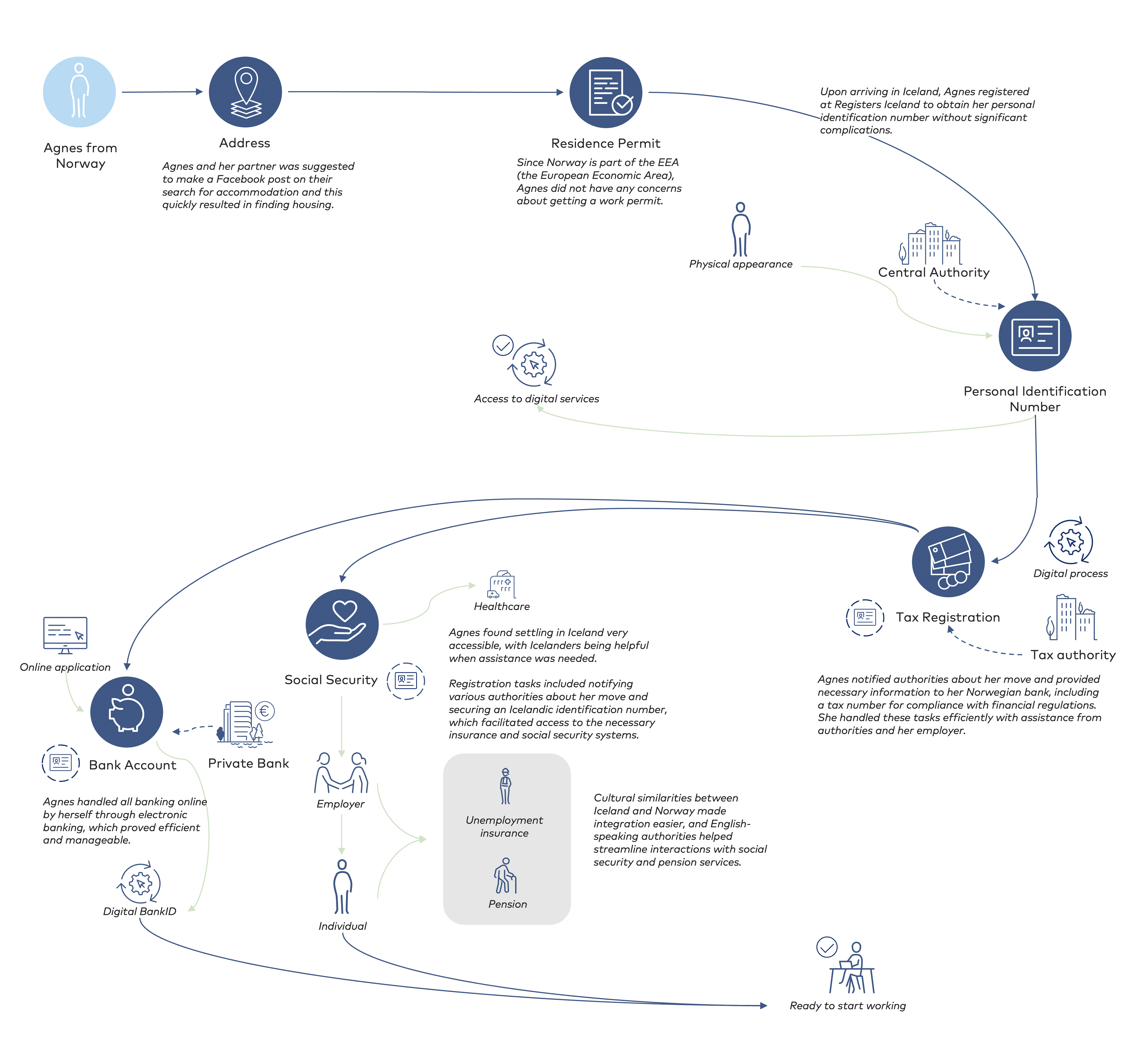
Figure 6 Journey Map for User Story 3
Note: The figure and related text boxes are based on information from interviews with users and stakeholders (authorities and companies appointed by the users).
Accommodation Agnes used the app Leiga for Accommodation, though it did not yield many suitable central options. A contact of her partner suggested posting on Facebook about her accommodation search, which quickly resulted in finding suitable Accommodation.
Residence Permit Agnes did not need a work permit, as Norway is part of the EEA, allowing her to work freely in Iceland.
Personal Identification (ID) Upon arriving in Iceland, Agnes’ primary task was to physically register at Registers Iceland to obtain an Icelandic identification number. Prior to moving, she researched the registration process using the comprehensive information available on island.is. The website provided detailed guidance on registration and instructions for completing the process quickly upon arrival. Ingrid found the staff at Registers Iceland to be helpful and successfully completed the registration without significant complications.
Tax payment Notifying authorities about her move and providing necessary information to her Norwegian bank was another important task for Agnes. Her bank requested a tax number to update their records and ensure compliance with financial regulations. Ingrid efficiently handled these tasks with the available information and assistance from authorities and her employer.
Bank account Opening a bank account in Iceland was one of Agnes’ tasks upon arrival. She managed all banking online through electronic banking, which proved efficient and manageable. Additionally, Agnes notified her Norwegian bank about her move to Iceland and provided them with her Icelandic tax number.
Insurance, Social Security, and pension Settling in Iceland was very accessible for Agnes, with helpful Icelanders providing assistance when needed. Registration tasks included notifying various authorities about her move and securing an Icelandic identification number, which facilitated access to the necessary insurance and social security systems. Cultural similarities between Iceland and Norway made integration easier, and English-speaking authorities helped streamline interactions with social security and pension services.
User Story 4 – Moving to Sweden for work as a Norwegian Citizen and moved back to Norway
Johan moved from Sweden to Norway in 2010 to work at a public agency. Originally planning a temporary stay, he enjoyed living in Norway and ultimately stayed for almost ten years. The decision to move was driven by the job opportunity in Norway, while his wife was still studying in Sweden. Although managing imports and document handling rules came with some challenges due to Norway's non-EU status, Johan found the process relatively straightforward, especially since he had fewer belongings as a student.
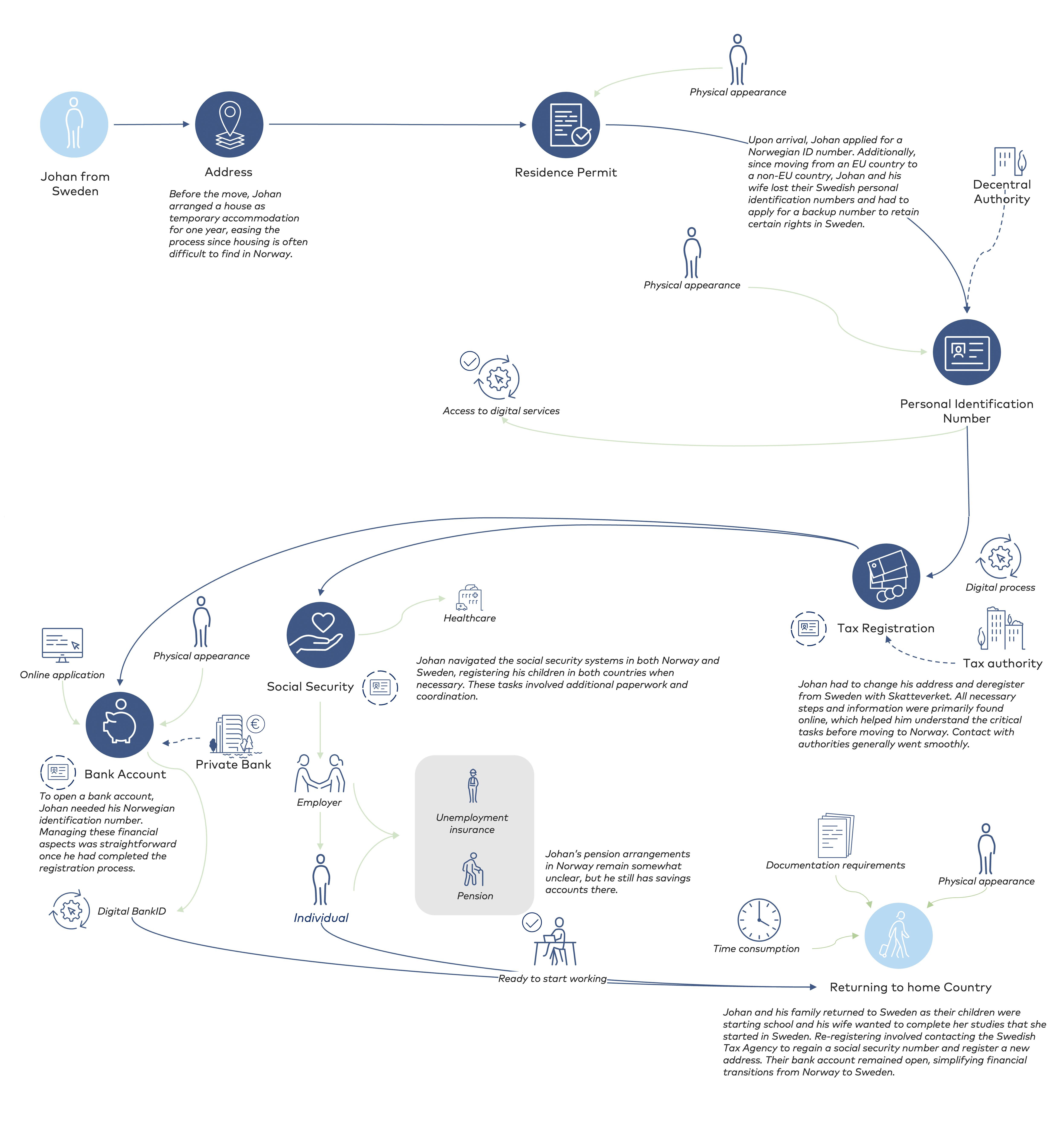
Figure 7 Journey Map for User Story 4
Note: The figure and related text boxes are based on information from interviews with users and stakeholders (authorities and companies appointed by the users).
Accommodation Before the move, Johan arranged temporary accommodation for one year, which eased the process given Norway's Accommodation challenges. Colleagues had mentioned difficulties, including the requirement to pay three months' rent in advance, which can be burdensome for recent graduates.
Personal Identification (ID) Upon arrival, Johan applied for a Norwegian ID number, essential for opening a bank account and managing taxes. He changed his address and deregistered from Sweden with Skatteverket, requesting them to forward mail to his new address in Norway. The process worked well. Moving from an EU country to a non-EU country meant Johan and his wife lost their Swedish personal identification numbers and had to apply for a backup number to retain certain rights in Sweden.
Tax payment Johan changed his address and deregistered from Sweden with Skatteverket. He found all necessary steps and information online, helping him understand critical tasks before moving to Norway. Contact with authorities generally went smoothly, although Johan had to manage import limits for bringing personal belongings into Norway.
Bank account In order to open a bank account, Johan needed his Norwegian ID number. Managing financial aspects was straightforward once he completed the registration process. Exchanging their Swedish car for a Norwegian car simplified their financial transitions, avoiding re-registration.
Insurance, Social Security, and pension Johan navigated the social security systems in both Norway and Sweden, registering his children in both countries when necessary, involving additional paperwork and coordination. Although eligible to apply for Norwegian citizenship after three years, he declined as it required giving up his Swedish citizenship.
Moving back to home country In 2019, Johan and his family returned to Sweden as their children started school and his wife wanted to complete her studies. Re-registering involved contacting the Swedish Tax Agency to regain their social security numbers and register a new address. Their bank account remained open, simplifying financial transitions from Norway to Sweden. They re-registered their car via the Swedish Customs and Swedish Transport Administration smoothly. His pension arrangements in Norway remain somewhat unclear, but he still maintains savings accounts there.
User Story 5 – Moving to Estonia for work as a Finnish citizen
Arvo moved from Finland to Estonia in 2015 to manage a local company. His decision to move was driven by the professional opportunity rather than personal or economic incentives. Arvo was recruited for the new role, and the new employer stated beforehand that they would not assist with the relocation process.
As Arvo moved alone, he expected to spend some weekends in Finland with friends and family. However, due to the complexities of cross-border taxation, even short visits were problematic. Arvo had prior experience working abroad and engaging in cross-border business, which influenced how he approached his move to Estonia. He had previously worked in Estonia as part of his job in Finland, where he was involved with subsidiary companies in Estonia. Additionally, he once considered establishing a company in Estonia but found maintaining it too complicated due to the need for additional accounting and tax reporting efforts required by the Finnish authorities.
This past experience made him aware of the challenges involved in cross-border work, but he was still surprised by the extent of the issues he faced after relocating. His prior exposure to international work helped him navigate some of the difficulties. However, even with that experience, he still had to rely on consultants and advisors to handle the complexities of taxation and social security. Also, some of the advice given by experienced consultants turned out to be wrong, and in these cases, the responsibility was still his own.
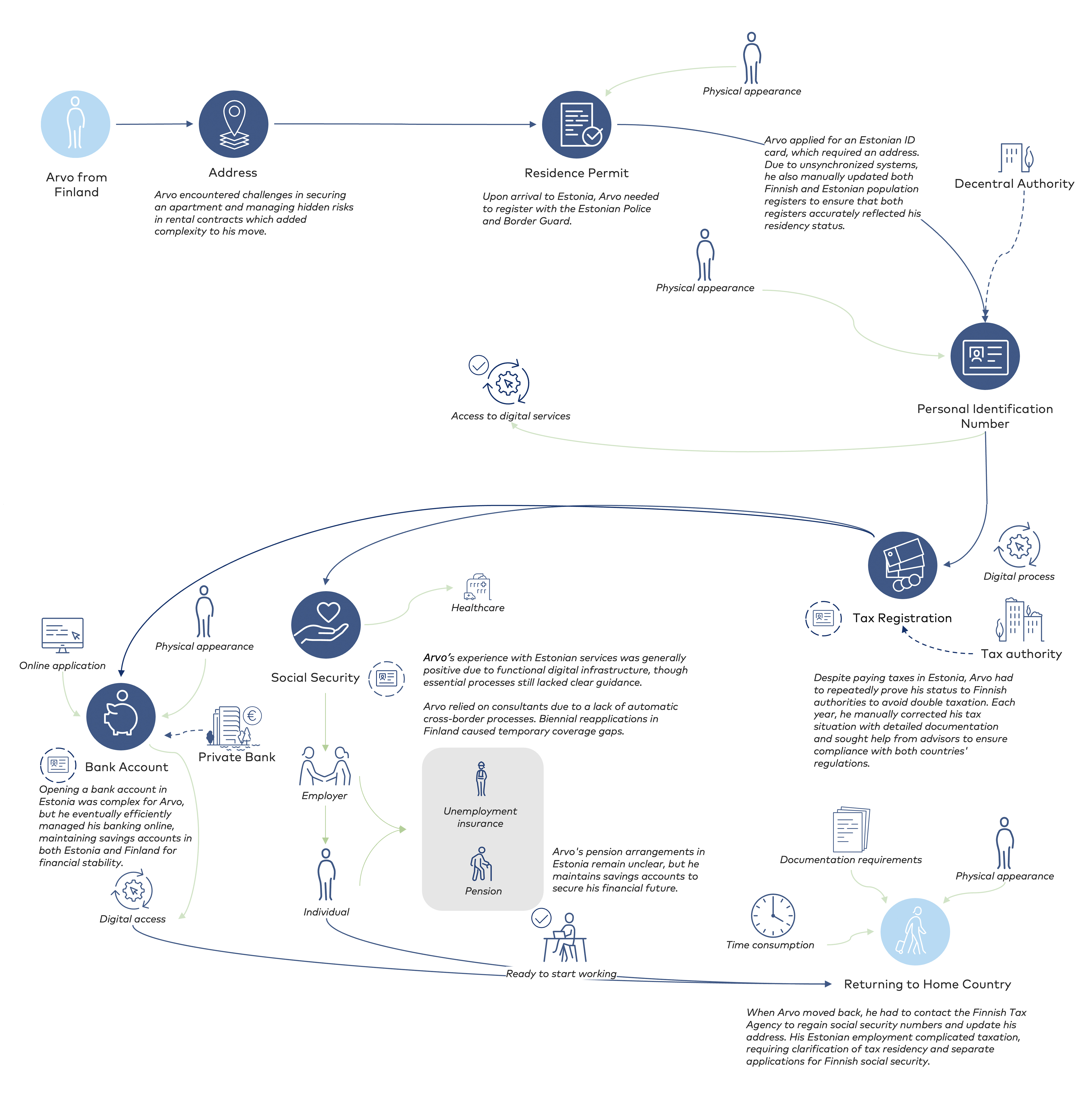
Figure 8 Journey Map for User Story 5
Note: The figure and related text boxes are based on information from interviews with users and stakeholders (authorities and companies appointed by the users).
Accommodation Before moving to Estonia, Arvo faced significant challenges in securing an apartment. Arvo had been warned to be aware of the hidden risks in rental contracts, such as tenants being held liable for illegal renovations. To overcome this, he relied on his network and made use of personal contacts to find suitable accommodation. Arvo was informally advised to use a friend's address until he found a permanent residence in order to be eligible for the registration process. The difficulty of finding appropriate accommodation added to the complexity of his move.
Arvo did not register his car in Estonia due to challenges associated with cross-border regulations, leasing restrictions, and practical constraints. Firstly, Estonian banks required a six-month employment period before granting car loans or leases, preventing him from immediately obtaining an Estonian vehicle. Secondly, his existing Finnish car was under a leasing agreement, prohibiting its registration in another country. At the same time, Estonian law mandated a rapid re-registration of vehicles upon relocation—faster than Arvo could feasibly secure local financing. Ultimately, confronted by these complexities and lacking viable alternatives, Arvo consciously accepted the risk of not re-registering his Finnish car during his residence in Estonia and using it only occasionally.
Personal Identification Upon arrival in Estonia, Arvo needed to establish his residency and obtain an Estonian ID card. He registered with the Estonian Police and Border Guard, where all supporting data was obtained automatically. Once his residency was established, Arvo applied for an Estonian ID card, which required undergoing a verification process. Here, Arvo’s address was necessary to meet the official requirement for obtaining his ID card. He also took steps to manually ensure that both Finnish and Estonian population registers accurately reflected his residency status, as the registers were not fully synchronized.
Tax Payment According to Arvo, navigating tax obligations in both Estonia and Finland posed significant challenges. He began by researching tax residency rules for both countries to understand how his income would be taxed and what documentation was required to prove his tax status. Arvo gathered necessary documentation, including proof of income, residency status in Estonia, and relevant tax forms, to contest tax bills issued by Finnish authorities for income already taxed in Estonia. Arvo manually corrected his tax situation with Finnish authorities each year by providing detailed documentation to avoid double taxation. He sought help from tax consultants and advisors to ensure compliance with regulations in both countries, carefully managing his cross-border tax obligations. At times, Arvo had to pay Finnish tax authorities upfront for mistaken tax invoices and later receive refunds.
Bank Account Arvo didn’t want to open a personal account in Estonia, because the European banking system allows making cross-border payments effectively. However, an Estonian account was required from Arvo by the bank to be able to handle his employer’s accounts and transactions. Opening the bank account in Estonia was unexpectedly complex for Arvo. The process required extensive financial disclosures and a formal application process. Despite the initial difficulties, Arvo finally managed his banking tasks online by maintaining accounts in both Estonia and Finland.
Insurance, Social Security, and Pension Arvo navigated insurance and social security matters by relying heavily on consultants due to the lack of automatic systems for cross-border processes. He needed to reapply for social security in Finland biennially, causing a temporary loss of coverage due to automatic removals from the system. Arvo's pension arrangements in Estonia remain somewhat unclear, though he maintains savings in Finland to secure his financial future. Throughout these processes, Arvo interacted with authorities and consultants to ensure compliance with regulations in both countries.
Before moving, Arvo took care of key logistical steps such as arranging temporary accommodation and transport of his belongings, for a smooth transition. Navigating healthcare services in Estonia proved challenging. Even after registering as an Estonian resident and being eligible for health care, Arvo needed to find a family doctor on his own. This process was difficult due to the lack of recommendations and background information. When Arvo needed medical help prior to finding a family doctor, even the private clinics refused to see him without a family doctor registration.
Arvo's experience with Estonian services was generally positive due to the functional digital services, though essential processes still lacked clear guidance. Learning the local language and understanding cultural differences aided Arvo in settling in.
Moving Back In 2016, Arvo returned to Finland. Arvo had intended to stay longer in Estonia but returned to Finland earlier than planned, primarily due to difficulties and complications associated with cross-border taxation that significantly restricted even brief visits to see family and friends. Re-registering involved contacting the Social Insurance Institution of Finland to regain social security numbers and register their new address. Taxation and social security posed major complications as Arvo's employment remained tied to Estonia, requiring clarification of tax residency and separate applications for Finnish social security. Exporting belongings was simple due to the proximity and open borders between Finland and Estonia. Managing bank matters required updating residency information to avoid account restrictions or tax issues. While the physical move itself was easy, bureaucratic aspects and personal accountability for complex matters made the transition extremely stressful, and it impacted Arvo’s health and well-being.
Arvo reflects on his cross-border move as a mix of valuable professional experience and significant bureaucratic challenges. He found Estonia's digital services and pragmatic processes to be efficient, while according to Arvo, Finland’s administrative processes and practices complicated matters for cross-border workers. The lack of coordination between Finland and Estonia in terms of taxation and social security required significant time and resources to manage.
User Story 6 – Moving to Finland for work as an Estonian citizen and moved back to Estonia
Anna, originally from Estonia, moved to Finland to work as a doctor. The move was motivated primarily by career development and financial stability, as Finland offered good opportunities and high salaries. Although the family was not the initial driver for her move, it later influenced her decision to return to Estonia. Anna did not have prior experience with relocating abroad. In some cases, navigating the system was challenging, as different officials provided conflicting information, and processes were not always clearly outlined. Anna primarily relied on Finnish government agencies such as the tax office (Vero) and the social security institution (Kela) for official information.
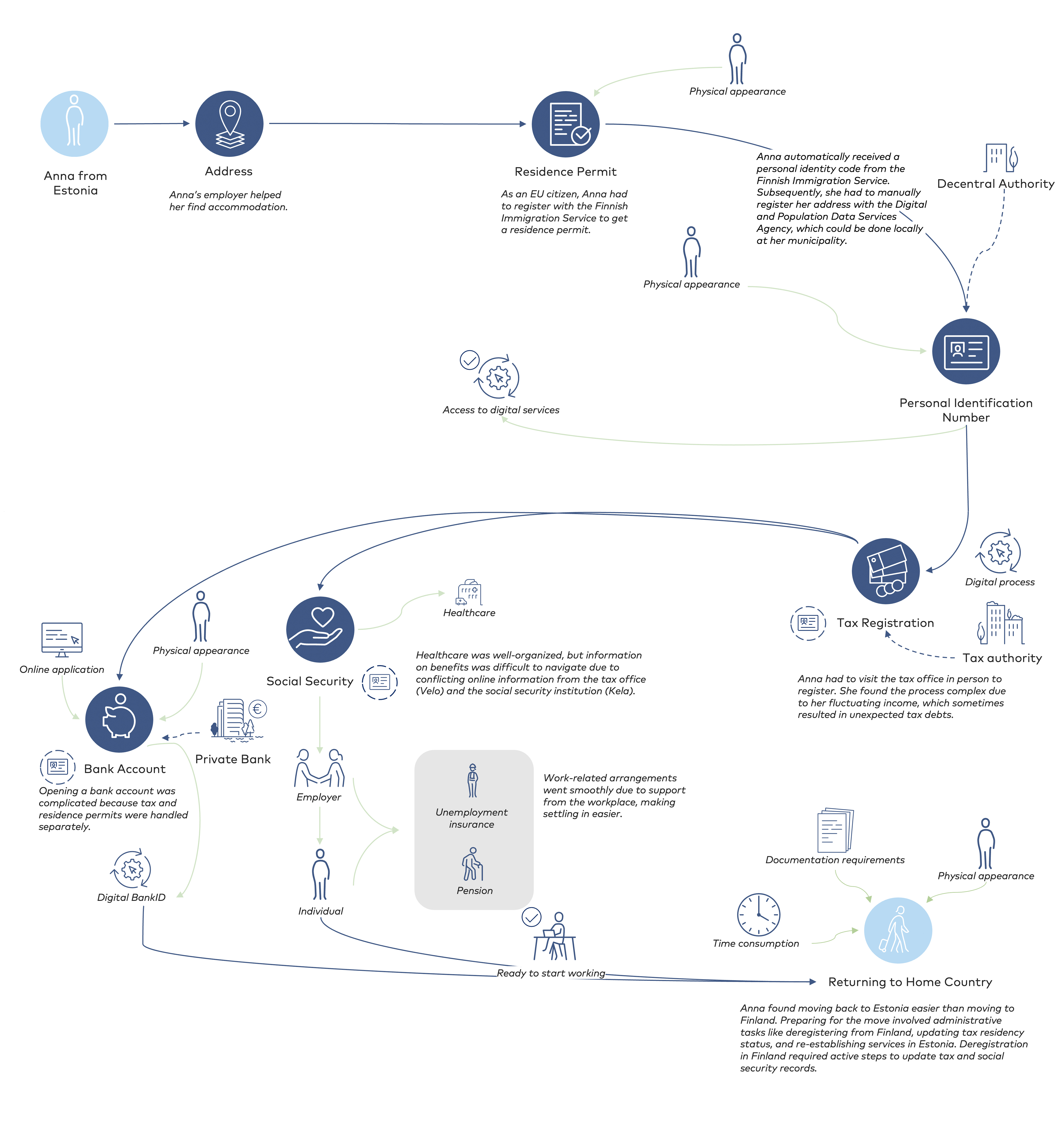
Figure 9 Journey Map for User Story 6
Note: The figure and related text boxes are based on information from interviews with users and stakeholders (authorities and companies appointed by the users).
Accommodation Anna’s employer helped her find accommodation.
Residence permit According to Anna, as an EU citizen, she did not need a work permit, but an EU residence permit to live in Finland for more than three months. To apply for the permit Anna needed to document her EU citizenship by presenting her passport and employment contract, as work was the intended purpose of residency in Finland. The processing time for an application is approximately one month.
Personal Identification (ID) Anna faced challenges with registration upon arriving to Finland. The process of validating her residency required multiple in-person visits and Anna experienced the process as confusing and bureaucratic partly due to the need for in-person meetings. When she finally obtained the ID, she had digital access to manage her administrative tasks.
Tax Payment Anna successfully created a tax card online with guidance from Vero. Anna encountered no major issues with registering for tax payments once she obtained her personal identification number. The taxation system, however, required close monitoring of tax obligations, especially since Anna experienced how changes in income could lead to unexpected tax debts that she would have to manage manually.
Bank account Opening a bank account was challenging for Anna as she initiated the process before she had obtained her personal identification number. The residency and tax registration processes were handled separately. The process required in-person visits, making it time-consuming and in Anna's experience not very efficient.
Social Security, Insurance, and Pension Anna's experience with social security involved navigating the healthcare system and understanding benefits. She enrolled in Kela for medical expenses but had to prove her tax residency. With her improved language skills and support from colleagues, she managed to integrate into the structured healthcare system in Finland. Although taxes and pension contributions required effort to manage, the overall social security experience became smoother over time.
As Anna spent some time in Estonia when expecting her first child, healthcare coverage presented complexities when Anna lived in Estonia but worked and paid taxes in Finland. Anna needed special permission from the Finnish Social Insurance Institution (Kela) to maintain her Finnish health insurance while temporarily staying in Estonia.
Moving Back to Estonia Returning to Estonia involved administrative tasks like deregistering from Finland and handling tax residency. The transition was more manageable due to her familiarity with the language and system. Estonia's digital services allowed quicker residency registration and benefits access, although tax residency updates caused issues like difficulty opening a bank account. Coordinating parental benefits and managing healthcare access for her children required additional effort, emphasizing the differences between Finnish and Estonian systems.
Anna noted the proactive role of the Estonian Social Insurance Board (Sotsiaalkindlustusamet). Upon returning to Estonia, the authority independently identified parental benefits that Anna and her spouse were eligible for, including simultaneous payments from Estonia and Finland, which Anna herself had not been aware of. This proactive approach simplified the administrative process for Anna and her family.
Upon returning to Estonia, Anna experienced an oversight where one of her children unintentionally remained officially registered in Finland, resulting in continued routine invitations for Finnish healthcare services like dental check-ups.
Anna experienced confusion regarding the differences between residency registration and tax residency upon returning to Estonia. She faced difficulties opening a bank account because her tax residency status was initially unclear despite already being registered as a resident.