Appendix 1: Methodology
This appendix outlines the study’s methodological approach to prioritize life events and data collection methods to conduct user stories. The methodological approach to prioritize life events involves performing desk research on life events, conducting interviews with national representatives, and hosting a prioritization workshop with the reference group. The data collection methods for developing user stories include conducting interviews with citizens and stakeholders in each country, as well as hosting a workshop with country experts to share and discuss the findings.
Method to prioritize life events
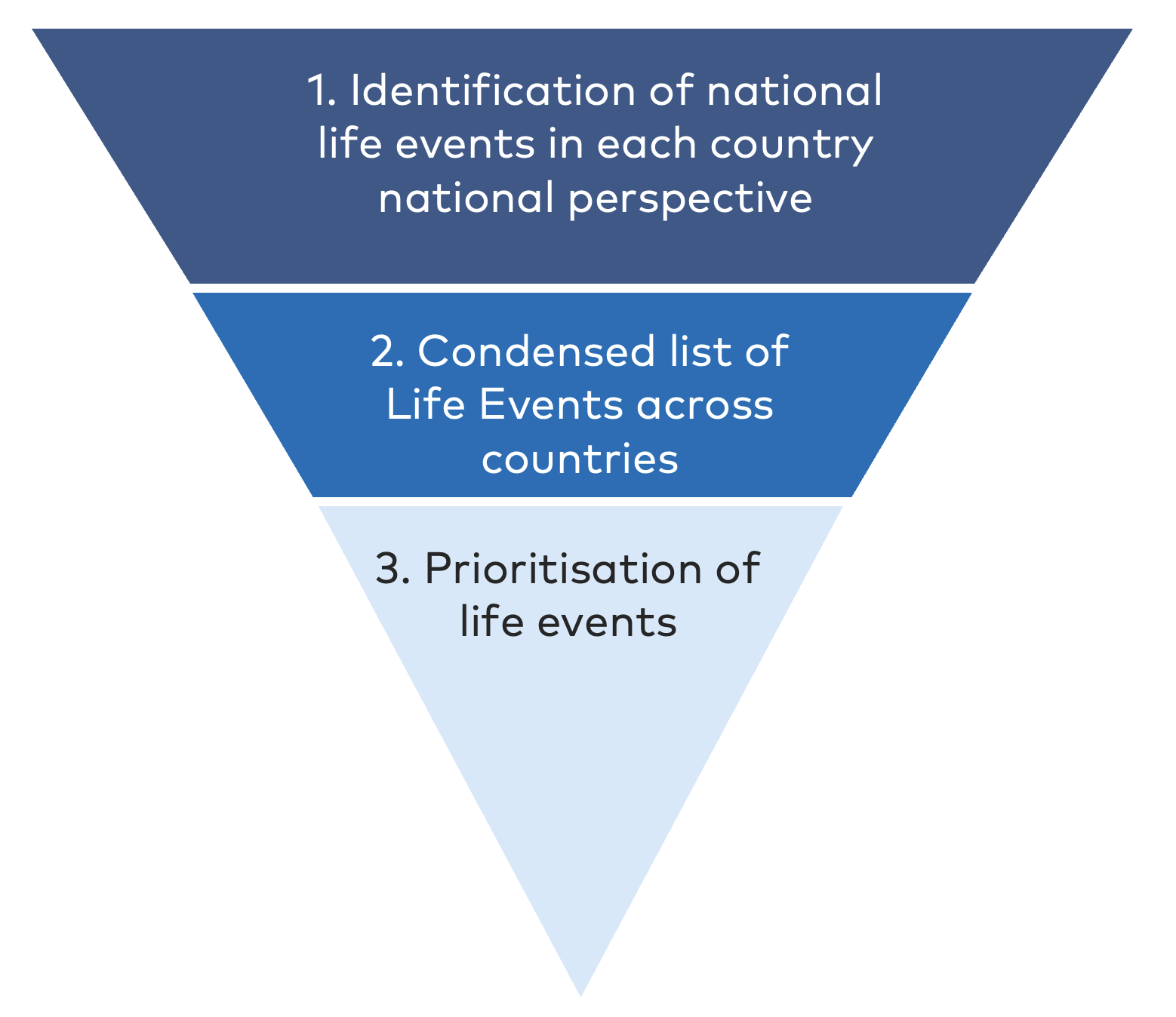
The first step in the report was to prioritize 2–3 life events. These life events were then developed into user stories, with a focus on those life events most significant for the Nordic and Baltic countries. The prioritization of life events involved four steps, as summarized in the figure below, and will be described in more detail in this chapter.
Desk research
One of the key elements in understanding how countries prioritize life events was conducting initial desk research on how each country approaches and selects among life events. The desk research examined both digital policies and national legislation relevant to life events (e.g. Norway’s “Prioriterte livshendelser”) and which life events are included in national citizen platforms (e.g.: Borger.dk; Suomi.fi; Eesti.ee). The desk research resulted in a list of each countries’ identified life events which is depicted in appendix 2.
Interviews with national representatives
The second step in identifying and prioritizing life events involved conducting interviews with national representatives from the 11 countries. The interviews aimed to provide better insights into the countries’ reasonings and analyses behind their prioritization of life events. The interviews were conducted by the core project team. Interviewees were digital experts from digital agencies in each country who had been contacted and recruited to the project by email.
Representatives from eight countries agreed to participate in an interview. Thus, the descriptions of countries’ reasonings and analyses behind the prioritization of life events were based on insights from a majority of the relevant countries, but not all. These included the Faroe Islands, Iceland, Denmark, Finland, Norway, Sweden, Lithuania, and Latvia.
All representatives were given the opportunity to review the draft country reports for fact-checking.
Prioritization workshop with reference group
As a third step, a workshop was held with the appointed reference group. The reference group consisted of members from the Nordic Council of Ministers and NOBID. The aim of the workshop was to decide on three life events that were perceived as the most important for cross-border mobility across the Nordic and Baltic countries. These three life events became the focus of the project and data collection in the following phases of the project.
Method to conduct user stories
After selecting 2–3 life events with NMC and the steering group, the core delivery team developed a data collection plan, taking into account cross-country similarities and differences. National experts then carried out the data collection in each country involved, in local languages and English when needed.
Through structured interviews with citizens in each country, each user story captured the full citizen journey through the system. To ensure a diverse and representative sample, the core delivery team collaborated with the steering group and used various recruitment methods, including authorities, educational institutions, municipal welcoming houses, and Facebook groups.
The aim of the project was to develop 16–20 user stories to represent the three prioritized life events across a majority of the countries involved in the project. During the scoping phase, the key life events and key country combinations had been identified. Each user story was based on 2–3 interviews, covering both user experiences and perspectives of relevant institutions the user encountered, totaling approximately 40–60 interviews. The number of cases could be expanded if fewer interviews were conducted per case.
All users received their individual user stories for quality assurance. Half of the users have provided feedback, with only a few requesting minor adjustments.
Country experts
The data collection for user stories followed a standardized data collection tool package developed centrally to ensure that collected data was streamlined and comparable across countries. The package included an analytical framework, interview guides, and documentation format, ensuring consistency across countries. While the country experts were free to decide how to best answer the questions in the framework, the core delivery team recommended prioritizing interviews to obtain more detailed data. The national experts in each country conducted the data collection in local languages, providing context-specific insights and cultural understanding.
Additionally, a workshop with the country experts was held with the aim of sharing and discussing the preliminary findings from the data collection on user stories from each country. The workshop was used to gather key insights to support further alignment and cross-border interoperability in data collection for user stories.
Each user story involved one interview with a user, followed by up to three interviews with relevant stakeholders. Interviews were first held with citizens to gain their personal experiences of traveling cross-border and of their interactions with different authorities in the process. This approach made it possible to investigate which stakeholders the individual had been in contact with during their journey and then reach out to them. In this way, the citizen's perspective drove the narrative of the user story, allowing subsequent focus to be solely on the relevant stakeholders.