

Chapter 3: Policy Ideas and Considerations
While all workshop participants were notionally part of a fictional “Nordic Food Security Task Force” assembled by regional governments to collectively deal with a series of climate-driven supply risks and shocks and other supply chain disruptions, they were split into three roughly-equal groups, with each group asked to consider either short, medium, or long-term policy considerations. The first group was directed to focus on ‘crisis preparedness and response”; the second group was asked to focus on agriculture and fisheries production; the third group was focused on trade, supply chains and finance. All participants were instructed to identify and consider various policy “trade-offs” such as maintenance of national sovereignty for political decisions versus decision-making by a regional institution; or, profitability versus biodiversity or lowered green-house gas emissions.
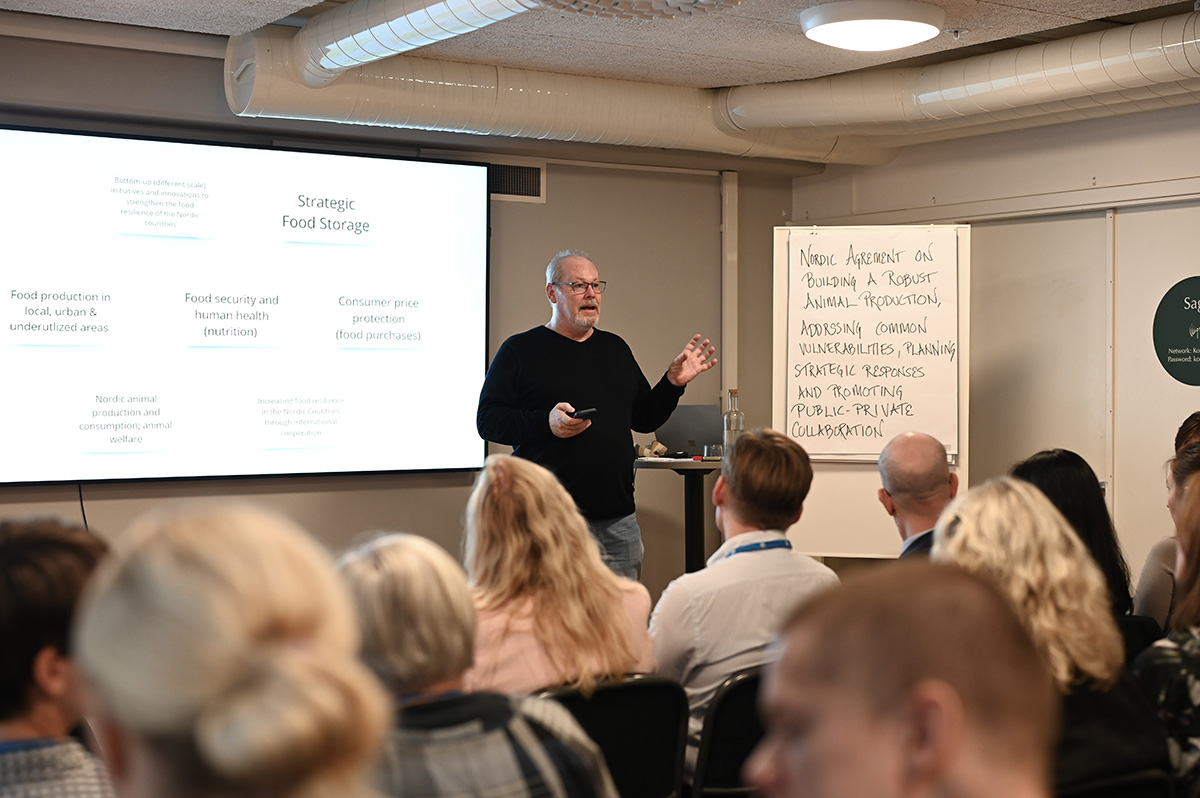
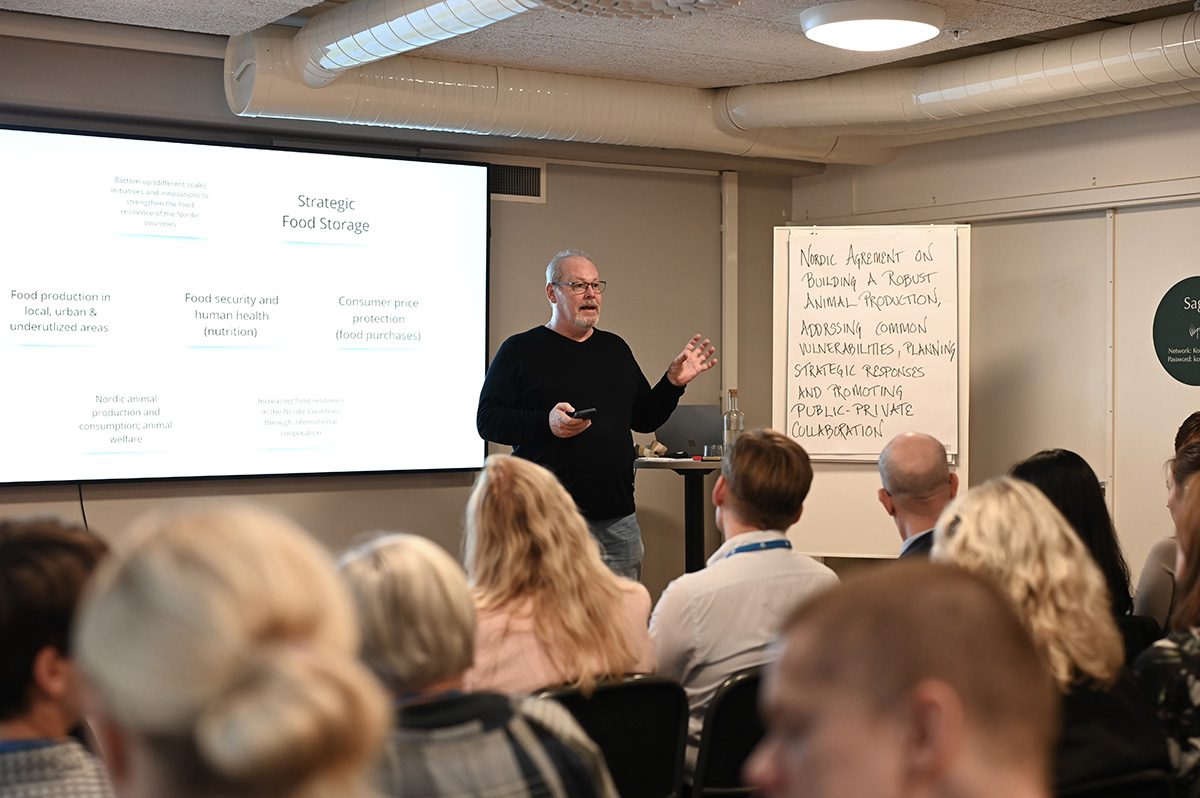
On Day One of the workshop, prompted by a series of “lobbying emails” received on their mobile phone application from fictional interest groups, participants were asked to identify several potential policy responses to the crises presented in several videos prepared specifically for the workshop and tailored to the risks and vulnerabilities of the Nordic region as identified by the project organizers with help from regional government experts. By the end of the workshop, participants working in small groups agreed on a list of eight specific topics where policy action among the Nordic governments might specifically focus, to address significant risks and weaknesses identified by the exercise. Those policy proposals centered on the following areas:
- Establishing a Nordic Food Forum for Resilience to foster bottom-up innovations and strengthen food resilience across the region.Premised on the conviction that Nordic nations can do more to elicit citizen engagement regarding the structure and operation of regional networks along with the fostering of more innovative thinking at local and regional levels, this group focused on the need for establishing common understandings of the risks and vulnerabilities of the region’s food supply as a basis for this Forum. Starting from the principle of transparency, such a forum, they argued, should be governed by Nordic leaders, meet quarterly, and include government representatives, farmer groups, food producer organizations, food retailer representatives, and academics/experts. This approach would, at its core, strengthen common understandings of food environment challenges and lead the way to more resilient systems and societies, prepared to respond more effectively to future crises.
- Implementing strategic food stockpiling to ensure emergency supply security for the Nordic countries.Starting from the notion that a common, regional situational understanding was needed, this group looked at the possibility of having a single, regional system for strategic food stockpiles that would benefit from national programs and experience, starting from a clear mapping of risks, resources and response capabilities. Such an approach, they reasoned, would spread the risk of bottle-necks and shortages, and allow for a broader regional responses to a given food-supply crisis. Premised upon a strong foundation of public-private cooperation, including the possibility of joint procurement agreements with the private sector managing stock-piles and any subsequent exchanges, this approach relies heavily on the principles of shared trust and regular and reliable communication systems.
- Expanding local food production in urban and underutilized areas to reduce reliance on imports.This group examined how to reduce dependencies on foreign food supplies, including by proposing strengthened local production of essential products and closer collaboration at various policy levels. This group proposed enhanced cooperation among producer groups within the region, along with enhanced public-private collaboration. Joint procurement agreements could be established to enhance cooperation and economies of scale, along with strengthened networks of producers and retailers, accompanied by appropriate legal tools to facilitate the augmentation of such enhanced ties and arrangements.
- Enhancing food security and nutrition to ensure health outcomes amidst shortages.This group examined how to prepare and sustain a coherent policy environment that can ensure positive human and environmental health outcomes, simultaneously, while strengthening regional self-reliance in anticipation of future external disruptions to the importation of key food supplies. Among their various policy recommendations, enhancement of local production and improved diets was particularly emphasized, to reduce import dependency on foreign-supplied products and reduction of unhealthy food options. This approach would prioritize strengthening of citizen food literacy and education along with heightened awareness of the impacts of food environments on societal resilience.
- Introducing consumer price protections for staple foods, alongside policies like price caps, allowances for vulnerable groups, and revised trade agreements.This group reasoned that during any significant food supply crisis prompted by military conflict directly affecting their region, a key aspect of resilience would be the ability of Nordic governments to quickly identify and respond to the social needs of its most vulnerable populations through effective social safety net programs. Not only is a clear and common understanding of such “vulnerable” groups needed for prompt delivery of required services, but also certain restrictions could be immediately applied on the import/export of certain goods deemed critical to safeguarding regional food supplies – considered in light of international rules, treaties and obligations (e.g., EU, NATO). First among proposed crisis responses would be the application of “price caps” for consumers on essential food products, intended to avoid price-gauging and profiteering to ensure availability and access to a basket of nutritionally-adequate and affordable foods.
- Crafting a Nordic agreement on animal production to address common vulnerabilities, promote public-private collaboration, and facilitate strategic responses.This group, after choosing to minimize attention on the thorny topic of reduced consumption of animal proteins – in lieu of more environmentally sustainable, plant-based food sources, focused on how to develop a regional agreement on animal production, to safeguard both livelihoods, regional food supplies, and enhanced public-private collaboration during times of crisis. A regional response, they assured, would facilitate quicker responses at regional level, including additional collaboration on alleviating supply shortages across Nordic cooperation when/where needed.
- Increasing Nordic food resilience through international cooperation to strengthen food system support networks.This group first looked into the possibility of developing and/or strengthening ongoing diplomatic and commercial ties with trading and development partners in food exporting countries where - in times of emergency - special trading preferences could be established to prioritize exports to the Nordic region. Eschewing this approach, deemed as overly colonialist/mercantilist by group members, this response sought instead to strengthen the overall open, global trading system which would ensure the free and smooth flow of food supplies even in the face of supply-side disturbances – whether from climate change or international conflict.
- Addressing food safety challenges to ensure standards under crisis conditions.This group focused mainly on the issues linked to a “One Health” approach to food systems, involving the holistic view of human, animal, and environmental health. Among its recommendations and suggestions for further policy attention was a close look at the impacts of over-use of antibiotics on domesticated animal herds, and the resulting anti-microbial resistance (AMR). The group proposed that Nordic governments establish regional standards on antibiotic usage in food production, produced by a regional task force working together in lab settings during peacetime, and together in response to any significant external crises.