6. Marine Heat Waves
Anne Britt Sandø and Silvana Y. Gonzalez
Institute of Marine Research, Norway
Institute of Marine Research, Norway
Marine heat waves (MHWs) are episodes of sharp increases in ocean temperature. There are several definitions, the most used one describes a MHW as “a discrete prolonged anomalously warm water event” (Hobday 2016). A MHW can be described by its duration, intensity, rate of evolution, and geographically spatial extent. Individual MHWs have highly different features, but they may (negatively) affect organisms and ecosystems with potentially far-reaching socio-economic consequences.
There has been more focus on MHWs in other (generally warmer) parts of the world, but also in Nordic waters one must be prepared. For example, Mohamed et al. (2022) found that the annual frequency of marine heat waves in the Barents Sea increased by 62% from the period up to 2004 to that from then on. From 1982–2020 half of the days with heat wave status in the Barents Sea were in the most recent decade. At the present global mean temperature of around 1 °C above preindustrial value, the North Sea and Norwegian Sea experience a frequency of MHWs 2–4 times the preindustrial probability. In a world with 3.5 °C warming, the relative probability is estimated to increase to 20-30 times that of preindustrial times (Borgman et al. 2022). The Borgman et al. (2022) report, ordered by the Norwegian Environmental Agency, reviewed and evaluated literature and concluded that scientific papers focused on MHWs in the Nordic Sea areas are few and saw a need for further work.
In Norway IMR and NERSC, collaborating within the Bjerknes Centre for Climate Research, have an ongoing project on characterising historical MHW events in Nordic waters (S. Gonzalez et al., work in prep.). Although not predictions, knowledge of Nordic MHWs is highly relevant for understanding the future climate and its impacts. This work examines both causes of MHWs in high latitude marine systems and their impacts on biological communities and ecosystems. They distinguish between surface MHWs, heavily influenced by local atmospheric conditions, and near-bottom MHWs, determined more by advection/currents in the ocean. The data applied are surface and near-bottom temperatures from TOPAZ reanalysis (1991–2022, 12.5 km resolution). The main findings of S. Gonzalez et al. so far are i) increasing trends in surface and near-bottom MHW frequency and intensities (Fig. 31), ii) highest surface MHW frequency along the Norwegian coast but low intensity and not persistent. Highest intensities around Svalbard and Barents Sea (Fig. 32), iii) near-bottom MHW characteristics depending on bathymetry. Highest frequencies in the shelf-break area and longest durations at >1000 m depth, and iv) near-bottom MHWs less frequent but more persistent than surface MHWs.
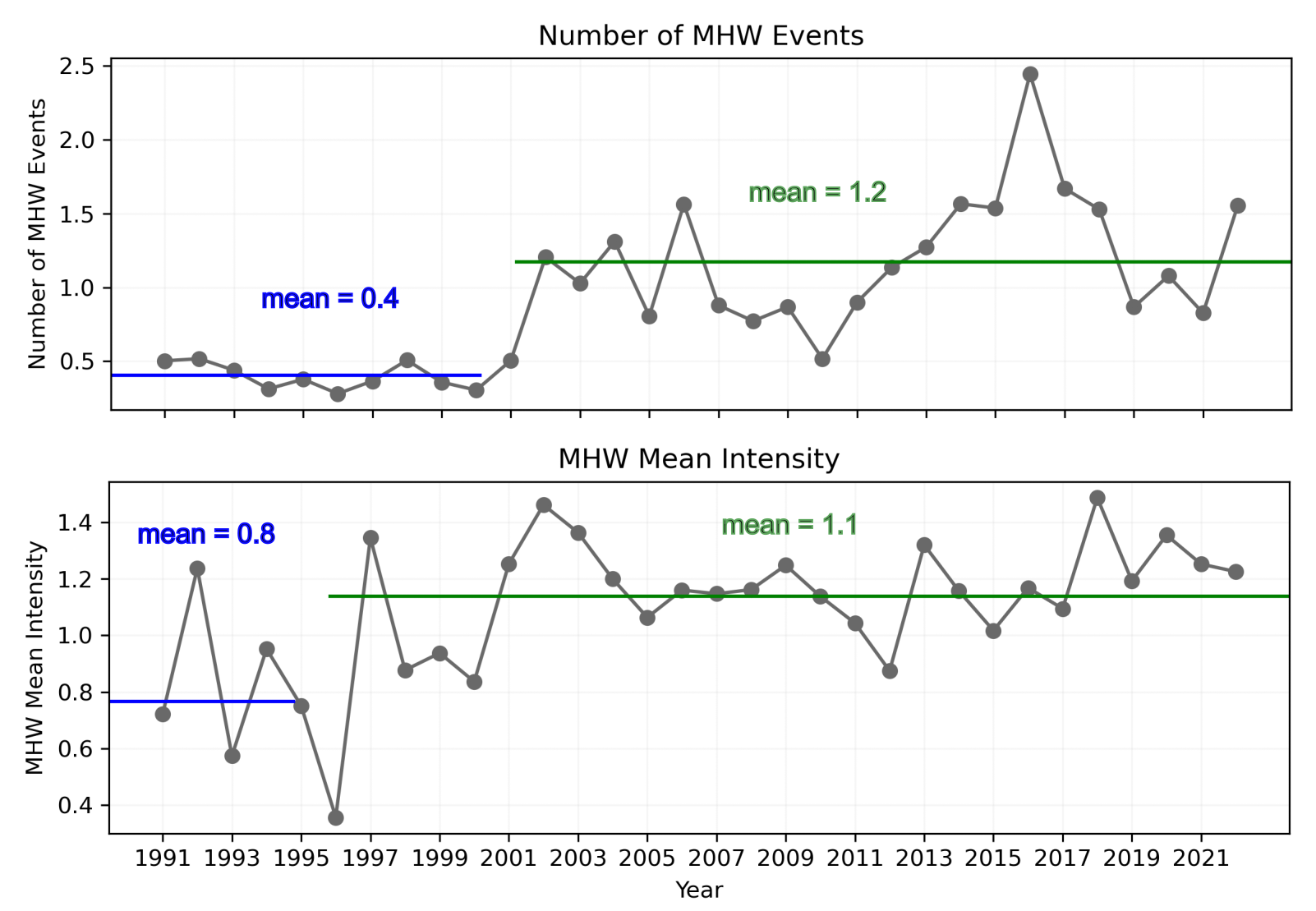
Figure 31. Spatially averaged surface MHW trends. Number of events per year following MHW definition in upper panel and mean intensity (°C) in lower panel. Trends for the whole period shown as stippled line, means for two main periods indicated in respectively blue and green.

Figure 32. MHW trends, changes 1991–2022. Left surface MHWs, right near-bottom MHWs. Number of events per year following MHW definition applied in upper panels and mean intensity (°C) in lower panels. Horizontal axis is degrees longitude, vertical axis is degrees latitude, colour scales are trends. Note different scales for both frequency and intensity between surface and near-bottom MHWs. S. Gozalez et al., work in progress.