1. Introduction
In its Sixth Assessment Report (AR6), the United Nations’ Intergovernmental Panel on Climate Change (IPCC) accentuates that climate change is even greater and clearer than previously assumed and that the effects on humans and nature will be extensive (IPCC 2022). Further, IPCC (2019), states that the ocean so far has acted as a buffer against climate change, but climate change now alters the ocean in many ways and consequences for nature and humanity are sweeping and severe. The changes affect physical properties of the ocean (including sea temperature, sea level, ice coverage, current patterns, mixed layer depth) and biogeochemistry (oxygen and nutrient levels, pH, and more). Many marine species and ecosystems will face environmental conditions outside what they are adapted to, and future impacts are expected to be pronounced.
To prepare the Nordic countries significant marine based industries (including aquaculture, fisheries, transportation, tourism and much more) for the unavoidable changes and maintain the region’s leading role in climate and environmental policy, it is essential to have the best possible knowledge base about future climate changes and their effects on our marine areas. This report focuses on The Baltic Sea, North Sea, Norwegian Sea, and Barents Sea (Fig. 1). Note that when we refer to “the Nordic sea area” or similar this covers all these seas, sometimes also including The Iceland- and Greenland Sea, although these two seas generally are less discussed.
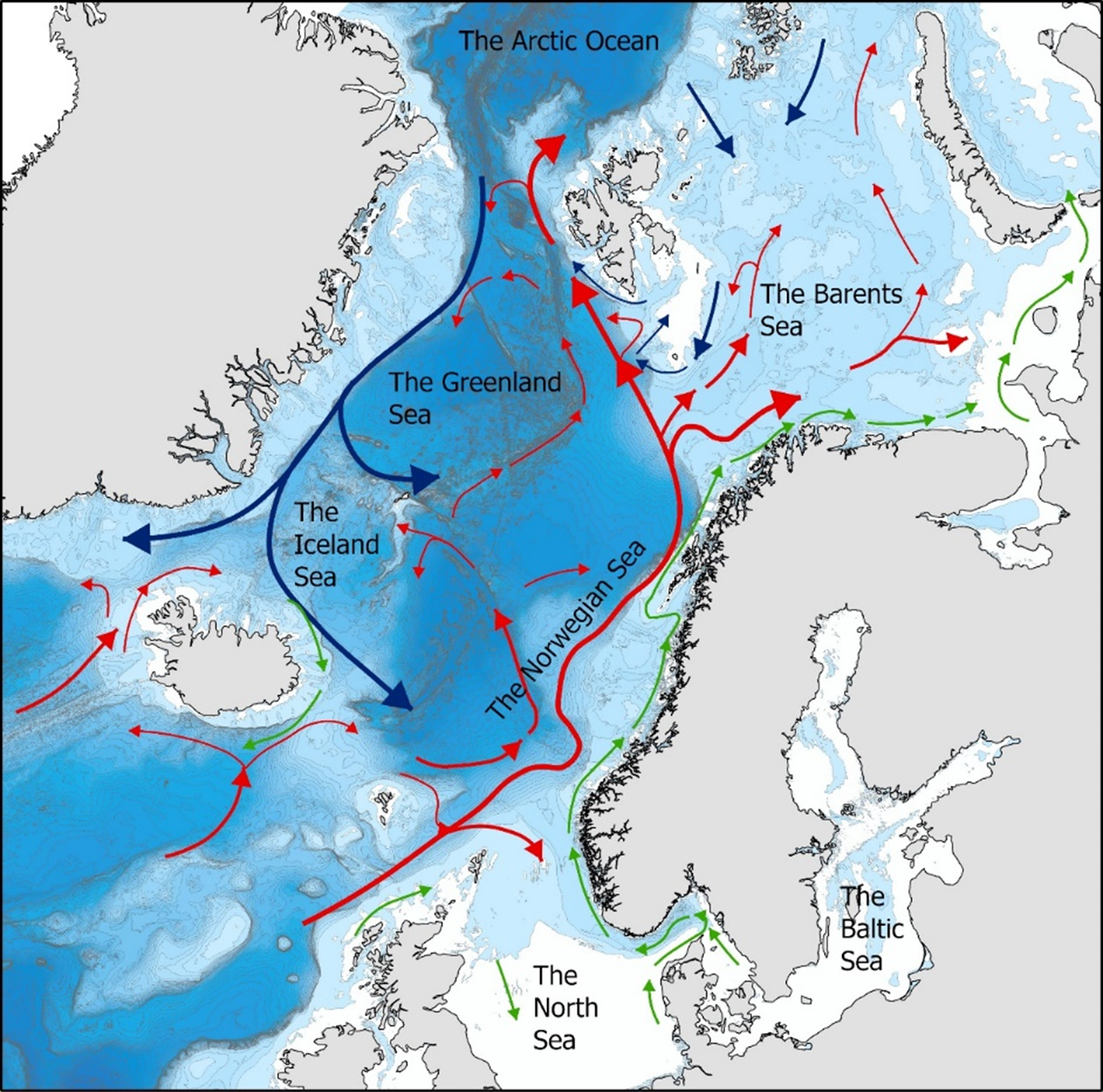
Figure 1. The main ocean regions covered in this report and dominating currents. Red arrows show warm close-to-surface (Atlantic) ocean currents, blue arrows cold deeper ocean currents, and green arrows coastal currents. Graphics by Per Arne Horneland, IMR.
This is especially the case since these seas have characteristics that distinguish them from many others and may make them especially vulnerable to future climate change (Table 1). The Nordic countries are wealthy and well organised, but still the high rate of the projected development of climate change in our region may make it extra difficult for states, society and the affected industries to adjust and implement adaptive measures.
Region | Key characteristics |
Baltic Sea | The Baltic Sea is a shallow, near-enclosed sea with low salinity and limited water exchange, making it prone to eutrophication. The health of key fisheries (cod, herring, sprat) is tied to the sea’s unique environmental conditions and face challenges from overfishing, pollution, and habitat degradation. Climate change is expected to further increase surface temperatures, shorten ice cover period, and lower the salinity and oxygen levels further. Human uses include fishing, maritime transportation, tourism, and offshore wind farms. |
North Sea | The North Sea is a shallow semi-enclosed northeastern arm of the Atlantic Ocean, with significant oil and natural gas reserves, as well as busy shipping lanes and historically rich fishing grounds. Consequently, the North Sea has an extensive total burden from many other human impacts, including eutrophication, habitat damage and intense fishing, in addition to climate change. |
Norwegian Sea | The Norwegian Sea is a deep, open ocean region. Despite the northerly location, most of the area is ice-free year-round due to the warm Atlantic current. Large quantities of phyto- (plant) and zooplankton are produced here. This allows the free water masses of the Norwegian Sea (and neighbouring Iceland- and Greenland seas) to be the habitat of large fish stocks, in particular of herring, mackerel and blue whiting. Their distribution is highly temperature dependent. Ocean acidification has advanced faster here than the global average. |
Barents Sea | The Barents Sea is a comparatively shallow shelf sea. While the southwestern part is heavily influenced by relatively warm Atlantic water masses, the northern and eastern parts are essentially of Arctic nature. The Barents Sea is home to several abundant and commercially harvested fish stocks, notably the “skrei” cod. With climate change some of the largest changes on the planet are expected in the northern Barents Sea, associated with the amplified temperature increase resulting in a fundamental change from a seasonally ice-covered to a (nearly) permanently open ocean system. Maritime transport and tourism is increasing. |
Table 1. Key characteristics and expected consequences of climate change for the seas examined.
Although IPCC AR6 contains an enormous amount of information and has better regional resolution than earlier IPCC assessments, it is difficult to scale down to more detailed local information. From a Nordic perspective it is particularly challenging that the state-of-the-art global climate models used to simulate future climate and climate effects under different emission scenarios (Coupled Model Intercomparison Project Phase 6, CMIP6) do not have sufficient resolution to provide a good basis for decision-making on our regional scale.
Comprehensive regional overviews and evaluations of expected climate change impacts on some Nordic sea areas exist, e.g., the books “Second Assessment of Climate Change for the Baltic Sea Basin” (BACC II Author Team 2015), and "North Sea Region Climate Change Assessment" (NOSCCA; Quante and Colijn 2016). These are still good sources of background knowledge, but climate models are rapidly developing, and these books do not capture this and especially not the knowledge gained from CMIP6 and derived information. Climate change is also an overarching theme in the work of HELCOM (helcom.fi), see, e.g., the very recent report Climate Change in the Baltic Sea (2024), and OSPAR (ospar.org).
The Nordic Council of Ministers (NCM) sees a need to fill such gaps and increase our understanding of the effects of future climate change specifically on the Nordic sea areas. Through the program Marine Management and Climate and specifically the call Climate change in Nordic sea areas towards 2100 NCM and has asked for regional analyses and assessments. NorScen answers to work package 1 of this call. As an important part of our proposal and contract certain Deliverables were agreed upon. The degree of compliance between ordered and actual deliveries of the project is detailed in Table 2.
Description of Deliveries and Activities | Comment /Deviation |
Report with overview of previously published and ongoing works on identified and expected future effects of climate change on marine environment and ecosystems in Nordic sea areas | Delivered as NorScen first report with content as described. Somewhat delayed, but this in agreement with NCM coordinator |
Downscaled physical model fields from simulations for the period 1950–2014 with the regional ocean model NEMO-NAA10km. NEMO-NAA10km covers the North Atlantic from 40 degrees N, the North Sea, Nordic Seas and the Arctic Ocean. For the Baltic Sea and North Sea, corresponding results from an ocean model with 3.7 km resolution. For Limfjorden, Denmark, high-resolution model results from the FlexSem model for the period 2009–2018 will be delivered | Done and described in this report, with some deviation. Applies to Deliverable 2, 3, and 4. For the Norwegian and Barents Seas an updated version of NEMO-NAA10km and NORWECOM.E2E were successfully applied and results produced for historical period and the scenarios SSP1-2.6 (low emissions), SSP2-4.5 (intermediate), and SSP5-8.5 (very high). Due to unexplained unexpected temperature values in the SSP3-7.0 (high) run, we do not report for this scenario For the North Sea and Baltic Sea downscaled fields were successfully produced with the ocean model NEMO-SCOBI. Due to severely late delivery of atmospheric forcing from external source downscaling was done for historical period 1951–2014 and future scenarios SSP1-2.6 and SSP3-7.0 For Limfjorden highly resolved physical and biogeochemical were produced by the FlexSem model according to plan for historical period and scenarios SSP1-2.6, SSP2-4.5, and SSP5-8.5. Due to the late delivery described above alternative input fields had to be and were found, but SSP3-7.0 was left out |
Downscaled physical model fields from simulations of IPCC scenarios SSP1-2.6, SSP2-4.5 and SSP3-7.0 with NEMO-NAA10km and corresponding results for other sea areas. For computational reasons, results will need to be delivered for specific periods ("time-slices"), not the entire period up to 2100 | |
Model fields from the coupled physical-chemical-biological model system NORWECOM.E2E for historical and future simulations as above. The physical model fields from 1. and 2. will be used as a basis for the NORWECOM.E2E runs, the latter will be set up for a smaller area. For the Baltic Sea-North Sea, corresponding model fields from the physical-biogeochemical model NEMO-Nordic-Scobi will be delivered | |
Model fields from the ecosystem model NoBa Atlantis for corresponding historical and future simulations as in No. 3 and 4. NoBa will use the same physical model fields as NORWECOM.E2E, but will additionally take into account various harvesting regimes for commercial species in the system (for example mackerel, herring and cod) | Done. Reported here. Of particular interest are the projected differences in response to ocean warming between SSP2-4.5 and SSP5-8.5 as compared to SSP1-2.6 |
Report/article describing results of analyses based on the future scenarios above. The results from the simulations will be analysed with respect to variation and trends in relevant physical and biogeochemical variables for selected habitats and sea basins to study climate effects on different marine ecosystem species. This analysis will include detailed studies of how sensitive various species and relevant populations are to changes in temperature, oxygen, acidification, primary and secondary production, and sea ice extent | Done, reported here |
Overall assessment of climate change effects on marine ecosystems in Nordic sea areas | Done, brief evaluations/assessment based on our model projections included in this report. For a more comprehensive review please see report from the NorMECC project |
Final report | Delivered |
Additional Activity undertaken and reported here. Possible due to additional NCM funding | A workshop on Economic consequences of climate change towards 2100 for fisheries and aquaculture in the Nordic region was arranged |
Additional Activity reported here | Work on Marine Heatwaves conducted at IMR within another project |
Table 2. Degree of compliance between ordered and actual deliveries.
The first NorScen report briefly summarised the present knowledge of the observed and expected future impacts of climate change on marine environment and ecosystems in the Nordic region (Ottersen et al. 2023). The present report documents the core of the work within NorScen, focusing on downscaling from global to regionally resolved information. We have produced model data fields for the most important physical variables on spatial scales suitable for understanding our sea and coastal areas. To achieve this, we have run regional model simulations for both historical periods and future (IPCC) scenarios to downscale information from global climate models. Based on these physical values, we by means of already developed and proven model systems, have produced data fields on historical and future values also for biogeochemical and ecological variables. Geographically and scale-wise we cover comprehensively and on different scales, from the Danish Limfjord and the Baltic Sea via the North Sea to the Norwegian- and Barents seas. The core of the report is structured according to geographical area, for each we provide information on the methods/models applied, describe and present results, and discuss them. In addition to the Summary given, we also provide an overall assessment of the effects of climate change on the marine environment and ecosystems in the Nordic region. While NorScen and this report provides enhanced knowledge specifically on climate change and its impacts, climate knowledge is an important basis also for assessing the effects of other impacts such as eutrophication and fisheries, as the future of the seas around the Nordic countries and the life in them is a combined effect of many influences.
Through generous additional funding from NCM we were able to arrange a workshop focusing on future economic and societal impacts of climate change on the marine fisheries and aquaculture sectors in the Nordic region. To facilitate this, we brought together a broad group of people working at the interface of natural sciences and societal impacts, including resource economists. The outcomes of the discussions during the meeting and afterwards are reported here.