4. Overview of measures for promoting waste prevention and reuse in the Nordics and beyond
Part 1 of the project identified 50 existing good practices (36 from the Nordic countries and 14 from other European countries) with potential to reduce municipal waste and promote reuse in the Nordics. These practices were selected for their ability to:
- reduce the quantity or harmful impact of waste
- reduce the content of hazardous substances in waste
- support waste prevention and extend product lifespans
- facilitate dematerialisation.
The results provide actionable insights into effective waste prevention and reuse strategies, laying a foundation for advancing circular economy goals in the Nordic region. By showcasing proven practices from both the Nordics and other European countries, the findings highlight transferable solutions that can enhance circularity and minimise waste generation.
Table 4 categorises the identified good practices into distinct groups, while the full list of 50 measures is provided in Annex 1. The examples draw from the Nordic countries as well as Belgium, Germany, the Netherlands, the UK, and Slovakia – countries chosen based on their advanced waste management systems and circular economy initiatives.
Table 4. Categorisation of identified good practices – some examples.
Type of steering instrument | Description | Examples from the Nordics |
Regulatory | Waste prevention measures that actors are obliged to implement by law, including bans, restrictions and other requirements or obligations. |
|
Economic | Tax regulations, subsidies, the introduction of fees and other waste management operations that make 'waste-light' products or services more competitive, incl. green public procurement. |
|
Voluntary | Actions taken by both governmental and non-governmental stakeholders that are not legally binding/obligatory, as well as voluntary agreements among stakeholders that do not necessarily require a political decision-making process but instead require negotiations. Research and pilot initiatives, establishment of reuse centres and networks, and other projects. | Green deals/voluntary commitments
Market-based business models
Municipal actions
Consumer movements
|
Informative | Communication campaigns, educational and training activities, and awareness-raising materials for consumers, businesses, or other target audiences. |
|
Extended producer responsibility (EPR) | EPR is an environmental policy approach that holds manufacturers and importers responsible for the entire lifecycle of their products, particularly after they have been sold. The main objectives of EPR are to reduce waste, promote recycling, and encourage the design of products that are easier to reuse and recycle (OECD, n.d.). This includes the establishment of EPR schemes, whether legally binding at EU level or voluntary, as well as activities that affect the core strategy and operation of the EPR schemes. EPR schemes mean extending the producer's financial responsibility for a product to include the waste management stage. | (Specifics of different EPR schemes were not studied in this project). |
The measures identified included various levels of actions, ranging from grassroots initiatives to governmental steering instruments. The 36 Nordic measures analysed were distributed as follows: regulatory 3%, economic 25%, voluntary 55%, informative 17%. Although the list of measures and steering instruments is not exhaustive, it reflects a quite significant imbalance between regulatory and economic measures versus the more abundant voluntary and informative initiatives.
Of the measures identified, the ones offering the most potential were shortlisted, and based on an expert assessment divided into two categories: ‘low-hanging fruits’ and ‘challenging but effective’. The category ‘low-hanging fruits’ includes measures that were assessed to be relatively easy to implement in the Nordic countries, and where the potential to reduce the quantity of waste was seen to be relatively high. These measures provide examples of ways to fast-track waste prevention in the Nordic countries (Figure 5).
In the category of ‘challenging but effective’, the potential to reduce the quantity of waste was assessed to be high, but the implementation was seen to be more demanding (Figure 6).
Examples of effective and easy-to-implement waste prevention measures | |
|---|---|
Material efficiency commitments and green deals | |
In Finland, the food and packaging industries and the food retail sector made the first Material Efficiency Commitment 2019–2021, encompassing nearly the whole value chain. Th general objective of the commitment is to improve the profitability and reduce environmental impacts of food production, packaging and distribution. The commitment includes elements such as the target of reducing food waste by 50% by 2030 in addition to reducing of the amount of plastic in the containers and increasing reuse of packages. | |
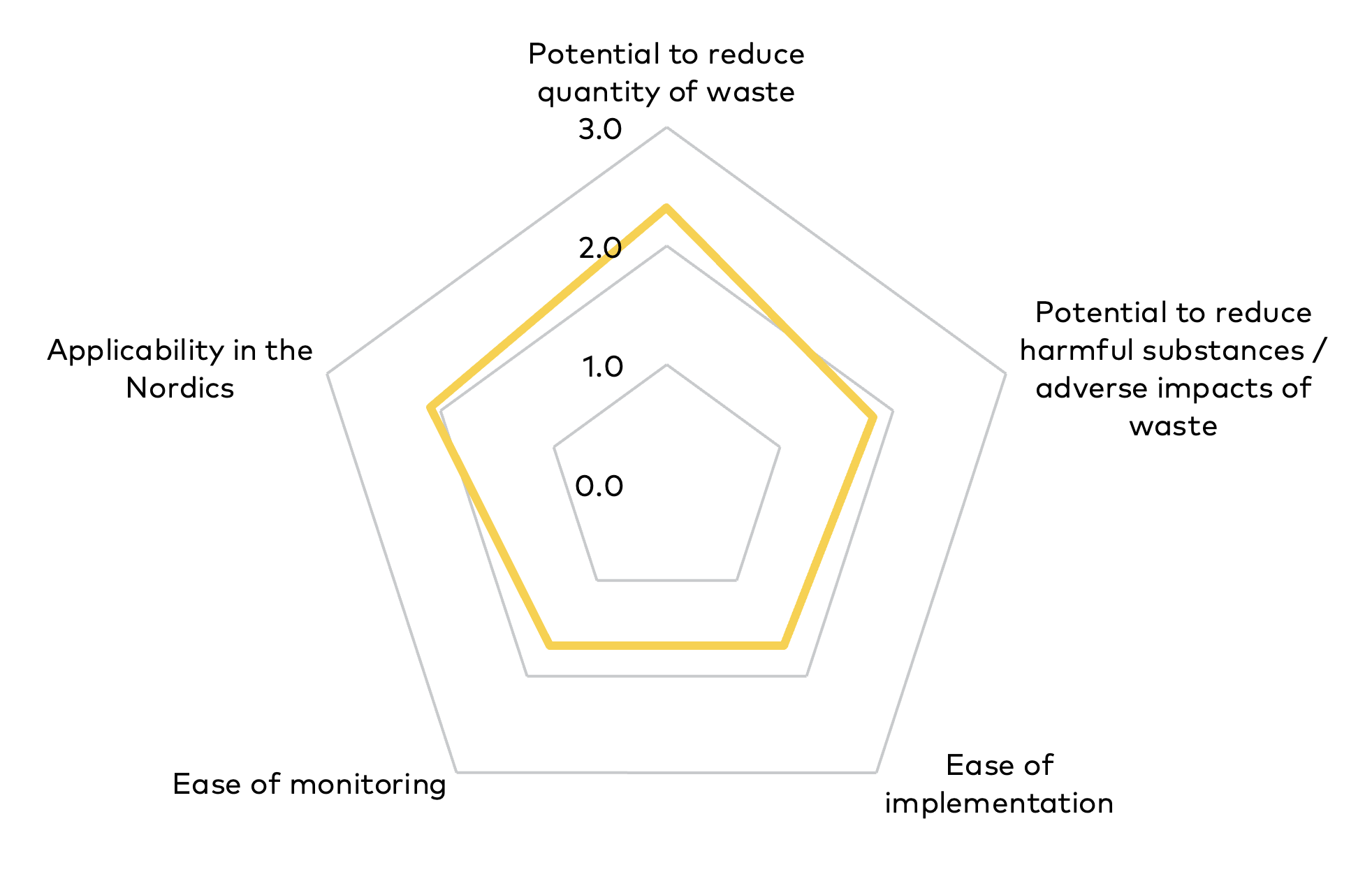 | The general attitude of experts towards material efficiency commitments was positive, with many recognising their potential to drive meaningful change. However, the experts noted that while making voluntary material efficiency commitments is relatively straightforward, achieving the goals set and delivering tangible impact is far more challenging. A key difficulty lies in ensuring that the commitments are sufficiently ambitious, and effective reporting can also pose a significant hurdle. |
Measure | Category | Examples | |
|---|---|---|---|
 | Digital platforms for selling products near their expiration date | Voluntary measure: business models | In Norway, food waste is reduced from restaurants, cafes, hotels etc., by selling surplus foods and drinks through Too Good To Go app. There are similar examples from other Nordic countries (e.g. ResQ in Finland). |
 | Second-hand platforms for private persons and companies | Voluntary measure: business models | Finn.no is the largest second-hand platform in Norway for both private persons and companies. It is exceptionally broad in scope, including everything from properties to various commodities. There are similar platforms (with narrower scope) in other Nordic countries (such as Tori.fi in Finland). |
 | Informative product stamps for consumers | Informative measure | A stamp on food and drink items in grocery stores, to help the consumer to understand that some foods and drinks still can be ok after the expiration date. |
 | Reuse stations | Voluntary measure: municipal actions | Norway has reuse stations for used items that are not damaged. It is free to pick up items from these stations. |
Figure 5. Examples of effective and easy-to-implement waste prevention measures.
Examples of effective but challenging-to-implement waste prevention measures | |
|---|---|
Concrete ecological requirements for public procurement | |
In Berlin, concrete ecological requirement criteria are made binding for the procurement of various products, construction, and services. For example, in the case of products for IT equipment, among other things, the availability of spare parts and the possibility of repairing them or expanding their performance with replaceable components and expansion interfaces must be guaranteed even several years after production has ceased. | |
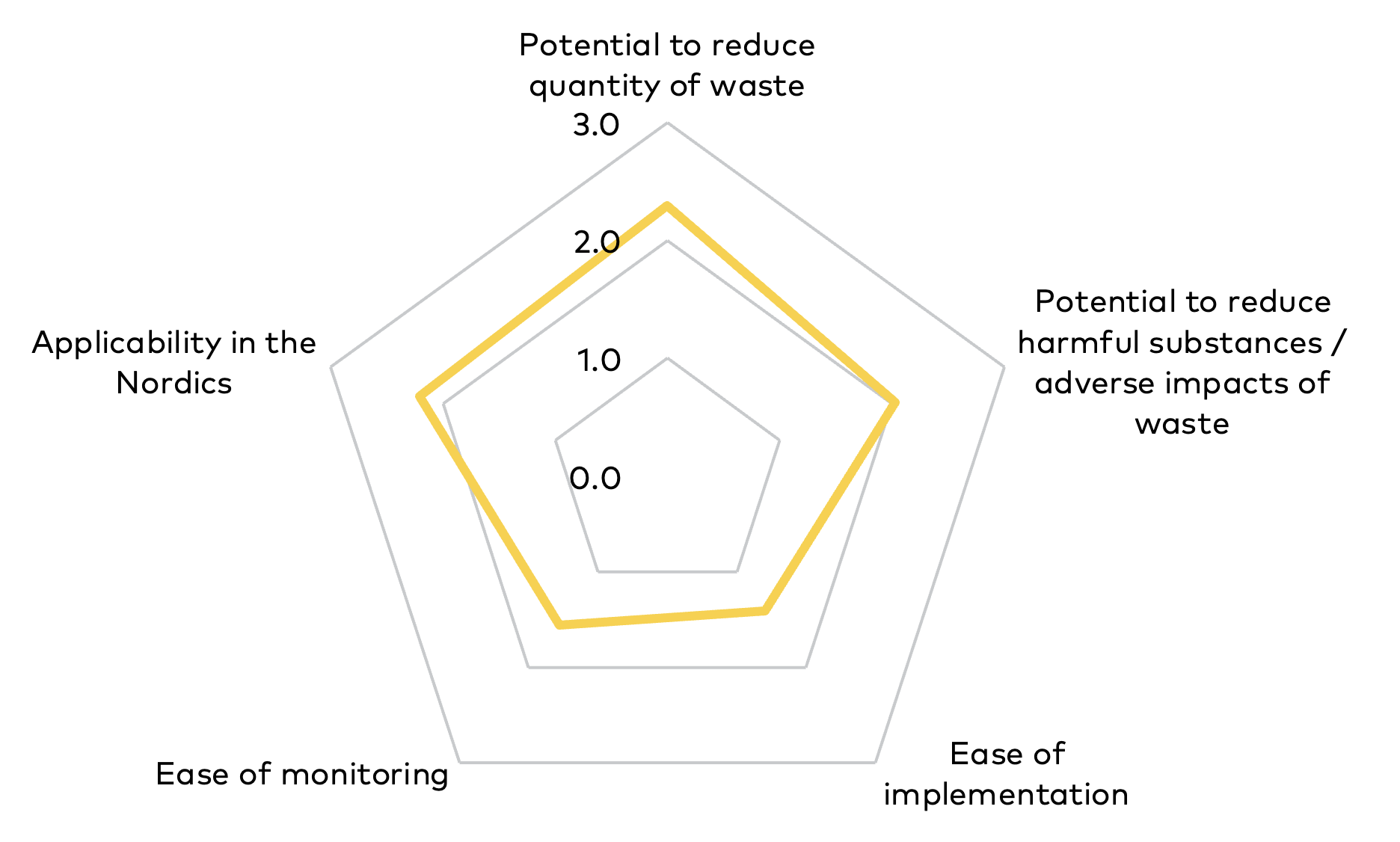 | There was general agreement among experts that public procurement holds significant potential but should rely on factors like Life Cycle Assessment (LCA) to avoid greenwashing. Respondents emphasised the need for clear, prioritised criteria to address environmental concerns effectively, especially when objectives to do with the climate, environment and nature may conflict. Many also highlighted the importance of environmental factors being given sufficient weight, even when monetary considerations are involved. |
Measure | Category | Examples | |
|---|---|---|---|
 | Consumer movements against food waste | Voluntary measure: consumer movements | Stop Wasting Food movement (Stop Spild Af Mad) – is a non-profit organisation in Denmark founded in 2008 that collaborates nationally and internationally with politicians consumers and the entire food value chain to combat food waste. As one many examples they also lead Denmark’s biggest online food platform www.GratisMad.dk which helps alleviate food insecurity, minimize food waste and provides free surplus food from local supermarkets and food producers to local charities. |
 | Reduced VAT for repairing services | Economic measure | In Sweden, the VAT rate on services repairing bicycles, shoes, leather products, clothes and textiles was lowered to 12% from the general level of 25% in 2017. In 2022 it was further lowered to 6%. On April 1 2023, VAT-level was changed back to 12% again. |
 | Weight-based pay-as-you-throw (PAYT) pricing | Economic measure | Weight-based PAYT (Pay-As-You-Throw) is a waste management system that charges individuals or businesses based on the weight of their waste. It involves the use of specially designed waste containers or weighing bins to determine the weight of the waste, and fees are applied based on a predetermined rate per unit of weight. |
 | Municipal waste reduction commitments | Voluntary measure: municipal actions | Avfall Sverige – the association of Swedish waste management - has challenged municipalities to a voluntary commitment to reduce the amount of food and incineration waste by 25% by 2025, compared to 2015. Gothenburg Municipality aims to reduce waste from its own institutions by 40% per employee. |
Figure 6. Examples of effective but challenging-to-implement waste prevention measures.
The results of this part of the study showed that the predominance of voluntary and informative measures contrasts with the ambitious circular economy targets set by the Nordics and the EU. The relative lack of regulatory and economic measures, including, for example, concrete ecological requirements for public procurement and VAT reductions, alone are not enough to drive deeper systemic changes in a move towards the circular economy. There is a need to innovate new policies and steering instrument for the circular economy, while scaling existing tools to create a more robust and effective policy mix that supports circularity.
Economic instruments are often seen in environmental policy as an effective way to influence the behaviour of individuals and businesses. Their core idea is to make environmentally harmful activities more expensive while making environmentally friendly actions more economically attractive. Part 2 of the project focused on exploring the potential of economic instruments in waste prevention (Chapter 5).