
Chapter 6: Conclusions and Recommendations
Chapter 6: Conclusions and Recommendations
In The Nordic Textile Collaboration, the aim was to identify and promote solutions for reducing unnecessary consumption, extending the lifespan of textiles, promoting circular business models, strengthening digitalization and traceability in the fashion and textile industry and supporting increased and improved collection, sorting, reuse, and recycling of textiles.
For this purpose, a new Nordic community for knowledge exchange was established across the value chain for textiles and across the four participating countries: Denmark, Finland, Norway and Sweden. A community that brought together companies, citizens, organizations, and research institutions allowing participants to learn from and inspire each other. This community discussed central topics and collaborated on identifying solutions from a holistic perspective, thus reaching mutual understanding across both national and disciplinary borders. During workshops, project participants generated a list of actions that they believed could push the development of a circular textile economy.
This chapter presents the list of actions grouped into three overall recommendations from participants in The Nordic Textile Collaboration:
- Support the growth of circular business models
- Engage citizens in the circular transition
- Make design for circularity the standard
The following section goes through each of the three recommendations, presenting the list of actions as well as the roles that different stakeholders could play in order to make these actions happen in reality.
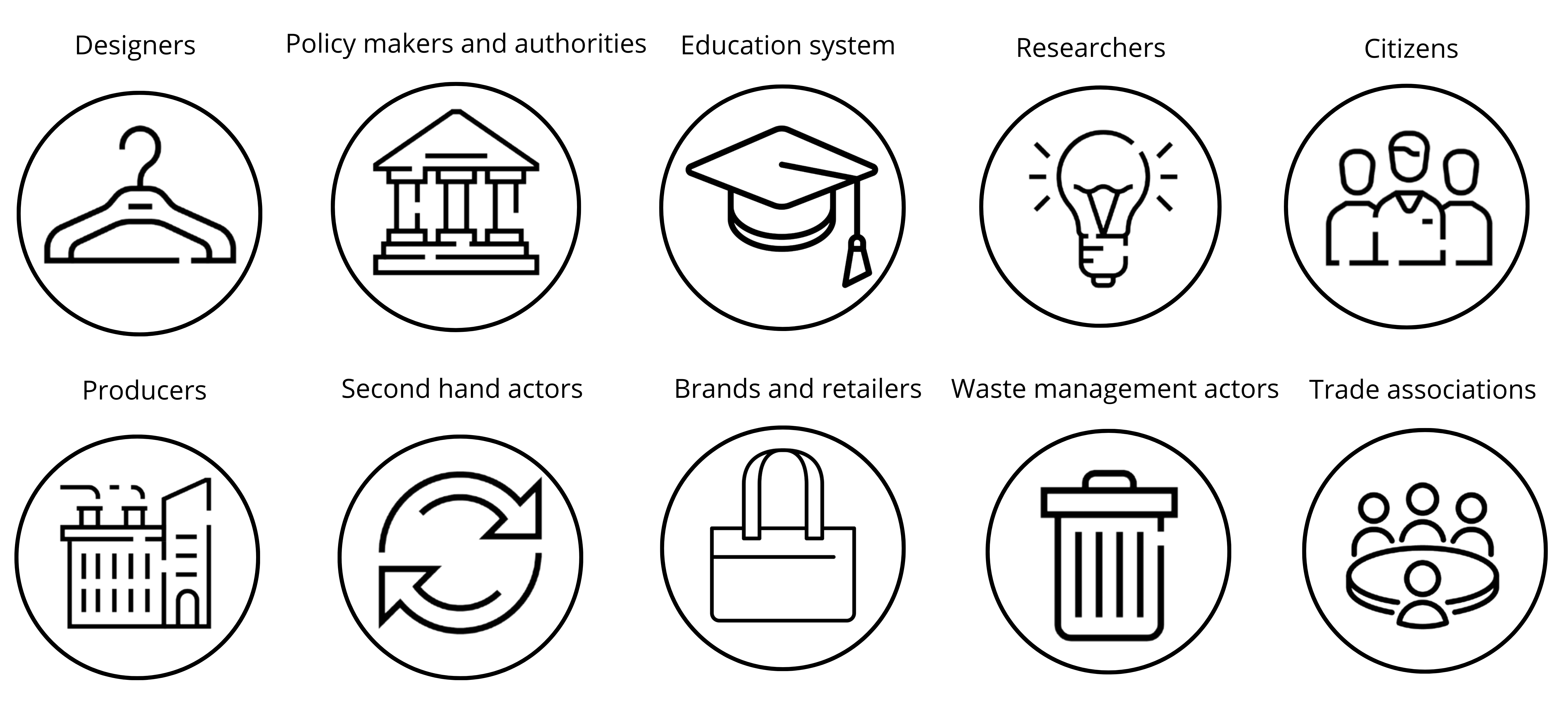
Designers

Policy makers and authorities

Education system

Researchers

Citizens

Producers

Second hand actors

Brands and retailers

Waste management actors

Trade associations

All recommendations represent the views and ideas of project participants; that is, presenters, participating citizens, companies, organizations and researchers. The recommendations are to be seen as a wish list based on the experiences and best practices of project participants. The recommendations primarily concern action supporting the uptake of a circular value chain for textiles. As emphasized by several participants during the project (see Chapter 3, Section 3.2, and Chapter 4, Section 4.2), the environmental impact of textiles will only decrease if the transition implies a reduction in production and consumption rates. Thus, the list of actions proposed here is not complete, and, according to project participants, it will take many more interventions and efforts to lower the environmental impact of textiles and fashion. Still, the following list of actions proposed by participants in The Nordic Textile Collaboration underline that several opportunities for moving in that direction do exist and could be realized.
6.1 Support the growth of circular business models
Circular business models can extend the lifespan of textile products by enabling more use per user, more users per product or users to go beyond physical products. While these are essential properties of circular business models, environmental gains might not be readily apparent. In the project, it was stressed during webinars that circular business models only achieve environmental gains if they contribute to the following goals: avoidance of new production, extension of product life, improved use-phase and reduced waste generation (see Chapter 3, Section 3.2.1).
While these principles for circular business models seem to be widely accepted across the Nordics, the project revealed huge barriers for turning these principles into practice. Participating companies pointed out that, at the moment, circular business models cannot compete with conventional business models when it comes to prices, time of delivery, availability and attractiveness. Participating citizens highlighted that there is a need for developing several sub-types of each circular business model to ensure that services and products fit citizen needs. These include remote services for repairs, easy return models for secondhand items, rental services for different situations (including pregnancy, workwear and festive) and training in do-it-yourself solutions. Accordingly, this opens up lots of unexplored avenues for companies who can earn money from providing new types of services and support functions as an alternative to earning money by producing new textiles.
Thus, according to participants in The Nordic Textile Collaboration, a wide set of actions needs to be undertaken for circular business models to flourish, and everyone has to do their part. The following catalogue of actions covers key recommendations from project participants about how to support the growth of circular business models in Nordic societies.
Action catalogue
Support the growth of circular business models
Establish VAT exemptions or other types of subsidies on repairs, redesigns, secondhand products and rentals, enabling these services to compete with the prices of new products.
According to project participants, this would be a task for policymakers, who could draw on experiences from those countries having successful experience with designing and implementing such interventions. 
Develop online directories and digital maps showing the landscape of product services, with addresses, opening hours and prices (bearing in mind the repairability scale).
According to project participants, this task involves collaboration across the value chain. Product service providers (or the trade associations representing them) should provide input and citizens should be involved in testing it. 


Action catalogue
Support the growth of circular business models
Establish VAT exemptions or other types of subsidies on repairs, redesigns, secondhand products and rentals, enabling these services to compete with the prices of new products.
According to project participants, this would be a task for policymakers, who could draw on experiences from those countries having successful experience with designing and implementing such interventions.

Develop online directories and digital maps showing the landscape of product services, with addresses, opening hours and prices (bearing in mind the repairability scale).
According to project participants, this task involves collaboration across the value chain. Product service providers (or the trade associations representing them) should provide input and citizens should be involved in testing it.



Establish circular solutions inside or close to stores selling new clothes to ensure that repair, redesign, secondhand products and rentals become natural elements of every shopping mall or street.
According to project participants, this could be a joint effort of city councils
and those who rent out space for shops to establish the necessary requirements
and conditions.
and those who rent out space for shops to establish the necessary requirements
and conditions.
Implement easy return models, such as take-back solutions, in secondhand shops and pick-up services for clothes in need of product care or repair, as well as rented outfits.
According to project participants, this is a task for companies that should build on best practices shared, for instance, through participation in sectoral collaborations facilitated by trade associations. 

Expand opening hours through after-hours self-service opening in secondhand shops.
According to project participants, this solution requires the willingness of companies and secondhand retailers to apply flexible frameworks for their service and, eventually, for their employees. 
Shorten delivery times on services and products
According to participants, this would be a joint effort of companies and developers of smart technologies. Higher education institutions can also play a role in training employees to use new technologies, such as 3D design. 

Establish circular solutions inside or close to stores selling new clothes to ensure that repair, redesign, secondhand products and rentals become natural elements of every shopping mall or street.
According to project participants, this could be a joint effort of city councils
and those who rent out space for shops to establish the necessaryrequirements
and conditions.
and those who rent out space for shops to establish the necessaryrequirements
and conditions.

Implement easy return models, such as take-back solutions, in secondhand shops and pick-up services for clothes in need of product care or repair, as well as rented outfits.
According to project participants, this is a task for companies that should build on best practices shared, for instance, through participation in sectoral collaborations facilitated by trade associations.


Expand opening hours through after-hours self-service opening in secondhand shops.
According to project participants, this solution requires the willingness of companies and secondhand retailers to apply flexible frameworks for their service and, eventually, for their employees.

Shorten delivery times on services and products
According to participants, this would be a joint effort of companies and developers of smart technologies. Higher education institutions can also play a role in training employees to use new technologies, such as 3D design.


Upgrade marketing skills of the providers of circular business models to get a broader outreach. For instance, resellers need to know how to display secondhand products in user-friendly and appealing ways and rental services can be promoted as a service for various types of occasional wear.
According to project participants, higher schools of education and trade
associations could collaborate on providing training sessions to providers of
circular business models.

associations could collaborate on providing training sessions to providers of
circular business models.
Arrange guided tours to promote circular business models as an attractive and natural part of society and as something to be proud of.
According to project participants, this activity could be developed through
collaboration between municipal offices and tourist agencies and facilitated by
trade associations.

collaboration between municipal offices and tourist agencies and facilitated by
trade associations.
Upgrade marketing skills of the providers of circular business models to get a broader outreach. For instance, resellers need to know how to display secondhand products in user-friendly and appealing ways and rental services can be promoted as a service for various types of occasional wear.
According to project participants, higher schools of education and trade
associations could collaborate on providing training sessions to providers of circular business models.
associations could collaborate on providing training sessions to providers of circular business models.


Arrange guided tours to promote circular business models as an attractive and natural part of society and as something to be proud of.
According to project participants, this activity could be developed through
collaboration between municipal offices and tourist agencies and facilitated by
trade associations.
collaboration between municipal offices and tourist agencies and facilitated by
trade associations.


6.2 Engage citizens in the circular transition
Overconsumption or “unnecessary consumption” often appears on the list of factors that contribute to the high environmental impact of the fashion and textile industry (see Chapter 1).
Still, this nut seems hard to crack. Several communication campaigns have tried to reach citizens, hoping to change consumer behavior towards an approach that puts less pressure on the planet, but so far with little success, as consumption rates continue to grow year after year.
Thus, communication campaigns are not enough and, inspired by other small-scale projects in the Nordics, The Nordic Textile Collaboration invited citizens to take active part in finding ways to combat overconsumption. In concrete terms, the project wanted to stress the role that citizens can play in a circular textile economy. Through the six-month challenge where participating citizens refrained from buying any new textile products for half a year, their experiences and views were gathered on the circular solutions that they could personally implement to prolong the lifespan of clothes and other textiles already produced, thus reducing the need for new products.
Getting insights from this dedicated group of Nordic citizens, the project revealed a unique overview of barriers hindering citizens from contributing to the development of a circular textile economy. Key barriers included lack of time, motivation, skills, equipment, materials, and overview. These insights led participants to identify a list of solutions. On this basis, the following catalogue presents recommendations for actions that, according to project participants, would support Nordic citizens in playing a more active role in a future circular textile economy.
Action catalogue
Engage citizens in the circular transition
Communicate that everyone can do simple repairs using basic tools at home (e.g., scissors, candles and pliers for fixing zippers, as well as needle and thread for fixing holes).
According to project participants, this is a task for many actors, including the school system and manufacturers, who could promote this idea when selling textile products; textile designers and producers, who need to enable care practices from the very beginning through choice of materials, labelling and instructions; and national authorities, who can support communication through campaigns and educational materials. 



Include product care, repair and redesign in educational systems to provide citizens with basic skills for maintaining textile products to keep them in use for longer.
According to project participants, policy-makers can push for handicrafts to be given high priority in relevant subjects in primary schools, while local design schools can take part in developing educational materials. 

Offer training sessions on the topics of product care, repair, redesign and styling (including sizing), stressing and showcasing how to use your existing wardrobe and what one can do at home without professional help
According to project participants, several actors can play a role: Policy-makers can support the opening of more repair cafés; brands can invite customers to workshops with tailors and stylists; and design schools can offer after-hour courses. 


Advertise the warranty on clothes to make it an active part of citizens’ repertoire.
According to project participants, this is a task for companies that should build on best practices shared, for instance, through participation in sectoral collaborations facilitated by trade associations. 

Promote do-it-yourself (DIY) tips on social media and in the public sphere ensuring easy access to books and tutorials about product care, repairs, redesigns and styling.
According to project participants, different stakeholders can take on this promotion, such as designers, teachers, and influencers, while the efforts could be supported by authorities. 


Organize easy access to equipment and materials for DIY solutions by, for instance, including free areas in secondhand stores with fabric (worn-out clothes), yarn, and DIY instructions, and offering public sewing machines at libraries and in repair cafes.
According to project participants, this constitutes a task for many actors, including public libraries, repair cafés, and secondhand shops. Also, manufacturers of textiles could make it part of their business model to offer citizens instructions and tools to do product care, repairs and redesigns themselves at home or in-store. Likewise, collectors and sorters of textile waste could make it part of their service to pass on materials for DIY solutions found in the discarded fraction. 
Action catalogue
Engage citizens in the circular transition
Communicate that everyone can do simple repairs using basic tools at home (e.g., scissors, candles and pliers for fixing zippers, as well as needle and thread for fixing holes).
According to project participants, this is a task for many actors, including the school system and manufacturers, who could promote this idea when selling textile products; textile designers and producers, who need to enable care practices from the very beginning through choice of materials, labelling and instructions; and national authorities, who can support communication through campaigns and educational materials.




Include product care, repair and redesign in educational systems to provide citizens with basic skills for maintaining textile products to keep them in use for longer.
According to project participants, policy-makers can push for handicrafts to be given high priority in relevant subjects in primary schools, while local design schools can take part in developing educational materials.


Offer training sessions on the topics of product care, repair, redesign and styling (including sizing), stressing and showcasing how to use your existing wardrobe and what one can do at home without professional help
According to project participants, several actors can play a role: Policy-makers can support the opening of more repair cafés; brands can invite customers to workshops with tailors and stylists; and design schools can offer after-hour courses.



Advertise the warranty on clothes to make it an active part of citizens’ repertoire.
According to project participants, this is a task for companies that should build on best practices shared, for instance, through participation in sectoral collaborations facilitated by trade associations.


Promote do-it-yourself (DIY) tips on social media and in the public sphere ensuring easy access to books and tutorials about product care, repairs, redesigns and styling.
According to project participants, different stakeholders can take on this promotion, such as designers, teachers, and influencers, while the efforts could be supported by authorities.



Organize easy access to equipment and materials for DIY solutions by, for instance, including free areas in secondhand stores with fabric (worn-out clothes), yarn, and DIY instructions, and offering public sewing machines at libraries and in repair cafes.
According to project participants, this constitutes a task for many actors, including public libraries, repair cafés, and secondhand shops. Also, manufacturers of textiles could make it part of their business model to offer citizens instructions and tools to do product care, repairs and redesigns themselves at home or in-store. Likewise, collectors and sorters of textile waste could make it part of their service to pass on materials for DIY solutions found in the discarded fraction.




6.3 Make design for circularity the standard
A recurring argument raised by project participants has been that the linear model for textile production stands in the way of achieving a circular textile economy. There is a need to move away from conventional methods and, instead, apply the three principles of design for circularity: 1) Design materials and products to be kept in use at their highest value for as long as possible; 2) Design to eliminate waste and pollution; and 3) Design to improve biodiversity, as well as air and water quality (see Chapter 4).
The application of these three principles requires a lot of effort from everyone in the global value chain and needs to build on insights from several disciplines. In the project, consumption research was proven to have a lot to offer designers. Project participants discussed how better understanding of the use-phase of textiles is crucial for improving design for circularity. Likewise, they highlighted that digitalization can help overcome several of the current barriers to circularity, including the traceability issue, where brands and suppliers struggle with tracking products from cradle to grave, preventing them from reselling products and making valid green claims.
Project participants shared knowledge about new production methods and materials that contribute to the reduction of waste and pollution. It was stressed that, although these methods and materials are ready and available, they are not widely used by the fashion and textile industry. This situation applies, for instance, to biocolors and recycled fibers. The market is already capable of producing biocolors and recycled fibers for most applications, but demand is lacking.
Finally, some presenters pointed to a diverse set of expectations from brands to explain why producers find this circular transition challenging; amongst other factors, they emphasized the necessity of incorporating social aspects into the circularity requirements imposed on producers (see Chapter 4, Section 4.2.5). This is crucial to ensure a fair transition for vulnerable groups within the supply chain.
Participants in The Nordic Textile Collaboration shared experiences and solutions to these issues. On this basis, the following catalogue gathers together a list of actions that, according to project participants, would make design for circularity the standard.
Action catalogue
Make design for circularity the standard
Design textile products that can circulate in society for a long time. Based on what we know about the use phase, we need products that are easy to maintain and repair, easy to redesign in order to accommodate changing styles and needs, easy to resell and easy to recycle.
According to project participants, designers play a key role in developing products fit for circularity, but more actors could take part, including researchers with expertise in textile consumption, as well as governments, who can provide support by providing research and development funds, whereas trade associations can establish forums for knowledge exchange between designers and users. 




Take advantage of the already existing infrastructure for sorting and recycling before establishing new national solutions.
According to project participants, it is important to ensure coordination among public and private actors across countries when it comes to textile waste management, as there is more to win than to lose from collaborating. 


Upgrade skills in 3D design to customize products and reduce the need for prototypes and stocks.
According to project participants, this is a task for educational and research institutions, who can offer training sessions together with trade organizations, and, potentially, supported by government funds. 



Invest in methods and tools for tracing products to support circularity, e.g., by making detailed product information available throughout the lifetime of products. Traceability is key for circularity as a lack of product information stands in the way of effective repairs, resales, rentals, etc.
According to project participants, designers and producers need to pair up with technology providers to achieve two main goals: 1) implement blockchain or other technologies to document environmental footprints; and 2) learn how to collect and analyze data. Project participants mentioned that trade associations can act as facilitators of these collaborations. 


Improve quality of products with recycled fibers by sharing knowledge regarding central issues, such as spinning techniques, and the right mix of recycled and virgin fibers.
According to project participants, producers of recycled fibers and designers can benefit from collaborating on improving the products in alliance with research institutions, potentially supported by public and private funds. 



Develop tests and certification of recycled fibers to increase demand. Currently, the demand for recycled fibers is low. Better information and uniform testing could make producers more comfortable utilizing recycled fibers.
According to project participants, this action can be supported by authorities, research institutions, textile recyclers and textile producers in collaboration. 



Teach designers how to design products with alternative materials and/or recycled fibers, e.g., utilizing material-driven design; asking which garments can be designed using circular materials rather than creating a design and needing to find a circular material to produce it.
According to project participants, this action requires cross-disciplinary collaboration between designers, research institutions and recyclers to create a common understanding of how to use “new” recycled or biobased materials. 


Action catalogue
Make design for circularity the standard
Design textile products that can circulate in society for a long time. Based on what we know about the use phase, we need products that are easy to maintain and repair, easy to redesign in order to accommodate changing styles and needs, easy to resell and easy to recycle.
According to project participants, designers play a key role in developing products fit for circularity, but more actors could take part, including researchers with expertise in textile consumption, as well as governments, who can provide support by providing research and development funds, whereas trade associations can establish forums for knowledge exchange between designers and users.




Take advantage of the already existing infrastructure for sorting and recycling before establishing new national solutions.
According to project participants, it is important to ensure coordination among public and private actors across countries when it comes to textile waste management, as there is more to win than to lose from collaborating.



Upgrade skills in 3D design to customize products and reduce the need for prototypes and stocks.
According to project participants, this is a task for educational and research institutions, who can offer training sessions together with trade organizations, and, potentially, supported by government funds.




Invest in methods and tools for tracing products to support circularity, e.g., by making detailed product information available throughout the lifetime of products. Traceability is key for circularity as a lack of product information stands in the way of effective repairs, resales, rentals, etc.
According to project participants, designers and producers need to pair up with technology providers to achieve two main goals: 1) implement blockchain or other technologies to document environmental footprints; and 2) learn how to collect and analyze data. Project participants mentioned that trade associations can act as facilitators of these collaborations.



Improve quality of products with recycled fibers by sharing knowledge regarding central issues, such as spinning techniques, and the right mix of recycled and virgin fibers.
According to project participants, producers of recycled fibers and designers can benefit from collaborating on improving the products in alliance with research institutions, potentially supported by public and private funds.




Develop tests and certification of recycled fibers to increase demand. Currently, the demand for recycled fibers is low. Better information and uniform testing could make producers more comfortable utilizing recycled fibers.
According to project participants, this action can be supported by authorities, research institutions, textile recyclers and textile producers in collaboration.




Teach designers how to design products with alternative materials and/or recycled fibers, e.g., utilizing material-driven design; asking which garments can be designed using circular materials rather than creating a design and needing to find a circular material to produce it.
According to project participants, this action requires cross-disciplinary collaboration between designers, research institutions and recyclers to create a common understanding of how to use “new” recycled or biobased materials.



Promote a broad definition of quality to make products with recycled fibers more attractive for customers. Quality needs to be understood as a unity of functionality, aesthetics and fashion.
According to project participants, it is important that designers and manufacturers engage in improving the aesthetics and emotional durability of products with recycled fibers rather than solely focusing on improving functional durability. 

Promote a broad definition of quality to make products with recycled fibers more attractive for customers. Quality needs to be understood as a unity of functionality, aesthetics and fashion.
According to project participants, it is important that designers and manufacturers engage in improving the aesthetics and emotional durability of products with recycled fibers rather than solely focusing on improving functional durability.


6.4 Final remarks
This report has presented key take-aways from The Nordic Textile Collaboration – a project carried out from 2022–2024 with participation from Nordic companies, citizens, organizations and research institutions. The aim of providing this comprehensive account of project activities and outcomes is to share experiences and establish an overview to build on for new initiatives. Instead of starting from scratch, it is hoped that future initiators will continue what has been started and consider the recommendations in this report when designing new projects and interventions.
As a final remark, it is important to highlight that common to all solutions listed in this report is that a) they have to bear environmental gains in mind; b) they imply development of new skills at all levels of society; and c) they require long-term commitment from everyone. In addition, it is important to stress that the proposed actions are interdependent. Circular business models will never grow without more people demanding and using them. Circular business models need to incorporate principles for circular design as alternatives to linear production methods to achieve environmental gains. Likewise, circular design principles will remain theoretical unless business models use them, and citizens demand textiles designed according to those principles. The overall aim of the transition needs to be to reduce the environmental impact of textiles and fashion. The uptake of a circular textile value chain contributes to achieving this but only if interventions and activities are designed for it.
Put briefly, there are roles and tasks for everyone on the agenda of a circular textile economy, and there is a strong need for continuous collaboration, locally, nationally, across the Nordics and globally to achieve progress and a more circular future.