3.2 Key take-aways from webinars and workshops
Six webinars and three workshops were organized for participants in Active Textile Society:
- Three webinars with six presentations held in the fall 2023 to prepare participants, ensuring a shared understanding of key concepts, such as the basic ideas of circular economy and circular business models (see sub-section 3.2.1), as well as introducing key figures about current textile consumption patterns in the Nordics (see sub-section 3.2.2).
- Three webinars with six presentations were held during the six-month challenge (January–June 2024), focusing on selected circular business models, including repair, redesign and product care (see sub-section 3.2.3), reuse and resale (see sub-section 3.2.4) as well as rentals and styling (see sub-section 3.2.5). After each webinar, online workshops were hosted where participants discussed barriers and identified solutions to the different circular business models.
Relevant presenters for the webinars were identified using the mapping report (see Chapter 2) as well as advice from affiliated partners to the project, including the steering committee and the reference group. All presenters were chosen based on their expertise, their extensive work on the selected topics for years, and their ability to present the latest cutting-edge knowledge. The webinar presentations were recorded and are available on the project website alongside slides from all the presentations.
Webinar presentations are available on the project website: https://mst.dk/erhverv/groen-produktion-og-affald/affald-og-genanvendelse/affaldshaandtering/affaldsfraktioner/tekstilaffald/the-nordic-textile-collaboration
3.2.1 Pre-challenge webinars about circular business models
Three presentations held in the fall of 2023 provided a common understanding about the principles of circular business models.
Webinar presentations about circular business models
Circular business models in the Nordics by Kia Egebæk, project manager at the Nordic Council of Ministers’ vision project "Product Service Systems in the Nordics". Presentation held on September 27, 2023. Learn more about the project here: http://www.pssinthenordics.com
Textile consumption trends: Mind the gap(s) by Susanne Nejderås, textile strategist at Science Park Borås. Presentation held on September 27, 2023. Learn more about the project here: https://issuu.com/hogskolaniboras/docs/mindthegaps_230623_final?fr=sNmNlMDUzMjQ5OQ
The Circular Toolbox by Gwen Cunningham, project manager at Circle Economy Foundation (presented by Louise Munkholm, project coordinator of The Nordic Textile Collaboration at the Danish Environmental Protection Agency as Gwen Cunningham was unavailable). Presentation held on December 13, 2023. Learn more about the project here: https://www.thecirculartoolbox.com/
The following sections summarize key take-aways from the webinar presentations and the workshop.
Take-aways from “Circular business models in the Nordics”
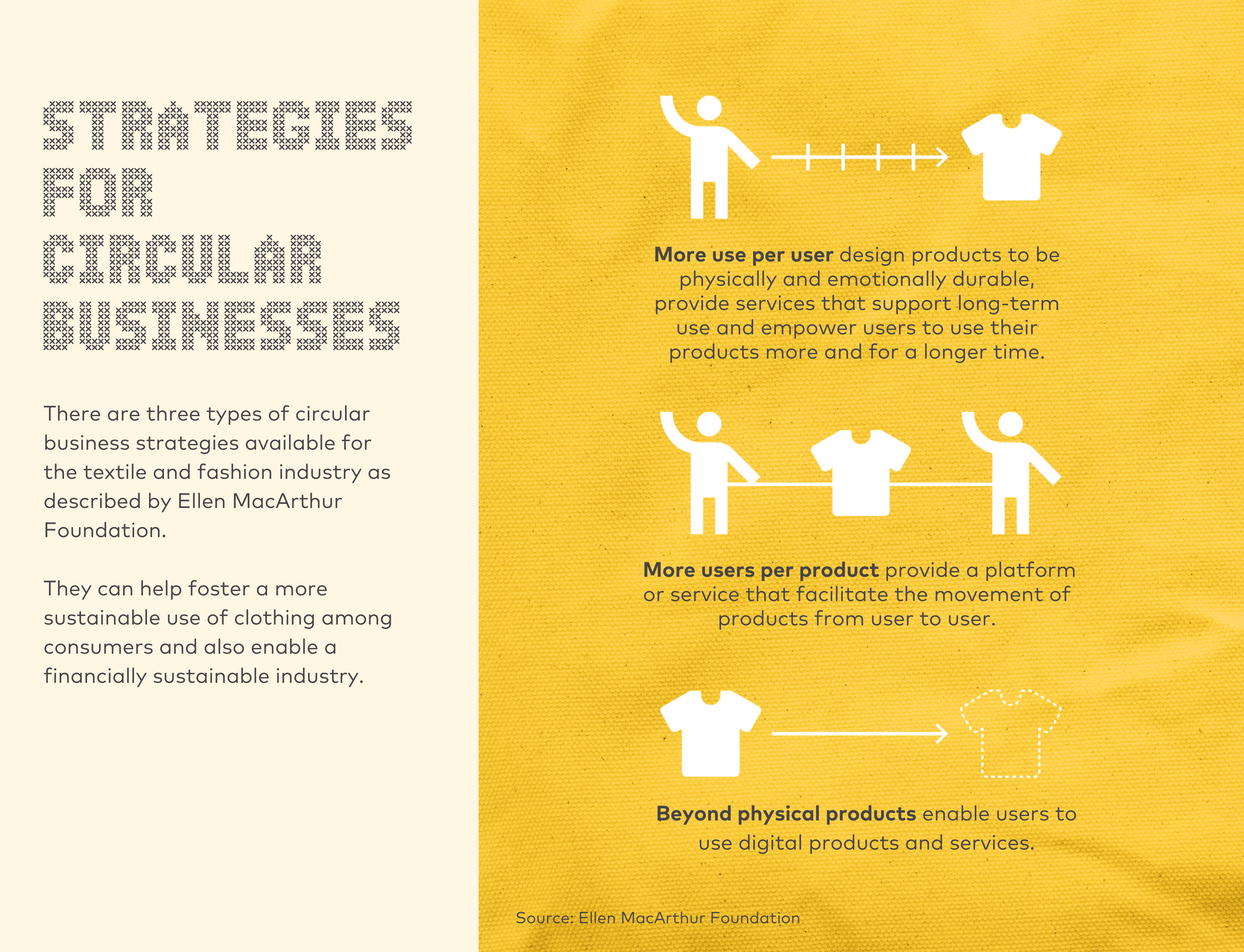
In her presentation, Kia Egebæk focused on how to contribute to the extension of textile lifespans from a business perspective. She presented three types of circular business strategies available for the textile and fashion industry, as described by the Ellen MacArthur Foundation:
Infographic developed by Holm Kommunikation based on webinar presentation
The first set of strategies enables more use per user by, for instance, designing products to be physically and emotionally durable, providing services that support long-term use, and empowering users to use their products more and for a longer time.
The second set of strategies enables more users per product by, for example, providing a platform or service that facilitates the movement of products from user to user.
The third set of strategies enable users to go beyond physical products by using digital products and services.
According to Kia Egebæk, these strategies come into play when companies set up product service systems (PSS). In PSS models, products are sold as services, e.g., through renting, leasing and sharing. Thus, the producer retains ownership of the product, enabling more use per user, more users per product and – in rare cases – users to go beyond physical products.
Kia Egebæk stressed that according to a study done by McKinsey, 71% of consumers are interested in using more environmentally friendly consumption practices, including circular business models such as resale and rental and refurbishment.
Global Fashion Agenda and McKinsey & Company. CEO Agenda 2020: COVID-19 Edition. https://globalfashionagenda.org/resource/fashion-ceo-agenda-2020-covid-19-edition/ (accessed 10-09-2024).
Ellen MacArthur Foundation, Circular business models: Redefining growth for a thriving fashion industry (2021). https://www.ellenmacarthurfoundation.org/fashion-business-models/overview (accessed 10-09-2024).
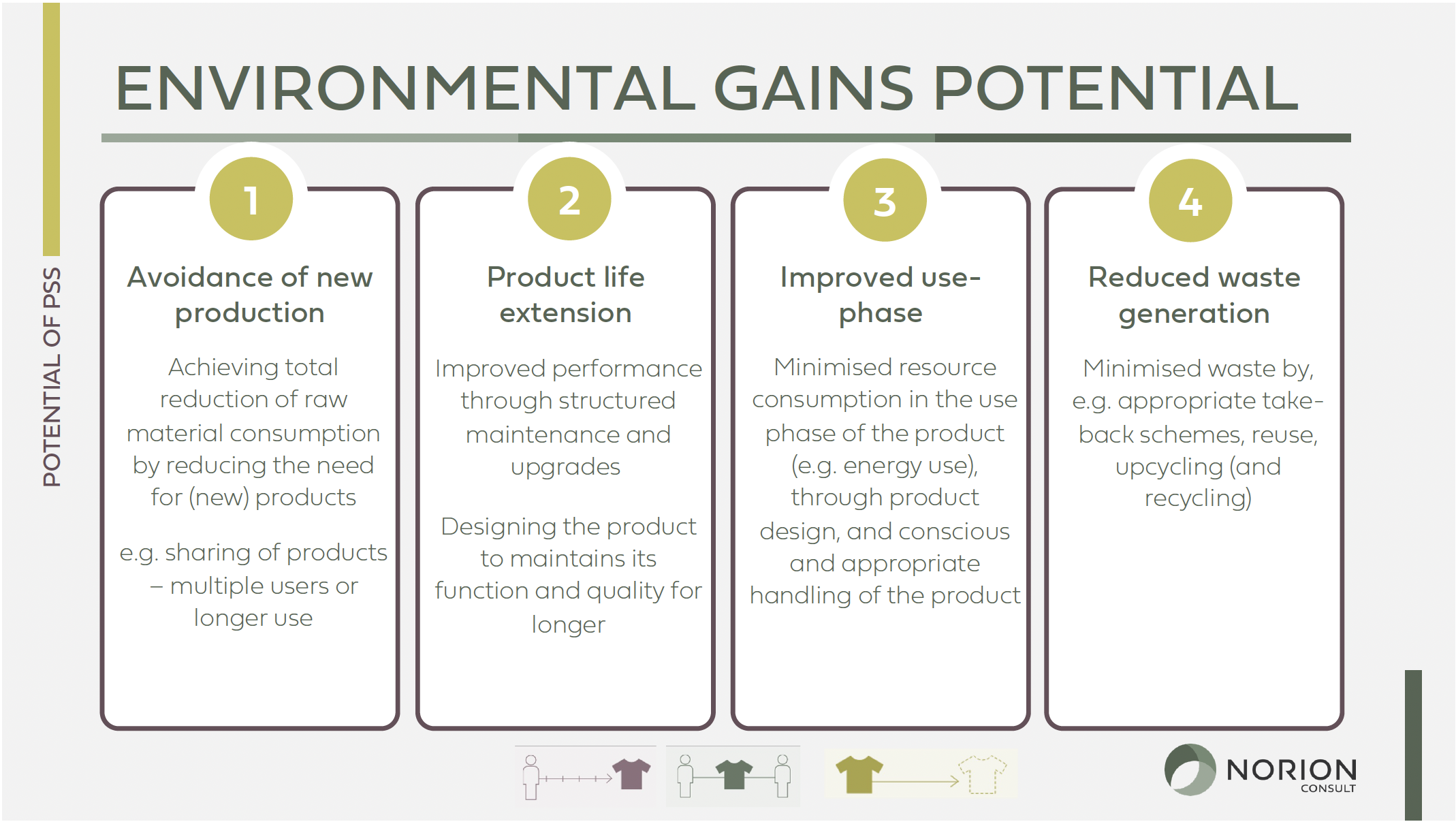
Finally, Kia Egebæk emphasized that PSS – or circular business models in general – are no guarantee of a circular economy or reduction in environmental impact: It all depends on how the system is organized. On this topic, Kia suggested that companies focus on achieving at least one of four goals to ensure environmental gains compared to traditional linear business models:
Source: Webinar presentation. Find slides and recordings on the project website.
Conversely, if PSS is not organized in accordance with these goals, the environmental gains will be limited or completely absent.
Take-ways from “Textile consumption trends: Mind the gap(s)”
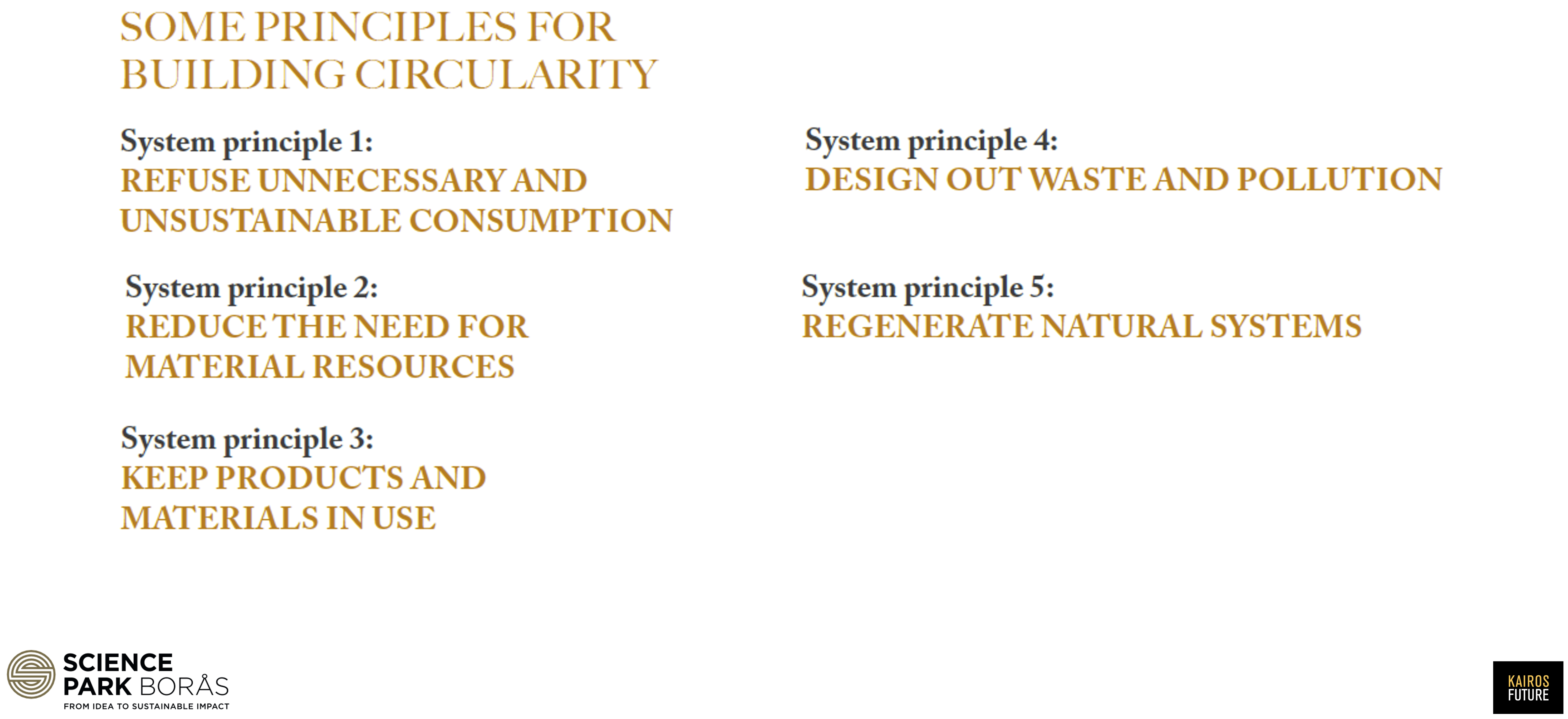
While Kia Egebæk’s presentation focused on circularity from a business perspective, Susanne Nejderås introduced a broader approach, presenting five principles for building circularity in society:
Source: Webinar presentation. Find slides and recordings on the project website.
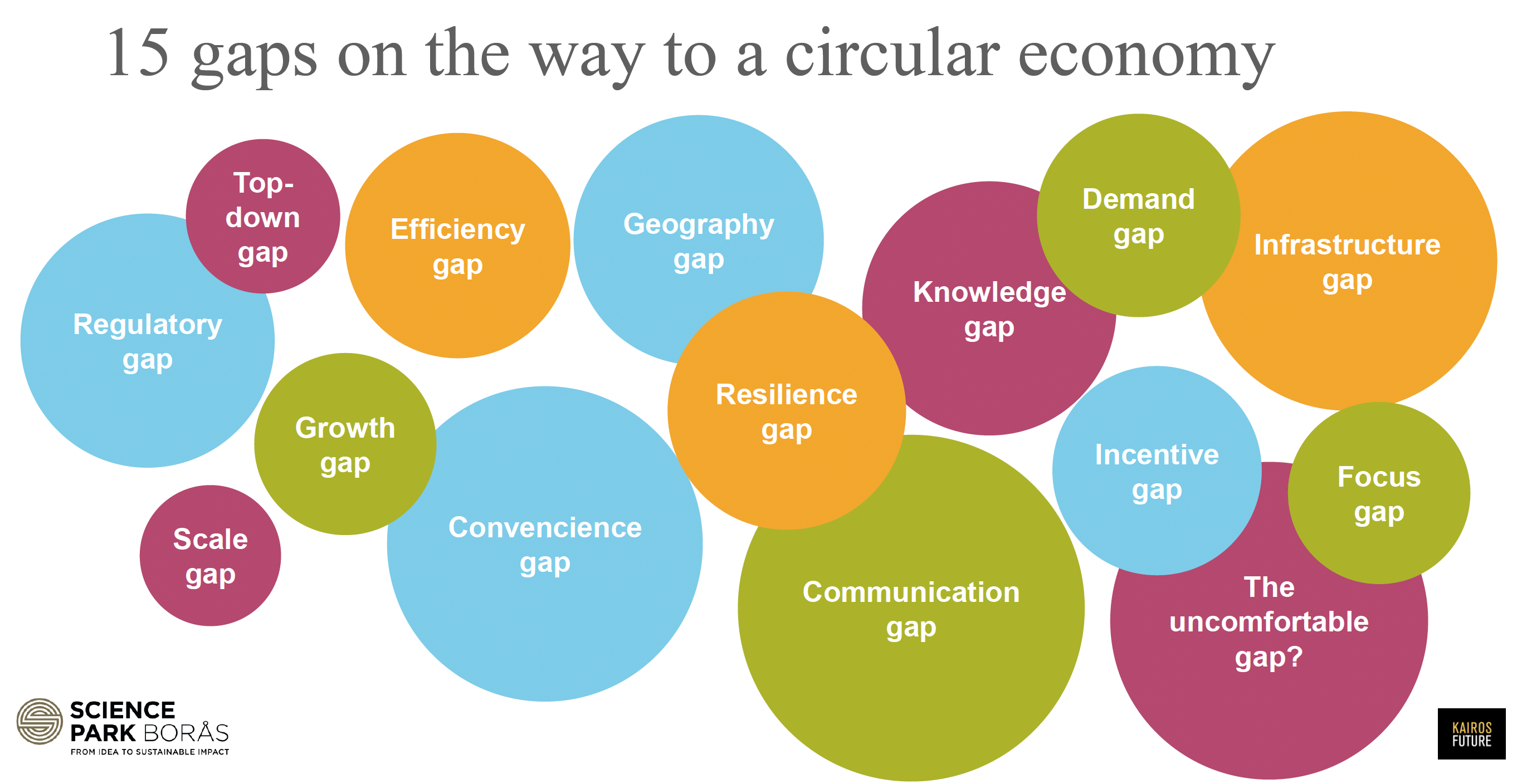
Susanne Nejderås stressed that while these five principles are key, they cannot work unless stakeholders overcome current gaps, referring to the report “Mind the gap(s)”. The report presents 15 gaps that must be overcome to achieve a circular textile economy.
Source: Webinar presentation. Find slides and recordings on the project website.
Just as Kia Egebæk did in her presentation, Susanne Nejderås highlighted the need to be aware of the risk of losing environmental gains related to circular business models. Susanne Nejderås added that obtaining environmental gains through circular business models is a responsibility of not only companies but of society.
Take-aways from “The Circular Toolbox”
Due to a last minute cancellation from Gwen Cunningham, project manager of The Circular Toolbox, the webinar showed a video recording available at YouTube with Gwen Cunningham presenting The Circular Toolbox (see the video here: https://www.youtube.com/watch?v=xOnRTlfbh1o) and shared general lessons from the project based on material available at The Circular Toolbox website: https://www.thecirculartoolbox.com/
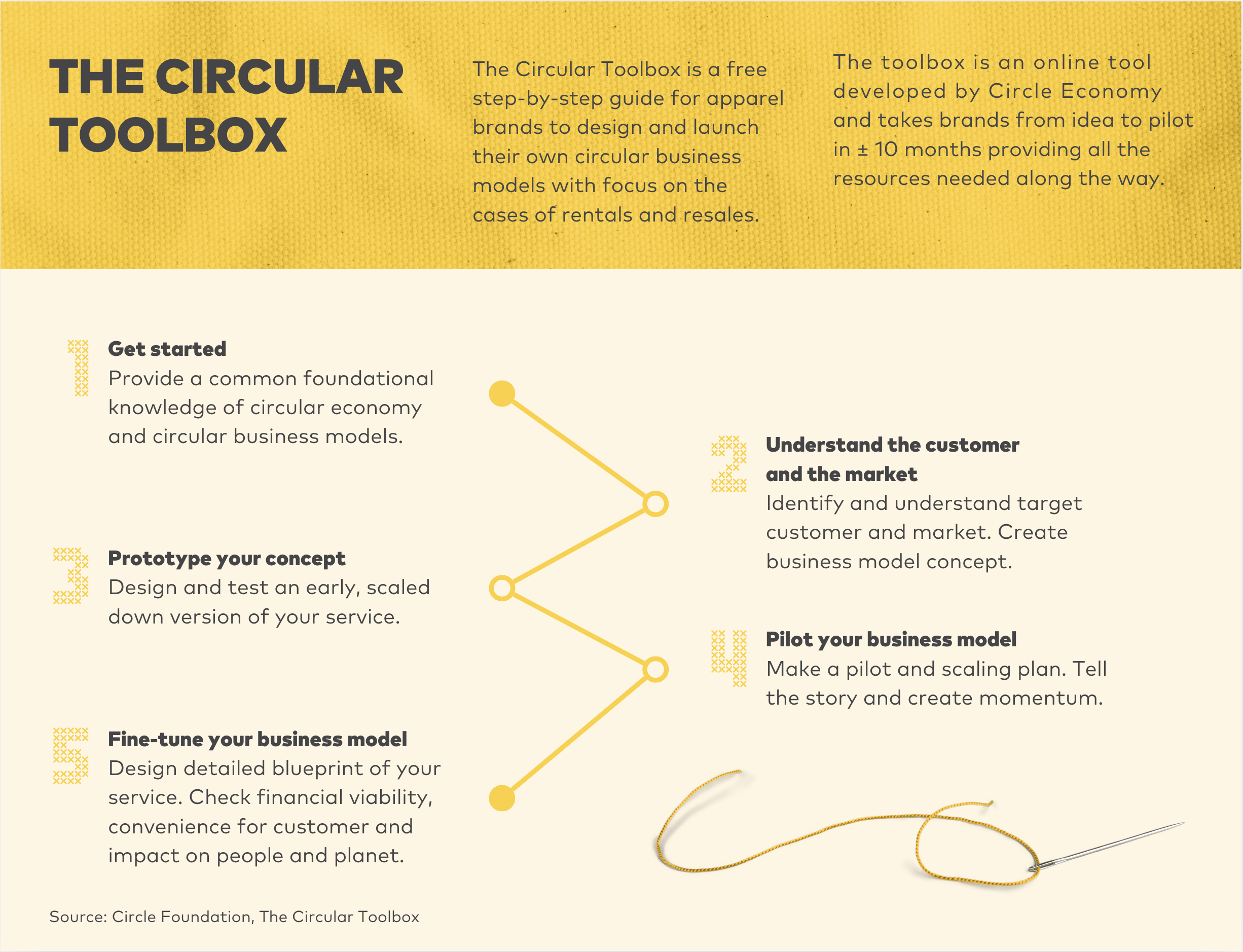
Louise Munkholm introduced participants to The Circular Toolbox developed by Circle Economy Foundation as part of the Switching Gear Project. The Circular Toolbox is a step-by-step guide for apparel brands to design and launch their own circular business models:
Infographic developed by Holm Kommunikation based on webinar presentation
The five steps are described by the Circle Economy Foundation in this way:
- Getting started: Getting your team on the same page as to why a circular business model is needed, knowing the individual skills of your team and establishing goals and success criteria.
- Understanding the customer and the market: Kicking off the work by identifying your target customer and market and translating and generating insights to develop a concept.
- Prototyping your concept: Getting knowledge on how to design and test a prototype. The goal of this step is to generate as much data and information as possible from the customer and the market to develop and make improvements.
- Fine-tuning your business model: Creating the business model blueprint, selecting the right partners and building the business case.
- Piloting your business model: Identifying a core-messaging hook and translating it into a concept, knowing how to create the right momentum and scaling the plan.
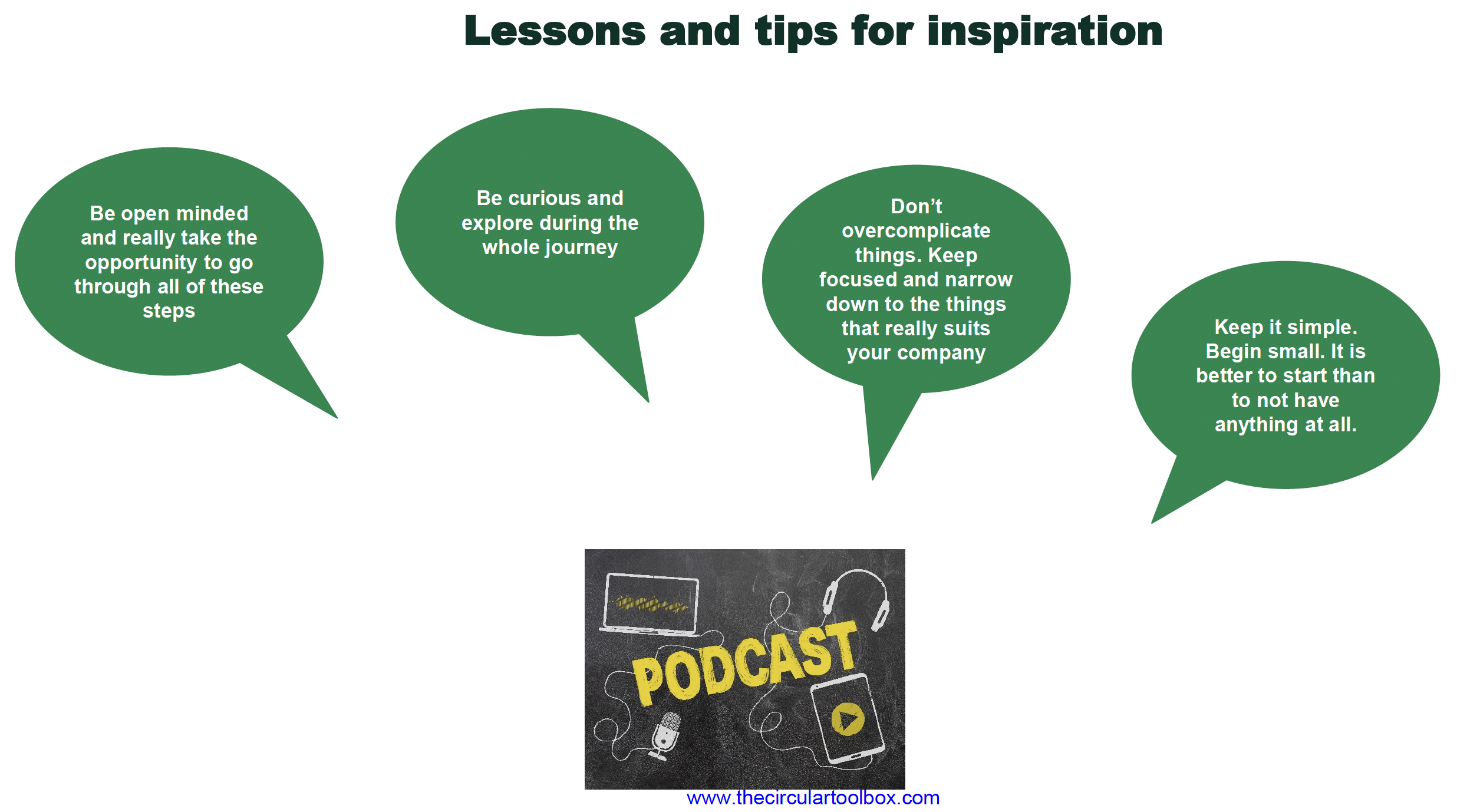
The Circular Toolbox is the result of a co-creation between Circle Economy Foundation and four Nordic brands: Asket, Lindex, Kuyichi and ETP. The four Nordic brands went through the five steps and reported their results in a podcast where tips for inspiration are shared, such as:
Source: Webinar presentation. Find slides and recordings on the project website.
3.2.2 Pre-challenge webinars about textile consumption
Besides conceptualizing circular business models, the preparatory webinars of Active Textile Society introduced research regarding textile consumption in the Nordic countries to inspire discussions about what it takes to change consumer behavior in a more environmentally friendly direction.
Three presentations during the fall of 2023 focused on textile consumption and the Nordic cases of Norway, Denmark and Sweden.
Webinar presentations about textile consumption in the Nordics
Consumption cultures: Findings from citizen surveys by Professor in clothing and sustainability Ingun Grimstad Klepp, and Senior Researcher Kirsi Laitala, Consumption Research Norway (SIFO), OsloMet. Presentation held on September 27, 2023. Learn more about the project here: https://clothingresearch.oslomet.no/
Together against waste of textile - Results from a study on clothing consumption in Denmark by Katja Øder Schlesinger, Anthropologist and Senior Consultant at Norion, involved in the Danish Consumer Council’s campaign “Stop Tøjspild”. Presentation held on November 14, 2023. Learn more about the project here: Sammen mod tøjspild | Forbrugerrådet Tænk (taenk.dk)
F/ACT Movement by Adrian Zethraeus, Project Coordinator, Science Park Borås, University of Borås. Presentation held on December 13, 2023. Learn more about the project here: F/ACT Movement (factmovement.se)
The following sections summarize key take-aways from the webinar presentations and the workshop.
Take-aways from “Consumption cultures: Findings from citizen surveys”
Ingun Grimstad Klepp and Kirsi Laitala presented key figures about textile consumption in the Nordic countries. First, they showed that in 2018, less than 1% of clothing was bought as secondhand in Norway, which is rather low compared to other countries, such as Denmark, where 12% of clothes were bought as secondhand at that time. They also pointed out that the sale of new clothes was the same in Norway and Denmark, indicating that the secondhand market did not replace the purchase of new clothes in Denmark. In general, there is currently no indication that the purchase of secondhand clothes in the Nordics is limiting the amount of newly produced clothes purchased.
Ingun Grimstad Klepp and Kirsi Laitala then presented results from their survey of Norwegian textile consumption from 2023 with 1200 citizens. Their survey shows that 20% of clothing is bought secondhand, indicating that the secondhand market in Norway is growing.
Share of clothing acquisitions from different sources
(Past three months, percentage of clothing, 2023)
- Men: 15%
- Women: 23%
- Average all clothing: 20%
Source: Webinar presentation. Find slides and recordings on the project website.
Furthermore, the 2023 survey of Norwegian textile consumption trends showed that “buying new clothes in a store” remains the most common method of clothing acquisition, closely followed by “buying new clothes online”. The survey results also indicate that buying new clothes, buying secondhand as well as making your own clothes are more often practiced by women compared to men, whereas receiving new clothes as gifts is more common among men than women:
Own clothing acquisition methods the past three months
(Percentage of respondents, 2023, N=1200)
Source: Webinar presentation. Find slides and recordings on the project website.
Another interesting finding from the survey presented by Ingun Grimstad Klepp and Kirsi Laitala was that the products bought the most in Norway are also the ones that are least available in the secondhand market. These products include socks, stockings and underwear. According to the presenters, this finding indicates that there is a need to buy certain items from new.
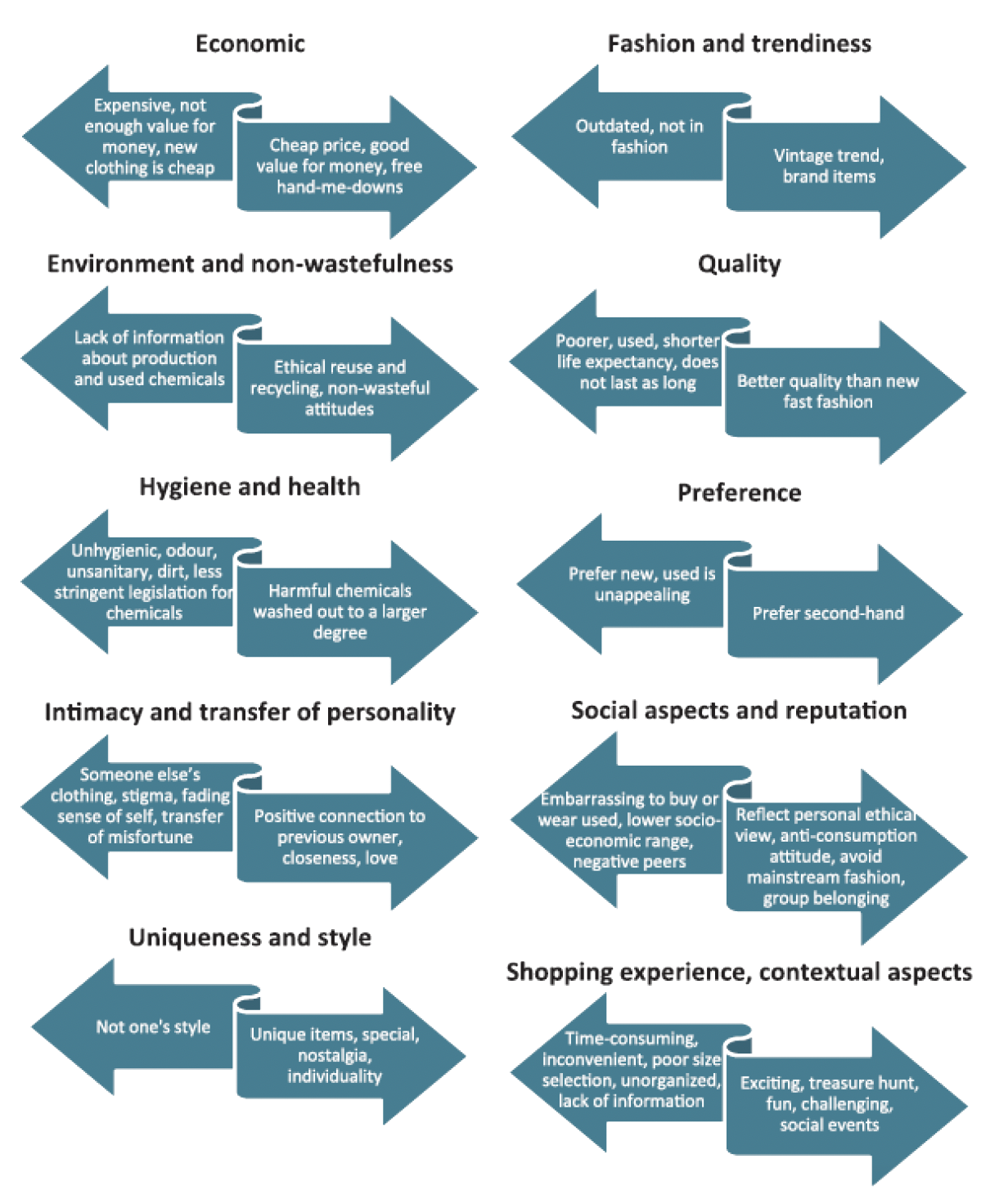
Ingun Grimstad Klepp and Kirsi Laitala grouped the barriers for using circular business models in pairs since some of the arguments are used by consumers both in favor of and against the use of secondhand clothing.
Motivations for and against second-hand clothing acquisition
Kirsi Laitala and Ingun Grimstad Klepp 0sloMet – Oslo Metropolitan University
Source: Webinar presentation. Find slides and recordings on the project website.
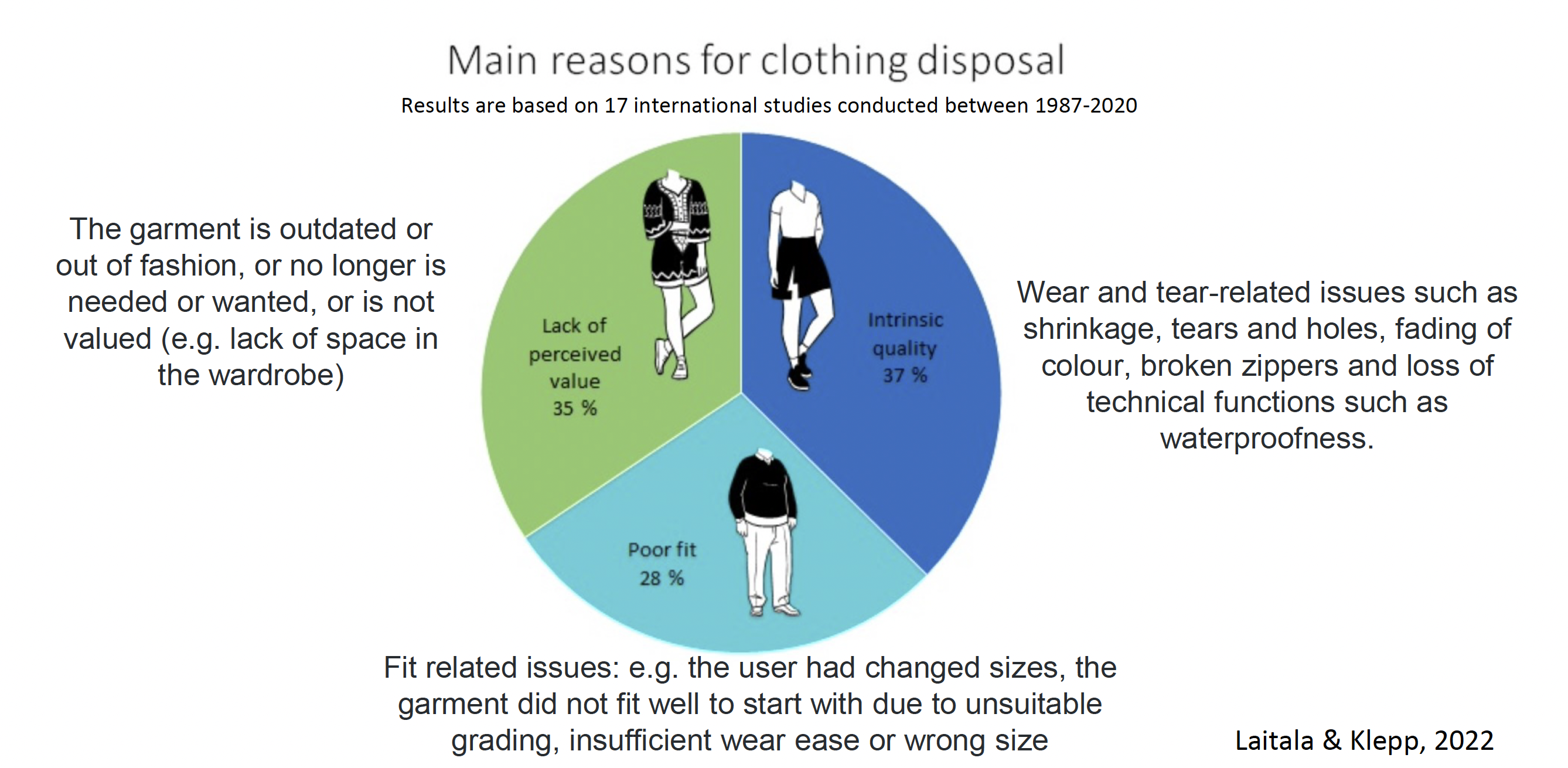
Ingun Grimstad Klepp and Kirsi Laitala also shared results from their studies showing the main reasons for clothing disposal. In their studies, they found three common themes: 1) The garment is outdated; 2) the garment is broken; and 3) the garment does not fit.
Source: Webinar presentation. Find slides and recordings on the project website.
In addition, Ingun Grimstad Klepp and Kirsi Laitala shared insights regarding repair habits of the surveyed Norwegians. They found that repair was very common in Norway, where many people do repairs themselves or help each other out. In comparison, to pay for repair is not that common: Between 0 and 3 percent of the population surveyed for the book Lettfiks have done that.
See Ingun Grimstad Klepp & Tone Skårdal Tobiasson (2021) Lettfiks. Klær med ni liv (Solum Bokvennen).
Furthermore, the study suggested that it is only high-priced clothing that people want to pay professionals to repair. This led the presenters to conclude that as long as very low-priced clothing is available, commercial repair is difficult to reach. They highlighted that this issue is actually relevant for all circular business models, which suffer from competition with a lot of new, low-priced clothing available on the market all the time. Therefore, according to the presenters, circular business models do not affect the environmental impact as long as they do not affect the tendencies of overproduction and overconsumption. Based on this argument, the presenters called for decision-makers in the Nordics to develop policy measures that favor the best business models from an environmental perspective while still securing a variety of clothes for Nordic citizens.
Take-aways from “Together against waste of textile - Results from a study on clothing consumption in Denmark”
Katja Øder Schlesinger presented findings from the national campaign targeted at adults over the age of 25 years and carried out from April 2022 to March 2023. The aim was to motivate consumers to purchase clothes with care, use and maintain clothes and pass on or dispose of clothes responsibly.
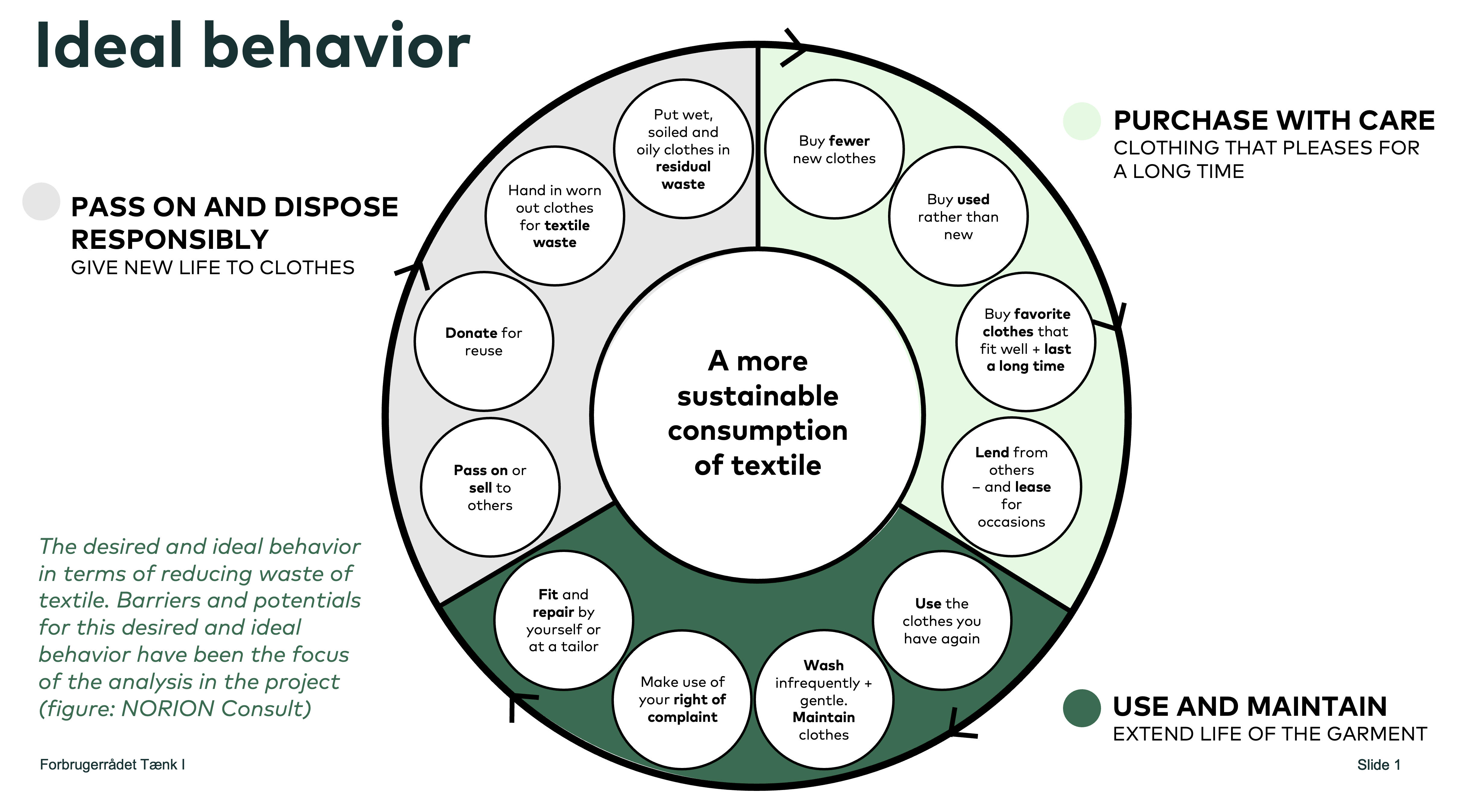
Source: Webinar presentation. Find slides and recordings on the project website.
Based on a quantitative study (a questionnaire with 2000 respondents) and a qualitative study (wardrobe survey with 15 frequent shoppers), the project identified a number of barriers to reducing the waste of textiles:
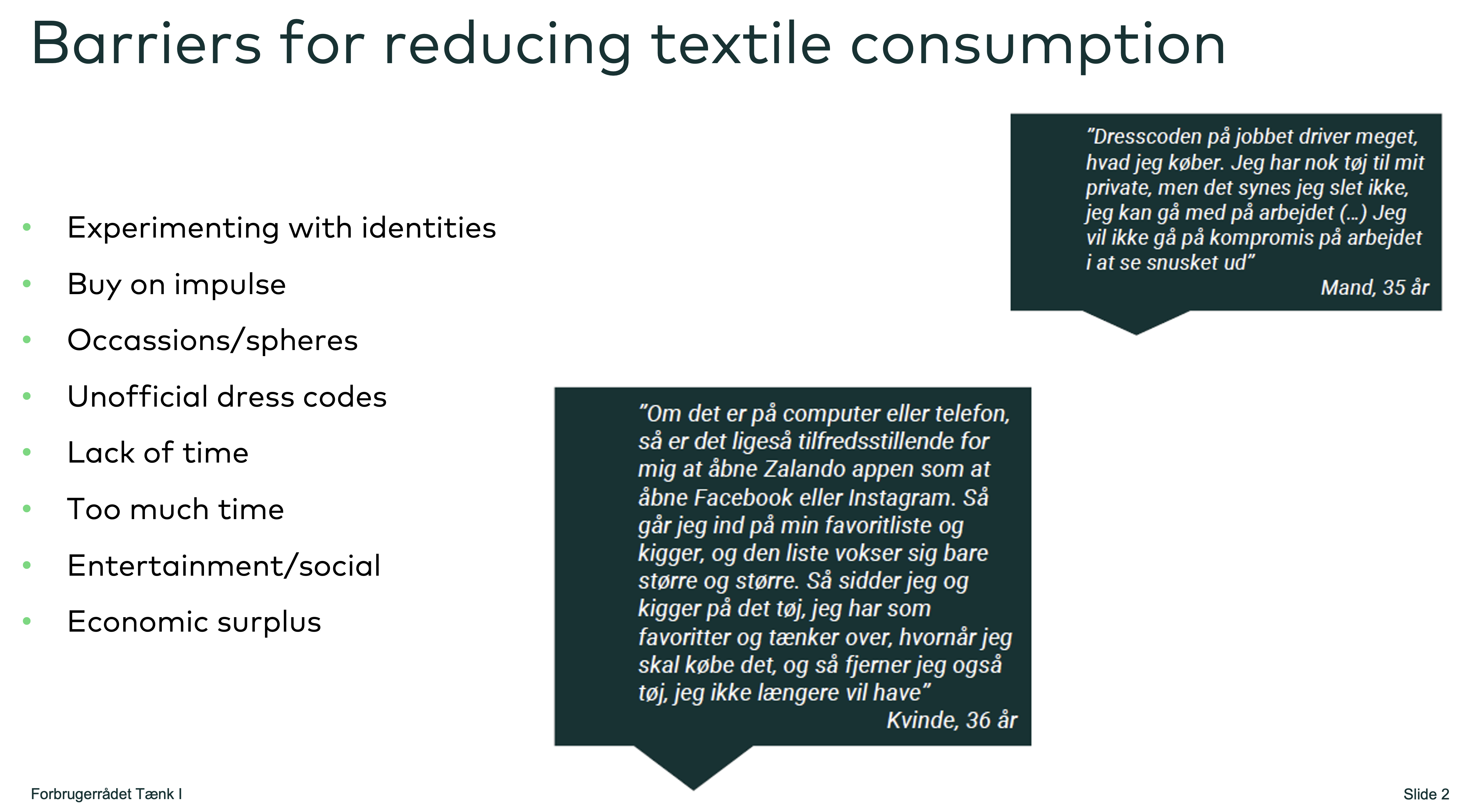
Source: Webinar presentation. Find slides and recordings on the project website.
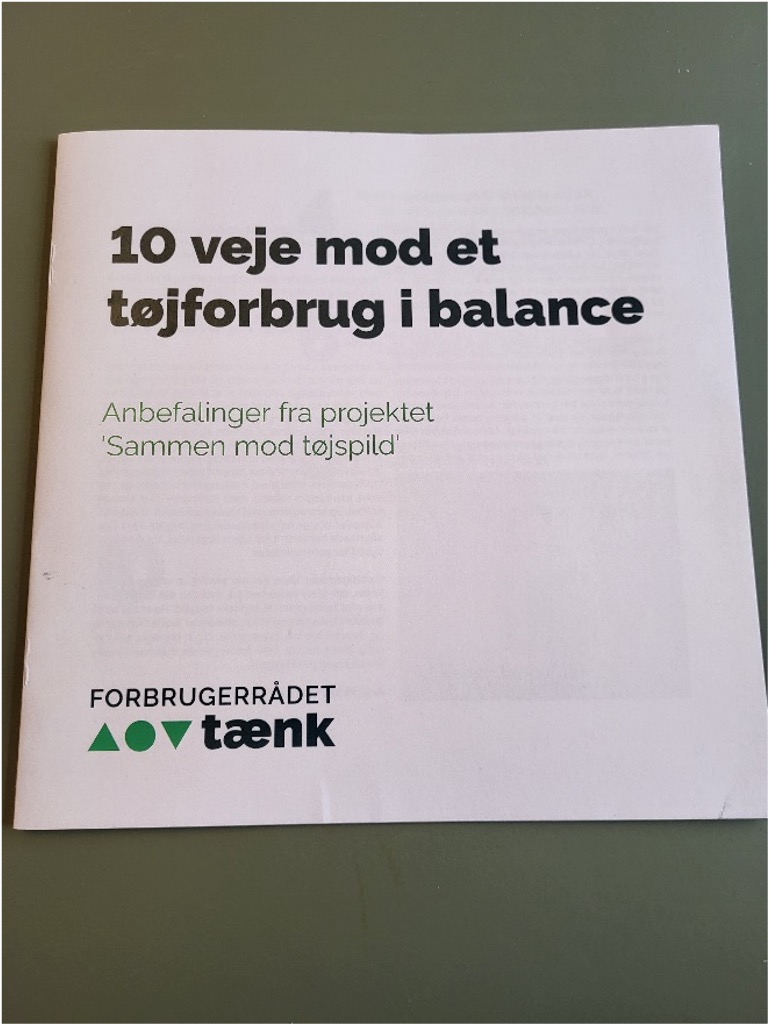
The project identified ten ways forward, calling on producers, politicians and stakeholders to act:
Ten ways towards balanced clothing consumption
Manufacturers: Dress the consumer for success
- Give the consumer more options to reduce waste of textile
- Rediscover old virtues and combine them with individual needs and frameworks
- Create clothes that create value for the consumer (90% doesn’t fit)
Politicians: Create system frameworks that reduce clothing waste
- Review existing legislation
- Branch code with industry to reduce waste of textiles
- Call for a national action plan
- Ban on destroying unsold clothes
Stakeholders: Gather all players
- Take advantage of a wide range of players with different expertise
- Use experiences from other sectors and countries
- Co-operate on uniform guidance for consumers based on reliable knowledge and safe reasons

Source: Webinar presentation. Find slides and recordings on the project website.
As a final remark, Katja Øder Schlesinger stressed that “Changing the way we acquire, use and pass on clothes can be funny and meaningful – especially if we do it together”, and she provided the following advice:
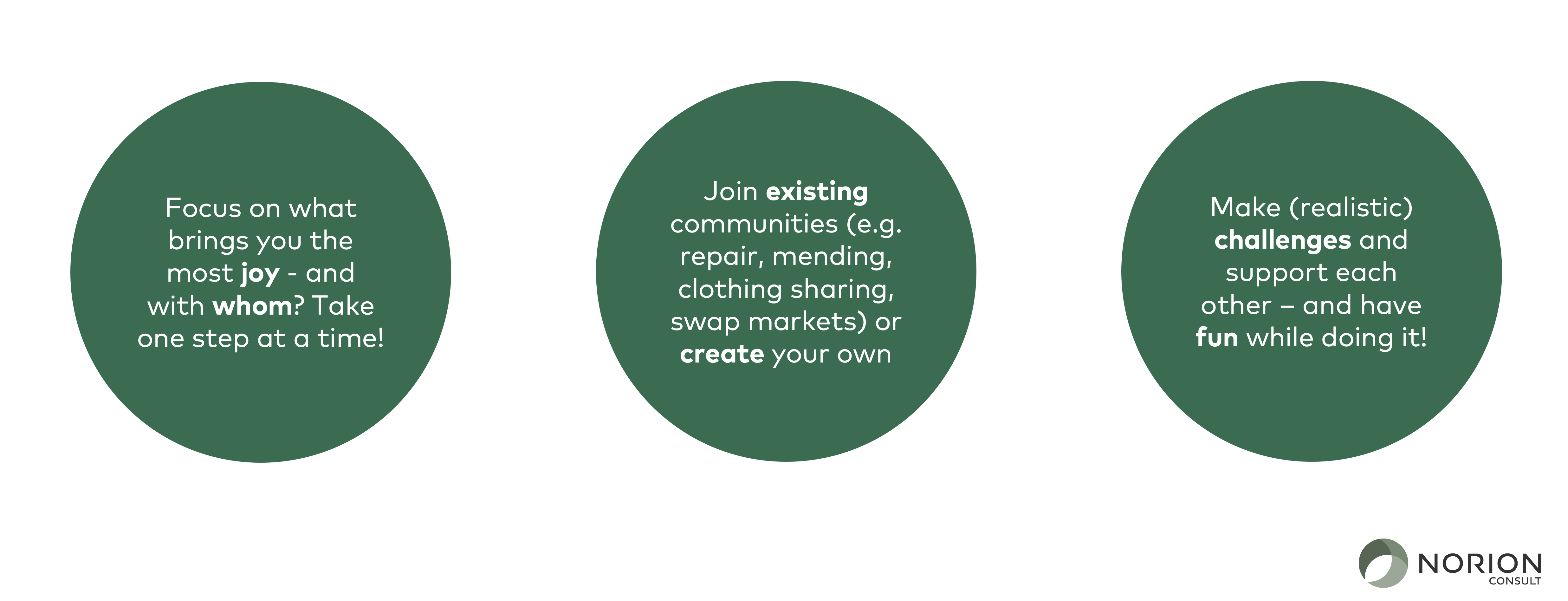
Source: Webinar presentation. Find slides and recordings on the project website.
Take-aways from “F/ACT Movement”
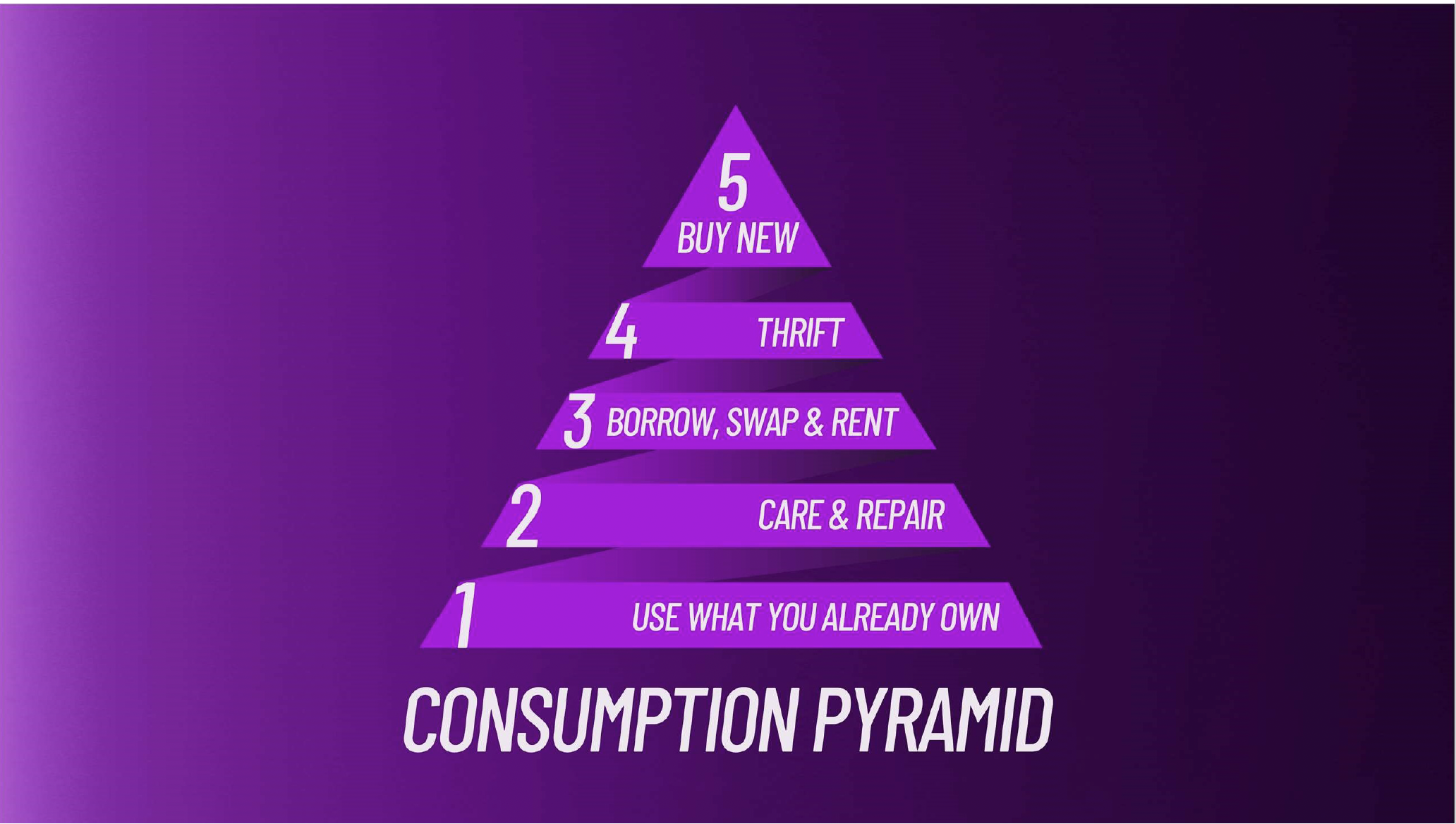
F/ACT Movement is a campaign organized by Science Park Borås under the national framework Textile & Fashion 2030 in Sweden. The campaign was launched in 2019 with the aim of highlighting the need to drastically change the way people consume textiles and fashion. The F/ACT Movement promotes a so-called consumption pyramid that visualizes how consumption should look in order to fit into a circular economy:
Source: Webinar presentation. Find slides and recordings on the project website.
According to this model, ideal textile consumption from an environmental perspective implies that people use what they already own and take good care of it, such as through repairs. If people need something that they do not already own, the consumption pyramid suggests starting with the options of borrowing, swapping or renting. If these options do not fulfil one’s needs, people may consider thrifting. Buying new is the very last option if all other options have been exhausted. Adrian Zethraeus argued that this new way of consuming textiles and fashion can also lead to new business opportunities for companies, characterized by new business-to-business operations, with service providers making these new consumption practices possible.
Based on the argument that it is difficult to change consumer behavior, Adrian Zethraeus highlighted the need for pursuing citizen training. To stimulate the uptake of the consumption pyramid, the F/ACT Movement therefore gathered 70 citizens in seven places around Sweden and asked them not to consume new clothes for a period of nine months. During the nine months, participating citizens convened for monthly meetings and workshops to jointly explore how they could best continue consuming and experiencing fashion without using any new raw materials to do so.
This mix of meetings, reflecting and discussing with each other resulted in not only the creation of a new type of community vibe but also the uptake of new skills, enabling participating citizens to apply methods themselves aiming to prolong the lifespan of textiles, such as repairs and redesigns. Thus, the F/ACT Movement found that both elements – the building of new communities around lifespan extension of textiles and the hands-on training – constitute key building blocks for moving consumer behavior in a direction that supports the development of a circular textile economy.
3.2.3 The six-month challenge: Webinar and workshop about repair, redesign and product care
The first topics investigated during the six-month challenge were repair, redesign and product care, forming the basis of the webinar and workshop in January 2024. The webinar part focused on the methods for repair, redesign and product care to extend the lifespan of textiles – both functionally and emotionally. The themes unfolded through two presentations (see below). In the workshop, participants discussed barriers and solutions for using repair, redesign and product care and how to make the methods widely accessible and appealing in the broader society.
Webinar about repair, redesign and product care, January 24, 2024
Long live our clothes! Repair and redesign by Jessica Nilsson, SySL Redesign. Read more about the tools here: https://sysl.dk/kurser-og-workshops/
Care for clothing – care for the planet by Kirsi Laitala, Senior Researcher, Oslo Metropolitan University. Read more about the research here: https://clothingresearch.oslomet.no/
The following sections summarize key take-aways from the webinar presentations and the workshop.
Take-aways from “Long live our clothes! Repair and redesign”
Everyone can do simple repairs using basic tools at home, such as scissors for changing zipper slider; candles when the zipper is tight and hard to slide; and pliers when the zipper is splitting (see the picture below). Jessica Nilsson’s mission is to spread this message by offering tutorials for simple repair and redesigns on her webpage. During her presentation, she went through some of her most popular tricks, focusing on methods for fixing a simple hole and repairing a zipper:
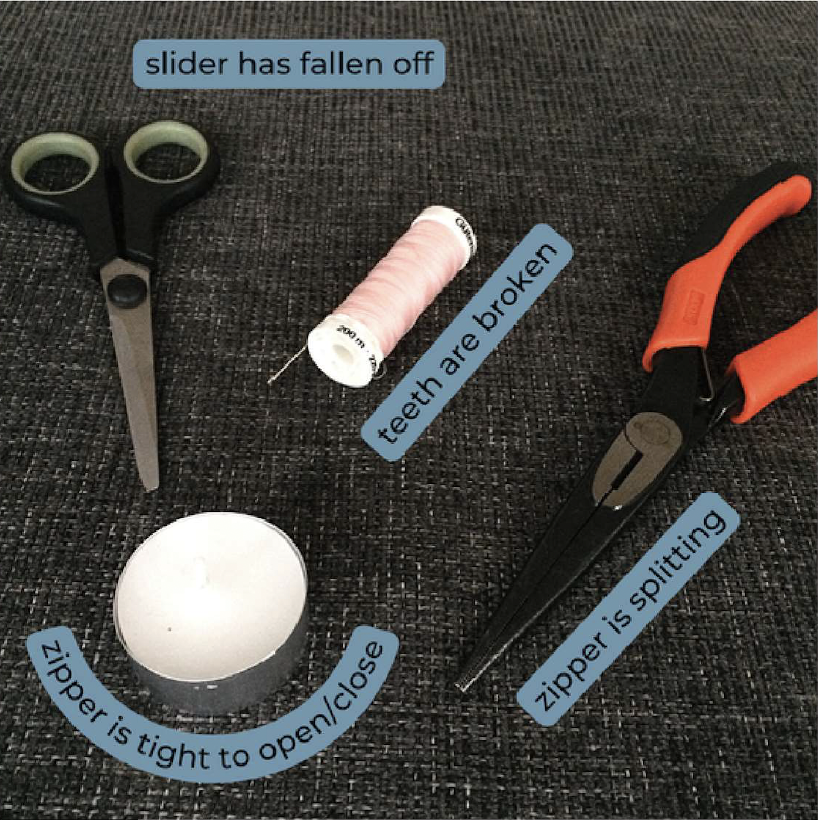
Photo by Jessica Nilsson
Source: Webinar presentation. Find slides and recordings on the project website.
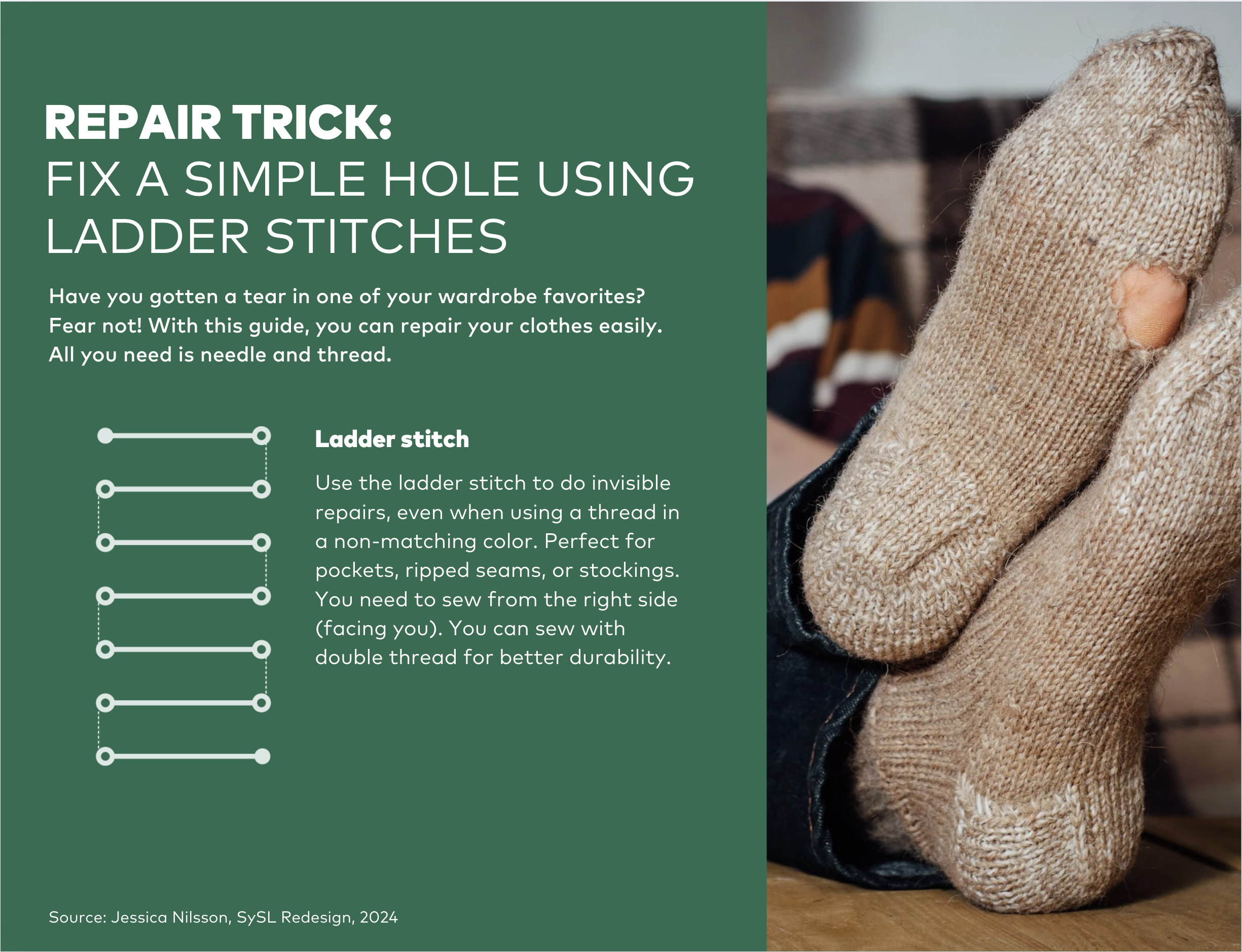
First, Jessica Nilsson presented the ladder stitch, which can be used to do invisible repairs (see instructions below). You can even use a thread in a non-matching color, and it will still be invisible. The ladder stitch is perfect for fixing pockets and ripped seams, e.g., stockings. You need to sew from the right side (facing you). You may sew with double thread for better durability.
Infographic developed by Holm Kommunikation based on webinar presentation
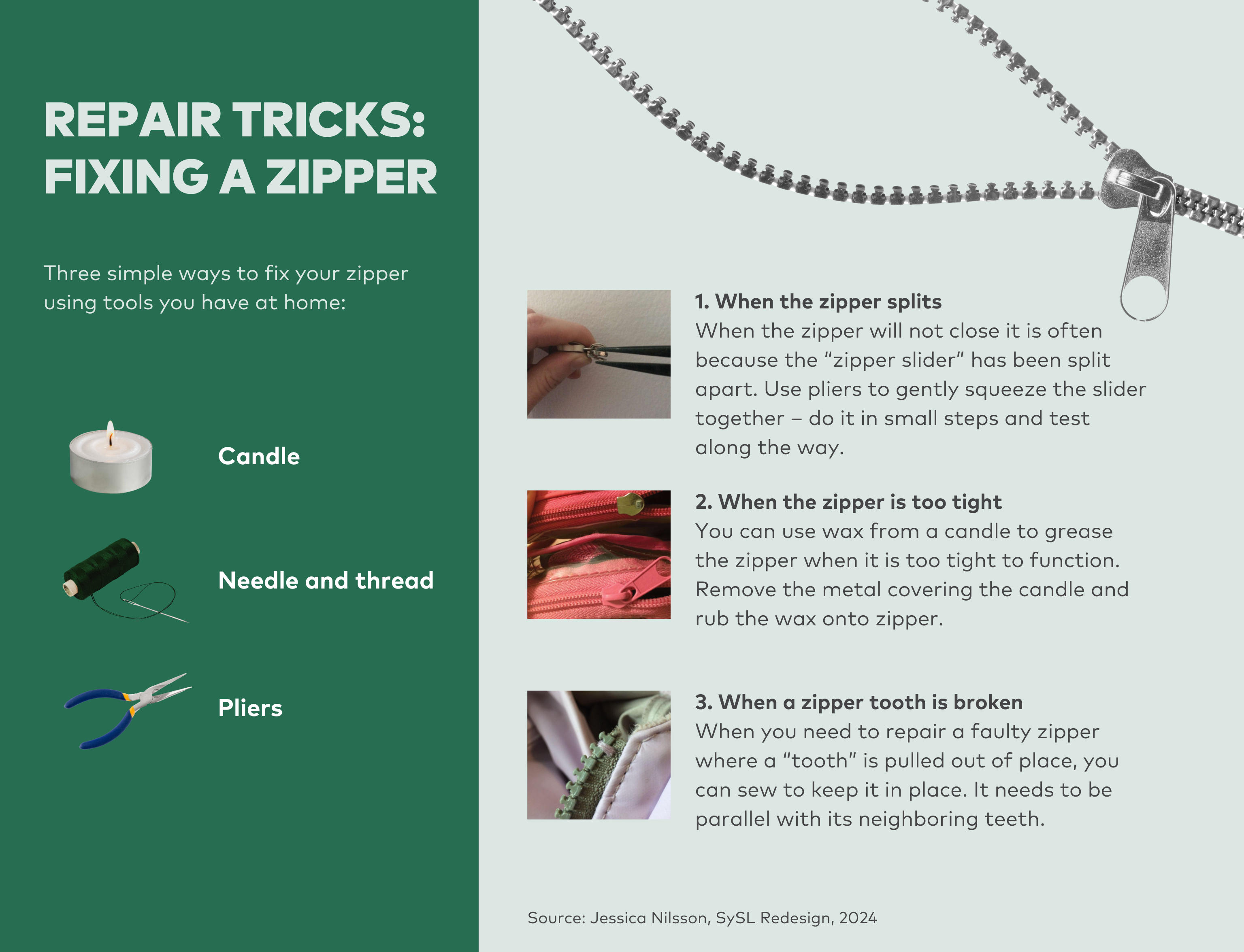
Secondly, Jessica Nilsson presented three repair tricks for fixing a zipper:
- Fixing a zipper when it is splitting because of too much pressure on the zipper (if your bag is too full) or if it is old and worn out.
- Fixing a zipper if it is too tight and hard to close.
- Fixing a zipper if a tooth is broken.
Infographic developed by Holm Kommunikation based on webinar presentation
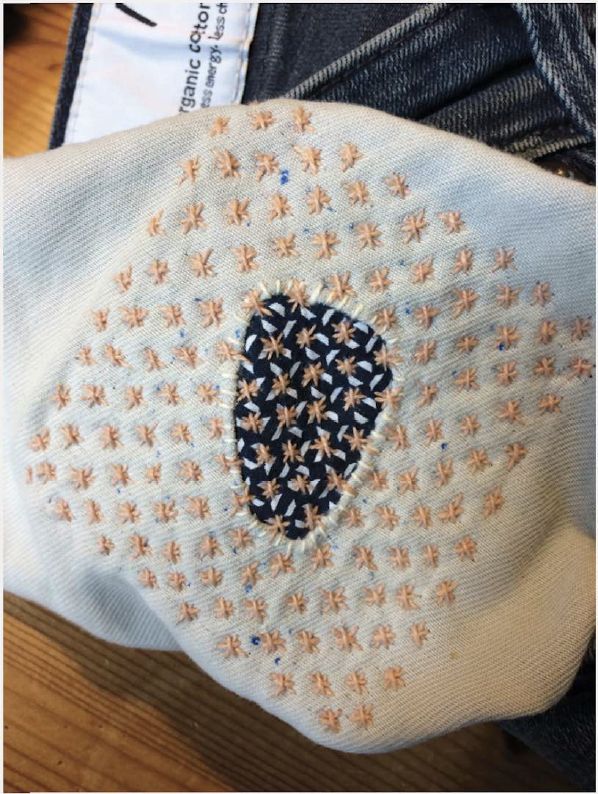
Photo by Jessica Nilsson
Source: Webinar presentation. Find slides and recordings on the project website.
Source: Webinar presentation. Find slides and recordings on the project website.
In closing her presentation, Jessica introduced the notion of refunction. With simple adjustments, Jessica illustrated how to use a piece of clothing for different purposes, as a child grows. In Jessica Nilsson’s example, it is a dress, which is turned into a shirt, and later a skirt:
Refunction
Using a dress for different purposes, as a child grows:
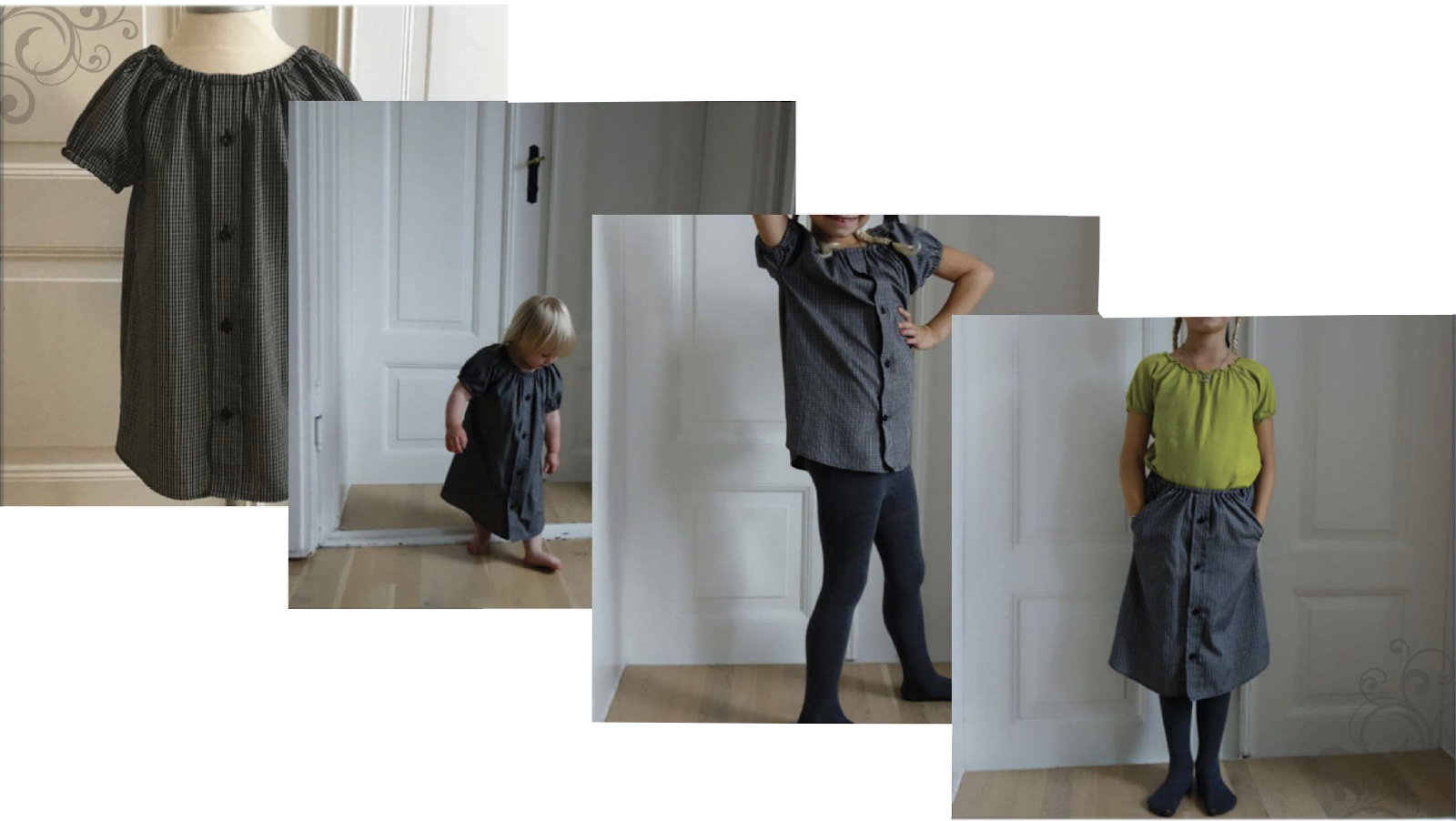
Photo by Jessica Nilsson
Source: Webinar presentation. Find slides and recordings on the project website.
Source: Webinar presentation. Find slides and recordings on the project website.
In summary, the tricks presented by Jessica provided hands-on advice for how to extend the lifespan of textiles and use the resources already available in existing wardrobes. The tricks require a few materials and equipment and, hopefully, provide the motivation for giving them a go at home.
Take-aways from “Care for clothing – Care for planet”
Following Jessica Nilsson’s presentation on repair, Kirsi Laitala’s presentation focused on methods for extending the lifespan of textiles through product care. An increase in care and maintenance is needed when people acquire fewer clothes and keep them for a longer time. According to Kirsi Laitala, product care consists of clothing care and mindful use. Product care concerns the way people touch, wear, store, hang up, air, wash, repair, and assess their clothes. Mindful use covers a range of daily practices such as dressing and undressing, putting clothes away, dropping them or folding them neatly, and keeping them clean. For example, to extend the lifespan of one’s textiles, clothes should be folded lightly or rolled to prevent hard crease lines. Likewise, hanging can stretch and distort clothes, especially when storing vintage or delicate pieces, cashmere sweaters, heavy knits and other articles with stretch. Kirsi Laitala also pointed to both caring for your clothes and reducing the environmental impact from laundering. The figure below provides an overview of Kirsi Laitala’s advice regarding product care:
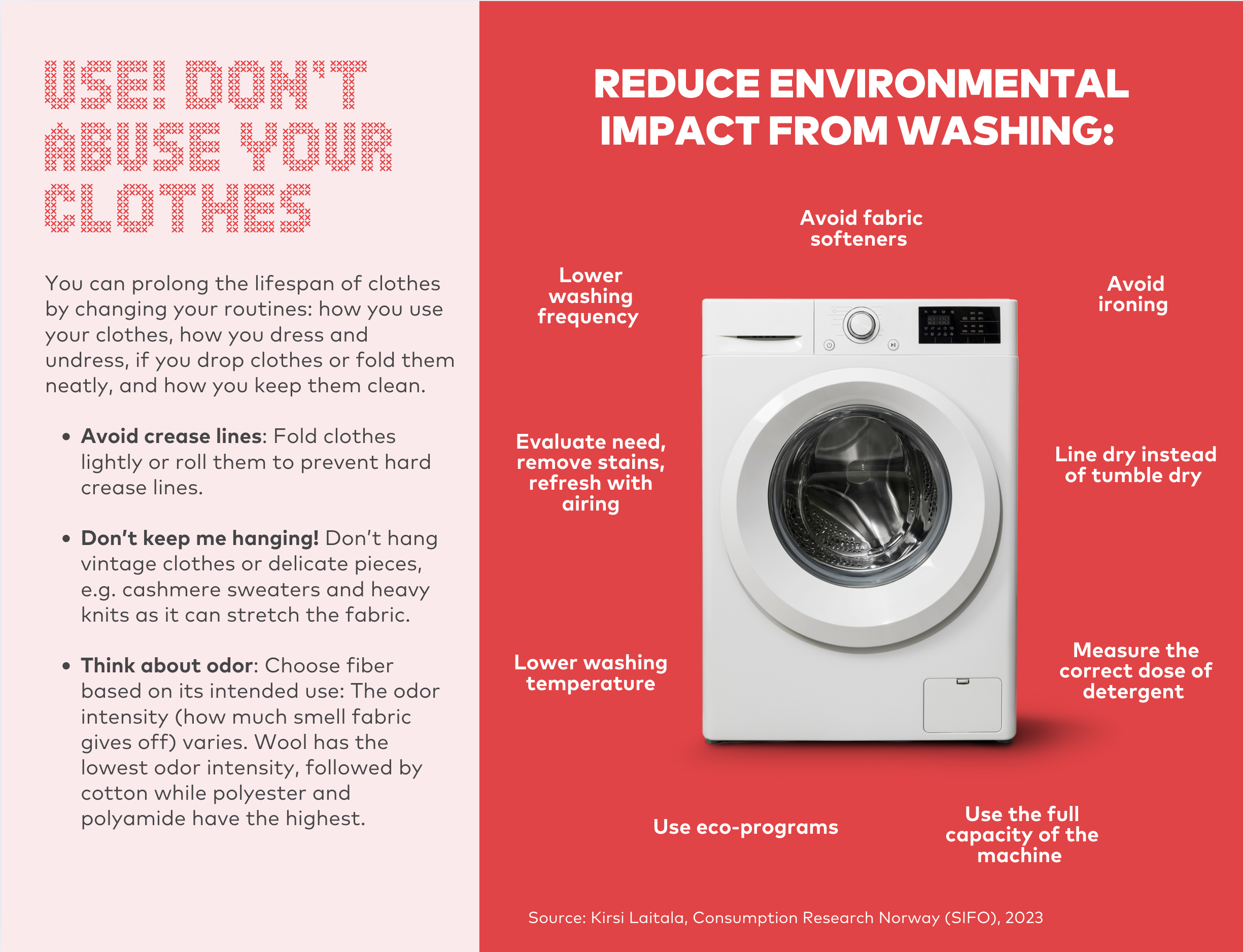
Infographic developed by Holm Kommunikation based on webinar presentation
Kirsi Laitala also stressed actions to be undertaken by producers and other stakeholders, including caring about the production conditions and people making the clothes; enabling care practices for consumers through the choice of materials, techniques, labelling, and instructions related to cleaning and repair; offering services for those tasks that are difficult for consumers to undertake themselves or tasks that require special equipment. These actions ensure that the products, when put on the market, are found valuable enough to be worth repairing and taking care of. Another important aspect of this issue is the lack of use of warranties. According to Kirsi Laitala, few citizens exercise their right to complain because they lack knowledge of consumer rights and because it requires too much effort and time to make a claim. Therefore, Kirsi devoted time in her presentation to provide an overview of warranty rights in EU/EEA countries based on the Consumer Purchases Act:
The length of consumers’ statutory rights based on the Consumer Purchases Act varies but is a minimum of two years in EU/EEA countries.
You’ll have legal rights if the item is:
- broken or damaged (not of satisfactory quality)
- unusable (not fit for purpose)
- not what was advertised or doesn’t match the seller’s description
- shelf-life/longevity is less than to be expected when purchasing such an item
You might be entitled to a repair, refund, replacement, or cancellation.
Reference: Laitala, Løvbak Berg and Strandbakken (2023) Why won’t you complain? Consumer rights and the unmet product lifespan requirements. Plate, Helsinki.
Wrapping up her presentation, Kirsi Laitala touched upon the topic of repair and presented the reparability scale as an addition to the hands-on tricks provided by Jessica Nilsson. Kirsi Laitala repeated Jessica’s message; you will come a long way with just a needle and a thread and there is already help available through simple means such as self-adhesive repair patches, books and online tutorials, repair cafés, friends or family members, including access to public sewing machines in some libraries. However, some repairs are more demanding and require professional help.
Repairability scale
1) Simple repairs/home repairs
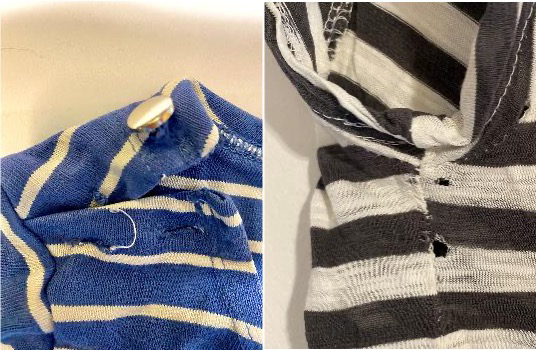
2) Demanding repairs/professional repairs
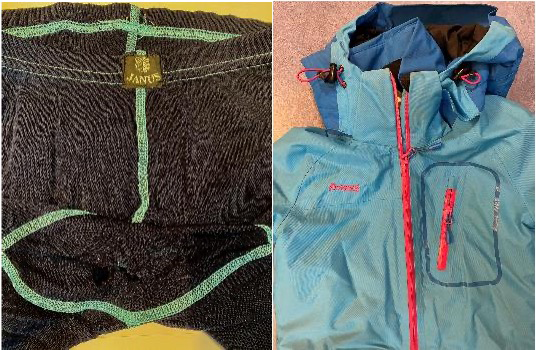
3) Impossible repairs/permanent damages
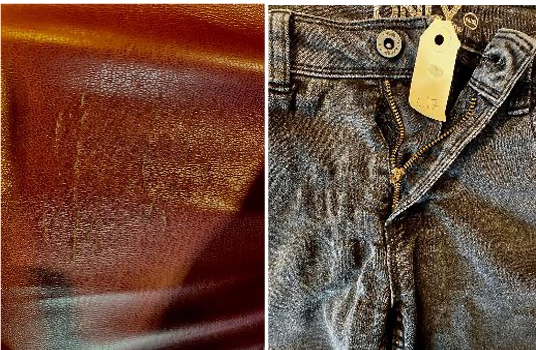
Source: Webinar presentation. Find slides and recordings on the project website.
As illustrated in the reparability scale, consideration should be given to which solutions are fit for simple, demanding and impossible repairs. Different types of repairs require different levels of skill and therefore different supporting mechanisms. Kirsi Laitala mentioned that, for example, holes in sportswear or children’s wear are more often repaired than holes and tears on more formal clothing. It is therefore important to bear in mind the repairability scale when designing interventions: different parts of the scale require different supporting mechanisms.
After the presentations from Jessica Nilsson and Kirsi Laitala, participants moved on to the workshop.
Workshop findings regarding repair, redesign and product care
For the workshop, participants were divided into country groups and asked to reflect on the presentations from the webinar as well as their own experiences, in order to identify barriers and solutions to making repair, redesign and product care more widely accessible and appealing in their country. The following section clarifies the barriers and solutions identified.
Barriers to using repair and redesign and making it more widely accessible and appealing
During the workshop, participants identified the following barriers:
- Limited overview of repair and redesign services and their availability. Mainly lacking the knowledge about which repair and redesign services exist, where they are and what they cost, as well as the physical distance to repair and redesign services, and limited opening hours.
- Lack of skills, equipment and materials. Knowledge and skills to do repairs and redesign are limited and access to equipment and materials for do-it-yourself (DIY) solutions are lacking.
- Concerns about costs and time. Both DIY and professional help are perceived to be too expensive (time and money-wise) and take too much time compared to buying a new item. Also, participants were unsure whether the result would be worth the effort, time or money.
- Lack of use of warranty. This is both due to missing knowledge of consumer rights and because it requires too much effort and time to make a claim. Kirsi also highlighted this issue.
- Human factors. Habits are hard to change, and repair and redesign practices are not part of one’s repertoire. At the same time, people lack an emotional connection with their clothes, preventing them from taking proper care of them. Shame was also mentioned as a barrier to taking one’s clothes to a professional for repair or redesign, as it is perceived to be embarrassing to take cheap and worn clothes to the tailor.
Solutions to make repair and redesign more widely accessible and appealing
To mitigate the barriers and challenges identified above, the following solutions were identified:
- Getting an overview of options by, for example, establishing maps and platforms showing which repair and redesign services exist, where they are, when they are open, what they cost, etc., and solving challenges in regard to availability by promoting remote tailoring services and after-hours services.
- Developing or reinventing skills by, for example, including repair and redesign skills in educational systems and promoting repair and redesign hacks and tricks on social media and in the public sphere to inspire change. This could also include promoting local sewing groups and workshops that, for instance, experiment with repair and redesign on second-hand clothes in order to gain experience with so-called “low-stakes” clothing. Moreover, developing and reinventing the required skills will make people aware of the value of clothes and textiles and, over time, hopefully, make people proud, rather than ashamed, when it comes to repairing and redesigning old and worn wardrobe staples.
- Acknowledging and promoting that time and costs are relative. Consider, for instance, time and money spent on repair vs. time and money spent on impulse shopping. Another aspect points towards government subsidy and government aid to cover costs and to kick-start the change (as seen from the energy sector).
- Ensure access to equipment and materials by establishing and promoting a (second-hand) market for equipment and materials for DIY solutions.
- Promote and raise awareness of warranty on clothes.
The workshop input from participants regarding repair and redesign formed the basis for recommendations for actions moving forward (see Chapter 6).
3.2.4 The six-month challenge: Webinar and workshop about reuse and resale
The next round of webinars and workshops during the six-month challenge focused on experiences and hands-on tools for prolonging the lifespan of textiles by means of reuse and resale. The webinar part provided an overview of existing types of reuse and resale avenues, when to go for which and how to organize them in ways that attract customers. The themes unfolded through two presentations (see below). In the workshop, participants discussed the barriers and solutions to buying second-hand clothes in physical shops and online.
Webinar about reuse and resale, 13 March 2024
Fashion Worth Circulating: Why resale is a preferred circular strategy, how it (doesn’t) work(s) and what we can learn from it by Mette Dalgaard Nielsen, PhD student, Royal Danish Academy. Learn more about the research here: https://adk.elsevierpure.com/en/persons/mette-dalgaard-nielsen
Reuse and resale of textiles - how we do it at Kierrätyskeskus Oy by Anu Hakala, Environmental specialist, Kierrätyskeskus. Learn more here: https://kierratyskeskus.fi/en/
The following sections summarize key take-aways from the two presentations and the workshop.
Take-aways from “Fashion Worth Circulating: Why resale is a preferred circular strategy, how it (doesn’t) work(s) and what we can learn from it”
Mette Dalgaard Nielsen presented her research on resale. According to Mette Dalgaard Nielsen, resale is known as one of the most resource-efficient business models that offer the option of extending the use and the lifespan of products. However, resale may entail an expansion of the existing paradigm of expansion and growth, rather than a model of change.
Currently, resale exists in a linear paradigm. Mette Dalgaard Nielsen elaborated that while second-hand markets might prolong the lifespan of textiles, there are no indications that fewer new clothes are being bought. Thus, the existence of a resale market does not mean that fewer new clothes are produced: Volumes keep increasing worldwide. At the same time, garments today are not made to last (design-wise). Mette Dalgaard Nielsen unfolded this by pointing to the systemic issue of ultra-fast fashion; the quality and the price of items are crucial for how people value textiles, including whether they are worth using, repairing and reselling. Thus, putting low-quality garments on the market creates needs rather than meeting them. Ultimately, people do not have the garments that a circular textile economy requires, and people do not use items in their wardrobe enough because they keep consuming more. For the full potential of the resale market to unfold, everyone needs to stop producing and consuming incessantly.
A key learning from Mette Dalgaard Nielsen’s research is that items the users consider valuable for resale may be wildly different (beige, colorful, high-end brand, high-street fashion, etc.). Moreover, the resale market consists of an entire ecosystem, with different models for resale meeting different needs and targeting different consumer segments. In her research, she has identified five different models as described in the infographic below.
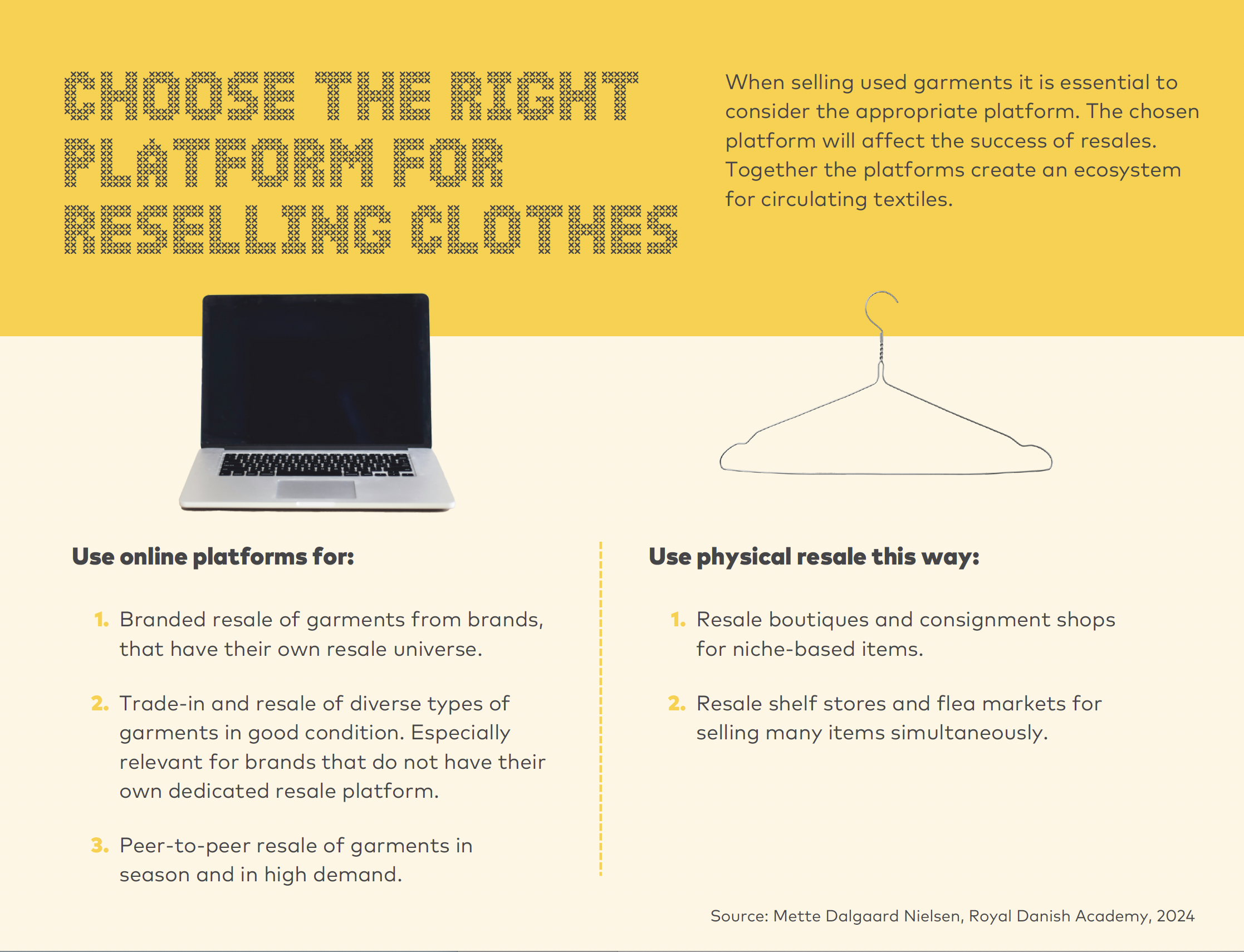
Infographic developed by Holm Kommunikation based on webinar presentation
The different models for resale mirror the market for first-line sales, which can also be differentiated. An ecosystem of different models for both physical and online resale makes it possible for more people to utilize the second-hand market, including those with specific needs or those who live far away from a physical store. If you want to sell or buy second-hand textiles, it is therefore important to know which type of resale is most suitable for the specific type of textile you have acquired. Mette Dalgaard Nielsen’s description of five different models can aid in choosing the right platform for reselling clothes.
In summary, Mette Dalgaard Nielsen underlines the importance of supporting the development of the ecosystem of resale models and ensuring that they reach their circular benefits by reducing volume and improving the quality of textiles.
Take-aways from “Reuse and resale of textiles – how we do it at Kierrätyskeskus Oy”
Anu Hakala presented the experiences of resale of donated, used textiles at the nonprofit company Kierrätyskeskus in Helsinki. Kierrätyskeskus operates 13 second-hand stores in Helsinki and one online store, handling around 850,000 kg of textiles in 2023, of which 84% were reused.
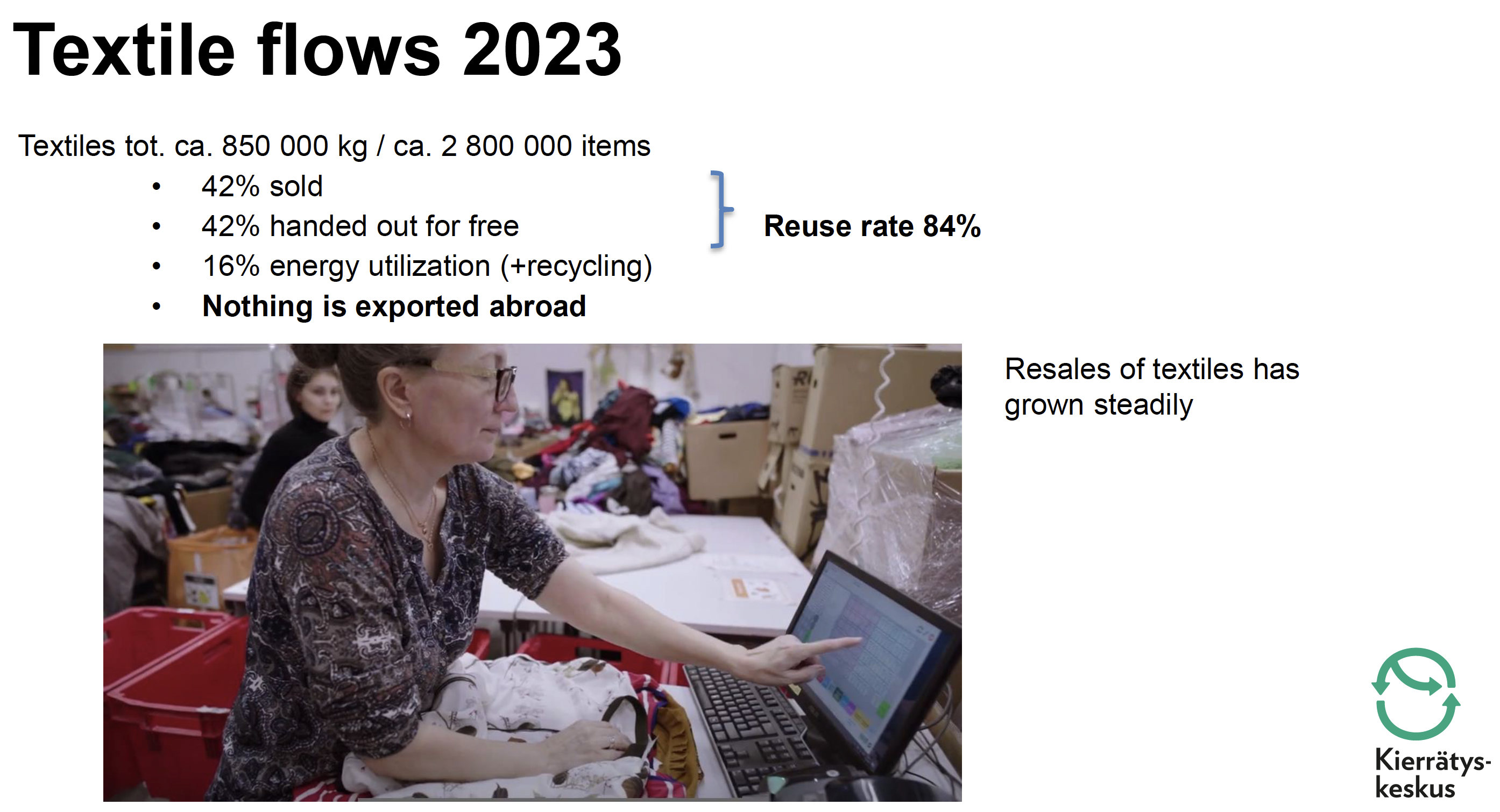
Source: Webinar presentation. Find slides and recordings on the project website.
As illustrated in the figure above, Kierrätyskeskus can sell 42% of the textiles received, while 42% are handed out for free. Resale of textiles is growing steadily and Kierrätyskeskus is using several strategies to increase sales. This includes improving their store environment and display of textiles to make it easy and appealing to find and buy second-hand. Kierrätyskeskus uses the strategies listed below to emphasize the importance of creating an easy overview of clothing categories based on, for example, gender, types of clothing and colors.
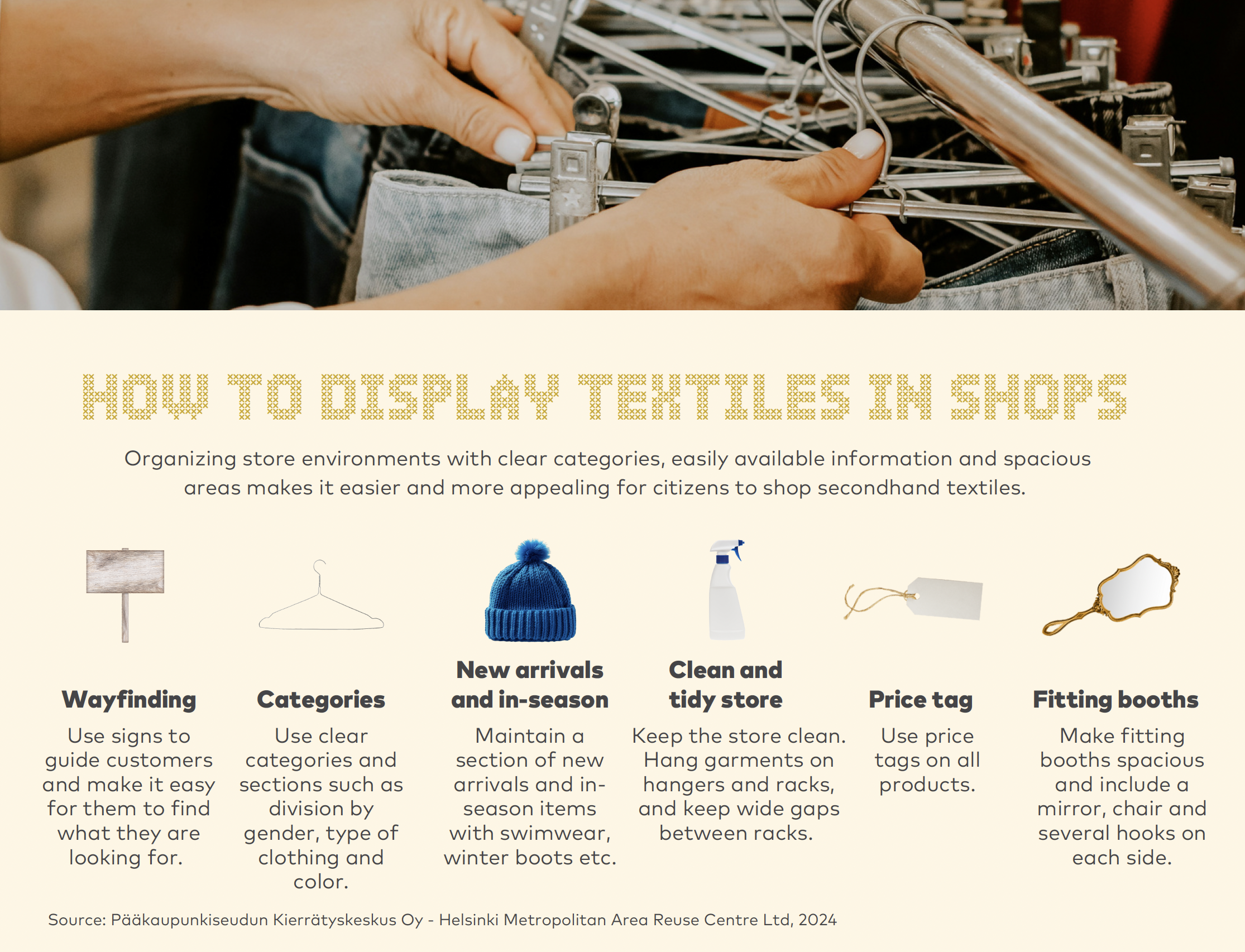
Infographic by Holm Kommunikation based on the webinar presentation
Besides improving the store environment and display of textiles, Kierrätyskeskus focuses on redesign and identifying products in high demand. They have their own brand called The Plan B-collection, where they sew clothes, home textiles and accessories of donated textiles. It is small in volume and has not been a big success yet, as markets for pricey, sustainable and domestic produced products are marginal. Kierrätyskeskus also has a “most-wanted” collection, where they identify good-quality products which are in demand and can be sold at a higher price point. Like the Plan B-collection, it is small in volume, but easier to resell. Having this collection requires expertise in recognizing potential items and constantly monitoring new trends.
The remaining 42% of the donated textiles are handed out for free: after 4–12 weeks in the store, textiles are moved to the “Free items” room. Mette Dalgaard highlighted that garments today are not made to last (design-wise). Anu Hakala backed this, emphasizing that the inflow of low-quality clothes is high, which makes it difficult not only to sell used clothes but also to pass them on for free. Kierrätyskeskus has a free-item shelf or room, but textiles are challenging to pass on to a new owner, despite being free of charge.
In conclusion, Anu Hakala emphasized the need to create awareness through different educational programs; Kierrätyskeskus offers visits to the sorting and logistics center and the store to learn more about their operations, as well as training in recognizing good quality: learn what to check, the signs of quality and why quality is important. For repair and handicrafts, Kierrätyskeskus also offers all kinds of handicraft materials for sale, including pieces and patches of cloth, yarns, etc. In addition, they offer handicraft workshops for groups.
After the presentations by Mette Dalgaard Nielsen and Anu Hakala, participants moved on to the workshop.
Workshop findings
For the workshop, participants were divided into country groups and asked to reflect on the presentations from the webinar, as well as their own experiences, in order to identify barriers and solutions for using and making physical and online second-hand sales widely accessible and appealing in society. In the following sections, the identified barriers and solutions are clarified for physical and online sale, separately.
Barriers to making physical second-hand sales widely accessible and appealing
During the workshop, participants identified several barriers to physical second-hand sale:
- Concerns about costs. The citizens pointed to concerns about costs and emphasized that second-hand is sometimes too expensive compared to buying a new item.
- Time is limited. It takes time to find what you are searching for when shopping second-hand. Many experiences limited selections, making it difficult to find specific garments, materials or colors, which makes it difficult to buy an entire outfit in the same store.
- Limited overview of options and availability challenges. This includes lacking knowledge about which second-hand shops exist, where they are, and what they sell. Secondhand shops might also be far away and have limited opening hours. Moreover, it can be an unpleasant shopping experience, as second-hand stores are too cluttered, and products are in poor condition or are not presented nicely. It may also be difficult to find second-hand clothes if you do not wear a standard size, and the availability of second-hand clothing for men is limited.
- Lacking skills to access quality. Lacking the knowledge and skills to assess quality and fit.
- No return option. Items are often not eligible for returns, which can be challenging when determining whether something matches the rest of your wardrobe.
- Human factors. As with repair and redesign, participants mentioned that habits are hard to change, and shopping second-hand is not necessarily part of one’s shopping habits. Participants also highlighted that shopping second-hand with a fast-fashion mindset can be a challenge with regard to extending the lifespan of textiles; this includes buying multiple items or buying more than you need, just because prices are low or because you do not have time to consider whether you actually need or will use them.
The price can make you buy it, more than the intention of wearing it or needing it. It’s good that we resell but that is still accelerating the momentum of fashion. This is also overconsumption in a way.
Solutions to making physical second-hand sales widely accessible and appealing
To mitigate these barriers, participants identified the following solutions:
- Behavioral changes and investing time in second-hand shopping. This could include visiting second-hand stores often to practice second-hand shopping “skills”. You need to have a pragmatic mindset rather than going with a specific garment in mind. Be proactive and think ahead; for instance, start to search for replacement items before a current item is worn out. At the same time, communicating the consequences of unsold second-hand garments going to waste could provide an incentive to shift to second-hand shopping.
- Government-supported marketing in the second-hand sector, as well as VAT exemption on second-hand items and compensation for volunteer staff are also potential solutions moving forward.
- Providing an overview and ensuring availability could be facilitated through second-hand shopping tours, a second-hand fashion map or app of cities, supported by SoMe profiles. At the same time, making store layouts more appealing and sorting them by color and size would make it easier to find what you are looking for. Ultimately, this means setting up second-hand stores like stores selling new clothes and making them attractive by ensuring that they have their own style and niche. However, Anu Hakala stressed that this requires many resources. Self-service opening hours in secondhand stores might help ensure availability. Some participants also pointed out that selling second-hand clothes in the same stores as new clothes would make them more aware of the benefits of buying second-hand.
- Second-hand stores should include a “free area” where textiles have a last chance of finding a new home. This is, among others, a practice at Kierrätyskeskus, which also offers a handicraft service where fabrics, yarn, etc. are handed out for free for schools and other institutions.
- You could bring your own clothes to the store to see if new items match your existing wardrobe, in order to mitigate the challenge of not having the right to return purchases.
- To ensure that you do not use second-hand shopping with a fast-fashion mindset, it was suggested that people should build personal resistance towards buying a garment, to be picky and ensure that the garment fits them in both size and style.
Barriers to using online second-hand platforms and making them widely accessible and appealing
Barriers to using online second-hand platforms were also discussed. The participants discussed online sales on both brand platforms and peer-to-peer platforms. The following barriers were identified:
- Limited selection. Brands selling second-hand alongside new items often do not have a lot to offer.
- Fear of being scammed or receiving faulty items. Several participants emphasized the fear of being scammed when they don’t know who they are buying from on peer-to-peer platforms. They fear purchasing counterfeits, and emphasized that poor item descriptions and blurry images, especially on peer-to-peer platforms, make it difficult to determine whether an item will fit, both in terms of size and their need for that specific piece of clothing in general.
- Time and money. It requires time and effort to find the right items, and some brands are overpriced when sold second-hand. Additional costs are also common when shopping online, transaction costs, shipping costs, hidden costs. Ultimately, the shipping costs can end up being higher than the cost of the item bought.
- Online second-hand platforms can be unmanageable, as there are varying systems across platforms, including different ways of managing and performing transactions.
- Return policies were yet again highlighted, as it is often not possible to return second-hand items bought online.
- Environmental concerns: Citizens prioritize local options as they wish to help reduce the increasing amount of transportation of clothes around the globe. Furthermore, participants discussed how they preferred not to buy second-hand clothing from companies who also sell newly produced fast fashion, which could indirectly support fast-fashion business models.
- Human factors. People miss the atmosphere and experience of shopping in a physical store or savor the memory of going somewhere special.
Solutions to making online second-hand sales widely accessible and appealing
A wide range of barriers to using online second-hand platforms were identified, and participants did not point to solutions to mitigate all of them. Nevertheless, two solutions were identified for mitigating the challenges related to managing online second-hand platforms:
- Develop and share skills among resellers in displaying second-hand clothes well and setting accurate prices across different resale platforms.
- Establish an online directory of online stores. This also includes developing different ways of encouraging recirculation, rather than only buying.
The workshop input from participants regarding repair and redesign formed the basis for developing recommendations for actions moving forward (see Chapter 6).
3.2.5 The six-month challenge: Webinar and workshop about rentals and styling
The third and last webinar and workshop during the six-month challenge focused on experiences and hands-on tools to prolong the lifespan of textiles by means of rentals and styling. The webinar part was held through two presentations (see below). In the workshop, participants discussed the barriers and solutions to using rental and styling as methods to prolong the lifespan of textiles.
Webinar about rentals and styling, May 15, 2024
When are rental services relevant and to whom? By Piia Nurmi, Senior Lecturer, Turku University of Applied Science. Learn more here: https://www.tuas.fi/en/
Rediscover your wardrobe: The 4 items (everyone already has) to provide endless outfits by Laura Lava, Independent wardrobe expert, author & speaker. Learn more here: https://lauralava.dk/
The following sections summarize key take-aways from the presentations and the workshop.
Take-aways from “When are rental services relevant and to whom?”
Like many of the other presenters in Active Textile Society, Piia Nurmi emphasized that taking care of your garments and extending their lifespan is key to reducing the environmental impact of textile production and consumption. Rental services are one way of prolonging the lifespan of textiles (more users per product), but environmental gains are obtained only if rental services are used as an alternative to new production.
Defining rental, Piia Nurmi underlined that a company owns the product and you, as a customer, are renting access to that product (using the product as a service model (PaaS) approach: see section 3.2.1), which means that customers do not buy the clothes but pay for the services related to wearing them. Rental is a customer-oriented service concept, which first and foremost requires products of a certain quality, but it must also provide added value for the consumer to use the product as a service rather than owning the product; for example, it could increase consumer convenience.
Piia Nurmi’s research shows that services such as style consultancy, repair and remodeling increase the attractiveness of rentals. At the same time, Piia Nurmi explained that to create a sustainable business model, the triple bottom line of sustainability must be included. In other words, the benefits for society and the environment are included, in addition to the economic value of a product:
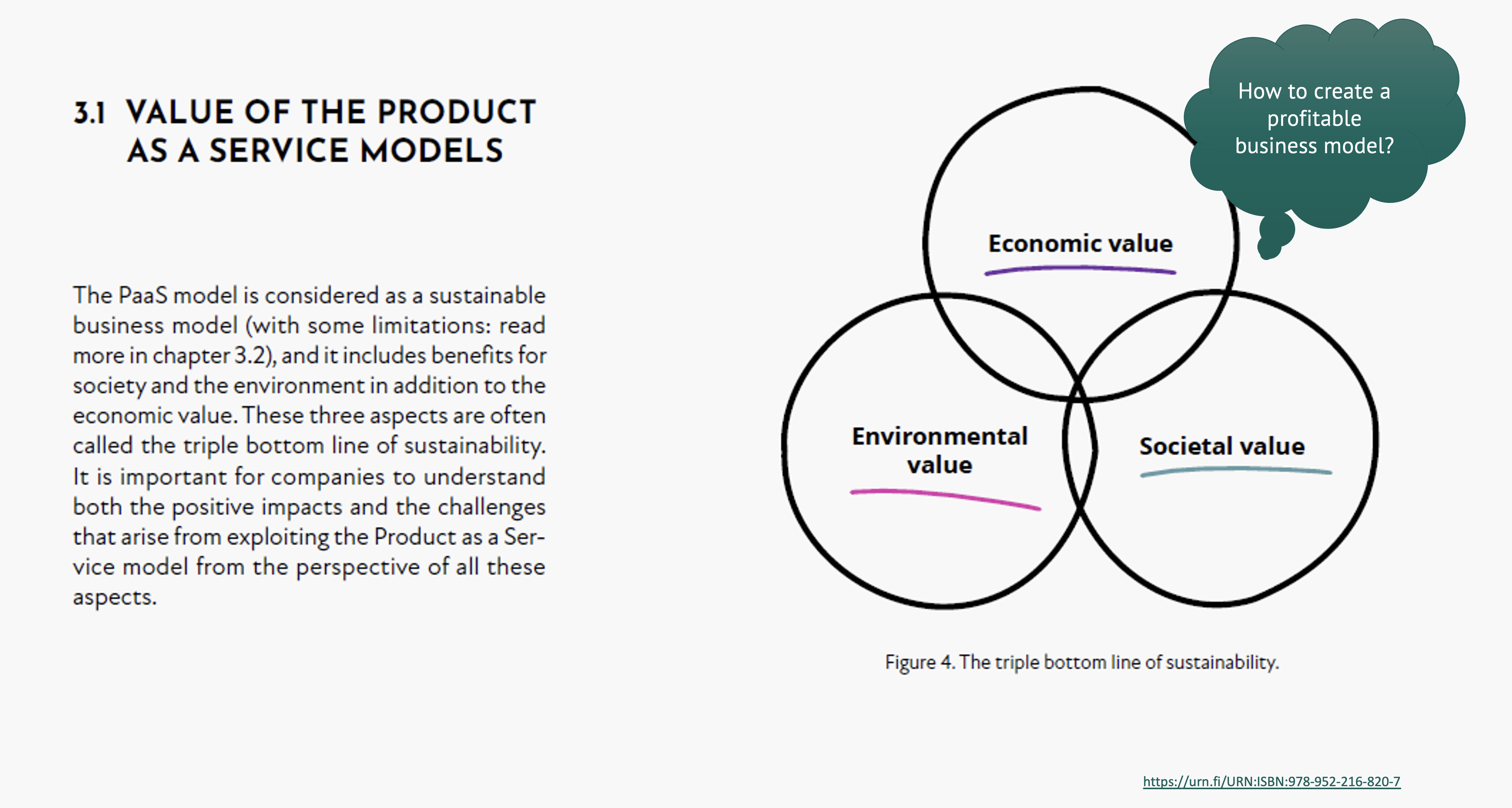
Source: Webinar presentation. Find slides and recordings on the project website.
Piia Nurmi advised brands to study what kind of services their customers need, as these are central to developing a rental model. For example, they should consider the duration of the use period; some customers are looking for short-term use, as they want to swap their clothes often, while others want long-term rental periods. Flexibility is also crucial; the setup must not require too much from the customer and should not be too expensive. In summary, customers want easy access, reliability, not having to care for or wash the product, flexibility and a good price. The figure below gives an overview of the benefits and the barriers of product-as-a-service models from a customer perspective, as presented by Piia Nurmi:
The benefits may include:
- Confidence that the product is ready for use when you need it
- No need to care for the product after or during use
- Flexibility when needs change – if you need something more or less, or need something different
- No need to invest in the product
The challenges and the barriers may include:
- Moving away from ownership of the project (changing mindset)
- Sharing the product with other customers (e.g., hygienic concerns)
- Arranging logistics and product maintenance (if not provided as a service)
- Requirements for planning (e.g., timing of product use)
- Incompatibility of the product selection with specific customer needs
To assist companies in developing rental services, Piia Nurmi introduced a guide for the development of product-as-a-service (see above). The guide provides information, examples and practical tools on how to develop and implement product-as-a-service-business models. Two pilot projects were highlighted: casual wear as a service and workwear as a service. A key learning from the two pilots is that it is crucial to identify the customer segment and design the service model in accordance with their needs, price incentive, etc., as highlighted earlier. Furthermore, the pilots revealed that data is often collected, but not used. Data information needs to be shared more to understand the model and the room for improvement. Furthermore, the barrier of an intense focus on hygiene was highlighted as this causes rented clothes to be washed often – perhaps even more than needed. While both pilots were successful, the rental model for casual wear is currently on hold, as the business is not sustainable at the moment, due to lack of demand. On the other hand, workwear as a service is thriving and, in general, there is a growing demand for rentals of workwear.
Take-aways from “Rediscover your wardrobe: The 3 items (everyone already has) to provide endless outfits”
Laura Lava started her presentation by highlighting the need to shift the focus away from the consumption of new goods to using what people already own. This implies investing time in using and maximizing one’s existing wardrobe. To succeed, Laura Lava identified three must-haves for a great wardrobe: time, overview, and a full-length mirror.
 | Time: you need time for sorting, repairing, and laying out your clothes/outfit for the next day. |
 | Overview: you need to know what you have to create an overview of your styling options. Laura used the term “building blocks” to organize the clothes in different categories as shown below. |
 | Full length mirror: an underrated, but very important item to be able to see your full outfit. |
Source: Webinar presentation. Find slides and recordings on the project website.
According to Laura Lava, the first thing to do in order to create an overview of one’s wardrobe is to declutter and re-organize it. It is not the number of clothes in the wardrobe that is important but knowing what clothes you have. One way to create this overview is to organize the clothes in building blocks; tops, bottoms, full-body garment, and outerwear. This will provide the overview you need to see the options available to build an outfit. A friendly wardrobe is a wardrobe with clothes that fit and are loved. Think of your wardrobe as a library, which may hold many items, but is very neatly organized to provide a clear overview.
The building blocks:
- Outerwear for example jacket, coat, blazer, sweater, cardigan, sweatshirt and waistcoat
- Top wear for example t-shirt, shirt, blouse, and tank top
- Bottom wear for example jeans, trousers, skirt, and shorts
- Full body garments for example dresses, and suits
Source: Webinar presentation. Find slides and recordings on the project website.
Once the wardrobe is organized in building blocks, you can focus on styling strategies and keeping your wardrobe tidy. Laura rounded off her presentation with a series of styling tips focusing on how to create your outfit, but also how to ensure a proper wardrobe strategy to ensure that your wardrobe is kept organized and relevant; for example, by making a positive and negative shopping list to guide your investments in new clothes.
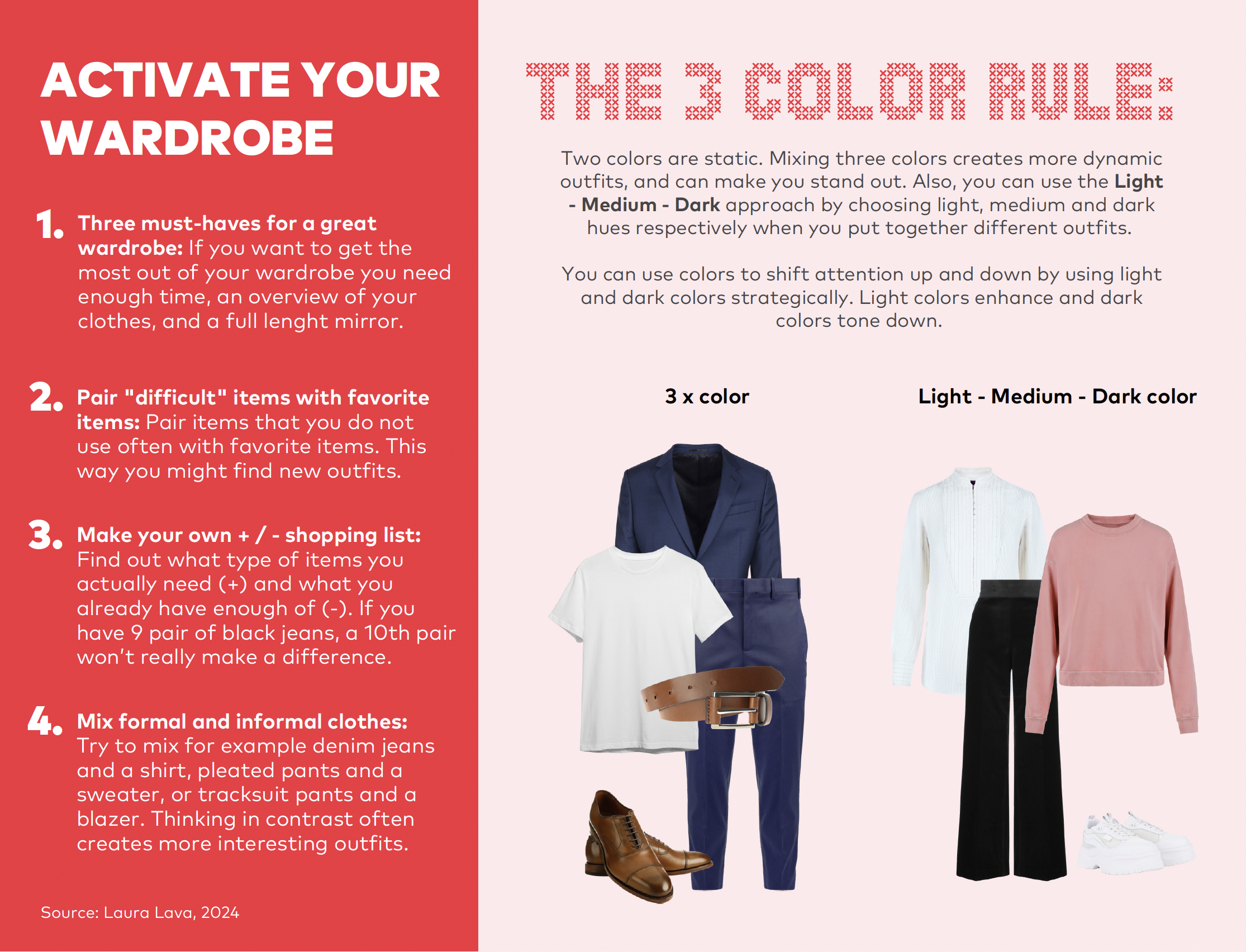
Infographic by Holm Kommunikation based on webinar presentation
After the presentations from Piia Nurmi and Laura Lava, participants moved on to the workshop.
Workshop findings
For the workshop, participants were divided into country groups and asked to reflect on the presentations from the webinar, as well as their own experiences, to identify barriers and solutions for using and making rental and styling widely accessible and appealing in society. The following section presents the identified barriers and solutions.
Barriers for using rental services and making them widely accessible and appealing
During the workshop, participants identified central barriers to using rental services. In general, a few of the participants had tried rental services and some did not know it was possible to rent clothes. Therefore, the barriers identified both reflect the experiences of some participants and the constraints met by others on even trying rental services.
- Limited overview of rental services and their availability. Several participants highlighted the lack of awareness of existing rental possibilities and emphasized that long distances to the closest rental place is a logistical challenge. Furthermore, not knowing what rental services offer and what they cost restricted many of the participants from seeking rental services.
- Concern about costs and liability. The participants perceived rental services as expensive and found it cheaper to own their clothes. Participants likewise emphasized concerns about liability if they ruined a garment during rental, such as by staining it.
- Inconvenient and time consuming. Participants find renting clothes to be cumbersome, especially with online services, where you have to send and receive rented clothes and are not able to try on or feel them. There is a fear of clothes not fitting, as it is hard to find the right size, especially if subscribing to a service. Bringing back the rented item also seems like a chore and is time consuming, as it takes time to plan when and how to use the rental service, and you will probably have to wait a few days to receive the piece – inconvenient if there is a sudden need for it.
- Hygienic concerns. Perception that rental clothes are dirty.
- Limited need for new clothes. Several participants also highlighted that they did not find rental services attractive, as they only owned and needed clothes that they love and use. When owning clothing, the participants emphasized that they know what quality and care is involved and could use the clothes for their entire lifespan. Most participants also emphasized that they find rental services relevant for workwear and clothes for special occasions, but not everyday wear.
Solutions to making rental services widely accessible and appealing
The participants suggested the following solutions:
- Providing incentives. The participants agreed that making it easy and providing incentives for using the service were key for making rental services an appealing option. One of the participants rented her wedding dress, but because she was the third person to rent the dress, she got the opportunity to keep it: this was a strong incentive for her to rent. Based on this, one idea was to establish that if the clothes have been rented out x times and it is "worn out", you could allow the last customer to keep them. Participants also emphasized the incentive of telling the story of how rentals reduce the environmental impact of textile consumption. Pregnancy wardrobe and children’s clothes were mentioned as ideal categories of clothes for a rental service, as these types of garments are often used for a limited period of time.
- Raise awareness of rental services. The participants emphasized a need to make citizens aware that rental services are an option for everyone.
- Making rental services convenient. It is important to ensure ease of access to physical rental stores and that they are close to stores selling new garments or combining selling and renting in the same store. In case of an online rental service, it requires a user-friendly website showing the services on offer. Returns should also be made easy and convenient, for instance, by offering a pickup service.
- Promoting an app that can help you with sizing would be useful; for example, by taking your measurements so that the tailor can prepare a perfect fit.
- Making it affordable. Providers should ensure a proper level of cost and explain how the cost is actually not higher than buying new garments every time. Also, they should emphasize that the citizen gains time by not having to do product care, washing, etc.
- Legislation: The government could introduce legislation requiring the offering of rental services and tax reduction on rental companies.
During the workshop, participants also discussed experiences with styling and identified a list of barriers and solutions to using styling as a tool for expanding the lifespan of textiles.
Barriers for using styling methods and making it widely accessible and appealing
During the workshop, citizens participating identified several barriers to using styling methods and organizing their wardrobe. In general, many of the participants felt that they lacked skills to style their wardrobe and ended up using the same outfits repeatedly. However, some participants already used many of the techniques presented by Laura and focused on limiting their wardrobe, for example, through the concept of a capsule wardrobe. The identified barriers to using styling methods and organizing their wardrobe are listed below:
- Limited styling skills. Several participants pointed to the issue of repeating outfits and not having imagination to see what things would fit together, but always going for the old, tried, safe combinations. Consequently, the participants usually started to fall out of love with their old clothes and wanted to buy new.
- Time constraints. It was not always possible to take the time needed to study and reorganize your wardrobe based on Laura Lavas methods.
- Concern that professional stylist services are costly.
Solutions to make styling methods widely accessible and appealing
The participants discussed and identified solutions to mitigate the barriers and challenges identified above. Many of the solutions listed below have direct links to Laura Lavas’ presentation, which underlines both how this topic was unknown to the participants, and how Laura’s presentation gave hands-on tips that seemed useful to the participants:
- Overview. Owning fewer items. Participants also suggested keeping winter and summer clothes separated and storing out-of-season clothes in boxes.
- Time. Take the time needed to pick out your outfit.
- Focus on accessories, such as a belt, to update your outfit and mitigate "outfit repeating".
- Getting styling tips and help from friends and family. Make it a social event, just like a shopping trip, which is cozy to do with friends. Consider helping each other with styling the clothes already in the wardrobe.
- Learn more about styling and get help through styling courses and tutorials or a personal virtual helper or digital wardrobe, but with solutions that are not expensive and at the same time easy to use and need limited time. Investing in a session with a professional stylist could also be seen as a one-time investment in knowing your preferred shape or fit, and ultimately save money in the longer run by limiting mistakes when shopping.
- Own a full-length mirror to be able to see your full outfit.
- Make a shopping list for clothes and only buy what is on the list. Remember to balance the list depending on what kind of clothes you have and do not, for example, buy tons of tops.
The workshop input from participants regarding repair and redesign formed the basis for developing recommendations for actions moving forward (see Chapter 6).
In parallel with webinars and workshops, participant experiences were gathered through surveys. The rest of the chapter presents results from these, focusing on companies and citizens and their experiences during the six-month challenge.