
Chapter 5: EU & Textile Coffee Breaks
Chapter 5: EU & Textile Coffee Breaks
This chapter summarizes the series of webinars titled EU & Textile Coffee Breaks hosted by the Danish Ministry of Environment for participants in The Nordic Textile Collaboration.
5.1 About the initiative
The purpose of this webinar series was to introduce participants to various aspects of the EU regulatory framework they would be working under in the coming years and link these insights to activities in Active Textile Society and Sharing Nordic Circular Competences. Each Coffee Break consisted of a presentation by a civil service official, introducing an initiative related to the EU Strategy for Sustainable and Circular Textiles that they were currently working on. The webinars gave participants the chance to connect with expert officials who could provide insight into current EU proposals for new legislation/initiatives and ongoing negotiations, which may otherwise be complex and challenging to grasp. The webinars also served as an open forum for questions that could be answered directly by the relevant presenter/expert.
Five EU & Textile Coffee Breaks were organized between October 2023 – August 2024. Each webinar consisted of 15–20-minute presentations and 10–15 minutes of Q&A. Presenters/experts were identified by the Department of the Danish Ministry of Environment, and each webinar was moderated by an official from the Ministry’s office for Circular Economy.
Presenters
Waste Framework Directive, by Mathias Bach Kirkegaard, the Danish Ministry of Environment.
Ecodesign for Sustainable Products Regulation, by Mathias Bach Kirkegaard, the Danish Ministry of Environment
Textile Labelling Regulation, by Mille Ertløv Hansen, the Danish Safety Technology Authority
Digital Product Passport, by Anders Bomholdt, Danish Business Authority and Green Claims by Karen Dalgaard Sanning, the Danish Ministry of Environment
Due Diligence by Shirin Ørberg, the Danish Business Authority
5.2 Key take-aways from the webinars
Below is a short summary of each webinar held in the EU & Textile Coffee Breaks series. The summaries are descriptions of insights presented at the time of the webinar, and do not reflect any further developments that may have ensued relating to the EU initiatives described. Slides from each webinar have been made available on the Danish Environmental Protection Agency’s website.
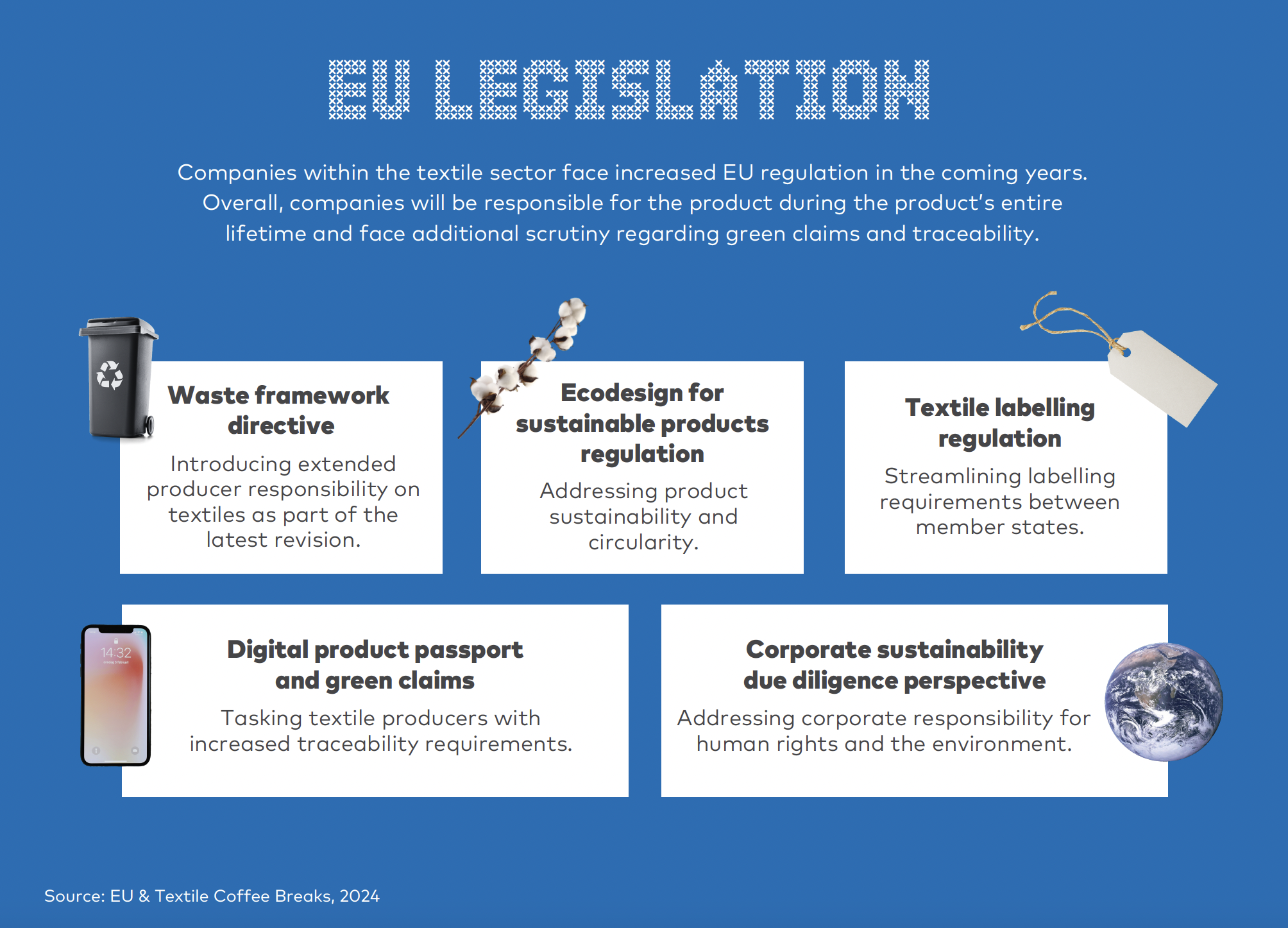
Infographic developed by Holm Kommunikation based on webinar presentations
5.2.1 Waste Framework Directive
Date: October 23, 2023
This session focused on the newly proposed revision of the EU’s Waste Framework Directive. It began with a general presentation of the directive and the relation to the European Green Deal and Circular Economy Action Plan, before zooming in on the proposed extended producer responsibility (EPR) for textiles as part of the directive’s revision. The presenter was selected because of his involvement in official EU negotiations and role in supporting to shape the Danish position on the directive. Participants were informed of the most recent developments in negotiations, including proposals on costs of EPR, national producer registers, the role of producer responsibility organizations and requirements to waste handling.
5.2.2 Ecodesign for Sustainable Products Regulation
Date: January 16, 2024
This session focused on the Ecodesign for Sustainable Products Regulation. The presenter was selected because of their involvement in EU negotiations and was able to provide a deep-dive into the final political agreement around the initiative and how it was expected to have an impact on products in the coming years. A mapping was presented of the way Ecodesign Regulation features in various EU legislation, including the Waste Framework Directive, Right-2-Repair Directive, End-of-Life Vehicles Regulation, Construction Products Regulation, Critical Raw Materials Act, Packaging and Packaging Waste Regulation and Battery and Waste Batteries Regulation. A specific case study on Ecodesign on jeans was presented to highlight what performance and information requirements might be expected in the textile industry. Other aspects of the regulation, which could impact the textile industry, were discussed, including digital product passes, banning the destruction of textiles and footwear, and public procurement requirements. Among the key take-aways was that preparatory work for Ecodesign requirements had already begun and was seen as a priority area for Ecodesign regulation.
5.2.3 Textile Labelling Regulation
Date: April 5, 2024
This session focused on the EU’s current Textile Labelling Regulation and upcoming revision as part of the EU Strategy for Sustainable and Circular Textiles. The presenter was a representative from the Danish Safety Technology Authority, who had taken part in providing Danish input to the EU Commission’s public consultation on the revision. The session began with a summary of the current Textile Labelling Regulation followed by an introduction to the Commission’s initiative to revise the current regulation. The objectives of the initiative were presented as addressing shortcomings in the current rules as well as divergent labelling requirements between Member States. Additional labelling domains were also explored. Finally, participants were made aware of the public consultation by the Commission until April 15, 2024, which would inform the evaluation of the Regulation and the impact assessment on its possible revision (first quarter 2025).
5.2.4 Digital Product Passport and Green Claims
Date: June 7, 2024
This session provided participants with updates on two central EU initiatives: The Digital Product Passport by The Danish Business Authority and Green Claims by the Danish Ministry of Environment. The speakers were selected due to their role in EU negotiations. The presentation on Digital Product Passports began with an introduction to the Ecodesign directive and regulation, and how the Digital Product Passport ties in. Examples of product performance and information requirements were described, including for durability, reliability, reusability, upgradability, repairability and more. It was explained that delegated acts for performance requirements, information and green public procurement will specify exactly which performance and information requirements will be included. Some main design features of the Digital Product Passport were presented, such as a decentralized approach to data storage, access through a product unique identifier, and access on a need-to-know basis. The presenter ran through a checklist of what companies will need to do to live up to Digital Product Passport regulations, and what a Digital Product Passport might look like. Finally, EU implementation work ahead was described, including aspects such as Digital Product Passport service providers, digital credentials, a Digital Product Passport registry and web portal, as well as the definition of standards by December 31, 2025.
The presentation of the Green Claims Directive began with a description of the scope of the proposal in the ongoing negotiations. This included business-to-consumer commercial practices, where environmental claims and labelling are voluntary and claims are related to environmental aspects, impacts and performance. The proposal also denotes that substantiation and communication of claims shall be reviewed and updated at least every five years.
The presenters then described how to substantiate claims, how to handle comparative claims, as well as how to communicate environmental claims according to the EU Commission’s proposal. The links between environmental labels and labelling schemes to the new directive were highlighted, such as the requirement to live up to the new directive, and a proposal from the Commission to prohibit the establishment of new national or regional publicly owed schemes.
Finally, proposed enforcement of the provisions for Member States was laid out, including what factors to consider when designing the appropriate penalty for infringement. The presentation ended with a description of the forthcoming process, including a council meeting on June 17, 2024, followed by Trilogue meetings, an agreement, publication, and implementation in each Member State.
5.2.5 Due diligence
Date: August 9. 2024
This session focused on the newly adopted EU Corporate Sustainability Due Diligence Directive (CSDDD), and how it reshapes corporate responsibility for human rights and the environment across the supply chain. The speaker was selected due to their role as the Danish national expert on CSDDD. A timeline of the EU process, including the deadline for national implementation in 2026, and phasing in of rules from 2027–2029, was shared. An overview was provided of the directive’s key components, including further details on the definition of very large companies, due diligence, addressing adverse impacts and companies’ chains of activities. Moreover, the requirements for companies to adopt climate plans were described. Key take-aways included CSDDD being game-changing legislation on responsible business, the close connection to CSRD (sustainability reporting) and that, even though only large companies are within scope, SMEs will be affected indirectly through the supply chain.
5.3 Sub-conclusion
The EU Textile Coffee Breaks provided participants from the corporate sector, business associations, waste management and academia with complementary knowledge to the ongoing activities in Active Textile Society and Sharing Nordic Circular Competencies by describing the EU regulatory environment for actors who play a part in the textile industry. Between 20–60 participants joined each session. Many participants had reported challenges in getting an overview of EU developments on textile-related topics, which this webinar series aimed to solve. Participants responded positively to these short informal updates, where connections were made to various experts, and participants were able to have their questions answered directly, summarizing complex information and negotiations in a compact, accessible way.