4.2 Key take-aways from webinars
In the following sections, each webinar from Sharing Nordic Circular Competences will be explored. Key lessons and take-aways will be presented, addressing the barriers and solutions to circular transition in the fashion and textile industry.
4.2.1 Webinar about wasted textiles
The webinar investigated the following question: What do we know about the user perspective and content of textile waste, including collection and sorting? The webinar included four presentations:
Webinar about wasted textiles, 26 October 2023
Wasted Textiles by Anna Sigaard, PhD Student, Consumption Research Norway (SIFO), OsloMet. Learn more about the project here: https://clothingresearch.oslomet.no/wasted-textiles/
What can we learn from the textiles in the waste bin? by Nynne Nørup, Assistant Professor, Industrial PhD, Department of Planning, Aalborg University Copenhagen. Learn more about the project here: https://vbn.aau.dk/da/publications/development-and-testing-of-a-sorting-and-quality-assessment-metho
Separate end-of-life textile collection, sorting and solutions by Anna Garton, Post-Consumer Textile Expert, Lounais-Suomen Jätehuolto Oy (LSJH). Learn more here: https://postconsumertextile.com
The challenges and possibilities of sorting and collecting textiles by Rustan Nilsson, Communications Officer, Sysav. Learn more here: https://www.sysav.se/foretag/produkter-tjanster/siptex
Take-aways from “Wasted Textiles”
Anna Sigaard has investigated what types of textiles people dispose of and why. Through interviews and sorting analyses of 28 households, she was able to uncover the characteristics of textile items that would otherwise be discarded, recycled or reused. She found that the condition of discarded items varied widely, with 41% of items deemed to be “like new” or with only minor damages, while 28% were deemed not useable or with oil stains or large holes. The most common types of damage included pilling
‘pilling’ refers to clusters of tangled fibers that create small balls and bumps on fabric surfaces. It happens when fibers rub against each other or other surfaces. https://www.testextextile.com/understanding-fabric-pilling-which-fabrics-are-prone-to-pilling/
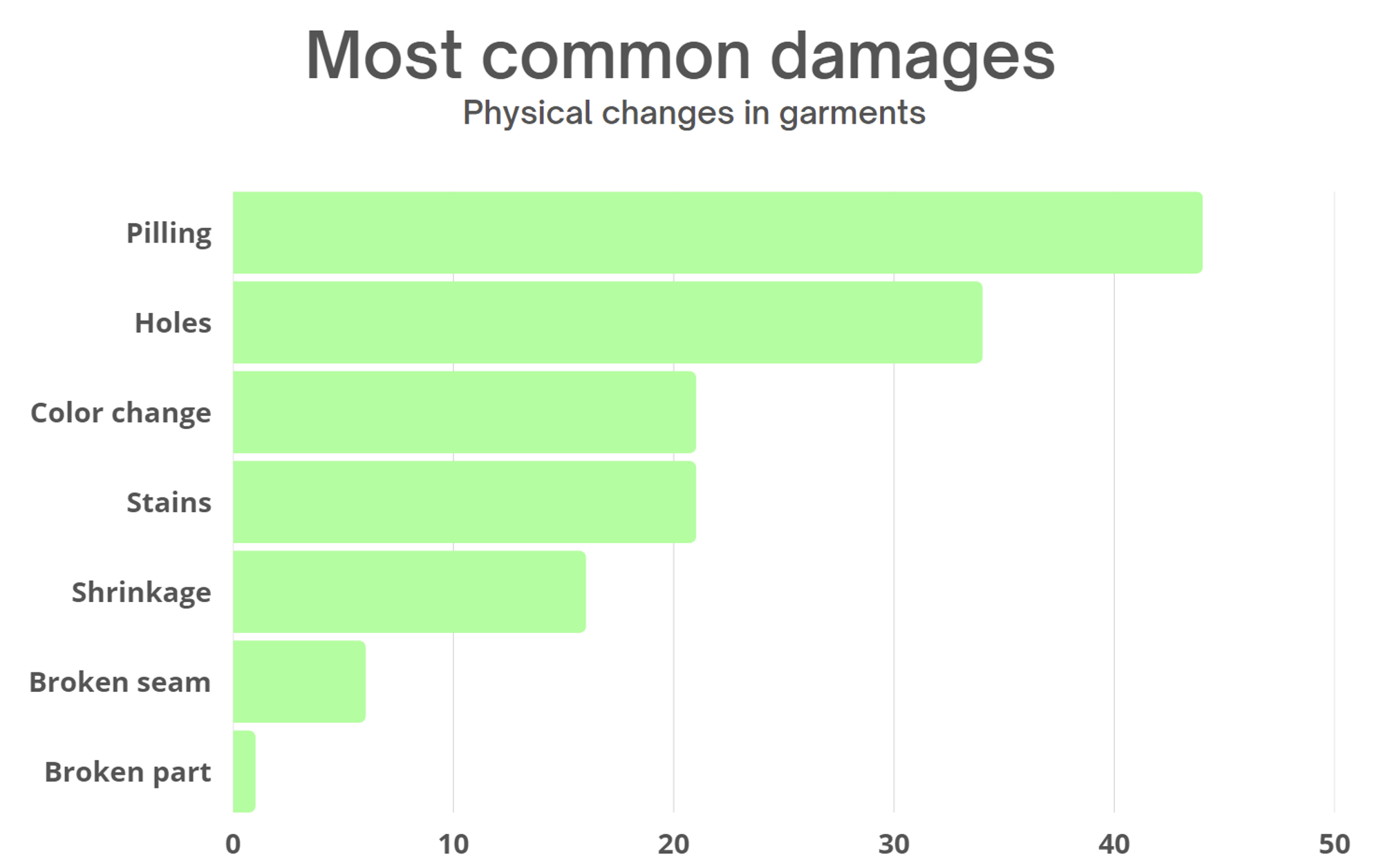
Source: Webinar presentation. Find slides and recordings on the project website.
The study also discovered a distinct correlation between damage and the reasons for clothing disposal, but suggested that some types of damage are more tolerable than others for the wearer. Roughly half of the items were disposed of because of their physical condition, while the other half were discarded because of poor fit or a lack of perceived value, such as style, lack of occasion or simply because they were replaced by new items. This led Anna Sigaard to the conclusion that non-physical aspects are important reasons for people discarding textiles and that improved physical durability is not a sufficient means to solve the issue.
Take-aways from “What can we learn from the textiles in the waste bin?”
Nynne Nørup’s study was aimed at improving the waste management system by studying the textile content of Danish residual waste and the small combustibles fraction.
Former Danish waste fraction, used to categorize small waste items that could be incinerated for energy recovery, such as non-recyclable waste.
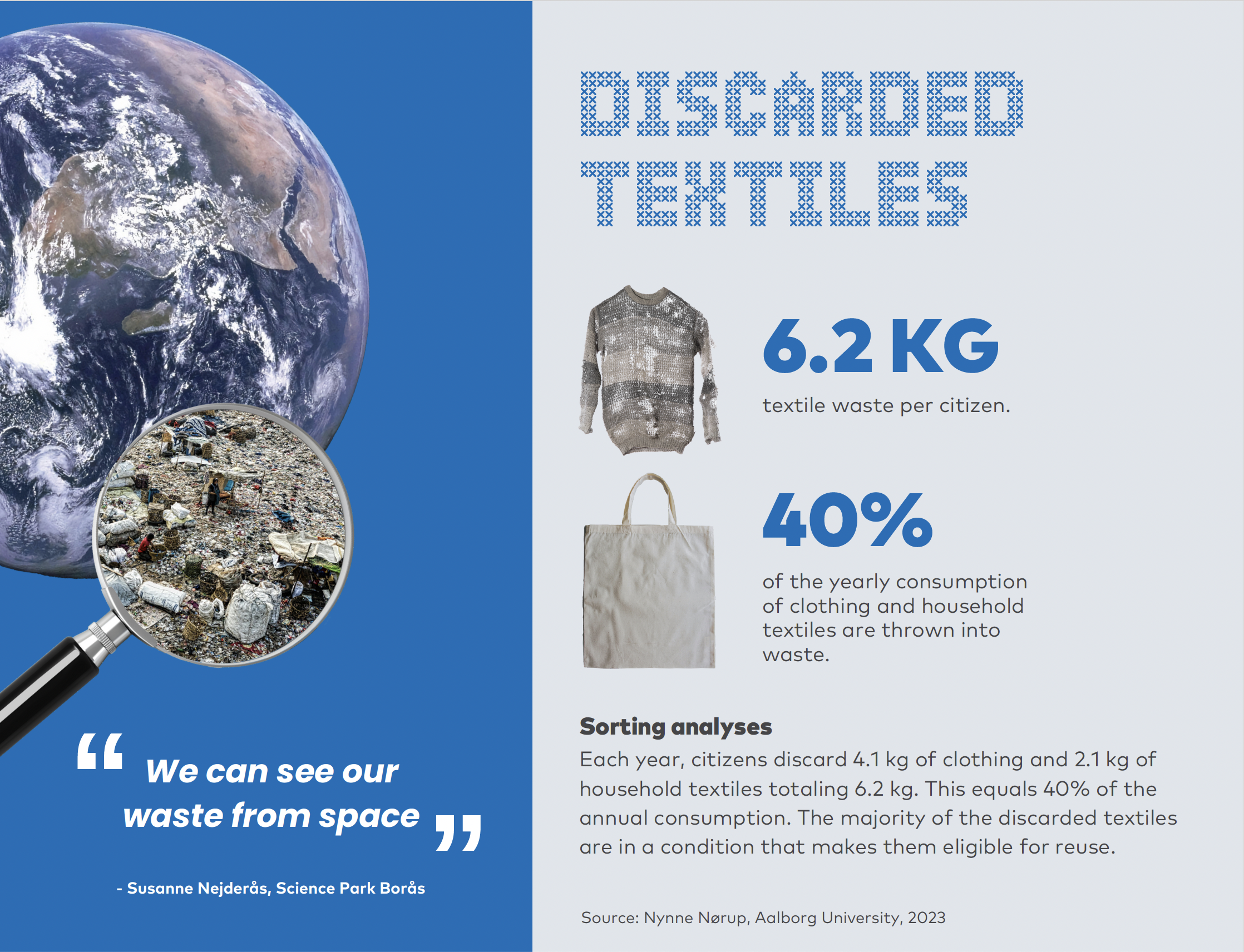
Infographic developed by Holm Kommunikation based on webinar presentation
The quality of discarded items was high, with 77–83% being suitable for reuse. This led Nynne Nørup to investigate the notion of quality, and she argued that the concept must include a combination of functionality, aesthetics and fashion to be understood. According to Nynne Nørup, the study findings challenge conventional understandings of 'quality' in waste management, and indicate that that stakeholders need to consider a multitude of factors when assessing the reusability of discarded textiles.
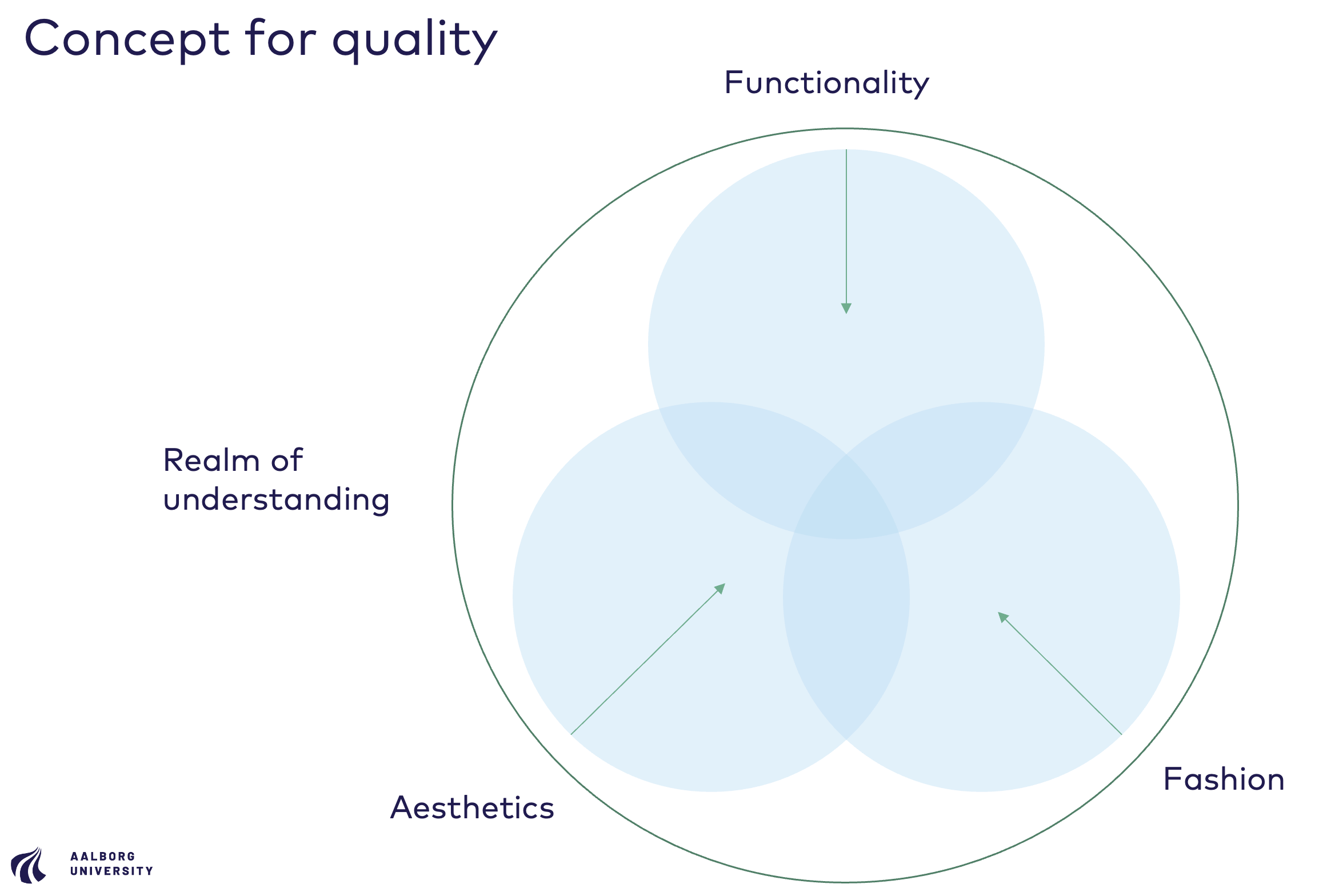
Source: Webinar presentation. Find slides and recordings on the project website.
Take-aways from “Separate end-of-life textile collection, sorting and solutions”
Anna Garton shared her experience with handling textile waste at Lounais-Suomen Jätehuolto Oy (LSJH). LSJH is a Finnish municipal waste management company involved in collection, sorting and processing of textile waste. Finland has required separate collection of textile waste since January 2023, but LSJH has operated a mechanical fiber opening facility since 2021 and processed 743 tons of textiles in 2022 alone.
One of the key business activities of LSJH is material-based sorting. According to Anna Garton, material-based sorting is key to finding the right application for the fibers, as not all fibers are usable for producing new textiles; some fibers might be usable for yarn production, while others are better suited for insulation panels or padding for furniture. Anna Garton stressed that recycled fibers cannot be used in exactly the same way as virgin fibers, and the industry therefore needs to come up with new designs, products or processes in order to utilize recycled fibers.
According to Anna Garton, LSJH sees mostly natural fibers in their sorting, which has led them to the conclusion that what they collect at the moment does not reflect what is currently being sold in stores. LSJH expects the share of synthetic fibers in their operation to increase in the future. The company also expects to see a change in the market in 10 years, with more demand for recycled fibers than supply. This means a total shift as the current market is characterized by very low demands for recycled fibers.
Key lessons from LSJH’s business operations so far are condensed in the infographic below:
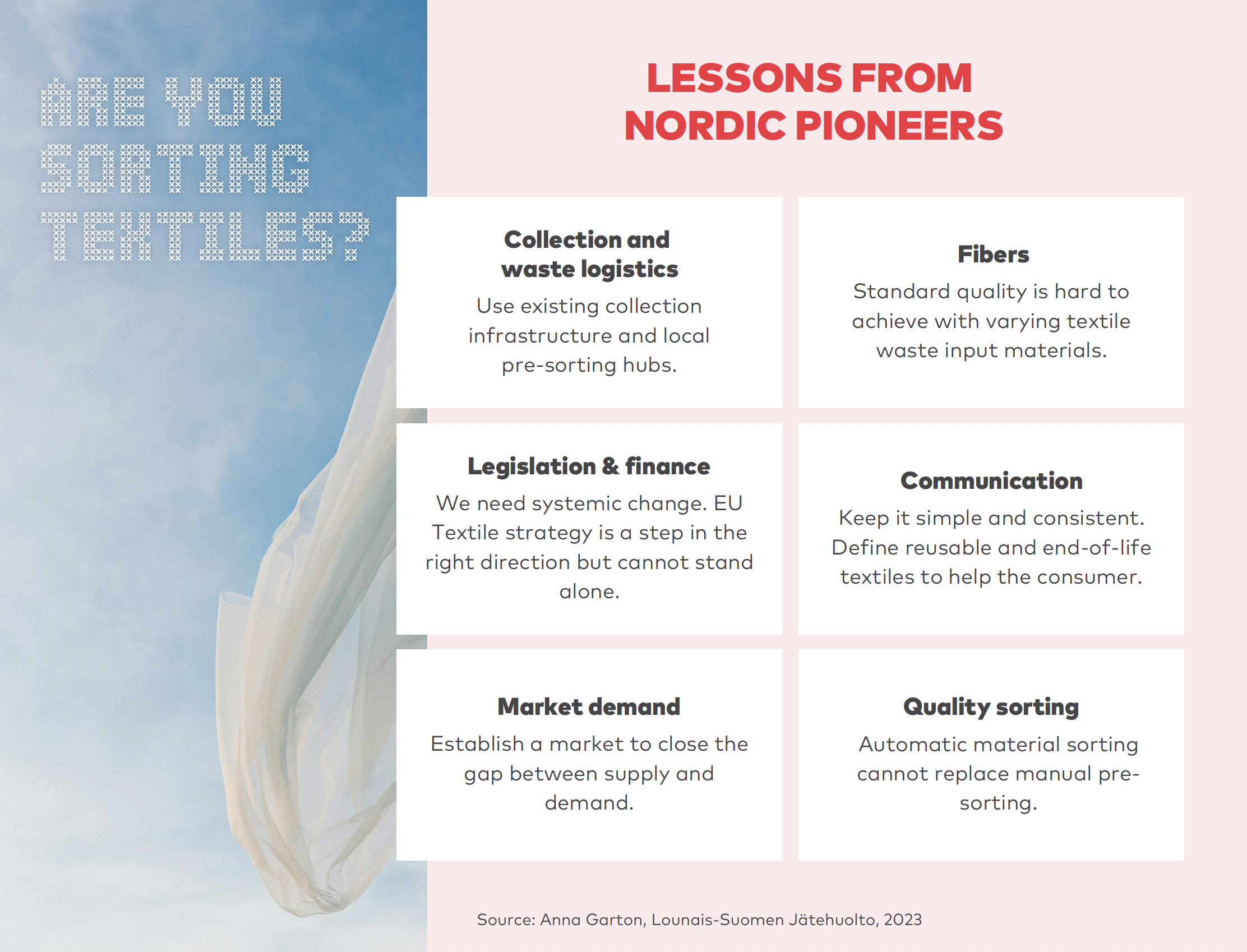
Infographic developed by Holm Kommunikation based on webinar presentation
In terms of achievements, Anna Garton highlighted that through investment in communication, LSHJ has managed to bring down the quantity of reusable textiles in the textile waste fraction to just 3 percent. She also advised waste management companies not to take any short-cuts when collecting and sorting textile waste, as, for example, manual sorting is still a necessity. Finally, she emphasized that while the EU Textile Strategy is a positive push, the market still needs incentives to engage in the transition towards a circular economy.
Take-aways from “The challenges and possibilities of sorting and collecting textiles”
Rustan Nilsson shared experiences from the Swedish Innovation Platform for Textile Sorting (SIPTEX). SIPTEX is a plant equipped with automatic textile sorting technology owned by the municipal waste company Sysav in Malmö. High-volume textile sorting was seen as a bottleneck in the value chain to make recycling possible and SIPTEX was built to provide this missing link. SIPTEX is able to sort textiles by fiber type and color using NIR sensor technology but has seen little demand for color sorting.
According to Rustan Nilsson, SIPTEX currently faces the following challenges:
- Demand is lacking for the sorted textile waste, making it hard to make sorting profitable.
- Textiles collected in Sweden are currently sent for manual presorting in Estonia. The Estonian sorters keep the reusable textiles, and Sweden buys back the textile waste. SIPTEX will need a presorting step in Sweden in the future but there is currently no manual sorting because of costs and lack of skills.
- SIPTEX is uncertain about the ownership situation of the sorted textiles when Extended Producer Responsibility is introduced on textiles in accordance with the current revision of the EU Waste Framework Directive, yet to be adopted. This comes along with a fear of access to materials if brands start collecting textile waste themselves.
- Recycling is not going to solve the problem on its own because a t-shirt produced with recycled fibers only reduces its climate impact by 1–3%. Thus, consumption must also be addressed.
4.2.2 Webinar about design and recycling
This webinar investigated the following question: How do we ensure the right quality of recycled fibers? How do we make clothes and textiles that are recyclable, and how can we use recycled fibers when designing new clothes? It included three presentations.
Webinar about design and recycling, January 17, 2024
Chemical recycling and reinforcement of fibers by means of the Ioncell(R) technique, by Inge Schlapp-Hackl, Postdoc researcher, Aalto University. Learn more here: https://ioncell.fi/
Recycling – Status, Challenges and Design, by Johnny Rodam, Business manager, Danish Technological Institute. Learn more here: https://www.teknologisk.dk/
Circular design strategies for recycled fibers, project Ready, by Anne Louise Bang, PhD, Senior Associate Professor in Design & Sustainability, VIA University College. Learn more about the project here: https://www.ucviden.dk/en/projects/ready-the-local-rd-factory-for-a-global-circular-textile-industry
Take-aways from “Chemical recycling and reinforcement of fibers”
Inge Schlapp-Hackl gave a technical presentation of the chemical recycling technique known as Ioncell and provided an overview of the different processing steps.
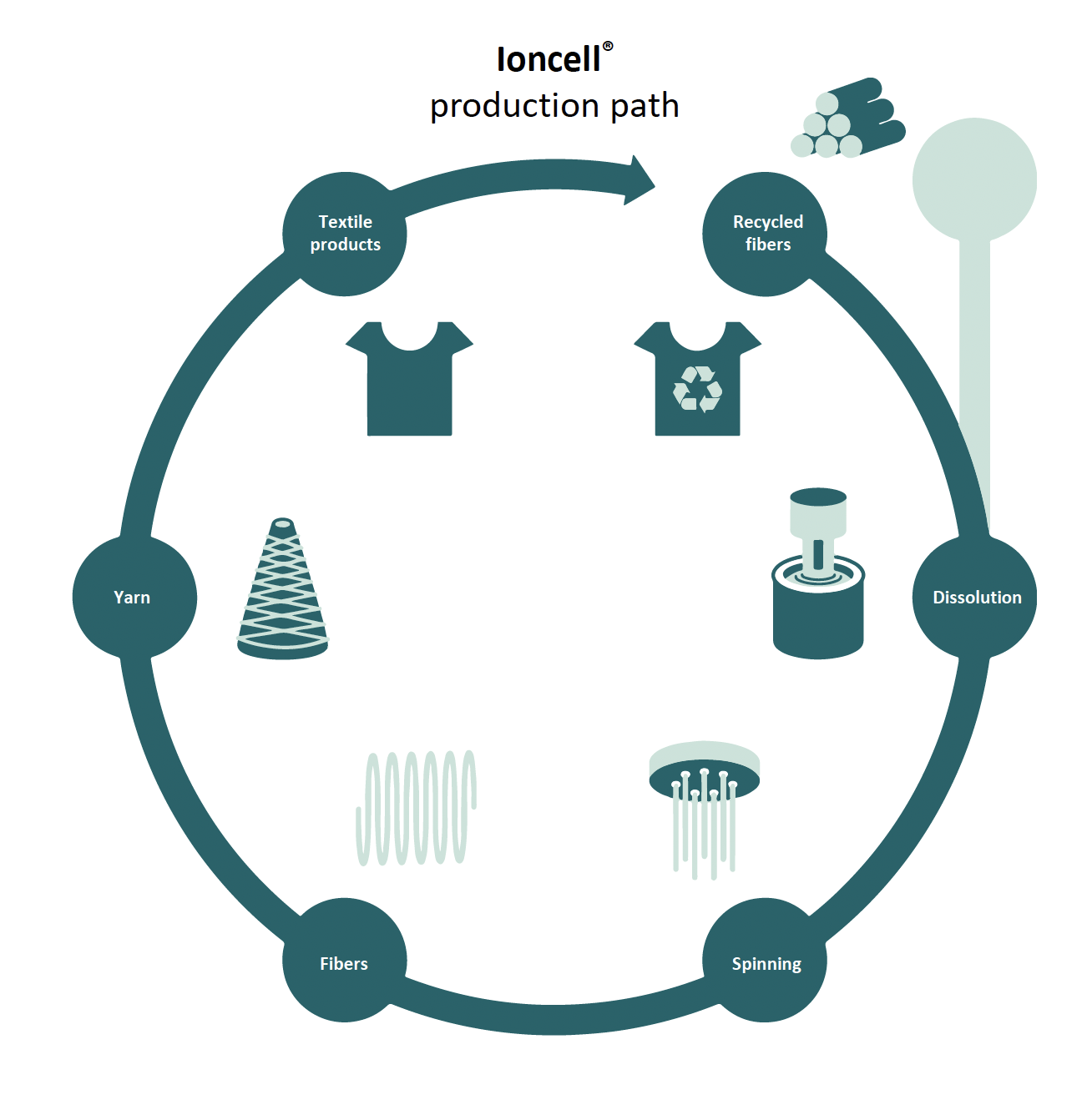
Ioncell is a Lyocell-type technique running at the pilot plant stage. It can treat cellulose-based fibers through the following production path:
Source: Webinar presentation. Find slides and recordings on the project website.
First, the input material is ground and dissolved in an ionic liquid. The dope is melted in a spinning piston and pushed through a spinneret. The fibers are then stretched in an air gap and finally immersed in a coagulation bath. The Ioncell technique differs from similar techniques in this last step by only using water, thus reducing the use of chemicals.
Recycled Ioncell fibers show promising properties, with a higher tenacity
Measure of yarn strength.
Inge Schlapp-Hackl highlighted that Ioncell’s analysis shows that Ioncell fibers made from cotton have double the tenacity of a virgin cotton fiber. However, she still believes that chemical recycling should be seen as the last step after a long life of use and reuse including repairs, remakes and using the yarn to create new items.
Take-aways from “Recycling – Status, Challenges and Design”
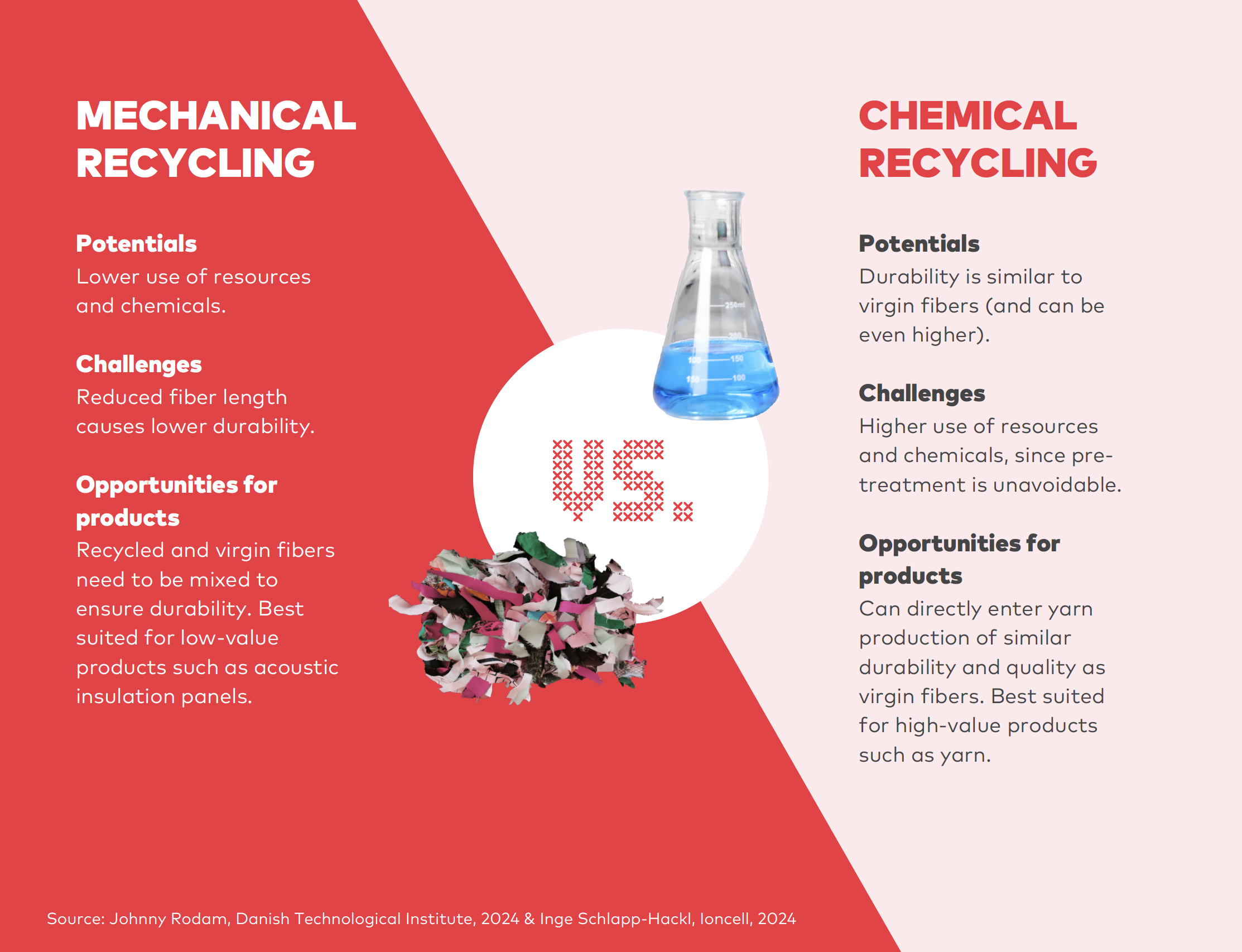
Johnny Rodam highlighted that mechanical and chemical recycling techniques have different advantages and effects. Mechanical recycling reduces the fiber length and breaks down polymeric chains, resulting in lower numbers of monomers per chain. This increases fragility and creates a tendency to peel, requiring extra twisting in the spinning process to ensure usable yarn strength. It also poses a liability issue in terms of chemical residue in the recycled fibers that are left from the original input. However, the advantage of mechanical recycling is its low use of chemistry and resources in the processing.
Chemical recycling, on the other hand, can work with any fiber length by breaking down the fibers into monomers and then rebuilding the polymers from that. This can produce output of virgin quality but requires a higher input of chemicals and resources than the mechanical process.
Following infographic shows some distinctions between mechanical and chemical recycling:
Infographic developed by Holm Kommunikation based on webinar presentation
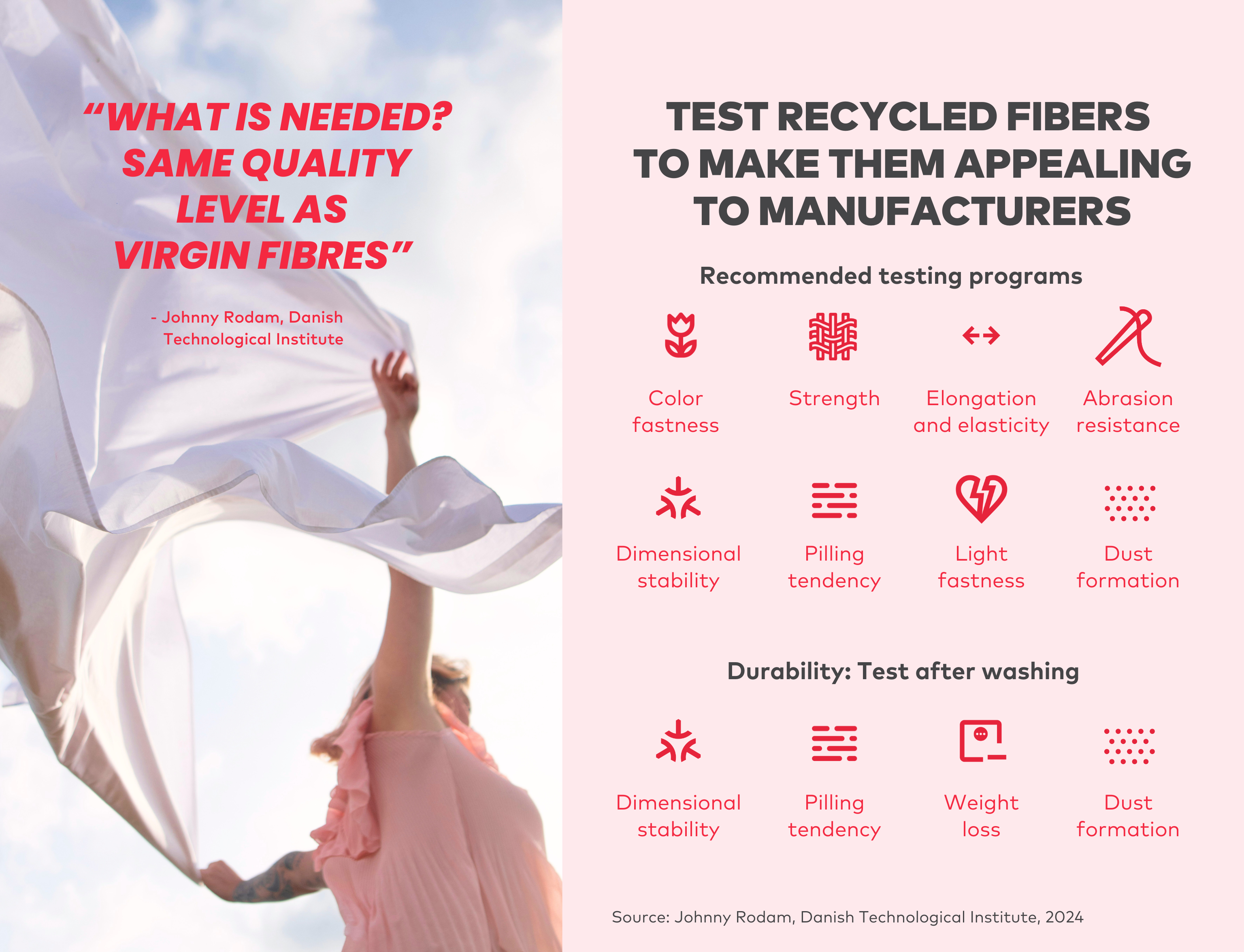
Recycled fibers on the market today come almost exclusively from downcycling of PET bottles and the market demand for recycled fibers from post-consumer textiles is very low. To change this, Johnny Rodam points to better information for the producers on the properties of recycled fibers. A centralized information system offering uniform testing could provide a solution, making producers comfortable with the use of recycled fibers. Johnny Rodam suggested a list of relevant tests:
Infographic developed by Holm Kommunikation based on webinar presentation
Johnny Rodam finished off with six pieces of advice on better design for recycling:
- Evaluate needed primary properties of your final product
- Which fiber material would best encapsulate your need
- Use single fiber material if possible
- Design areas of increased abrasion for longer durability
- Use recycled material according to your main material type
- Choose accessories accordingly and be aware of how they can be reused or removed.
Take-aways from “Circular design strategies for recycled fibers”
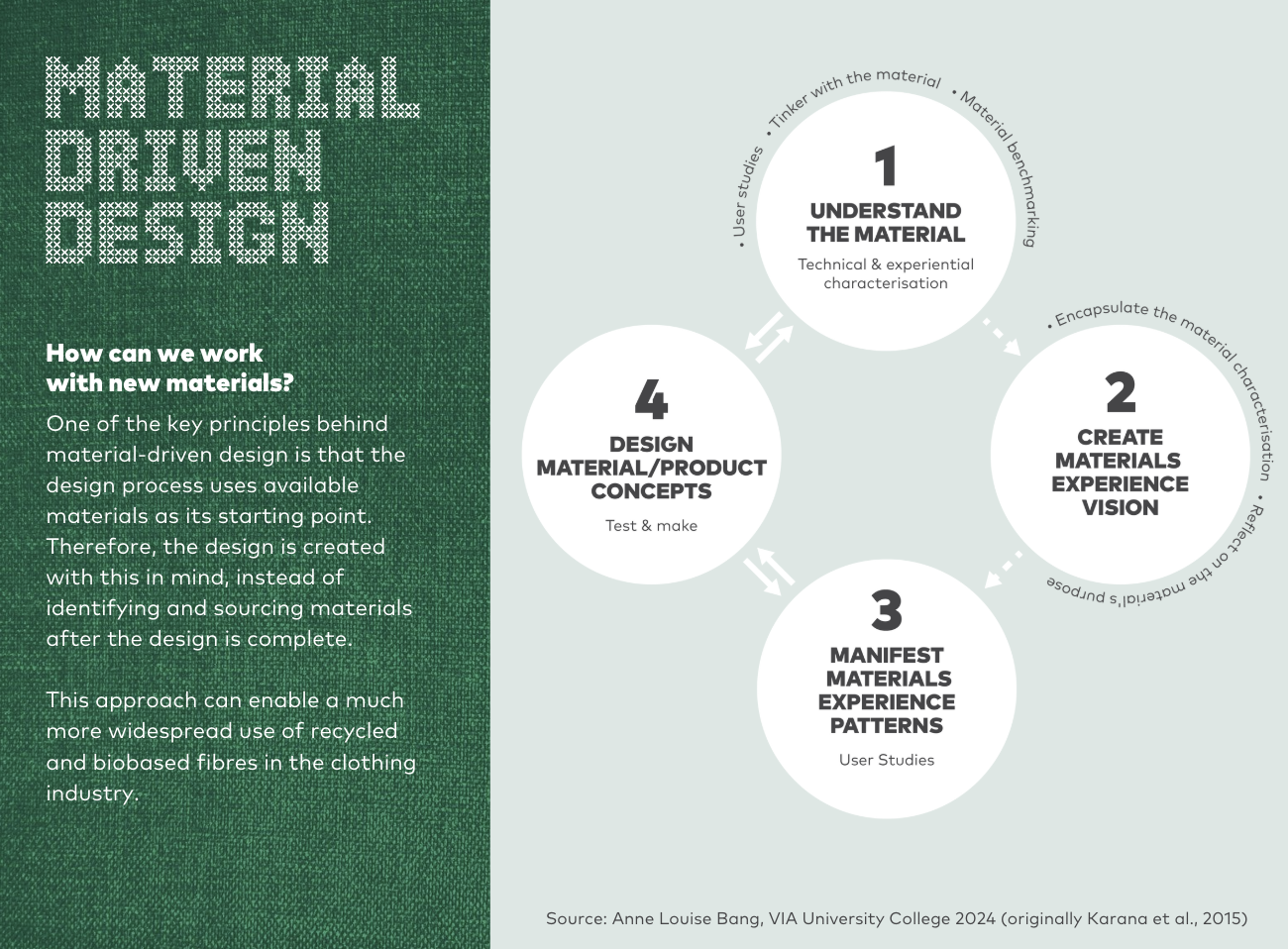
Anne Louise Bang presented the visions for the research project READY, which aims to create a local R&D factory in Denmark to support the transition to a circular global textile industry. The project expects to produce new, material-driven, “design for circularity” strategies, but also aims to investigate how to come up with strategies that are both circular and sustainable. Since circularity is not necessarily sustainable if it does not address the speed of production, Anne Louise Bang emphasizes the need to turn the design phase around and utilize material-driven design, where you start with the material and not with the design.
Infographic developed by Holm Kommunikation based on webinar presentation
The project hopes to address the following three challenges:
- Loss of material in the recycling process
- How to mix virgin and recycled fibers to improve quality
- How to handle color variety
A new spinning mill will be established in Herning, which will make it possible for the project to process textiles through the entire value chain locally. This will be used to investigate new fiber feedstock that can be spun, knitted, woven and printed on directly in the lab. Anne Louise Bang stresses the importance of viewing and testing recycled fibers as if they were a new type of fiber, because they do not necessarily behave like their virgin equivalents. This underlines the need for cross-disciplinary collaboration to investigate the full value chain.
4.2.3 Webinar about processing and production
The webinar investigated the question: How can we replace conventional processing and production with methods that have less environmental impact? The webinar included three presentations.
Webinar about processing and production, April 10, 2024
Innovative fiber blends and yarn spinning techniques, by Nawar Kadi, Professor of Textile Technology, University of Borås. Learn more about the project here: https://www.bioinnovation.se/en/projekt/innovative-fiber-blends-and-yarn-spinning-techniques-a-part-of-citex/
Micro Factories – Local small-scale production, by Trine Young, Founder & CEO, Rodinia Generation. Learn more here: https://www.rodiniageneration.io/
BioColor – Viable alternatives to synthetic dyes and colorants, by Riikka Räisänen, PhD, Professor of Craft Science, University of Helsinki. Learn more about the project here: https://biocolour.fi/en/frontpage/
Take-aways from “Innovative fiber blends and yarn spinning techniques”
Nawar Kadi suggested that fiber length is one of the most important properties when recycling textile waste mechanically. Long fibers are the basis of the quality of recycled yarn, but a mechanical shredding process shortens them. The University of Borås has investigated how pre-treatment of textile waste with lubricants can mitigate this fiber-length reduction. By spraying the fibers with a polyethylene glycol (PEG) solution, they found a significant increase in fiber length in cotton, polyester and polycotton. This enables rotor-spun yarn from 100% recycled fibers, but does not significantly increase yarn tenacity, meaning yarns solely made from recycled fibers still have lower strength than yarns made from virgin fibers.
Nawar Kadi presented the project “Innovative fiber blends and yarn spinning techniques”, which investigated two important challenges – fiber spinning and fiber mixing. The project studied how to increase the spinnability of mechanically recycled fibers by mixing them with other natural fibers, such as hemp. Nawar Kadi highlighted that a general goal of the market is to achieve a 50/50 mix of virgin and recycled fibers, but it can currently only achieve 70/30. The project showed that it is possible to achieve a 55/45 mix by using hemp fibers and adding finishing to the recycled fiber.
According to Nawar Kadi, spinning techniques are also important to reduce the use of elastane in products, as new techniques can introduce more stretch in a fabric and lower the need for elastane from 5% to 1%.
Take-aways from “Micro Factories – Local small-scale production”
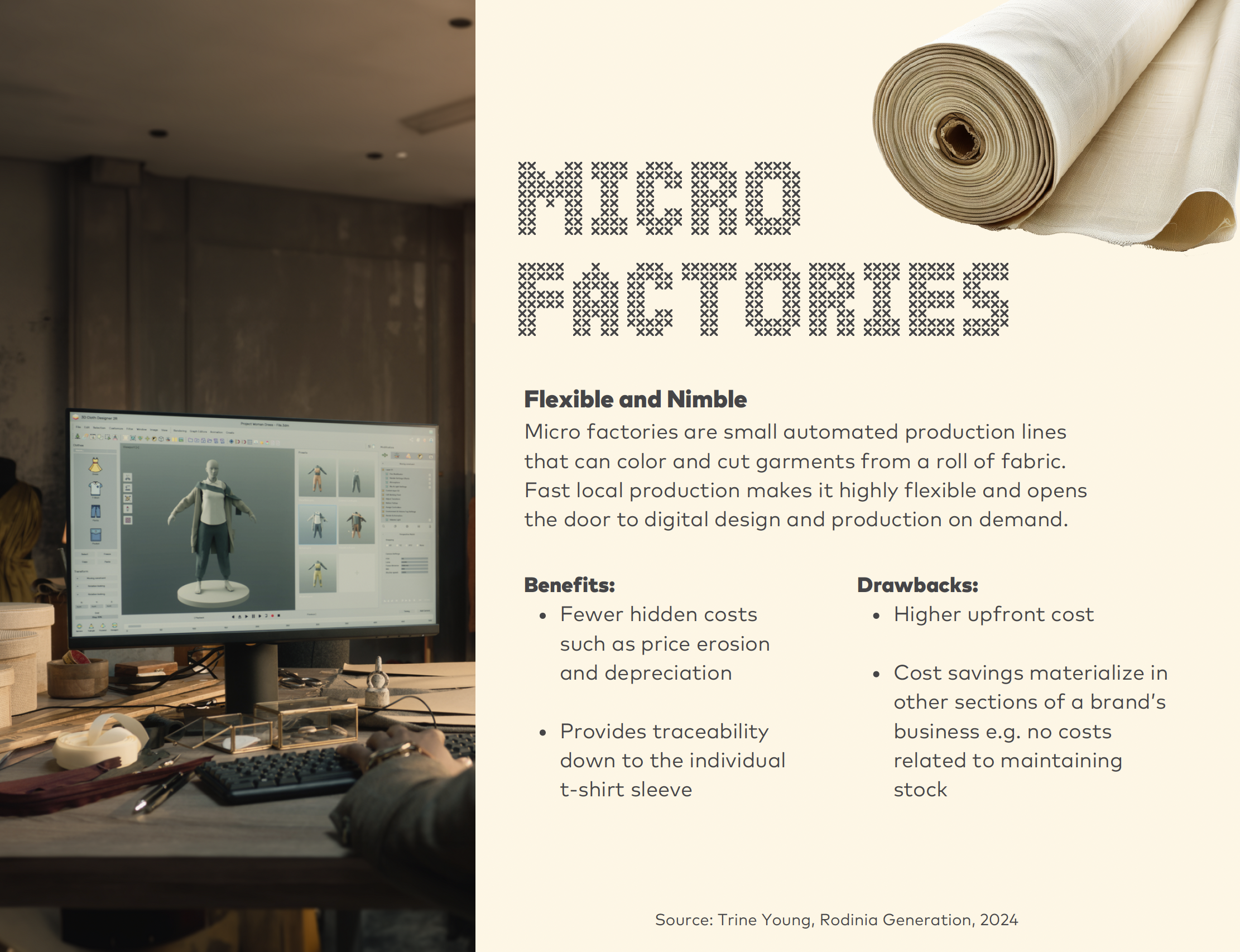
A micro-factory sets itself apart from the traditional production chain by delivering flexible on-shore production that is highly automated. Starting with a roll of fabric, it can color and cut garments efficiently, no matter how many unique pieces are being produced, resulting in low environmental impact with no use of water and limited use of resources.
According to Trine Young, the concept has the potential to disrupt the way brands produce textiles because it offers low lead-times (48 hours from order to delivery) and customizability without extra cost. It does not matter whether you need to produce 100 pieces or just 1. This also opens the door to production on demand, where brands can design and sell their garments before they have to produce them; a potentially revolutionary approach that could transform today’s value chain.
This method of production has fewer hidden costs such as price erosion and depreciation, but naturally comes with a higher upfront cost. This makes it harder to assure brands of cost saving as it materializes in other sections of their business, e.g., maintaining stock. It does, however, come with clear benefits in traceability, down to the individual t-shirt sleeve.
Technologies still need to mature to allow the use of recycled fibers and for brands to utilize the potential for digital design and production on demand. The micro-factory in Copenhagen also does not have the ability to produce knitwear.
Infographic developed by Holm Kommunikation based on webinar presentation
Take-aways from “BioColour – Viable alternatives to synthetic dyes and colorants”
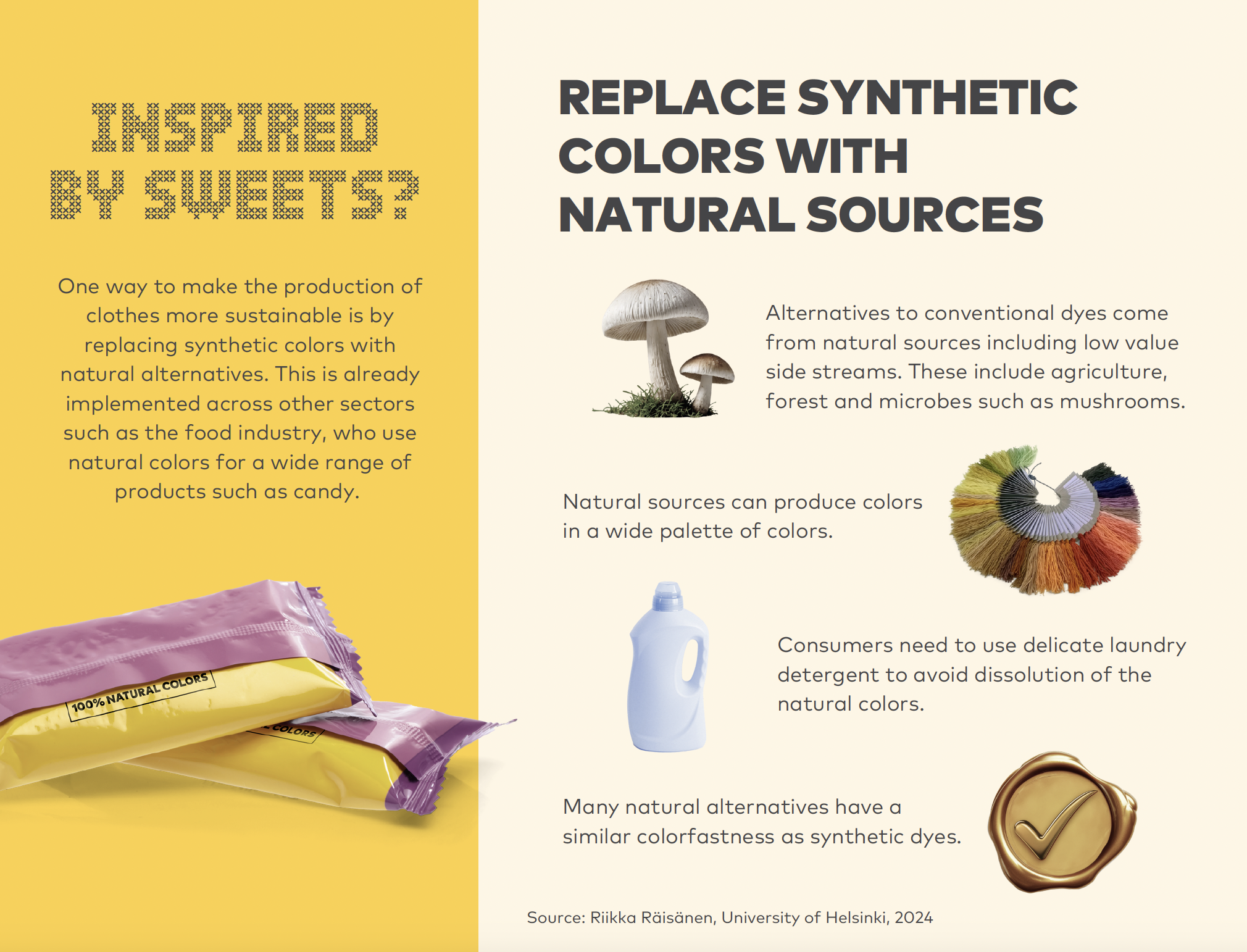
Current synthetic colorants on the market can have negative impacts on human health and the environment. Colorants come from the petrochemical industry that utilize aromatic compounds such as benzene, catalysts such as zinc and chrome, and solvents including acids and alkali. The basic process of dyeing cotton, for example, is very complex in itself and consumes a lot of water and energy. After dyeing, testing is often done for color stability and affinity, but rarely for toxicity.
According to Riikka Räisänen, biocolorants, on the other hand, can come from a variety of natural sources, including low-value side streams that would otherwise be wasted. They can create a wide palette of colors and be used on both natural fibers and synthetic fibers for printing, dyeing or mass coloration.
The BioColour project aims to develop new methods of large-scale production of biocolorants, produce a colorful palette of human and environmentally safe natural dyes and establish a database that covers the whole production chain.
Infographic developed by Holm Kommunikation based on webinar presentation
Methods investigated in the BioColour project include:
- Waterless textile dyeing using fungal anthraquinones
- Enzyme modification of weld extract
- Acid dyes for wool using dermorubin extracted from mushrooms
- Printing instead of coloring
- Biocolorants from fermentation tanks
According to Riikka Räisänen, there are suitable natural dyes for all fibers, but textile brands and consumers are key for pushing this forward. There is a need for a change of habit at the brand level, where conventional colors are known and effectively make biocolors more difficult to work with. At the consumer level, washing habits have to change, as natural dyes need pH-neutral laundry detergents
4.2.4 Webinar about digitalization and traceability
The webinar investigated the question: How can we use digital tools to trace the life of textile products? The webinar included three presentations: first, an overview of some modern digital tools and their innovative application; second, how blockchain technology can improve Nordic traceability and business; and finally, a dive into 3D design strategies and how brands can implement them.
Webinar about digitalization and traceability, June 12, 2024
Twin transition – green and digital transformation, by Jonas Larsson, Associate Professor in Textile Management, University of Borås. Learn more here: https://www.hb.se/en/research/research-portal/researchers/JKL/
Blockchain – traceability, transparency and circular innovation, by Heidi Svane Pedersen, Head of Digital, Lifestyle & Design Cluster. Learn more here: https://ldcluster.com/portfolio-item/nordic-blockchain-alliance/
3D design strategies, by Jon-Amund Søfferud, Technical Manager, Manufacture Oslo. Learn more here: https://www.manufacture-oslo.no/
Take-aways from “Twin transition – green and digital transformation”
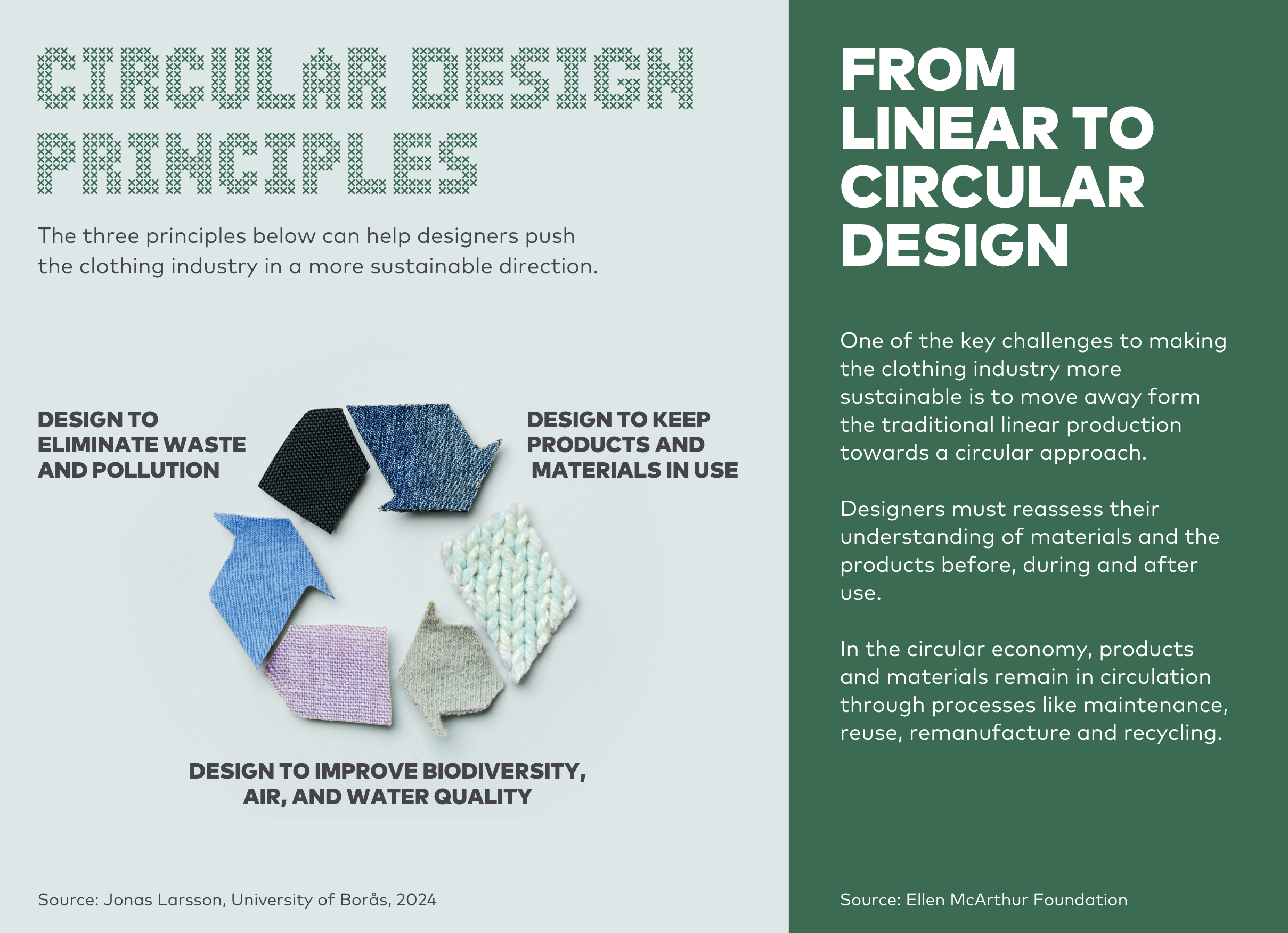
Jonas Larsson presented the project “System demonstrator for a more sustainable textile system.” The project builds on the circular design principles developed by the Ellen MacArthur Foundation. These include three overall elements: circulate material, eliminate waste and regenerate nature.
Infographic developed by Holm Kommunikation based on webinar presentation
Jonas Larsson presented different examples of using digital tools to support these principles.
Circulate:
In one project, a company offered free print upgrades to old garments to keep products in use. They used an in-store printing machine to produce the design that customers had created on a 3D customizer. Another project developed an autonomous delivery robot to enhance the sharing economy. The aim was to eliminate the logistics barrier to sharing while achieving 99.8% lower carbon emissions compared to a traditional distribution car. A third project activated people’s wardrobe using RFID-tags. These can communicate with phones and notify the user if a garment has not been worn for a long time. The software can even offer to sell that garment automatically and arrange pickup for a new buyer.
Eliminate:
The first project introduced virtual fitting rooms for customers to use with a digital avatar. This meant clothing could be customized to fit the specific customer’s needs, e.g. sleeve length, for a slight increase in price. Another project targeted the challenge of custom coloring using a digital printing machine that could dye yarn immediately before it entered the knitting machine. The project achieved 97% less water usage, 98% less process chemicals and lower energy use. All in a system that is flexible and can produce close to market. A third project tried to train an AI to do automated sewing but found that virtual simulation of materials needed to get better to achieve this.
Traceability is also needed to locate and eliminate waste. In addition, one project looked at documenting the journey of garments from fiber to customer using an app. This information was logged on a blockchain and social aspects like wages were verified from three parties to ensure trust. Another project created a portable sensor to harvest data from production machinery or measure indoor air quality in production facilities.
Regenerate:
The final goal was to create a system that has no waste, inspired by the lifecycle of the Japanese cherry blossom. One niche project demonstrated biospheric design – using substances from the earth’s surface that could be safely returned and simultaneously ensure human prosperity. This became a vest made from nettle-fiber yarn sourced from communities in the Nepalese mountains.
Take-aways from “Blockchain – traceability, transparency and circular innovation”
According to Heidi Svane Pedersen, we are currently moving from Economy of Scale to Economy of Scope – focusing on individualization, digital value chains and elimination of waste. One of the technologies that will scale this economy is blockchain.
Think of blockchain as a toy train with little magnets that connect the different carriages. One carriage has information on where the cotton comes from; another has information about the production and a third has information on where it is going to be sold. The blockchain is the magnets between the carriages; it helps us to trace all this information. This provides traceability, transparency and trust in a supply chain with many actors, low trust or many unknowns – a decentralized registry that is tamper proof.
The Nordic Blockchain alliance has worked with four business cases that come along with blockchain:
 |  |  |  |
INCREASED TRACEABILITY | ENHANCED AUTHENTICITY | INCREASED CIRCULARITY | PURSUING NEW REVENUE STREAMS |
With enhanced traceability, companies can promote transparency within the supply chain | Companies can strengthen brand identity with digital ownership and proof of authenticity | Through the utilisation of decentralised and open marketplaces, companies can actively contribute to strengthening the circular economy | By fostering greater consumer engagement, companies can pursue new revenue streams |
Source: Webinar presentation. Find slides and recordings on the project website.
The first business case is Increased Traceability, with the example of TextileGenesis, which provides infrastructure for Bestseller and H&M to start collecting data every time a garment moves through their value chain.
The second business case is Authenticity, illustrated by Spoor, which is utilizing public data around animal welfare and the origin of animals in leatherware production.
The third business case is Circularity, with the example of Empower, which provides smart contracts and crypto currency to support waste pickers. This data is then used in a digital product passport by the company Vestre to document the use of recycled plastics in their furniture. Smart contracts can also ensure that designers and other parts of the value chains get paid when things are resold throughout the lifespan of the product.
The final business case is New Revenue Streams, illustrated by Rotate, who launched a collection of summer clothes both in the real world and on the Korean metaverse platform Ifland, where consumers would buy a digital version of the clothes and link it to the physical object.
Heidi Svane Pedersen emphasizes that a Nordic blockchain would hold great business potential. The Nordics are a trusted brand out in the world and could be backed by our own blockchain. If Nordic brands were to use a European blockchain, the transparency standards might simply be too low to hold a competitive edge in this field.
Take-aways from “3D design strategies”
Manufacture Oslo is working on bridging the competence gaps that exist in the fashion and textile industry. This is well under way because Norway has provided funding to raise the competencies of businesses focusing on sustainability and technology.
Jon-Amund Søfferud explains the benefits of 3D technology in the fashion industry by showcasing the difference between 3D illustrations and 2D, which is the current state for many businesses. 3D is a communication aid that helps link the value chain more seamlessly and helps companies make better choices on sourcing and materials. Prototyping leads to many wasted resources because 37–45% of designs never end up in stores. Creating digital product twins can prevent this.
Working with 3D can solve issues with efficiency, consistency, sustainability, speed, competitive edge, innovation and supply chain optimization. It reduces carbon emissions by 96% compared to ordering a physical prototype from abroad and gives designers a better understanding of the garments, enabling them to make better products.
Transitioning to 3D is a difficult process for a company, taking 3–5 years. Each brand strategy is going to be unique but boils down to staff training and a good proof of concept. This has the potential to bring huge time savings – with one example reducing the development of a garment from 26 weeks to 10, including a 75% reduction in the need for physical prototypes.
Key areas to consider when implementing 3D design processes are condensed in the infographic below:
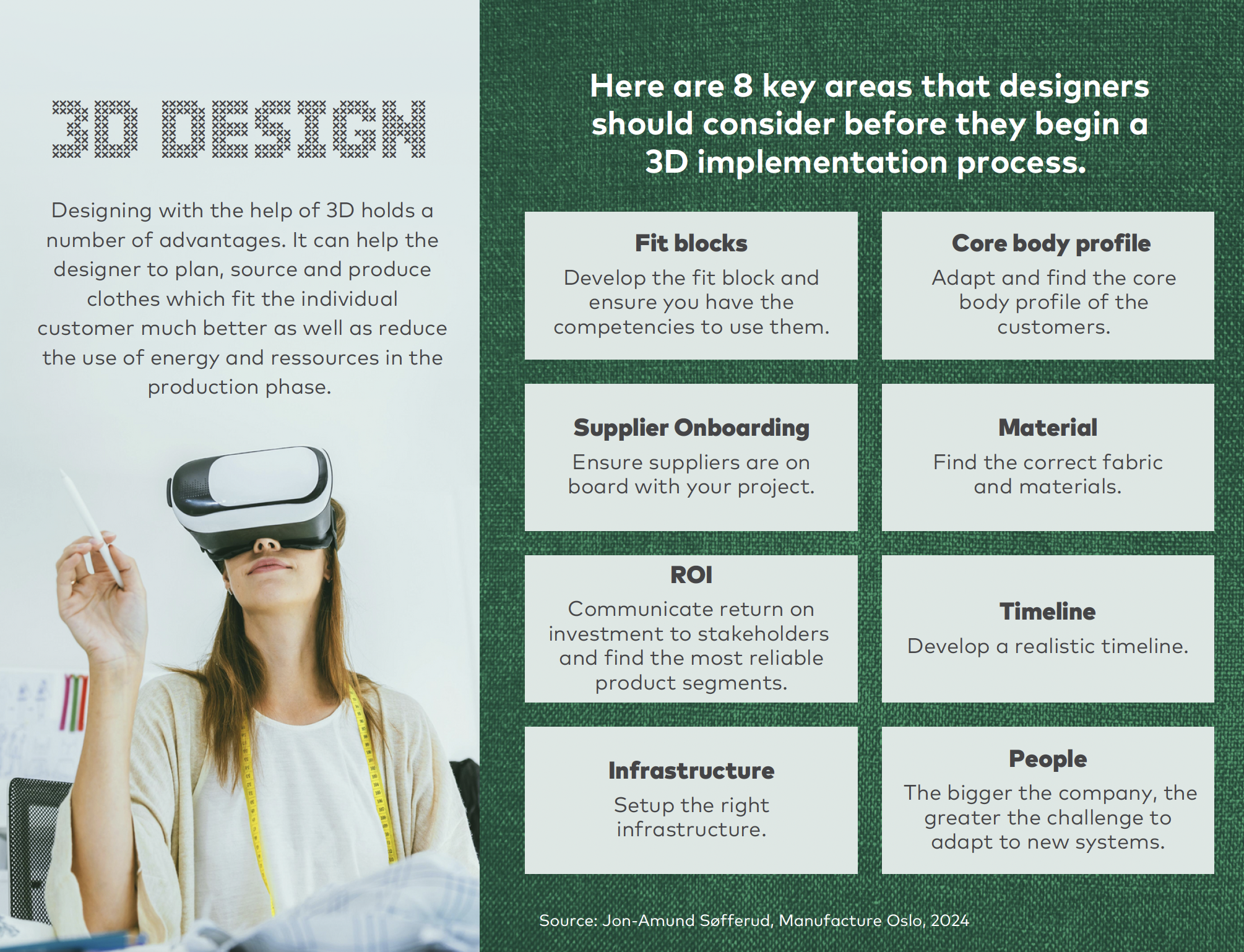
Infographic developed by Holm Kommunikation based on webinar presentation
4.2.5 Webinar about global perspectives
The webinar investigated the question: How can we adapt the supply chain to support the transition towards a circular economy? The webinar included three presentations: first, an overview of the global value chain; second, how Danish and Indian actors have worked to improve the supply chain; and finally, how farming and purchasing practices are being advanced in South Africa.
Webinar about global perspectives, August 14, 2024
Value chains in the global garment industry, by Peter Lund-Thomsen, Professor at Copenhagen Business School. Learn more here: https://research.cbs.dk/en/publications/sustainable-value-chains-in-the-global-garment-industry
Green Textile Project, by Anandita Prakash, Head of Emerging Technologies at Innovation Centre Denmark, India. Learn more about the project here: https://ldcluster.com/portfolio-item/indo-danish-green-textiles-project/
Empowering Stakeholders for Responsible Global Supply Chains, by Kaja Gresko, Senior Advisor at Ethical Trade Norway. Learn more about the project here: https://etiskhandel.no/artikel/10-shearing-sheds-in-south-africa-receive-certification-for-sustainable-cape-wool-standard/
Take-aways from “Value chains in the global garment industry”
Peter Lund-Thomsen introduced the concept of global garment and textile value chains, presenting his views on the economic, social, and environmental implications of the placement of recycling hubs. He explained that modern value chains are global in nature because production capacity is primarily located in Asia, facilitated by the development of digital communication tools such as fax and email. Another contributing factor is the decrease in transportation prices over the last 30–40 years, as well as lower labor costs and more lenient environmental regulations in these regions.
Peter Lund-Thomsen explained that textile and garment production is “footloose”, meaning small wage increases could lead to the relocation of production. He cited China as an example, where wage increases in the last 10–15 years have led to production moving away to countries like Vietnam, Bangladesh, and Indonesia.
According to Peter Lund-Thomsen, it is financially unviable to establish large-scale garment and textile production in the Nordics due to high labor costs, strict environmental regulations, and the loss of production knowledge due to outsourcing.
Peter Lund-Thomsen argued for the utilization of well-established recycling chains in Asia instead of establishing new ones in the Nordics. Countries like Pakistan and India are seen as world leaders in mechanical recycling. However, chemical recycling in these countries is associated with increased environmental pollution due to insufficient facilities for water treatment.
The social aspects also need to be considered, as recycling provides employment for many women who earn their living in the informal sector. However, there is a need for improvements in labor and social conditions, including updates to machinery to avoid workers being exposed to fiber dust.
Peter Lund-Thomsen's final argument is that the Nordics should focus on supporting the development of new technologies to be implemented in Asia to create large-scale change in the industry. The Nordics should also support economic, social, and environmental upgrading of Micro, Small & Medium Enterprises (MSMEs), while limiting overall consumption in the Nordics.
Take-aways from “Green Textile Project”
The Green Textile project was conducted through a partnership between Innovation Centre Denmark in Bangalore, Danish Industry, and Lifestyle & Design Cluster. It aimed to improve the supply chain through production and sourcing, including trying to implement Nordic technology in India. Anandita Prakesh explained that smaller brands with a strong sustainability focus often struggle to find suppliers willing to accommodate their order quantities, leading to limited bargaining power. The project aimed to address this issue by assisting these brands in collaborative sourcing but saw limited interest in this approach. The project, however, successfully highlighted some of the challenges producers face in transitioning to more sustainable practices. These include:
- A diverse set of expectations from brands when it comes to defining sustainability and circular practices, making it necessary to align with each company's specific requirements.
- Understanding and complying with EU-regulation, which can be costly and time-consuming. Producers feel that regulations are designed without a full understanding of realities on the ground.
- Insufficient wastewater treatment. A strong market focus on prices makes it hard to tackle, despite a strong political will for regulation.
- Logistical issues, as recycling hubs in India are spread far apart.
- Literacy issues among recycling workers make sorting difficult, compromising the quality of recycled products.
- Lack of digitalization at the plants results in low traceability for the brands.
Anandita Prakesh concluded that the green textile project identified a significant disconnect between brand ambitions and minimum order quantities. She also highlighted that labor practices and digitalization are areas that require further attention to enhance sustainability efforts in the textile industry. Lastly, she emphasized the importance of brands developing exit strategies if they choose to leave a production location, as such a decision significantly impacts many people's livelihoods. This underlines the need for a holistic approach to sustainability, taking into account both environmental and social consequences.
Take-aways from “Empowering Stakeholders for Responsible Global Supply Chains”
The “Eastern Cape Upliftment, Empowerment and Sustainability” project takes place in South Africa, aimed at strengthening sustainable production, decent work, and climate change resilience in the wool and mohair industries. The project was initiated based on a due diligence study from 2020, revealing various issues including:
- Severe impacts of climate change on farmers' livelihoods.
- Frustrations with differing requirements of various sustainability standards.
- Difficulties faced by communal farmers in securing investments and land rights.
The project works with the National Wool Growers Association (NWGA) to support and represent communal farmers, including the institutional development of local representative structures. It has provided farmers with training and tools, such as advisors and virtual vet services. It has also managed to facilitate certification for 10 shearing shed associations, which received “Certificates of Compliance” with the Sustainable Cape Wool Standard. This certification ensures a price premium for farmers, while also satisfying the demands from brands, who are increasingly using certification as a tool in their due diligence efforts. However, many international standards are not viable options for these rural farmers.
The project also facilitates capacity-building courses for workers in processing and brokerage firms, resulting in a strengthened acknowledgment of new international requirements and the need for more ethical and sustainable practices in meeting market expectations. Likewise, members of Ethical Trade Norway, who source wool internationally, have engaged in dialogue forums with South African producers. These discussions allow farmers to directly interact with the buyers of their wool, providing the brands with first-hand insights into the complexities and challenges in the raw material stage of their supply chains.
Kaja Gresko concluded by stressing the challenges that farmers face from brand demands and emphasized the importance of a holistic approach to circular transition, ensuring a just transition for vulnerable and marginalized groups in the global supply chain.
Key lessons from Anandita Prakash and Kaja Gresko’s presentations are condensed in the infographic below:

Infographic developed by Holm Kommunikation based on webinar presentation