Chapter 3: When Siglufjörður and Ólafsfjörður became one
An Icelandic story of diversification from above
Grétar Þór Eyþórsson & Sigríður K Þorgrímsdóttir
3.1 Background
In December 2022 a report with the title “Sustainable Value Chains in Nordic Coastal Communities” (NORVALUE) was published as a Tema Nord Report (Hovgaard & Bærenholdt, 2022). The NorValue project investigated how people in Nordic Atlantic local communities were involved in connections and linkages crucial to their survival and livelihoods as a part of the Nordic Atlantic societies of Greenland, Iceland, the Faroe Islands and Northern Norway. The report provided descriptive accounts of our approach, and developments in the coastal communities studied. The focus was on one particular research question: Based on a local and historical perspective, as well as insight into changes in demography and political regulation from 2000, how have the value chains most important for local communities, changed? (Bærenholdt & Hovgaard, 2022, p. 10).
In our Icelandic case in our earlier book-chapter on the development in Siglufjörður and Ólafsfjörður (Eythórsson & Þorgrímsdóttir, 2022), two traditional fishing towns in north Iceland, we raised the key question: Has the community created from the two towns demonstrated resilience in the process of transforming from traditional Icelandic fishing towns into a community that is more diversified, and today characterized by tourism and the knowledge industry? Resilience is in this context defined as “the capacity to cope with change and continue to develop” (Giacometti & Teräs, 2019, p. 11).
We concluded that the socio-economic changes in the amalgamated municipality of Fjallabyggð, containing the two towns Siglufjörður and Ólafsfjörður, have primarily been created by decisions at the national government level. A state-built road tunnel connecting the towns closely, financial support for the amalgamation of the municipalities and the foundation of the state run upper-secondary school in Ólafsfjörður were all significant inputs from the state, with the tunnel as the prerequisite for all these. These public sector projects stimulated investment in tourism and biotechnology, led by an individual entrepreneur. Siglufjörður and even Ólafsfjörður to some extent, have transformed from traditional fishery towns to communities displaying more diversified economic activities. Thus, the value chains have changed in the municipality of Fjallabyggð as a whole, but particularly in Siglufjörður, where both tourism and biotechnology have become a significant part of the economic life. The value chains have changed less in Ólafsfjörður, but the upper secondary school located there brought new jobs into the community.
Before year 2000, the decline of employment in fishing and fish processing in both towns had led to depopulation and ageing communities. The fishery decline, and associated demographic changes, were the main reasons for state involvement in financing the road tunnel. Shortly after, a decision on the road tunnel project in Fjallabyggð was made. The input of a private investor, Róbert Guðfinnsson, also plays an important role for the development. All those financial decisions and actions weigh heavily in building resilience in those two communities, especially in Siglufjörður. It also raises the question of what would have happened without these external inputs. The growth in the sectors, tourism, and biotechnology, meant that both skilled and unskilled workers had to be recruited externally, and a local workforce willing to make adjustments was required. This seems to have succeeded. But would the people in those two towns, facing depopulation and an ageing community, have had the strength to adapt and go further on their own?
How have the communities – local authorities, businesses, households, and civil society - in the two towns adapted to what has happened after 2005? We have shown that Siglufjörður and Ólafsfjörður have displayed somewhat different trajectories. Our interviews conducted in 2022 indicate that people in Ólafsfjörður are not as happy as in Siglufjörður with the economic changes. And in our citizen-survey conducted in early 2021 we see more positive responses among the people in Siglufjörður. Further, many people in both towns agreed with our statement that conflicts and disputes between people in the two towns existed. That is of course something that might threaten a positive development towards a better future community in Fjallabyggð. Still, we also saw more optimistic views on current situation and future among the younger people in the answers to the open-ended questions in the survey in 2021 (Eythórsson & Þorgrímsdóttir, 2022).
Our results, mainly based on the survey, did not answer all questions and in some cases, they raised new questions. With a qualitative study and some further look into statistics and facts, we intend to provide further answers and deepen our insight into how the two towns have developed the last twenty years or so. In the next section we define our aim and research questions.
3.1.1 Data and method
In the second phase of the NORVALUE-project our further data collection was fieldwork in the two communities: interviews and focus group meetings conducted in June/July 2022. The Covid-19 pandemic had made earlier visit to the towns difficult if not impossible. Finally, two days, 21st and 22nd June 2022 were set. Local people were interviewed, key persons in fisheries, tourism and people from the public sector – a total of 5 interviews, 3 in Siglufjörður and 2 in Ólafsfjörður.
One of the interviews in Ólafsfjörður was conducted later, 6th July through Teams. Later on (February 2023), a telephone interview with Jón Hrói Finnsson, operating mayor in Fjallabyggð 2006-2010 was conducted.
We held two focus-group meetings 21st June, one in each town, with selected people, six in each town. Recruiting people was of some reason difficult and a lot of people avoided participation. In the end the participants turned out to be a blend of people from businesses, educational sector, industries, fishing sector and services. Ages from 30 up to 70, three males and nine females.
As said earlier our intention was to get more in-depth knowledge about things that weren’t fully answered in the survey in 2021. Further, to answer questions that emanated during the survey work. Schutt (2019) describes the difference between quantitative and qualitative approach by saying that “qualitative methods emphasize observations about natural behaviour and artifacts that capture social life as participants experience it, rather than in categories the researcher predetermines” (Schutt, 2019, p. 367). However, let us not forget that the quantitative approach allows the researcher to collect more data and therefore generalize about what is being investigated.
3.2 A further study on the case of the two towns
In this chapter we intend to answer the following questions about the development in Fjallabyggð. We found them emerging after our first study on the case, mainly concerning the differences in people’s attitudes and perceptions on developments and prospects in the two towns investigated:
- Why do people in Siglufjörður and Ólafsfjörður perceive the development in municipal services in different ways after the amalgamation and opening of the road tunnel?
- People at different ages seem to look differently at the future. How different are the generation views towards the future economic development?
- Rigor, traction and even conflicts between people in the two towns seem to be present. What might be the causes?
3.2.1 Different views on changes in municipal services and other services
The survey results from 2021 showed in our report from 2022 that the amalgamation of the two municipalities was generally seen as a positive input (55%), but the people of Ólafsfjörður were much less satisfied with it (30%). The survey indicated that the people of Ólafsfjörður felt that specific services in their town had declined in their part of the municipality. Why municipal services were perceived as worsened in Ólafsfjörður but not in Siglufjörður, was bound to be examined further (Eythórsson and Þorgrímsdóttir 2022, p. 70).
Research results on the impact of municipal amalgamations on services point in the same direction. Eythórsson and Karlsson (2018) found that the general pattern is that people coming from and living in the administrative and service centers are more positive towards the impact of amalgamations on services, both in general and on four selected service posts. Those who live in the peripheral parts seem to be more negative. In an evaluation study on amalgamations in the 1990s by Eythórsson and Jóhannesson (2002), they found indications of this causal connection between amalgamations and service quality as well as less satisfaction with the services in the peripheral parts. Last, but not least, we mention here that a survey study on the impact of the tunnel and the amalgamation from 2009, just before opening of the tunnel but three years after the amalgamation, showed that people in Siglufjörður were significantly happier with the municipal services than the people in Ólafsfjörður (Eythórsson, 2010).
Asking about this in the second round of our data collection it turned out that even though the administration was divided between the towns to begin with, the part of the administration of the new municipality of Fjallabyggð located in Ólafsfjörður was moved to Siglufjörður in May 2014.
Bæjarskrifstofur lokaðar fimmtudag og föstudag | Fjallabyggð (fjallabyggd.is). Retrieved from www.fjallabyggd.is 16. February 2023.
Bæjarráð Fjallabyggðar - 333. fundur - 25.02.2014 | Fjallabyggð (fjallabyggd.is). Retrieved from www.fjallabyggd.is 16. February 2023.
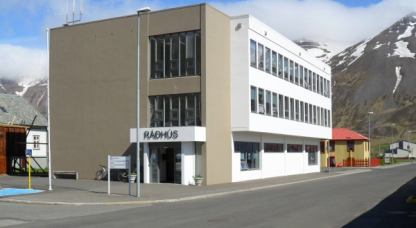
The Fjallabyggð city hall located in Siglufjörður.
Photo: Fjallabyggd.is
Today, the Fjallabyggð administration is entirely in Fjallabyggð city hall at Gránugata 24 in Siglufjörður. One municipal office in Ólafsfjörður (Ólafsvegur 4) is used for the mayor‘s regular presence on Wednesdays between 9 and 12 as well as meeting room for different occasions.
https://www.fjallabyggd.is/is/stjornsysla/stjornskipulag/baejarskrifstofur Retrieved 9. February 2023 from www.fjallabyggd.is
So, this centralization of administrative functions seems to have been a deliberate decision by the local authorities in 2010-2014 and to have caused imbalance between the two towns. We have not succeeded in finding any documentation of the decision to move the administration to Siglufjörður, neither in the meeting minutes from the municipal council (bæjarstjórn) or the municipal board (bæjarráð) in the years 2010-2014. This must have been an administrative decision then, performed and implemented without objections from the council representatives (perhaps a consensus issue because one single administrative localization will reduce the municipality’s administrative expenses). What happened after this was that state offices and private companies also moved from Ólafsfjörður to Siglufjörður. Here we mean for example services like the ambulance, the post-office and one bank (Arion). This has undeniably led to dissatisfaction among people in Ólafsfjörður and it is still in the heads of people 10 years later - the findings on this from our survey were clearly confirmed in the focus group meetings held in both Siglufjörður and Ólafsfjörður 21st June 2022.
The rigor and traction existing are rather much related to age – less among the children. And it seems to be slowly vanishing (participant in the focus group in Ólafsfjörður 21st June 2022).
We still hear people say that this tunnel should be closed. People in Ólafsfjörður are still suffering from inferiority complexes (participant in the focus group meeting in Siglufjörður 21st June 2022). After the amalgamation and opening of the tunnel there were conflicts about how to solve the question on the location of primary school services. The solution was to split the services into two units with 1st to 5th class in Siglufjörður and 6th to 10th class in Ólafsfjörður.
Grunnskóli Fjallabyggðar. https://www.grunnskoli.fjallabyggd.is/is/skolinn/um-skolann Retrieved 23. September 2022.
3.2.2 The economic development – some socio-economic factors
One of our findings from the first study was that the continued change of value chains, and the challenges related to the transformation of the two towns into one robust and resilient community seems to rely much on the younger people. Our intention in this report is to get to know more about the different views of older and younger in the context of what has happened, and what could happen in the future. We take a look at how the fishery, the harbours and the fishing industry developed, the development of municipal services and other services, we look at both public and private investments and finally we look at rigor, tractions and conflict between the towns. Thus, we intend to show how our respondents from the interviews evaluated the socio-economic impact for the last 15-20 years, the years when these fishing communities went through great transformation.
Harbour and fishing companies
One consequence of the opening of the tunnel and the amalgamation was that people soon realised that the harbour activities in the new municipality should be concentrated to Siglufjörður. The harbour in Siglufjörður is by nature much better than the one in Ólafsfjörður – better sheltered from the north-east storms that quite often occur. The fishing and fish processing company in Siglufjörður, Þormóður Rammi was established in 1971. In 1997 there was a merger between Þormóður Rammi and the company Sæberg in Ólafsfjörður and later the same year a merger of the fishing and fish processing companies Þormóður Rammi and Magnús Gamalíelsson into Þormóður Rammi – Sæberg, later Rammi. At the same time fish processing in Ólafsfjörður stopped and most of the harbour activities were moved to Siglufjörður, where harbour facilities could serve a new and larger trawler in a better way. Today Rammi is located in Siglufjörður and in Þorlákshöfn in South of Iceland, and no longer any activity or ships in the harbour of Ólafsfjörður (Ingvarsdóttir, 2021). We heard in one of our interviews that this was really a change to the worse for middle aged and older people in the town – not seeing ships or signs of life in their harbour – which had through the decades been the heart of the economic life and activity in town. This, in addition to the transfer of jobs in public and private sector from Ólafsfjörður to Siglufjörður had negative effects on people in Ólafsfjörður. As one respondent in Siglufjörður said: “Looking daily at an empty harbour must be frustrating for people in Ólafsfjörður – especially the older ones.”
Interview with Örlygur Kristfinnsson in Siglufjörður 21st June 2022.
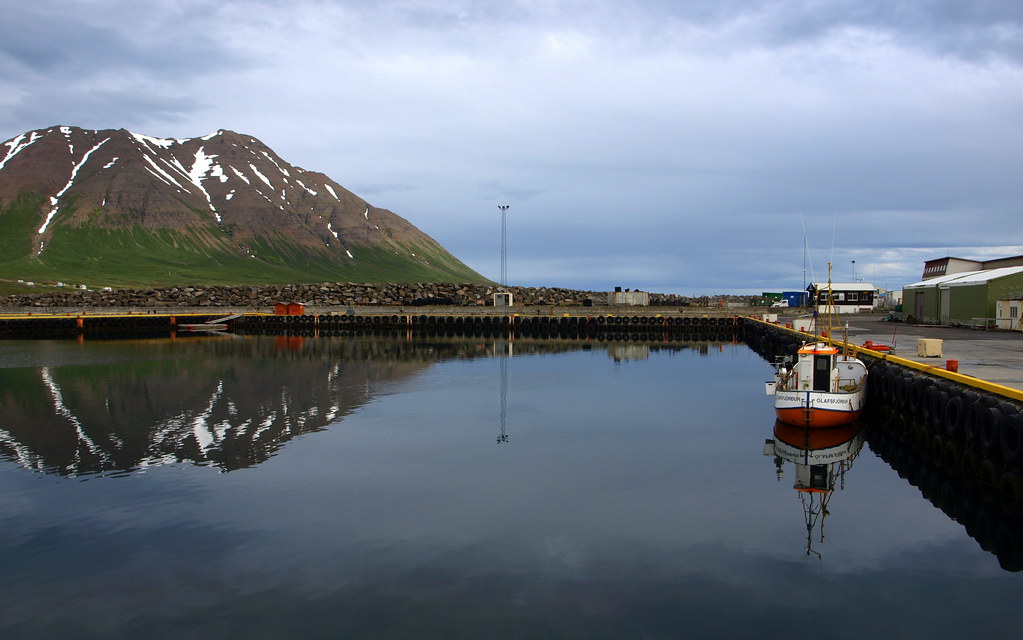
The empty harbour in Ólafsfjörður.
Photo: Hugi Ólafsson
Public investments
From our first study we learnt that the most significant public investments in Fjallabyggð had been: a) the construction of the road tunnel between the towns, which opened in 2010; b) the state support to facilitate the amalgamation of the municipalities of Ólafsfjörður and Siglufjörður in 2006; c) establishing the state-run upper-secondary school in Ólafsfjörður in 2010 (MTR). From our field work in 2022 we also learned that the state input by building the avalanche prevention in the mountain above Siglufjörður in 1997-2000 made the people feel much safer and to stay, as one of our interviewees in Siglufjörður, Örlygur Kristfinnsson, put it.
The state investment input into the new municipality of Fjallabyggð has to be seen as significant, in a 20 years’ perspective. The tunnel can be regarded as a prerequisite to the other measures, since the amalgamation could not have taken place without it, and the isolation of Siglufjörður could not have been reduced without it. The results from the survey showed us the importance of all this in the eyes of the people, with little difference apparent between the towns. It further showed that the amalgamation had strengthened the community and increased the capacity in the running of municipal services. The upper-secondary school has attracted educated people to Fjallabyggð and enhanced the education level in the towns. Our interviewees in both towns also pointed out how important it was to keep the 16-19 years old at home during wintertime, that it was both costly to live elsewhere than at home and that it brought life to town in the wintertime. In the focus group in Ólafsfjörður people pointed out that the existence and impact of the upper-secondary school MTR (Menntaskólinn á Tröllaskaga) was not fairly valued by all local people, partly because it provides more distant learning-and-teaching than locally based education. Further road-tunnel building is even suggested by some in the interviews and focus-group meetings we held in summer 2022. People see better connection with a tunnel to the west (to Fljót) and a better tunnel to the east/south (to Dalvík) as necessary for supporting positive development of the two communities. Without any investigation we can accept that both projects would improve the situation, though without being able to evaluate how necessary they would be for Fjallabyggð’s further development. In a fresh report written for the “The Icelandic Road and Coastal Administration” the authors, however, conclude that the east/south tunnel alternative would increase security and strengthen the economic development in the area (Jóhannesson & Heiðarsson, 2022). In the same report they conclude that the west tunnel alternative would increase security and strengthen the economic development, especially in tourism.
Private investments
Private investments in Fjallabyggð, almost entirely in Siglufjörður, have been enormous in context with the size of the community. This has been primarily the work of one person, Róbert Guðfinnsson who has invested heavily in tourism and in biotechnology with funding gained from the sale of fish quotas. He is estimated to have invested for some billion ISK, primarily in the Siglufjörður economy. Ólafsfjörður has been far less affected by this private investment. Tourism in Fjallabyggð increased dramatically in the years after the opening of the road tunnel in 2010. The biotech-company Genís, operating in Siglufjörður, is a limited liability company and produces therapeutic chitin derivatives (chitin-based products derived from the North Atlantic shrimp exoskeleton). Currently, about 20 people work at Genis, many of them young, educated scientists. The company’s intention is to expand, a goal which was temporarily postponed due to the COVID-19 crisis and to some extent by problems in recruiting experts and management staff on the condition of moving to this small community.
Interview with Róbert Guðfinnsson in June 2022.
The socio-economic impact
By our respondents from the qualitative study, it was a common belief that the road-tunnel of Héðinsfjarðargöng has been the main factor behind much of the progress in the two towns. This was also a clear result from the survey. Not only stimulated it people to stay and to move to the community but also it had contributed substantially to diversity in the economic life – which was confirmed both in the survey and the interviews. More significantly we heard from people in focus groups – both in Ólafsfjörður and Siglufjörður that more women in childbearing age had moved to Fjallabyggð. Our former report supports this finding, by statistics showing that women at the age of 20-29 years constitute a higher share of the total population than before. In year 2000 they were 4.0%, respectively 4.4%, but in 2020 they were 5.2%, respectively 6.0% of the total population in the two towns (Eythórsson & Þorgrímsdóttir, 2022). The knowledge based firm Genís and the Upper-secondary school have attracted people with higher education. The diversity in the economic life had increased and more educated people were needed than before. Earlier research tells us that this is generally the case in Iceland: A survey conducted by Karlsson, Eythórsson and others in 2006 showed that when people in the capital area of Iceland were asked to rank what living conditions, they thought were most important for them should they move to other areas in the country. “Diversity on the labour market” scored highest and it was also apparent that family related factors such as “good primary schools”, “good kindergartens” and in general “good conditions for raising children” scored high (Karlsson & Eythórsson, 2009).
An analysis by Karlsson of surveys conducted 2016 and 2017 indicated similar things. The inhabitants of urban centers on the margins of the capital placed strong importance on services for children and are satisfied with those that exist in their communities (Karlsson, 2021).
Second homes
“Second homes” is something that we want to mention and discuss in the Fjallabyggd context. By second homes we are referring to houses or flats that are owned by someone who has not legal domicile in the municipality and by housing we mean residential property. This number for the municipality of Fjallabyggð is the second highest in proportion in Iceland. It means that out of 1.087 houses/flats in Fjallabyggð, 215 are second homes.
There are few studies on second homes in Iceland as such, but it so happens that the two articles we can use in this chapter are about Fjallabyggð. It is one study and two articles, one published in 2010 in Icelandic and the other in English in 2012, its content built on the former one.
In this study the author (Huijbens, 2012) defines two types of second homes; purpose-built homes and converted homes – and it is the latter one we are thinking about in this chapter. Huijbens also talks about two types of house-owners of second homes. These descriptions or categories fit both in Fjallabyggð and in general in Iceland. The two owner-categories can be described as a) the people that have roots in the village (the homesick), were brought up there and have family and relatives living there, and b) the others that have no such ties and are described as “those pursuing a lifestyle of creative leisure” and are active in community project while the homesick are passive.
Those two groups choose houses for different reasons. Those with the roots, the homesick ones, either inherit a house or buy it from someone related to them, the other ones buy a house they like and find appealing as well as the surroundings. Interesting is the fact that the former group, those with roots, are not socially active in their former hometown, they come for visiting their relatives and old hometown and though they may participate in local events they play no part organising them or have a role in the cultural life. They are guests. The other group may on the other hand be active in the community, participate in cultural life and events, offering their vision, knowledge, and experience, perhaps in order to make something new.
Huijbens talks about pros and cons for the town (both the community and the municipality) to have such “empty houses” and his numbers show that 17.5% of total housing in Fjallabyggð are second homes and the proportion is much higher in Siglufjörður, 25% (Huijbens 2012). So, the proportion of these second homes seems to be high in Fjallabyggð.
In parliament 2022-2023 the minister of infrastructure answered an enquiry of second homes in Iceland and what the government was doing in that area. In the minister’s answer there is a table of 20 towns and villages around Iceland and the proportion of second homes in those places. In the table below which is a part of this table we see that Fjallabyggð has 19.8% of total houses as second homes, the number has gone up 2.3% since 2012 and the number of second homes as well, from 150 to 215, or 65 houses/flats.
Total housing | Second homes | Ratio | |
Siglufjörður (2012) | 489 | 120 | 25% |
Ólafsfjörður (2012) | 310 | 30 | 10% |
Fjallabyggð total (2012) | 799 | 150 | 18% |
Fjallabyggð total (2023) | 1087 | 215 | 20% |
Table 3.1: Total housing and second homes in Siglufjörður, Ólafsfjörður and Fjallabyggð 2012 and 2023.
Source: (Huijbens, 2012, p. 341) www.althingi.is/altext/153/s/1426.html
Source: (Huijbens, 2012, p. 341) www.althingi.is/altext/153/s/1426.html
Table 3.1: Total housing and second homes in Siglufjörður, Ólafsfjörður and Fjallabyggð 2012 and 2023.
Total housing | Second homes | Ratio | |
Siglufjörður (2012) | 489 | 120 | 25% |
Ólafsfjörður (2012) | 310 | 30 | 10% |
Fjallabyggð total (2012) | 799 | 150 | 18% |
Fjallabyggð total (2023) | 1087 | 215 | 20% |
In 2012 there was a big difference in the proportion of second homes in Siglufjörður and Ólafsfjörður and there is no reason to believe that this has changed much. We should though bear in mind that the local government in Siglufjörður before the amalgamation 2006, practically gave away old houses several years ago, by selling them for few “krónur” on the condition that the new owner renovated them. It had a big impact on Siglufjörður since many beautiful old houses had been neglected and now got a new life with better look. No similar action was made in Ólafsfjörður.
Huijbens argues that the existence of second homes and the willingness and interest of their owners to participate in the community and contribute to its development is important. In our context we agree on this, and this can affect the development of the community negatively, especially if the rate of second homes is high and that high rate of the owners is the homesick type. That would not contribute to the resilience of the community. However, no data on the types of second home owners exist. We therefore do not have the possibility to identify the rate of the homesick and the others. We can just speculate that the high rate of second homes in Siglufjörður and Ólafsfjörður is at least not a positive thing.
3.3 Rigor, traction, and conflicts
How have people in the two towns responded to what has happened after 2005? We have found that Siglufjörður and Ólafsfjörður have followed somewhat different trajectories. People in Ólafsfjörður are not as happy with the economic changes as is the case in Siglufjörður. In the survey we see more positive viewpoints among the people in Siglufjörður than in Ólafsfjörður. Further, people in both towns agree with the statement that conflicts and disputes between people in the two towns do exist. The fact that the survey in 2021 showed signs of rigor and traction between people in the two towns and in many ways a bad spirit, has stimulated us to look deeper into local community tensions. Do we have something here that is not a healthy element in the community’s future development? Is the kind of atmosphere reported preventing cooperation and initiatives in the face of value chain changes? A study on rigor in the two towns was done in 2012 as a Bachelor-thesis at University of Akureyri (Þorláksson 2012). A main result is that isolation seemed to have been a factor that made it important for people in Tröllaskagi (Siglufjörður and Ólafsfjörður) to have enemies which also led to the conclusion that the break of isolation by the tunnel would abolish the rigor. But we seem to be still waiting, judging from the situation today.
If anticipation against the changes will reduce – it would help the communities to adapt better. Maybe the amalgamation has not settled enough in the mindset of people yet? So many years after the evidence of these conflicts they are still existing, and discontent has seemingly rather increased than decreased. One respondent in the focus group in Ólafsfjörður went as far as to use the word “trenches” to describe the situation today. Despite high hopes and optimism when the towns were amalgamated things have not developed much. But in the last years newcomers have moved to town – a part of them foreigners. They are probably not so likely to foster old conflicts – so maybe the hopes for improved situation will come true.
In both our focus-groups people felt and expressed the view that coming generations will straighten the current rigor and traction out. Going together from primary school (in Siglufjörður) to upper-secondary level (in Ólafsfjörður), creates both trust between them from an early stage, and knowledge about life in the part of the municipality where one does not live.
3.4 Siglufjörður and Ólafsfjörður: Success into the future?
What is keeping these two communities together? Is there a connection between value chains and people’s desire to move to, and to stay in the municipality? Some of our findings point in that direction but others not. Recruitment of educated people seems to be at least a concern but still people with education have moved in. We have even seen growth in the number of women in childbearing age and in an age which is “workforce”-feasible for the tourism sector.
But can a small municipality like Fjallabyggð foster knowledge branches like the firm Genis is a part of? Is the small scale and the remoteness a hindrance for further development? If so, maybe improved tunnel infrastructure with easier access to Fjallabyggð might help?
Several interviewees and participants expressed optimism for the future of Siglufjörður and Ólafsfjörður. There are two key aspects that people regard as decisive to ensure a brighter future for the two communities: Further investments in businesses and further build-up and/or improvements of tunnel connections to the west (Skagafjörður, with access to the capital area) and to the south (the regional centre of Akureyri). Still, people are not occupied with hopes for population increase, this is not regarded as the most important key issue for the future. But people believe that Genís will be stronger and that diversity in the economic life will further increase, through investments and by start-up businesses. The belief in the future is undeniably positive in both towns.
Looking at municipal services and administration an imbalance has developed between the towns ever since the amalgamation and the tunnel opening. The decision of leaving the Ólafsfjörður harbour empty increased the imbalance – even though this was a decision which can be seen as rational or natural due to environmental and economic circumstances. Private investments have also mainly occurred in Siglufjörður.
There are clear signs of rigor between the people in the two towns and significantly more discontent in Ólafsfjörður. This can be traced to the imbalance we have noticed in our investigation of how these towns have transformed in the last 20 years or so. The opening of the tunnel was a far more positive event for Siglufjörður, compared to Ólafsfjörður, substantially reducing travel time from Siglufjörður to Akureyri, and opening access to the better harbour of Siglufjörður – and for tourism attractions there. Additionally, we mention the investments of Róbert Guðfinnsson the son of Siglufjörður who entirely invested there with his home returning quota capital. This imbalance however has been countered by the educational investment in Ólafsfjörður, but as residents there tend to highlight their loss rather than their gain, this could be an obstacle for Fjallbyggd’s ability to develop into a homogenous community. Despite having shown a lot of signs of being resilient, “homemade” problems seem to have affected the potentials of cooperation and common innovative moves. There cannot be found any political signs for being causes to how things developed – at least no party-political ones. The political parties active in Fjallabyggð do not seem to have had very different views on how the communities should develop. However, when looking at the home addresses of elected officials in the Fjallabyggð local elections 2006–2022 some slight imbalance between the towns appears in Table 2:
Table 3.2: Number and share of elected officials in Siglufjörður and Ólafsfjörður and share of population by residence in the local elections in Fjallabyggð 2006–2022.
Town/Year of election | 2006 | 2010 | 2014 | 2018 | 2022 | |
N elected | Ólafsfjörður | 3 | 4 | 2 | 4 | 2 |
N elected | Siglufjörður | 6 | 5 | 5 | 3 | 5 |
Share elected | Ólafsfjörður | 33% | 44% | 29% | 57% | 29% |
Share elected | Siglufjörður | 67% | 56% | 71% | 43% | 71% |
Share of population | Ólafsfjörður | 41% | 41% | 40% | 40% | 39% |
Share of population | Siglufjörður | 59% | 59% | 60% | 60% | 61% |
Source: This information was collected with various methods, such as looking up in telephone catalogue, using internet search and asking people.
We see that for the most part Siglufjörður has had majority of elected officials for this period and even when population size is taken into account. This has one exception – the 2018 elections when there was a great turnaround and Ólafsfjörður got 4 out of 7 elected. Here we have to have in mind that residence is not at all any part of nomination or election processes, we have just collected information on the residences of the elected officials. Whether this slight imbalance in favour of Siglufjörður has had any effect on decisions in the town council is impossible to say, at least we have not seen any signs of such in debate or general discussion.
In our first report on the case of Siglufjörður and Ólafsfjörður (Eythórsson & Þorgrímsdóttir, 2022) we based our analysis on a survey among the citizens conducted in early year 2021. Already there we noticed some signs of discontent with how the community had developed in the last two decades. This first and foremost among the people in Ólafsfjörður. Our aim with field study which was mainly conducted in June 2022 was to dig deeper into topics that came up in the survey but were not fully explained or answered. The field study has brought us such data. We can therefore say that most of our main findings are based on two studies, one quantitative and one qualitative, stand on a solid ground. They allow us to say that something existing in the spirit in the community can be an obstacle for future development. On the other hand, and more promising, is the more optimistic attitude among younger people – having experienced a common Fjallabyggð school “community” from primary to upper-second levels. In the qualitative study in Fjallabyggð in 2022 we managed to confirm many of our findings from the survey in 2021. In addition, we got deeper information and explanations to some of the causes behind the still existing rigor and tractions. By combining methods, we have collected both broad and deep information on the two towns and to what extent they can be considered resilient.
References
Bærenholdt, J. O. & Hovgaard, G. (2022). Introduction. In G. Hovgaard & J. O. Bærenholdt (Eds.). Value chains and resilient coastal communities in the Nordic Atlantic (p. 9-23). TemaNord 2022:555. Nordic Council of Ministers.
Eythórsson, G. T. (2010). Sveitarfélagið Fjallabyggð og Héðinsfjarðargöng. In T. Bjarnason & K. Stefánsson (Eds.). Fjallabyggð fyrir Héðinsfjarðargöng. Samgöngur, samfélag og byggðaþróun (p.116-124). Háskólinn á Akureyri. [e. Fjallabyggð municipality and Héðinsfjörður road tunnel].
Eythórsson, G. T. (2010). Starfsemi ríkis og sveitarfélags í Fjallabyggð. In T. Bjarnason & K. Stefánsson (Eds.). Fjallabyggð fyrir Héðinsfjarðargöng. Samgöngur, samfélag og byggðaþróun (p. 125-132). Háskólinn á Akureyri. [e. Fjallabyggð municipality and Héðinsfjörður road tunnel].
Eythórsson, G. T. & Jóhannesson, H. (2002). Sameining Sveitarfélaga. Áhrif og Afleiðingar. Rannsókn á sjö sveitarfélögum. RHA. [e. Municipal amalgamations. Impact and consequences]
Eythórsson, G. T. & Karlsson, V. (2018). The impact of amalgamations on services in icelandic municipalities. Nordicum-Mediterraneum, 13(1). https://nome.unak.is/wordpress/volume-13-no-1-2018/double-blind-peer-reviewed-article-volume-13-no-1-2018/impact-amalgamations-services-icelandic-municipalities/
Eythórsson, G. T. & Þorgrímsdóttir, S. K. (2022). Structural changes and how they are perceived in two Icelandic towns. In G. Hovgaard & J. O. Bærenholdt (Eds.), Value chains and resilient coastal communities in the Nordic Atlantic (p. 53-76). TemaNord 2022:555. Nordic Council of Ministers.
Giacometti, A. & Teräs, J. (eds.). (2019). Regional economic and social resilience: An explanatory in-depth study in the Nordic countries. Nordregio Report 2019:2. https://nordregio.org/publications/regional-economic-and-social-resilience-an-exploratory-in-depth-study-in-the-nordic-countries/
Grunnskóli Fjallabyggðar. https://www.grunnskoli.fjallabyggd.is/is/skolinn/um-skolann. Retrieved 23 September 2022.
Hovgaard, G. and Bærenholdt, J. O. (2022) (eds.). Value chains and resilient coastal communities in the Nordic Atlantic. TemaNord 2022:555. Nordic Council of Ministers. https://pub.norden.org/temanord2022-555/
Huijbens, E. H. (2012). Sustaining a village’s social fabric? Sociologia Ruralis. 52 (3), 332-352.
Ingvarsdóttir, R. R. (2021). Þróun sjávarútvegs á Siglufirði 1966-2020. Háskólinn á Akureyri. https://skemman.is/handle/1946/38924
Jóhannesson H. and Heiðarsson J. Þ. (2022). Jarðgöng á áætlun. Mat á arðsemi, umferðaröryggi, tengingu svæða og byggðaþróun. Rannsóknamiðstöð Háskólans á Akureyri.
Karlsson, V. (2021). On communities’ size and remoteness: the attractiveness of small and remote communities in Iceland compared to the larger and more central ones. Australasian Journal of Regional Studies, 27(1), 113-144.
Karlsson, V. & Eythórsson, G. T. (2009). Búsetuskilyrði á Íslandi. Hverju sækist fólk eftir? In H. S. Guðmundsson & S. B. Ómarsdóttir (2009) (eds.). Rannsóknir í Félagsvísindum X. Félagsvísindastofnun Háskóla Íslands. [e. Living conditions in Iceland. What do people prefer?]
Schutt, R. K. (2019). Investigating the social world. The process and practice of research (9th ed.). SAGE.
Þorláksson, B. (2012). Hrepparígur á Tröllaskaga. BA-thesis from University of Akureyri. [e. Rigor in Tröllaskagi].