Chapter 5: Value creation and internal resilience in South Greenland
The case of Nanortalik – a town in the municipality of Kujalleq
Joan Nymand Larsen & Jón Haukur Ingimundarson
Joan Nymand Larsen and Jón Haukur Ingimundarson were also supported by funding received from the EU H2020 project JustNorth, grant agreement no. 869327.
5.1 Introduction
In this chapter we present an analysis of some of the critical issues, central challenges and emerging trends identified in our case study on value creation and internal resilience in South Greenland. With a focus on Nanortalik in the municipality of Kujalleq, and with reference to other localities in South Greenland where relevant, we discuss the local challenges and prospects related to value creation, resilience and economic diversification, and the difficulties of attracting and retaining labour. Our discussion and analysis take as point of departure the local context of Nanortalik as presented in the NorValue I report, Value Chains and Resilient Coastal Communities in the Nordic Atlantic (Larsen, Hovgaard & Ingimundarson, 2022), which focuses more broadly on livelihoods and socio-economic transformation within Kujalleq and rests on field-based observations, interviews, focus groups and community consultation meetings among a broad range of stakeholders in Nanortalik, Narsaq and to lesser extent the municipal capital of Qaqortoq. While data on and derived from Narsaq and Qaqortoq is important for this chapter, its focus is specifically on Nanortalik which, for reasons of severe weather and flight cancellations, became the only site where a sufficiently comprehensive survey was conducted and where two field seasons instead of just one could be carried out.
Our chapter is guided by four main research questions: What is the role and contribution of local value-creation to economic development in Nanortalik? What are foundations of and obstacles to socio-economic development in Nanortalik? What are the state and prospects of a resilient community and economy in Nanortalik? And what are some of the examples of success stories in Nanortalik, and to what extent can their example be lessons elsewhere?
Although significant socio-economic challenges face the local population of Nanortalik - in many respects similar to numerous other small communities in the Arctic region - our data analysis suggests that most residents find comfort in a sense of belonging and community and natural place attachment, and many share a common vision of hope for the future. Moreover, according to local informants, critical push factors that drive youth and young families away in search of better opportunities and service provision elsewhere, are often factors that can be addressed through improved transparency and a more balanced division of power.
While many communities in Greenland are places of hope and collective visions for greater sustainability and more internal resilience, many are also places that face significant levels of vulnerability. The case of Nanortalik, located on the outer rim of South Greenland, is in many respects a community apart from others with its economic volatility and periods of stagnation or decline. With 1,119 inhabitants as of January 1st 2023, it is the 11th largest town in Greenland, yet must be considered small-scale when viewed in combination with its remote location, challenging accessibility and connectivity, and social and economic inequalities. Prior to amalgamation into the larger Kujalleq municipality in 2009, Nanortalik was the administrative center of a municipality that was designated by its name but also included the surrounding district´s settlements of Aaappilattoq, Alluitsup Paa, Ammassivik, Narsarmijit, Tasiusaq and Qorlortorsuaq as well as several farmsteads (Larsen, Hovgaard & Ingimundarson, 2022). The community´s vulnerability is revealed by its population decline since the municipal restructuring in 2009: The populations of the town was 1,448 residents in 2010, 1,261 in 2015, 1,185 in 2020 and 1,129 in 2022, and it continued decreasing as of 2023 (Greenland in Figures, 2010, 2015, 2020 and 2022). For many, this process is both a cause and effect of the growing trend of youth out-migration, and a manifestation of the difficulties in attracting and retaining newcomers and young families. The process has been offset to some extent by incomers – seeking services, work or residence – who come from aforementioned satellite settlements that have been experiencing a very steep population decline since the turn of the century, but collectively, these settlements and farmsteads numbered 1,013 residents in 2000, 700 in 2010, 507 in 2015 and only 444 in 2022 (Greenland in Figures, 2010, 2015 and 2022). Based on primary field data we describe some of the central issues and matters of debate facing our case region and particularly the conditions that affect Nanortalik´s internal and external resilience, or lack thereof, and point to critical trade-offs that must be made in decisions regarding resource allocation to address them.
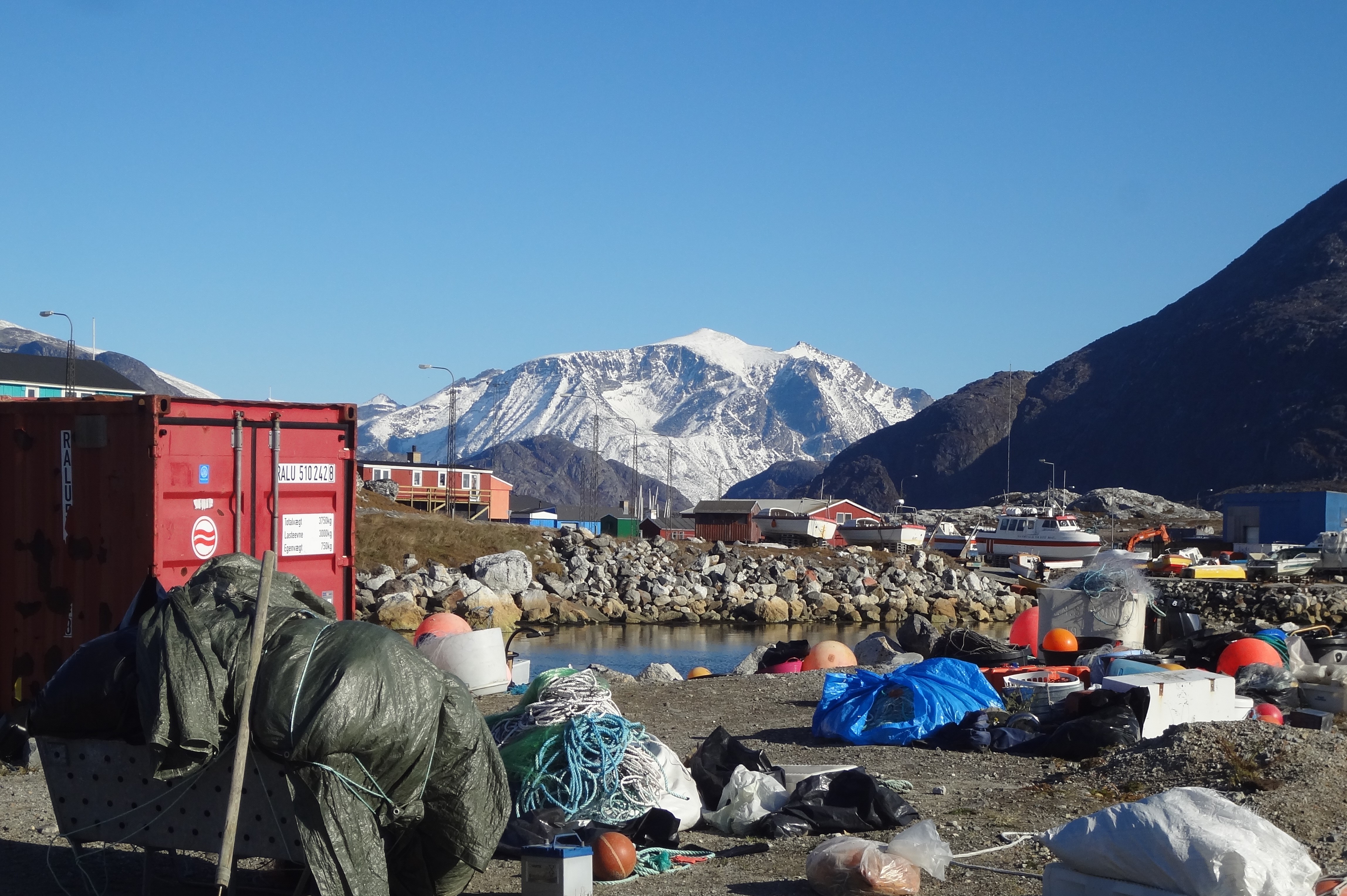
Nanortalik town seen from the dinghy harbour area.
Photo: Joan Nymand Larsen
In the case of Nanortalik, key areas of much attention, as documented in NorValue I, include a critical housing shortage and lack of affordable and better quality housing; a small, declining, and aging population; an increasing youth outmigration, and a growing dependency ratio. Moreover, a lack of stable and well-paying jobs; challenges in accessing services to meet demand, and associated difficulties of attracting and retaining newcomers are critical challenges. In addition, a lack of critical infrastructure to meet growing needs in fisheries and tourism and other trades, including harbour facilities and a new airstrip; and a general lack of educational attainment and access to educational facilities and opportunities for training, makes Nanortalik a case of significant human and fiscal resource gaps (Larsen, Hovgaard & Ingimundarson, 2022).
The following analysis is based on extensive interviews, focus groups, and informal conversations conducted in September 2021 and March 2022 with a variety of local stakeholders representing both public and private sectors, local institutions, different levels of government, businesses, and civic society. In addition, a survey on perceptions regarding the socio-economic situation of the locality was completed in Nanortalik in 2021 and provides additional background data and context for more nuanced analysis of the complexity of the local socio-economic situation, the divergence of views among locals on critical issues, and the challenges of achieving economic development, stability, and internal resilience. Among the 64 individuals who completed the survey in Nanortalik 56.5% were long-time residents having lived in Nanortalik for more than 15 years, while 25.8% had lived there for less than 5 years. 12.9% had lived in the town for 6-10 years, and 4.8% for 11–15 years.
In this chapter, we first present an overview and discussion (section 5.2) of the qualities and strengths of the community in the small town of Nanortalik. This is followed by an analysis of some of the central barriers to economic development in the local town (section 5.3). Next, in section 5.4, we take a closer look at local prospects for sustainability and provide an overview of the internal resilience and future visions for Nanortalik. This is followed in section 5.5 by reflections on local success stories and concluding comments on the future of Nanortalik.
5.2 The nature and strength of local community
While significant socio-economic challenges do confront the daily lives of people in Nanortalik, in our conversations with locals it becomes clear that on balance many residents nonetheless feel a sense of comfort being part of the community in which they live and hopes for a better future in coexistence with nature and each other are present among and within all groups of stakeholders.
5.2.1 A sense of community
Results from extensive interviews conducted with individuals in the public and private sectors as well as other local inhabitants of Nanortalik, also including some interviews from the nearby town of Narsaq, suggest that a strong sense of community is widely experienced by the residents of both towns. Overwhelmingly, when expressing their sense of social solidarity, individuals were referring to the qualities of community relationships and sentiments within their own town, not the municipality of Kujalleq. On the other hand, when discussing cultural wellbeing, social cohesion and belongingness, many interviewees made references to other towns, particularly within Kujalleq. For example, several individuals in well-established career positions made references to the municipal center of Qaqortoq, which some associate with challenges to their local community wellbeing and a perceived lack of autonomous agency. Others, on the other hand, associated the municipality center with promising development opportunities and new initiatives, colleagues, and collaborative networks across Kujalleq. Also, the residents interviewed in Nanortalik and Narsaq frequently expressed the situation in their town relative to that of the other. For example, they compared and characterized the two towns in terms of different opportunities and problems, and social, economic, and institutional factors and activities which either promote or impede a positive sense of community. Many of our interviewees see their community as endowed with a strong sense of collective consciousness, collective conscience, and social cohesion, e.g., “ It goes without saying that there is inequality in Nanortalik. Yes, it's there - it's just not as pronounced here as in many other places. We are good at helping each other with food and clothes for example. People share quickly. Inequality yes, there will always be some.” ; and “ Narsaq has a strong political movement which worked against the Uranium mine, around 90%, and in favour of making Narsaq a UNESCO heritage site [including the town in the Kujaata world heritage area].”
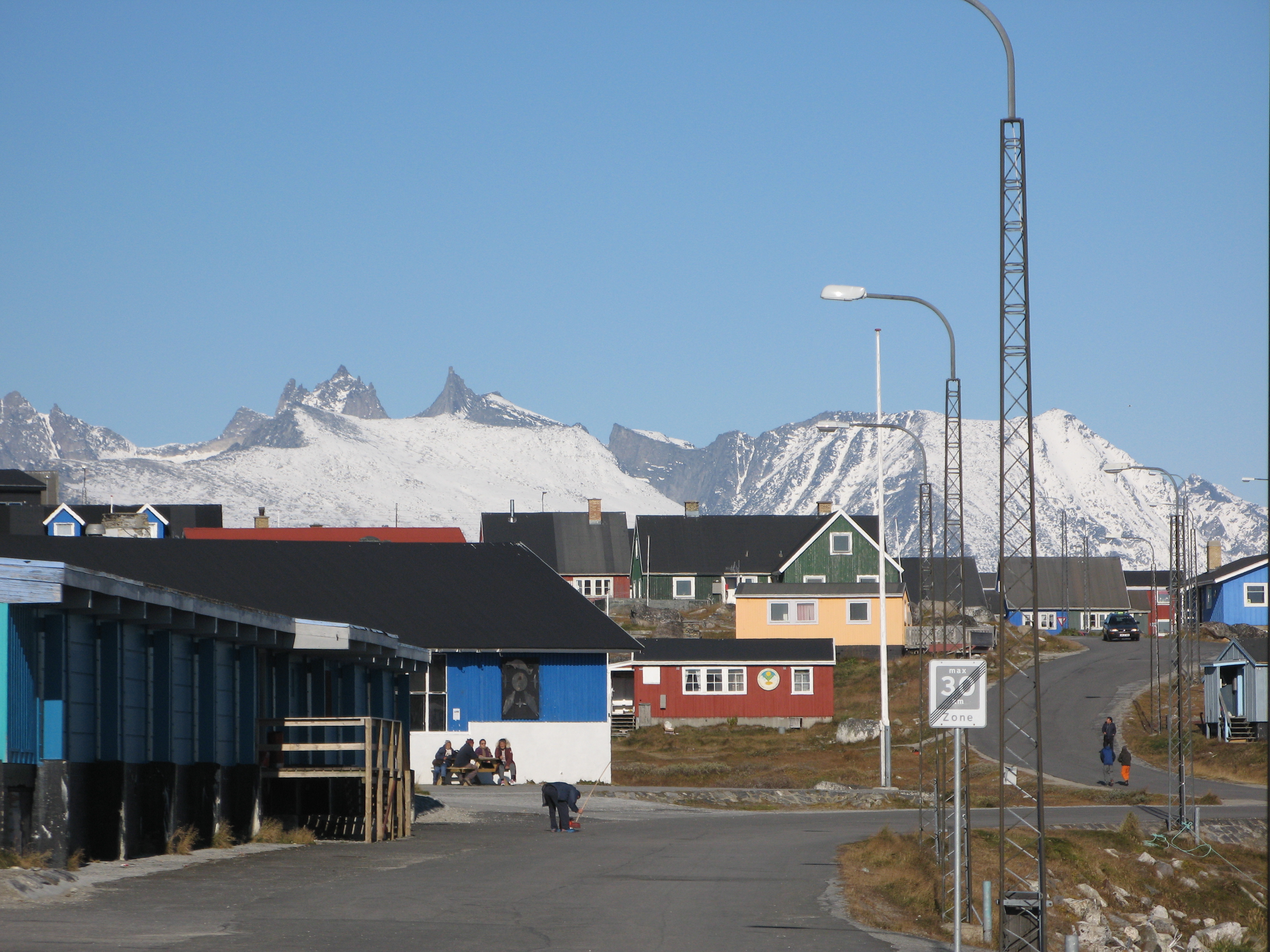
Center of Nanortalik town including the community hall and its bench area, a place where locals like to gather.
Photo: Joan Nymand Larsen
Nanortalik is in many respects a very open community. It is a community that readily and actively seeks and welcomes newcomers, including migrants and fly-in-fly-out workers. It is a place where newcomers feel they have a role, a place, and an opportunity to contribute and be integrated into the many aspects of local life; where the limited, restricted public decision-making processes afforded to the local community are perceived as inclusive of newcomers, and where people feel their voice matters locally. At the same time, several local leaders pointed in interviews to the question of how to become more inclusive, how to bring more of the local population into discussions about the future that effects their lives, so that people, including newcomers, find a reason to stay and help ensure that value-added production, services and human resourses remain and continue to grow within the community.
Interview material from Nanortalik included conversations with several in-migrants and newcomers – mostly individuals who live in Nanortalik either temporarily or on a more permanent basis because of an offer of good and meaningful employment. This might include management and leading positions in public institutions or industry, and good and meaningful opportunities in the private sector, including entrepreneurship. Many of our interview respondents had lived in Nanortalik for a long time, but several had moved to Nanortalik within the past 5 years. Interviewees often expressed a feeling of being integrated and described their role and contribution to society. Generally, in-migrants described as decisive pull factors the economic opportunity or job offer they received, whereas nature or cultural attachment in many instances only became of importance after having settled there.
Strongly agree | Agree | Neither/nor | Disagree | Strongly disagree |
1.64% | 9.84% | 19.67% | 42.62% | 26.23% |
Figure 5.1: The amalgamation has increased our sense of community
In response to the survey statement “The amalgamation has increased our sense of community” (Fig. 5.1), only 11.4% of those surveyed in Nanortalik responded that they agree or strongly agree. While a 68.8% majority of respondents declined this assertion (and 19.7% responded neither/nor), we can merely assume that the 26.2% who strongly disagree are of the opinion that the municipal amalgamation has decreased residents´ sense of community. The word “our” in this survey query is an unclear reference, but as mentioned above, most of the people we interviewed understood a sense of community as referring to perceptions of residents in the context of their town, not their municipality.
5.2.2 A community with a shared vision for the future
Despite current vulnerabilities, our interview data, particularly from Nanortalik, suggests that locals share many similar hopes and visions for the future of their hometown. Broadly described, these community aspirations include e.g., maintaining, enhancing, and expanding successful businesses, institutions, organizations, and activities; reclaiming authority and productive activities lost or in decline; and acquiring new opportunities, resources, infrastructure, and enterprises. Specifically, commonly shared hopes expressed by our interviewees included prospering fisheries, retaining the fish factory, expanding tourism in a sustainable way, more educational opportunities (including secondary school in town), more affordable and better housing, an airstrip, a new harbour to meet a growing demand, and reopening of a gold mine with opportunities for locals. In addition, local hopes for the future included changes in municipal structure and administrative practices that would lead to more respect and sensitivity toward local needs, transparency, power balance, and equality. These common aspirations are linked to the residents’ shared perceptions of the challenges their community is facing such as housing shortage and housing quality problems; youth outmigration and declining and ageing population; low availability of stable employment; and limited means for attracting and retaining newcomers. Additional challenges and issues include a lack of certain critical infrastructure (such as airstrip and sufficient harbour facilities); human and fiscal resource gaps; changes to municipality structure; and climate change in the forms of increased storms and more unpredictable weather and sea ice that impact travel, resupply and connectivity and procurement of ecosystem services.
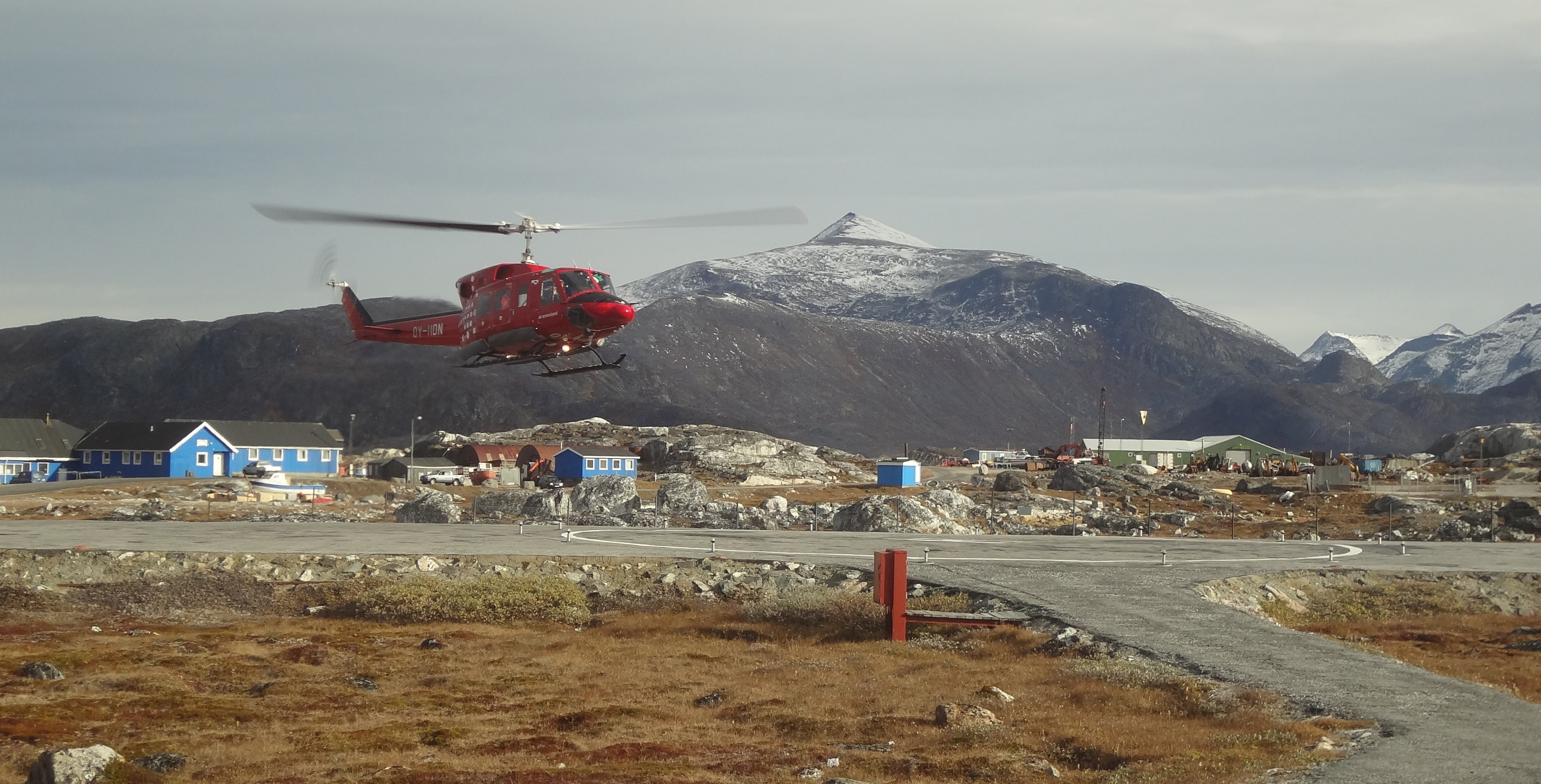
The only connection by air in Nanortalik is the helicopter on weekdays. Weather and technical problems are a frequent challenge.
Photo: Joan Nymand Larsen
With the survey statement, “I feel in good control of my future”, merely 20.6% of Nanortalik respondents disagreed or strongly disagreed. Many more respondents (50%) agreed or strongly agreed and thus accepted an assertion that implies a sense of (potential) empowerment or a sense of individual responsibility as well as available options and opportunities (as residents of Nanortalik). However, 29.3% of respondents replied neither/nor (Fig. 5.2).
These results beg the question of whether and how many Nanortalik residents feel that their community is in control of or responsible for its own destiny. While the survey did not include a comparable query regarding feelings of collective fate control, many interviewees elaborated on this issue while invoking the importance of either external or internal agency or both. Most of our informants emphasized the need for these resources to be brought favourably together, e.g.
Strongly agree | Agree | Neither /Nor | Disagree | Strongly disagree |
15.52% | 34.48% | 29.31% | 17.24% | 3.45% |
Figure 5.2: I feel in good control of my future
Many pointed to certain positive aspects of Nanortalik´s culture and current living conditions as providing a strong foundation for a viable future, e.g. “ What gives a good life here, these are the people who live here - we do not meet the prejudices we see elsewhere. There is togetherness and you know each other. Security is part of it - I do not lock the door .” Several informants also reported on recent successful developments which they attributed to local culture, agency, and human resources, e.g. “ People need to survive but they also need reasons to survive, and culture gives that reason. After they [disadvantaged youth] got the citizen house there have been no suicides, and nobody has been moving away.”
Furthermore, our survey data suggests that many Nanortalik residents are content with local healthcare services or at least do not experience the quality of healthcare declining. In responding to the survey statement “Healthcare services have developed negatively”, 31.7% disagreed and 25% strongly disagreed, whilst 15% agreed and only 3.3% strongly agreed. During our interviews we frequently listened to positive assessments of local facilities respectively serving the elderly, handicapped individuals, disadvantaged youths, and educating and assisting children.
However, while the town’s cultural wellbeing and social solidarity and security were frequently invoked as a critical asset and basis for sustainable future, 47.5% of respondents agreed or strongly agreed with the survey statement “Culture has developed negatively since the time of the amalgamation” (Fig. 5.3). Even so, a significant 20.4% disagreed or strongly disagreed with the assertion and a compelling 32.2% responded neither/nor. Furthermore, it should be noted that this survey question invited participants to assess culture change over time, while our interviewees who emphasized today’s cultural wellbeing in Nanortalik frequently did so in the context of comparing it with living conditions in other Greenlandic towns.
Strongly agree | Agree | Neither/Nor | Disagree | Strongly disagree |
11.86% | 35.59% | 32.20% | 13.56% | 6.78% |
Figure 5.3: Culture has developed negatively since the time of amalgamation
The survey results speak strongly to two notions which we frequently encountered during our interviews and were respectively expressed by two of our informants as “Since the amalgamation, it has all come to a standstill” and “The town needs to learn how to help itself .” Disagreement toward the survey statement “The municipal amalgamation has been very important for Nanortalik” was 73.7% - including 28.1% who disagreed and 45.6% who strongly disagreed - while 14% responded neither/nor to the statement. The word “very” in this query may appear to reduce the value of its results, except that the strikingly high percentage of individuals who strongly disagreed speak loudly for the widespread opinion against the statement. Equally important, by agreeing or strongly agreeing with this strong statement a significant 12.3% of respondents are making it clear that they earnestly consider the municipal amalgamation as having been beneficial for Nanortalik.
Not surprisingly, the relative proportions of individuals who answered agree (10.5%), strongly agree (0%), disagree (31.6%), and strongly disagree (29.2%) in response to the survey statement “Municipality amalgamation has increased people´s belief in a better future” are very similar to the results discussed above. The only notable difference between the two query results is that the percentage of those who responded neither-nor with respect to this question (28.1%) is twice as high as those who did so in response to the statement “The amalgamation has been very important for Nanortalik”. We suggest that the reason for this difference is that the statement concerning whether amalgamation has increased belief in a better future does not mention the survey-takers’ hometown and is more open and not as strongly worded as the statement concerning the importance of the amalgamation for Nanortalik.
Responding to the survey statement “Municipality amalgamation has increased people´s belief in a better future”, 10.5% agreed, 0% strongly agreed, 31.6% disagreed, 29.2% strongly disagreed and 28.1% answered neither/nor. In indirect contrast to how few survey respondents agreed with this statement, nearly twice as many Nanortalik residents agreed or strongly agreed (18.9%) with the idea that the future for Kujalleq municipality is bright (Fig. 5.4). This mildly significant finding when taken together with the above presented survey results on the perceived impacts of the amalgamation on Nanortalik residents, evokes the impression that many Nanortalik residents feel as if theirs is a community left behind (or to itself).
Strongly agree | Agree | Neither/Nor | Disagree | Strongly disagree |
3.45% | 15.52% | 36.21% | 25.86% | 18.97% |
Figure 5.4: The future for Kujalleq municipality is bright
Indeed, many of our interviewees both in Nanortalik and Narsaq testified to the experience of living in a community left behind, e.g. by making assertions such as “w e are the end station here” (local business owner), “s ince the amalgamation, it has all come to a standstill” (civil servant) , and “ there are not that many people who come and talk to us down here” (civil servant) . Some emphasized their community’s disempowerment interlocked with external domination and obstacles: “ We feel colonized, first by Nuuk and then by Qaqortoq ”; and “ Nanortalik and Narsaq’s development has been on standby. Qaqortoq is where there is development, you can just look at our roads, lots of holes, lots of closed houses .” But there were others who agreed with the notion that their community is left to itself but emphasized the need and possibilities for community residents to make a positive difference and to reclaim stronger measures of fate control, or as expressed by one of our informants: “How do we reverse a negative view? I can use myself and my story. It was a good decision for me to return. Many of my friends have decided to stay elsewhere. I say to them: If you stay there, nothing will happen here (in terms of development).” In agreement with our survey results, several of our Nanortalik and Narsaq informants expressed the opinion that the municipal amalgamation has been important for their town and that the future for Kujalleq is bright.
5.2.3 Community with strong sense of place and attachment to nature
As previously discussed, many of our interview informants described their quality of life in Nanortalik as positive by virtue of its culture of togetherness, familiarity, generosity, security and shared values and participation in popular activities. Just as often did our informants express their wellbeing and comfort and community attachment by referring to their contact with and love for nature. As expressed by one interviewee, “ What makes Nanortalik a good place to live, that's the culture. It is different from Qaqortoq and Narsaq. Qaqortoq is modern and growing - Narsaq is agriculture - Nanortalik is 'old', it is fishermen / hunters. Everyone knows each other here - you do not do that in Qaqortoq. When I am away in bigger cities, I miss Nanortalik and Narsaq. Almost everybody is related to one another.” A local hunter commented “ The high point for Nanortalik is in May when the season of hunting hooded seal begins.” Others expressed their sense of belonging as:
5.3 Barriers to economic development
5.3.1 Remoteness, accessibility, and resupply
Critical challenges of creating a more internally resilient community in Nanortalik include its small size, remoteness, and lack of accessibility due to climate or other environmental factors as well as lack of necessary infrastructure, such as an airstrip and updated heliport, and new harbour facilities. These challenges, in turn, lead to high costs of transportation and problems with the resupply of goods and services. One local interviewee explained the difficulties with resupply due to increasingly common severe weather events: “It´s a challenge receiving goods here. Everything is one day behind everywhere else, and when a storm comes, we may be cut off for days. This means a need to be able to adjust the routine all the time.” And another interviewee commented, “ We know about climate change here. It is a reality. Sometimes the ships must turn around just as they are approaching town. This winter has been one of the worst in terms of storms, and many flights have been cancelled and people stranded.” And on the problem of missing an order in the context of remoteness and lack of accessibility a local resident described the challenge further: “Here we receive resupply once a week. If we forget to put in an order, then it takes up to a month before we receive the order.” These reflections shared by locals describe an environment where instability and uncertainty and the frequent need for adjustments to plans and schedules create bottlenecks and shortages that affect the regular flow of daily life and business.
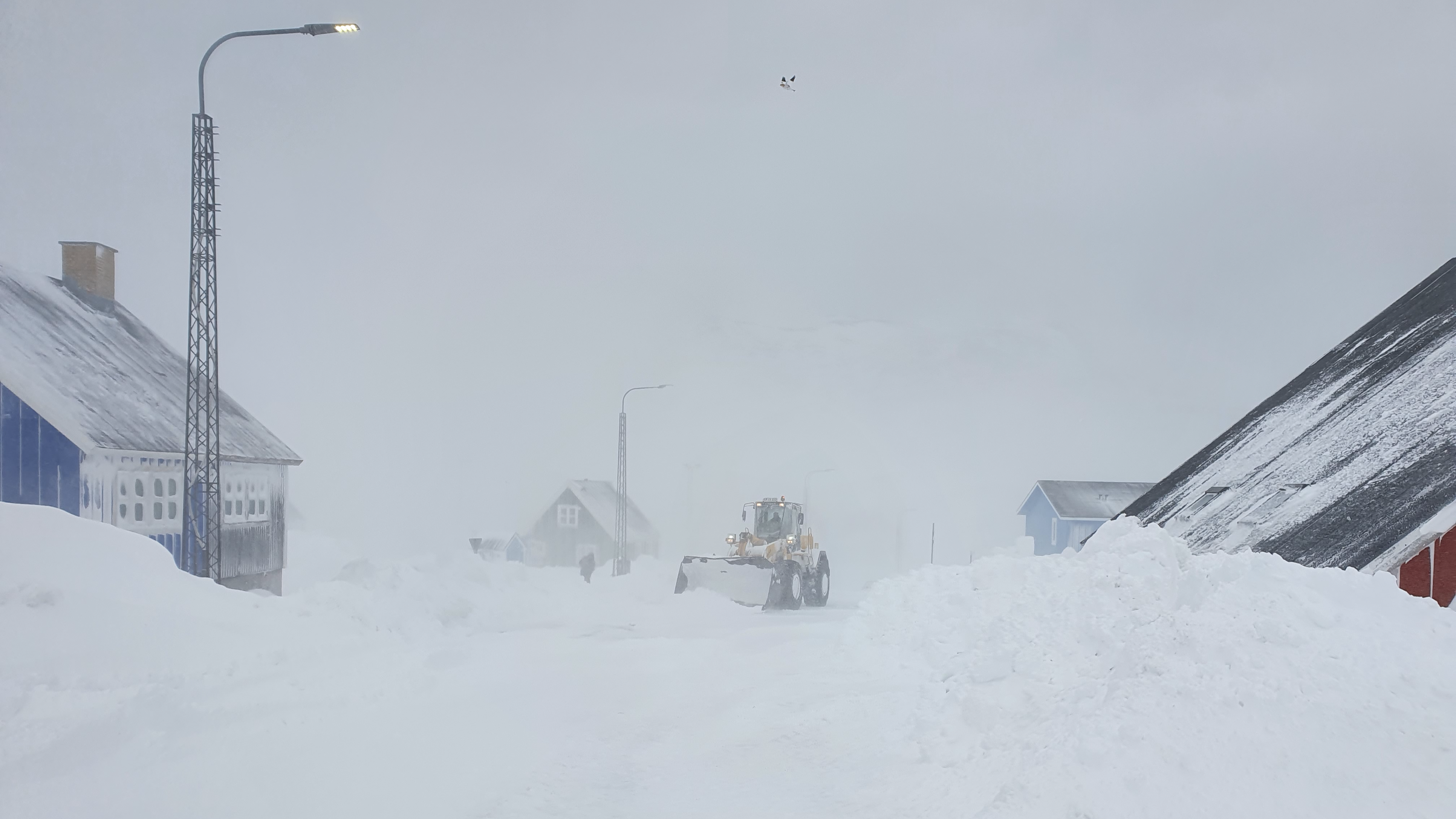
The clean-up begins towards the end of a big winter storm that closed down Nanortalik for several days.
Photo: Joan Nymand Larsen
5.3.2 Employment, and attracting and retaining people.
Opportunities for good, stable, and well-paying jobs in Nanortalik have been relatively limited, and attracting and retaining labour has tended to be equally challenging. The working age population has been declining over time, while demographics, as in other parts of the Arctic, is showing an aging population, and an increasing youth out-migration (Larsen, Hovgaard & Ingimundarson, 2022). With the population of Nanortalik not only decreasing, but also getting older, there is an increasing dependency ratio which challenges community resilience. This is not a situation unique to Nanortalik, but common among smaller coastal communities in Greenland and other Arctic regions. However, the case of Nanortalik is that of a place left on the margin according to some indicators, especially when combined with other key challenges such as remoteness, lack of accessibility and limited opportunities for low-cost geographical connectivity between places. The low and declining proportion of young families and productive workforce impacts the level of public services. The declining youth cohort can be linked to lack of stable employment, training, and educational and recreational opportunities. Moreover, shortages of safe and affordable housing and good facilities for daycare and kindergarten makes attracting newcomers and younger families, and retaining staff, even more difficult.
In Nanortalik, as in many other places in Greenland, the housing situation is complicated, including meeting the demand for safe and affordable housing, dealing with issues of overcrowding and deteriorating infrastructure, and frequently long waiting lists, all of which means that the fraction of the population living in vulnerable situations is relatively high. The housing situation makes attracting and retaining newcomers more challenging, and in turn becomes a factor in efforts towards increasing the level of internal resilience.
5.3.3 Economic diversity
Economic diversity can help provide for a more stable and resilient community. We surveyed local perceptions about economic diversity in Nanortalik. On the statement “The economic life in my town has become more diverse since the time of amalgamation”, 28.1% of local residents disagreed and 12.3% strongly disagreed, while 21.1% agreed and 10.5% strongly agreed, and 28.1% responded neither/nor (Fig. 5.5).
Strongly agree | Agree | Neither/Nor | Disagree | Strongly disagree |
10.53% | 21.05% | 28.07% | 28.07% | 12.28% |
Figure 5.5: The economic life in my town has become more diverse since the time of amalgamation.
Perceptions and concerns about the limited degree, distinctive attributes and challenges of local economic diversity are strongly reflected in many responses gathered through one-on-one interviews. One interviewee expressed concern over the future of Nanortalik: “ It will be bad when the hotel owners leave “. Another interviewee added, “ If the factory closes, we can no longer survive. We are afraid that the fish factory will close. There are many early retirees and retirees here.” One more interviewee added, “ You can earn something in the cafe for one to two days when there is payment of pensions. But the rest of the time there is nothing.” While these responses are phrased in very strong and absolute terms, they nonetheless reflect a sense of the vulnerability perceived by locals – that the survival of the community overwhelmingly depends on the status of one or a few local businesses.
Unlike on the question of changes in diversity of economic life in the town of Nanortalik in and of itself, on the survey question “The development in my town since amalgamation has not affected peoples´ lifestyle”, a striking 45.7% responded that they agreed or strongly agreed, only 33.9% disagreed or strongly disagreed, and merely 20.3% responded with neither/nor (Fig. 5.6). Survey responses such as these as well as the above presented interview results reveal the common perception of residents being left to their own devices and ways of living, perhaps including the idea that development occurring in the municipality of Kujalleq has not had a similar or proportionally equal impact on Nanortalik as on some other localities in the region.
Strongly agree | Agree | Neither/Nor | Disagree | Strongly disagree |
20.34% | 25.42% | 20.34% | 18.64% | 15.25% |
Figure 5.6: The development in my town since amalgamation has not affected peoples’ lifestyle
Generally, people of Nanortalik feel that development of economic life has had challenges. As shown in Fig. 5.7, only 11.3% agree and 1.6% strongly agree that the town’s economic development has been positive since the amalgamation, whereas a 66.1% majority of respondents either disagree (27.4%) or strongly disagree (38.7%) with the statement, and 21% responded neither/nor.
Strongly agree | Agree | Neither/Nor | Disagree | Strongly disagree |
1.61% | 11.29% | 20.97% | 27.42% | 38.71% |
Figure 5.7: Economic development in my town has been positive since amalgamation
5.3.4 Value added and economic diversification
The private sector, local institutions, and residents of Nanortalik like other places in South Greenland are looking for ways to diversify the small and narrowly based economy. Further diversification could be built on the rich cultural heritage and subsistence-based traditions, including arts and crafts, and local products of fish, meat, skins, and plants. Also, tourism plays an increasing important role in Nanortalik with its unique nature, landscapes and culture, and small-scale manufacturing for local, regional, and international markets might also be possible. Improved transportation infrastructure, including sea and air, could provide greater market connectivity for the people of Nanortalik. The emphasis in Nanortalik and Narsaq is primarily on economic diversification in the key economic sectors of fisheries, agriculture, tourism, and mineral resources as well as in the creative arts. One hopeful Nanortalik interviewee commented that “What is most important for the future of this town is that the factory stays open and that we get a new harbour, new apartments for young people and a goldmining operation providing many jobs.” In the case of Nanortalik it will also be interesting to look at possibilities for other types of sectors and trades, such as knowledge-based industries, arts and crafts, small-scale manufacturing, professional and technical services, food, recreation, and local retail trade. These are examples of ways to diversify into new services and product lines. Economic diversification in Nanortalik is, among other, also taking place through increased processing of fish products, and in the type and variety of tour packages and activities offered in tourism.
Among critical stumbling blocks has been the need for more role models. One interviewee noted, “ We lack people who can help entrepreneurs and be role models." Such sentiments were expressed by several young people, students, and apprentices as well as adults desiring to enter a more stable and meaningful career path. Locals are generally acutely aware of the importance of role models who can provide motivation, inspiration, and support, and make goals more tangible. While locals in their conversations with us did not point to specific role models they often would mention the name of individuals in town who were viewed as being particularly successful and to whose success they seemed to aspire. Seeing others succeeding and pushing for their work to be the best can inspire others to do the same. Entrepreneurial role models can be a possible source of relevant human or social capital, which is important when critical gaps of these capitals are present at the local level. A better understanding of this potential driver of entrepreneurship may lead to the development and use of additional (policy) instruments to enhance entrepreneurial activity and outcomes, including education and training, and small business loans. While policymakers tend to agree that entrepreneurship is instrumental for economic growth and technological progress, the local residents of Nanortalik are similarly aware of this fact as was also reflected in many aspects of their conversations with us including their frequent reflection on the consequences of the acute lack of certain access to critical human and financial capital.
5.3.5 Youth and out-migration – a destabilizing trend
While locals in Nanortalik generally convey a sense of community and belonging (as discussed above), a major concern expressed by many interviewees is the lack of educational and recreational activities for young people. The survey data show overwhelmingly that Nanortalik residents feel that young people lack opportunities locally, and that this presents barriers to internal resilience. Of the respondents only 8.3% agreed and 1.7% strongly agreed with the statement that young people have good opportunities within the town (Fig. 5.8).
Strongly agree | Agree | Neither/Nor | Disagree | Strongly disagree |
1.67% | 8.33% | 11.67% | 46.67% | 31.67% |
Figure 5.8: Young people have good opportunities in this town.
One interviewee described this challenge in the context of lack of educational and training opportunities: “It is mostly the girls who go to business school and high school. What is lacking for the boys is a post-secondary technical or vocational school, a school where one uses one’s hands rather than just books. Narsaq and Qaqortoq have post-secondary vocational schools and some from Nanortalik enrol in these, but if we had a vocational school in Nanortalik then young people would come to our town from elsewhere (the smaller settlements) to study.”
A strong majority of the local population surveyed either agreed (50%) or strongly agreed (19.6%) with the statement that more efforts in economic development will reduce out-migration (Fig. 5.9). This suggests that out-migration is caused by both pull and push factors, and that more emphasis on creating opportunities locally could help address this negative trend.
Strongly agree | Agree | Neither/Nor | Disagree | Strongly disagree |
19.6% | 50.0% | 12.5% | 10.7% | 7.1% |
Figure 5.9: More efforts in economic development will reduce out-migration.
While many people interviewed commented that one of the challenges in town was the lack of sports and recreational activities, survey responses nonetheless suggest that many people of Nanortalik find that sports and recreation have developed positively, with 43.3% agreeing (although only 3.3% strongly agreed) on this. 35% responded neither/nor (Fig. 5.10).
Strongly agree | Agree | Neither/Nor | Disagree | Strongly disagree |
3.33% | 40.00% | 35.00% | 18.33% | 3.33% |
Figure 5.10: Sports and recreation have developed positively since the amalgamation.
One interviewee remarked, “ Leisure options are ok. People compare too much Denmark with us. There is a lot to do – we have nature, football pitches and something happens.” Lack of opportunities stand in the way of many, e.g.
One education representative explained, “ Once they (the youth in Nanortalik) have completed Majoriaq (schooling after elementary school) then many of them cannot find an apprenticeship. Either they must travel or do nothing. Many boys would go on if they could get an apprenticeship. There are also many girls who do not break through. Maybe there are better opportunities for the boys. When we were a municipality, there were better opportunities for the girls.” This last point suggests a possible gender division in jobs and training, and with fewer jobs for girls in public service after the municipality amalgamation.
With an aging population the migration and educational challenges become important to resolve. A well-educated and skilled workforce will be needed to support local sustainable development. Today, the municipality is lacking such a workforce, and a general challenge is the persistent mismatch between local competences and skills required, leading to a situation where there can be unemployment and vacancies at the same time. A significant share of the young people that leave their hometown for educational purposes decide not to return to make a living there. Young people who choose to stay typically have limited education, training or experience with job opportunities, or do not have the qualifications, safety net and independence for faring well in the external job market.
Generally, employment and business opportunities are scarce, especially for the younger generation, and there tends to be a lack of professional services, particularly for younger families. While many residents of Nanortalik describe the town as a good place to live, they also express concern about what kind of future their children might have if the family chooses to stay. Some residents perceive the standard of primary education to be lower than elsewhere, and they often express concern and frustration over a lack of teachers, quality daycare and kindergartens, as well as limited sports and recreational activities for the youth.
Many Arctic communities struggle with limited job prospects and economic opportunities. The lack of diverse industries and employment options in many small towns and settlement often lead young people to seek better opportunities in more central and urban areas. Moreover, the impact of environmental and climate change is significant in regions within Greenland as in other places of the Arctic (e.g. Jungsberg et al., 2023). Climate change and changing ecosystems can have significant implications for local industries and traditional livelihoods, which may also contribute to outmigration as young people search for more stable employment opportunities and better living conditions.
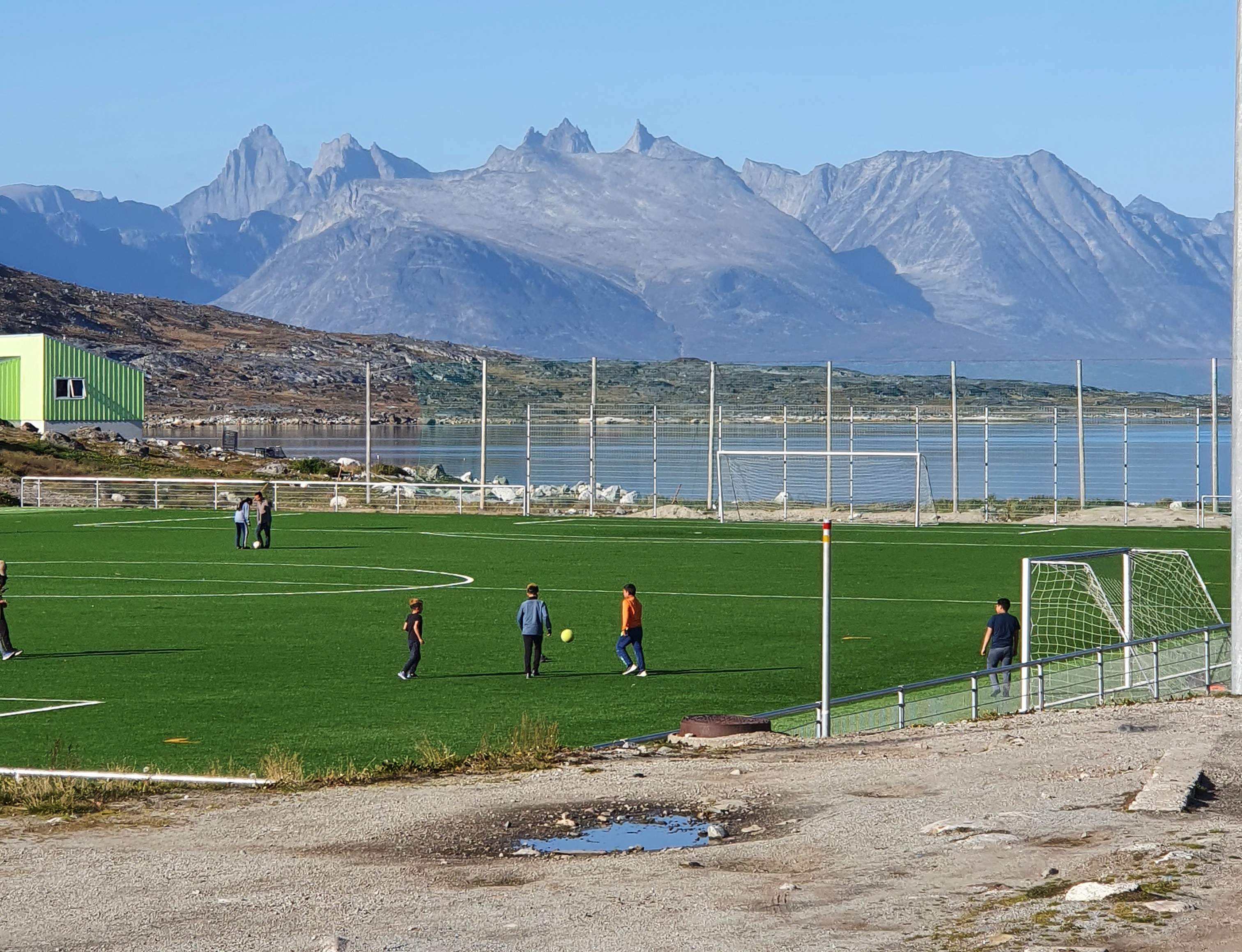
Football field in Nanortalik – a popular place for many youngsters during summer and after school during winter and fall.
Photo: Jón Haukur Ingimundarson
The trend in youth out-migration in Nanortalik and other South Greenland localities, as well as in the broader Arctic region in general, contributes to population decline, ultimately leading to demographic imbalances and challenges for community sustainability, indigenous cultures and heritage, and social networks and community cohesion, as also witnessed in the case of Nanortalik and other smaller Greenlandic localities. When young people leave it impacts on the social dynamics and support systems which challenge community resilience. In conversations with town representatives and other locals from public and private sectors we listened to a variety of perceptions regarding youth outmigration. Mostly locals pointed to a need for more and better educational infrastructure and access to skill development programs which create hope, meaningful opportunities and help youth feel a sense of empowerment. Solutions may require a closer collaboration between different levels of government and the local community. Such collaboration may be weaker where locals perceive a disempowerment due to socio-economic factors.
Nanortalik is experiencing a general challenge attracting newcomers. Several issues explaining these trends have been raised by locals such as the lack of affordable housing, and the lack of services. One interviewee explains, “ The town is having a housing shortage with a shortage of apartments also for those employed by the municipality. The government has been selling many of the public housing apartments, and this has created a critical shortage.” Another commented, “ One block has been closed off for the past 5 years because of mould, and nothing has been done about it yet, because of lack of resources.”
One interviewee explained, “ I think the town should become a little more attractive to people who are going down here, housing for example. When we as a school recruit staff down here, we lack housing to offer, and then they live in vacant housing for a long time .” Another respondent commented, “ It is difficult to find accommodation and housing for people down here. In that closed off block over there (points) there has been mould for a very long time, and they still haven´t started the work of renovating. The block has been closed off for the past 5 years. It would be easier to build a new one. There is a huge waiting list .”
On the issue of changes in the quality of services, a major share of respondents disagreed (33.9%) or strongly disagreed (38.7%) with the statement “Level of municipality services has generally improved”. Only 9.7% agreed and no one strongly agreed, whereas 17.7% responded with neither/nor. Similarly, in response to the statement “Services and trade have generally improved in my town”, 60% either disagree or strongly disagree, only 6.7% agreed and 3.3% strongly agreed, while 30% responded neither/nor.
While many locals express a dissatisfaction with the level of service provision in Nanortalik and point to the lack of housing and schooling as main explanations for outmigration and difficulties of attracting newcomers, the survey nonetheless found that 39.4% of the respondents perceive that the primary school has developed positively, about 34.4% respond neither/nor, whereas 26.2% feel it has not developed positively. Also, we received from our informants many positive comments expressing a sense of place and belonging, connection with a particular local culture, and feelings of being safe in a small place where most people know or know of each other. In fact, in our interviews, especially with youth and adult members of young families, we often heard people saying that they could not see themselves living in a big place like Nuuk.
5.3.6 Municipality amalgamation and a change in balance of power
In interviews and discussions with locals in Nanortalik and Narsaq, concerns over the Kujalleq municipality amalgamation, and the fall-out and aftermath of its implementation, often became part of discussions (see also Larsen, Hovgaard & Ingimundarson, 2022). Local perceptions and criticisms in particular concerned challenges with daily social services, the lack of maintenance of roads and other infrastructure, and the perceived decline in local empowerment. Locals perceive a change in the balance of power, which to some has left Nanortalik and Narsaq worse off in terms of socio-economic status and political clout, and this in sharp contrast to Qaqortoq – the headquarters of Kujalleq. These power imbalances are perceived by many locals to be a root cause of experienced inequalities in socio-economic outcomes.
A major share of the Nanortalik population perceives that amalgamation of the municipalities of Nanortalik, Narsaq, and Qaqortoq has not been a good step. More than half of the respondents (55.4%) strongly disagree with the statement “the amalgamation has been good for the people in my town”, while another 23.2% merely disagree. Only 7.2% either agree or strongly agree (Fig. 5.11).
Strongly agree | Agree | Neither/Nor | Disagree | Strongly disagree |
3.57% | 3.57% | 14.29% | 23.21% | 55.36% |
Figure 5.11: The amalgamation has been good for people in my town.
Local perceptions about the municipality amalgamation are also reflected in people's feelings about the mood in Kujalleq (Fig. 5.12), but among the survey respondents 41% disagreed and 27.9% strongly disagreed with the statement “the mood in the municipality of Kujalleq is good”, while only 8.2% either agreed or strongly agreed. This strongly suggests that a major share of the Nanortalik population feels that the mood in Kujalleq is not good. It is particularly striking that fewer than 10% either agree or strongly agree that the mood is good. One interviewee noted, “ after the municipal amalgamation things fell apart.”
Strongly agree | Agree | Neither/Nor | Disagree | Strongly disagree |
3.28% | 4.92% | 22.95% | 40.98% | 27.87% |
Figure: 5.12: The mood in the municipality of Kujalleq is good.
More than half of the survey respondents in Nanortalik either agreed (43.9%) or strongly agreed (19.3%) that there is tension between Qaqortoq and the other towns, while only 7% disagreed with this statement. Correspondingly, many of our interview informants declared that power has become more concentrated in Qaqortoq and that most of the municipality administrators have moved there, and only rarely do they visit Nanortalik. Some described how the town has moved from being one of the richer municipalities to being poorer with a drain of human and financial resources, and with fewer services and resources, including lack of repair and maintenance. One interviewee noted, “ Things have become worse after the municipality restructuring; less resources, and the kindergarten has mould, and nothing has been done about having it fixed.” Others emphasized the lack of opportunity to participate in decision-making at the municipality level, as well as the loss of authority, responsibility, and resources, e.g. “ Everything has gotten worse since the municipality amalgamation. The municipality sold a lot of its public apartments, and the working conditions have deteriorated.” Another interviewee added, “ I have experienced the merger (municipal amalgamation), but so far, I can see it´s all going down. We are becoming depopulated, and companies are moving to Qaqortoq.”
5.4 Internal resilience and future visions
The level of internal resilience of a place is determined by a multitude of critical factors, including the level of economic diversification; the quantity and quality of fixed community assets, knowledge, and education; the nature of the local market; the number and engagement of local entrepreneurs; the importance and role of the traditional economy, contact with nature and overall cultural wellbeing; and political and administrative authority, and fate control.
Thus, economic diversification is one among a set of key factors in the internal resilience of a place. Achieving a more diversified economic structure is a challenge for small, remote towns dominated by primary commodity dependence (more concentrated economic structures), such as in fisheries. With limited diversification an economy may experience less stability and be more volatile towards shocks and disturbances from external markets, which in turn can lead to lower rates of economic growth. This may create barriers to future internal resilience, as the degree of diversification is linked with structural transformation of the economy and the achievement of higher levels of productivity that results from moving resources within and between economic sectors. Hence, not surprisingly, attaining a higher level of economic diversification is a major challenge for smaller and remote places such as Nanortalik which tend to have limited productive trade, primary and single commodity dependence in trade, and limited resource mobility due to educational gaps and challenges with existing infrastructure.
In the case of South Greenland, and in Nanortalik in particular, examples of new activities might include the expansion of the agricultural sector and sheep husbandry, knowledge-based industries, arts and crafts, small-scale manufacturing and more processing of marine products, professional and technical services, food preparation, recreation, and local retail trade. However, successful diversification also depends on supply of appropriate incentive frameworks; investments and policy reform that is geared towards reducing trade costs; supports for the reallocation of resources towards new economic activities (including from the informal sector); government interventions (market interventions) and attention to weaker institutions, and new and improved infrastructure, such as airstrip, harbour, roads. Many of these incentive frameworks today are either limited or absent in Nanortalik and Narsaq and are perceived by many residents as being particularly weak since the municipality amalgamation. Some locals described challenges with getting the necessary start-up support; the lack of resources and collaboration with the municipality offices; and a general feeling of power being increasingly concentrated in Qaqortoq, and often at the expense of initiatives or creative ideas formulated in Nanortalik and Narsaq (Larsen, Hovgaard & Ingimundarson, 2022; Larsen & Ingimundarson, 2023).
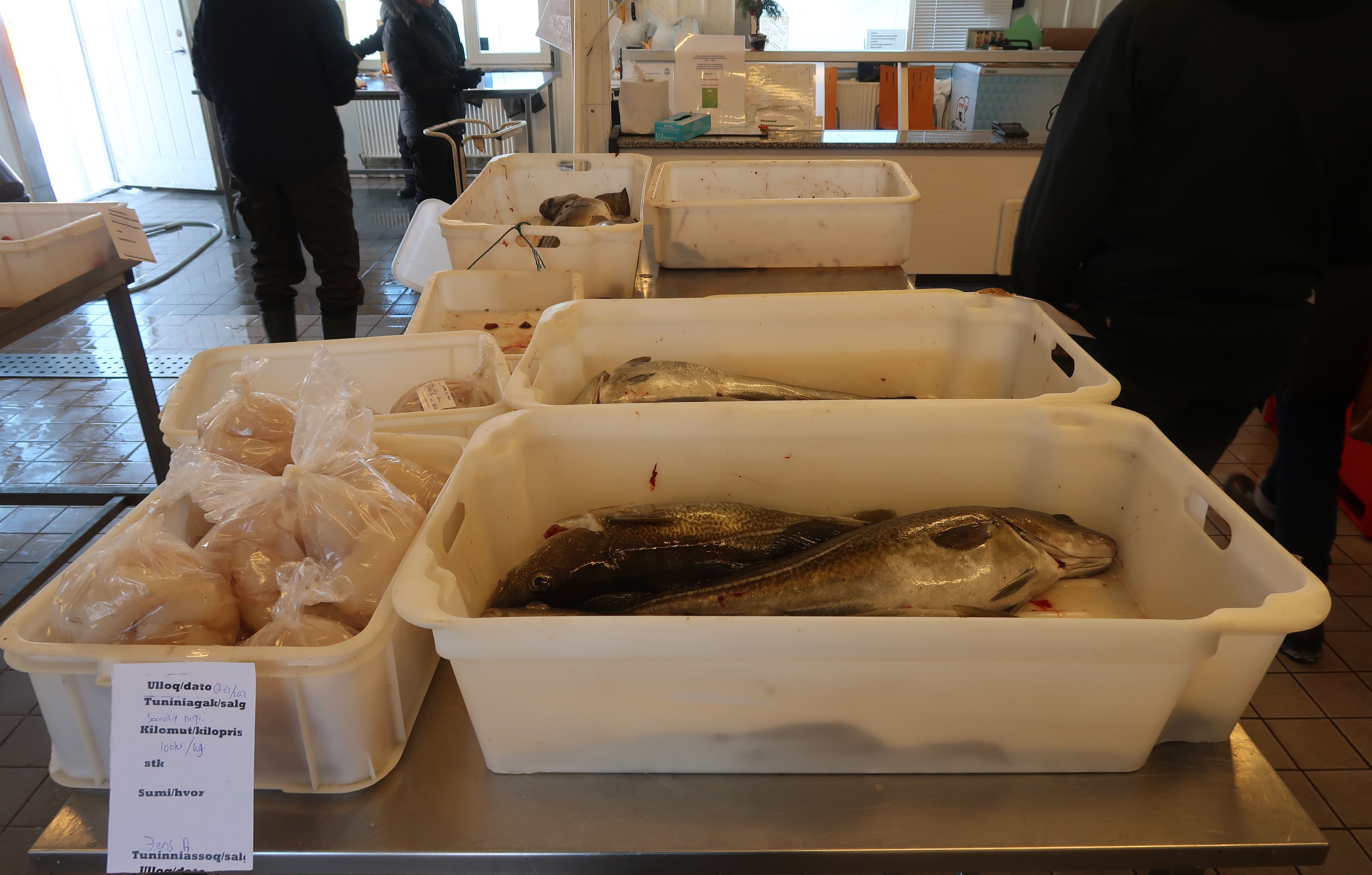
Brættet (traditional fish and meat market) in Qaqortoq where fresh fish and meat from local hunters and fishermen is sold.
Photo: Jón Haukur Ingimundarson
Nanortalik and Narsaq are facing sluggish demand for some of their main products and services, with fluctuating prices and earnings. Due to their remoteness and small size, connections to external suppliers and markets are relatively weak. Therefore, achieving a more resilient and sustainable future requires finding opportunities that produce value added locally and maximize benefits for locals. In this regard, in interviews with locals the conversation often turned to hopes surrounding the fish factory or the new goldmine nearby.
On the survey question of whether the respondents in Nanortalik see themselves in town 10 years from now, i.e. “I can see myself in this town 10 years from now”, only 3.5% of respondents strongly disagreed and 17.2% disagreed, whereas 17.2% strongly agreed and 17.2% agreed, and 44.8% responded neither/nor. Thus, while trends suggest a future with more depopulation and stagnation, a strong majority of respondents either do or can see themselves living in Nanortalik ten years from now. While these results may reveal certain positive prospects for internal resilience, the fact that 61.4% of respondents either disagree or strongly disagree with the statement “Municipality amalgamation has increased people´s belief in a better future” may be more indicative of resident´s common perception towards the prospects for internal resilience.
One interviewee explains, “ The municipality amalgamation was in 2009, and after that everything got increasingly worse .” Another person notes, “ There is more bureaucracy, and everything takes longer time .” Yet another respondent perceives that times were much better before amalgamation: “ Before the amalgamation we were a rich municipality: the fishery, the goldmine, tourism ”, and “ The amalgamation is the reason why Nanortalik is no longer a rich municipality; the new municipality no longer listen to what locals here have to say .”
In analysing the internal structure, the degree of resilience, and the level and potential of increased economic diversification, an approach is to study the strength and number of local economic linkages. Industries are linked to other industries and sectors in ways that can be considered in deciding on a development strategy – or in evaluating the impact of resource development. Linkages to consider include for example backward linkages. While our case study region is very small, backward linkages (input from other industries) in general are most effective when the using industry (e.g. fisheries) becomes so large that supplying industries (e.g. safety clothes) can achieve economies of scale of their own, thus lowering their production costs and becoming competitive. Backward linkages might include e.g. clothing, food, machinery, equipment, security, subcontracting, supplier contracts, service collaborations, and so on. However, such economies of scale in supplying industries would be difficult to generate for a small locality such as Nanortalik.
Forward linkages are also important for the region. This includes input into other industries, i.e. when investment in a project leads to investments in subsequent stages of production, for example, adding value by processing fish instead of exporting it raw or unprocessed. Our many observation and interviews in the local industrial fish processing plant, which is owned and operated by Arctic Prime Fisheries, revealed that many capital and labour intensive steps had been taken to increase locally benefitting value creation, including the production of a final product (dried salted cod) for export (mostly to Spain and Portugal), providing stable employment for about 35 to 40 local residents, as well as providing jobs on the company´s offshore vessel to a similar number of Kujalleq residents, most of them from Nanortalik.
There are also potential horizontal linkages, such as skills developed in one sector that can be transferred to other sectors (for example personnel receiving management training in fisheries who will then be able to use that training in e.g., mining projects, public administration, etc.). These kinds of linkages seem realistic for a place like Nanortalik. Moreover, there are the basic consumption linkages, also referred to as final demand linkages, where a place realizes an increase in demand by those who have realized an increase in income and as a result spend more on consumption goods (i.e. more demand for basic consumer goods in the local stores due to increased local income). This type of linkage will be smaller when earnings are lower (as in the case of unskilled labour), earnings are not spent locally, or profits leave home jurisdictions as payments to shareholders (i.e. the case often observed in remote locations in extractive industries). In the case of Nanortalik local residents expect increased income for many if the goldmine becomes a success and if locals will receive more of the well-paying jobs. In addition to these types of linkages, there may also be side-stream linkages, which are links to support infrastructure (power, logistics, communications, water) that can be used for other projects or sectors as the place develops further. The same is the case for basic infrastructure linkages (e.g. roads, water, ports, power grids, communications, airports, etc). These types of linkages have tended to be rather weak in the case of Nanortalik in particular, which is also reflected in the interview data.
Probably one of the most important linkages in a northern context is the fiscal linkage, when government revenues (corporate and income taxes, and royalties) can be used to finance development in other sectors in the region or locally. This type of linkage is contingent on the nature of institutional arrangements and cost-benefit agreements made. In the case of South Greenland, the fiscal linkage primarily connects to the central government, and funds are subsequently distributed from there to the benefit of Greenland in general, and not specifically to the town or regional locality where the economic project or activity is taking place.
Nanortalik does not have much productive trade except for activities in fisheries, tourism, and the start-up of goldmining. But these are sectors that are small in Nanortalik. The fish factory in Nanortalik is the heart of town, where production could be potentially larger with more quota, more local production, and with more small-scale fishers selling more of their catch to the local factory. But local fishermen described a lack of financial support for new fishing boats and sorely needed upgrading of equipment. In interviews with locals concerns over deteriorating or lacking infrastructure and support was expressed by several people, e.g. “ What is missing and what we need in Nanortalik is a first-rate harbour for big fishing ships and harbour facilities which can accommodate cruise ships with 1000 passengers or more.” Some further argued, “ Fisheries would be better if local hunters could sail further out, but they need new boats and motors for that, and support is lacking.”
In the case of tourism, the local community is somewhat divided on the question of whether the expansion of tourism has been positive for the town, with 42.1% responding that it has not been positive, whereas 24.6% agree and 7% strongly agree that it has been positive. 26.3% responded neither/nor. The relatively big negative response may be related to the growth in cruise tourism with large cruise ships (1-2000 passengers) visiting the town, resulting in large numbers of tourists relative to the small size of the town. Also, common issues of rapid growth of the tourism sector includes concerns that cruise companies and cruise ships negatively impact communities through air and water pollution, economic leakage, and tax avoidance. Tourism can put enormous stress on local land use, and can lead to soil erosion, increased pollution, natural habitat loss, and more pressure on endangered species. Negative factors such as strain on local infrastructure, limited money spent locally, cruise ships sometimes changing their schedules, or not keeping to agreements can add additional frustration and negative sentiments about this sector. Yet, in interviews with local residents, where interviewees have had time to reflect on the issues, we heard positive takes on the growth of this sector, but also concerns over lack of infrastructure to meet the growing needs. One interviewee explained, “ We need more opportunities for people to visit Nanortalik and its surrounding nature. We do not have an airstrip and Air Greenland can only bring 9 passengers each time they arrive at our helicopter port. The company Disko Line does not bring enough tourists to Nanortalik, and their tickets are very expensive.”
In interviews locals have explained the following procedure: “ When a cruise ship docks near our town for a day or two, one thousand or more passenger tourists are brought ashore in smaller boats. We sell these tourists ahead of time various ’packages’ – which are put together in collaboration with different local service providers and people in charge of institutions such as the school, church and the museum – and included in these packages are such things as visit to our big indoor and outdoor local museum, the church and harbour market place, listening to choruses (there are three in town), observing performances of various sort, enjoying things and activities produced by the elementary school´s children and their teachers, and going on speedboats into our fjord to enjoy icebergs, the glacier, Greenland´s only evergreen forest and nature in general as well as fishing“. About 50–150 locals participate in making and offering tours. Activities also includes smaller day tours, and activities like kaffemik (coffee and cake usually at someone’s home) folkdance, church choir, etc. There are also local artists who set up booths and sell their craft. The museum offers activities such as demonstration of how to clean a seal, etc. Earnings from these local tour and event activities amount to 70,000– 150,000 DKK, and this income is distributed among those who have participated.
But one operator explains, “ We all gain when the ships come in; many people work together, and the benefits are distributed among many households.” Another notes, “ We have a good flow of tourists, but they only buy a few souvenirs.” Some interviewees explain the opportunities and challenges: “ In spite of Covid 19 it has been good this summer - it has been busy. There have been new hotel guests from North Greenland – they meet a Greenland they do not know at all, and it amazes them when they come here,” which by some is viewed as a sign of resilience because the local market was able to expand to meet the increased demand from domestic tourists. At the same time others argue in a similar vein as often heard in other small towns along the Arctic coast, that there is too little staff to handle demands of thousands of tourists. Moreover, as explained by some, infrastructure or sites need repairs to be able to meet demand. There is a need for more toilet facilities and in general more of a strategy to prepare for a sustainable tourism. These kind of challenges – although a concern at the local level – are similar to many other places in the early phases of a tourism growth strategy.
While fishing and tourism have been important economic pillars for Nanortalik for a long time, mining has been viewed by many as a possible source of income and jobs for locals, both in the case of the goldmine Nalunaq, but also in earlier days the once proposed rare earth and uranium mine in Narsaq. So far there are not many locals who have worked for the mine, but one interviewee explained that the goldmine nonetheless provides some income for Nanortalik, because of service and consumer goods purchased from Nanortalik. One local in Nanortalik remarked, “ The goldmine is our last chance – the fish is not enough. We cannot live of the tourists either – we have no accommodation. They have been talking about 20–30 years ahead in time with the goldmine.”
While most locals have seen opportunities in the start-up of goldmining located in an area of about 37 km from the town of Nanortalik, some worry about jealousy from potential increased inequality between those who get opportunities with the mine and those who do not. One local noted,
There are many challenges with ineffective linkages and barriers to realizing growth, many of which would be interesting to study in the context of the case study in South Greenland. These might include sluggish demand, fluctuating prices and earnings, linkages that are slow to materialize, difficulty for smaller and more remote locations to link up with communities and centres economically. In the case study region, especially in the case of mining in South Greenland, backward linkages to suppliers and consumption linkages may be less likely to work well; or infrastructure (ports, railroads, transport) built for the mine site may not lower costs and stimulate investments in other industries – nor may remote and specialized capital be well suited for other projects. Also, in terms of fiscal linkages, given the many fiscal challenges and a growing need for financial resources, it may be difficult to choose between options for where to channel resource wealth.
Successful economic diversification toward more diverse production and trade structure depends on many things, including supply of appropriate incentive frameworks; investments and policy reform that is geared towards reducing trade costs; effective policies that supports the reallocation of resources towards new economic activities (including from the informal sector); and government interventions (market interventions), addressing weak institutions (need for new institutional arrangements). There needs to be political commitment and societal support towards economic development, a capacity to manage a diversification process, and local stakeholder interest and support in new sectors, including human capital formation and institutional arrangements. Addressing the persistent gaps in human and fiscal capacity is critical, and so far a place such as Nanortalik have many challenges to overcome.
5.5 Concluding comments
The case of Nanortalik in South Greenland describes a place with a strong sense of community and belonging and hopes for a more sustainable future. At the same time, as illustrated in this chapter, some locals have described a sense of disempowerment and decline in economic wellbeing, with many long-time residents of the local town describing how things were better in the old days when Nanortalik was its own municipality and there were better opportunities for participation in decision making that affects one’s life. Among those residents who were more critical of how the system has changed were often those working within the municipality offices or local institutions. Local hunters and fishermen who were connected primarily to the traditional sector were to some extent more focused on the positive aspects of local life, living so close to nature, and expressing pride with being able to provide for the household through traditional activities, hunting, and fishing.
Many interviewees pointed to the lack of coordination and networking, and the negative consequences for local development and business start-up. At the same time, some locals also questioned to what extent a small and remote place such as Nanortalik realistically can become internally resilient even with efforts to reverse outmigration. At the same time, these people acknowledged that this is also a question of looking at alternative ways of doing things, and to look at how things are done in other places, and what is it that enables some people to succeed. A local stakeholder also described the importance of the town helping itself instead of waiting for support and assistance from outside the community. The town has entrepreneurial talent, with several entrepreneurs who look for new and creative opportunities to create work and income locally, including expanding on tourism tours, boat transportation, local taxi service, creating products from plants and berries etc. Yet, it seems that the economic potential of this entrepreneurial talent has not had the opportunity to fully flourish, and some benefits have not been realized.
Some of the success stories in Nanortalik include the local fish factory that provides stable and valued employment for many, as well as training and education opportunities in the local fisheries and a subsequent increase in local leadership roles at the factory. The local fish factory has also found innovative ways of contributing to more stable employment by investing in new technology (defrosting tank) that has enabled a more stable flow of resources thereby allowing for stable work throughout the week and in all seasons. Also, as explained in interviews, a shift to increased specialization in cod and processing it as saltfish or bacalao has increased the competitiveness and product quality and contributed to a more stable workforce.
The local elementary school has similarly had success with alternative methods. One school representative explains, “ Two years ago, we started bringing Nanortalik’s culture more into teaching. The students started going out to fishing grounds, the heartlands, making lard, cooking trout etc. It has been a great success, and the plan is for more classes to go on such a trip, and with the elders staying overnight for a few days.” The representative went on to explain how this has had a positive effect on the students and their interest in schooling.
Other places in Kujalleq have also found innovative alternatives, such as the case of Narsaq where tourism needed to find new and adaptable ways due to Covid. One representative explains, “ Covid taught us to be adaptable: Locals, students, researchers, and increased number of Greenlandic tourists have participated in the museum-organized ‘Historical Picknicks’, which take place both in summer and winter and are a combination of lectures, art shows, exercise, hiking, and enjoying culture and nature, and cooking and eating together.”
A representative from an economic development office in Qaqortoq also explains:
In nearby Qaqortoq one local resident describes that there is a need to increase export and to do more than just sell fish, birds, and meat products at the informal market, and that a new airport will make it easier to expand the market and e.g., sell birds in Denmark. The interviewee further explains, “ In Greenland we have reindeer, musk oxen, grouse, hares – it can all be sold from Greenland – just like you can buy this in our grocery store here.... When we catch a whale then the stores decide to buy it all. But this is only small scale. There are millions living elsewhere whom we could sell these products to.” For many local interviewees it is perceived that the airport development in Qaqortoq which is now underway, will help improve access conditions for the population of South Greenland, and in particular people living in Qaqortoq, as well as nearby Narsaq.
While many challenges persist and, in some instances, seem to be mounting only further, there is a sense of hope for the future. Above all, many locals express a desire to live close to nature in a safe and familiar setting close to those they have grown up with and that they know. These are the strong foundations that cannot easily be overlooked - a sense of place and community – that help provide some semblance of continuity when much else points in a different direction.
References
Arctic human development report. Regional processes and global linkages (AHDR II) (2014). J. N. Larsen & G. Fondahl, editors. TemaNord 2014:567. Nordic Council of Ministers. https://norden.diva-portal.org/smash/get/diva2:788965/FULLTEXT03.pdf. http://dx.doi.org/10.6027/TN2014-567
Greenland in Figures 2010. (2010). Statistics Greenland.
https://stat.gl/publ/da/GF/2010/oversigt/GIF_2010.pdf
https://stat.gl/publ/da/GF/2010/oversigt/GIF_2010.pdf
Greenland in Figures 2015. (2015). Statistics Greenland.
https://stat.gl/publ/en/gf/2015/pdf/greenland%20in%20figures%202015.pdf
https://stat.gl/publ/en/gf/2015/pdf/greenland%20in%20figures%202015.pdf
Greenland in Figures 2020. (2020). Statistics Greenland.
https://stat.gl/publ/en/gf/2020/pdf/Greenland%20in%20Figures%202020.pdf
https://stat.gl/publ/en/gf/2020/pdf/Greenland%20in%20Figures%202020.pdf
Greenland in Figures 2022. (2022). Statistics Greenland.
https://stat.gl/publ/en/GF/2022/pdf/Greenland%20in%20Figures%202022.pdf
https://stat.gl/publ/en/GF/2022/pdf/Greenland%20in%20Figures%202022.pdf
Jungsberg, L., Huynh, D. Larsen, J. N., Timlin, U. & Ratio, A. (2023). Young voices from the Arctic: Insights on climate change and permafrost degradation. Nordregio Working Paper 2023:6. Nordic Council of Ministers, Nordregio. DOI: 10.6027/WP2023:61403-2511. https://pub.nordregio.org/wp-2023-6-young-voices-from-the-arctic/about-this-publication.html
Larsen, J. N., Hovgaard, G. & Ingimundarson, J. H. (2022). Value chains and social resilience in two Greenlandic towns. In G. Hovgaard & J. O. Bærenholdt (Eds.), Value chains and resilient coastal communities in the Nordic Atlantic, (pp. 98-124). TemaNord 2022:555. Nordic Council of Ministers. http://dx.doi.org/10.6027/temanord2022-555
Larsen, J. N. & Huskey, L. (2015). The Arctic economy in a global context. In B. E. Evengaard, J. N. Larsen & Ø. Paasche. (Eds.), The new Arctic (pp. 159-174). Springer International Publishing.
Larsen, J. N. & Huskey, L. (2020). Sustainable economies in the Arctic. In J. K. Graybill & A. N. Petrov (Eds.), Arctic sustainability: Key methodologies and knowledge domains. A synthesis of knowledge I. Routledge.
Larsen, J. N & Ingimundarson, J. H. (2023). Overarching issues of justice in the Arctic: Reflections from the case of South Greenland. In C. Wood-Donnelly & J. Ohlsson (Eds.), Arctic justice. Environment, society and governance (pp. 154-167). Bristol University Press. https://doi.org/10.51952/9781529224832.ch011
Larsen, J. N. & Petrov, A. (2015). Human development in the Arctic. In B. Evengaard, J. N. Larsen & Ø. Paasche (Eds.), The new Arctic (pp. 133-146). Springer International Publishing.
Larsen, J. N. & Petrov, A. N. (2019). The Economy of the Arctic. In K. S. Coates & C. Holroyd (Eds.), The Palgrave handbook of Arctic policy and politics, (pp. 79-95). Palgrave Macmillan. https://link.springer.com/chapter/10.1007/978-3-030-20557-7_6
Sörlin, S., Dale, B., Keeling, A. & Larsen, J. N. (2023). Patterns of Arctic extractivism: Past and present. In S. Sörlin (Ed.), Resource extraction and Arctic communities. The new extractivist paradigm (pp. 35-65). Cambridge University Press. https://doi.org/10.1017/9781009110044