Appendix 4: Web-panel survey on changes in households’ energy behaviour in relation to the 2021–2023 energy crisis
4.1 Descriptions and proposed questions
INTRO TO THE SURVEY
The purpose of the survey is to gain a better understanding of Nordic households’ attitudes, behaviours, and motivations concerning their home energy consumption and the implementation of efficiency measures, especially considering the global energy crisis of 2021-2023. This period saw households facing high energy prices, leading to growing awareness of one’s own energy consumption and possible ways to increase energy efficiency. It also led to a heated public debate, which resulted in government intervention to protect households from the worst of the price shock.
The survey will take approximately 10 minutes to complete
Your participation in this survey is greatly appreciated. All data collected will be treated with the utmost confidentiality and anonymity, in compliance with the General Data Protection Regulation (GDPR). Your responses will be aggregated to ensure your individual identity will remain completely anonymous throughout the process. Thank you for your valuable input!
SECTION 1 – BACKGROUND (part 1) | |||
ID | Question | Answers | Logic |
HOU_1 | What type of house do you live in? | 1. Detached house/villa 2. Semi-detached house 3. Terraced house or other small detached house 4. Apartment building/ block of flats 5. Building for shared housing 6. Other building type (please specify) | |
HOU_2 | What is your occupancy status? | 1. Owner (no mortgage) 2. Owner (mortgage 3. Tenant 4. I do not know | |
HOU_3 | What is the living floor area of your apartment/house (excluding storage rooms, garage, etc.)? | (free text field) | |
HOU_4 | What is the energy label of your house? | 1. A 2. B 3. C 4. D 5. E 6. F 7. G 8. I do not know | Not relevant for The Faroe Islands or Iceland |
HOU_5 | When was the house built (approx.)? | 1. <1949 2. 1950-1959 3. 1960-1969 4. 1970-1979 5. 1980-1989 6. 1990-1999 7. 2000-2009 8. 2010-2019 9. >2020 | |
HOU_6 | When did you move to your house? (specify the approx. year) | (free text field) | |
HOU_7 | What space heating systems are at your home, and how much are they used during the time of year when the home is heated? | 1. District heating /Central heating 2. Electric panel heaters 3. Electric floor heating 4. Liquid to water (rock, ground, water-source) heat pump 5. Air to water heat pump 6. Air to air heat pump 7. Fire stove/fire place/wood burner 8. Gas furnace/burner/boiler 9. Oil furnace/burner/boiler 10. Bio furnace/burner/boiler 11. Other (please specify) | Multiple choice columns: 1. Not found in the home 2. Found but rarely or never used 3. Used occasionally or primarily in specific rooms 4. Used as main heating source for the whole house 5. I don’t know |
HOU_8 | Do you pay a different energy price depending on the time of the day you use it? Example: It is more expensive to use energy in the morning, than late in the evening? | 1. Yes 2. No 3. I do not know | |
HOU_8a | Do you pay a different energy rate depending on how much energy you use at the same time? Example: Is your rate lower if you use appliances like a washing machine and dishwasher at different times rather than running both at the same time, even if the total energy used is the same? | 1. Yes 2. No 3. I do not know | |
HOU_9 | Do you have an electric vehicle | 1. Yes 2. No 3. I do not know | |
STA_1 | Who in the household pays expenses related to the home (electricity, water, property tax, etc.)? | 1. Me 2. My partner/spouse 3. Children 3. Other family members 5. Others who are not family 6. It is included in the rent | Multiple choice (all that apply) |
STA_2 | How much electricity (measured in kWh and the local currency) did your household use approximately during the period 2021-2023? Enter an estimate of your average annual electricity consumption and/or cost for this period. | 1. Yes 2. No 3. I do not know | |
STA_3 | How much district heating (measured in kWh or m3 of water and the local currency) did your household use approximately during 2021-2023? Enter an estimate of your annual consumption and/or cost for this period. | 1. [kWh] 2. [m3 of water] 3. [local currency] 4. I do not know | If answer 1 in HOU_7 |
STA_4 | During the energy crisis in 2021-2023, how often did you lower the temperature of your home to uncomfortable levels specifically to avoid economic difficulties? |
| |
SECTION 2 – ATTITUDES / MOTIVATIONS | |||
ID | Question | Answers | Logic |
ATT_1 | How much do you agree or disagree with each of these statements? | 1. I care about whether my energy consumption has an impact on global greenhouse gas emissions 2. I think about the energy costs every day 3. I could do more to save energy 4. I want to move to a more energy-efficient house 5. Energy efficiency and energy saving is a recurring topic in my household 6. I am considering getting an electric vehicle 7. I believe that people should be able to use as much energy as they want if they can afford to pay for it. | Multiple choice columns: 1. Strongly disagree 2. Somewhat disagree 3. Neither agree nor disagree 4. Somewhat agree 5. Strongly agree 6. I don’t know 7. Not relevant |
ATT_2 | Has your awareness of energy use changed since the energy crisis in 2021-2023? | 1. I am much less aware 2. I am a little less aware 3. Unchanged 4. I am a little more aware 5. I am much more aware 6. I do not know | |
ATT_7 | During a significant increase in energy prices, which policy measure would you prefer? | 1. Reduced energy tariffs (Lower costs for energy use, often due to incentives such as reduced energy or value-added taxes) 2. Cash payouts to all (Financial assistance to all members of a population, regardless of their socioeconomic status or other factors) 3. Cash payouts to selected groups (Financial assistance exclusively to specific demographics or categories within a population) 4. Economic support based on energy consumption (Financial assistance or benefits provided to individuals or entities, determined by their energy use) 5. Price regulation, like subsidized price and social tariffs. (Prices’ control, often through financial assistance or implementing special pricing schemes to ensure affordability for certain groups within the population) 6. Subsidy scheme for energy efficiency measures (Financial assistance or incentives for implementing measures aimed at improving energy efficiency) 7. Other (please specify) | Multiple choice (up to 3) |
ATT_6 | Before, during, and after the energy crisis in 2021-2023 - What was your motivation to save on your energy consumption at home? | 1. I had no motivation to save on energy 2. To save money 3. To contribute to a sustainable future energy system 4. To contribute to avoid that the energy supply becomes under pressure 5. Nothing could motivate me to save even more on energy 6. To do something good for the climate and environment 7. Other (please specify) 8. I do not know | Multi-column (before 2021 / during the energy crisis 2021-2023 / after) Not relevant for The Faroe Islands |
ATT_3 | Before, during, and after the energy crisis in 2021-2023 - Did you follow the development of electricity prices from day to day? | 1. Yes, I actively monitored hourly electricity prices using an app or the internet 2. No, I relied on a smart management system that automatically controlled my electricity usage 3. No, I only checked electricity prices when I received app or SMS notifications about high prices. 4. No, I had a general impression of how electricity prices tended to vary and didn’t feel the need to actively follow them. 5. No, I only gauged whether electricity was cheap or expensive based on discussions around me and the media. 6. No, I didn’t pay attention to electricity prices at all | Multi-column (before 2021 / during the energy crisis 2021-2023 / after) Not relevant for The Faroe Islands |
ATT_4 | Before, during, and after the energy crisis in 2021-2023 - How often did you think about your electricity and/or heat consumption? | 1. More than one time a day 2. One time a day 3. 1-2 times a week 4. 1-2 times a month 5. 1-2 times a year 6. Never 7. I do not know | Multi-column (before 2021 / during the energy crisis 2021-2023 / after) Not relevant for The Faroe Islands |
ATT_5 | Before, during or after the energy crisis in 2021-2023 - Did you move parts of your energy consumption to different times with lower electricity prices? | 1. Yes 2. I started to explore options for doing so, and plan to implement some 3. I started to explore options, but opted out due to comfort or convenience 4. I would have liked to, but could not due to work schedule or household needs 5. No | Multi-column (before 2021 / during the energy crisis 2021-2023 / after) Not relevant for The Faroe Islands |
ATT_8 | Did you consider retrofitting your home by investing in energy efficiency measures? | 1. Yes, I considered it (but I didn’t take any action) 2. Yes, I implemented energy efficiency measures 3. No | If answer 1 and 2 in HOU_2 |
ATT_8a | What are the potential barriers for retrofitting your home (investing in energy-efficient measures)? | 1. I can't decide what to do first when it comes to retrofitting 2. It is not yet the right time to retrofit my house 3. Building protection regulations prevent me from carrying out retrofitting 4. I do not have available financial resources (savings or loans) to invest in retrofitting 5. The construction companies are inexperienced and/or lack the necessary knowledge 6. I have to agree with my neighbours if I want to retrofit my house 7. A retrofitting project creates a lot of disruption and practical disorder in daily life 8.Retrofitting my home requires a lot of time to the follow-up of the craftsmen 9. I have negative experiences from previous retrofitting projects 10. There are long waiting times for building materials 11 I can’t get hold of craftsmen 12. Upgrading will ruin the charm of the house 13 Lack of information/support/advice on what to do and expected savings of different measures 14. There are no cost-efficient options of energy-efficient measures available 15. Other (please specify) | If answer 1 or 3 in ATT_8 Multiple choice (all that apply) |
SECTION 3 – BEHAVIOUR | |||
ID | Question | Answers | Logic |
BEH_1 | Before, during, and after the energy crisis in 2021-2023- Which of these measures did you adopt to reduce energy consumption and/or save money? You can choose multiple alternatives | 1. Lower temperature in unused rooms when you are at home 2. Lower rooms’ heating/air conditioning when you are not at home 3. Lower rooms’ temperature during night 4. Lower all rooms’ temperature when you are at home 5. Shower less often/take shorter showers 6. Lower the water temperature when showering 7. Turn off lightning and other electric devices when not in use 8. Pay more attention to cooking habits (i.e. put lids on boiling pans) 9. Load full dishwasher before turning it on 10. Lower the water temperature when hand washing the dishes 11. Load full washing machine before turning it on 12. Use washing machine programmes with lower temperatures 13. Air dry clothes instead of using the tumble dryer 14. Swich to use electric appliances to hours with lower electricity prices 15. Reduce the use of electric devices (such as: computer, TV…) 16. Shift to other fuels for heating (i.e. firewood) when the electricity prices are high 17. Reduce the use of energy-intensive amenities, such as hot tubs, saunas, etc. 18. None of these 19. Other (please specify) | Multi-column (before 2021 / during the energy crisis 2021-2023 / after) |
BEH_3 | Before, during, and after the energy crisis in 2021-2023 -How much money do think you have saved with these measures? | 1. None at all 2. A small amount 3. A moderate amount 4. A great deal 5. I do not know | Only measures that were selected in BEH_1 |
BEH_4 | To what extent are you willing to stick to your current energy habits for the next three months? | 1. To a great extent 2. To a considerable extent 3. To some degree 4. To a low degree 5. Not at all 6. I do not know | Only measures that were selected in BEH_1 for "after 2023" |
SECTION 4 – MEASURES | |||
ID | Question | Answers | Logic |
MEA_1 | Before, during, and after the energy crisis in 2021-2023 - Which of these measures have you implemented or do you plan to implement in the next 2-3 years, to save energy and/or money? You can choose multiple alternatives | 1. Enhance building airtightness 2. Install energy-efficient exterior doors 3. Install energy-efficient double-glazed windows 4. Install energy-efficient triple-glazed windows 5. Replace high-energy consuming appliances with energy-efficient appliances 6. Install solar thermal collectors for domestic hot water and/or home heating 7. Install solar panels (PV) for electricity production 8. Install air-to-air heat pump 9. Install air-to-water heat pump 10. Install liquid-to-water (rock, ground, water- source) heat pump 11. Install accumulator tank for storing and distributing hot water 12. Add extra insulation to the roof and/or ceiling facing unheated attic spaces 13. Add extra insulation to the floor facing outdoors or unheated spaces 14. Add extra insulation to external walls 15. Improve heat recovery in existing ventilation system 16. Insulate hot water pipes 17. Improve fan power efficiency in existing ventilation system 18. Install balanced ventilation system with heat recovery 19. Use an energy monitoring system 20. Implement night temperature lowering system 21. Install a waterborne heating system 22. Employ energy consultancy 23. Install programmable timers and motion sensors for lighting control 24. Install a smart control system for heating and/or cooling/ventilation 25. Replace incandescent or halogens bulbs with energy-efficient LED lighting 26. None of these 27. Other (please specify) 28. Not relevant, I am renting or my building does not allow such measures | Multi-column (before 2021 / during the energy crisis 2021-2023 / after / the next 2-3 years) |
MEA_2 | Before, during, and after the energy crisis in 2021-2023 - How much money do you think you have saved with these measures? | 1. None at all 2. Very little 3. A small amount 4. Some amount 5. A moderate amount 6. A significant amount 7. A great deal 8. I do not know | Only measures that were selected in MEA_1 |
MEA_4 | Are you planning to apply for a support scheme to implement some of these measures? | 1. Yes 2. Yes, but I do not know the potential options 3. Yes, but I do not know how to apply for available support schemes 4. No, there are no appropriate support schemes available 5. No | |
SECTION 5 – FUTURE INTENTIONS |
In this section, you will encounter four hypothetical scenarios where you can choose to adopt one out of two energy efficiency measures presented or none of them. Each measure is characterized by factors such as investment cost, potential energy savings, and government investment support. Please respond as if you have not yet implemented any of these measures, regardless of whether you own or rent your property. Please note that the values for installation price and energy savings are not absolute but rather relative among the considered measures. |
BLOCK 1 Which of these options, if any, would you prefer to implement in your home, regardless of whether you own it or rent it, assuming you have not yet implemented any of these measures? |
SET 1_1 | Option 1 | Option 2 | None |
Measure | Use energy monitoring system | Implement night temperaure lowering system | |
Investment cost |  |  | |
Energy savings |  |  | |
Investment support | Financed 0% investment cost | Financed 35% investment cost |
Which of these options, if any, would you prefer to implement in your home, regardless of whether you own it or rent it, assuming you have not yet implemented any of these measures? | |||
SET 1_2 | Option 1 | Option 2 | None |
Measure | Install energy-efficient triple-glazed windows for the entire home | Add extra insulation to the external walls | |
Investment cost |  |  | |
Energy savings |  |  | |
Investment support | Financed 0% investment cost | Financed 15% investment cost | |
Which of these options, if any, would you prefer to implement in your home, regardless of whether you own it or rent it, assuming you have not yet implemented any of these measures? | |||
SET 1_3 | Option 1 | Option 2 | None |
Measure | Install energy-efficient triple-glazed windows for the entire home | Add extra insultation tothe external walls | |
Investment cost |  |  | |
Energy savings |  |  | |
Investment support | Financed 15% investment cost | Financed 35% investment cost | |
Which of these options, if any, would you prefer to implement in your home, regardless of whether you own it or rent it, assuming you have not yet implemented any of these measures? | |||
SET 1_4 | Option 1 | Option 2 | None |
Measure | Implement night temperature lowering system | Install balanced ventilation system with heat recovery | |
Investment cost |  |  | |
Energy savings |  |  | |
Investment support | Financed 0% investment cost | Financed 15% investment cost | |
BLOCK 2 Which of these options, if any, would you prefer to implement in your home, regardless of whether you own it or rent it, assuming you have not yet implemented any of these measures? | |||
SET 2_1 | Option 1 | Option 2 | None |
Measure | Implement night temperature lowering system | Install balanced ventilation system with heat recovery | |
Investment cost |  |  | |
Energy savings |  |  | |
Investment support | Financed 15% investment cost | Financed 35% investment cost | |
Which of these options, if any, would you prefer to implement in your home, regardless of whether you own it or rent it, assuming you have not yet implemented any of these measures? | |||
SET 2_2 | Option 1 | Option 2 | None |
Measure | Use energy monitoring system | Install balanced ventilation system with heat recovery | |
Investment cost |  |  | |
Energy savings |  |  | |
Investment support | Financed 35% investment cost | Financed 35% investment cost | |
Which of these options, if any, would you prefer to implement in your home, regardless of whether you own it or rent it, assuming you have not yet implemented any of these measures? | |||
SET 2_3 | Option 1 | Option 2 | None |
Measure | Install energy-efficient triple-glazed windows for the entire home | Add extra insulation to the external walls | |
Investment cost |  |  | |
Energy savings |  |  | |
Investment support | Financed 0% investment cost | Financed 15% investment cost | |
Which of these options, if any, would you prefer to implement in your home, regardless of whether you own it or rent it, assuming you have not yet implemented any of these measures? | |||
SET 2_4 | Option 1 | Option 2 | None |
Measure | Use energy monitoring system | Implement night temperature lowering system | |
Investment cost |  |  | |
Energy savings |  |  | |
Investment support | Financed 15% investment cost | Financed 35% investment cost | |
SECTION 1 – BACKGROUND (part 2) | ||||
ID | Question | Answers | Logic | Comment |
DEM_1 | How old are you? | (free text field) | Norstat-panel | |
DEM_2 | What is your gender? | 1. Woman 2. Man 3. Other | Norstat-panel | |
LOC_1 | Where do you live? Fill in your postcode | (free text field) | Norstat-panel | |
DEM_3 | What is your highest level of education? | 1. Primary school 2. Secondary school 3. Vocational school, apprenticeship certificate, or other 1–2-year education after upper secondary school 3. University/college up to 3 years 4. University/college, 4 years or more 5. Other | Norstat-panel | |
DEM_4 | What is your employee status? | 1. Employed full-time with income 2. Employed part-time with income 3. Self-employed 4. Age pensioner 5. Currently unemployed/receiving employment benefit 6. Other type of social security recipient 7. Pupil, student 8. Stay-at-home/homemaker 9. Other (please specify) | As Behaviour survey | |
DEM_6 | What type of household structure do you have? | 1. Live alone 2. Live with friends/in a collective 3. Live with a partner/spouse without children 4. Live with a partner/spouse with children 5. Live alone with children 6. Live with my parents 7. Other (please specify) 8. I prefer to not answer | Norstat-panel | |
DEM_7 | How many people live in your home, including you? | 1. 1 person 2. 2 persons 3. 3 persons 4. 4 persons 5. 5 persons or more | As Behaviour survey | |
DEM_8 | What is the average annual gross income (before taxes) of your household, including all members? | 1. Fill in (local currency) 2. I prefer to not answer 3. I don’t know | ||
4.2 Figures and detailed responses
This section provides a comprehensive analysis of the findings from the web-panel survey.
Household size and structure: Norway, Denmark, and Finland had smaller households, mostly with one or two members, while over 30% of Faroese respondents lived in households with more than five members. Average household sizes ranged from 2.5 in Denmark to 3.6 in The Faroe Islands.
Figure A 4. Distribution of household structure in the survey, by country.
* Note that the answers "Other (please specify)" and "I prefer not to answer" are excluded from the graph due to their negligible contributions.
* Note that the answers "Other (please specify)" and "I prefer not to answer" are excluded from the graph due to their negligible contributions.
Figure A 5. Distribution of household size in the survey, by country.
Housing information: respondents answered questions related to their house, the occupancy status of their residential place, and ownership of an electric car. Analysing the results and comparing differences between countries revealed several differences among them. First, The Faroe Islands was the only country among all respondent countries where most of the respondents lived in detached houses or villas. While almost half of the respondents in Iceland, Finland and Sweden lived in blocks, this percentage was lower in Denmark and Norway, in favour of detached houses and villas. Homeownership was highest in Norway, The Faroe Islands, and Iceland, often with mortgages. In Denmark, Finland, and Sweden, renting was more common. Awareness of energy labels was highest in Norway, followed by Denmark, Sweden, and Finland.
Figure A 6. Distribution of household types in the survey, by country.
Figure A 7. Distribution of the occupancy status in the survey for households, by country.
Figure A 8. Distribution of energy labels in the survey for households, by country.
Figure A 9. Distribution of the years when residential properties were built in the survey for households, by country.
The average living floor area of apartments and houses, excluding storage rooms, garages, and similar spaces, varied across the Nordic countries as follows: Norway had an average of 132 m2, Sweden 101 m2, Iceland 118 m2, Finland 87 m2, Denmark 109 m2, and the Faroe Islands 161 m2.
In addition, respondents were asked to indicate when they had moved into their current house. On average, respondents in Norway have lived in their current homes for 12 years, while in Sweden and Denmark, the average was 13 years. In Iceland and Finland, the average was 11 years, whereas in the Faroe Islands, respondents reported an average of 16 years.
Electric car ownership: Norway led in electric vehicle ownership at over 30%, followed by Iceland, Denmark, The Faroe Islands, Sweden, and Finland.
Figure A 10. Ownership of electric vehicles in the survey for households, by country.
Energy consumption pattern: A set of question was proposed to the respondents to describe their heating system and energy consumption pattern. In Norway, electric floor heating, panel heaters, wood burners, and air-to-air heat pumps were prevalent. In the Faroe Islands, respondents mainly used oil burners, air-to-water and liquid to water heat pumps. In Iceland, Denmark, and Finland, district heating and central heating were dominant, with additional use of liquid to water heat pumps in Iceland, and electric floor heating, panel heaters and wood burners in Denmark and Finland. In Sweden, heating sources were diverse, including district heating and central heating, electric floor heating, fire stove/fireplace/wood burner, air to air heat pumps, liquid to air heat pumps, and electric panel heaters. The detail for each country is illustrated in the figures below:
Figure A 11. Distribution of heating sources from the survey for households in Norway
Figure A 12. Distribution of heating sources from the survey for households in the Faroe Islands.
Figure A 13. Distribution of heating sources from the survey for households in Iceland.
Figure A 14. Distribution of heating sources from the survey for households in Denmark.
Figure A 15. Distribution of heating sources from the survey for households in Finland.
Figure A 16. Distribution of heating sources from the survey for households in Sweden.
The survey asked respondents about their household electricity consumption and costs for the period 2021-2023, measured in kWh and local currency. A significant proportion of respondents in each country did not provide any estimate of their electricity usage or cost (65% in Norway, 67% in Sweden and Denmark, 87% in Iceland, 60% in Finland, and 52% in Faroe Islands). Among the remaining respondents, the responses varied across countries as follows:
Norway: 21,000 kWh annual consumption, costing 26,000 NOK on average
Sweden: 16,000 kWh annual consumption, costing 39,000 SEK on average.
Iceland: 16,000 kWh annual consumption, costing 24,000 ISK on average.
Finland: 10,000 kWh annual consumption, costing 1,412 EUR on average.
Faroe Islands: 4,700 kWh annual consumption, costing 8,600 DKK on average.
Denmark: 5,400 kWh annual consumption, costing 13,600 DKK on average.
Sweden: 16,000 kWh annual consumption, costing 39,000 SEK on average.
Iceland: 16,000 kWh annual consumption, costing 24,000 ISK on average.
Finland: 10,000 kWh annual consumption, costing 1,412 EUR on average.
Faroe Islands: 4,700 kWh annual consumption, costing 8,600 DKK on average.
Denmark: 5,400 kWh annual consumption, costing 13,600 DKK on average.
Respondents were also asked about their district heating consumption during the period 2021-2023; however, the response rate for this question was negligible across all Nordic countries.
Energy saving behaviours before, during and after the energy crisis of 2021-2023
The figures below show the responses on short-term measures applied before, during, and after the energy crisis, per Nordic country.
The figures below show the responses on short-term measures applied before, during, and after the energy crisis, per Nordic country.
Figure A 17. Distribution of applied short-term energy efficiency measures before, during and after the energy crisis in Norway.
Figure A 18. Distribution of applied short-term energy efficiency measures before, during and after the energy crisis in the Faroe Islands.
Figure A 19. Distribution of applied short-term energy efficiency measures before, during and after the energy crisis in Iceland.
Figure A 20. Distribution of applied short-term energy efficiency measures before, during and after the energy crisis in Denmark
Figure A 21. Distribution of applied short-term energy efficiency measures before, during and after the energy crisis in Finland.
Figure A 22. Distribution of applied short-term energy efficiency measures before, during and after the energy crisis in Sweden.
Respondents were asked how often they lowered their home temperature to uncomfortable levels to avoid economic difficulties during the energy crisis of 2021-2023. Overall, 49% of respondents never lowered the temperature, with Iceland showing the highest percentage (80%), followed by Faroe Islands (57%) and Finland (53%). In contrast, Sweden, Norway, and Denmark reported lower percentages of respondents who never adjusted the temperature (43%, 29%, and 35%, respectively). The remaining respondents reported varying frequencies, with 16% sometimes lowering the temperature, 7% often, and 3% very often. Only 2% stated they always lowered the temperature.
Respondents showed varying levels of awareness and experience regarding time-of-day and consumption-based energy pricing, with notable differences across the countries.
Overall, 46% of respondents said they do not pay a different energy price depending on the time of day, 29% said they do, and 26% were unsure (‘I don’t know’). Norway had the highest percentage of ‘yes’ responses (62%), followed by Denmark (46%). The highest percentage of ‘no’ responses came from the Faroe Islands (75%), followed by Finland (60%) and Sweden (57%). Iceland had a notably high percentage of ‘I don’t know’ responses, at 46%.
Overall, 49% of all respondents said they do not pay a different energy rate based on how much energy they use at the same time, while 18% said they do, and 33% were unsure (‘I don’t know’). Norway had the highest percentage of ‘yes’ responses (50%), while other countries showed much lower percentages, with rates of up to 15%. Finland had the highest percentage of ‘no’ responses (69%), followed by the Faroe Islands (66%) and Sweden (57%). A notable percentage of respondents, especially in Iceland (47%) and Denmark (43%), were unsure about this.
Overall, most respondents (81%) replied that they pay the household expenses themselves, followed by 39% stating that their partner does it. For 7%, it is included in the rent. The trend was similar across all countries, with few divergencies.
The figure below shows the perceptions of the impact of energy saving measures aggregated for all respondents.
Among the most common energy-saving measures, ‘Turning off lights and devices when not in use’ is widely recognized. 53% of respondents across all countries believed it could save a small amount of money, while 16% thought it could save a moderate amount, and another 16% were unsure. Finland had the highest proportion (62%) believing it could save a small amount of money, with the Faroe Islands and Iceland showing somewhat lower perceptions, at 34% and 45%, respectively.
For the measure ‘Load full dishwasher before turning it on’, 46% of respondents across all countries believed it saved a small amount of money, while 20% thought it saved a moderate amount. Finland, Sweden and Denmark reported the highest proportions of respondents feeling they saved a small amount (around 52%, 50% and 50%, respectively).
A similar trend characterised the measure ‘Load full washing machine before turning it on’, where 45% of respondents across all countries believed it saved a small amount of money, while 22% thought it saved a moderate amount. A significant number of respondents in Finland (52%) and Denmark (49%) felt they saved a small amount. Iceland reported the largest number of respondents uncertain about their savings (30%).
Finally, for the measure ‘Air dry clothes instead of using the tumble dryer’, 29% of respondents across all countries believed it saved a small amount of money, and 28% thought it saved a moderate amount. Finland (33%) and Denmark (32%) saw the highest number of respondents saving a moderate amount, with Sweden reporting a relatively higher percentage of people who saved a great deal (19%).
Figure A 23. Distribution of perceptions of the impact of energy saving actions, per energy efficiency measure,
and aggregated for Norway, Sweden, Finland, Denmark, Iceland and the Faroe Islands.
The figure below illustrates the willingness to sustain the energy saving behaviour among all respondents in all countries. However, the results show variations when it comes to sticking to energy-saving habits over the next three months.
For ‘Turning off lights and devices when not in use’, 59% of all respondents were willing to stick to this habit to a great extent. Iceland (69%) had the highest commitment, while the Faroe Islands (37%) showed the least.
For ‘Loading full dishwashers before turning them on’, 63% of all respondents were willing to maintain this habit. Denmark (71%), Iceland (70%), and Sweden (69%) had the highest willingness, with the Faroe Islands at 39%.
Regarding ‘Loading full washing machines before turning them on’, 64% of all respondents were committed to sticking with it, led by Iceland (74%) and Sweden (71%).
For ‘Air drying clothes instead of using the tumble dryer’, 66% of all respondents were willing to continue. Sweden (71%) had the highest commitment, while the Faroe Islands (50%) showed the least.
Figure A 24. Distribution of willingness to sustain energy saving behaviours over time, per energy efficiency measures,
and aggregated for Norway, Sweden, Finland, Denmark, Iceland and the Faroe Islands.
Medium to long-term energy efficiency measures: Respondents were asked which energy-saving measures they have implemented or plan to implement in the next 2-3 years to save energy and/or money. The following graph summarises the results for all respondents in Nordic countries, as similar patterns were observed across the countries. Only the Faroe Islands showed a slightly different trend in the answers, with specific measures such as adding extra insulation in external walls and ceilings, installing energy-efficient windows, and replacing high-energy consuming appliances with energy-efficient ones standing out with higher percentages compared to the other countries.
Figure A 25. Distribution of responses about energy saving measures in the Nordic countries.
Note that, for one of the most chosen measures, ‘Replace incandescent or halogen bulbs with energy-efficient LED lighting’, 51% of respondents reported saving a small amount, 23% a moderate amount, and 8% a great deal, with the highest proportion of respondents in Finland and Sweden (57%) believing they saved a small amount.
Attitudes and motivations towards energy consumption and efficiency: The following sections explore respondents' attitudes, motivations, and behaviours related to energy consumption, efficiency measures, and responses to energy crises. Topics include agreement with energy-related statements, preferred policy measures, awareness and monitoring of energy usage, behavioural changes, and motivations for energy-saving actions. Results highlight variations across countries and shifts before, during, and after the energy crisis (2021-2023).
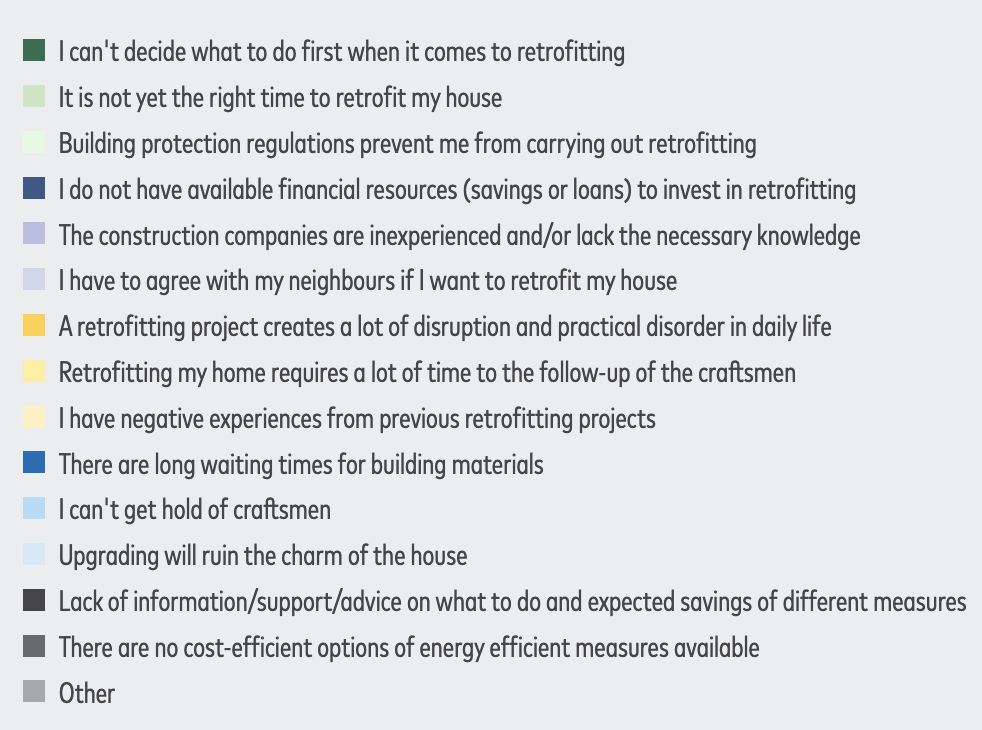
Figure A 26. Respondents' agreement with statements on energy consumption, efficiency, and environmental impact across the Nordic countries
Regarding preferred policy measures during a significant increase in energy prices, 49% of all respondents favoured ‘reduced energy tariffs. However, there were notable differences across countries: Norway had the highest preference for this measure (59%), while Finland had the lowest (37%). A ‘subsidy scheme for energy efficiency measures’ was another popular choice, particularly in Iceland (48%) and Norway (45%). ‘Price regulation, such as subsidized prices and social tariffs’, was favoured by 30% overall, with Norway leading at 44%, while Iceland had the lowest preference at 20%. ‘Cash payouts to all’ were selected by 11% overall, but this was highest in Norway (17%) and lowest in Iceland (9%). ‘Economic support based on energy consumption’ was preferred by 16%, with Finland showing the highest support (19%).
Before, during, and after the energy crisis (2021-2023), the way respondents followed electricity prices varied. Before 2021, 33% didn’t pay attention to electricity prices at all, and 25% had a general impression of how prices fluctuated but didn’t actively track them. A smaller portion (10%) actively monitored prices through apps or the internet, and 8% relied on smart systems to control usage. During the energy crisis, active monitoring significantly increased, with 36% of all respondents tracking hourly prices, particularly in Norway (51%). However, many still had a general sense of price trends (20%), and a smaller group (10%) checked prices when notified by app or SMS. After 2023, 31% of respondents continued actively monitoring prices, with the highest rates in Norway (40%) and Iceland (39%). While fewer used smart systems (7%) or checked prices through notifications (11%), many still relied on general impressions (23%) or media discussions (15%). Note that this question was not directed to the Faroe Islands and Iceland.
Before, during, and after the energy crisis (2021-2023), respondents showed varying levels of awareness regarding their electricity and heating consumption. Before 2021, 24% of all respondents did not think about their electricity and heating consumption at all, with Finland and Sweden at 26%. About 23% of respondents considered it 1-2 times a month, particularly in Denmark (25%) and Sweden (26%). Only 3% of respondents thought about it more than once a day, with Norway at 4%. During the energy crisis, there was an increase in attention towards energy use, with 14% of respondents thinking about it more than once a day and 19% once a day. Norway led with 20% of respondents thinking about it more than once daily, while Sweden was lower at 10%. After 2023, awareness decreased slightly, with 8% of respondents thinking about it more than once a day. Norway remained higher at 11%, while Sweden had only 4%. Note that this question was not directed to the Faroe Islands and Iceland.
Before, during, and after the energy crisis (2021–2023), there was a shift in respondents' behavior regarding the timing of energy consumption, i.e., adjusting the energy use to times with lower electricity prices. Before 2021, only 10% adjusted their consumption, with Denmark (14%) leading and Sweden (5%) having the lowest rate. A significant portion (71%) did not make any changes. Additionally, 7% explored options but didn’t implement them, and 7% considered but opted out due to comfort or convenience. During the crisis, 32% of respondents adjusted their usage, with Denmark (46%) and Norway (42%) having the highest engagement. However, 43% still did not move their consumption, and 8% explored options but didn’t act on them. After 2023, 30% of all respondents continued adjusting energy consumption, with Denmark (43%) still with the highest engagement, while 46% of respondents opted not to change. Notably, 11% of all respondents explored options and planned to implement them. Sweden continued to have the lowest engagement, with 68% of respondents not making any changes. Note that this question was not directed to Faroe Islands and Iceland.
Regarding motivations to save energy before, during, and after the energy crisis (2021-2023), 50% of respondents cited ‘saving money’ as their primary motivation, followed by ‘doing something good for the climate and environment’ (45%). In Denmark, Finland, and Sweden, the main motivation was saving money (68%, 69%, and 60%, respectively), while Norway stood out with 73% selecting ‘to do something good for the climate and environment’ and only 5% choosing ‘to save money.’ Other motivations included contributing to a sustainable future energy system (25%) and preventing energy supply pressure (15%). 8% of respondents felt nothing could motivate them to save more energy, while 7% had no motivation to save at all. Note that this question was not directed to the Faroe Islands and Iceland.
Respondents were asked whether they considered retrofitting their homes by investing in energy efficiency measures. The results revealed that 22% of all respondents took action, with the highest percentage in the Faroe Islands (39%). Another 20% considered implementing measures but did not follow through, with Iceland showing the lowest percentage in this category (13%). The majority of respondents (58%) did not consider house retrofitting, with the highest ‘no’ responses coming from Iceland (81%) and Finland (62%).
Respondents were also asked about potential barriers to retrofitting their homes for energy efficiency, such as financial constraints, lack of knowledge or information, and practical challenges like disruption to daily life or coordinating with neighbours. The respondents had the option to choose more than one alternative and therefore the percentage of the answers exceeds 100% in the row data. The figure below summarises the normalised percentage of the chosen alternatives across the countries.
Figure A 27. Potential barriers to retrofitting homes and investing in energy-efficient measures across the Nordic countries.
Demographics: The following demographic information provides an overview of various respondent characteristics across Denmark, Sweden, Norway, Finland, the Faroe Islands, and Iceland, including age distribution, gender, education, employment status, and other related factors.
Regarding the respondents' age, there was an even distribution among the age groups across all countries. In Norway, the oldest group (60+) made up the majority (31%), followed by the 18-29 age group (19%). In the Faroe Islands, the 40-59 age group prevailed (54%). In Iceland, the 30-39 age group represented 30%, with the 60+ group at 28%. In Denmark, the 60+ group accounted for 33%, followed by the 18-29 group at 19%. In Finland, 36% were in the 60+ group, followed by the 18-29 group (17%) and the 30-39 group (16%). In Sweden, the 60+ group also represented 33%, with the 18-29 and 30-39 groups each at 18%
Overall, 50% of respondents were men, and 50% were women across all countries.
Additionally, 29% of respondents had the highest level of education (university/college). 25% of respondents had 1-2 years of education after upper secondary school, and 17% had only completed secondary school. There were some differences across countries, with the highest percentage of university/college education in Iceland (41%), the Faroe Islands (32%), and Norway (30%). In contrast, Finland (37%) and Denmark (31%) had the highest percentages for 1-2 years of education after upper secondary school. Sweden had the highest percentage (34%) for secondary school education. Other education levels, such as primary school or other types of education, were reported by smaller percentages of respondents across the countries.
Overall, 47% of respondents were employed full-time, with the highest percentage in the Faroe Islands (66%) and the lowest in Denmark (36%). Age pensioners accounted for 23%, with Finland having the highest percentage (28%), followed by Denmark (27%), Sweden (26%), and Norway (24%). Part-time employment was reported by 8%, with the Faroe Islands having the highest at 11%. Students represented 7%, with Denmark having the highest percentage (11%). Self-employed individuals made up 5%, while unemployed respondents were 3%, with the highest unemployment rate in Finland (6%).
Respondents were asked to provide the information about the household annual income, and they were given the option not to give this information. A significant share of respondents across the surveyed countries did not provide information about its annual household income: 37 % in the Faroe Islands 41% in Norway, and around 50% in Sweden, Finland, Denmark and Iceland. Among those who responded, the average annual gross income before taxes was 1,400,000 NOK in Norway, 628,000 SEK in Sweden, 13,260,000 ISK in Iceland, 53,700 Euros in Finland, 860,000 DKK in the Faroe Islands, and 644,000 DKK in Denmark.