Appendix 3: Questionnaire on barriers for Nordic energy efficiency
3.1 Descriptions and proposed questions
1. Awareness and familiarity across practitioners
Main question: How familiar are industry professionals and practitioners with national as well as EU regulations that embrace energy efficiency in the building or industry sector?
1.1 How do you perceive the level of awareness among industry professionals and practitioners regarding energy efficiency regulations and standards?
1.2 Which national or EU regulations that embrace energy efficiency are you aware of?
1.3 Which governmental incentives or programmes promoting energy efficiency in your region/country are you aware of? Mention some of them.
1.4 In your opinion, what specific actions or initiatives could be taken by governments to promote energy efficiency awareness? Please, select up to five (5) options that you consider most important.
- Public awareness campaigns
- Educational programmes
- Financial incentives
- Mandatory energy efficiency standard
- Energy labelling and certification
- International cooperation and development funding
1.5 a) How do you and other industry professionals currently stay updated on energy efficiency regulations and best practices? Please, select up to five (5) options that you consider most important.
- Government notifications and alerts
- Government websites and agencies
- Government-sponsored training programmes or incentives related to energy efficiency
- Actively engaging with government agencies or industry organizations responsible for setting regulations
- Online platforms and forums
- Attending conferences, webinars and courses
- Industry publications
- Professional associations
- Collaborating with consulting firms and experts
- Following relevant social media accounts and online forums
- Other
1.5 b) How could these mechanisms be improved? Please, select up to five (5) options that you consider most important.
- Increasing accessibility of online resources by centralizing information on a dedicated platform or website
- User-friendly mobile apps
- Collaboration with educational institutions
- Creating interactive online virtual communities
- Regular webinars and virtual events
- Providing incentives or subsidies for professionals to attend conferences, seminars, and training programmes related to energy efficiency
- Enhancing government-industry collaboration
- Integration with project management tools
- Open data initiatives
- Customized content delivery
- Other
1.6 Based on your experience, can you provide examples of successful strategies or programmes that have effectively increased awareness and understanding of energy efficiency among practitioners in your sector (building or industry) in your country?
Your answer can include any mechanism (financial or knowledge) from the past years. Please, state roughly the year that the mentioned programmes were active.
2. Addressing change
Main question: How can the efforts of the building and industry sector be driven towards energy efficiency?
2.1 a) Have you or your organization already implemented energy efficiency measures?
2.1 b) If so, what were the motivating factors? Please, select up to five (5) options that you consider most important.
- Return on investment
- Regulatory compliance (e.g. ESG-reporting)
- Corporate social responsibility
- Government incentives
- Health and well-being
- Job creation
- Customer expectations
- Employee engagement
- Environmental responsibility
- Other
2.2 What factors have prevented the implementation of energy-efficient measures in your organization? Please, select up to five (5) options that you consider most important.
- Budget constraints
- Return on investment uncertainty
- Lack of incentives
- Lack of awareness about energy efficiency potential
- Negative perception of new technologies
- Lack of expertise
- Prioritization of other projects
- Short-term focus
- Inadequate regulatory push
- Other
2.3 What do you consider as the main challenges industry professionals encounter when wanting to shift to energy-efficient systems and practices in building and industry projects?
Please, select up to five (5) options that you consider most important.
- Initial investment cost
- Return on investment uncertainty
- Long payback period
- Lack of incentives or rewards for adopting energy-efficient practices
- Uncertain technology lifespan
- Uncertain regulatory environment
- Regulatory barriers
- Resource and time costraints
- Concerns about potential disruptions to ongoing operations
- Resistance to change or inertia within organizations
- Lack of awareness and education
- Lack of skilled workforce
- Other
2.4 From your point of view, how can "your" sector`s efforts be directed on making energy efficiency a core element of their business models and operations?
Please, select up to five (5) options that you consider most important.
- More national financial support schemes
- More local financial support schemes
- Stricter regulations at national level
- Stricter regulations at EU level
- A more proactive information policy towards (end) users
- Stronger societal focus on benefits of energy efficiency measures
- Higher leadership commitment
- Regular energy audits and assessments
- Comprehensive strategy
- Other
2.5 How should we address decision factors (in management) that might hinder the implementation of measures?
2.6 What strategies or initiatives have been successful in encouraging industry professionals to adopt energy-efficiency in their projects?
2.7 In your experience, what are the most effective communication and marketing strategies for overcoming psychological resistance and encouraging energy-efficient practices among consumers, businesses, and industry stakeholders?
3. Incentive schemes
Main question: How can government incentive schemes become more effective across the target groups of consumers and industry?
3.1 In your experience, how well are government incentive programmes working to encourage energy efficiency in buildings and industries?
3.2 Does the regulatory framework in your country support and enable investments in energy efficiency?
3.3 How much support do the authorities at various levels provide for development and implementation of energy efficiency projects in your country?
a) At the national level
b) At the regional (provincial) level
c) At the local (municipal) level
3.4 What kind of legislation, policy or programmes does your country have to support (investments in) energy efficiency?
- Framework legislation (Law on energy efficiency or equivalent)
- By-laws (secondary legislation) on energy efficiency (meaning legislations tailored to address specific regional or local needs, conditions, and priorities
- Standards on energy efficiency
- Government programmes and policies to support investments in energy efficiency
- Energy efficiency labeling and certification
- Energy performance contracts (EPCs)
- Voluntary agreements
- Public procurement policies
- Other
3.5 What barriers or limitations do government incentive schemes face when targeting different segments of consumers and industry professionals in your country?
Please, select up to five (5) options that you consider most important.
- Diverse market needs
- Lack of awareness
- Complexity of application process
- Bureaucratic hurdles
- Long payback periods
- Competing priorities
- Limited access to information
- Policy and regulatory uncertainty
- Other
3.6 Can you provide examples of innovative incentive schemes, whether locally or internationally, that have demonstrated success in driving energy efficiency adoption in "your" sector (buildings or industries)?
3.7 What specific improvements or changes can be made to government incentive schemes to make them more effective in driving energy efficiency?
Please, select up to five (5) options that you consider most important.
- Simplified application processes
- Increased funding and budget certainty
- Tailored incentives for different sectors
- Flexible financing options
- Public awareness campaigns
- Continuous programme evaluation
- Performance-based incentives
- Feedback mechanisms
- Tax incentives and deductions
- Other
3.8 Have you or your organization ever participated in a government incentive programme related to energy efficiency?
- Yes (if yes, please tick the last box and state which programmes you participated in)
- No
- I don`t know
- Other
3.9 What do you believe are the main barriers or challenges preventing you or your organization from taking advantage of such incentive schemes?
Please, select up to five (5) options that you consider most important.
- Complex application processes
- Uncertainty about returns
- Perceived disruption to operations
- Lack of technical expertise
- Inadequate information on benefits
- Skepticism about effectiveness
- Competing priorities
- Regulatory uncertainty
- Other
3.10 How can policymakers and stakeholders collaborate more effectively to design and implement incentive schemes that encourage energy-efficiency practices across the building and industry sector?
Please, select up to three (3) options that you consider most important.
- Engage stakeholders early and often
- Transparent communication
- Provide education and training
- Public-private partnerships
- Regular evaluation and adjustment
- Demonstrate success stories
- Other
3.11 a) Does your country have institutions at the national level responsible for developing and/or implementing policies supporting investments in energy efficiency projects?
- Yes (If Yes, please tick the last box and name these institutions (e.g. energy efficiency agency, unit at the ministry of energy, energy efficiency fund, etc.))
- No
- More...
3.11 b) How effective are these institution(s)?
3.12 What are, in your opinion, the main barriers to increasing investment and financing flows to energy efficiency projects in your country?
Please, select up to five (5) options that you consider most important.
- Lack of specific policies, programmes, legislation, by-laws, norms and standards
- Inadequate implementation and enforcement of existing policies and legislation
- Administrative barriers, bureaucracy
- Political/economic instability in the country
- High interest rates for energy efficiency projects
- Too low energy prices
- Difficulties with obtaining commercial loans and other types of financing
- Lack of understanding of energy efficiency financing by banks or other financial institutions
- Low awareness about the multiple benefits of energy efficiency projects
- Lack of technical expertise and capacity to identify/evaluate/implement projects
- Other
3.13 What are, in your opinion, the main business benefits to your organisation/company from implemented energy efficiency measures?
Please, select up to five (5) options that you consider most important.
- General cost control
- Risk management – hedging against volatile energy costs
- Demonstrate corporate social responsibility
- Comply with legislation
- Comply with requests from shareholders, customers and/or suppliers
- Improve production efficiency and quality
- Ensure security of power supply
- Other – please specify
3.14 What are, in your opinion, the main barriers that your organisation/company faces when considering investment in energy efficiency?
Please, select up to five (5) options that you consider most important.
- Energy costs too low to provide economic incentive
- Lack or high upfront capital cost
- High Investment risk
- Lack of information on energy efficiency opportunities
- Little or no government policy
- Insufficient management commitment or unfavourable company environment
- Lack of in-house technical expertise
- Lack of government incentives
- Low priority as not part of the core business
- Other
10.3 In your experience, what strategies or interventions have been effective in addressing behavioural and psychological barriers among consumers and industry professionals regarding energy efficiency?
3.2 Detailed analysis of findings
Awareness and familiarity across practitioners
The main question was how familiar industry professionals and practitioners are with national as well as EU regulations that embrace energy efficiency in the building or industry sector.
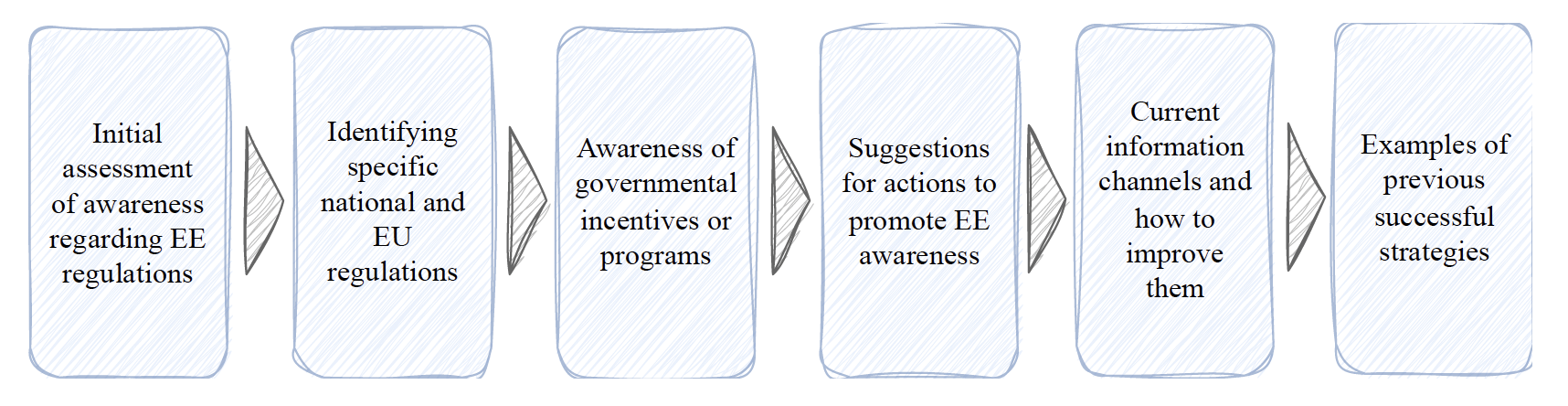
Figure A 1. Sequential approach to investigate the awareness and familiarity with EE regulations across practitioners.
A sequence of questions helped establish a comprehensive understanding of the level of awareness and the effectiveness of existing mechanisms, while also gathering insights on potential improvements. This structured approach, presented in Figure A1, enabled a thorough exploration of the topic, progressing from general awareness to specific knowledge and suggestions for enhancement.
The first question aimed to understand what the perceived awareness among industry professionals regarding existing energy efficiency regulations is. Approximately 43% of the respondents perceived the level of awareness as average, answering 3 on a scale from 1 (not aware) to 5 (fully aware). The majority of the respondents perceived the level of awareness among professionals rather high, answering 4 on the same scale. Respondents from Iceland and the Faroe Islands rated the level of awareness as very low, which may be attributed to the fact that they are not members of the EU. This initial question confirmed the overall perception that professionals are mostly aware of energy efficiency regulations, but that there are differences between the Nordic countries.
The second question was an open question and asked which specific regulations that embrace energy efficiency the respondents were aware of. The responses can be broken down into two parts: i) the most commonly mentioned directives and regulations, and ii) a general understanding of the geographical spread and specificity of the answers. The responses frequently mentioned a few key directives:
- The EED was mentioned by 13 out of 21 respondents, reflecting its broad impact and recognition across EU member states as a core component of energy efficiency legislation.
- Almost as commonly recognised as the EED, the EPBD (11 out of 21) focuses specifically on improving the energy performance of buildings within the EU.
- The eco-design directive appeared in several responses (5 out of 21), indicating awareness of regulations aimed at improving the energy efficiency of products through design requirements.
Various national laws and regulations were mentioned, demonstrating a mix of knowledge on both EU-wide directives and country-specific laws, such as the Swedish Building Regulations (BBR), the Finnish National Building Code and Danish Building Regulations. Some responses indicated a robust understanding of both EU and national regulations, while others showed a more limited or specialised awareness. A few responses explicitly stated a lack of familiarity with specific regulations or mentioned only very broad themes, such as building codes or national laws without specific references. The responses included references from various EU countries, including Sweden, Finland, Denmark, and non-specific EU references. This variety shows both common EU directives and varied national approaches to implementing energy efficiency. There was also an indication of awareness outside the EU, as shown by the mention from the Faroe Islands highlighting peripheral knowledge of EU directives despite non-membership.
The third question was also an open question and asked about governmental incentives or programmes promoting energy efficiency. Respondents listed a variety of energy efficiency programmes and incentives specific to their regions or countries. The programmes mentioned included both broad initiatives and very specific projects aimed at enhancing energy efficiency. The responses illustrated that awareness of incentives was closely tied to local or national contexts. There were mentions of initiatives for each Nordic country reflecting the geographical diversity of the respondents. The responses suggested a robust awareness of local programmes, which vary significantly in their nature and scope. These range from grants and financial incentives to strategic agreements and technology-specific initiatives (such as those for PV cells and energy storage). It appears that in each country, the respondents were primarily aware of the programmes directly impacting their sector or local area, highlighting the localised approach to promoting energy efficiency.
Question 1.4 asked about specific actions or initiatives that governments could take to promote energy efficiency awareness. A variety of actions was suggested, and the respondents were allowed to select up to five options. Financial incentives and energy labelling and certification were among the most frequently mentioned initiatives, indicating a strong belief in their effectiveness for enhancing public awareness and compliance with energy efficiency standards. Research and development funding and public awareness campaigns were highly regarded, suggesting that both direct financial support for technological innovation and efforts to educate the public were seen as crucial. Mandatory energy efficiency standards were noted as a tool, which implies a need for regulatory measures alongside educational and financial incentives. Educational programmes and international cooperation were seen as less important, being less frequently mentioned compared to other options.
The next question targeted methods for staying updated on energy efficiency regulations. Again, a variety of actions was suggested, and the respondents were allowed to select up to five options. The methods were quantified by how often each was mentioned across responses. The use of consulting firms and experts was the most common method, followed by attending conferences, webinars, and courses. Following government notifications and alerts and engagement with government agencies or organisations were also commonly used. Online platforms and forums, industry publications, and social media and online forums were used to varying extents.
In direct connection to the previous question, the follow-up question was about improving mechanisms to keep industry professionals updated on energy efficiency regulations and best practices.
The findings indicate that while professionals actively utilise a range of methods to stay informed, there is a strong call for more integrated, accessible, and interactive tools. The emphasis on online resource accessibility and the popularity of webinars and virtual events in the suggestions for improvement reflect a significant interest in digital solutions that streamline information gathering and learning processes. This shift towards digital platforms can also be linked to broader trends in workplace digitisation and remote learning, accelerated by recent global events, such as the COVID-19 pandemic. The responses also suggest that while current methods are valued, there is a perceived gap in how these methods integrate with each other and how easily accessible they are. Improvements in government-industry and educational collaborations indicate a desire for a more cohesive regulatory framework and educational outreach, which could help in bridging the gap between current practices and the ideal state as envisioned by the respondents. The findings underscore the importance of adaptive and forward-thinking strategies in the dissemination of regulatory and best practice information in the field of energy efficiency, with a clear leaning towards enhancing digital accessibility and collaborative efforts.
The final question asked for the personal experience of the respondents regarding previous successful strategies or programmes that enhanced the awareness of industry professionals on energy efficiency regulations. Various examples of successful strategies or programmes in the building or industrial sectors within different countries were mentioned. Among the strategies mentioned, national programmes and incentives played a significant role. Examples included the national procurement programmes for energy efficiency, such as those overseen by NUTEK in Sweden, which have historically set benchmarks for promoting energy efficiency technologies. Another notable programme was TETS in Finland, a voluntary energy saving agreement involving major real estate owners, which has been active since 1995. This programme has demonstrated the long-term commitment necessary for sustained improvements in energy practices.
Research and development initiatives also emerged as critical components of successful strategies. Initiation projects supported by the Research Council of Norway highlighted the role of innovation in promoting energy efficiency through the development of new building technologies. In Denmark, the Danish Energy Agency was active in developing and promoting state-of-the-art demonstration projects, although such initiatives have decreased over time. Public awareness campaigns are another effective strategy. The ‘Down a degree’ (‘Astetta alemmas’) campaign in Finland focused on lowering energy use and engaged the public directly to improve energy literacy. Similarly, the Orkusetur initiative in Iceland, originally funded through an EU project, was successful in promoting energy efficiency through various outreach efforts.
Economic incentives, even when indirectly related to energy efficiency, can also foster a broader energy-conscious mindset among practitioners. These incentives encourage a shift towards renewable energy sources, which indirectly supports energy efficiency measures by promoting a more holistic approach to energy usage.
From the examples provided, it is evident that successful strategies for promoting energy efficiency awareness combine policy support, economic incentives, technical innovation, and public engagement. A multifaceted approach appears essential, utilising sustained governmental programmes, innovative research projects, and targeted public campaigns to create an environment conducive to ongoing improvement and widespread understanding of energy efficiency practices. This holistic approach not only educates and engages practitioners and the public but also establishes a framework for continuous advancement in energy efficiency.
Addressing change
The main question was how the efforts of the building industry sector could be driven towards energy efficiency.

Figure A 2. Sequential approach to investigate how to address a change towards widespread implementation of energy efficiency measures.
A sequence of questions facilitated a comprehensive understanding of the motivating and hindering factors for implementing energy efficiency measures, as well as strategies to address change and overcome psychological barriers in companies.
The first question asked for the level of implementation of energy efficiency measures by respondents’ organisations. The responses were based on a Likert scale (1 to 5) where higher values indicated a greater degree of implementation. Among the 22 respondents, 17 reported a high level of implementation, answering 3 or higher. The survey showed a generally positive trend towards the adoption of energy efficiency measures among the surveyed entities, with a significant proportion reporting moderate to high implementation levels.
The second question aimed to understand the motivating factors for the implementation of energy efficiency measures. Several answer possibilities were proposed, and respondents could choose up to five answers. Return on investment and environmental responsibility were the most frequently cited reasons, each mentioned by 13 respondents (60%). Corporate social responsibility followed closely with 12 mentions (55%) and regulatory compliance (e.g., ESG-reporting) was also a significant factor for 11 respondents (50%). Less frequently mentioned, but still notable, were government incentives, customer expectations, health and well-being, and employee engagement, each cited in several responses.
The follow-up question targeted the barriers for implementation of energy efficiency measures. The key preventive factors that have hindered the implementation of energy efficiency measures within organisations were budget constraints, which represented the most frequently cited barrier (55%). This indicates that financial limitations significantly impact organisations’ ability to adopt energy-efficient practices. Additionally, uncertainty about the return on investment was a major concern (36%), as many respondents doubted the financial returns on such investments. Other significant factors included the prioritisation of other projects (50%), suggesting that energy efficiency often competes with other business initiatives for resources. A short-term focus within some organisations also prevented the adoption of practices that could provide long-term sustainability benefits. Lack of incentives and expertise were also considerable barriers, highlighting the need for external support and internal capabilities to implement these measures. Lastly, inadequate regulatory push and a lack of awareness about the potential of energy efficiency revealed opportunities for policy improvement and education to enhance adoption rates. The survey highlights the need for multifaceted strategies to address these barriers, including better financial incentives, regulatory support, and awareness campaigns to increase the adoption of energy efficiency measures.
The main challenges industry professionals encounter when wanting to shift to energy-efficient systems and practices in building and industry projects are part of the next question. The survey reveals that initial investment costs (68%) and long payback periods (60 %) are prominent concerns, cited by many respondents. Additionally, there is a significant focus on the return-on-investment uncertainty (40%), which reflects financial risk perceptions related to energy efficiency investments. Resistance to change or inertia within organisations also appeared as considerable challenges, illustrating the cultural and structural barriers to adopting new technologies or practices. Other notable challenges included concerns about potential disruptions to ongoing operations and a lack of incentives or rewards for adopting energy-efficient practices (55%). These factors collectively highlight the complex array of internal and external barriers that must be navigated to enhance the adoption of energy-efficient solutions in the industry.
The sixth question aimed to understand how efforts can be directed to making energy efficiency a core element of the sectors’ business models and operations. The survey revealed that stricter regulations at both the national (50%) and EU levels (32%) were frequently cited as necessary approaches. This indicates a belief that more robust legal frameworks could drive compliance and integration of energy-efficient practices. Higher leadership commitment (40%) was also seen as crucial, reflecting the need for top-down encouragement and prioritisation of energy efficiency. Regular energy audits and assessments were mentioned multiple times (27%), suggesting that ongoing monitoring and optimisation are key to embedding energy efficiency within operational practices. National financial support schemes were noted as significant enablers (73%), alongside a more proactive information policy towards end users (50%), which could help raise awareness and foster an environment supportive of energy efficiency measures. These insights indicate a comprehensive approach involving regulatory, financial, and educational strategies to promote energy efficiency more effectively within the industry.
The responses to the next question, on how decision factors (in management) that might hinder the implementation of measures should be addressed, illustrated diverse perspectives on overcoming management-related obstacles in implementing energy efficiency measures. The question was formulated in an open way so that respondents had to provide an answer themselves. Each respondent provided unique insights, reflecting the complexity of integrating such strategies into business practices. The responses ranged from advocating for the use of life-cycle cost (LCC) methods and emphasising energy efficiency as a regular part of management evaluation, to calling for stronger leadership commitment and increasing financial incentives. Several responses suggested enhancing stakeholder engagement and promoting demonstration projects to showcase the benefits of best available technologies (BAT). Others emphasised the need for comprehensive management strategies that include financial, market, social, and health considerations. A recurring theme suggested that improving information dissemination about the success of ongoing projects and the potential benefits of energy efficiency could help shift management perspectives. Some responses also highlighted the importance of aligning energy efficiency with organisational goals through regulatory frameworks or more focused management practices.
The responses to the question ‘What strategies or initiatives have been successful in encouraging industry professionals to adopt energy efficiency in their projects?’ highlighted a range of successful approaches that have promoted the integration of energy efficiency within industry settings. The respondents were asked to formulate their own answer. Several respondents emphasised the importance of financial incentives such as energy tax cuts, green bonds, and subsidy schemes that align the economic benefits with energy efficiency goals, making such projects financially attractive. The use of free audits and expert support teams were mentioned as critical mechanisms, providing the necessary expertise and guidance to help industries understand and implement energy efficiency measures effectively. Regulatory tools, such as national building codes, were praised for setting high standards that require energy efficiency as a compliance norm, pushing industries towards greener practices. Education and awareness campaigns had played a substantial role in shifting industry perspectives, making professionals more aware of the benefits and necessities of energy efficiency. Cross-sectorial collaboration and sharing of best practices, particularly through demonstration projects, such as those involving industrial heat pumps, were also mentioned as effective.
The last question of this section asked for the respondents’ experience on what the most effective communication and marketing strategies were for overcoming psychological resistance and encouraging energy-efficient practices among consumers, businesses, and industry stakeholders. Respondents highlighted the effectiveness of storytelling and personal narratives as powerful tools to connect emotionally with stakeholders, making the benefits of energy-efficient practices more tangible and relatable. Several responses underscored the importance of showing quantitative results and case studies that detail the financial payoffs and other benefits, suggesting that concrete data and examples can significantly reduce psychological barriers. Education and open dialogue about the advantages and potential drawbacks of energy efficiency were also considered critical. This approach helped in setting realistic expectations and addressing any misconceptions directly, which can enhance stakeholder engagement and acceptance. The use of benchmarking was mentioned as a method to create competitive and motivational incentives for adopting energy efficiency, by showing how businesses or consumers stack up against peers. Industry-specific approaches, such as targeted marketing by associations to their members, and hosting site visits and conferences were strategies that had been used to effectively spread the message within particular sectors. Communication during crisis situations, such as the recent energy crises, where the relevance of energy efficiency becomes even more pronounced due to high and fluctuating energy prices, was noted as particularly effective. This scenario naturally drives the conversation about energy consumption and can be leveraged to promote energy-efficient solutions. These strategies collectively emphasise the need for a multifaceted approach that combines emotional engagement, factual education, competitive benchmarking, and timely communication to effectively address psychological barriers and motivate diverse stakeholders towards energy-efficient practices.
Incentive schemes
The main question was how government incentive schemes can become more effective across the target groups of consumers and industry.

Figure A 3. Sequential approach to investigate how to improve incentive schemes towards widespread implementation of energy efficiency measures.
A sequence of questions helped establish a comprehensive understanding of how to improve incentive schemes to reach a more widespread implementation of energy efficiency measures.
The first question, ‘In your experience, how well are government incentive programmes working to encourage energy efficiency in buildings and industries?’, received a range of responses on a scale from 1 to 5, where 1 represented ‘least effective’ and 5 represented ‘most effective’. The responses showed a general leaning towards the effectiveness of government incentive programmes, with the majority rating them as 4 (13 out of 22), implying good effectiveness. The average rating (3.4), slightly above neutral, further supported this view, indicating overall positive feedback about the incentive programmes’ impact on promoting energy efficiency in buildings and industries. This analysis provides a clear indication that while there is some room for improvement, the incentive programmes were generally viewed as beneficial by the majority of respondents.
The next question, ‘Does the regulatory framework in your country support and enable investments in energy efficiency?’, received varied responses on a scale from 1 to 5, where 1 signified ‘strongly disagree’ and 5 signified ‘strongly agree’. The responses to this question revealed diverse opinions across Nordic countries. Many respondents agreed or remained neutral, but a notable number expressed disagreement, indicating a critical perspective. While opinions generally leaned towards a neutral or slightly positive view, Iceland clearly showed dissatisfaction, highlighting varied experiences and needs related to regulatory support in these countries. This mixed feedback suggests the need for a possible re-evaluation or adjustment in the regulatory frameworks to better support and encourage investments in energy efficiency, reflecting the diverse experiences and perceptions of the respondents.
The third question explored the support provided by authorities at various levels (national, regional/provincial, and local/municipal) for the development and implementation of energy efficiency projects. The national level showed slightly higher (mean 2.8) support than regional (mean 2.0) and local levels (mean 2.2 each), suggesting more positivity in perceptions of national support for energy efficiency projects. At the regional level, the support was perceived as the least favourable, with the lowest mean score, indicating strong disagreement about adequate support. The local level scores were similar to the national but still indicated an overall perception of insufficient support, closely mirroring the regional level. The analysis indicates that respondents generally perceived a lack of sufficient support across all levels of government, with the regional level viewed as the least supportive for energy efficiency projects. This suggests potential areas for improvement in policy and support frameworks at regional and local levels to better align with national efforts or perceptions.
The fourth question focused on legislative, and policy supports for energy efficiency measures.
The analysis of responses regarding the types of legislative and policy support for energy efficiency investments showed a comprehensive approach across different countries. Government programmes and policies were the most frequently cited form of support, appearing in 14 responses, which highlights their central role in national energy strategies. Close behind were energy efficiency labelling and certification, and standards on energy efficiency, mentioned in 13 and 12 responses, respectively. These measures are crucial for promoting and standardising energy efficiency practices. Framework legislation, such as laws on energy efficiency, was also prominent, featured in 10 responses, indicating that foundational legal frameworks are commonly in place. Public procurement policies, which encourage energy-efficient choices in government procurement, appeared in nine responses, underscoring their importance in driving market demand for efficient products and services. Voluntary agreements were noted in six responses, suggesting that some countries rely on collaborations with industry stakeholders to exceed baseline regulatory requirements. The survey revealed a mix of mandatory regulations and voluntary initiatives, pointing to a multifaceted approach to fostering energy efficiency. The varied responses underscore the importance of a layered policy framework that includes both broad legislation and specific programmes tailored to local or regional needs.
The fifth question targeted barriers and limitations that government incentive schemes face when addressing different segments of consumers and industry professionals. The analysis of responses highlights several barriers and limitations that government incentive schemes for energy efficiency face, each varying in importance and impact. Bureaucratic hurdles emerged as the most critical barrier, mentioned by the highest number of respondents, which indicates a prevalent issue with administrative complexities that significantly impede the effectiveness of these schemes. Competing priorities, which include the need to balance energy efficiency with other pressing economic, political, or social goals, also represented a major challenge, as they were nearly as frequently cited as bureaucratic hurdles. Long payback periods stood out as another significant economic barrier, suggesting that the slow return on investment discourages participation in energy efficiency projects. This was closely followed by diverse market needs, underscoring the inadequacy of one-size-fits-all approaches and highlighting the necessity for schemes that are adaptable to varied consumer requirements. Complexity of the application process and lack of awareness were also substantial barriers, indicating that both the procedural difficulties in accessing schemes and insufficient knowledge about them hinder effective participation. Policy and regulatory uncertainty, although mentioned less frequently, still posed a considerable challenge by creating an unstable investment climate. Limited access to information, although not as prevalent as other barriers, still critically affected the ability of consumers and professionals to engage fully with energy efficiency initiatives. Minor issues, such as poorly constructed incentive schemes and inadequate budget allocation, while mentioned infrequently, pointed to specific areas that could be addressed to enhance the effectiveness of incentive programmes.
In the sixth question, the respondents were asked to provide information regarding innovative incentive schemes that were successful in promoting energy efficiency in the building and industry sectors. The respondents provided specific examples reflecting both success stories and challenges. One example of a specific method mentioned was the total concept method
Total Concept Method, “Major reduction of energy use in non-residential Buildings.” Accessed: Apr. 20, 2024. [Online]. Available: https://totalconcept.se/
European Commision, “Enterprise Europe Network (EEN).” Accessed: Apr. 20, 2024. [Online]. Available: https://een.ec.europa.eu/
Swedish Energy Agency, “Programmet för energieffektivisering. Erfarenheter och resultat efter fem år med PFE [The program for energy efficiency. Experiences and results after five years with the PFE],” 2011. [Online]. Available: https://energimyndigheten.a-w2m.se/System/TemplateView.aspx?p=Arkitektkopia&id=b1b49f2d3ad6467e83dad1c60fcaced6&q=pfe&lstqty=1
Danish Energy Agency, “Afrapportering af energispareordningen [Reporting on the Energy Saving Scheme],” 2022. [Online]. Available: https://ens.dk/forsyning-og-forbrug/energiselskabernes-energispareindsats
The next question aimed to understand which specific improvements or changes could be made to government incentive schemes to make them more effective in driving energy efficiency. From the 22 respondents, 15 proposed increased funding and budget certainty, followed by tax incentives and deductions (12 out of 22), and tailored incentives for different sectors (11 out of 22). To a lesser extent, flexible financing options (8/22), simplified application processes (6/22), public awareness campaigns (6/22) and performance-based incentives (6/22) were chosen.
For the following question on perceived main barriers or challenges that prevent the respondents’ organisation from taking advantage of relevant incentive schemes, the respondents were allowed to choose up to five options. The main barriers were competing priorities (8/22), complex application processes (7/22) and uncertainty about returns (5/22). Perceived disruption to operation (3/22), lack of technical expertise (2/22) or inadequate information on benefits (2/22) were voted for to a lower extent.
The next question aimed at understanding how policymakers and stakeholders can collaborate more effectively to design and implement incentive schemes that encourage energy efficiency practices across the building and industry sector. The respondents were allowed to choose up to three options. The two main drivers were engaging stakeholders early and often (16/22) and demonstrating success stories (15/22). Other measures, such as transparent communication, providing education and training, and public-private partnerships each received 7 votes.
Another question investigated which institution at national level is responsible for developing and implementing energy efficiency policies and how effective these institutions are. Most respondents (10/22) rated the effectiveness of their national institutions as neutral (rating 3 on the Likert scale). However, even though not representative for the whole country, it should be noted that the Finnish respondents perceived their national institutions as most effective among the respondents, scoring the highest on average.
The next question asked for the personal opinion of the respondents on what the main barriers to increasing investment and financing flows to energy efficiency projects in their respective countries were. Respondents were allowed to choose up to five options among 10 different options. By far the most evident barriers were lack of specific policies, programmes, legislation, by-laws, norms and standards (14/22), too low energy prices (13/22), and low awareness about the multiple benefits of energy efficiency projects (12/22).
The responses were more varied for the question on the main business benefits to the respondents’ organisation from implemented energy efficiency measures. Excluding the respondents working in consultancy, a total of 19 respondents were included in the analysis of this question. Among the 19 respondents, 15 chose demonstration of corporate social responsibility as one of the main business benefits, followed by complying with legislations (11/19). The other options were selected almost equally with 9/19 for risk management – hedging against volatile energy costs and improving production efficiency and quality, 8/19 for general cost control and ensure security of power supply, and 7/19 for comply with requests from shareholders, customers and/or suppliers.
Focusing on the barriers that companies face when considering investments in energy efficiency, 10 out of 22 marked too low energy costs and thus low economic incentive as the main barrier, followed by a lack of information on energy efficiency opportunities and low priority as energy efficiency is not part of the core business of the company (both 7/22). A high investment risk was barely considered a barrier for investing in energy efficiency.
The responses to addressing behavioural and psychological barriers in energy efficiency emphasised the importance of a multipronged approach. Key strategies included continuous public awareness through newsletters, embedding energy efficiency in business strategies, and leveraging regulations and voluntary agreements. Effective communication, demonstrated by successful case studies and campaigns, such as the ‘down a degree’ initiative in Finland, also played a crucial role. These methods collectively highlight the necessity of integrating educational, regulatory, and strategic efforts to shift perceptions and encourage sustainable practices in energy efficiency.