1. Introduction
1.1 Background
In 2023, the worldwide total final energy consumption reached approximately 445 exajoules (EJ). The industrial sector claimed the largest share, accounting for 39% of the usage, followed by buildings at 28% and transport at 27%. Over the years, the industrial energy consumption has consistently increased, with an annual growth rate of about 1.5% from 2010 to 2023. Industrial energy demand grew by 2% in 2023 while emissions saw an increase of under 1%. In 2023, the energy demand in buildings was over 120 EJ, with an average annual increase of 0.9% from 2010 to 2023
International Energy Agency (IEA), “Energy efficiency 2024,” OECD Publishing, Paris, France, 2024. [Online]. Available: https://www.iea.org/reports/energy-efficiency-2024#overview
Energy efficiency means the ratio of output of performance, service, goods, or energy to energy input
The European Parliament and The Council of The European Union, Directive (EU) 2023/1791 of the European Parliament and of the Council of 13 September 2023 on energy efficiency and amending Regulation (EU) 2023/955 (recast). Accessed: Nov. 21, 2024. [Online]. Available: https://eur-lex.europa.eu/legal-content/EN/TXT/PDF/?uri=CELEX:32023L1791
L. Pérez-Lombard, J. Ortiz, and D. Velázquez, “Revisiting energy efficiency fundamentals,” Energy Efficiency, vol. 6, no. 2, pp. 239–254, May 2013, doi: 10.1007/s12053-012-9180-8.
Energy efficiency is a key priority in the European Union (EU) as it plays a crucial role in lowering the overall energy consumption and realizing the climate goals. It contributes to the EU’s aim of reducing GHG emissions by at least 55%, compared to the 1990 levels, by 2030, and thus ensuring a more sustainable and secure energy future.
The principle of ‘Energy Efficiency First’ mirrors EU objectives and harmonizes with the union’s aims for sustainability, climate neutrality, and fostering green growth. It prioritizes producing only necessary energy, avoiding investments in stranded assets, and managing energy demand cost-effectively while considering supply security and market integration
European Commission, “Energy Efficiency First principle.” Accessed: Nov. 21, 2024. [Online]. Available: https://energy.ec.europa.eu/topics/energy-efficiency/energy-efficiency-targets-directive-and-rules/energy-efficiency-first-principle_en
European Commission, “EU strategy on energy system integration.” Accessed: Nov. 21, 2024. [Online]. Available: https://energy.ec.europa.eu/topics/energy-systems-integration/eu-strategy-energy-system-integration_en
The Nordic region has a relatively high gross final energy consumption per capita, averaging 3.7 tonne of oil equivalent (toe) in 2019 compared to the EU’s 2.3 toe. This reflects the region’s cold climate, low population density, and the prevalence of energy-intensive industries and highlights the significance of implementing energy efficiency measures to address and manage energy
Renewable Energy in the Nordics 2021. Nordic Energy Research, 2021. doi: 10.6027/NER2021-03.
The International Energy Agency (IEA) database
International Energy Agency (IEA), “Energy system of Europe.” Accessed: Mar. 19, 2024. [Online]. Available: https://www.iea.org/regions/europe
- Final energy consumption: Industry dominates energy consumption in most Nordic countries, with Iceland (43%) and Finland (41%) ranking highest. Denmark (29%) and Sweden (23%) have the highest residential consumption. Meanwhile, commercial services make up 12–16% of the consumption in most countries, and transport is most significant in Denmark (31%) and Norway (24%).
- Renewable energy: Iceland has the highest share of renewables in final energy consumption (82%), followed by Norway (61%), Sweden (58%), Finland (50%), and Denmark (40%).
- Energy mix: Denmark’s energy mix is dominated by oil (37%) and biofuels (35%). Finland relies heavily on biofuels (31%) and nuclear energy (28%). In Iceland, wind and solar contribute to 70% of its energy. Norway predominantly depends on hydropower (43%) while Sweden relies on a combination of biofuels (29%) and nuclear energy (27%).
- Residential energy use: Denmark relies mainly on heat (43%) and electricity (22%), whereas Finland combines electricity (39%), heat (32%), and biofuels (24%). Iceland uses mostly heat (81%) while Norway and Sweden have higher electricity shares (81% and 49%, respectively).
- Services and industrial energy use: Electricity is the main energy source in services across Nordic countries, ranging from 44% to 77%, and heat plays a larger role only in Iceland (61%). In industry, electricity is predominant in the Nordic region, reaching 98% in Iceland, while biofuels are significant in Sweden (43%) and Finland (38%).
- Electricity generation: Denmark generates 58% of its electricity from wind, Iceland relies on hydropower (70%) and geothermal energy (30%), Norway’s electricity is primarily from hydropower (89%), and Sweden uses a mix of hydropower (40%) and nuclear (29%).
However, the Nordic countries are striving to reduce their primary energy intensity through targeted energy efficiency measures, as tracked by the IEA Energy Efficiency Progress Tracker
International Energy Agency (IEA), “Energy Efficiency Progress Tracker.” [Online]. Available: https://www.iea.org/data-and-statistics/data-tools/energy-efficiency-progress-tracker#overview
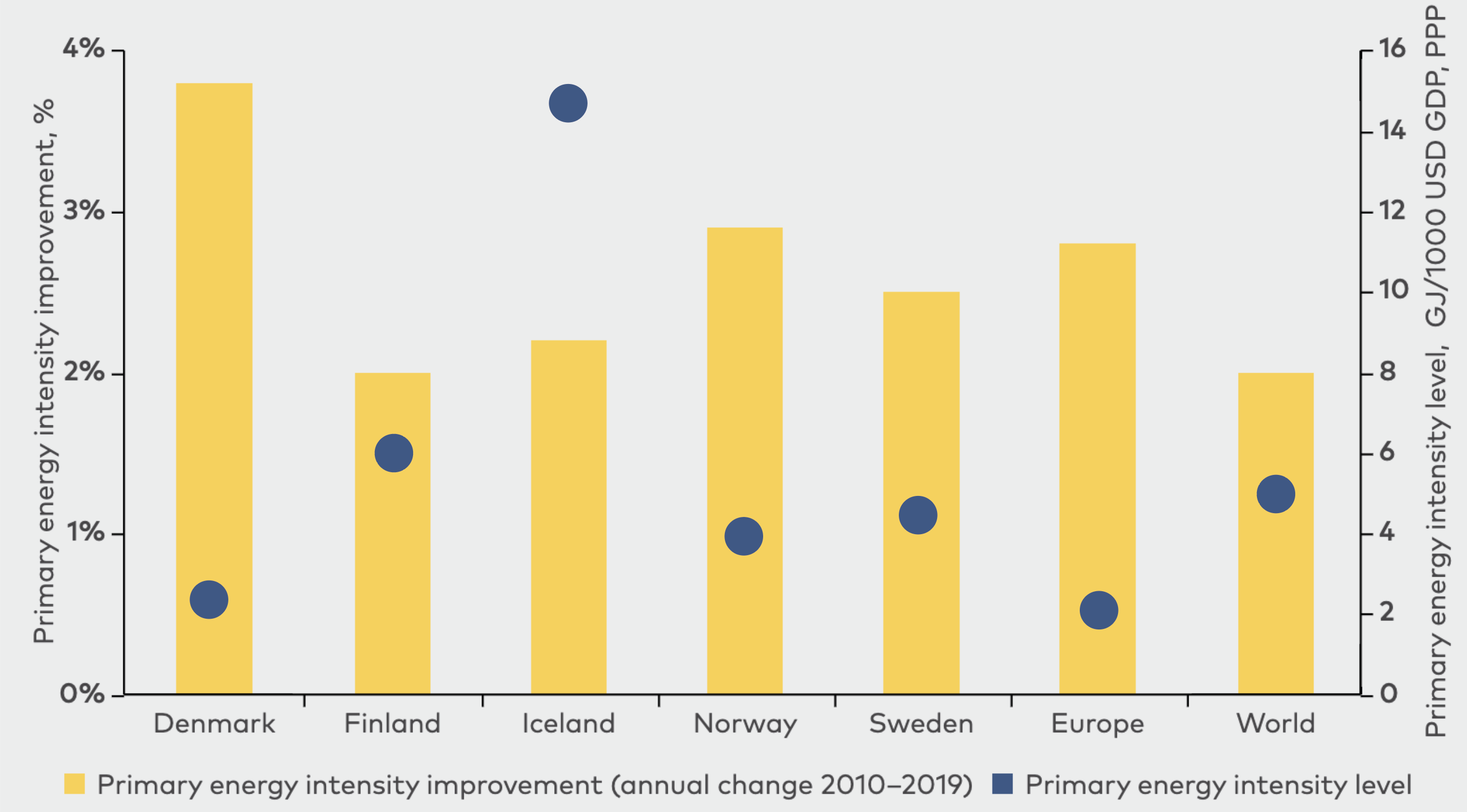
Figure 1: Primary energy intensity and annual improvements in energy intensity from 2010 to 2019, across the Nordic countries, Europe and the world.
1.2 Aim of the project
This report summarizes the findings of a project initiated by the Nordic Committee of Senior Officials for Energy Policy (EK-E) to foster knowledge sharing and collaboration among the Nordic countries to meet their energy efficiency goals. In response to the EU’s comprehensive directives and detailed energy efficiency requirements, the project maps and analyses the experiences of Norway, Sweden, Finland, Denmark, Iceland, and the Faroe Islands.
The key tasks of the project include mapping the past and current activities related to energy efficiency in the Nordics, evaluating the best practices and exemplary policies or programmes, assessing the transferability of successful initiatives, identifying the barriers such as behavioural and psychological challenges, and analysing household energy behaviour during the 2021–2023 energy crisis. Insights were gathered through a comprehensive approach, which included reviewing national and international reports and databases, gathering input from Nordic experts on energy efficiency, and conducting surveys.