4. New insights
The following section of the conference focused on questions of belonging, participation, the integration paradox, and policy effects. Integration appears as a layered and at times a contradictory process across the Nordic countries. Progress in one dimension does not always translate into progress in another. Research from Sweden shows that children of immigrants are structurally well-integrated in school and often highly motivated, yet cultural differences and limited social interaction with peers with native born parents persist. Findings from Norway highlight the integration paradox: the more established and successful immigrant families become, the more discrimination and weaker societal acceptance their children report. Long‑term evidence from Finland demonstrates that well‑designed integration policies for adults can positively influence their children’s educational and labour‑market outcomes many years later. Together, the studies show that integration advances unevenly across structural, cultural, social, and psychological dimensions – and that both policy design and societal attitudes shape the next generation’s opportunities.
Research presentation: Integration among youth in a multidimensional perspective
Knowledge base for the talk
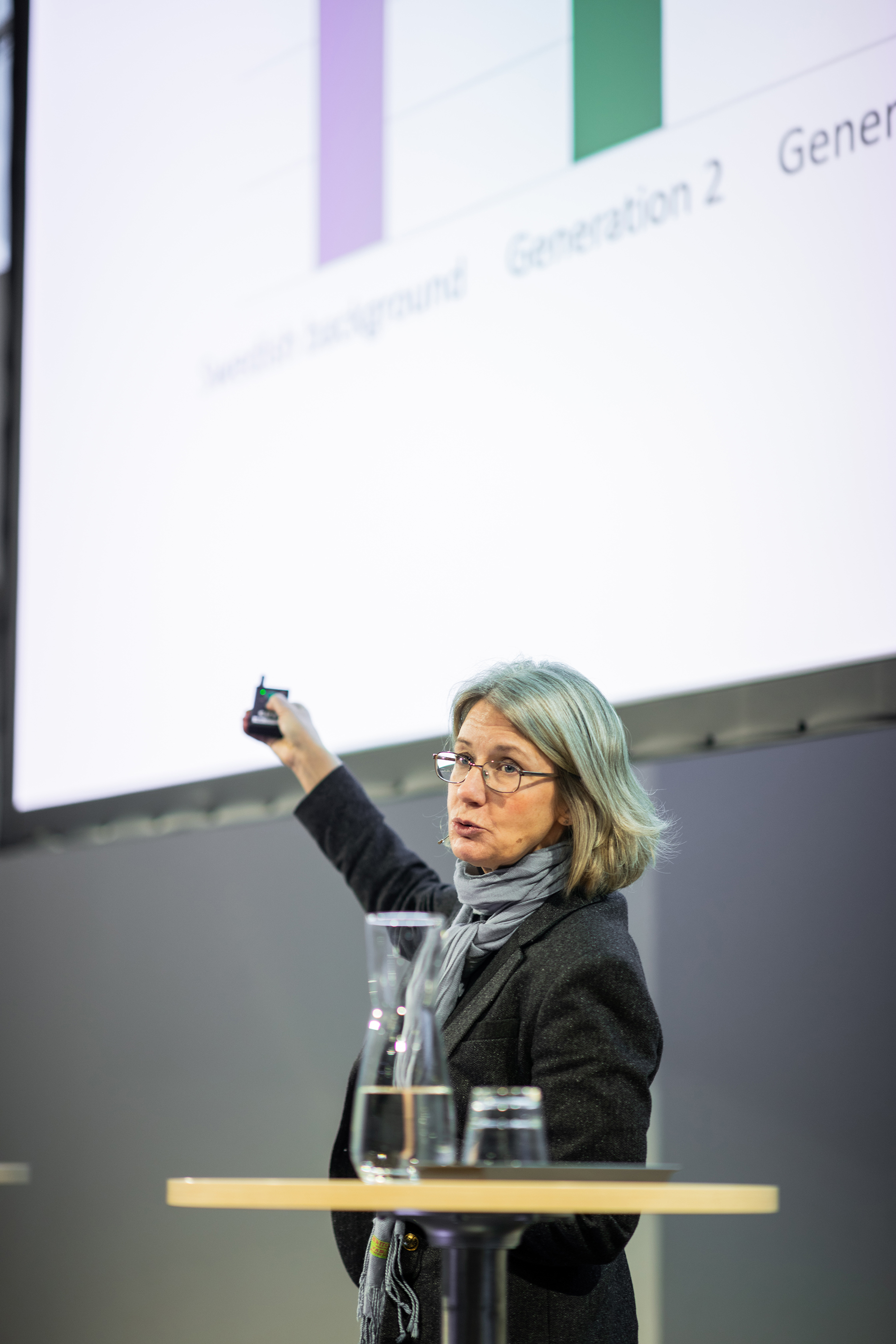
Professor Carina Mood shares her findings based on 16 years of research on integration and inequality.
The main research papers and reports informing her presentation are available at:
Professor Carina Mood from the University of Stockholm defines integration as multidimensional, distinguishing four dimensions:
Structural integration , which relates to education and work.Cultural integration , concerning identity and values.Social integration , involving relationships between groups and individuals.Psychological adaptation , which pertains to potentially negative psychological effects of migrating or being in a minority.
Regarding structural integration, Carina Mood states that, despite widespread concerns in Sweden, there is no evidence that students with foreign backgrounds attend lower-quality schools. Students report receiving the support they need, they are not disscriminated against in tracking or grading, and they have higher school engagement than students with native-born parents.
At the same time, students from foreign backgrounds have lower grades. The descendants of immigrants tend to achieve higher grades than the children who have migrated, but they still do not reach the level of students with a Swedish background. Carina Mood describes the overall situation as bipolar. Students with parents who have migrated face disadvantages at lower levels of education, but they are not disadvantaged in attaining higher educational qualifications, despite starting from a weaker socioeconomic position.
At the same time, students from foreign backgrounds have lower grades. The descendants of immigrants tend to achieve higher grades than the children who have migrated, but they still do not reach the level of students with a Swedish background. Carina Mood describes the overall situation as bipolar. Students with parents who have migrated face disadvantages at lower levels of education, but they are not disadvantaged in attaining higher educational qualifications, despite starting from a weaker socioeconomic position.
They have higher aspirations and more positive attitudes towards education. However, they often have fewer parental resources and lower grades. Students with migrant parents are more likely to start tertiary education and face no disadvantage at university.
Regarding cultural integration, research has identified the most significant differences compared to the Swedish native population.
– Students with migrant parents are most commonly Muslim, accounting for 50% of such students, while one third are Christian. Among students of native-born parents, more than half are Christian, and more than 40% report they have no religion.
– Students with migrant parents are most commonly Muslim, accounting for 50% of such students, while one third are Christian. Among students of native-born parents, more than half are Christian, and more than 40% report they have no religion.
As many as 75% of students with migrant parents say religion is important, while only 14% of Swedish-background students say that religion matters to them. Religiosity decreases somewhat over time in both groups, but it does not converge between the student groups. Individuals with migrant parents also have more conservative values on non-married cohabitation, homosexuality, divorce, and abortion.
– All groups become less conservative over time, but the gap between Swedish and those with immigrant backgrounds remains constant. When it comes to attitudes towards gender roles, there is a slightly declining gap over time.
– All groups become less conservative over time, but the gap between Swedish and those with immigrant backgrounds remains constant. When it comes to attitudes towards gender roles, there is a slightly declining gap over time.
Regarding ethnic identity, researchers have found that it makes a difference where the parents of the children were born. At 16 years of age, almost half of those born in Sweden to foreign-born parents define themselves as having a dual identity, both Swedish and tied to their parents’ home country.
As for the psychological adaptation, individuals with migrant parents have the same mental well-being as others and higher self-related health, stronger beliefs in the future, greater life satisfaction, and greater self-confidence than youth with Swedish-born parents.
– The overall picture indicates selective integration. According to our survey, social integration is not as strong as structural integration. Young people from different backgrounds often move within separate social circles, shaped by differing socioeconomic conditions, values, and levels of everyday interaction.
Research presentation: Integrated but not accepted – when fitting in does not make you feel at home
Knowledge base for the talk
Researcher Kristin Dalen has extensive experience of research on living conditions, political preferences, and policy development. She has worked as a researcher for the past 20 years.
The main report that Dalen draws on is available at:
According to classical integration theory, immigrants and their children will experience less discrimination as they become more integrated in society. However, this is not always the case. Studies have shown that children of immigrants are at least as exposed to discrimination, and that several indicators of integration (such as length of residence, generation, socioeconomic status) are associated with more, not less, experienced discrimination and lower belonging and acceptance.
– This is sometimes called the integration paradox. You have been living in a country for a long time, and have achieved good results both in education and on the labour market. And yet you don’t feel you belong, and the feelings of discrimination may be higher compared to migrants who have arrived more recently.
Research directorKristin Dalen presented results from a survey-based study on how immigrants in Norway perceived their own and their children’s Norwegianness, and how they think the rest of society sees them.
More than half of all immigrants consider that they are completely or somewhat Norwegian, regardless of their origin. Migrants from Western countries generally feel that others perceive them as Norwegians, whereas fewer immigrants from Eastern Europe and elsewhere feel that they are perceived as Norwegians.
Regarding immigrants from non-Western countries, there is a notable gap between how Norwegian they feel and how they perceive society views their integration. Of immigrants from non-Western countries, 60% feel Norwegian themselves, and 77% see their children as Norwegian, while only 30% believe that society views them as Norwegian, and 60% think society sees their children as Norwegian.
Research director
More than half of all immigrants consider that they are completely or somewhat Norwegian, regardless of their origin. Migrants from Western countries generally feel that others perceive them as Norwegians, whereas fewer immigrants from Eastern Europe and elsewhere feel that they are perceived as Norwegians.
Regarding immigrants from non-Western countries, there is a notable gap between how Norwegian they feel and how they perceive society views their integration. Of immigrants from non-Western countries, 60% feel Norwegian themselves, and 77% see their children as Norwegian, while only 30% believe that society views them as Norwegian, and 60% think society sees their children as Norwegian.
But the most striking result comes from children of non-Western immigrants: 73% of these children see themselves as Norwegian, but only 43% believe they are perceived as Norwegians by society.

The gap between how people feel and how they think others feel about them was also reflected in how integrated and accepted the second-generation immigrants feel. This gap becomes even wider among children of immigrants, in alignment with the integration paradox.
– They grew up in Norway and went through the Norwegian educational system. Many of them pursued higher education. Yet, there remains a gap between how they feel that they have integrated into society and how they see others accepting them for who they are, Kristin Dalen says.
– They grew up in Norway and went through the Norwegian educational system. Many of them pursued higher education. Yet, there remains a gap between how they feel that they have integrated into society and how they see others accepting them for who they are, Kristin Dalen says.
Norwegian-born children of immigrants report the largest gap between feeling integrated and being accepted. They experience higher levels of discrimination and negative everyday encounters, particularly in public social settings, and often in the form of subtle status-reducing behaviour.
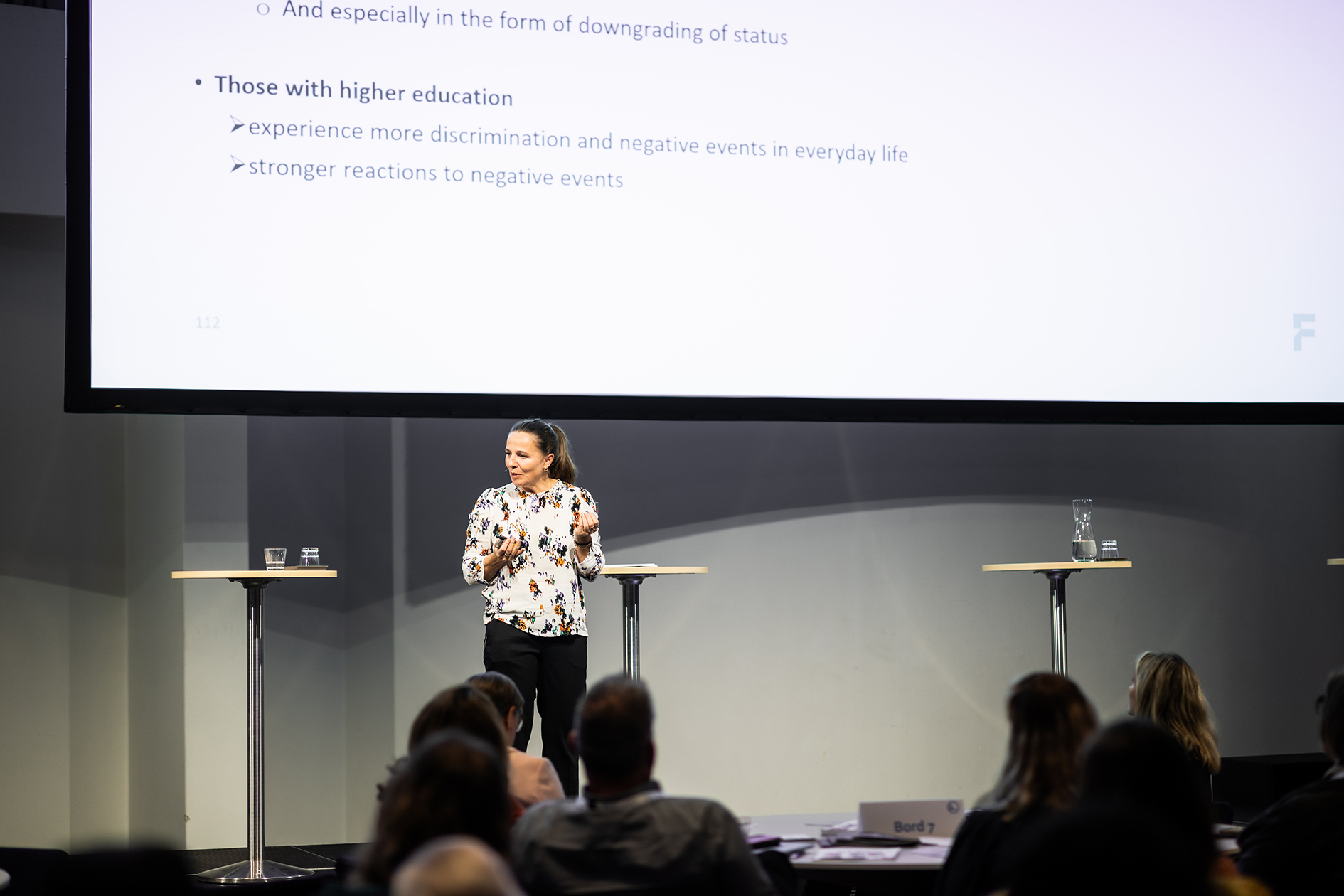
Those with higher education report more discrimination and negative experiences – and they tend to react more strongly to them.
Research presentation: Effects of an integration policy on the next generation
Knowledge base for the talk
Research Director Hanna Pesola’s research focuses on labour markets and immigration-related issues. Her ongoing research analyses issues such as the educational choices of immigrants’ children and labour-market outcomes of immigrants. Hanna also works in Statistics Finland Research Services on developing research data. She gained her PhD in economics from Aalto University in 2011.
The main research paper that Hanna Pesola builds her speech on is available at:
Interventions aimed at adult immigrants can influence their children, but the benefits of integration policy reforms may only become apparent after an extended period. Research director Hanna Pesola from the VATT Institute for Economic Research in Finland emphasises the importance of considering this when evaluating the costs and advantages of potential reforms.
Hanna Pesola highlighted the fact that children of immigrants often struggle in school. There are significant gaps between children of immigrants and children of natives in completing secondary education.
– We know that immigration programmes targeted at adult immigrants are quite positive in how they impact labour-market outcomes. We also know that school-based interventions for immigrant children can have a substantial impact on both educational outcomes and on entry into the labour market. Also, parents’ earnings and success in the labour market can influence their children, and job loss can be detrimental to their children’s education.
Hanna Pesola highlighted the fact that children of immigrants often struggle in school. There are significant gaps between children of immigrants and children of natives in completing secondary education.
– We know that immigration programmes targeted at adult immigrants are quite positive in how they impact labour-market outcomes. We also know that school-based interventions for immigrant children can have a substantial impact on both educational outcomes and on entry into the labour market. Also, parents’ earnings and success in the labour market can influence their children, and job loss can be detrimental to their children’s education.
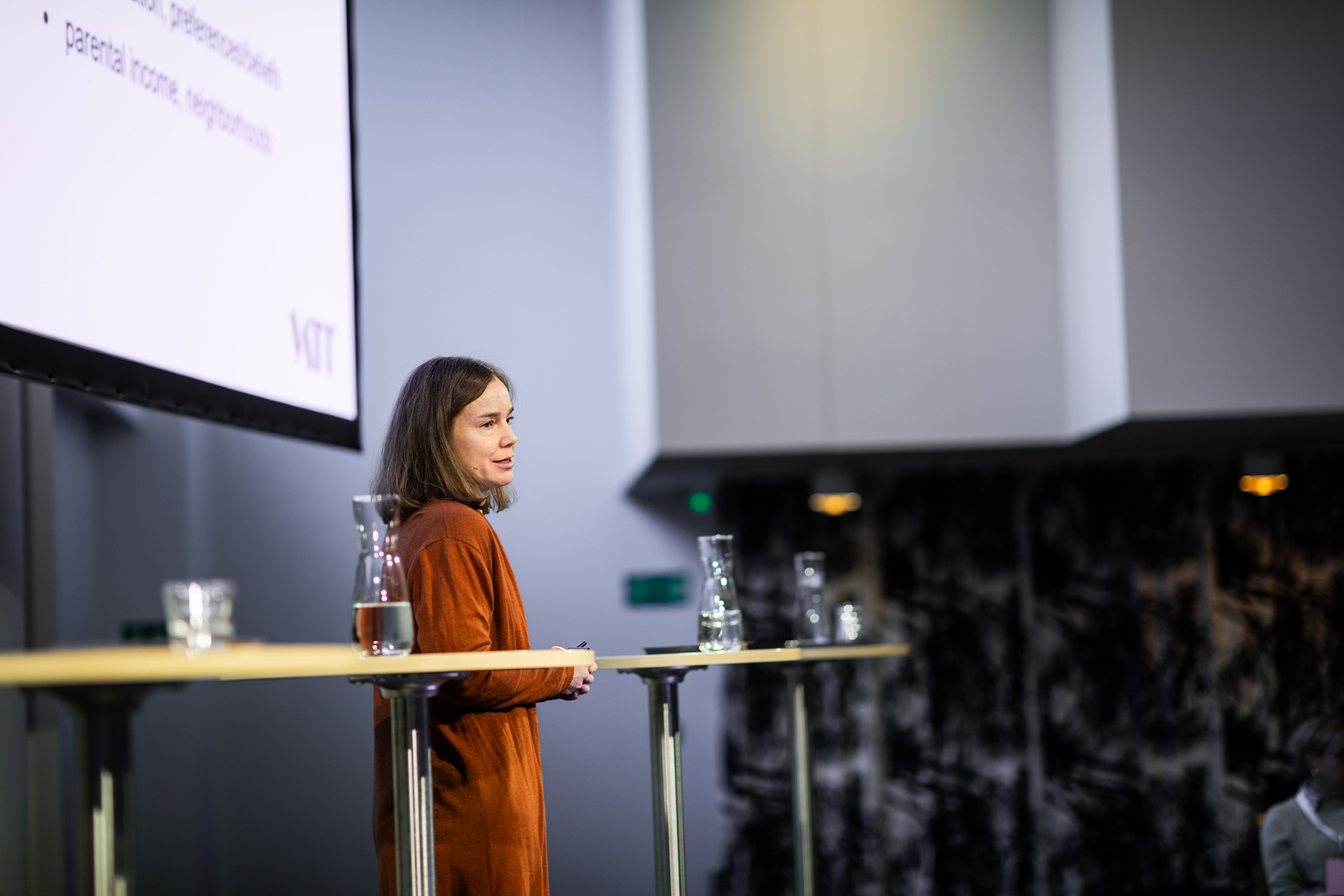


In her presentation, Hanna Pesola highlighted the effects of the 1999 Act on the integration of immigrants and reception of asylum seekers in Finland, which introduced individualised training, subsidised work, and other active labour-market programmes.
– The integration plan was mandatory for recently arrived immigrants who were unemployed or collected welfare benefits on a non-temporary basis.
– The integration plan was mandatory for recently arrived immigrants who were unemployed or collected welfare benefits on a non-temporary basis.
Hanna Pesola explains that by focusing on a policy implemented many years ago, she and her research colleagues were able to study the children of individuals who constituted the policy’s original target group in the late 1990s.
Hanna Pesola presented new statistics on this, showing that the 9th-grade grade point average (GPA) increased among children of immigrants affected by the policy.
– The same children also enrolled in and completed degrees with higher average earnings. Their actual annual earnings at age 31 were higher compared to the children of immigrants who arrived before the mandatory integration plan.
Examining the heterogeneity of the study, Hanna Pesola points out that the majority of the GPA effect is driven primarily by girls, indicating that the intervention received by their parents had a comparatively greater effect on them. There were no substantial differences by country of origin.
Examining the heterogeneity of the study, Hanna Pesola points out that the majority of the GPA effect is driven primarily by girls, indicating that the intervention received by their parents had a comparatively greater effect on them. There were no substantial differences by country of origin.
The main takeaway is that an integration reform that targeted adult immigrants also had a positive effect on their children. This is positive and should be considered in future policy development. We cannot say much about the mechanisms. Still, based on our findings, it seems reasonable that parents' exposure to host-country labour markets may support children in making more informed educational choices.
Panel discussion: How identity, policy, and perceived acceptance intersect
The first panel discussion of the conference began by exploring the dual identity many young people with immigrant parents report, as well as the gap between how they see themselves and how they believe others perceive them.
– I think it is quite clear that visibility, whether it is the religious markers you wear or the colour of your skin, actually drives the discrepancy between how you see yourself and how society perceives you, Kristin Dalen says, reflecting on the research results she presented earlier in the conference.
– I think it is quite clear that visibility, whether it is the religious markers you wear or the colour of your skin, actually drives the discrepancy between how you see yourself and how society perceives you, Kristin Dalen says, reflecting on the research results she presented earlier in the conference.
When evaluating integration policies and their outcomes, the researchers agreed that it is important to analyse outcomes for boys and girls separately, as they may differ. Hanna Pesola, who studied the impact of integration reforms in Finland in the late 1990s and their effects on immigrant children, says the Finnish study mainly found positive results for girls in terms of grade point average. At the same time, a similar study in Denmark also found positive results for boys in terms of reduced crime rates. New research in this field is ongoing in Finland, Denmark, and Sweden.
– There will be some follow-up studies on many interventions that have been seen as positive for adults and are currently being examined in the context of their children. There is ongoing work on this as well as previous results, especially from Denmark. In many of these cases, researchers have found that the intergenerational effects are just as significant, or even larger, for the children, Hanna Pesola says.
Reflecting on the importance of fostering a sense of belonging and acceptance, the researchers expressed concern that the Nordics have not fully recognised the value of this, which could lead to a brain drain if young people choose to leave.
Let me make a plea for data; that is the only way to know these things. We need evidence-based policy. We have wonderful register data, but in addition to that, we need to collect subjective data on how people feel continuously, though it is very costly, Carina Mood said.


– We can’t be misled into thinking that integration is successful if we only achieve the hard measures; integration is multidimensional and also subjective. Achieving integration goals is always a two-way process, Kristin Dalen added.
The researchers also reflected on the current direction of Nordic integration. Regarding immigration policies, the conditions under which people can stay in the country, Hanna Pesola noted that the Nordics have many common goals. For instance, language skills are seen as necessary.
The researchers also reflected on the current direction of Nordic integration. Regarding immigration policies, the conditions under which people can stay in the country, Hanna Pesola noted that the Nordics have many common goals. For instance, language skills are seen as necessary.
– We need to consider how to better include people in society. If parents feel they don’t belong, it will have consequences for their children. Substantial research shows that making it more difficult to obtain permanent residence or citizenship is generally not beneficial for integration. Therefore, restrictive immigration policies may not incentivise the newly arrived but rather have the opposite effect: they will feel that they will never be able to meet these demands, Hanna Pesola says.
The panel also noted the exchange of good practices and knowledge among the Nordics. The benefit of having similar institutions is that we can learn from each other, and there is strong Nordic collaboration between researchers.
– However, I think we could be better at communicating the research that we do, both to policy makers and to the broad audience, Kristin Dalen concluded.