Thematic Session 1
Balancing solar energy and land use: Policy and practice in the Nordic region
Case presentations
1. Policy development for regulating solar power expansion in Finland
Sanna Andersson, Senior Ministerial Adviser, Ministry of the Environment, Finland
The growth of renewable energy production in Finland has been rapid in recent years, and solar power has stood out with particularly high growth figures. The growth is expected to remain strong since large-scale industrial solar plants start going online. Solar power complements wind power well, as it peaks in summer while wind peaks in winter.
In Finland, solar power projects with a capacity exceeding one megawatt are often classified as industrial-scale installations. Despite its northern location, Finland's solar energy potential is comparable to that of Central Europe. New solutions are also combining energy production with other land uses – for example, agriculture or supporting biodiversity.
Solar energy construction is generally subject to the same regulations as other types of construction. The required land use planning and permits for a project depend on its size, impacts, location, the current land use planning status of the area, and the need to coordinate land use. A new chapter concerning specific provisions for solar power construction is proposed to be added to the Land Use Act (draft Government Proposal was published on 16.5.2025). The draft proposes adding a new chapter on solar power master plans and construction of solar power plants larger than 10 hectares in size would always require a solar power master plan or a local detailed plan. Under the proposed rules, the special conditions for approving construction of solar projects would be evaluated in the master plan process and a solar power master plan would also have to meet a set of special content requirements.
The Ministry of the Environment has also granted financial support to municipalities and regional councils for green transition investment projects, such as land use planning, permitting, and related studies for large-scale solar power production. Through high-quality assessments and land use planning that reconciles various needs and land uses, the aim is to identify the most suitable and promising areas for solar energy development.
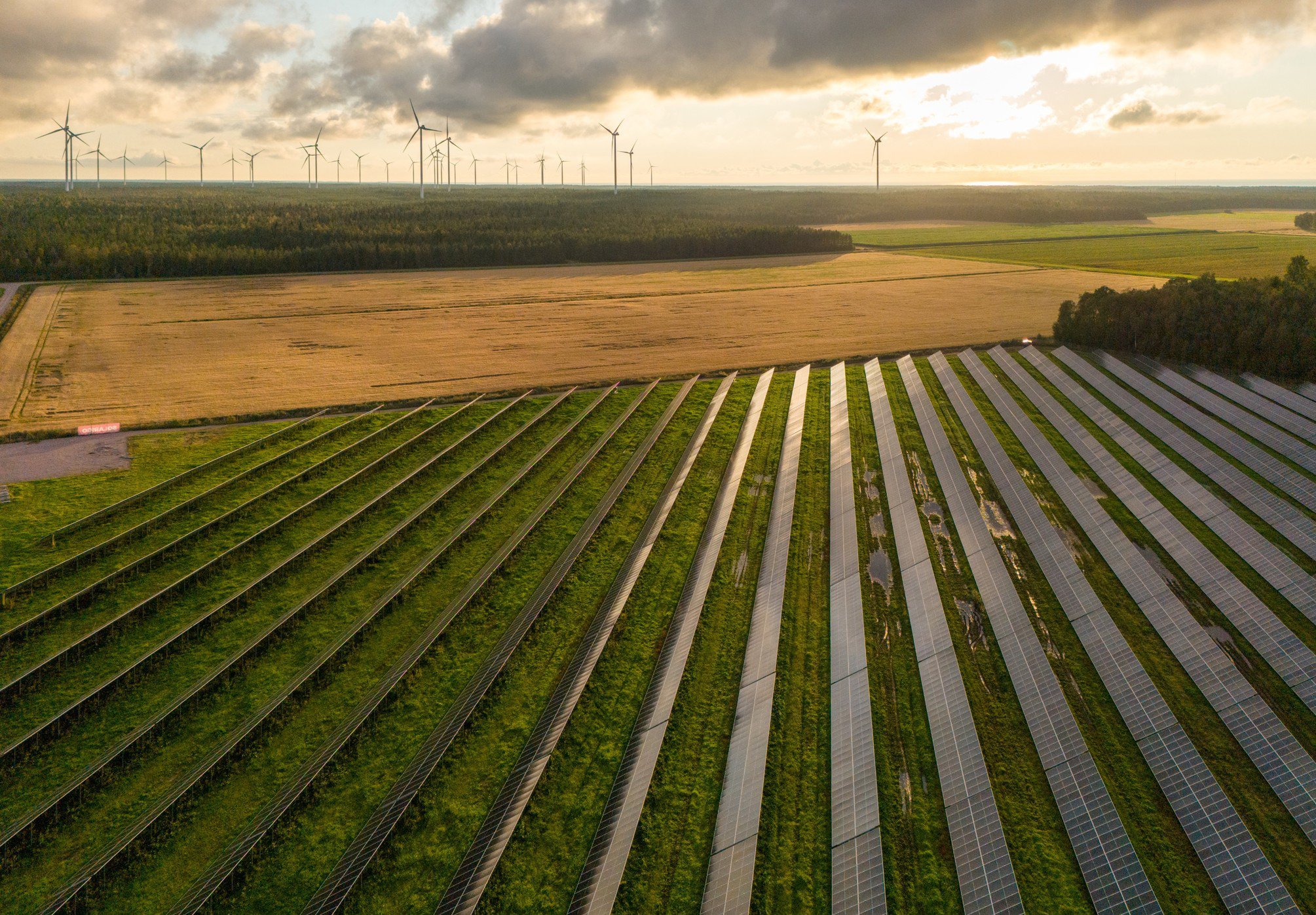
Agrivoltaics installation combining solar panels with agricultural production, illustrating how renewable energy generation can be integrated with continued food production and other land-use interests.
2. Agri-PV: Combining agriculture and solar energy in Nordic countries
Espen Olsen, Professor, Department of Physics, Norwegian University of Life
In Agri-PV systems, agriculture is combined with solar PV installations. The aim is to avoid the use of pristine nature for electrical energy production. This combination has gained popularity in southern parts of Europe where solar panels are installed elevated above the field where crops are grown. In this case increase in crop yield can be achieved due to better water management in dry areas. Further north (Germany and The Netherlands) Agri-PV systems are installed as vertically mounted rows of bifacial panels where the crops are grown between the rows, separated by a distance fitted to the machinery used. At NMBU in Ås, Norway such vertical Agri-PV system is installed in the form of a medium-scale pilot rated at 27.4 kWp mounted in the north-south direction harvesting sunlight from the east and west. The system is mounted in an otherwise research-driven field to establish knowledge of the impact of the PV installation on the crop yield of the field. The system is provided by a European commercial manufacturer of such systems (Next2Sun) and was installed during 2025. During the 2025 growing season, two variants of barley has been grown. The results are yet to be evaluated but a problem with the soil quality varying from one end of the installation to the other has been identified. Preliminary results indicate that the growing conditions are not severely impacted by the installation. The issues regarding the soil will be remediated for the 2026 growing season. The system was connected to the grid in October 2025 so no results regarding electrical power production is yet available. A full set of power production data is expected for 2026.
3. Agri- & Ecovoltaics in a Swedish/Danish perspective
Tora Råberg, Researcher, Department of Crop Production, RISE Research Institutes of Sweden
RISE has been a part of several agrivoltaics and ecovoltaic projects during the last years, like Solbruk i Skåne, Eko-sol, Den självförsörjande gården, Solbruk i våra odlingslandskap and the most recent Agrivoltaics in Norrbotten. One of the outcomes from this experience has led to a handbook for ecovoltaics and agrivoltaics with focus on biodiversity and ecosystem services. There is now a living lab for agrivoltaics with sites in both Sweden and Denmark, where several actions have been introduced to increase the sustainability of the practices. Food crop diversity and areas for pollinators are some of the adaptations. We are also evaluating the function of automatic vehicles in solar parks with sun tracking panel tables. In one of our sites in the living lab we will test gutters for rainwater catchment in the centre of the panel table of a 1-axis system. The aim is to avoid soil erosion and increase the opportunity of returning water as irrigation when it is needed. Several of the sites are planning for energy storage in classical batteries and thermal batteries with one of the sites planning for a greenhouse, using the thermal energy storage in cold periods of the year. There is also testing and upscaling of P2X in one of the farms that we are working with, that has chosen to produce ammonia when the panels produce a surplus of energy compared to the energy demand. This farm has a 2-axis system with orientation to the south as a default. The wheat yield in this farm has been evaluated and showed no significant change in yield as we compared full sun exposure to the semi-shade. Projects are also developing in northern Sweden, where snowy conditions make vertical panels an interesting option.
Group discussion summary
The recommendations presented in this chapter are based on the group discussions held during Thematic Session 1: Balancing Solar Energy and Land Use: Policy and Practice in the Nordic Region.
Core question
What national-level policy measures could help ensure that solar power expansion does not create conflicts in rural areas in the Nordic countries?
Policy recommendations
Discussion summary
Support Nordic frameworks for AgriPV and EcoPV development
Participants highlighted the value of Nordic-level support for funding schemes, coordination, and knowledge exchange that promote solar energy solutions capable of coexisting with agriculture, nature conservation, and other landscape functions, rather than contributing to land-use conversion.Facilitate alignment and mutual learning across policy domains
The discussion pointed to challenges arising from differing national regulatory and subsidy frameworks, particularly where PV installations affect agricultural land classification. Nordic cooperation was seen as a platform for mutual learning, comparison of approaches, and exploration of pathways that better align energy and agricultural policies.Develop shared Nordic guidance and knowledge resources
There was broad support for developing Nordic guidance materials, such as a handbook or shared principles for agrivoltaics and ecovoltaics, drawing on experiences from across countries to reduce knowledge gaps and support national and local decision-making.Strengthen Nordic support for Living Labs and research infrastructure
Participants emphasized the value of Nordic collaboration in supporting Living Labs and other test environments where technologies, business models, and land-use interactions can be explored at small scale before wider implementation, including assessments of productivity, climate impacts, and operational effects.Promote Nordic research on multifunctional land-use solutions
The discussion identified a need for Nordic-level coordination of research on solutions that combine solar energy with biomass production, peatland re-wetting, and diverse cropping systems, as well as system designs that enhance multiple benefits for climate, water quality, biodiversity, agriculture, and energy production.Encourage exchange on social acceptance and conflict dynamics
Participants underlined the importance of better understanding social acceptance and local conflict dynamics related to solar energy development. Nordic cooperation was seen as well suited to support exchange of experiences, methods, and lessons learned in this area.Use Nordic cooperation as a learning and coordination platform
The discussion emphasized that Nordic cooperation provides added value through shared learning across diverse geographic and policy contexts. Existing platforms such as SNS, NKJ, and the Nordic Council of Ministers were seen as well positioned to convene relevant actors and support coordination.