6. The segments:
What are the main opportunities emerging in the Nordic Ocean Economy?
Now that we have examined the Ocean Economy opportunity, the global trends reshaping the market, the Nordic region’s competitive strengths, and the current landscape of innovation, the final step is to determine where the strongest opportunities for growth and investment are emerging—what we define as the Nordic Ocean Opportunity .
At its core, this step answers the key question:
Step five of the investment thesis framework brings together insights from the previous steps to identify the most strategic areas for investment. It focuses on where innovation, market demand, and Nordic strengths converge. To do this, we use an opportunity mapping analysis —a structured method to highlight the most scalable and high-impact segments. The goal is to segment the Nordic Ocean Economy in a way that highlights where the best solutions can emerge—solutions that serve large and growing markets, improve on existing approaches, scale efficiently, offer a distinct advantage, and generate long-term value.
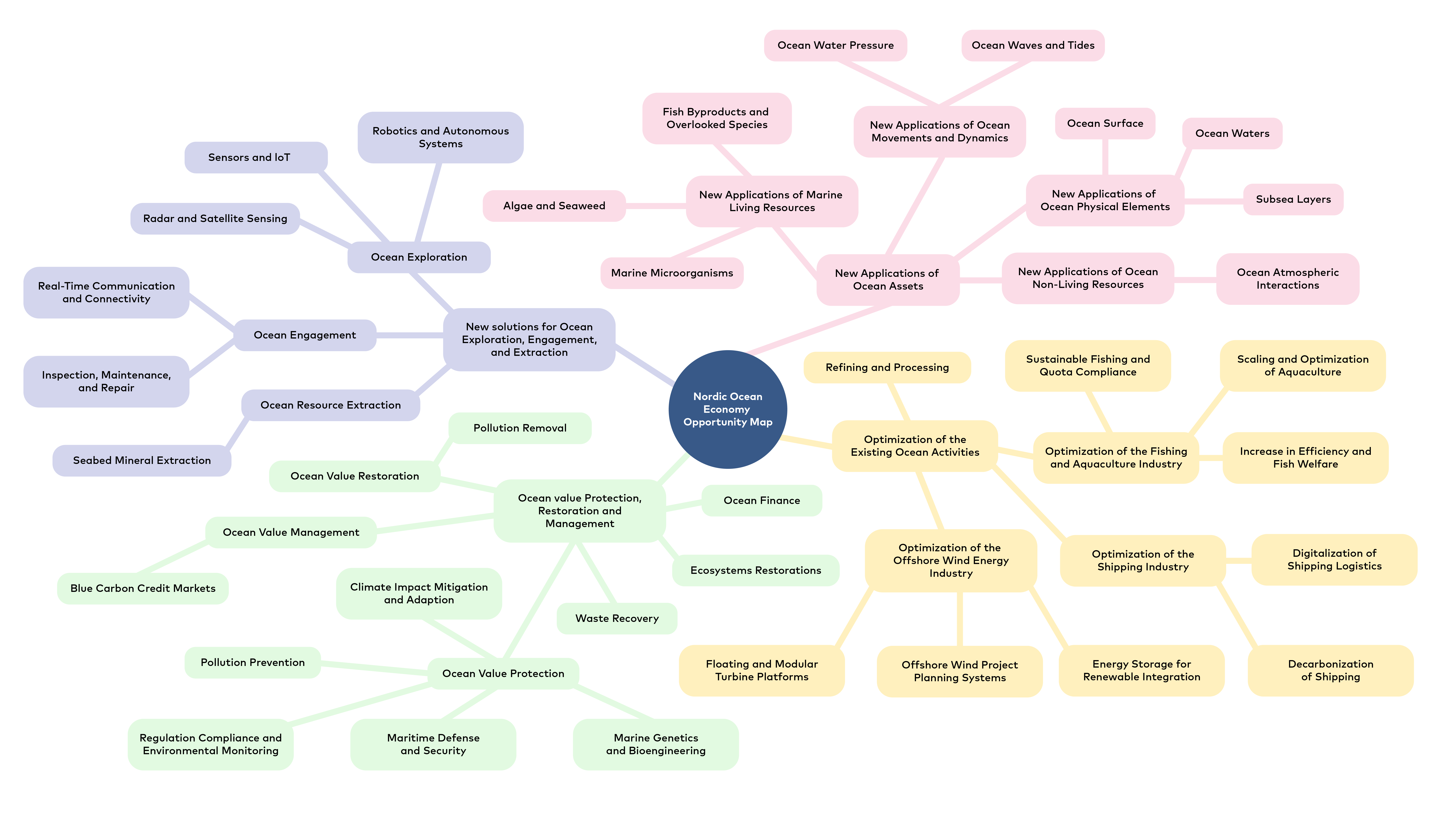
Through this process, we have identified 13 key opportunities within four main segments . Each segment represents a long-term structural area of the Nordic Ocean Economy, expected to remain relevant over time. In contrast, each opportunity is a specific business or investment potential within a segment, influenced by market conditions, technological advancements, and regulatory changes—making it more dynamic and subject to change over time.
The four key segments are:
Optimization of existing ocean activities: New applications of ocean assets: New solutions for ocean exploration, engagement, and extraction: New solutions for ocean value protection, restoration, and management:
6.1 Segment 1: Optimization of the existing ocean activities
The optimization of existing ocean activities is the largest, most obvious, and most immediate investment opportunity in the Nordic Ocean Economy, representing more than half of the total dealflow today. This segment encompasses solutions, technologies, and innovations that support the efficiency, sustainability, and profitability of established ocean industries where the Nordics hold global leadership today—such as shipping, fishing and aquaculture, and energy production.
These industries form a cornerstone of the Nordic economy, contributing 13% of regional GDP and an extraordinary 40% in Norway. However, as they face mounting pressures from stricter regulations, resource scarcity, and rising operational costs, the need for innovative solutions is greater than ever. The demand for change is driven not only by internal industry challenges but also by global trends. The world’s increasing appetite for fish proteins, clean energy, and maritime trade creates an unprecedented opportunity for growth in these sectors. At the same time, unsustainable practices in ocean industries are leading to tighter regulations, compelling players to adopt greener, more efficient approaches.
Across these industries, Nordic businesses face a strong push to increase efficiency and reduce their negative climate impact. And these dynamics are spurring the emergence of new companies across the Nordics that are addressing these challenges head-on. Many of the solutions developed locally for shipping, seafood production, and offshore wind, if proven successful, can also be applied globally, creating a significant potential for long-term growth. We expect many promising opportunities to emerge from this segment in the coming decades, addressing the key challenges faced by established ocean industries.
Within this segment, the most significant specific opportunities that dominate are those where Nordics are leaders today and that face the main optimization challenges:
- Optimization of the shipping industry
- Optimization of the fishing and aquaculture industry
- Optimization of the offshore wind energy industry
Improving the efficiency and value of key Nordic Ocean industries like shipping, aquaculture, and offshore wind through advanced technologies such as AI, automation, and precision tools.
Optimisation of shipping industry | Optimisation of fishing and aquaculture industry | Optimisation of offshore wind energy industry |
Decarbonisation of shipping | Scaling and optimisation of aquaculture | Floating and modular turbine platforms |
Digitalisation of shipping logistics | Sustainable fishing and quota compliance | Energy storage for renewable integration |
Increase in efficiency and fish welfare | Offshore wind project planning systems |
The potential of this segment is exemplified by Cognite, a Norwegian company founded in 2016. In just a few years, the company has grown into a global leader valued at $1.6 billion (as of January 2025) by providing an industrial data platform that optimizes operations in sectors like oil and gas. Cognite shows how large companies in this sector can become and highlights the value potential of solutions dedicated to improving established ocean activities.
Moving forward, the most successful solutions in this space will be those that are able to combine increased productivity and efficiency for these leading ocean industries with sustainable practices that protect the environment and avoid harm. In the new era, winners will be the companies that can deliver both economic value and environmental responsibility.
6.1.1 Optimization of the shipping industry
Nordic countries are global leaders in shipping, with strong infrastructure, large fleets, and a focus on digitalization and decarbonization. This leadership puts them in a prime position to tackle the challenges and opportunities shaping the future of maritime transport.
The shipping industry is under growing pressure as global seaborne trade is expected to increase 35% by 2050, requiring greater cargo capacity and operational efficiency. At the same time, disruptions like the Suez Canal blockage and geopolitical shifts expose vulnerabilities in global trade routes, making resilient and adaptable logistics systems a priority. Environmental regulations are also tightening. The industry emits about one billion metric tons of CO₂ annually, pushing regulators to enforce stricter emissions targets. Meanwhile, new technologies—including AI, IoT, and advanced propulsion systems—are transforming operations, enabling smarter, cleaner, and safer shipping.
These converging factors create a pressing need to transform the shipping industry by increasing efficiency, reducing emissions, and enhancing safety. Nordic countries, as global leaders in shipping—ranking 4th globally in fleet size (Norway) and 10th (Denmark), and home to major shipping companies like Maersk—are under increasing pressure to digitalize operations.
At the heart of this opportunity lies the potential to decarbonize shipping, digitize logistics, and improve crew safety, ensuring that the sector evolves to meet the demands of the future. Main areas where new Nordic solutions are emerging:
Decarbonization of shipping: New regulations are driving operators to cut emissions, creating a major opportunity to provide solutions that help the industry decarbonize in a cost-effective way. The range of emerging solutions spans from fuel optimization technologies to complete fuel replacement. The Nordic region is at the forefront of three main approaches to decarbonization:Fuel optimization: ZeroNorth (Denmark) providing platforms to optimize fuel consumption and fleet operations.Cetasol (Sweden) , Frugal Technologies (Denmark) , andHefring Marine (Iceland) creating tools to enhance vessel performance, cut fuel use, and lower emissions.Alternative Propulsion Systems: Oceanbird (Sweden) designing wind-powered systems for large vessels, whilePascal Technologies (Norway) Alternative fuels and Electrification: Liquid Wind (Sweden) ,Hyrex (Norway) , andKvasir Technologies (Denmark) are producing low-carbon fuels like methanol and hydrogen. Inelectrification Evoy (Norway) andCandela (Sweden) lead with advanced electric propulsion systems, whileAlma Clean Power (Norway) is innovating in fuel cell technology to further cut emissions.
Digitalization of shipping logistics: Fleet coordination: Seaber (Finland) Navidium (Sweden) that offers advanced solutions for logistics management and operational planning, enabling better fleet coordination and resource use.Cargo management: Awake.AI (Finland) that integrates digital tools for ports, streamlining cargo flows and reducing bottlenecks,Xeneta (Norway) that provides data-driven platforms to benchmark shipping rates, helping stakeholders optimize cargo management, andGlobe Tracker (Faroe Islands/Denmark) Port operations and crew safety: Portchain (Denmark) that uses real-time data and advanced scheduling solutions to improve coordination between ships and ports.Scoutbase (Denmark) that develops real-time monitoring tools to enhance crew safety and prevent accidents.Dimeq (Norway) Maranics (Iceland)
6.1.2 Optimization of fishing and fish farming industry
Global seafood demand is rising rapidly, with consumption expected to grow from 158 million tons in 2020 to nearly 190 million tons by 2030.
These converging factors create a pressing need to transform the fishing and aquaculture industry by increasing efficiency, optimizing production, ensuring compliance with new regulations, and minimizing environmental impact. Nordic countries, as global leaders in fish exports and aquaculture—particularly with Norway farming 90% of its salmon—are under increasing pressure to adapt and enhance their practices.
At the heart of this opportunity lies in solutions that support the increase of seafood production while ensuring regulation compliance and environmental considerations. Main areas where new Nordic solutions are emerging:
Scaling and optimization of aquaculture. Scaling aquaculture systems: Salmon Evolution (Norway) orGeoSalmo (Iceland) that focuses on sustainable land-based aquaculture systems to meet increasing demand.KIME Akva (Norway) Increase in efficiency and fish welfare: Aquabyte (Norway/US) that uses AI cameras for fish growth monitoring, disease detection, and feeding optimization.Stingray Marine Solutions (Norway) that uses laser technology to remove sea lice, reducing the need for chemicals.Remora Robotics (Norway) that develops autonomous cage-cleaning systems to enhance water quality and reduce maintenance.Sea Farm Innovations (Faroe Islands) that employs mechanical delousing technologies to gently remove sea lice, boosting fish welfare.Advanced feed and nutrition solutions: Molofeed (Norway) that produces advanced feed solutions to enhance fish growth and minimize waste.Calanus AS (Norway) that develops marine-based feed products that improve fish nutrition.
Sustainable fishing and quota compliance: Reducing bycatch and improving harvesting methods: EcoTrawl (Norway) Compliance and monitoring tools: PingMe (Norway) that provides digital compliance tools for tracking fishing activities and meeting regulatory standards.Aqua Robotics (Norway) that develops systems to monitor fishing practices and ensure compliance with environmental regulations.
6.1.3 Optimization of the offshore wind energy industry
Global energy demand is set to increase by 50% by 2050, driven by industrial growth, urbanization, and energy-intensive technologies like electric vehicles and hydrogen production. Meeting this demand requires a major shift toward low-carbon energy sources, expected to provide up to 80% of global power generation by mid-century. Offshore wind is emerging as a key pillar of this transition, offering scalable energy production without competing for land. Capacity is projected to grow from 40 GW in 2020 to 2,465 GW by 2050, creating an urgent need to expand infrastructure and develop new technologies. However, scaling offshore wind presents significant challenges. High installation costs in deep waters, complex grid connections, and harsh marine conditions make deployment expensive and technically demanding. Another major bottleneck is grid stability and energy storage, as wind production fluctuates and must be balanced with demand.
These converging factors create a pressing need to optimize the offshore wind energy industry by reducing installation costs, improving grid integration, enhancing maintenance efficiency, and addressing the challenges of deep-water deployment and variable energy production. Nordic countries, as global leaders in offshore wind, are under increasing pressure to expand their capacity and meet ambitious renewable energy targets.
At the heart of this opportunity lies the potential to scale offshore wind energy, optimize turbine technology, and develop the necessary infrastructure to meet the growing demand for clean energy, ensuring that the sector evolves to support the global transition to low-carbon energy. Main areas where new Nordic solutions are emerging:
Floating and modular turbine platforms: Floating and modular designs for deep waters: Windeed (Sweden) – floating offshore wind platforms for cost-effective deep-sea deployment;Seatwirl (Sweden) andStiesdal (Denmark) – modular turbine designs for scalable, flexible deep-water deployment.Multi-turbine platforms: Windcatching Systems (Norway) – Multi-turbine floating platforms that use less space to capture more wind, lowering costs and increasing energy production.Hybrid platforms: Floating Power Plant (Denmark) – Hybrid platforms that combine wind and wave energy, enhancing efficiency and overall energy output.
Energy storage for renewable integration: High density battery storage: Freyr Batteries (Norway) that develops high-density batteries for large-scale storage, improving the reliability of renewable energy supply.Maritime and offshore energy storage: Corvus Energy (Norway) that specializes in energy storage systems for offshore and maritime applications.
Offshore wind project planning systems: Analytics and optimization: Aegir Insights (Denmark) that provides advanced analytics for optimizing offshore wind project planning, including site selection and performance forecasts.FutureOn (Norway) that offers digital platforms to visualize and manage subsea infrastructure.Operational simulations: Shoreline (Norway) – Cloud-based solutions for optimizing offshore wind operations;Vind AI (Norway) –AI-driven platform for wind project planning and optimization.
6.2 Segment 2: New applications of ocean assets
New applications of ocean assets represent roughly a third of the dealflow in the Nordic Ocean Economy, making this segment an exciting and transformative opportunity. Building on the Nordics’ established leadership in traditional ocean industries like fishing, shipping, and offshore wind, this segment is about exploring new ways to create value from the ocean. The success of offshore wind in Denmark exemplifies this mindset. By leveraging its offshore oil and gas expertise and abundant wind resources, Denmark became a global leader in offshore wind energy—a sector shaping the future of energy production. This success has inspired a wave of innovators across the Nordics to ask: What else can we do with these resources? How can we use them differently to meet global needs and create disruptive new applications of ocean assets?
The Nordics are particularly well-suited to lead in this area because of their access to vast ocean territories—spanning over seven million square kilometers. These waters not only provide abundant resources but also serve as a real-world laboratory for developing and testing innovative solutions. This unique combination of access, resources, and expertise allows the Nordics to pioneer new applications of ocean assets and scale them effectively. Several factors are driving this opportunity. The region is home to world-class marine research institutions, active industries in ocean sectors, and a strong entrepreneurial culture in the ocean space. These elements create a supportive environment for developing disruptive innovations.
Additionally, global demand for ocean solutions—such as green energy, alternative proteins, clean water, and eco-friendly materials—is pushing for new discoveries and applications. As land becomes increasingly constrained, industries are turning to the ocean to meet the demands of growing populations. The ocean offers critical materials, energy sources, and opportunities for sustainable innovation, such as through marine living resources like algae, seaweed, and fish by-products, as well as ocean physical elements for energy production, urban development, and climate change mitigation. At the same time, new regulations limiting the use of plastics and rising self-sufficiency policies, along with geopolitical tensions, are making the ocean an essential resource for securing new sources of materials, critical materials, and energy. Furthermore, advances in tech, science, and engineering open up new possibilities for utilizing ocean assets in diverse ways.
This segment invites an open-minded approach, encouraging the exploration of all possible new applications of ocean assets, such as:
- Marine living resources
- Physical elements
- Ocean movements, dynamics, and atmospheric interactions
- Geological and chemical components (non-living resources).
Finding new ways to use Nordic ocean resources to solve problems and create new products, such as marine-based medicines, algae proteins, and renewable energy solutions like floating solar and wave power.
Marine living resources | Ocean physical elements | Ocean movements | Non living resources |
New uses of algae and seaweed | New uses of ocean surface | New uses of ocean waves and tides | Using of ocean plastics |
New uses of fish byproduct and overlooked species | New uses of subsea layers | New uses of ocean atmospheric interactions | |
New uses of marine microorganisms | New uses of ocean water | New uses of ocean water pressure |
A great example of the potential in this segment is Kerecis , acquired by Coloplast for $1.3 billion in 2023. Founded in 2009 in Iceland, the company transformed fish skin—traditionally seen as a low-value byproduct—into a high-value medical product. By using the natural collagen and omega-3 fatty acids in fish skin, Kerecis created a globally recognized wound care solution to treat burns and chronic wounds. This success story demonstrates how underutilized marine resources can be transformed into breakthrough products, showcasing the significant potential of ocean-based innovations.
Moving forward, the most promising solutions in this segment will be those able to provide disruptive value of ocean assets, more than those providing an incremental value, and those solutions capable of transforming low-value ocean assets into high-value applications with significant global impact. We expect incredible breakthroughs in this space, many of which are yet to be discovered, as the ability to harness and repurpose ocean assets continues to evolve.
6.2.1 New applications of marine living resources
Advancements in science and technology are unlocking new ways to utilize marine living resources—such as algae, seaweed, fish by-products, and microorganisms—to create sustainable solutions in food, energy, and materials. Once considered underutilized, these resources are now being developed into high-value applications ranging from alternative proteins and bioplastics to health products and biofuels. Nordic companies are at the forefront of these innovations, transforming marine biomass into commercially viable and environmentally friendly solutions. Main areas where new Nordic solutions are emerging:
Bioplastics and materials for manufacturing and production: Origin by Ocean (Finland) that converts invasive algae into bio-based ingredients for packaging, cosmetics, and food production.Swedish Algae Factory (Sweden) that utilizes diatom shells from algae to enhance solar panel efficiency, supporting renewable energy applications.Nordic SeaFarm (Sweden) that cultivates seaweed for use in biodegradable packaging, sustainable furniture, and food products.Alternative proteins for human and animal feed: Nordic SeaFarm (Sweden) ,Ocean Rainforest (Faroe Islands) andTari (Faroe Islands) that cultivate seaweed for human food and animal feed:Algiecel (Denmark) andAliga Microalgae (Denmark) that develop algae/microalgae protein for food and feed.Health compounds: Alginor (Norway) that extracts compounds from seaweed for anti-inflammatory and immune-support applications, offering sustainable alternatives to synthetic products.Biofuels: Biofuel Region (Sweden) that develops biofuels from algae as a renewable energy source.
Alternative Proteins: Pronofa (Norway) that utilizes small fish and byproducts from seafood processing to create sustainable protein options for animal feed.Ava Ocean (Norway) Musselfeed (Sweden) that processes blue mussels into powder and flour from marine by-productsPharmaceutical and nutraceutical applications: Pelagia (Norway) that processes marine byproducts into pharmaceutical-grade ingredients.Vestland Pharma (Norway) that produces cod liver oil and other marine ingredients for supplements and medicines.Smartfish (Norway) that develops omega-3 formulations for improving metabolic health.Therapeutic applications: Kerecis (Iceland) that turns fish skin into wound dressings for tissue regeneration.Regenics (Norway) that uses salmon roe extracts to develop wound dressings and hydrogels for tissue regeneration.Marealis (Norway)
Chemical alternatives for industrial manufacturing: Again.bio (Denmark)
6.2.2 New applications of ocean physical elements.
Innovations in using the physical aspects of the ocean—such as its surface, subsea structures, and cold deep waters—are unlocking new opportunities in renewable energy, urban expansion, carbon storage, and industrial efficiency. These advancements leverage the ocean in ways that were previously unfeasible, offering scalable solutions for energy production, climate mitigation, and infrastructure development. Nordic companies are at the forefront of these emerging applications. Main areas where Nordic solutions are emerging:
Renewable energy production: Ocean Sun (Norway) that develops floating solar arrays in coastal waters for renewable energy.Alotta (Norway) that combines solar energy with offshore infrastructure for optimized energy production.Urban development: Urban Rigger (Denmark) Aviation landing: Elfly (Norway) that has developed the first fully electric seaplanes for coastal mobility.
Carbon storage: GreenSand (Denmark) andNorlights (Norway) that use undersea geological formations, previously used for oil and gas extraction, to store CO₂ captured from industrial emissions, reducing greenhouse gases in the atmosphere.
Data center cooling: Orcaconnect (Norway)
6.2.3 New applications of ocean movements, dynamics, and atmospheric interactions.
Advancements in technology and engineering are opening new ways to harness ocean forces for energy production, climate mitigation, and freshwater generation. By leveraging ocean waves, tides, atmospheric interactions, and water pressure, Nordic innovators are unlocking new ocean solutions that were previously unfeasible. These technologies present significant opportunities for renewable energy, environmental protection, and resource efficiency. Main areas where Nordic solutions are emerging:
New sources of green energy: Minesto (Sweden) that designs underwater kite-like devices that harness tidal currents to generate electricity.CorPower Ocean (Sweden) that produces wave-energy buoys that convert wave motion into electricity.Tidetec (Norway) that develops compact tidal turbines for efficient energy capture and deployment.Production of fresh water: Ocean Oasis (Norway) that uses wave energy to convert seawater into drinkable water, providing an innovative solution to freshwater scarcity.Wavepiston (Denmark) Deploys a modular wave energy system to generate electricity and desalinated water.
Mitigation of weather impacts: OceanTherm (Norway) that is exploring underwater bubble barriers to reduce hurricane intensity by cooling surface waters, helping mitigate storm impact.Carbon capture: AlgaePro (Norway) that cultivates algae for carbon capture and nutrient removal, enhancing water quality and reducing ocean eutrophication.
Energy efficiency desalination technologies: Waterise (Norway) andFlocean (Norway) – Develop subsea desalination systems that harness ocean depth pressure to create freshwater with reduced energy.
6.2.4 New applications of ocean non-living resources.
While non-living ocean resources—such as minerals and plastics—have long been explored, new innovations are emerging that expand their potential applications across multiple industries. These developments are transforming ocean-derived resources into high-value materials, unlocking new opportunities to be utilized across industries. Main areas where Nordic solutions are emerging:
Materials manufacturing and production: This growing issue presents a significant opportunity to transform ocean plastic into valuable materials for manufacturing and production. Examples of companies in the space include: AION (Norway) Ogoori (Norway) that upcycles ocean plastic waste into high-quality regranulate, creating a sustainable circular value chain for manufacturing.
6.3 Segment 3: New solutions for ocean exploration, engagement, and extraction
Ocean exploration, discovery, and engagement currently account for less than 15% of the dealflow in the Nordic Ocean Economy. However, its importance is growing rapidly as we enter the "Ocean Rush" era. This era is marked by a global race to explore ocean assets, uncover their potential, and engage with marine environments, alongside increasing competition for critical resources. With more than 80% of the ocean still unexplored, the development of new solutions to fully engage with the ocean represents one of the most significant and transformative opportunities for the future. This vast potential is amplified by advancements in technology and engineering, which are enabling new capabilities for ocean exploration, resource extraction, and environmental management.
The Nordic region, rich in ocean assets and backed by decades of expertise in oil and gas operations, is uniquely positioned to lead in the development of these solutions. Nordic extensive ocean territories hold abundant, yet largely untapped, resources, creating both a pressing need and a unique opportunity for innovation. The region also has a long history of ocean and Arctic exploration, with a legacy spanning early maritime trade routes, Arctic expeditions, and decades of leadership in oil and gas exploration. This combined expertise in exploration and innovation, as well as the region’s strong energy infrastructure, including offshore platforms, pipelines, and maritime facilities, provides a strong foundation for creating the next generation of tools to map, monitor, and access areas of the ocean that were previously out of reach.
Global factors are accelerating the need for innovation in ocean exploration. Emerging trends, like the global race for critical materials and shifting geopolitical dynamics, are intensifying the focus on oceans as a key resource frontier. As demand for minerals, energy, and marine data grows, especially in the Arctic and Greenland regions, competition for marine assets has intensified. Climate change is making these areas more accessible, increasing global interest in technologies that map, monitor, and secure critical resources. This includes accessing untapped resources, establishing trade routes, addressing defense needs, and supporting environmental monitoring. This places the Nordics, with their Arctic expertise and strategic positioning, at the center of a rising global demand for ocean exploration and engagement solutions.
The segment encompasses three key areas:
- Solutions for ocean exploration
- Solutions for ocean engagement
- Solutions for ocean resource extraction
Building advanced tools to better explore the ocean, collect data, engage with the ocean and extract resources from it in a responsible way.
Ocean exploration | Ocean engagement | Ocean resource extraction |
Rada and satelite sensing | Real time communication and connectivity | Seabed mineral extraction |
Sensors and IoT | Inspection manteinance and repair | Refining and processing |
Robotics and autonomous systems | Ocean mobility |
A great example of the potential in this segment is ICEYE, a radar satellite company valued at over $900 million (as of January 2025). Founded in 2014 in Finland, ICEYE revolutionized ocean exploration with its high-resolution satellite imaging technology, capable of capturing detailed images in any weather condition. This capability is crucial for Arctic navigation, resource mapping, and disaster response. ICEYE demonstrates how advanced technologies can transform how we explore, understand, and engage with the ocean, setting a precedent for further innovation in this space.
Moving forward, the most promising solutions in this segment will be those that provide the infrastructure to enable the development of new tools for ocean exploration, discovery, and engagement, or solutions that can support multiple ocean sectors in their exploration and engagement activities.
6.3.1 New solutions for ocean exploration.
New technologies are revolutionizing how we explore and understand the ocean. Innovations in data collection, satellite imaging, and autonomous robotics are making ocean mapping, environmental monitoring, and resource exploration more precise and accessible—even in remote or extreme conditions. These advancements are improving our ability to track climate change, assess marine ecosystems, and identify potential resources. The focus here is on gathering data and expanding knowledge of the ocean environment. Main areas where Nordic solutions are emerging:
Radar and satellite sensing: ICEYE (Finland) that provides radar satellite imagery in all weather conditions, supporting Arctic surveillance, ice monitoring, and disaster response.Quadsat (Denmark) that develops satellite antenna testing systems to ensure reliable communication for remote ocean applications.Dynaspace (Norway) Sensors and IoT: Kongsberg Digital (Norway) SmartOcean (Norway) that develops IoT-based systems for maritime data collection and infrastructure monitoring.Scanreach (Norway) Water Linked (Norway) Robotics & autonomous systems: Argeo (Norway) that provides advanced robotics and geophysical imaging systems for precise underwater mapping, resource exploration, and infrastructure management.Maritime Robotics (Norway) that produces USVs and surface drones for infrastructure monitoring and environmental assessments, streamlining routine maintenance.
6.3.2 New solutions for ocean engagement.
Unlike exploration and engagement, this category focuses on physically accessing and utilizing ocean resources. Advancements in robotics, imaging technology, and extraction processes are making it possible to retrieve valuable materials from the seabed—such as minerals, metals, and other critical resources—while minimizing environmental impact. These technologies enhance industries like energy production, electronics, and advanced manufacturing, allowing for more efficient and controlled resource utilization. The defining element here is the focus on extracting and processing ocean-based materials for industrial use. Main areas where Nordic solutions are emerging:
Real time communication and connectivity: Ocean Access (Norway) that focuses on enabling real-time communication and IoT connectivity for offshore operations.Onomondo (Denmark) that provides IoT connectivity solutions for seamless data collection and transmission in maritime environments.Ocean Space Communication (Norway) that develops control systems for autonomous and remotely operated vessels, enabling seamless communication and operation.Inspection, maintenance, and repair: Eelume (Norway) that designs snake-like robots that maneuver through tight spaces to inspect and repair underwater assets, reducing downtime and risk.ScoutDI (Norway) that develops drone-based systems for fully digitalized inspections in confined industrial spaces.Skarv Technologies (Norway) Ocean mobility: Hyke (Norway) that designs electric, autonomous ferries for urban water transport.Zeabuz (Norway) that provides autonomy-as-a-service for electric ferries, enabling urban water transport.
6.3.3 New solutions for ocean resource extraction.
Advancements in robotics, imaging technology, and refining processes are enabling more precise and efficient extraction of ocean resources. These new solutions allow industries to access valuable materials from the seabed while reducing unnecessary environmental disruption. They also improve the ability to operate in extreme marine conditions, such as deep-sea environments and remote offshore areas. Nordic innovators are developing technologies that enhance exploration, extraction, and processing of critical materials, supporting key industries like energy, electronics, and manufacturing. Main areas where Nordic solutions are emerging:
Seabed mineral extraction: Loke Marine Minerals (Norway) Adepth Minerals (Norway) that utilizes advanced robotics and geophysical tools to explore and assess resources with precision and minimal environmental impact.Refining and processing: Reetec (Norway) – Specializes in refining rare earth elements to support the growing demand for clean energy technologies.Retein Tech (Sweden)
6.4 Segment 4: New solutions for value protection, restoration, and management
Ocean value restoration, protection, and management represent an early but critical segment of the Nordic Ocean Economy. While opportunities in this space are few today, this segment holds the potential to redefine how we perceive and interact with the ocean in the coming decades. The core opportunity lies in recognizing the increasing value of ocean assets and building an industry focused on their protection, restoration, and management—what can be called the "ocean asset management" industry.
Unlike other segments that focus on creating value from the ocean, extracting resources, or expanding existing activities, this segment is about safeguarding and managing the value of the ocean itself. Although this may sound futuristic, the need for such solutions will become inevitable as we better explore, measure, and understand the true value of the ocean and as the pressure to protect it grows.
This opportunity is driven by mounting global challenges, such as pollution, climate change, and unsustainable practices that degrade marine environments. The push for ocean protection and restoration comes from multiple sources: environmental movements advocating for healthier ecosystems, coastal populations facing threats from pollution and rising seas, governments recognizing the strategic importance of ocean assets, and supranational organizations like the UN and NATO pushing for better ocean governance and protection.
The Nordic region’s reliance on the ocean makes this a pressing priority. With 75% of the population in coastal areas and the Ocean Economy contributing 13% to GDP—well above global averages—the health of ocean resources is essential for industries like shipping, fisheries, and offshore energy, and therefore the Nordics have a vested interest in maintaining the health and value of their ocean assets. Furthermore, the Nordics’ deep commitment to sustainability, demonstrated by initiatives like Norway’s Sustainable Ocean Plan, sets them apart as global leaders in preserving and managing ocean resources. Moreover, as Arctic nations, they face firsthand the challenges of climate change and environmental degradation, giving them practical experience and a clear incentive to invest in solutions for ocean restoration and management.
The segment encompasses three areas, but due to the limited dealflow in the space as of today we have grouped them into two:
- Ocean value protection
- Ocean value restoration
- Ocean value management
Creating systems to protect and restore Nordic ocean assets, including pollution tracking, habitat restoration, and better resource management frameworks.
Ocean value protection | Ocean value restoration | Ocean value management |
Regulation compliance and environmental monitoring | Ecosystem restorations | Marine genetics and bioengineering |
Climate impact mitigation and adaptation | Pollution removal | Ocean finance |
Pollution prevention | Waste recovery | Blue carbon credit markets |
Maritime defence and security |
Although this is a new and evolving space, with no established success stories yet, the most promising solutions in this segment will be those that protect or restore the ocean’s most valuable assets and introduce disruptive innovations capable of increasing the intrinsic value of these assets.
6.4.1 New solutions for ocean assets value protection
As pressures on marine environments grow, new technologies are emerging to protect ocean assets, enforce regulations, and mitigate risks from illegal activities, pollution, and climate-related impacts. These solutions are improving maritime security, enabling real-time environmental monitoring, and strengthening long-term ocean management. Nordic companies are at the forefront of these developments, offering advanced tools that support ocean protection while ensuring compliance with evolving regulations. Main areas where Nordic solutions are emerging:
Regulation compliance and environmental monitoring: Oceanscore (Norway) Klappir (Iceland) that develops software solutions to monitor and manage environmental impacts in marine and industrial activities, ensuring compliance with sustainability targets.Spoor AI (Norway) that uses AI-powered systems to track marine life near shipping lanes and detect environmental violations.Syrenna (Norway) advanced sensors for pollution tracking and biodiversity monitoring, supporting resource management and ecosystem restoration.Climate impact mitigation and adaptation: Skyfora (Norway) that offers weather prediction systems to enhance climate adaptation strategies for maritime operations and coastal regions.7Analytics (Norway) that utilizes AI to model coastal flood risks, helping safeguard critical infrastructure and vulnerable communities from rising sea levels and extreme weather.Ocean GeoLoop (Norway) – CO₂ capture and utilization technologies to reduce emissions and mitigate climate change impacts on oceans.Pollution prevention: Pinovo (Norway) that offers solutions for eco-friendly surface preparation and paint removal that prevent microplastics from entering the ocean.RiverRecycle (Finland) that focuses on removing plastic waste from rivers before it reaches the ocean, addressing the root cause of marine plastic pollution.Maritime defense and security: Vake (Norway) Kelluu (Finland) that provides autonomous airships for continuous aerial monitoring, supporting maritime security and large-scale environmental observation.Nordic Air Defence (Sweden) that develops a drone interceptor platform with AI-driven aerial threat detection for maritime protection.
6.4.2 New solutions for ocean assets value restoration
The field of ocean restoration is still emerging but is gaining momentum with new technologies that aim to reverse environmental damage and enhance the economic value of marine ecosystems. Advances in pollution removal, waste recovery and ecosystem restoration are helping recover the value of the ocean assets. Main areas where Nordic solutions are emerging:
Pollution removal and waste recovery: Lamor (Finland) that specializes in oil spill response and environmental cleanup to restore polluted marine environments.Clean Sea Solutions (Norway) – Automated systems to collect and remove floating plastic waste from oceans and harbors.Norwegian Technology (Norway) that provides waste treatment solutions for offshore and onshore industries.
6.4.3 New solutions for ocean assets value management
New technologies are changing how ocean assets such as fish, seaweed, and water are valued, managed, and enhanced. These innovations are not just about improving operations—they focus on recognizing both the intrinsic and economic value of marine resources and actively increasing their worth. This is still a new field in the Nordics, but interest is growing as industries and investors see opportunities to better define, protect, and expand the worth of ocean-based assets. While early, this space has strong growth potential, with new solutions emerging to optimize and scale value creation. Main areas where Nordic solutions are emerging:
Bioengineering of ocean assets: BMK Genetics and AquaGen (Norway) – Develop genetically optimized fish breeds to improve aquaculture productivity and quality.Seaweed Solutions (Norway) – Enhances seaweed varieties for better cultivation through breeding and molecular techniques.Monitoring and analytics of ocean assets: Thalasso (Norway) andThetis (Faroe Islands) – Provide water quality analytics and safety testing for marine farming and industries.Microwise (Denmark) – Offers ballast water testing to prevent invasive species spread.