4. The market focus:
Why is the Nordic region best positioned to capture this opportunity?
After defining the Ocean Economy opportunity and why the timing is right, the next step is to determine where to focus. Identifying the right market is critical—not all regions are equally positioned to capitalize on this shift, and investors must assess which geographies provide the strongest foundation for success.
Step three in the investment thesis framework is about market focus . It is not just about recognizing a global opportunity, but also about identifying where the conditions are best for startups and investments to succeed. This means answering key questions:
Is there a significant unfair advantage? Does the region have access to unique resources, infrastructure, or regulatory advantages that make it a natural leader in this space?What is the level of expertise and past experience? Have industries and institutions already built capabilities in this sector, providing a foundation for new ventures?What is the quality and quantity of deal flow? Are there enough strong startups emerging in this space, and is the pipeline of new companies deep enough to sustain investment?Is there a strong investment ecosystem? Are there enough co-investors and follow-on investors to support companies beyond the early stages and drive long-term growth?What is the track record? Has the region successfully built and scaled companies in related sectors before?
By analyzing these factors, investors can determine where the most promising companies are likely to emerge and which markets offer the strongest conditions for scaling new solutions.
In this section, we explore why the Nordics stand out as one of the best-positioned regions to capture this opportunity. Four key factors explain why this region stands out, each of which will be explored in the following sections:
- A region rich in ocean assets
- A region with high expertise in creating value from ocean assets today
- A region with favorable factors supporting the development of new ocean solutions
- A region with proven capacity to generate returns for investors in this space
4.1 A region rich in ocean assets
The Nordics are uniquely positioned to capture the Ocean Economy opportunity due to their vast and diverse marine territories, which provide a significant “unfair” advantage to the region's capacity to create value from ocean assets. This extensive access to ocean territory provides unparalleled opportunities for innovation and resource utilization.
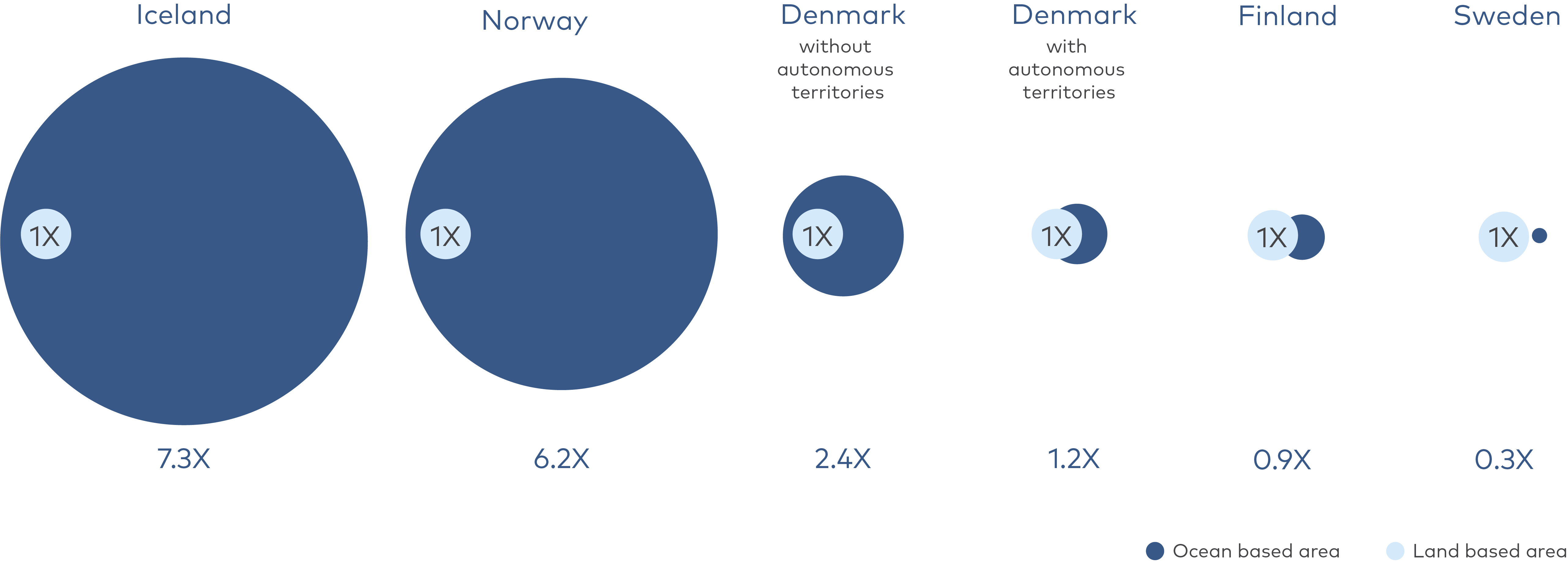
Geographically, the region is deeply connected to the ocean. The Nordic region holds one of the largest ocean territories in the world, deeply shaping its economy and strategic position. Surrounded by eight major seas—including the Barents Sea, Norwegian Sea, North Sea, and the Arctic Ocean—the Nordic countries collectively control 6.6 million square kilometers of Exclusive Economic Zones (EEZs), an area larger than the entire European Union, and a coastline of circa 121,000 kilometers, equivalent to circling the Earth more than three times.
The largest contributor to this ocean territory is Norway, which controls 2.8 million square kilometers, including the strategically significant maritime area around Svalbard. Denmark follows closely, with 2.6 million square kilometers, when including the maritime zones of Greenland and the Faroe Islands. Of this, Greenland alone accounts for 2.2 million square kilometers, making it a dominant force in Denmark’s maritime presence, while the Faroe Islands contribute an additional 274,000 square kilometers. Iceland also plays a major role, with an EEZ of 758,000 square kilometers. Finland, including the autonomous Åland Islands, holds 298,000 square kilometers of EEZ, while Sweden controls 160,000 square kilometers of EEZ.
In relative terms , the region’s ocean territories are almost 2 times larger than their combined land area , with Iceland and Norway leading at 7 and 6 times their landmass, respectively.
The wealth of resources within Nordic ocean territories underlines the region's competitive edge. Norway, for instance, boasts Europe’s largest oil reserves, with 7.7 billion barrels of crude oil,
If the Ocean Economy is defined as the system that creates value from ocean assets, then the Nordics, with their vast and resource-rich marine territories, are naturally positioned to take a leading role. Their abundance of ocean assets serves as the foundation for innovation, industry development, and economic value creation in the Ocean Economy.
4.2 A region with high expertise in creating value from ocean assets today
The Nordic region’s rich ocean resources have enabled the development of strong capabilities and expertise in creating value from ocean assets. This is evident in the significant role the Ocean Economy plays in the region’s overall economy and the Nordic leadership in key ocean industries, such as shipping, aquaculture, and renewable energy.
The Ocean Economy plays a much larger role in the Nordics compared to global averages. Nearly 75% of the Nordic population
In 2022, the Nordic Ocean Economy contributed over EUR 250 billion to GDP, accounting for 15% of the region’s total economic activity
This figure is based on 2022 GDP data from the World Bank and ocean economy contributions from Norway.no, Sjávarklasinn, and estimated contributions for Sweden, Denmark, and Finland based on broader marine sector analyses.
Employment in the Nordic Ocean Economy reflects its high levels of industrialization and resource-driven focus. In 2023, an estimate of 750,000 people
This figure was calculated by aggregating the Ocean Economy GDP contributions of each Nordic country using national statistics databases.
Globally, ocean-based sectors employ around 350 million people, or nearly 7% of the global active workforce. https://dealroom.co/guides/blue-economy
This expertise, combined with the abundance of ocean resources, has made the Nordics global leaders in several key Ocean Economy activities today, such as:
Oil and gas: Norway is the third-largest exporter of natural gas and the fifth-largest exporter of oil in the world, contributing 3% and 2% of global production, respectively.In 2023, Norway exported crude oil, natural gas, NGL, and condensate worth approximately NOK 1,200 billion, accounting for 62% of its total goods exports. Norway’s reserves of 7.7 billion barrels of crude oil are the largest in Western Europe. Shipping: Norway is the fourth-largest shipping nation globally, with a merchant fleet valued at USD 80 billion.Denmark ranks as the 10th largest maritime nation, operating approximately 58 million tons of shipping tonnage. In 2022, shipping accounted for 27% of Denmark's total exports, led by companies like A.P. Moller-Maersk, the world’s second-largest shipping line by fleet size and cargo capacity. Ship construction: Additionally, Finland has constructed over 60% of the world’s icebreakers, with exports worth €200 million in 2019, reinforcing its dominance in this critical Arctic and Baltic niche. Fish and seafood: — and salmon alone accounted for 71% of this volume. Greenland is the largest producer of cold-water shrimp globally, with an annual catch of approximately 105,000 tons in 2022, contributing significantly to the international seafood supply. Offshore wind energy: Denmark pioneered offshore wind energy with the world’s first offshore wind farm in 1991. Today, Denmark continues to lead with an installed offshore wind capacity of 3 GW, representing 4% of the world’s total and meeting 24% of the country’s electricity demand. Offshore and onshore wind combined provide 55% of Denmark’s electricity consumption.Tidal energy: The Faroe Islands are first in the world to use tidal kites for big-scale power, built by Minesto, a Swedish company.The Dragon 12 kite, cranking out 1.2 MW, started feeding the grid in 2024, pulling electricity straight from ocean tides, making the Faroes a top player in sea-powered energy.
4.3 A region with favorable factors supporting the development of new ocean solutions
For innovation to succeed, it requires three key elements: talent, infrastructure, and capital. And the Nordics excel in all three within the ocean domain, creating a favorable environment for ocean solutions and innovations to be developed, grow, and succeed.
The Nordics are uniquely positioned to develop and scale disruptive ocean solutions, thanks to a strong combination of talent, infrastructure, and capital that drives innovation across the Ocean Economy.
In a survey of 100 Nordic investors, respondents highlighted the region's exceptional talent as a key driver of the Ocean Economy. Investors indicated that the Nordics stand out globally for their high levels of entrepreneurship, innovation, and the quality of ocean companies. Specifically:
- 44% of the investors see higher entrepreneurship levels in Ocean Economy in the Nordics than in other regions
- 55% believe innovation levels in the Nordic Ocean Economy are higher than other regions
- 48% say Nordic ocean companies are higher quality than average than ocean companies in other regions.
With these figures, it is evident that general investors hold a strong positive view of the Nordic Ocean Economy, with nearly half recognizing the region’s companies as exceeding average quality standards. However, ocean investors—defined as those who have made at least one investment in an ocean-related company within the past three years—demonstrate even greater enthusiasm. A notable 53% of these investors commended the quality of Nordic ocean companies as above average, while 58% highlighted their exceptional innovation.
This heightened optimism, particularly among local investors and specialized ocean investors, represents a positive indicator. It suggests that the confidence of those with regional and sector-specific expertise could resonate with the broader investment community, reinforcing the Nordics’ position as a hub for high-quality, innovative ocean solutions.
The Nordics have a well-established and integrated maritime infrastructure, built on a long history of ocean activities and Nordic cooperation. Cross-border institutions, such as the Nordic Investment Bank, support infrastructure development, while large Nordic maritime companies actively collaborate through joint ventures to drive new projects. Together, these efforts enable the region to develop, scale, and implement innovative ocean solutions.
This comprehensive maritime infrastructure spans key areas:
Marine Universities and Research Institutes. The Nordics host leading marine universities and research institutes with specialized maritime departments that advance ocean innovation. Institutions such as the Technical University of Denmark (DTU), Norway’s University of Bergen, Chalmers University of Technology in Sweden, and Aalto University in Finland drive cutting-edge research and collaborate with industries on practical applications. For example, Aalto University partners with Wärtsilä to integrate smart technologies into maritime operations. Another example is the OFFWOFF project (Offshore Floating Wind and Offshore Fish Farms) is a collaborative effort between Freja Offshore AB, Nordic research institutions, and local marine operators to optimize offshore wind and aquaculture co-use infrastructure.Transport Infrastructure. The Nordic ferry decarbonization project, a joint venture between NatWest, Fjord Line, and other stakeholders, is one of several examples of how the region is transitioning to cleaner propulsion systems and upgraded facilities to support sustainable transport. Energy infrastructure. The energy sector is anchored by Norway’s extensive oil and gas infrastructure, including offshore platforms, pipelines, and onshore facilities that have long supported energy generation and transportation.However, the Nordics are actively developing new green energy infrastructure, like the Faroe Islands’ Vestmannasund project—the region’s largest tidal energy site with a 1.2 MW kite system powering over 1,000 homes since 2024. Another example is Equinor, a leader in the sector, has committed up to $6.7 billion annually through 2035 for offshore wind and renewable energy projects. For example, joint ventures like the Norlights project, a collaboration between Equinor and Kongsberg Gruppen, focus on building and managing renewable energy systems, using advanced technology to monitor and optimize offshore wind farms and other green energy infrastructure. Communications infrastructure. The Nordics’ communications infrastructure ensures reliable connectivity for maritime operations. Telenor’s Maritime Connectivity Center provides critical voice and data services for ships, offshore rigs, and coastal communities. Additionally, projects like GlobalConnect’s recently completed Nordic digital infrastructure initiative—the largest in a decade—installed over 125,000 kilometers of new fiber-optic cable, significantly enhancing data capacity and connectivity across the region.Collaborations between telecom providers and maritime stakeholders are enabling advancements like IoT integration and real-time data platforms, improving efficiency and safety for maritime industries.
A final key factor supporting innovation and the development of ocean companies in the Nordic Ocean Economy is the availability of sufficient risk capital across all company stages. This ensures that early-stage startups can secure funding to innovate and grow, while later-stage companies have access to the capital needed to scale and expand into global markets.
The Nordics benefit from a unique "capital flywheel," where wealth generated from traditional ocean industries—such as shipping, fishing, and offshore energy—is reinvested into emerging sectors like marine biotechnology, aquaculture, and renewable energy. This self-sustaining cycle drives continuous growth, ensuring that profits from established businesses support the next wave of disruptive innovations.
This capital ecosystem includes family offices reinvesting wealth from maritime industries, corporate venture arms of major companies like Maersk and Equinor funding innovation, and specialized early-stage venture funds supporting ocean startups. Private equity firms and state-backed investors also play critical roles in scaling mature companies, while public markets offer opportunities for raising growth capital and providing liquidity to investors. Together, these investors create a robust support system, ensuring both capital and ocean expertise are available for ocean-based companies across all stages of growth.
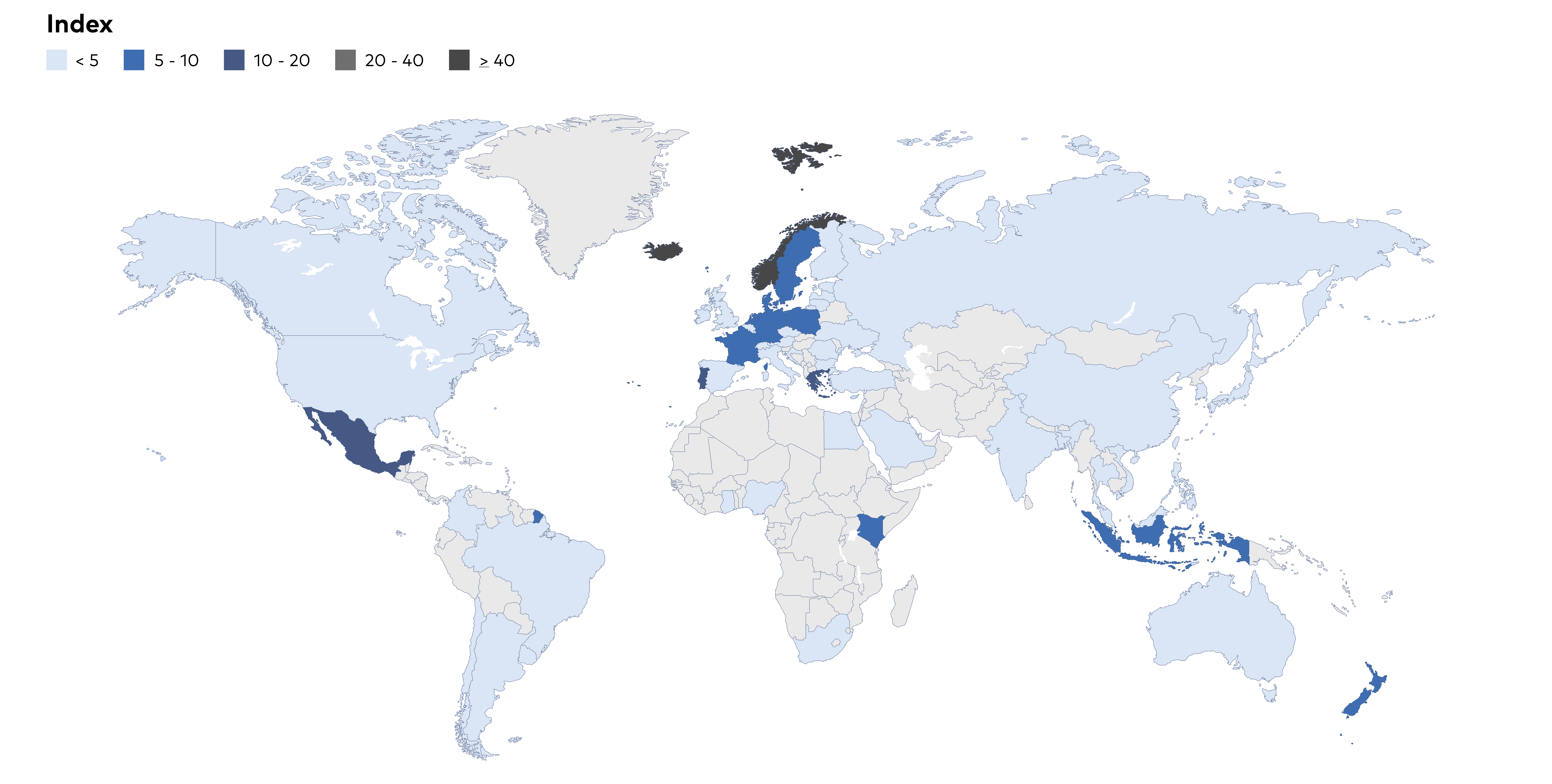
Recent data from Dealroom.co highlights the exceptional nature of this capital ecosystem. Between 2017 and 2024, over 40% of all venture capital (VC) funding in Norway and Iceland went to Blue Economy ventures—a figure that far exceeds the global average. This high concentration of capital directed toward ocean innovation reflects the Nordics' prioritization of the sector, and high levels of ocean focused investors.
A survey of Nordic investors further supports this view, with a total of 55–70% of respondents indicating that funding levels for ocean-related companies were average or above average across every stage of growth.
4.4 A region with proven capacity to generate returns for investors
The final reason why the Nordic region is best positioned to capture the Ocean Economy investment opportunity is simple: they’ve done it before. The Nordics have consistently demonstrated their ability to build successful ocean-related companies that scale globally, generate significant returns for investors, and become global category leaders. This track record of success reinforces the region's position as a global hub for innovation and investment in the Ocean Economy.
In public markets, Nordic ocean-related companies are among the region’s most valuable. Across the top 10 companies by market capitalization from each of the five Nordic countries—50 firms in total—32%, or roughly one out of every three, are ocean-focused, contributing 21% of the region’s total market cap. Global giants like Equinor (USD 67 billion), a leader in energy; DSV (USD 49 billion), a logistics giant; and Maersk (USD 27 billion), a global leader in shipping, dominate critical ocean-related industries. Beyond their size, these companies deliver exceptional returns: Aker BP, operating in the oil and gas industry, has achieved 25.2x MOIC since its 2009 listing, while Mowi, a global leader in aquaculture, has delivered an extraordinary 63x MOIC since 2004. These examples are some of the indicators of how large and profitable companies in the Nordic Ocean Economy can become.
40% | 33% | 33% | 20% | 13% | |
Rank | Norway | Denmark | Iceland | Finland | Sweden |
1 | Equinor | Novo Nordisk | Alvotech | Nordea Bank | Spotify |
2 | DNB | DSV | Marel | Nokia | Investor AB |
3 | Kongsberg Gruppen | Novozymes | Embla Medical | KONE | Atlas Copco |
4 | Telenor | Coloplast | Arion Banki | Sampo | Volvo Group |
5 | Aker BP | Danske Bank | Islandsbanki | Amer Sports | EQT |
6 | Norsk Hydro | Maersk | Sildarvinnslan | UPM-Kymmene | Assa Abloy |
7 | Mowi | Ørsted | Brim | Fortum | Swedbank |
8 | Gjensidige Forsikring | Pandora | Hagar | Wärtsilä | Ericsson |
9 | Orkla | Genmab | Kvika Banki | Neste | Hexagon AB |
10 | Vår Energi | Vestas Wind Systems | Festi | Stora Enso | Sandvik |
11–15 | 12 SalMar | 14 Eimskipafelag Islands | 11 Metso, 15 Konecranes | 11 Sandvik, 14 Epiroc | |
Ocean Economy companies | |||||
In private markets, the Nordics boast a dynamic and fast-growing ecosystem. Companies like Cognite (Norway), valued at USD 1.6 billion in 2021, and Kerecis (Iceland), acquired for USD 1.3 billion in 2023, demonstrate the region’s ability to scale startups into billion-dollar businesses. Other notable examples include Marlink (USD 1.4 billion valuation) in satellite communications, Iceye (USD 900 million in 2024) in space-based monitoring, PharmaQ (sold to Zoetis for USD 765 million) in aquaculture health, Salmon Evolution (USD 580 million post-listing in 2021) in aquaculture innovation, and Kongsberg Digital (USD 540 million after raising USD 90 million in 2023) in digital maritime solutions. Companies like CorPower Ocean, which raised USD 100 million in 2021 for wave energy technology, and Again, which secured USD 43 million in 2024 to develop technology that turns CO₂ into sustainable chemicals, showcase how disruptive Nordic solutions can be. These funding rounds and success stories highlight the region’s capacity to create highly innovative companies that attract significant capital to develop, grow and scale.
The Nordic Ocean Economy also has an active exit landscape, with active IPOs and strategic M&A activity. Nordic ocean companies consistently attract acquisitions from both regional and global corporations, reflecting their competitiveness on the world stage. Recent examples include Novo Nordisk’s acquisition of Stingray Marine Solutions for USD 300 million and BMK Genetics, expanding its aquaculture portfolio. Zoetis, an US animal health company, has made significant investments in the region, acquiring multiple Nordic companies such as PharmaQ, Scan Aqua and Vaki, to strengthen its aquaculture presence. Other notable exits include Eniram, acquired by Wärtsilä in 2024, and Valka, acquired by Marel in 2021, both leading companies in Finland and Iceland respectively that rank among the largest by market capitalization in their home countries.
This extensive track record of scaling businesses, attracting significant capital, and reaching high valuations clearly shows the potential of this sector to create global category leaders and proves the Nordic Ocean Economy's capacity to generate significant returns to investors that take the risk to back them.